April 17, 1861: John Henry Brown’s Journal

John Henry Brown was a painter of portrait miniatures, living and working in Philadelphia. He had met Lincoln in August of 1860 when he was commissioned to paint Lincoln’s portrait for a supporter, but although Brown liked Lincoln personally, he did not agree with Republican policies.

1861-04-17

Transcript:

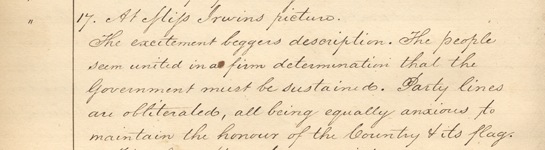
At Miss Irwin’s picture.

The excitement beggars description. The people seem united in a firm determination that the Government must be sustained. Party lines are obliterated, all being equally anxious to maintain the honour of this country & its flag.


Citation: John Henry Brown (1818-1891), autograph journal/account book. Philadelphia, 1844-1890. AMs 574/14.1

April 15, 1861: John Henry Brown’s Journal

John Henry Brown was a painter of portrait miniatures, living and working in Philadelphia. He had met Lincoln in August of 1860 when he was commissioned to paint Lincoln’s portrait for a supporter, but although Brown liked Lincoln personally, he did not agree with Republican policies.

1861-04-15

Transcript:

At Miss Irwin’s picture.

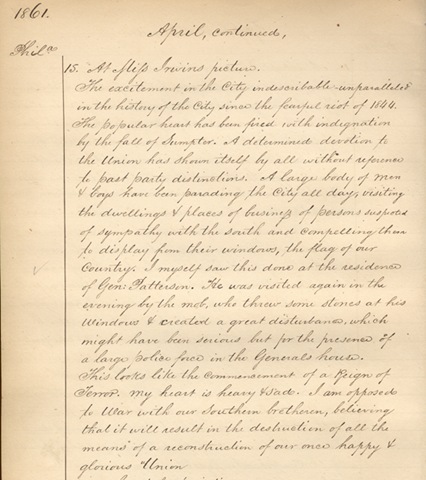
The excitement in the City indescribably unparalleled in this history of the city since the fearful riot of 1844. The popular heart has been fired with indignation by the fall of Sumpter. A determined devotion to the Union has shown itself by all without reference to past party distinctions. A large body of men & boys have been parading the City all day, visiting the dwellings & places of business of persons suspected of sympathy with the south and compelling them to display from their windows, the flag of our country. I myself saw this done at the residence of Gen: Patterson. He was visited again in the evening by the mob, who threw some stones at his windows & created a great disturbance, which might have been serious but for the presence of a large police force in the Generals house. This looks like the Commencement of a Reign of Terror. My heart is heavy & sad. I am opposed to War with our southern brethren, believing that it will result in the destruction of all the means of a reconstruction of our once happy & glorious union.


Citation: John Henry Brown (1818-1891), autograph journal/account book. Philadelphia, 1844-1890. AMs 574/14.1

April 14, 1861: John Henry Brown’s Journal

John Henry Brown was a painter of portrait miniatures, living and working in Philadelphia. He had met Lincoln in August of 1860 when he was commissioned to paint Lincoln’s portrait for a supporter, but although Brown liked Lincoln personally, he did not agree with Republican policies.


April 10-14, 1861

Transcript:

Sunday, At Church.

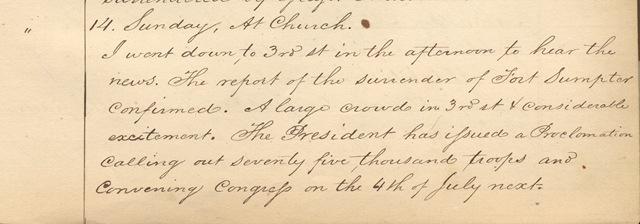
I went down to 3d st in the afternoon to hear the news. The report of the surrender of Fort Sumpter confirmed. A large crowd in 3d st & considerable excitement. The President has issued a Proclamation calling out seventy five thousand troops and convening Congress on the 4th of July next.

Citation: John Henry Brown (1818-1891), autograph journal/account book. Philadelphia, 1844-1890. AMs 574/14.1

April 13, 1861: John Henry Brown’s Journal

John Henry Brown was a painter of portrait miniatures, living and working in Philadelphia. He had met Lincoln in August of 1860 when he was commissioned to paint Lincoln’s portrait for a supporter, but although Brown liked Lincoln personally, he did not agree with Republican policies.

  Transcript:

April 10-14, 1861

Transcript:

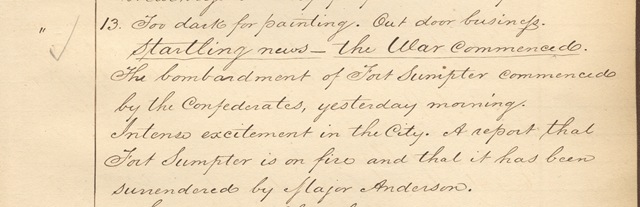
Too dark for painting. Out door business. Startling news—the War commenced. The bombardment of Fort Sumpter commenced by the Confederates, yesterday morning. Intense excitement in the City. A report that Fort Sumpter is on fire and that it has been surrendered by Major Anderson.

Citation: John Henry Brown (1818-1891), autograph journal/account book. Philadelphia, 1844-1890. AMs 574/14.1

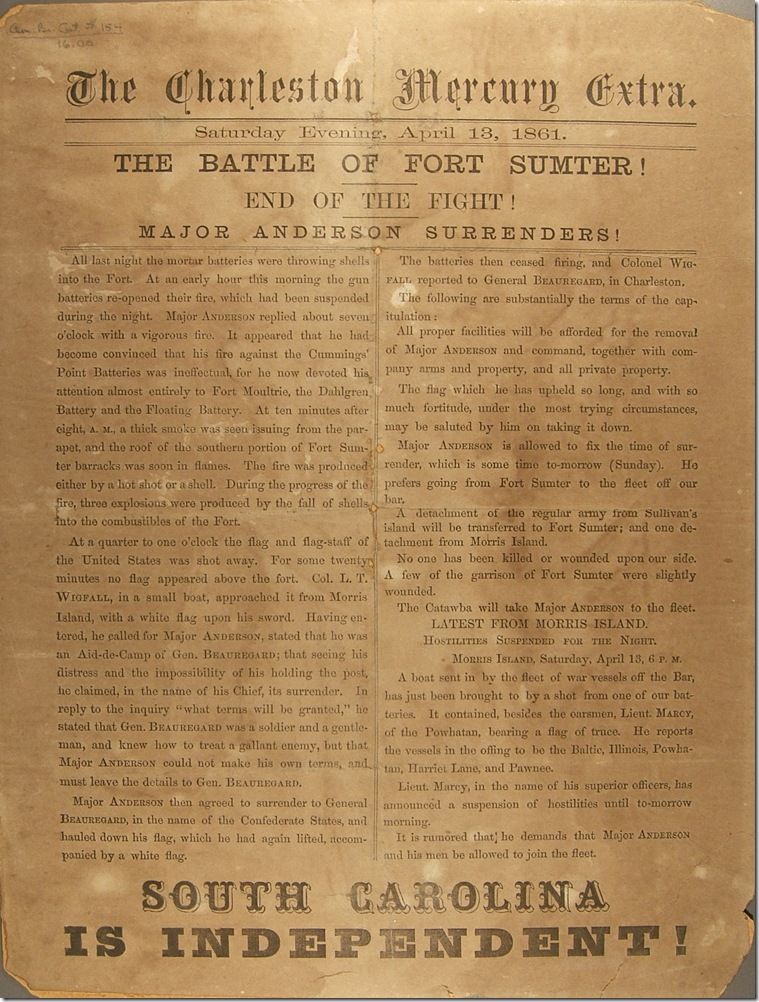
April 13, 1861: Charleston Mercury

Charleston Mercury 4-13-1861 edited

Transcript:

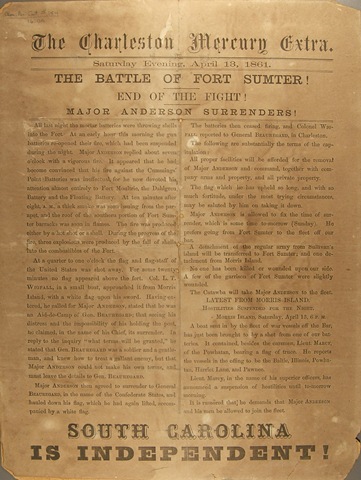
The Charleston Mercury Extra

Saturday Evening, April 13, 1861

THE BATTLE OF FORT SUMTER!

END OF THE FIGHT!

MAJOR ANDERSON SURRENDERS!

All last night the mortar batteries were throwing shells into the Fort. At an early hour this morning the gun batteries re-opened their fire, which had been suspended during the night. Major ANDERSON replied about seven o’clock with a vigorous fire. It appeared that he had become convinced that his fire against the Cummings’ Point Batteries was ineffectual, for he now devoted his attention almost immediately to Fort Moultrie, the Dahlgren Battery and the Floating Battery. At ten minutes after eight, A.M., a thick smoke was seen issuing from the parapet,and the roof of the southern portion of Fort Sumter barracks was soon in flames. The fire was produced either by a hot shot or a shell. During the progress of the fire, three explosions were produced by the fall of shells into the combustibles of the Fort.

At a quarter to one o’clock the flag and flag- staff of the United States was shot away. For some twenty minutes no flag appeared above the fort. Col. L.T. WIGFALL, in a small boat, approached it from Morris Island, with a white flag upon his sword. having entered, he called for Major ANDERSON, stated that he was an Aid-de-Campe of Gen. BEAUREGARD; that seeing his distress and the impossibility of his holding the post, he claimed, in the name of his Chief, its surrender. In reply to the inquiry “what terms will be granted,” he stated that Gen. BEAURGEARD was a soldier and a gentleman, and knew how to treat a gallant enemy, but that Major ANDERSON could not make his own terms, and must leave the details to Gen. BEAUREGARD,

Major ANDERSON then agreed to surrender to General BEUAREGARD, in the name of the Confederate States, and hauled down his flag, which he had again lifted, accompanied by a white flag.

The batteries then ceased firing, and Colonel WIGFALL reported to General BEAUREGARD, in Charleston. The following are substantially the terms of the capitulation:

All proper facilities will be afforded for the removal of Major ANDERSON and command, together with company arms and property, and all private property.

The flag which he has upheld so long, and with so much fortitude, under the most trying circumstances, may be saluted by him on taking it down.

Major ANDERSON is allowed to fix the time of surrender, which is some time to-morrow (Sunday). He prefers going from Fort Sumter to the fleet off our bar.

A detachment of the regular army from Sullivan’s island will be transferred to Fort Sumter; and one detachment from Morris island.

No one has been killed or wounded upon or side. A few of the garrison of Fort Sumter were slightly wounded.

The Catawba will take Major ANDERSON to the fleet.

LATEST FROM MORRIS ISLAND

HOSTILITIES SUSPENDED FOR THE NIGHT

MORRIS ISLAND, Saturday, April 13, 6 P.M.

a boat sent in by the fleet of war vessels off the Bar, has just been brought to by a shot from one of our batteries. it contained, besides the oarsmen, Lieut. MARCY, of the Powhatan, bearing a flag of truce. He reports the vessels in the offing to be the Baltic, Illinois, Powhatan, Harriet Lane, and Pawnee.

Lieut. Marcy, in the name of his superior officers, has announced a suspension of hostilities until tomorrow morning.

It is rumored that he demands that MAJOR ANDERSON and his men be allowed to join the fleet.

SOUTH CAROLINA IS INDEPENDENT!

Citation: Charleston Mercury extra. Charleston, 13 April 1861. AN .C477
April 12, 1861: John Henry Brown’s Journal

John Henry Brown was a painter of portrait miniatures, living and working in Philadelphia. He had met Lincoln in August of 1860 when he was commissioned to paint Lincoln’s portrait for a supporter, but although Brown liked Lincoln personally, he did not agree with Republican policies.


1861-04-12

Transcript:

At Miss Irwins picture. Waiting with breathless anxiety for further news from Charleston.

Citation: John Henry Brown (1818-1891), autograph journal/account book. Philadelphia, 1844-1890. AMs 574/14.1

April 11, 1861: Confederate Commissioners’ Telegrams

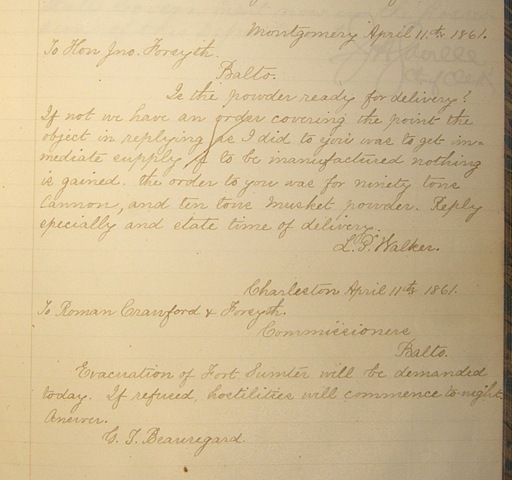
During March and April 1861, after seven states had seceded and formed the Confederate States of America but before war broke out, Confederate Secretary of State Robert Toombs appointed Martin J. Crawford, John Forsyth, and A.B. Roman as Commissioners of the Confederate States to Washington, DC. Their purpose was to seek diplomatic recognition from the United States and negotiate peace—at least for a while. Central to the question of peace or war was whether the United States would continue to retain claim over federal forts located in the southern states that had seceded, including Fort Pickens in Florida and Fort Sumter in South Carolina. This item is transcribed from a letter book maintained by J.T. Pickett, secretary to the commissioners, containing copies of 72 letters, dispatches, and telegrams sent and received by the commissioners from the time of their appointment to the demand for the evacuation of Fort Sumter. 

AMs 811-20 p219 Confederate Letter Book 4-11-1861 telegrams

Montgomery April 11th 1861.

To Hon Jno. Forsyth.

Balto.

Is the powder ready for delivery? If not we have an order covering the point the object in replying as I did to you was to get immediate supply if to be manufactured nothing is gained. The order to you was for ninety tons cannon, and ten tons musket powder. Reply especially and state time of delivery.

L.P. Walker.


Charleston April 11th 1861.

To Roman Crawford & Forsyth.

Commissioners

Balto.

Evacuation of Fort Sumter will be demanded today. If refused, hostilities will commence tonight. Answer.

G.T. Beauregard.

Citation:Commissioners of the Confederate States of America to the Government of the United States, letter book.Washington, D.C., Feb 27-April 11, 1861.AMS 811/20

April 11, 1861: John Henry Brown’s Journal

John Henry Brown was a painter of portrait miniatures, living and working in Philadelphia. He had met Lincoln in August of 1860 when he was commissioned to paint Lincoln’s portrait for a supporter, but although Brown liked Lincoln personally, he did not agree with Republican policies.


April 10-14, 1861

Transcript:

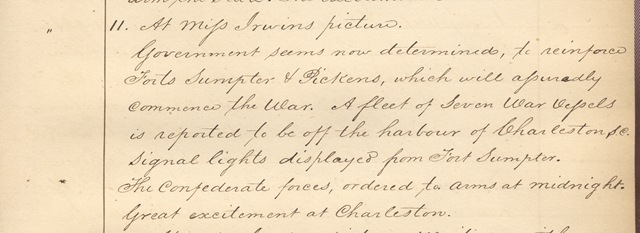
Government seems now determined, to reinforce Forts Sumpter & Pickens, which will assuredly commence the war. A fleet of seven war vessels is reported to be off the harbour of Charleston S.C. Signal lights displayed from Fort Sumpter. The Confederate forces, ordered to arms at midnight. Great excitement at Charleston.

Citation: John Henry Brown (1818-1891), autograph journal/account book. Philadelphia, 1844-1890. AMs 574/14.1

April 10, 1861: John Henry Brown’s Journal

John Henry Brown was a painter of portrait miniatures, living and working in Philadelphia. He had met Lincoln in August of 1860 when he was commissioned to paint Lincoln’s portrait for a supporter, but although Brown liked Lincoln personally, he did not agree with Republican policies.


1861-04-10

Transcript:

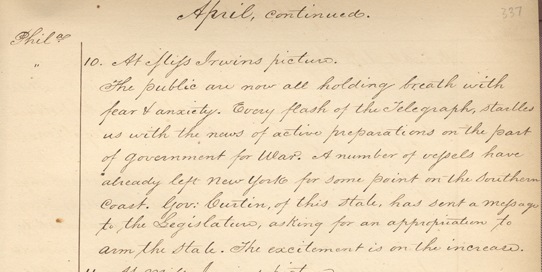
At Miss Irwins picture.

The public are now all holding breath with fear & anxiety. Every flash of the Telegraph startles us with the news of active preparations on the part of the government for War. A number of vessels have already left New York for some point on the Southern Coast. Gov. Curtin, of this state, has sent a message to the Legislature, asking for an appropriation to arm the State. The excitement is on the increase.

Citation: John Henry Brown (1818-1891), autograph journal/account book. Philadelphia, 1844-1890. AMs 574/14.1