April 25, 1861: Hugh Craig to Jennie Craig Warner

Hugh Craig was the older brother of Jennie Craig Warner, who was the grandmother of the poet Marianne Moore> These letters are preserved as part of Marianne Moore’s family papers. Moore VI-4-17 p1 Hugh to sister 4-25-61 Moore VI-4-17 p2 Hugh to sister 4-25-61 Moore VI-4-17 p3 Hugh to sister 4-25-61 Moore VI-4-17 p4 Hugh to sister 4-25-61

Transcript:

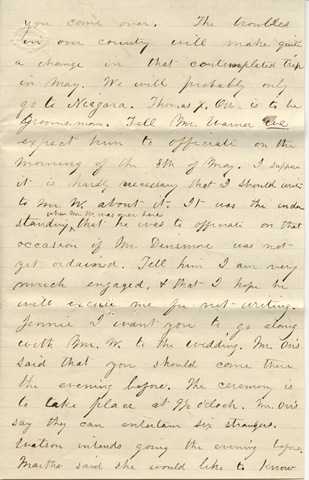
Locust Hill, April 25th 1861

Dear Sister:

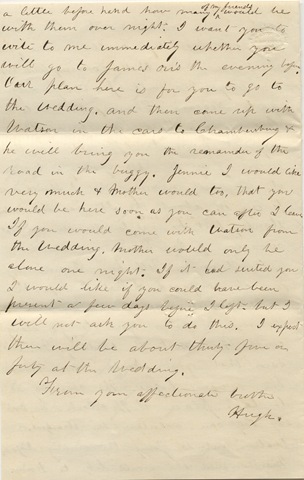
I have a good many letters to write. And a good deal of work to attend between this and the 8th of May. For these reasons I must write you but a short letter. I arrived home yesterday evening. And was right glad to get home, so that I might be free to some extent from the excitement. George was to leave this morning for York. He has accepted the post of Pay-master in Col. Stumbaugh’s Regiment. Mary of course felt sad at George’s departure, but she bore up very well. Mother is a good deal troubled about the War. She says she would like to get away from Mason’s & Dixon’s line as far as she could. She says that she would not like to go either to Chambersburg or Gettysburg. She thinks the only safe place would be in Canada. The Marylanders around us are all Union men so far as I know. The Clearspring people were very much rejoiced that so many troops came to Chambersburg, they feel safer now. They are strong for the Union in Clearspring. Dr. Firey says he will spend all he has to defend the Union. I can’t pay you more than the interest on that note this spring. It might be that after awhile I might pay you some. I paid that note off, that Uncle held against you, and destroyed it. You may bring that note of mine along with you over, or mark the interest on it paid for one year and I will make all right when you come over. The troubles in our country will make quite a change in that contemplated trip in May. We will probably only go to Niagara. Thomas X. Orr is to be grooms-man. Tell Mr. Warner we expect him to officiate on the morning of the 8th of May. I suppose it is hardly necessary that I should write to Mr. W. about it. It was the understanding when Mr. W. was over here that he was to officiate on that occasion if Mr. Dinsmore was not yet ordained. Tell him I am very much engaged, & that I hope he will excuse me for not writing. Jennie I want you to go along with Mr. W. to the wedding. Mr. Orr’s said that you should come there the evening before. The ceremony is to take place at 9 ½ o’clock. Mr. Orr’s say they can entertain six strangers. Watson intends going the evening before. Martha said she would like to know a little before hand how many of my friends would be with them one night. I want you to write to me immediately whether you will go to James Orr’s the evening before. Our plan here is for you to go to the wedding, and then come up with Watson in the cars to Chambersburg & he will bring you the remainder of the road in the buggy. Jennie I would like very much & Mother would too, that you would be here as soon as you can after I leave. If you would come with Watson from the wedding, Mother would only be alone one night. If it is had suited you I would like if you could have been present a few days before I left—but I will not ask you to do this. I expect there will be about thirty five or forty at the wedding.

From your affectionate brother

Hugh

Citation: Hugh Craig, autograph letter signed to Jennie Craig Warner. Locust Hill, Penn, 25 April 1861. Moore VI:04:17

April 24, 1861: Henry & Mary Warner Letter to John and Jennie Warner

Henry and Mary Warner lived in Allegheny City, Pennsylvania, now part of Pittsburgh. They are the great-grandparents of poet Marianne Moore.  By the 1860s they had three surviving children:  John, Henry, and Annie. Their letters to John, a Presbyterian minister living in Gettysburg, are preserved as part of Marianne Moore’s family papers.
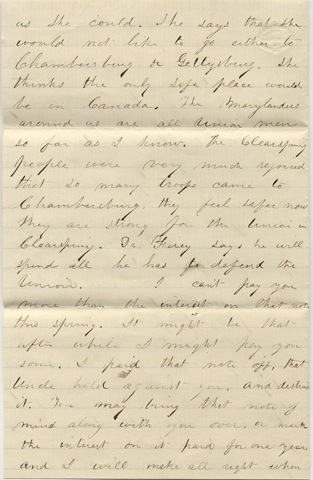
Moore VI-4-17 p1 Henry and Mary Warner to Children 4-24-61

Moore VI-4-17 p2 Henry and Mary Warner to Children 4-24-61

Moore VI-4-17 p3 Henry and Mary Warner to Children 4-24-61

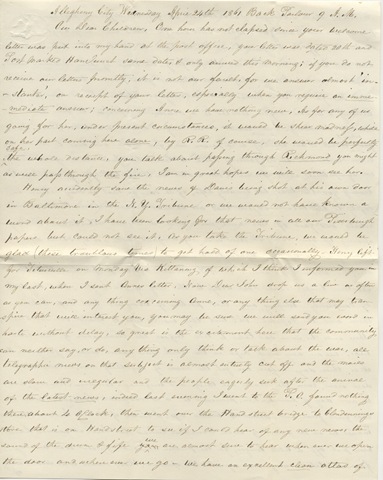
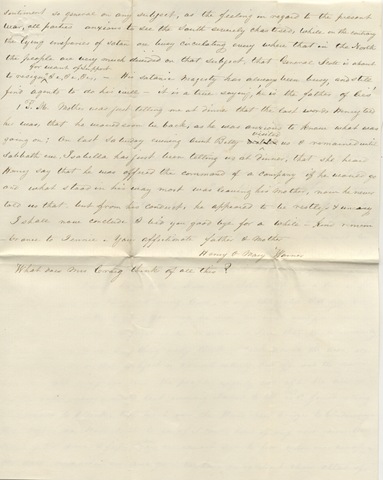
Allegheny City Wednesday April 24th 1861 Back Parlour 9 A.M.

Our Dear Children, One hour has not elapsed since your welcome letter was put into my hand at the post office, your letter was dated 20th and Post Marked [Home Junct] same date, I only arrived this morning; if you do not receive our letters promptly, it is not our fault, for we answer almost instanter’, on receipt of your letter, especially when you require an immediate answer; concerning Anne we have nothing new. As for any of us going for her, under present circumstances, it would be sheer madness, while on her pact coming here alone, by R.R. of course, she would be perfectly safe the whole distance, you talk about passing through Richmond you might as well pass through the fire, I am in great hopes we will soon see her.

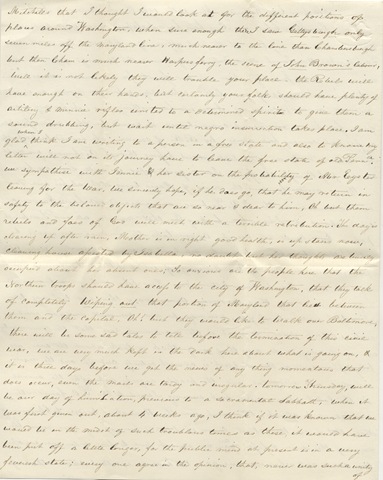
Harry accidentally saw the news of Davis being shot at his own door in Baltimore in the N.Y. Tribune or we would not have known a word about it, I have been looking for that news in all our Pittsburgh papers but could not see it. As you take the Tribune, we would be glad (these troublous times) to get hold of one occasionally—Henry left for Titusville on Monday via Kittaning, of which I think I informed you in my last, when I sent Anne’s letter. Now Dear John drop us a line as often as you can, and any thing concerning Anne, or any thing else that may transpire that will interest you, you may be sure we will send you word in haste without delay, so great is the excitement here that the community can neither say, or do, any thing only think or talk about the war, all telegraphic news on that subject is almost entirely cut off and the mails are slow and irregular and the people eagerly seek after the arrival of the latest news, indeed last evening I went to the P.O. found nothing there, about 4 oclock, then went over the Hand street bridge to Clendennings store that is on Hand street to see if I could hear any new news, the sound of the drum & fife we are almost sure to hear when ever we open the door and when ever we go. We have an excellent clean atlas of Mitchells that I thought I would look at for the different positions of places around Washington, when sure enough there I saw Gettysburgh only seven miles off the Maryland line, much nearer to the line than Chambursburgh but then Cham is much nearer Harpers Ferry, the scene of John Brown’s labour, well it is not likely they will trouble your place—the Rebels will have enough on their hands, but certainly your folks should have plenty of artillery & Minnie rifles united to a determined spirit to give them a sound drubbing, but wait until negro insurrection takes place. I am glad when I think I am writing to a person in a free state and also to know my letter will not on its journey have to leave the free state of old Penna. We sympathise with Jennie & her sister on the probability of Alex Eyster leaving for the War, we sincerely hope, if he does go, that he may return in safety to the beloved objects that are so near & dear to him, Oh but them rebels and foes of God will meet with a terrible retribution. The day is clearing up after rain, Mother is in right good health, is upstairs now, cleaning house assisted by Isabella, no doubt but her thoughts are lively occupied about her absent ones; So anxious are the people here that they talk of completely Wiping out that portion of Maryland that lies between them and the Capital, Oh! but they would like to walk over Baltimore, there will be some sad tales to tell before the termination of this civil war, we are very much kept in the dark here about what is going on, & it is three days before we got the news of any thing momentous that does occur, even the mails are tardy and irregular. Tomorrow Thursday, will be our day of humiliation, previous to a sacramental Sabbath, when it was first given out, about 4 weeks ago, I think if it was known that we would be in the midst of such troublous times as these, it would have been put off a little longer, for the public mind at present is in a very feverish state; every one agree in the opinion, that, never was such a unity of sentiment so general on any subject, as the feeling in regard to the present war, all parties anxious to see the South severely chastised, while on the contrary the lying emissaries of Satan are busy circulating every where that in the North the people are very much divided on that subject, that General Scott is about to resign for want of support” &c&c&c—His Satanic majesty has always been busy, and still find agents to do his will—it is a true saying, he is the father of lies.

1 P.M. Mother was just telling me at dinner that the last words Henry told her was, that he would soon be back, as he was anxious to know what was going on; on last Saturday evening Aunt Betty visited us & remained until Sabbath eve, Isabella has just been telling us at dinner, that she heard Harry say that he was offered the command of a company if he would go and what stood in his way most was leaving his mother, now he never told us that, but from his conduct, he appeared to be restless & uneasy

I shall now conclude & bid you good bye for a while—kind remembrance to Jennie—Your affectionate father & mother

Henry & Mary Warner

What does Mrs Craig think of all this?

Citation: Henry and Mary Warner, autograph letter signed to John and Jennie Warner. Allegheny City [Pittsburgh], 24 April 1861. Moore VI:04:17

April 22, 1861: The New York Herald

Top

Transcript (excerpt):

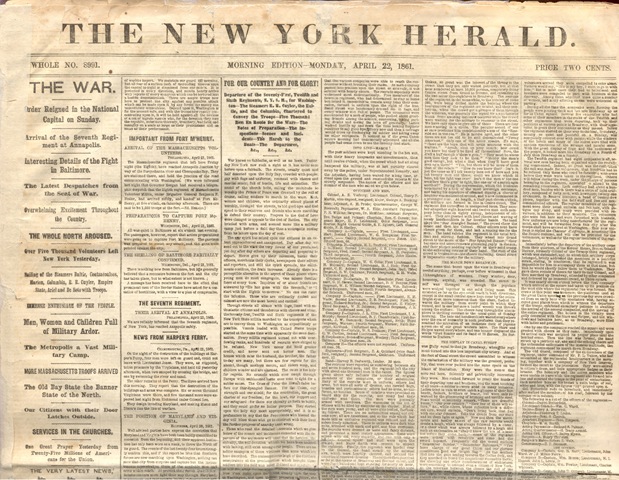
The New York Herald, New York, Morning Edition, Monday, April 22, 1861.

Page 1, Upper Half

News From Harper’s Ferry.

Chambersburg, Pa., April 21, 1861.

On the night of the destruction of the buildings at Harper’s Ferry, four men were left on guard and, could not leave without Lieutenant Jones. They were, as supposed, taken prisoners by the Virginians, and held till yesterday afternoon, when two escaped by crossing the bridge, and one by swimming the river and canal.

The other remains at the Ferry. The three arrived here this morning. They report that the destruction of the buildings and arms was complete. Six or seven thousand Virginians were there, and five thousand more were expected last night from Richmond under Colonel Lee.

They design invading Maryland, and making Mason and Dixon’s line the line of warfare.

Citation: New York Herald. 22 April 1861. Gift of Susan and Steven Raab. AN .N56792

April 21, 1861: John Henry Brown’s Journal

John Henry Brown was a painter of portrait miniatures, living and working in Philadelphia. He had met Lincoln in August of 1860 when he was commissioned to paint Lincoln’s portrait for a supporter, but although Brown liked Lincoln personally, he did not agree with Republican policies.

1861-04-21

Transcript:

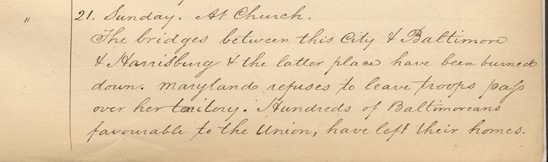
Sunday. At Church.

The bridges between this city & Baltimore  & Harrisburg & the latter place have been burned down. Maryland refuses to have troops pass over her territory. Hundreds of Baltimoreans favourable to the Union, have left their homes

Citation: John Henry Brown (1818-1891), autograph journal/account book. Philadelphia, 1844-1890. AMs 574/14.1

April 20, 1861: Letter from Robert E. Lee to Winfield Scott

A West Point graduate who had served for nearly 32 years, Col. Robert E. Lee felt strong ties to the United States and to the U. S. Army. But when Virginia voted for secession, his choice was clear, if not easy. Lee wrote the letter shown here to his mentor, Gen. Winfield Scott, explaining his decision to resign his commission.

AMs 359-23 p1 Robert E Lee to Winfield Scott

AMs 359-23 p2 Robert E Lee to Winfield Scott

Transcript:

Arlington, Washington City P. O.

20 April 1861

Lt. Genl. Winfield Scott

Commd the Army

Genl

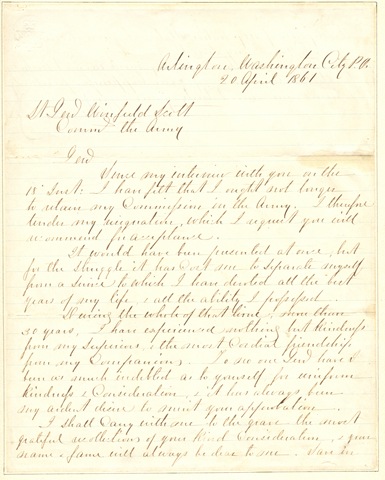
Since my interview with you on the 18 Inst: I have felt that I ought not longer to retain my Commission in the Army. I therefore tender my resignation, which I request you will recommend for acceptance.

It would have been presented at once, but for the struggle it has cost me to separate myself from a Service to which I have devoted all the best years of my life [and] all the ability I possessed.

During the whole of that time, more than 30 years, I have experienced nothing but kindness from my Superiors [and] the most Cordial friendships from my Companions. To no one Genl have I been as much indebted as to yourself for uniform kindness [and] Consideration, [and] it has always been my ardent desire to merit your approbation.

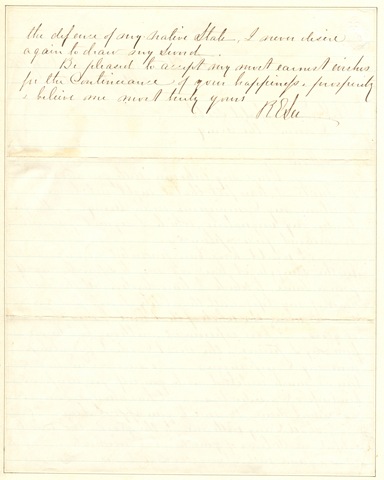
I shall carry with me to the grave the most grateful recollections of your kind Consideration [and] your name [and] fame will always be dear to me. Save in the defense of my native State, I never desire again to draw my Sword.

Be pleased to accept my most earnest wishes for the Continuance of your happiness [and] prosperity [and] believe me most truly yours

R E Lee

Citation: Robert E. Lee, autograph letter signed to Winfield Scott. Arlington, Va., 20 April 1861. AMs 359/23

April 19, 1861: New Orleans Daily Crescent

New Orleans Daily Gazette

Transcript (excerpt):

New Orleans Daily Crescent, New Orleans, Friday Morning, April 19, 1861.

Page 1, Upper Half

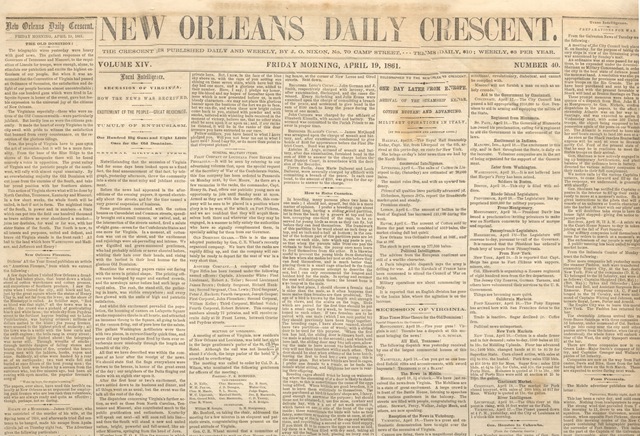
Notwithstanding that the secession of Virginia had for some days been looked upon as a fixed fact, the final announcement of that fact, by telegraph, yesterday afternoon, threw the community into a state of the most noisy and jubilant excitement.

Before the news had appeared in the after-editions of the evening papers, it spread electrically about the streets, and for the time caused a very general suspension of business.

Some gentlemen connected with the cotton houses on Carondelet and Common streets, speedily brought out a small cannon, or swivel, and, at the intersection of the streets named, fired a salute of eight guns – seven for the Confederate States and one more for Virginia. In a moment all cottondom was out on the street, and the excitement and rejoicings were all-pervading and intense. We saw dignified and grave-mannered gentlemen, who had probably seldom or never shouted before, whirling their hats over their heads, and vieing with the lustiest in their loud huzzahs for the glorious Old Dominion.

Citation: New Orleans Daily Crescent. New Orleans, 19 April 1861. Gift of Steven and Susan Raab. AN .N557

April 19, 1861: John Henry Brown’s Journal

John Henry Brown was a painter of portrait miniatures, living and working in Philadelphia. He had met Lincoln in August of 1860 when he was commissioned to paint Lincoln’s portrait for a supporter, but although Brown liked Lincoln personally, he did not agree with Republican policies.

1861-04-19

Transcript:

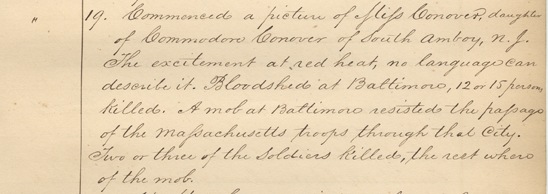
Commenced a picture of Miss Conover, daughter of Commodore Conover of South Amboy, N. J.

The excitement at red heat, no language can describe it. Bloodshed at Baltimore, 12 or 13 persons killed. A mob at Baltimore resisted the passage of the Massachusetts troops through that city. Two of three of the soldiers killed, the rest where of the mob.


Citation: John Henry Brown (1818-1891), autograph journal/account book. Philadelphia, 1844-1890. AMs 574/14.1

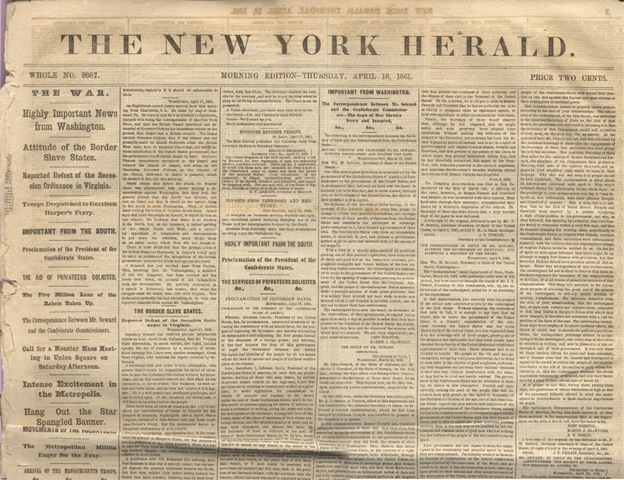
April 18, 1861: New York Herald

Top

Transcript:

Page 1, Upper Half

The Border Slave States

Reported Defeat of the Secession Ordinance in Virginia.

Washington, April 17, 1861.

Secretary Seward has received private information within an hour, direct from Richmond, that the Virginia State Convention, in secret session, last night, decided against the act of secession by a majority of seven. Since learning this I have seen another messenger, direct from Virginia, who confirms the report received by Mr. Seward.

A messenger has just come in from Alexandria, who asserts that it would be impossible for an act of secession to pass the Richmond Convention without his knowledge, and he this moment assures me that when he left Alexandria, at eleven o’clock this forenoon, no such action had been taken, and he does not believe it will happen. He is a well posted and intelligent gentleman, and can be relied upon. If the secession act should pass, it will have to be submitted to the people.

Citation. New York Herald. 18 April 1861. Gift of Steven and Susan Raab. AN .N56792

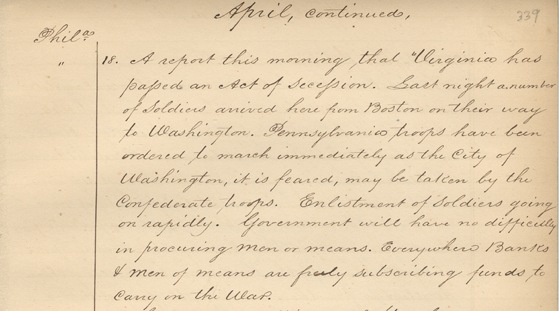
April 18, 1861: John Henry Brown’s Journal

John Henry Brown was a painter of portrait miniatures, living and working in Philadelphia. He had met Lincoln in August of 1860 when he was commissioned to paint Lincoln’s portrait for a supporter, but although Brown liked Lincoln personally, he did not agree with Republican policies.

1861-04-18

Transcript:

A report of this morning that Virginia has passed an Act of Secession. Last night a number of soldiers arrived here from Boston on their way to Washington. Pennsylvania troops have been ordered to march immediately as the City of Washington, it is feared, may be taken by the Confederate troops. Enlistment of soldiers going on rapidly. Government will have no difficulty in procuring men or means. Everywhere Banks & men of means are freely subscribing funds to carry on the War.


Citation: John Henry Brown (1818-1891), autograph journal/account book. Philadelphia, 1844-1890. AMs 574/14.1