May 8, 1861: Henry & Mary Warner to John Warner

Henry and Mary Warner lived in Allegheny City, Pennsylvania, now part of Pittsburgh. They are the great-grandparents of poet Marianne Moore.  By the 1860s they had three surviving children:  John, Henry, and Annie. Their letters to John, a Presbyterian minister living in Gettysburg, are preserved as part of Marianne Moore’s family papers.
Moore VI-4-18 Henry and Mary Warner to Children 5-8-61

  Transcript:

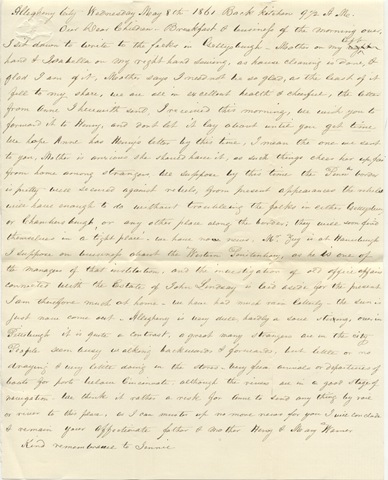
Allegheny City Wednesday May 8th 1861 Back kitchen 9 ½ A.M.

Our Dear Children—Breakfast & business of the morning over, I sit down to write to the folks in Gettysburgh—Mother on my left hand & Isabella on my right hand sewing, as house cleaning is done, & glad I am of it, Mother says I need not be so glad, as the least of it fell to my share, we are all in excellent health & cheerful, the letter from Anne I herewith send, I received this morning, we wish you to forward it to Henry, and dont let it lay about until you get time. We hope Anne has Henry’s letter by this time, I mean the one we sent to you, Mother is anxious she should have it, as such things cheer her up, for from home among strangers. We suppose by this time the Penna border is pretty well secured against rebels, from present appearance the rebels will have enough to do without troubling the folks in either Gettysburgh or Chambersburgh, or any other place along the border; they will soon find themselves in a tight place. We have no news, Mr. Zug is at Harrisburgh I suppose on business about the Western Penitentiary, as he is one of the managers of that institution, and the investigation of old office affairs connected with the Estate of John Lindsay is laid aside for the present. I am therefore much at home—we have had much rain latterly—the sun is just now come out—Allegheny is very dull, hardly a soul stirring, over in Pittsburgh it is quite a contrast, a great many strangers are in the city. People seem busy walking backwards & forwards, but little or no draying & very little doing in the stores—very few arrivals or departures of boats for ports below Cincinnati, although the rivers are in a good stage of navigation—We think it rather a risk for Anne to send any thing by rail or river to this place, as I can muster up no more news for you I will conclude

I remain your Affectionate father & mother Henry & Mary Warner

Kind remembrance to Jennie

Citation: Henry and Mary Warner, autograph letter signed to John and Jennie Warner. Allegheny City [Pittsburgh], 8 May 1861. Moore VI:04:18

May 6, 1861: John Henry Brown’s Journal

John Henry Brown was a painter of portrait miniatures, living and working in Philadelphia. He had met Lincoln in August of 1860 when he was commissioned to paint Lincoln’s portrait for a supporter, but although Brown liked Lincoln personally, he did not agree with Republican policies.


1861-05-06

Transcript:

At Com: Conovers picture.

These are fearful times. A silent, but nevertheless perfect, reign of terror exists here. Those who do not approve of a settlement of our troubles, by the sword, are, for prudential reasons, obliged to remain very quiet. This prudential silence has created a seeming oneness of sentiment in the north, which really does not exist.


Citation: John Henry Brown, autograph journal/account book. Philadelphia, 1844-1890. AMs 573/14.1

May 6, 1861: John Henry Brown’s Journal

John Henry Brown was a painter of portrait miniatures, living and working in Philadelphia. He had met Lincoln in August of 1860 when he was commissioned to paint Lincoln’s portrait for a supporter, but although Brown liked Lincoln personally, he did not agree with Republican policies.

1861-05-06

Transcript:

At Com: Conovers picture.

These are fearful times. A silent, but nevertheless perfect, reign of terror exists here. Those who do not approve of a settlement of our troubles, by the sword, are, for prudential reasons, obliged to remain very quiet. 

This prudential silence has created a seeming oneness of sentiment in the North, which really does not exist.


Citation: John Henry Brown (1818-1891), autograph journal/account book. Philadelphia, 1844-1890. AMs 574/14.1

May 5, 1861: New York Herald

Top

Transcript (Excerpt):

Page 1, Upper Half

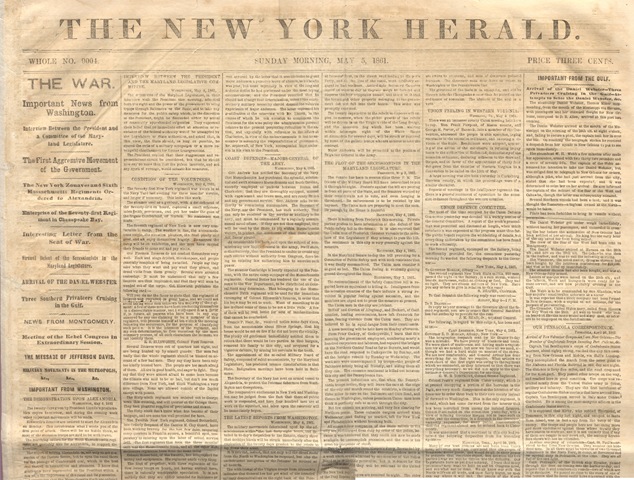
Condition of the Volunteers

Washington, May 4, 1861

The Seventy-first New York regiment was sworn in at the Navy Yard last evening for three months’ service, and longer if necessary. This looks like work. The steamer used as a gunboat, with a detachment of the Seventy-first on board, captured a small schooner, laden with provisions, and put her under the guns of the frigate Cumberland, off Norfolk. No resistance was made.

The Seventh regiment of New York is now very comfortable in camp. The weather is fine, the accommodations ample, the situation pleasant, the food plenty and good, and all enjoy themselves hugely. To-morrow the camp will be on exhibition, and the men have invited their friends to come out and pay visits.

Citation: New York Herald. 5 May 1861. Gift of Steven and Susan Raab. AN .N56792

May 4, 1861: John Henry Brown’s Journal

John Henry Brown was a painter of portrait miniatures, living and working in Philadelphia. He had met Lincoln in August of 1860 when he was commissioned to paint Lincoln’s portrait for a supporter, but although Brown liked Lincoln personally, he did not agree with Republican policies.

1861-05-04

Transcript:

At Com: Conovers picture.

Things are crowding so fast that it will be impossible to keep up with the news of each day. The reader of this must therefore, if anxious to know the daily events, turn to a file of newspapers or the written history of the times.


Citation: John Henry Brown (1818-1891), autograph journal/account book. Philadelphia, 1844-1890. AMs 574/14.1

May 3, 1861: Pass for George Williams

AMs 811-2-6 pass for George Williams

Transcript:

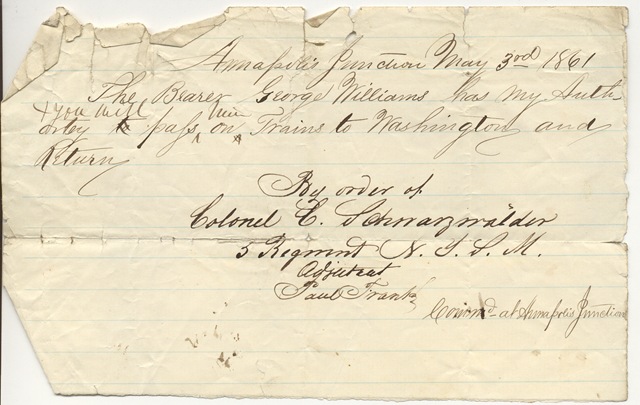
Annapolis Junction May 3rd 1861

The Bearer George Williams has my Authority to pass here on Trains to Washington and Return

By order of
Colonel C. Schwarzwalder

5 Regiment N.Y.S.M.

Adjutant

Paul Frank

Commd at Annapolis Junction


Citation: Pass for George Williams. Annapolis Junction, 3 May 1861. Ams 811/2.6

May 1, 1861: New York Times

top

Transcript (excerpt):

Page 1, Lower Half

No Prospect of Secession

From information gained from gentlemen whose position and influence puts them in the way of knowing the feeling and views of the majority of the Legislature of Maryland, we feel warranted in saying that body will not even pass a bill to call a State Convention, but will content themselves with making a calm, dignified appeal to the country.

A dispatch from Frederick says: “A gentleman from Washington informs me that Gen. Scott showed him yesterday the copy of a proclamation to be issued immediately, declaring partial martial law in the District of Columbia and over the line of railway established by the Government for National purposes, so far as to suspend the right of habeas corpus.“

Citation: New York Times. 1 May 1861. Gift of Steven and Susan Raab. AN .N5682

April 30, 1861: Henry & Mary Warner to John Warner

Henry and Mary Warner lived in Allegheny City, Pennsylvania, now part of Pittsburgh. They are the great-grandparents of poet Marianne Moore.  By the 1860s they had three surviving children:  John, Henry, and Annie. Their letters to John, a Presbyterian minister living in Gettysburg, are preserved as part of Marianne Moore’s family papers.

Moore VI-4-17 p1 Henry and Mary Warner to Children 4-30-61

Moore VI-4-17 p2 Henry and Mary Warner to Children 4-30-61

Transcript:

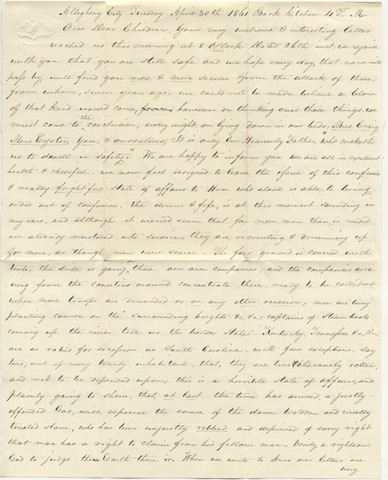
Allegheny City Tuesday April 30th 1861 Back kitchen 4 P.M.

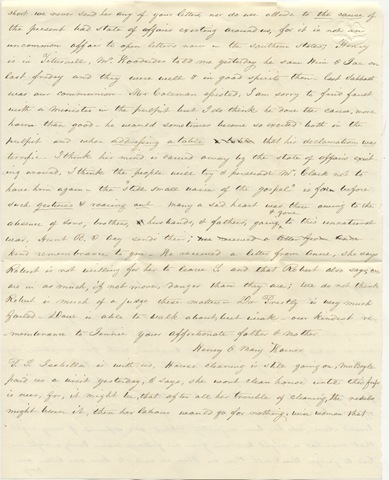
Our Dear Children Your very welcome & interesting letter reached us this morning at 8 oclock Dated 26th inst, we rejoice with you that you are still safe and we hope every day, that now will pass by, will find you more & more secure from the attack of those, from whom, seven years ago, we could not be made believe a blow of that kind would come, however on thinking over these things, we must come to the conclusion, every night, on lying down in our beds, Mrs Craig, Mrs Eyster, You, & ourselves, It is only Our Heavenly Father, “who maketh us to dwell in safety.” We are happy to inform you we are all in excellent health & cheerful, we now feel resigned to leave the issue of this confused & really frightful state of affairs to Him who alone is able to bring order out of confusion, the drum & fife, is at this moment sounding in my ears, and although it would seem that far more men than is needed are already mustered into service, they are recruiting, & drumming up for more, as though men were scarce—The fair ground is covered with tents, the drill is going on there, our own companies, and the companies arriving from the counties around concentrate there, ready to be called out when more troops are demanded, or, on any other occasion, men are busy planting cannon on the surrounding heights &c, &c; captains of Steamboats coming up the river, tell us, the border states—Kentucky, Tennessee &c&, are as rallied for succession as South Carolina, with few exceptions, say two, out of every twenty inhabitants, that, they are treacherously rotten, and not to be depended upon, this is a horrible state of affairs, and plainly going to shew, that, at last, the time has arrived, a justly offended God, will espouse the cause of the down trodden and cruelly treated slave, who has been unjustly robbed and deprived of every right that man has a right to claim from his fellow man—Verily, a righteous God to judge the Earth there is. When we write to Anne our letters are very short, we never send her any of your letters, nor do we allude to the cause of the present bad state of affairs existing around us, for it is not an uncommon affair to open letters now in the Southern States; Henry is in Titusville, Mr. Woodsides told me yesterday he saw Him & Joe on last friday and they were well & in good spirits then—last Sabbath was our communion—Mr Coleman assisted, I am sorry to find fault with a minister in the pulpit but I do think he done the cause, more harm than good—he would sometimes become so excited both in the pulpit and when addressing a table that his declamation was terrific—I think his mind is carried away by the state of affairs existing around, I think the people will try & persuade Mr. Clark not to have him again—the “still small voice of the gospel” is for before such gestures & roaring out—Many a sad heart was there owing to the absence of sons, brothers, husbands, & fathers, going & gone to this unnatural war. Aunt B. & Asy sends their kind remembrance to you—We received a letter from Anne, she says Robert is not willing for her to leave L and that Robert also says, we are in as much, if not more, danger than they are; we do not think Robert is much of a judge these matters—Dr Prestly is very much failed—Dave is able to walk about, but weak—our kindest rememberance to Jennie Your affectionate father & mother

Henry & Mary Warner

P.S. Isabella is with us, House cleaning is still going on, Mrs Boyle paid us a visit yesterday, & says, she wont clean house until this fuss is over, for, it but be, that after all her trouble of cleaning, the rebels might burn it, then he labour would go for nothing, wise woman that


Citation: Henry and Mary Warner, autograph letter signed to John and Jennie Warner. Allegheny City [Pittsburgh], 30 April 1861. Moore VI:04:17

April 27, 1861: John Henry Brown’s Journal

John Henry Brown was a painter of portrait miniatures, living and working in Philadelphia. He had met Lincoln in August of 1860 when he was commissioned to paint Lincoln’s portrait for a supporter, but although Brown liked Lincoln personally, he did not agree with Republican policies.

1861-04-27

Transcript:

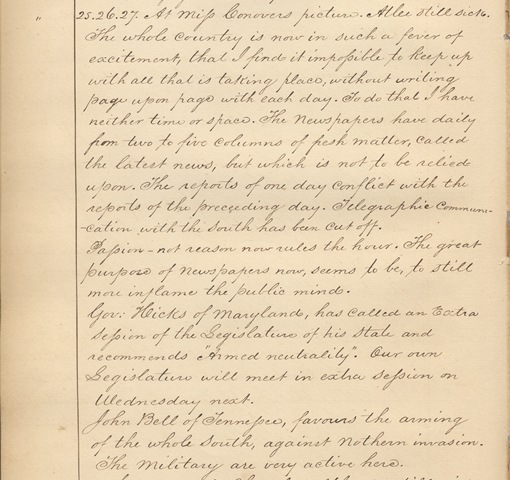
At Miss Conover’s picture. Atlee still sick.

The whole country is now in such a fever of excitement, that I find it impossible to keep up with all that is taking place, without page upon page with each day. To do that I have neither time not space. The Newspapers have daily from two to five columns of fresh matter, called the latest news, but which is not to be relied upon. The reports of one day conflict with the reports of the preceding day. Telegraphic communication with the South has been cut off. Passion—not reason now rules the hour. The great purpose of newspapers now, seems to be to still more inflame the public mind.

Gov. Hicks of Maryland, has called an Extra session of the legislature of his state and recommends “Armed neutrality.” Our own Legislature will meet in extra session on Wednesday next.

John Bell of Tennessee, favours the arming of the whole South against Northern invasion.

The military are very active here.


Citation: John Henry Brown (1818-1891), autograph journal/account book. Philadelphia, 1844-1890. AMs 574/14.1

April 26, 1861: Letter from Capt. Shaler to Col. Ellsworth

Col. Elmer Ellsworth was a lawyer and soldier and friend of Abraham Lincoln who would become one of the first casualties of the Civil War. As a colonel of the Chicago National Guard Cadets before the war, Ellsworth introduced French-inspired Zouave uniforms and drills to the unit. He worked in Lincoln’s law office in August 1860 and assisted him during the fall campaign. After Lincoln’s election he helped organize troops, including the 11th New York Volunteer Infantry Regiment. He was shot and killed on May 24, 1861 while removing a large Confederate flag from a tavern in Alexandria, Virginia.


AMs 811-2-6 p1 Shaler ALS to Ellsworth

AMs 811-2-6 p2 Shaler ALS to Ellsworth

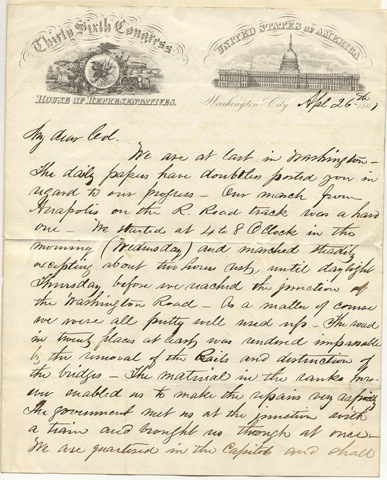
Washington City Apl 26th 1861

My dear Col.

We are at last in Washington- The daily papers have doubtless posted you in regard to our progress- Our march from Anapolis on the R. Road track was a hard one- We started at 4 to 8 Oclock in the morning (Wednesday) and marched steadily excepting about two hours rest, until daylight Thursday before we reached the junction of the Washington Road- As a matter of course we […] all pretty well used up- The road in twenty places at least […] was rendered impassable by the removal of the Rails and destruction of the bridges- The material in the ranks however enabled us to make the repairs very rapidly. The government met us at the junction with a train and brought us through at once- We are quartered in the Capitol and shall remain here for a few days until our Camp equipage- which was left at Anapolis can be brought through- The sight for our Camp has not so far as I know been yet selected- Our men are in excellent spirits- notwithstanding their disappointment in not meeting the contemptible scoundrels who obliged them to build a rail road anew for the sake of having a clean shirt in Washington-

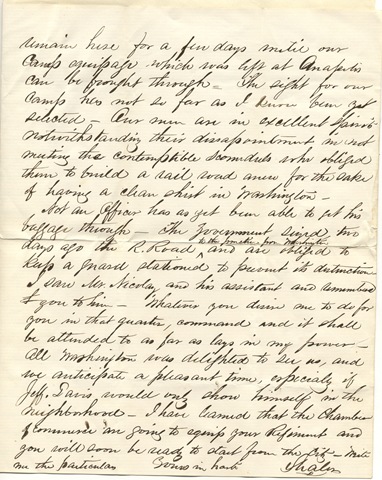
Not an officer has yet been able to get his baggage through- The government seized two days ago the R. Road to the junction from Washington and are obliged to keep a guard stationed to prevent its destruction- I saw Mr. Nicolay and his assistant and remembered you to him- Whatever you desire me to do for you in that quarter, command and it shall be attended to as far as lays in my power- All Washington was delighted to see us, and we anticipate a pleasant time, especially if Jeff. Davis would only show himself in the neighborhood- I have […] that the Chamber of Commerce are going to equip your Regiment and you will soon be ready to start from the City- Write me the particulars

Yours in haste Shaler


Citation: Capt. Shaler, autograph letter signed to Elmer Ellsworth. Washington, D.C.; 26 April 1861. AMs 811/2.6