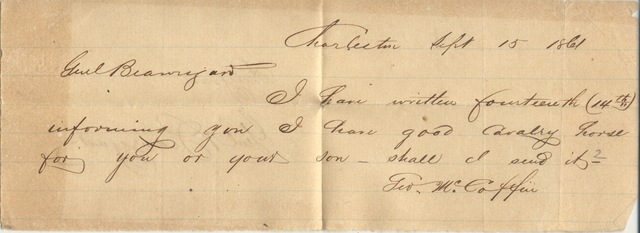
September 15, 1861: George McCoffin telegram to P. G. T. Beauregard

Pierre Gustave Toutant Beauregard was a Louisiana-born general of the Confederate States Army. He had graduated second in his class from West Point in 1838 and was an admirer of Napoleon. He achieved fame early in the Civil War for commanding the Fort Sumter bombardment and as the victor of the first battle of Manassas. He later served in the Western Theater (including Shiloh and Corinth), Charleston, and the defense of Richmond, but his career was hampered by friction with Jefferson Davis and other generals.


This is one of approximately 1000 military telegrams in P.G.T. Beauregard’s papers at the Rosenbach.

AMs 1168-11 1861-09-15


Transcript:

Charleston Sept 15 1861

Genl Beauregard,

I have written fourteenth (14th) informing you I have good cavalry horse for you or your son__shall I send it?

Geo Mc.Coffin


Citation:George McCoffin, telegram to G. T. Beauregard. Charleston, 15 September 1861. AMs 1168/11

September 14, 1861: Leroy and Matilda Pope Walker to P. G. T. Beauregard

Pierre Gustave Toutant Beauregard was a Louisiana-born general of the Confederate States Army. He had graduated second in his class from West Point in 1838 and was an admirer of Napoleon. He achieved fame early in the Civil War for commanding the Fort Sumter bombardment and as the victor of the first battle of Manassas. He later served in the Western Theater (including Shiloh and Corinth), Charleston, and the defense of Richmond, but his career was hampered by friction with Jefferson Davis and other generals.


AMs 360-20  Leroy Pope to Beauregard p1 300 dpi AMs 360-20  Leroy Pope to Beauregard p2 300 dpi AMs 360-20 Matilda Pope to Beauregard p1 300 dpi AMs 360-20 Matilda Pope to Beauregard p2 300 dpi

Transcript:


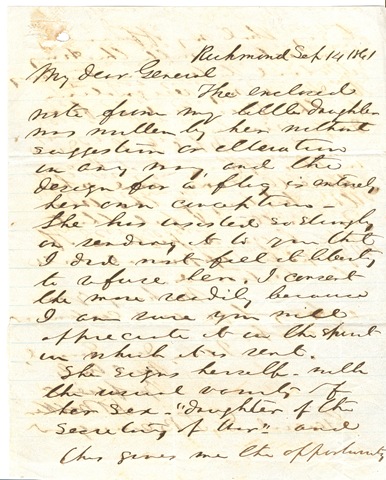
Richmond Sept 14 1861

My dear General

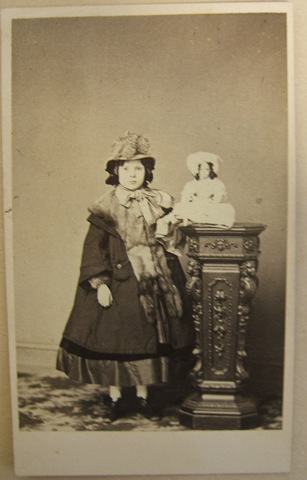
The enclosed note from my little daughter was written by her  without suggestion or alteration in any way, and the design for a flag is entirely her own conception. She has insisted so stringently on sending it to you that I did not feel at liberty to refuse her. I consent the more readily because I am sure you will appreciate it in the spirit in which it is sent.

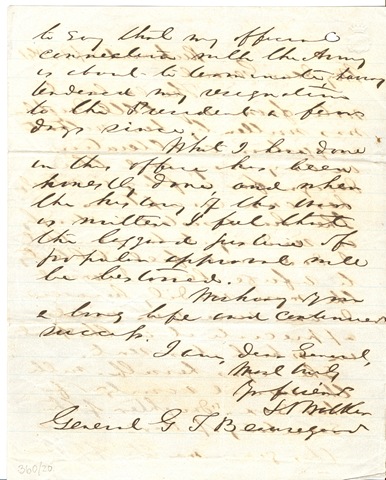
She signs herself with the usual vanity of her sex—“daughter of the Secretary of War”—and she gives me the opportunity to say that my official connection with the Army is about to terminate, having tendered my resignation to the President a few days since.

What I have done in the office has been honestly done, and when the history of the war is written I feel that the [laggard justice?] of popular approval will be [bestirred?].

Wishing you a long life and continued success.

I am, dear General,

Most truly

Your friend

L P Walker


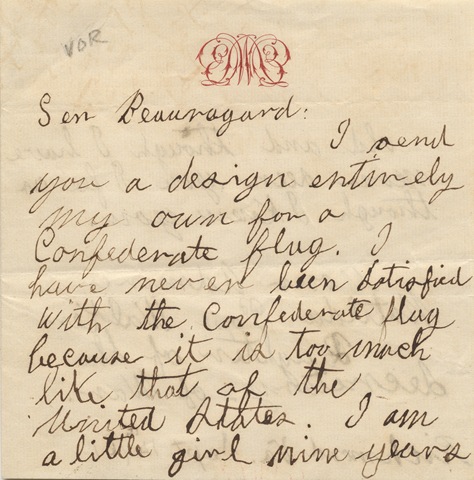
Gen Beauregard:

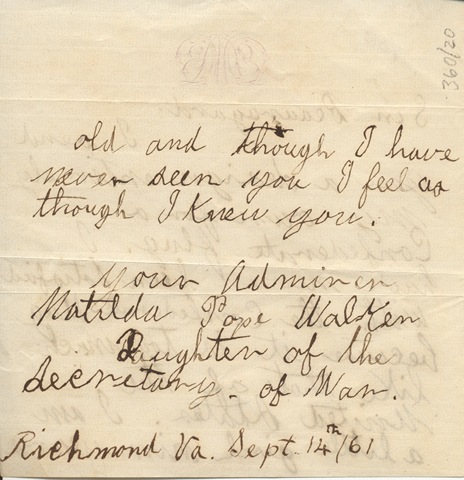
I send you a design entirely my own for a Confederate flag. I have never been satisfied with the Confederate flag because it is too much like that of the United States. I am a little girl nine years old and though I have never seen you I feel as though I know you.

Your Admirer

Matilda Pope Walker

Daughter of the Secretary of War


Citation: C. Richmond, 14 September 1861. AMs 360/20

September 13, 1861: New York Times

top

Transcript (excerpt):

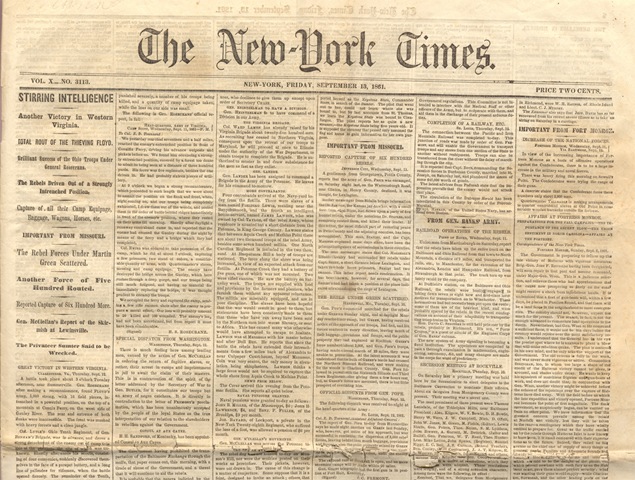
GREAT VICTORY IN WESTERN VIRGINIA.

Clarksburgh, Va. Thursday, Sept. 12.

A battle took place about 3 o’clock Tuesday afternoon, near Sumnerville. Gen. Rosecrans after making a reconnaissance, found Floyd’s army, 5,000 strong, with 16 field pieces, intrenched in a powerful position, on the top of a mountain at Cannix Ferry, on the west side of Gauley River. The rear and extreme of both flanks were inaccessible. The front was masked with heavy forests and a close jungle.

Citation: New York Times. 13 September 1861. Gift of Steven and Susan Raab. AN .N5682

September 11, 1861: Henry and Mary Warner to John Warner

Henry and Mary Warner lived in Allegheny City, Pennsylvania, now part of Pittsburgh. They are the great-grandparents of poet Marianne Moore.  By the 1860s they had three surviving children:  John, Henry, and Anne. Their letters to John, a Presbyterian minister living in Gettysburg, are preserved as part of Marianne Moore’s family papers.
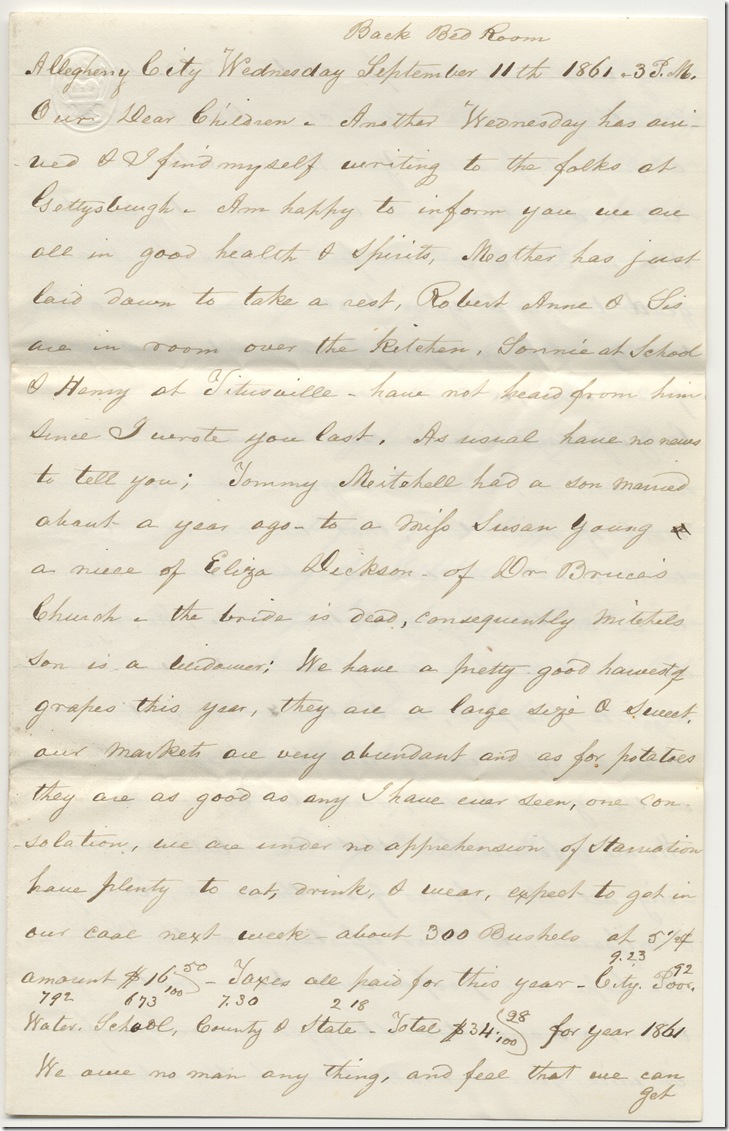
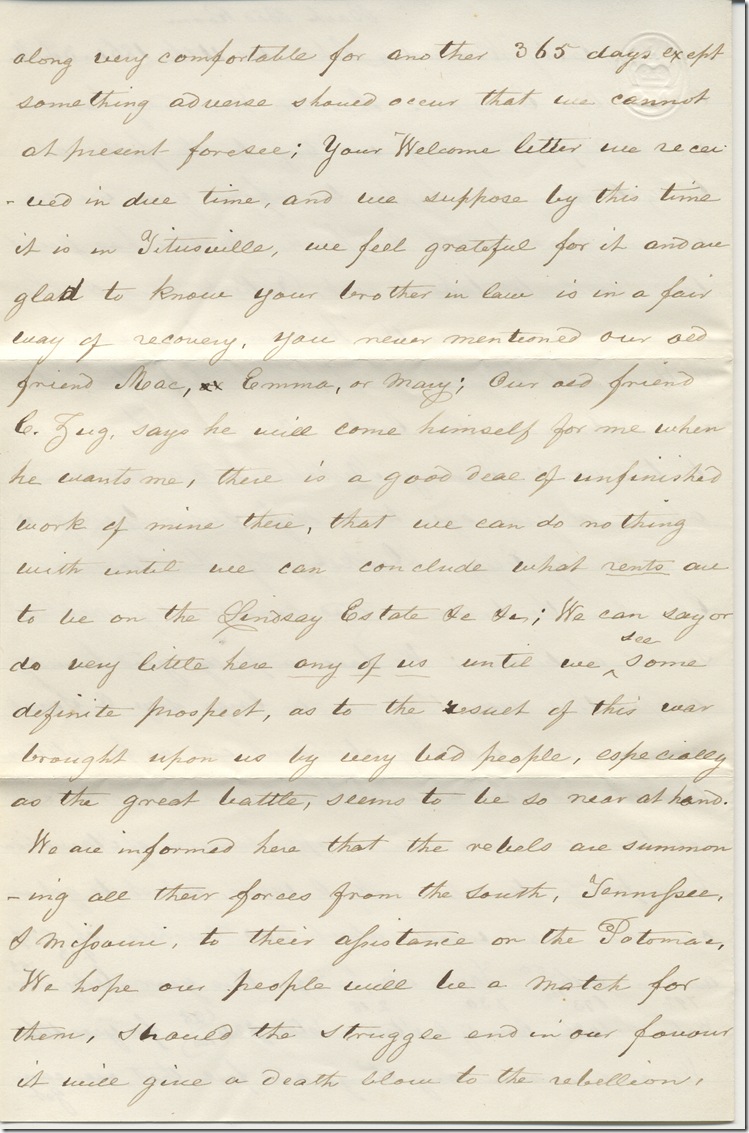
 Moore VI-4-21 p1 Henry and Mary Warner to Children 9-11-61Moore VI-4-21 p2 Henry and Mary Warner to Children 9-11-61

 Moore VI-4-21 p3 Henry and Mary Warner to Children 9-11-61

Transcript:

Back Bed Room

Allegheny City Wednesday September 11th 1861, 3 P.M.

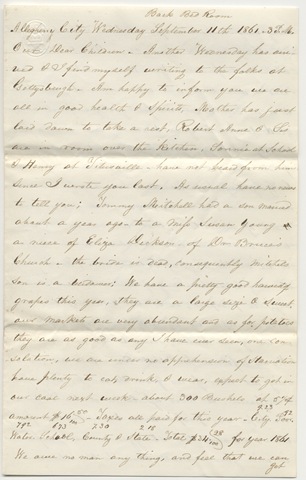
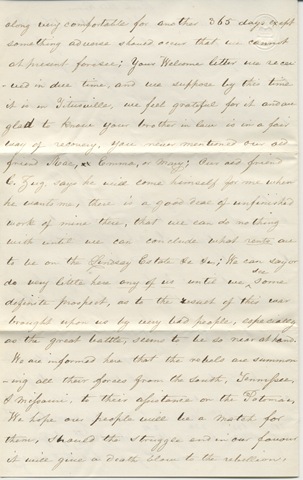
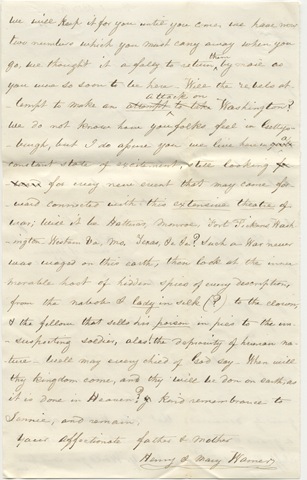
Our Dear Children—Another Wednesday has arrived & I find myself writing to the folks at Gettysburgh. Am happy to inform you we are all in good health & spirits. Mother has just laid down to take a rest, Robert Anne & Sis are in room over the kitchen, Jonnie at School & Henry at Titusville—have not heard from him since I wrote you last. As usual have no news to tell you; Tommy Mitchell had a son married about a year go—to a miss Susan Young a niece of Eliza Dickson—of Dr Bruca’s Church—the bridge is dead, consequently Mitchells son is a widower; We have a pretty good harvest of grapes this year, they are a large size & sweet, our markets are very abundant and as for potatoes they are as good as any I have ever seen, one consolation, we are under no apprehension of starvation here plenty to eat, drink, & wear, expect to get in our coal next week—about 300 Bushels at 5 ½¢ amount of $16.50—Taxes all paid for this year—City 9.23, Poor 92, Water 792, School 673.100, County 7.30 & State 218—Total $34.100 28 for the year 1861. We owe no man any thing, and feel that we can get along very comfortable for another 365 days except something adverse should occur that we cannot at present foresee; Your Welcome letter we received in due time, and we suppose by this time it is in Titusville, we feel grateful for it and are glad to know your brother in law is in a fair way of recovery. You never mentioned our old friend Mac, Emma, or Mary; Our old Friend C. Zug, says he will come himself for me when he wants me, there is a good deal of unfinished work of mine there, that we can do nothing with until we can conclude what rents are to be on the Lindsay Estate &c&c; We can say or do very little here any of us until we see some definite prospect, as to the result of this war brought upon us by very bad people, especially as the great battle, seems to be so near at hand.

We are informed here that the rebels are summoning all their forces from the South, Tennessee, & Missouri, to their assistance on the Potomac. We hope our people will be a match for them, should the struggle end in our favour it will give a death blow to them rebellion. The burning of the Supports under the Rail Road in Missouri, was a hellish plot, to destroy the lines of unsuspecting men, women & children.

One thing certain, we can match any people on earth, in this beloved country of ours, for the essence of atrosity—but it is no use to comment on the thousand and one occurrences daily taking place, it would fill volumes—kind remembrance to Jennie.

We are very well satisfied you put off your visit until the beginning of October, our communion will be last Sat of September, we think it will suit all parties better, and it may be, by that time, momentous events to our beloved country, may take place by that time.

Your affectionate father & mother

Henry & Mary Warner


Citation: Henry and Mary Warner, autograph letter signed to John Riddle Warner. Allegheny City [Pittsburgh], 11 September 1861. Moore VI:04:22

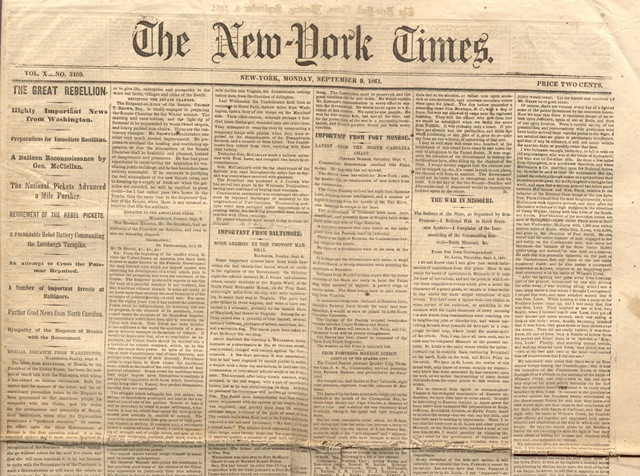
September 9, 1861: New York Times

top

Transcript (excerpt):

Page 1, Upper Half

Important From Fort Monroe.

Latest From The North Carolina Coast.

Fortress Monroe, Saturday, Sept. 7.

Commodore Stringham reached Old Point to-day. His flag-ship has not arrived.

The Harriet Lane has sailed for New York; also, the Quaker City, in consequence of new orders from the Commodore.

It is supposed the Secessionists will make a stand at Fort Macon, a strong casemated work guarding the approach to Beaufort.

Refugees from North Carolina report that the lower counties of the State are ready to hoist the Union flag when assured of support. A perfect reign of terror exists. The State troops were in part returning from Virginia.

A prominent clergyman declared at the Hatteras Inlet, should a Federal force invade the main land near Beaufort, it would at once be joined by 2,000 North Carolina Unionists.

Citation: New York Times. 9 September 1861. Gift of Steven and Susan Raab. AN .N5682

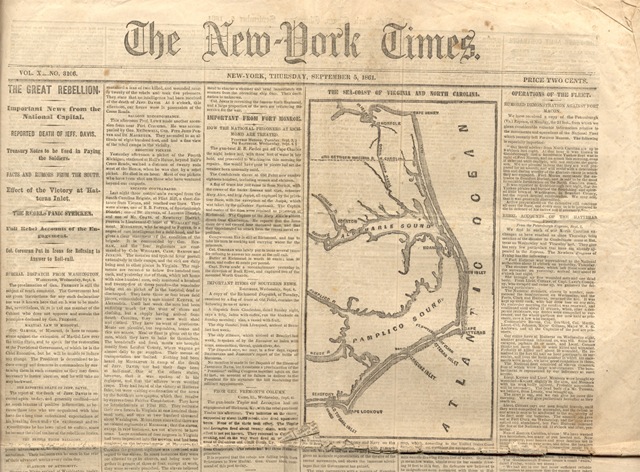
September 5, 1861: New York Times

top

Transcript (excerpt):

Page 1, Upper Half

Martial Law in Missouri

Gov. Gamble, of Missouri, is here to remonstrate against the extension of Martial Law over the entire State, and to speak for the restoration of the Provisional Government, of which he is the Chief Executive, but he will be unable to induce any change. The President is determined to induce energy and firmness in commanders by sustaining them in such measures as they may deem necessary to insure success, and he will take no step backward.

The Reported Death of Jeff. Davis

The report of the death of Jeff. Davis is received again to-day, and generally credited – not as much because of positive information, as because those here who are acquainted with him have for a long time entertained expectations of his breaking down under the excitement and responsibilities he has been called to endure, since he became the chief traitor of the rebellious States.

Citation: New York Times. 5 September 1861. Gift of Steven and Susan Raab. AN .N5682

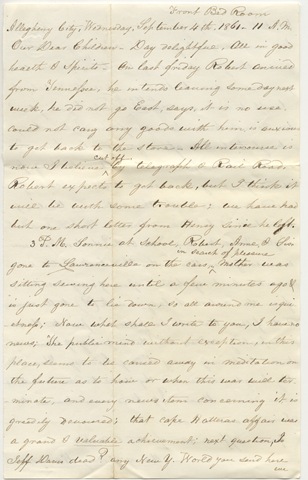
September 4, 1861: Henry and Mary Warner Letter to John Warner

Henry and Mary Warner lived in Allegheny City, Pennsylvania, now part of Pittsburgh. They are the great-grandparents of poet Marianne Moore.  By the 1860s they had three surviving children:  John, Henry, and Anne. Their letters to John, a Presbyterian minister living in Gettysburg, are preserved as part of Marianne Moore’s family papers.
 

Moore VI-4-21 p1 Henry and Mary Warner to Children 9-4-61

  Moore VI-4-21 p2 Henry and Mary Warner to Children 9-4-61

Transcript:

Front Bed Room

Allegheny City, Wednesday, September 4th, 1861—11 A.M.

Our Dear Children—Day delightful, All in good health & spirits—On last friday Robert arrived from Tennessee, he intends leaving some day next week, he did not go East, says, it is no use could not carry any goods with him, is anxious to get back to the store—All intercourse is now I believe cut off by telegraph & Rail Road. Robert expects to get back, but I think it will be with some trouble; we have had but one short letter from Henry since he left.

3 P.M. Jonnie at school, Robert, Anne & Sis gone to Lawrenceville on the cars in search of pleasure. Mother was sitting sewing here until a few minutes ago & is just gone to lie down, so all around me is in quietness; Now what shall I write to you, I have no news; The public mind without exception, in this place, seems to be carried away in meditation on the future as to how or when this war will terminate, and every news item concerning it, greedily devoured; that cape Hatteras affair was a grand & valuable achievement; next question, Is Jeff Davis dead? Any New Y. World you send here we will keep it for you until you come. we have now two numbers which you must carry away when you go, we thought it a folly to return them by mail as you were so soon to be here—Will the rebels attempt to make an attack on Washington? We do not know how you folks feel in Gettysburgh, but I do assure you we live here in a constant state of excitement, still looking for every new event that may come forward connected with the extensive theatre of war; Will it be Hatteras, Monroe, For Pickens, Washington, Western Va, Mo. Texas, &c&c? Such a War never was waged on this earth, then look at the innumerable host of hidden spies of every description, from the nabob & lady in silk (?) to the clown, & the fellow that sells his poison in pies to the unsuspecting soldier, alas! the depravity of human nature—Well may every child of God say—When will thy kingdom come, and thy will be don on earth, as it is done in Heaven? kind remembrance to Jennie, and remain,

Your Affectionate father & mother

Henry & Mary Warner


Citation: Henry and Mary Warner, autograph letter signed to John Riddle Warner. Allegheny City [Pittsburgh], 4 September 1861. Moore VI:04:22
August 31, 1861: U.S. Grant to His Father

AMs 357-5 p1 U.S. Grant to Jesse Root Grant AMs 357-5 p2 U.S. Grant to Jesse Root Grant AMs 357-5 p3 U.S. Grant to Jesse Root Grant

Transcript:

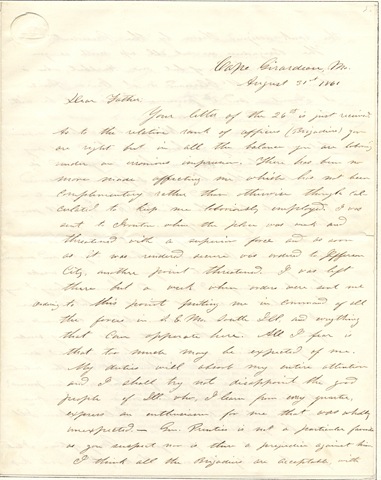
Cape Girardeau, Mo.

August 31st 1861

Dear Father,

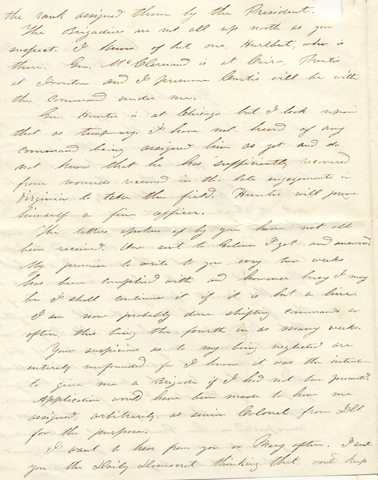
Your letter of the 26th is just received. As to the relative rank of officers (Brigadiers) you are right but in all the balance you are laboring under an erroneous impression. There has been no more made affecting me  which has not been complementary rather than otherwise though calculated to keep me laboriously employed. I was sent to Ironton when the place was weak and threatened with a superior force and as soon as it was rendered secure was ordered to Jefferson City, another point threatened. I was left there but a week when orders were sent me ordering to this point putting me in command of all the forces in S.E. Mo. South Ill, and everything that can opperate here. All I fear is that too much is expected of me. My duties will absorb my entire attention and I shall try not disappoint the good people of Ill. who, I learn from every quarter, express an enthusiasm for me that was wholly unexpected. – [Gen.] Prentiss is not a particular favorite as you suspect nor is there a prejudice against him. I think all the Brigadiers are acceptable, with the rank assigned them by the President.

The Brigadiers are not all up north as you suspect. I know of but one, Hurlbut, who is there. Gen. McClernand is at Cairo, Prentis at [Scranton] and I presume Curtis will be with the command under me.

Gen. Hunter is at Chicago but I look upon that as temporary. I have not heard of any command being assigned him as yet and do not know that he has sufficiently recovered from wounds received in the late engagements in Virginia to [take] the field. Hunter will prove himself a fine officer.

The letters spoken of by you have not all been received. Those sent to [Galena] I got and answered. My promise to write to you every two weeks has been complied with and however busy I may be I shall continue it if it is but a line. I am now probably done shifting commands so often, this being the fourth in as many weeks.

Your suspicions as to my being neglected are entirely unfounded for I know it was the intention to give me a Brigade if I had not been promoted. Application would have been made to have me assigned, arbitrarily, as senior Colonel from Ill. for the purpose.

I want to hear from you as Mary often. I sent you the Daily Democrat thinking that would keep you better posted in this section – than I could do and being a cheap correspondent.

I wrote to you that I would like to have Mary go out to Galena and stay some time. I do not want Julia to leave Galena being anxious to retain my residence after the many kindnesses received from the people there.

I only arrived at this place last night and can not tell you much about things here. The people however are generally reported to be secessionists.

Ulys.

Citation: Ulysses S. Grant (1822-1885), autograph letter signed to Jesse Root Grant. Cape Girardeau, Mo., 31 August 1861. AMs 357/5