October 4, 1861: James Garfield to J. H. Jones

Future U.S. President Garfield was lieutenant-colonel and then colonel of the 42nd Ohio Volunteers; he would become a brigadier general in 1862 before resigning to serve as a Congressman in 1863.

AMs 774-4 James A Garfield to JH Jones

Transcript:

Camp Chase, Oct. 4, 1861

Dear Rev. Jones,

Jefferson is here—has been mustered into the Hiram company & is well—I expect a large deputation of friends & brethren here—from Hiram—to visit us next Saturday week—and to spend Lord’s Day—how I want you to come with them—and preach to our boys on Sunday—I will pay your Expenses at least—

The friends will leave on the first train from Cleveland Saturday morning—and you must come down with them—I presume they will buy some thing in the Eating way– & want you all to have a touch of camp life—May be you will conclude to stay—

Cant the Dr come down also & bring some others with him?

Truly Your Brother

J. A. Garfield

P.S. Answer me soon—J.A.G.

Citation: James A. Garfield (1831-1881), autograph letter signed to J. H. Jones. Camp Chase, Ohio; 4 October 1861. AMs 774/4

October 2, 1861: John and Mary Warner letter to John Warner

Henry and Mary Warner lived in Allegheny City, Pennsylvania, now part of Pittsburgh. They are the great-grandparents of poet Marianne Moore.  By the 1860s they had three surviving children:  John, Henry, and Anne. Their letters to John, a Presbyterian minister living in Gettysburg, are preserved as part of Marianne Moore’s family papers.

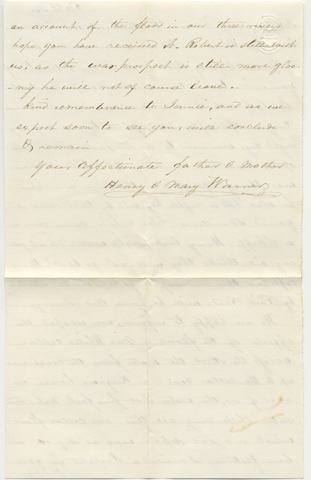
Moore VI-4-23 p1 Henry and Mary Warner to Children 10-2-61

 Moore VI-4-23 p2 Henry and Mary Warner to Children 10-2-61

Transcript:

2 ½ P.M.

Allegheny City Wednesday October 2nd 1861 Front Bed Room

Our Dear Children. We are all in excellent health & Spirits. Hope by this day week, one or the other of you, will be in the midst of us, perhaps both. On last sabbath, when we came home from meeting in the afternoon, got in by means of my night-key, wondered to see the parlour door half open, I walked in, when lo! I behold! here was Henry squatted in the large armchair, he also had a night key, and by that means gained admittance, Joe & him came down in a Skiff, Henry looks right well—did not get any old, thinks they will not go back, Henry left here this morning to go to John McMasters by Rail Road, will be home this evening;

We are happy to inform you, we escaped the effects of the flood, in Mrs Whites cellar across the street, the water from the canal was up to the cellar door—in Kingons house in rear of us, the water was five feet deep, and notwithstanding all this, our cellar floor which is a good depth was as dry as a bone. Yesterday I mailed a Dispatch for you giving an account of the flood in our three rivers hope you have received it. Robert is still with us, as the war prospect is still more gloomy he will not of course leave—

kind remembrance to Jennie, and as we expect soon to see you, will conclude & remain

Your affectionate father & mother

Henry & Mary Warner


Citation: Henry and Mary Warner, autograph letter signed to John Riddle Warner. Allegheny City [Pittsburgh], 2 October 1861. Moore VI:04:23

October 1, 1861: Abraham Lincoln, Plan of a Military Campaign

AMs 545-21_1

AMs 545-21_3

AMs 545-21_5

Transcription:

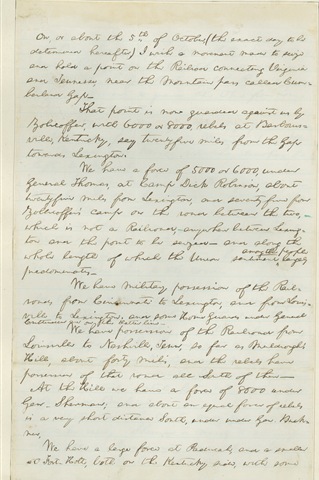
On, or about the 5th. of October, (the exact day to be determined hereafter) I wish a movement made to seize and hold a point on the Railroad connecting Virginia and Tennesse, near the Mountain pass called Cumberland Gap.

That point is now guarded against us by Zolicoffer, with 6000 or 8000, rebels at Barboursville, Kentucky, say twentyfive miles from the Gap towards Lexington.

We have a force of 5000 or 6000, under General Thomas, at Camp Dick Robinson, about twentyfive miles from Lexington, and seventyfive from Zollicoffer’s camp on the road between the two, which is not a Railroad, anywhere between Lexington and the point to be seized—and along the whole length of which the Union sentiment among the people largely predominates.

We have military possession of the Railroads from Cincinnati to Lexington, and from Louisville to Lexington, and some Home Guards under General Crittenden are on the latter line.

We have possession of the Railroad from Louisville to Nashville, Tenn, so far as Muldrough’s Hill, about forty miles, and the rebels have possession of that road all South of there. At the Hill we have a force of 8000 under Gen. Sherman; and about an equal force of rebels is a very short distance South, under under [sic] Gen. Buckner.

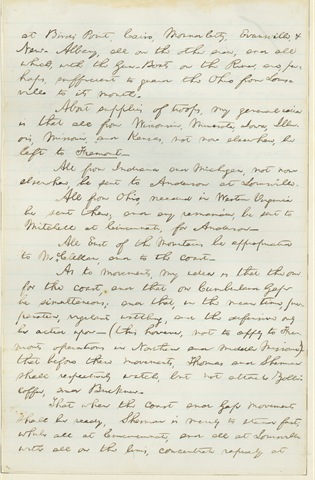
We have a large force at Paducah, and a smaller at Fort-Holt, both on the Kentucky side, with some at Bird’s Point, Cairo, Mound City, Evansville, & New-Albany, all on the other side; and all which, with the Gun-Boats on the River, are, perhaps, sufficient to guard the Ohio from Louisville to it’s mouth.

About supplies of troops, my general idea is that all from Wisconsin, Minesota, Iowa, Illinois, Missouri, and Kansas, not now elsewhere, be left to Fremont.

All from Indiana and Michigan, not now elsewhere, be sent to Anderson at Louisville.

All from Ohio, needed in Western Virginia be sent there; and any remainder, be sent to Mitchell at Cincinnati, for Anderson.

All East of the Mountains be appropriated to McClellan, and to the coast.

As to movements, my idea is that the one for the coast, and that on Cumberland Gap be simultaneous; and that, in the mean time, preparation, vigilant watching, and the defensive only be acted upon—(this however, not to apply to Fremonts operations in Northern and middle Missouri)—that before these movements, Thomas and Sherman shall respectively watch, but not attack Zollicoffer, and Buckner.

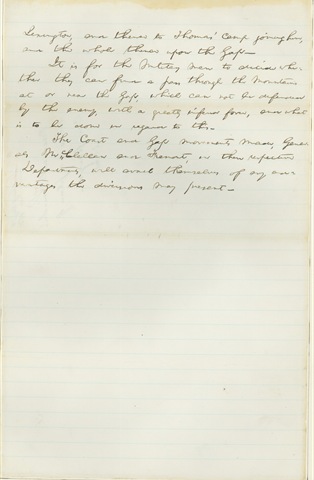
That when the coast and Gap movements shall be ready, Sherman is merely to stand fast; while all at Cincincinnati [sic], and all at Louisville with all on the lines, concentrate rapidly at Lexington, and thence to Thomas’ camp joining him, and the whole thence upon the Gap.

It is for the Military men to decide whether they can find a pass through the mountains at or near the Gap, which can not be defended by the enemy, with a greatly inferior force, and what is to be done in regard to this.

The Coast and Gap movements made, Generals McClellan and Fremont, in their respective Departments, will avail themselves of any advantages the diversions may present.


Citation: Abraham Lincoln, Plan of a military campaign. Washington, D.C., [ca. 1 Oct. 1861]. AMs 545/21

September 30, 1861: New York Times

top

Transcript (excerpt):

Page 1, Upper Half

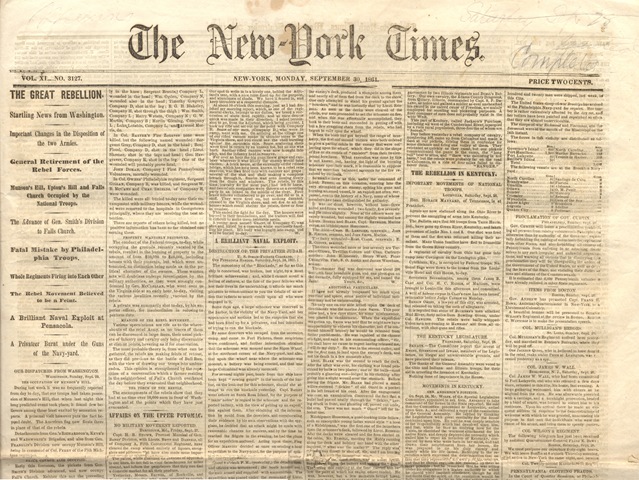
Our Dispatches From Washington

Washington, Sunday, Sept. 29.

The Occupation of Munson’s Hill

During last week it was so frequently reported from day to day, that our troops had taken possession of Munson’s Hill, that when last night this long predicted event took place, it found few believers among those least excited by sensation reports. A personal visit however puts the fact beyond doubt. The American flag now floats there in place of that of the rebels.

Detachments from Gen.’s Richardson’s, Keye’s and Wadsworth’s Brigades, and also from Gen. Franklin’s Division now occupy Munson’s Hill, being in command of Col. Ferry of the Fifth Michigan regiment.

Citation: New York Times. 30 September 1861. Gift of Steven and Susan Raab. AN .N5682

September 26, 1861: Statement of a Conference at Fairfax Court House

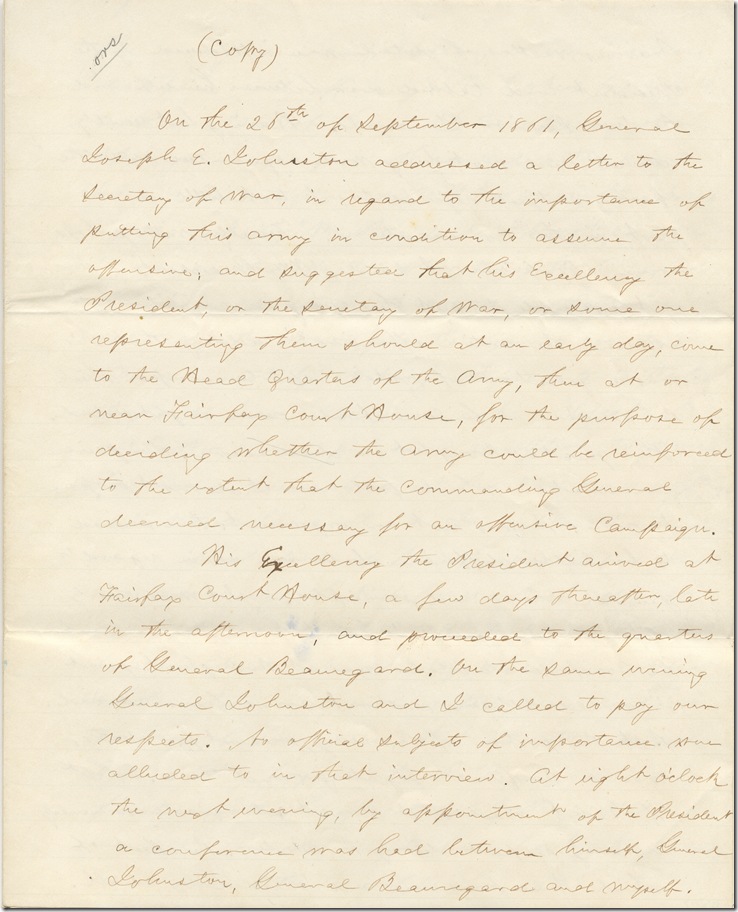
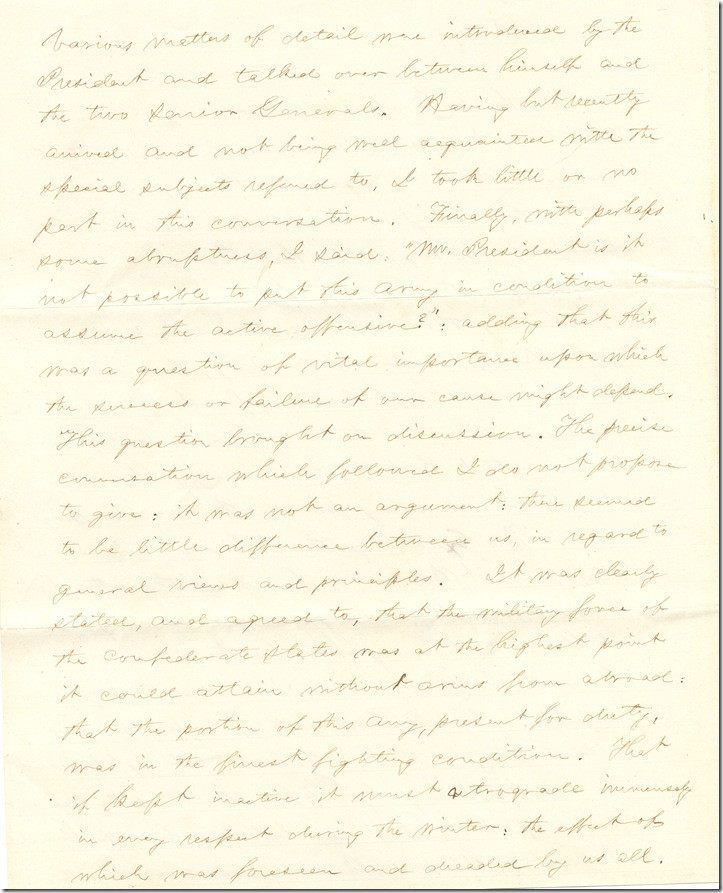
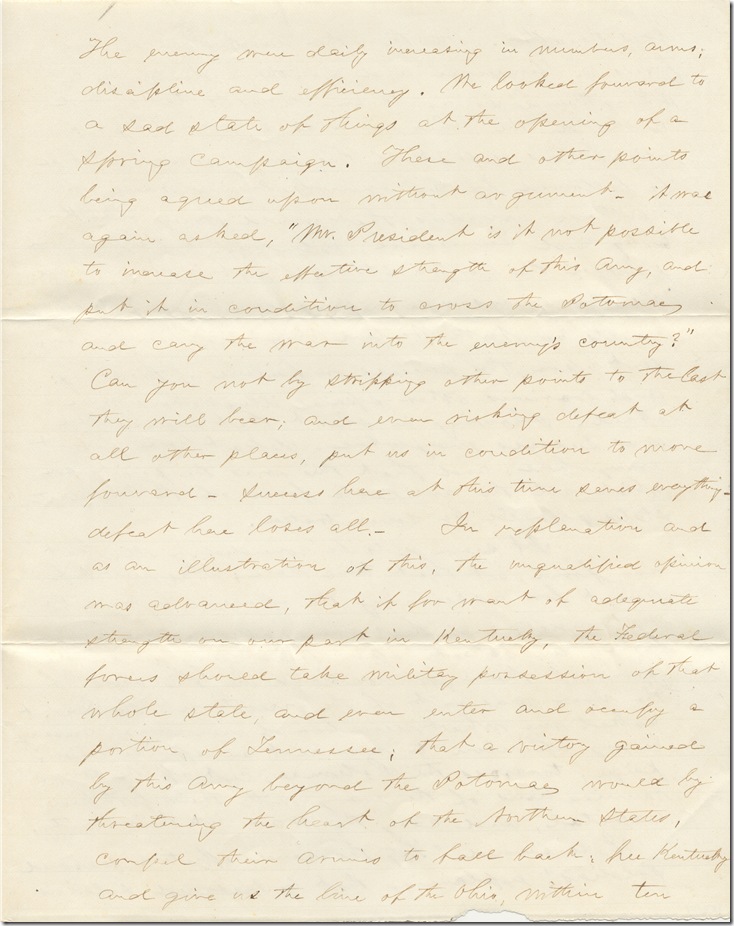
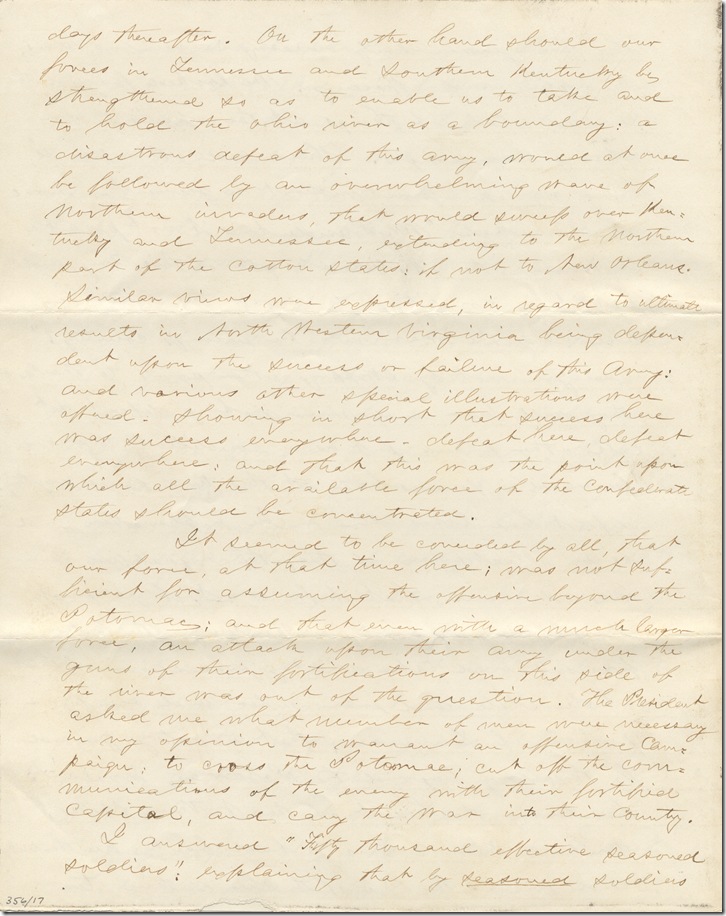
 AMs 356-17 p1  Gustavus Smith 300 dpi AMs 356-17 p2  Gustavus Smith 300 dpi AMs 356-17 p3  Gustavus Smith 300 dpi AMs 356-17 p4  Gustavus Smith 300 dpi AMs 356-17 p5  Gustavus Smith 300 dpi AMs 356-17 p6  Gustavus Smith 300 dpi AMs 356-17 p7 Gustavus Smith 300 dpi AMs 356-17 p8  Gustavus Smith 300 dpi AMs 356-17 p9  Gustavus Smith 300 dpi

Transcript:

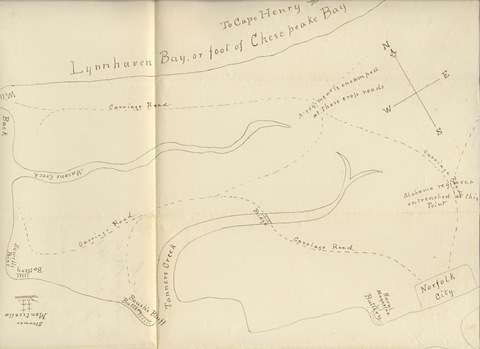
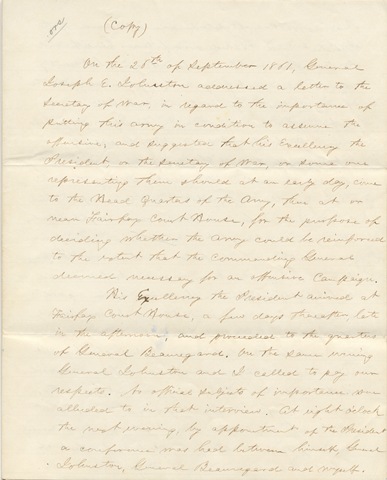
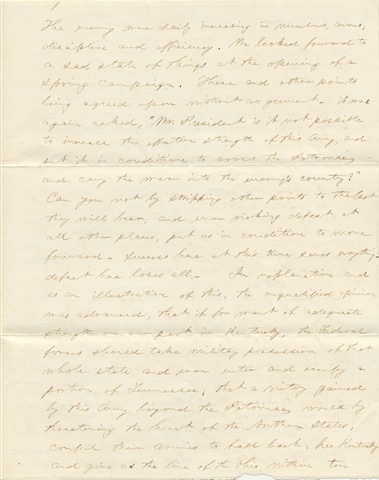
On the 26th of September 1861, General Joseph E. Johnston addressed a letter to the Secretary of War, in regard to the importance of putting this army in condition to assume the offensive; and suggested that his Excellency the President, or the Secretary of War, or some one representing them should at an early day, come to the Head Quarters of the Army, then at or near Fairfax Court House, for the purpose of deciding whether the Army could be reinforced to the extent that the Commanding General deemed necessary for an offensive Campaign.

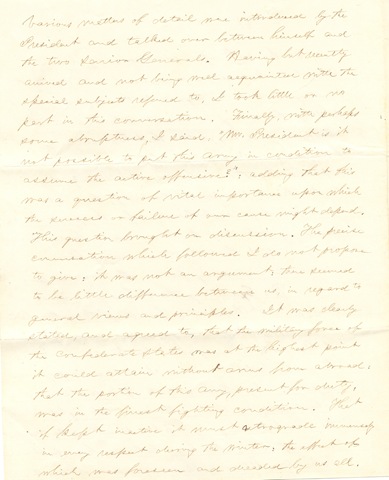
His Excellency the President arrived at Fairfax Court House, a few days thereafter, late in the afternoon, and proceeded to the quarters of General Beauregard. On the same evening General Johnston and I called to pay our respects. No official subjects of importance were alluded to in that interview. At eight o’clock the next evening, by appointment of the President a conference was had between himself, General Johnston, General Beauregard, and myself. Various matters of detail were introduced by the President and talked over between himself and the two senior Generals. Having but recently arrived and not being well acquainted with the special subjects referred to, I took little or no part in this conversation. Finally, with perhaps some abruptness, I said: “Mr. President is it not possible to put this Army in condition to assume the active offensive?”: adding that this was a question of vital importance upon which the success or failure of our cause might depend. This question brought on discussion. The precise conversation which followed I do not propose to give: it was not an argument: there seemed to be little difference between us, in regard to general views and principles. It was clearly stated, and agreed to, that the military force of the Confederate States was at the highest point it could attain without arms from abroad: that the portion of this Army, present for duty, was in the finest fighting condition. That it kept inactive it must retrograde immensely in every respect during the winter: the effect of which was foreseen and dreaded by us all. The enemy were daily increasing in numbers, arms, discipline and efficiency. We looked forward to a sad state of things at the opening of a spring campaign. These and other points being agreed upon without argument- it was again asked, “Mr. President is it not possible to increase the effective strength of this Army, and put it in condition to cross the Potomac and carry the men into the enemy’s country?” Can you not by stripping other points to the least they will bear; and even risking defeat at all other places, put us in condition to move forward- success here at this time saves everything- defeat here loses all.- In explanation and as an illustration of this, the unqualified opinion was addressed, that if for want of adequate strength on our part in Kentucky, the Federal forces should take military possession of that whole state, and even enter and occupy a portion of Tennessee; that a victory gained by this Army beyond the Potomac would by threatening the heart of the Northern States, compel their Armies to fall back: free Kentucky, and give us the line of the Ohio, within ten days thereafter. On the other hand should our forces in Tennessee and Southern Kentucky be strengthened so as to enable us to take and to hold the Ohio river as a boundary: a disastrous defeat of this Army, would at once be followed by an overwhelming share of Northern invaders, that would sweep over Kentucky and Tennessee, extending to the Northern part of the cotton states: if not to New Orleans. Similar views were expressed, in regard to ultimate results in North Western Virginia being dependent upon the success or failure of this Army: and various other special illustrations were offered. Showing in short that success here was success everywhere- defeat here, defeat everywhere: and that this was the point upon which all the available force of the Confederate States should be concentrated.

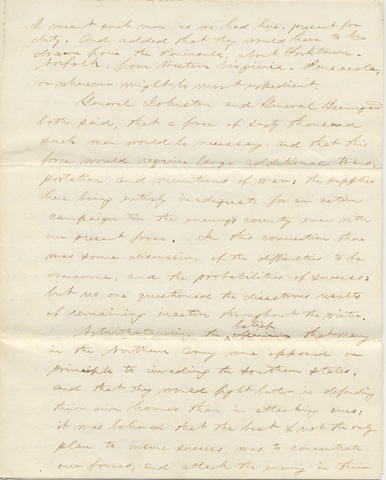
It seemed to be considered by all, that our force, at that time here; was not sufficient for assuming the offensive beyond the Potomac; and that even with a much larger force, an attack upon their Army under the guard of their fortifications on this side of the river was out of the question. The President asked me what number of men were necessary in my opinion to mount an offensive campaign: to cross the Potomac; cut off the communications of the enemy with their fortified capitol; and carry the men into their country.

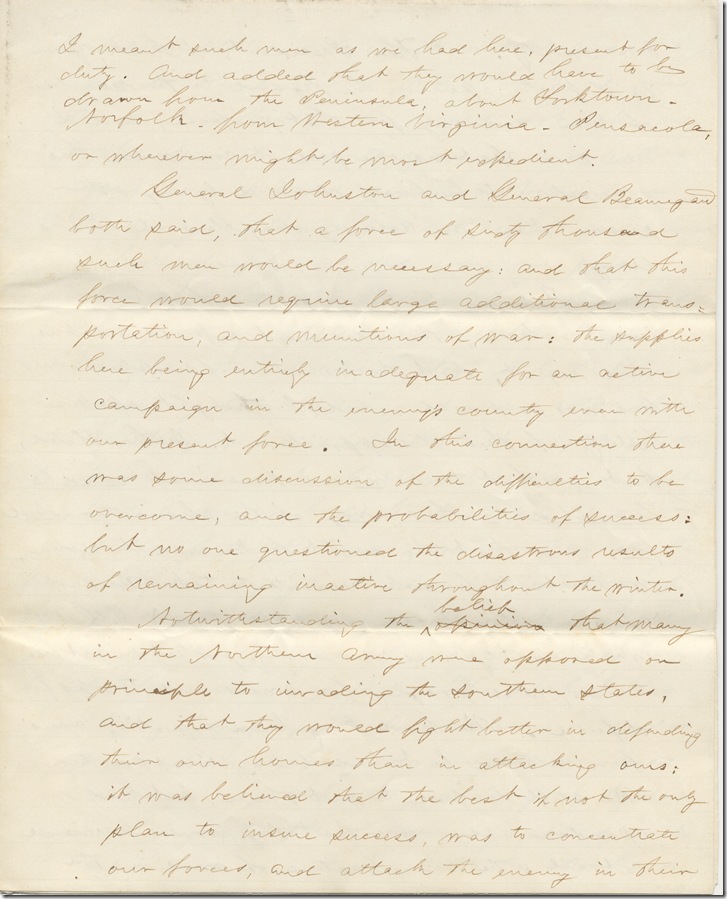
I answered “Fifty thousand effective seasoned soldiers”: explaining that by seasoned soldiers I meant such men as we had here, present for duty. And added that they would have to be drawn from the Peninsula, about Yorktown- Norfolk- from Western Virginia- Pensacola, or wherever might be most expedient.

General Johnston and General Beauregard both said, that a force of sixty thousand such men would be necessary: and that this force would require large additional transportation, and munitions of war: the supplies here being entirely inadequate for an active campaign in the enemy’s country even with our present force. In this connection there was some discussion of the difficulties to be overcome, and the probabilities of success: but no one questioned the disastrous results of remaining inactive throughout the winter.

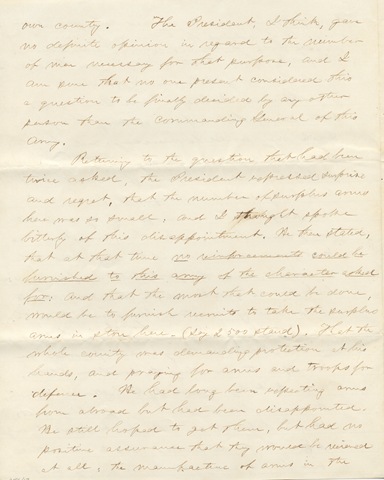
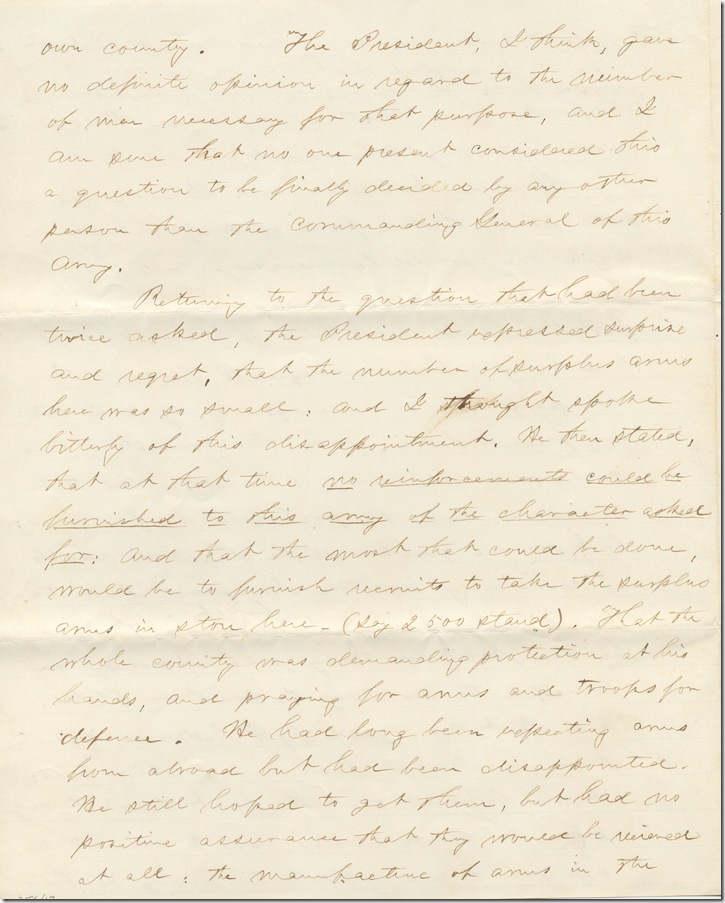
Notwithstanding the belief that many in the Northern Army were opposed on principle to invading the Southern States, and that they would fight better in defending their own homes than in attacking arms: it was believed that the best is not the only plan to insure success, was to concentrate our forces, and attack the enemy in their own country. The President, I think, gave no definite opinion in regard to the number of men necessary for that purpose, and I am sure that no one present considered this a question to be finally decided by any other person than the commanding General of this Army.

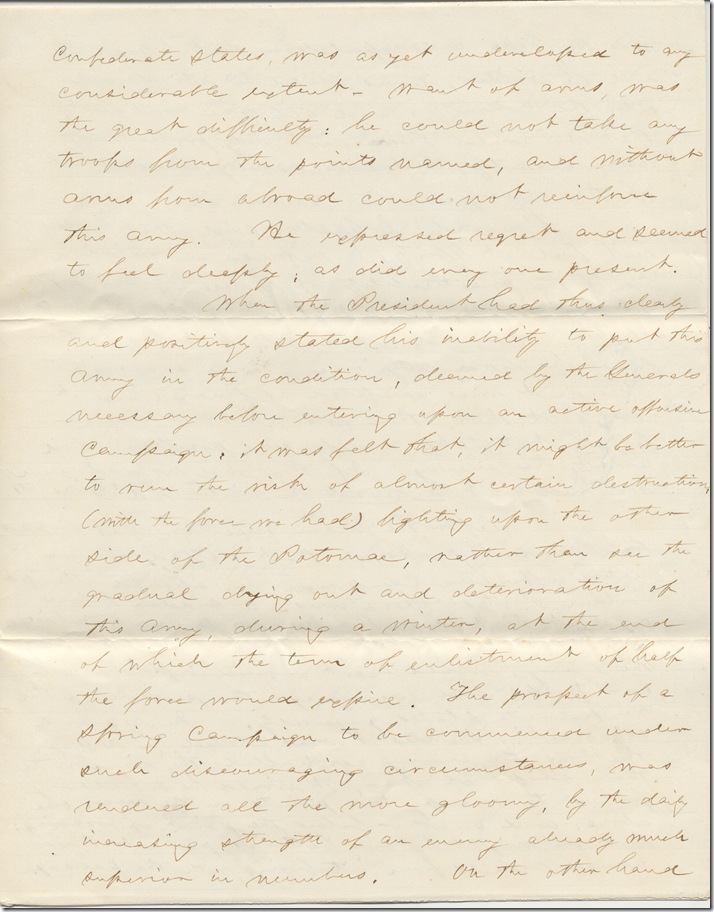
Returning to the question that had been twice asked, the President expressed surprise and regret, that the number of surplus arms here was so small: and I thought spoke bitterly of this disappointment. He then stated, that at that time no reinforcements could be furnished to this army of the character asked for: And that the most that could be done, would be to furnish recruits to take the surplus arms in store here (say 2500 stand). That the whole country was demanding protection at his hands, and praying for arms and troops for defence. He had long been expecting arms from abroad but had been disappointed. He still hoped to get them, but had no positive assurances that they would be received at all: the manufacture of arms in the Confederate States, was as yet undeveloped to any considerable extent- want of arms, was the great difficulty: he could not take any troops from the points named, and without arms from abroad could not reinforce this Army. He expressed regret and seemed to feel deeply: as did every one present.

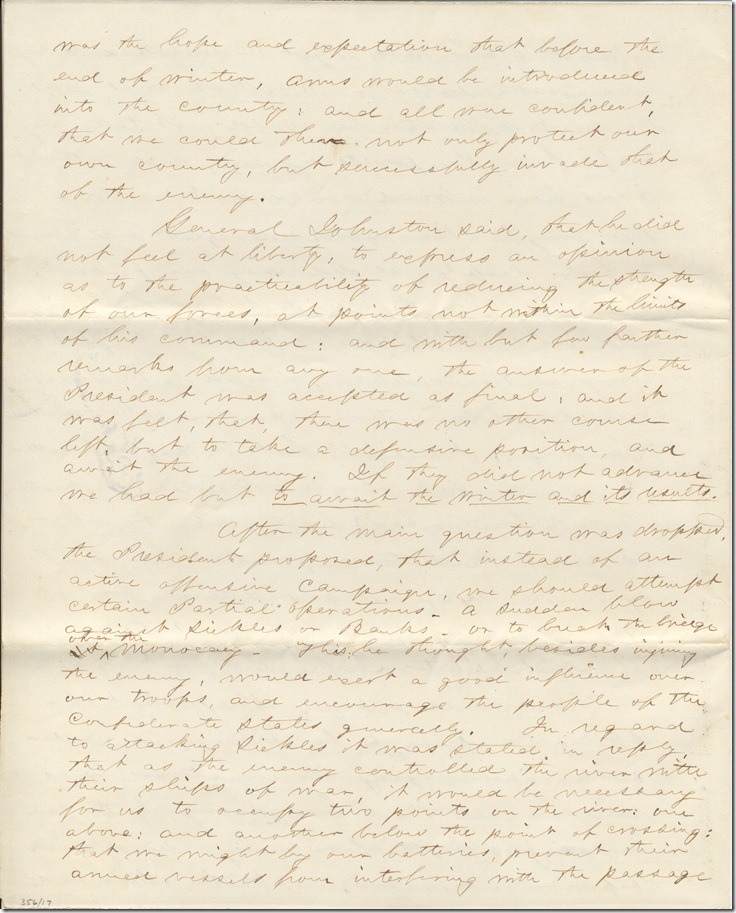
When the President had thus clearly and positively stated his inability to put the Army in the condition, deemed by the Generals necessary before entering upon an active offensive campaign: it was felt that, it might be better to run the risk of almost certain destruction, (with the force we had) fighting upon the other side of the Potomac, rather than see the gradual dying out and deterioration of this Army, during a winter, at the end of which the term of enlistment of half the force would expire. The prospect of a spring campaign to be commenced under such discouraging circumstances, was rendered all the more gloomy, by the daily increasing strength of an enemy already much superior in numbers. On the other hand was the hope and expectation that before the end of winter, arms would be introduced into the country: and all were confident, that we could then not only protect our own country, but successfully invade that of the enemy.

General Johnston said, that he did not feel at liberty, to express an opinion as to the practicality of reducing the strength of our forces, at points not within the limits of his command: and with but few further remarks from any one, the answer of the President was accepted as final, and it was fact, that, there was no other course left, but to take a defensive position, and await the enemy. If they did not advance we had but to await the winter and its results.

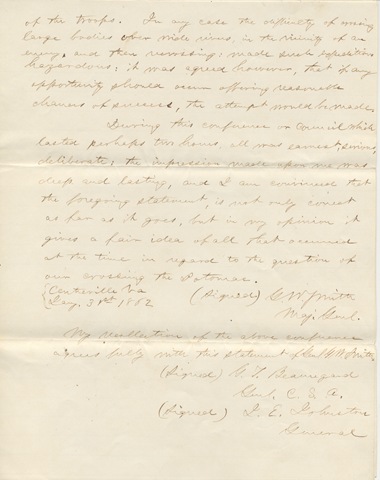
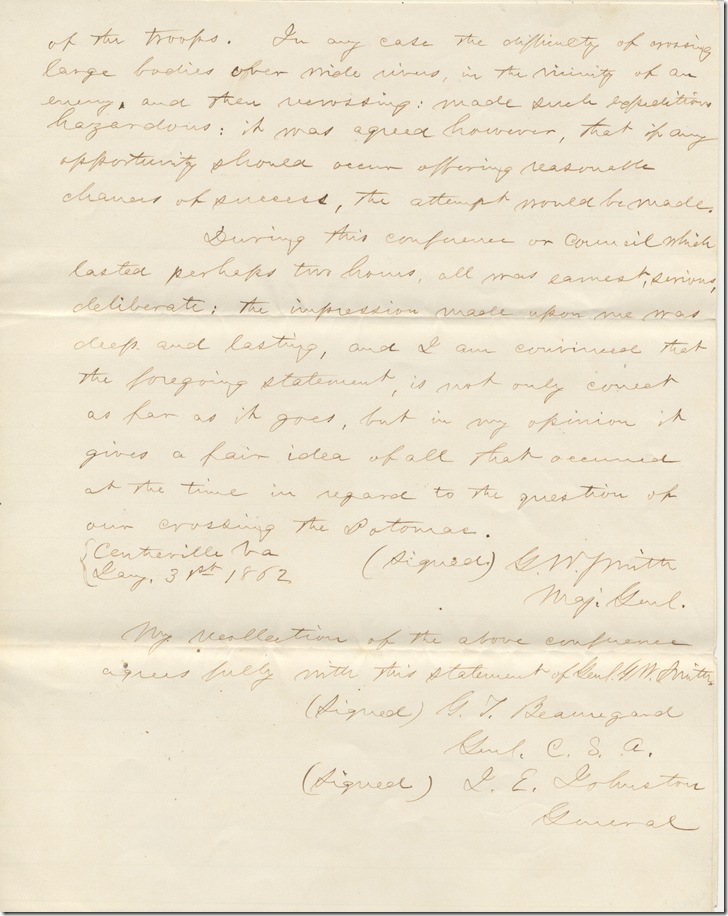
After the main question was dropped, the President proposed, that instead of an active offensive campaign, we should attempt certain Partial operations- a sudden blow against Sickles or Banks- or to break the siege over the Monocacy- This he thought, besides injuring the enemy, would exert a good influence over our troops, and encourage the people of the Confederate States generally. In regard to attacking Sickles it was stated in reply, that as the enemy controlled the river with their ships of war, it would be necessary for us to occupy two points on the river: one above: and another below the point of crossing: that we might by our batteries, prevent their unused vessels from interfering with the passage of the troops. In any case the difficulty of crossing large bodies over wide rivers, in the vicinity of an enemy and then recrossing: made such expedition hazardous: it was agreed however, that if any opportunity should occur offering reasonable chances of success, the attempt would be made.

During this conference or council which lasted perhaps two hours, all was earnest, serious, deliberate; the impression made upon me was deep and lasting, and I am convinced that the foregoing statement, is not only correct as far as it goes, but in my opinion it gives a fair idea of all that occurred at the time in regard to the question of our crossing the Potomac.

Centreville Va

May 31st 1862

Signed G. W. Smith

Maj. Genl.

My recollection of the above conference agrees fully with the statement of Genl. G. W. Smith

Signed G. T. Beauregard

Genl. C. S. A.

Signed J. E. Johnston

General


Citation:  Gustavus Woodson Smith (1822-1896), Statement of a conference at Fairfax C.H. Sept. 26th 1861. Centreville, Va, 31 May 1862. AMs 356/17

September 25, 1861: Henry and Mary Warner to John Warner

Henry and Mary Warner lived in Allegheny City, Pennsylvania, now part of Pittsburgh. They are the great-grandparents of poet Marianne Moore.  By the 1860s they had three surviving children:  John, Henry, and Anne. Their letters to John, a Presbyterian minister living in Gettysburg, are preserved as part of Marianne Moore’s family papers.

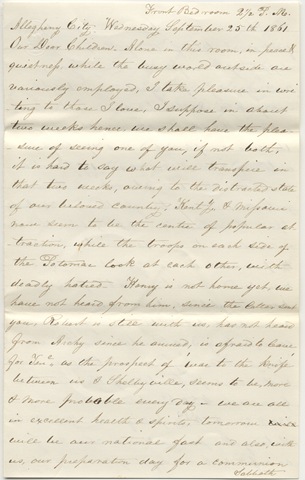
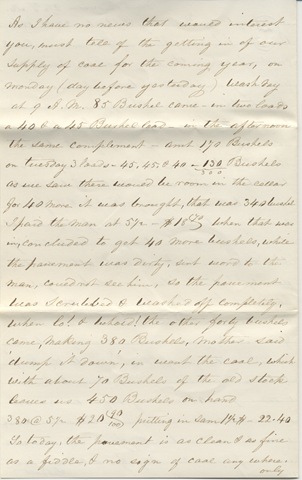
Moore VI-4-21 p1 Henry and Mary Warner to Children 9-25-61

Moore VI-4-21 p2 Henry and Mary Warner to Children 9-25-61

Moore VI-4-21 p3 Henry and Mary Warner to Children 9-25-61

Transcript:

Front Bedroom 2 ½ P.M.

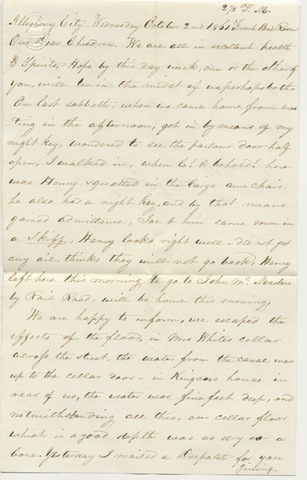
Allegheny City Wednesday September 25th 1861

Our Dear Children—Alone in this room, in peace & quietness, while the busy world outside are variously employed, I take pleasure in writing to those I love. I suppose in about two weeks hence, we shall have the pleasure of seeing one of you, if not both, it is hard to say what will transpire in that two weeks, owing to the distracted state of our beloved country. Kenty & Missouri now seem to be the centre of popular attraction, while the troops on each side of the Potomac look at each other, with deadly hatred—Henry is not home yet, we have not heard from him, since the letter sent you, Robert is still with us, has not heard from Archy since he arrived, is afraid to leave for Tene as the prospect of ‘war to the knife’ between us & Shelbyville, seems to be, more & more probable every day—we are all in excellent health & spirits, tomorrow will be our national fast and also, with us, our preparation day for a communion Sabbath. As I have no news that would interest you, must tell of the getting in of our supply of coal for the coming year, on monday (day before yesterday) washday at 9 A.M. 85 Bushel came – in two loads a 40 & a 45 Bushel load—in the afternoon the same complement—amt 170 Bushels on tuesday 3 loads—45, 45, & 40—130/300 Bushels as we saw there would be room in the cellar for 40 more it was brought, that was 340 Bushel I paid the man at 5 ½– $18.70 When that was in, concluded to get 40 more bushels, while the pavement was dirty, sent word to the man, could not see him, so the pavement was scrubbed & washed off completely, when lo! I behold! the other forty bushels came, making 380 Bushels, Mother said ‘dump it down,’ in went the coal, which with about 70 Bushels of the old stock leaves us 450 Bushels on hand 380 @ 5 ½ $20.90/100 putting in sam 1 ½$– 22.40

So today, the pavement is as clean & fine as a fiddle, & no sign of coal any where, only in the cellar, the weather was delightful Monday, Tuesday & today, and we all consider it a good job over—Weather here is quite cool, provisions good & cheap, and general health good, do not hear of any cases of sickness any where about.

Kind remembrance to Jennie

Must close this short & uninteresting missive, for want of something to write about, — your affectionate father & mother

Henry & Mary Warner


Citation: Henry and Mary Warner, autograph letter signed to John Riddle Warner. Allegheny City [Pittsburgh], 25 September 1861. Moore VI:04:22

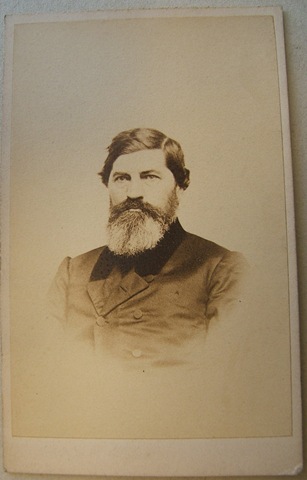
September 21, 1861: Photograph of Michael Reinhard


20061890

“GERMON/702 CHEST ST./PHILA.” embossed  below image.

Label on reverse: “FROM/THE PHOTOGRAPHIC GALLERY OF/ W.L. GERMON,/No. 702 Chestnut Street, Philadelphia/IVORYTYPES of all   sizes/Photographs from life or Daguerreotypes/Photographs from Miniature to Life size/Photographs Life size in Oil/Photographs   plain by the dozen/Photographs in Water Colors/Photographs in India Ink/Photographs in Pastel./DAGUERREOTYPES/Of all sizes & styles in the highest perfection of Art”.


Citation: W. L. Germon, photograph of Michael Reinhard. Philadelphia, ca. 1860. 2006.1890

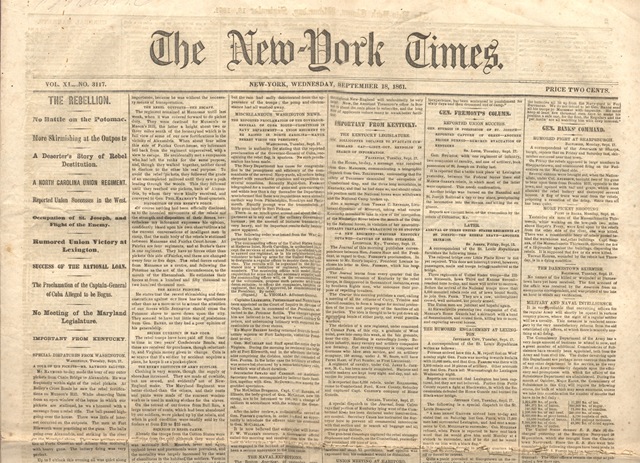
September 18, 1861: New York Times

top

Transcript (excerpt):

Page 1, Upper Half

Reported Union Success

Gen. Sturgis in possession of St. Joseph – Reported capture of Green – Another bridge burned – Rumored evacuation of Kentucky

St. Louis, Tuesday, Sept. 17.

Gen. Sturgis, with one regiment of infantry, two companies of cavalry, and one of artillery, took possession of St. Joseph on Friday last.

It is reported that a battle took place at Lexington yesterday, between the Federal forces there and Martin Green’s rebels, in which most of the latter were captured. This needs confirmation.

Another bridge was burned on the Hannibal and St. Joseph Railroad a day or two since, precipitating the locomotive into the stream and killing the engineer.

Reports are current here of the evacuation by the rebels of Columbus, Ky.

Citation: New York Times. 18 September 1861. Gift of Steven and Susan Raab. AN .N5682