August 30, 1861: New York Tribune

top

Transcript (excerpt Page 1, Upper Half)


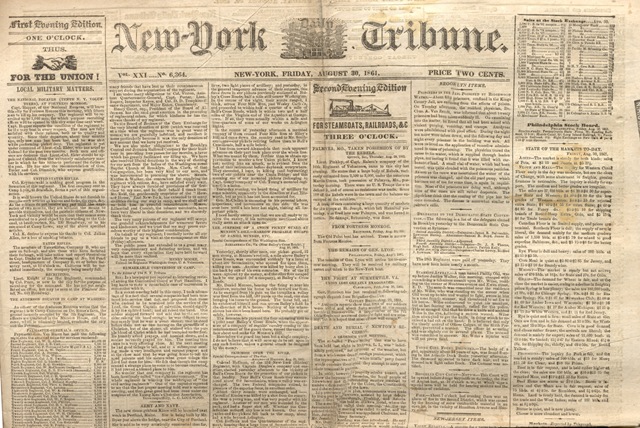
Palmyra, Mo., taken possession of by the Rebels.

Quincy, Ill. Thursday, Aug. 29, 1861

Lieut. Pinkley, of Capt. Ralson’s company of the 16th Regiment of Volunteers, came to this city last evening. He states that a large body of Rebels, variously estimated from 2,500 to 3,000, under the notorious Martin Green, took possession of Palmyra, Mo., yesterday morning. There were no U.S. Troops there to defend it, and of course no resistance was made. Some 500 of the Rebels were in the town and the balance encamped on the outskirts.

A train of cars containing a large quantity of muskets for the troops at St. Joseph, which left Hannibal yesterday, was fired into near Palmyra, and was forced to return. No damage, fortunately, was done.


Citation: New York Daily Tribune. New York, 30 August 1861. Gift of Steven and Susan Raab. AN .N5675

August 29, 1861: New York Tribune

top

Transcript: (excerpt, Page 1, Upper Half)


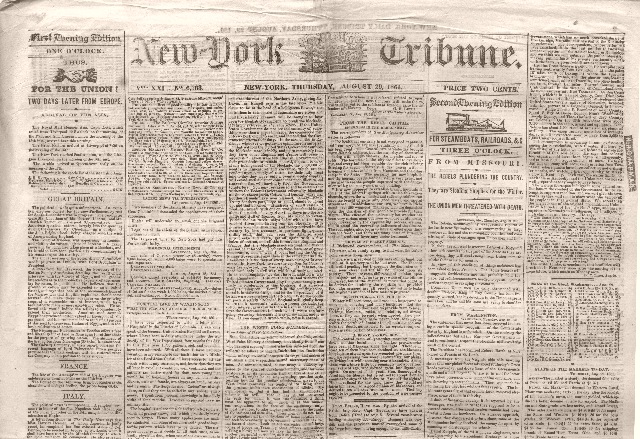
From the Rebel Capital.

Sickness in the Rebel Army.

The correspondent of The Montgomery Advertiser writes as follows:

“The health of our army is not very good at present, and I am sorry to say that the fatality among the sick has been great. The Central cars of yesterday brought down 350 sick soldiers, but the majority of them were suffering with slight diseases, like measles and severe colds. The hospitals in the city are filled to overflowing, and every building suitable for the sick is being fitted up for them. Scarcely a day passes without bringing in a number of sick from Manassas and the other camps in the State. The necessity for new hospitals and the increase of the medical staff is very great, and I am glad to see the people impressed with the danger of crowding too many sick in one building.


Citation: New York Daily Tribune. New York, 29 August 1861. Gift of Steven and Susan Raab. AN .N5675

August 28, 1861: Henry and Mary Warner Letter to John Warner

Henry and Mary Warner lived in Allegheny City, Pennsylvania, now part of Pittsburgh. They are the great-grandparents of poet Marianne Moore.  By the 1860s they had three surviving children:  John, Henry, and Annie. Their letters to John, a Presbyterian minister living in Gettysburg, are preserved as part of Marianne Moore’s family papers.
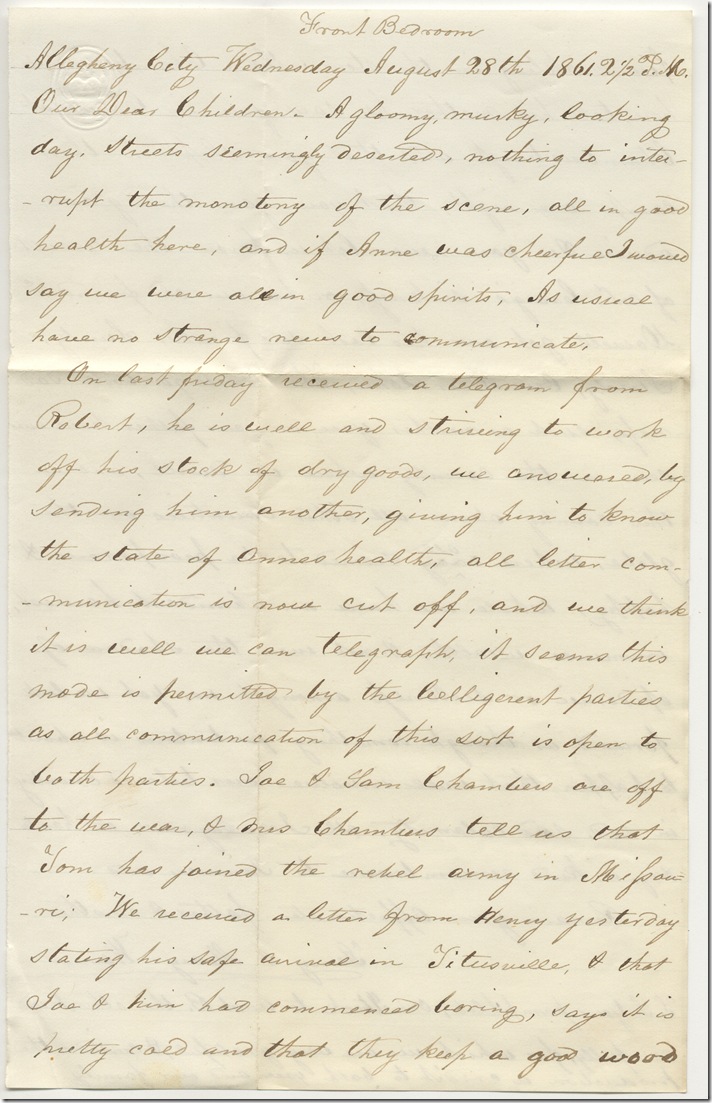
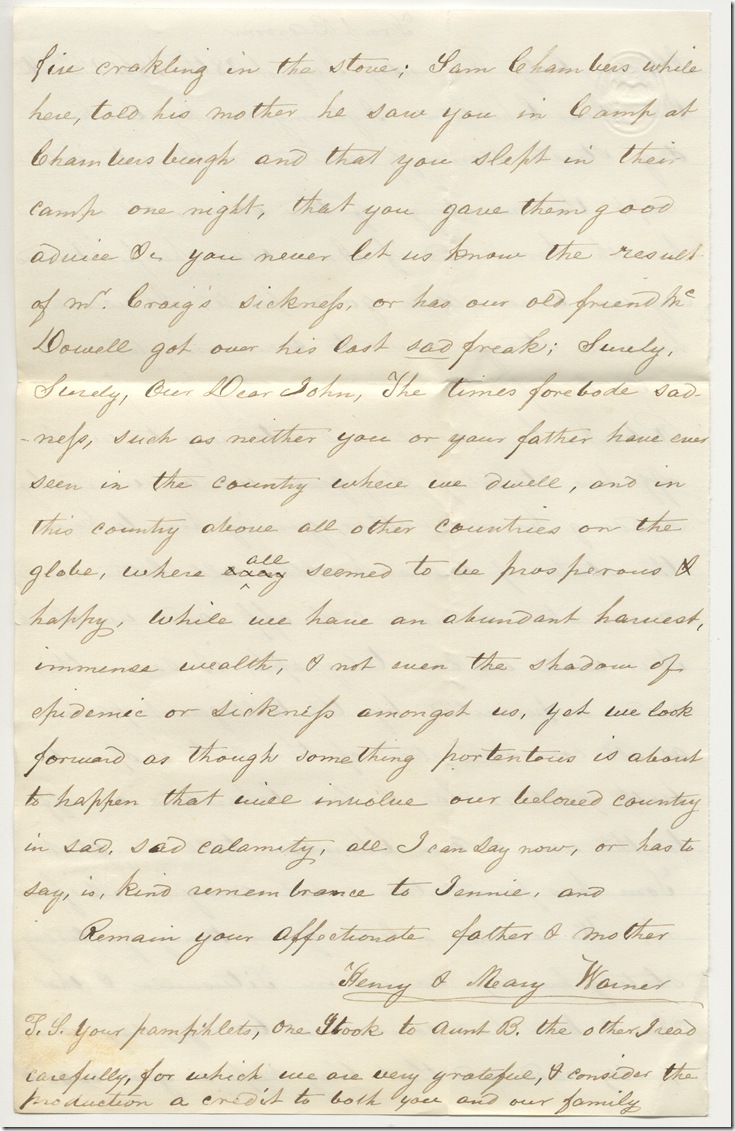
 

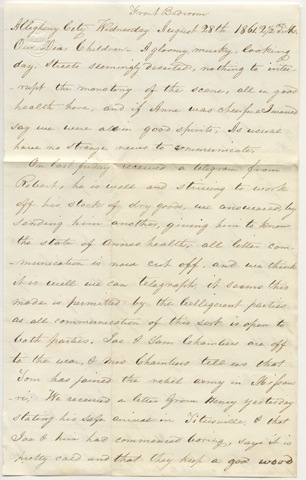
 Moore VI-4-21 p1 Henry and Mary Warner to Children 8-28-61

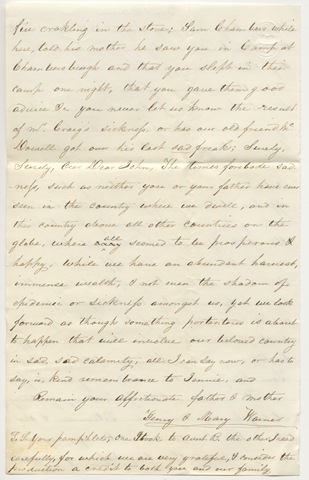
Moore VI-4-21 p2 Henry and Mary Warner to Children 8-28-61

Transcript:

Front Bedroom

Allegheny City Wednesday August 28th 1861. 2 ½ P.M.

Our Dear Children—A gloomy, murky, looking day, streets seemingly deserted, nothing to interrupt the monotony of the scene, all in good health here, and if Anne was cheerful I would say we were all in good spirits. As usual have no strange news to communicate.

On last friday received a telegram from Robert, he is well and striving to work off his stock of dry goods, we answered, by sending him another, giving him to know the state of Annes health, all letter communication is now cut off, and we think it is well we can telegraph, it seems this mode is permitted by the belligerent parties as all communication of this sort is open to both parties. Joe & Sam Chambers are off to the war, & Mrs Chambers tell us that Tom has joined the rebel army in Missouri; We received a letter from Henry yesterday stating his safe arrival in Titusville, & that Joe & him had commenced boring, says it is pretty cold and that they keep a good wood fire crakling in the stove; Sam Chambers while here, told his mother he say you in Camp at Chambersburgh and that you slept in their camp one night, that you gave them good advice &c you never let us know the result of Mr Craig’s sickness, or has our old friend McDowell got over his last sad freak; Surely, Surely, Our Dear John, The times forbode sadness, such as neither you or your father have ever seen in the country where we dwell, and in this country above all other countries on the globe, where all seemed to be prosperous & happy, while we have an abundant harvest, immense wealth, & not even the shadow of epidemic or sickness amongst us, yet we look forward as though something portentous is about to happen that will involve our beloved country in sad, sad calamity, all I can say now, or has to say, is, kind remembrance to Jennie and

Remain your Affectionate father & mother

Henry & Mary Warner

P.S. Your pamphlets, one I took to Aunt B. the other I read carefully, for which we are very grateful, & consider the production a credit to both you and our family


Citation: Henry and Mary Warner, autograph letter signed to John Riddle Warner. Allegheny City [Pittsburgh], 28 August 1861. Moore VI:04:21
August 27, 1861: U.S. Grant to His Father

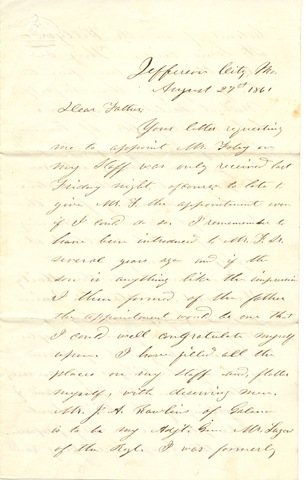
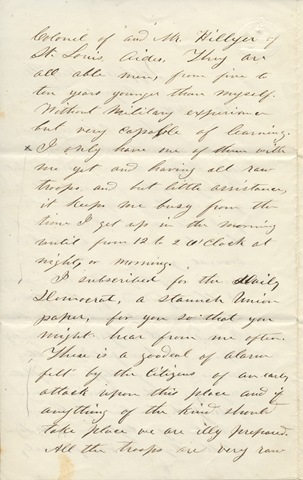
 AMs 357-4 p1 U.S. Grant to Jesse Root Grant AMs 357-4 p2 U.S. Grant to Jesse Root Grant AMs 357-4 p3 U.S. Grant to Jesse Root Grant AMs 357-4 p4 U.S. Grant to Jesse Root Grant

Transcript:

Jefferson City, Mo.

August 27th, 1861


Dear Father,

Your letter requesting me to appoint Mr. Foley on my staff was only received last Friday night, of course, to late to give Mr. F. the appointment even if I could do so. I remember to have been introduced to Mr. F. Sr. several years ago and if the son is anything like the impression I then formed of the father the appointment would be one that I could well congratulate myself upon. I have filled all the placed in my staff and, flatter myself, with deserving men. Mr. J. A. Rawlins of Galena is to be my Adgt. Gen. Mr. Lagow of the Rgt. I was formerly Colonel of and Mr. Hillyer of St. Louis, Aides. They are all able men from five to ten years younger than myself. Without military experience but very capable of learning. I only have one of them with me yet and having all raw troops and but little assistance it keeps me busy from the time I get up in the morning until from 12 to 2 o’clock at night, or morning.

I subscribed for the Daily Democrat, a staunch Union paper, for you so that you might hear from me often.

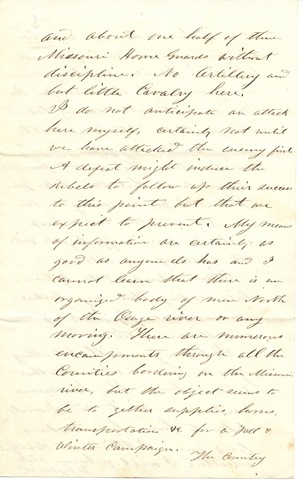
There is a good deal of alarm felt by the citizens of an early attack upon this place and if anything of the kind should take place we are illy prepared. All the troops are very raw and about one half of them Missouri Home Guards without discipline. No Artillery and but little Cavalry here.

I do not anticipate an attack here myself, certainly not until we have attacked the enemy first. A defeat might induce the rebels to follow up their success to this point but that we expect to prevent. My means of information are certainly as good as anyone else has and I cannot lean that there is an organized body of men North of the Osage river or any moving. There are numerous encampments through all the counties bordering on the Missouri River, but the object seems to be to gather supplies, horses, transportation etc. for a fall & winter campaign.

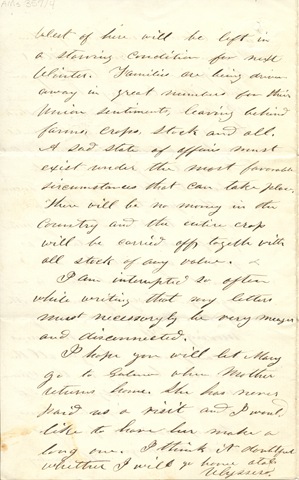
The country West of here will be left in a starving condition for next Winter. Families are being driven away in great numbers for their Union sentiments, leaving behind farms, crops, stock and all. A sad state of affairs must exist under the most favorable circumstances that can take place. There will be no money in the country and the entire crop will be carried off together with all stock of any value. I am interrupted so often while writing that my letters must necessarily be very meager and disconnected. I hope you will let Mary go to Galena when Mother returns home. She has never paid us a visit and I would like to have her make a long one. I think it doubtful whether I will go home at all.

Ulysses


Citation:  Ulysses S. Grant (1822-1885), autograph letter signed to Jesse Root Grant.  Jefferson City, Mo., 27 August1861. AMs 357/4

August 26, 1861: John Henry Brown’s Journal

John Henry Brown was a painter of portrait miniatures, living and working in Philadelphia. He had met Lincoln in August of 1860 when he was commissioned to paint Lincoln’s portrait for a supporter, but although Brown liked Lincoln personally, he did not agree with Republican policies.

1861-08-26 August 31, 1861

Transcript:

At Rosie Grants picture.

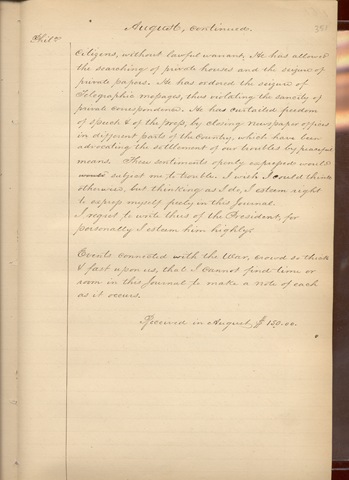
My business is dwindling down to nothing. I cannot lose sight of the fact that but for this odious war I would now have plenty of employment at increased prices. Aside from any personal or selfish feeling in the matter, I regard this war as most unholy. I think it madness to try and settle our troubles by the sword. The Union can only be held together by Equality, Kindness & brotherly love. In attempting to restore the Union by force of arms we may lose our liberties and be cursed with an odious military despotism. If we do overcome the south, we can only hold them by the strong arm of military power; what then becomes of the great principle underlying our form of government, enunciated in the Declaration of Independence “That Government derives its just powers from the consent of the governed.” Already has the President, exercised powers not granted by the Constitution. He has increased the standing army, in direct violation of that instrument. He has suspended the writ of Habeas Corpus. He has refused submission to the mandates of the Supreme Court. He has authorized one of his military subordinates, to declare the law of a Sovereign state (Missouri) unconstitutional & to call on its citizens to disregard it. He has authorized the arrest of peaceable citizens, without lawful warrant. He has allowed the searching of private houses and the seizure of private papers. He has ordered the seizure of Telegraphic messages, thus violating the sanctity of private correspondence. He has curtailed freedom of speech & of the press, by closing newspaper offices in different parts of the country, which have been advocating the settlement of our troubles by peaceful means. These sentiments openly expressed would subject me to trouble. I wish I could think otherwise, but thinking as I do, I esteem right to express myself freely in this Journal. I regret to write thus of the president, for personally I esteem him highly. 

Events connected with the War crowd so thick & fast upon us, that I cannot find time or room in this journal to make a note of each as it occurs.


Citation: John Henry Brown, autograph journal/account book. Philadelphia, 1844-1890. AMs 573/14.1

August 23, 1861: Robert Armstrong to Anne Warner Armstrong

Anne and Robert Armstrong lived in Shelbyville, Tennessee, but at the outset of the war Anne and their children went to Pittsburgh to stay with her parents, Henry and Mary Warner. Anne was the great-aunt of the poet Marianne Moore and these letters are preserved as part of Marianne Moore’s family papers.

Moore VI-4-21 Robert to Anne 8-23-61


Transcript:

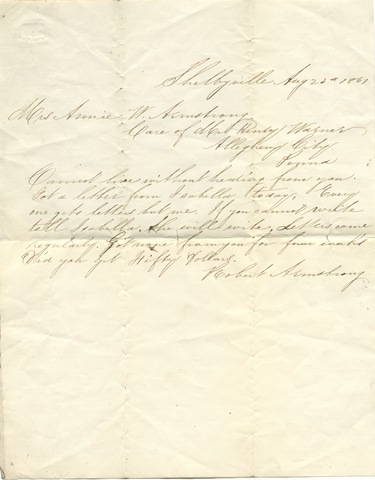
Shelbyville Aug 23d 1861

Mrs Annie W. Armstrong

Care of Mr Henry Warner

Allegheny City

Penna

Cannot live without hearing from you. Got a letter from Isabella today. Every one gets letters but me. If you cannot write tell Isabella. She will write. Letters come regularly. Got none from you for four weeks. Did you get Fifty Dollars.

Robert Armstrong


Citation: Robert Armstrong, autograph letter signed to Anne Armstrong. Shelbyville, Tenn; 23 August 1861. Moore VI:04:21
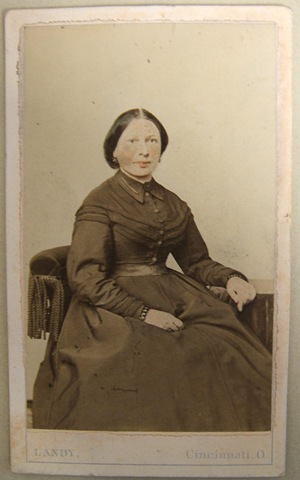
August 20, 1861: Photograph of an Unidentified Rosenbach Ancestor

20060978

Backmark reads: “ LANDY/Photographer,/161 West Fourth  St./Cincinnati,/OHIO/Duplicates of this picture/can be had at any time.”

Red stamp on reverse:” REMOVED TO/No. 208 Fourth Street,/N.W.  CORNER PLUM.”

Landy began photography in Cincinnati in 1861; this photograph dates ca. 1861-65; if anyone has information regarding Landy that would allow better dating, please let us know!

Citation: James Landy, photograph of unknown woman. 1861-1865. 2006.978

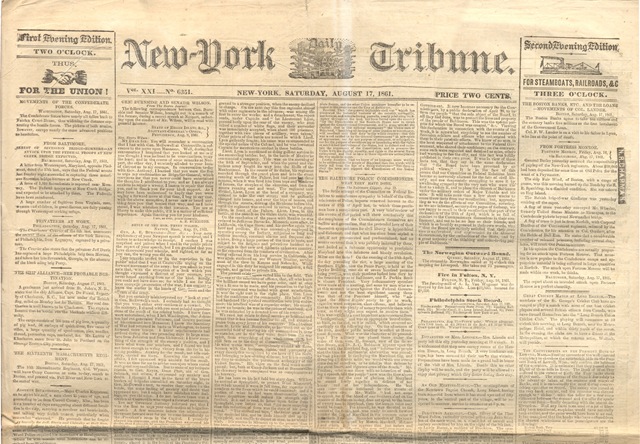
August 17, 1861: New York Tribune

New York Tribune 8-17-1861 top

Transcript: (excerpt page 1)

From Baltimore.

Arrest of Secession Bridge-Burners – An Attack upon the Federal Troops at New Creek Bridge Expected.

Baltimore, Saturday, Aug. 17, 1861.

A letter from Westernport, Maryland opposite Piedmont, dated the 13th, inst., says that the Federal scouts last Sunday night succeeded in capturing three notorious Secession bridge-burners at New Creek.

A force of 1,100 Secessionists is reported near Romney. The Federal troops are at New Creek Bridge, and expected to be attacked by them. The Federals have been reinforced.

A large number of fugitives from Virginia, men, women, and children, in great distress are daily passing through Washington seeking refuge.


Citation: New York Daily Tribune. New York, 17 August 1861. Gift of Steven and Susan Raab. AN .N5675