March 5, 1862: John Adams telegram to Thomas Jordan

Pierre Gustave Toutant Beauregard was a Louisiana-born general of the Confederate States Army. He had graduated second in his class from West Point in 1838 and was an admirer of Napoleon. He achieved fame early in the Civil War for commanding the Fort Sumter bombardment and as the victor of the first battle of Manassas. He later served in the Western Theater (including Shiloh and Corinth), Charleston, and the defense of Richmond, but his career was hampered by friction with Jefferson Davis and other generals.

This is one of approximately 1000 military telegrams in P.G.T. Beauregard’s papers at the Rosenbach.

AMs 1168-11 1862-03-05


Transcript:

By telegraph from Memphis 5 1861

To Col T. Jordan A.A.G.

A Cavalry Company aggregate ninety armed with shot guns distance thirty seven miles on RR. Shall I muster it in for twelve months.

Jno Adams


March 5, 62

Muster in the Compy.

By order of Genl B

Thomas Jordan


Citation: John Adams, telegram to Thomas Jordan. Memphis, 5 March 1862. AMs 1168/11

March 4, 1862: Lincoln’s Recommendation for Edward Burke

 AMs 353-11 p1 Edward Burke letters of rec 

Transcript:

Executive Mansion,

Washington, March 4. 1862
Whom it may concern

Edward Burke, the bearer of this, was at service in this Mansion for several months now last past; and during all the time he appeared to me to be a competent, faithful, and very genteel man. I take no charge of the servants about the house; but I do not understand that Burke leaves because of any fault or misconduct.

A. Lincoln

If Mr Newton can do any thing for Edward Burke, the bearer of this, I will be obliged to him I think him worthy O H Browning


Citation: Abraham Lincoln, letter of recommendation for Edward Burke. Washington, D. C.; 4 March 1862. AMs 353/11.1

March 3, 1862: Telegram to P. G. T. Beauregard

Pierre Gustave Toutant Beauregard was a Louisiana-born general of the Confederate States Army. He had graduated second in his class from West Point in 1838 and was an admirer of Napoleon. He achieved fame early in the Civil War for commanding the Fort Sumter bombardment and as the victor of the first battle of Manassas. He later served in the Western Theater (including Shiloh and Corinth), Charleston, and the defense of Richmond, but his career was hampered by friction with Jefferson Davis and other generals.

This is one of approximately 1000 military telegrams in P.G.T. Beauregard’s papers at the Rosenbach.

AMs 1168-11 1862-03-03

Transcript:

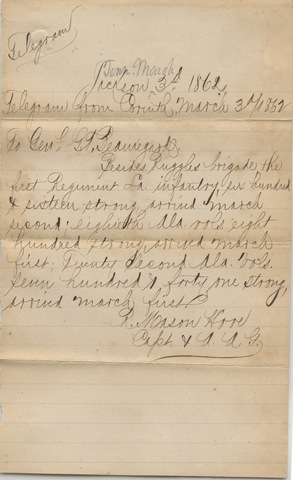
Telegram

Tenn. March

Jackson 3rd 1862

Telegrams from Corinth March 3rd 1862

To Genl G.T. Beauregard

Besides Ruggles brigade the first Regiment La. Infantry, six hundred + sixteen strong, arrived march second eightieth Ala. Vols. Seven hundred strong + forty one strong, arrived march first.

R. Mason Hoo[r?]

Capt. + A. A. G.


Citation:R. Mason Hoo[r?], telegram to G. T. Beauregard. Corinth, Miss., 3 March 1862. AMs 1168/11

February 27, 1862: Telegram to P. G. T. Beauregard

Pierre Gustave Toutant Beauregard was a Louisiana-born general of the Confederate States Army. He had graduated second in his class from West Point in 1838 and was an admirer of Napoleon. He achieved fame early in the Civil War for commanding the Fort Sumter bombardment and as the victor of the first battle of Manassas. He later served in the Western Theater (including Shiloh and Corinth), Charleston, and the defense of Richmond, but his career was hampered by friction with Jefferson Davis and other generals.

This is one of approximately 1000 military telegrams in P.G.T. Beauregard’s papers at the Rosenbach.

AMs 1168-11 1862-02-27

Transcript:

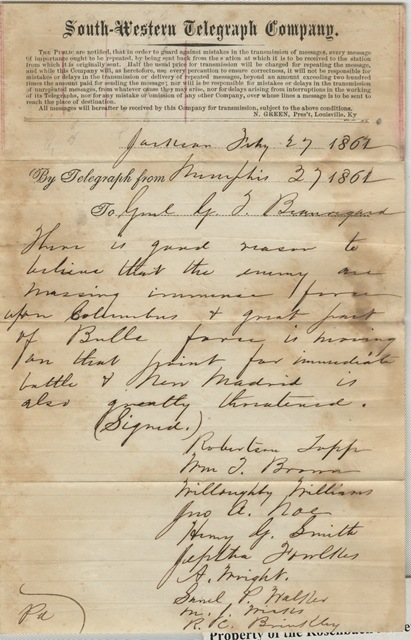
Jackson Feby 27 1862

By telegram from Memphis 27 1862

To Genl G.T. Beauregard

There is good reason to believe that the enemy are massing immense force upon Columbus and great part of Bulls force is moving on that point for immediate battle + New Madrid is also greatly threatened.

(Signed.)

Robertson Tupp

Wm J. Brown

Willoughby Williams

Jno. A. Noe

Henry G. Smith

Jeptha Fowlkes

A. Wright

Samuel P. Walker

M. J. Winks

R.C. Brinkley

Pa.


Citation:Robertson Tupp and others, telegram to G. T. Beauregard. Memphis, Tenn., 27 February 1862. AMs 1168/11

February 24, 1862: J. S. Burford telegram to G. T. Beauregard

Pierre Gustave Toutant Beauregard was a Louisiana-born general of the Confederate States Army. He had graduated second in his class from West Point in 1838 and was an admirer of Napoleon. He achieved fame early in the Civil War for commanding the Fort Sumter bombardment and as the victor of the first battle of Manassas. He later served in the Western Theater (including Shiloh and Corinth), Charleston, and the defense of Richmond, but his career was hampered by friction with Jefferson Davis and other generals.

This is one of approximately 1000 military telegrams in P.G.T. Beauregard’s papers at the Rosenbach.

AMs 1168-11 1862-02-24

Transcript:

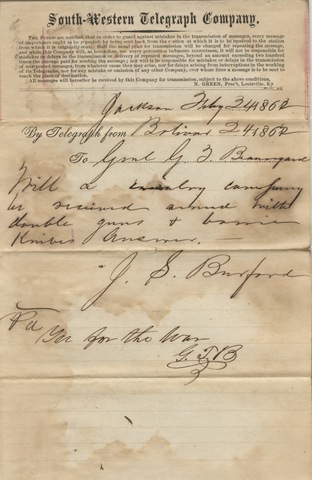
Jackson Friday 24 1862

Bolivar

Genl G.T. Beauregard

Will a cavalry company [illeg]  armed with double guns + bowie knives. Answer

J. S. Burford

Pa

[illeg.] for the war

G.T.B.


Citation:J. S. Burford, telegram to G. T. Beauregard. Bolivar, Miss.; 24 February 1862. AMs 1168/11

February 22, 1862: John Henry Brown’s Journal

John Henry Brown was a painter of portrait miniatures, living and working in Philadelphia. He had met Lincoln in August of 1860 when he was commissioned to paint Lincoln’s portrait for a supporter, but although Brown liked Lincoln personally, he did not agree with Republican policies.

1862-02-22

Transcript:

At Charlotte Kilgours picture.

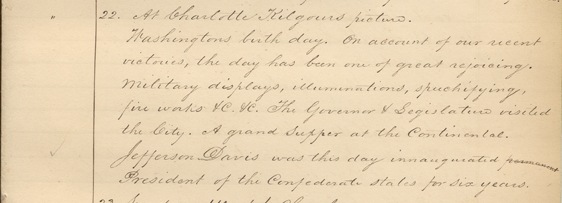
Washington’s birth day. On account of our recent victories, the day has been one of great rejoicing. Military displays, illuminations, speechifying, fire works &c &c. The Governor & Legislature visited the City. A grand supper at the Continental. Jefferson Davis was this day inaugurated President of the Confederate States for six years.


Citation: John Henry Brown, autograph journal/account book. Philadelphia, 1844-1890. AMs 573/14.1

February 19, 1862: John Henry Brown’s Journal

John Henry Brown was a painter of portrait miniatures, living and working in Philadelphia. He had met Lincoln in August of 1860 when he was commissioned to paint Lincoln’s portrait for a supporter, but although Brown liked Lincoln personally, he did not agree with Republican policies.

1862-02-19

Transcript:

At Miss Kilgours picture.

The Presidents second son, Willie, died last night, at the White House.


Citation: John Henry Brown, autograph journal/account book. Philadelphia, 1844-1890. AMs 573/14.1

February 18, 1862: John Henry Brwons’ Journal

John Henry Brown was a painter of portrait miniatures, living and working in Philadelphia. He had met Lincoln in August of 1860 when he was commissioned to paint Lincoln’s portrait for a supporter, but although Brown liked Lincoln personally, he did not agree with Republican policies.

1862-02-18

Transcript:

Commenced Miss Kilgours picture. The country in a blaze of glory at our successes last week. My own troubles of a pecuniary nature have so absorbed my mind, that I have no feeling for anything else.


Citation: John Henry Brown, autograph journal/account book. Philadelphia, 1844-1890. AMs 573/14.1

February 17, 1862: John Henry Brown’s Journal

John Henry Brown was a painter of portrait miniatures, living and working in Philadelphia. He had met Lincoln in August of 1860 when he was commissioned to paint Lincoln’s portrait for a supporter, but although Brown liked Lincoln personally, he did not agree with Republican policies.

1862-02-17

Transcript:

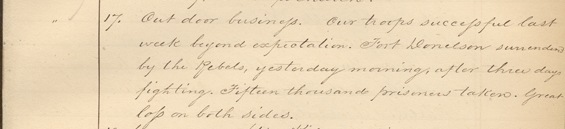
Out door busniess.  Our troops successful last week beyond expectation. Fort Donelson surrendered by the Rebels, yesterday morning, after three days fighting. Fifteen thousand prisoners taken. Great loss on both sides.


Citation: John Henry Brown, autograph journal/account book. Philadelphia, 1844-1890. AMs 573/14.1