March 21, 1862: Robert E. Lee to P.G.T. Beauregard

Pierre Gustave Toutant Beauregard was a Louisiana-born general of the Confederate States Army. He had graduated second in his class from West Point in 1838 and was an admirer of Napoleon. He achieved fame early in the Civil War for commanding the Fort Sumter bombardment and as the victor of the first battle of Manassas. He later served in the Western Theater (including Shiloh and Corinth), Charleston, and the defense of Richmond, but his career was hampered by friction with Jefferson Davis and other generals.

This telegram is from The Telegraphic History of the Civil War; a compiled album of telegrams to Beauregard from Davis, Lee, Johnston and others.
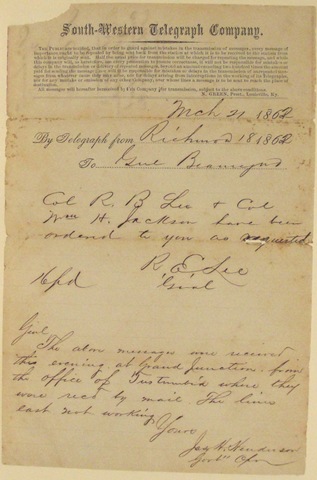
Telegram 3-21-62 Lee to Beauregard 10 mp

Transcript:

March 21 1862

By Telegraph from Richmond 18 1862

To Genl Beauregard

Col R. B Lee & Col Wm H. Jackson have been ordered to you as requested.

R.E. Lee

Genl


Genl

The above messages were received this evening at Grand Junction from the office of Tustumbia where they were recd by mail. The lines east not working.

Yours

Jas H. Henderon

Gov”t Opr.


Citation:Robert E. Lee (1807-1870), telegram to G.T. Beauregard. 21 March 1862. In The telegraphic history of the Civil War, 1861-1865. AMs 434/16
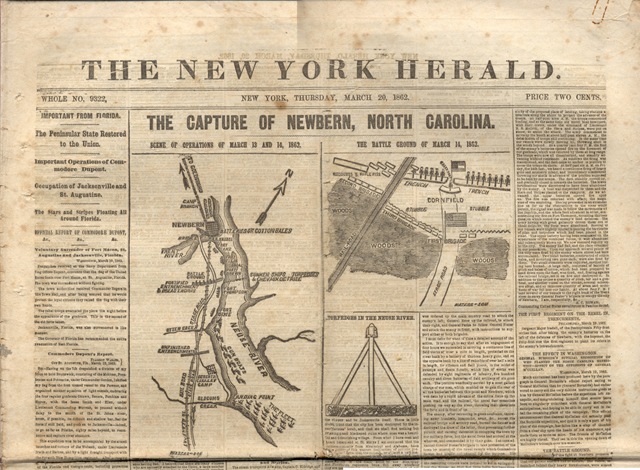

March 20, 1862: New York Herald

top for web

Transcript (excerpt):

Page 1, Lower Half

General Burnside’s Report,

Headquarters Department of North Carolina

Newbern, March 16, 1862

General L. Thomas, Adjutant General United States Army:-

General – I have the honor to report that, after embarking the troops with which I intended to attack Newbern, in conjunction with the naval force, on the morning of the 11th, a rendezvous was made at Hatteras Inlet. Flag Officer Goldsborough having been ordered to Hampton Roads, the naval fleet was left in command of Commodore Rowan. Early on the morning of the 12th the entire force started for Newbern, and that night anchored off the mouth of Slocum’s creek some eighteen miles from Newbern, where I had decided to make a landing. The landing commenced by seven o’clock the next morning, under cover of the naval fleet, and was affected with the greatest enthusiasm by the troops. Many, too impatient for the boats, leaped into the water, and waded waist deep to the short, and then, after a toilsome march through the mud, the head of the column marched within a mile and a half of the enemy’s stronghold, at eight P.M., a distance of twelve miles from the point of landing, where we bivouacked for the night, the rear of the column coming up with the boat howitzers about three o’clock next morning, the detention being caused by the shocking condition of the roads, consequent upon the heavy rain that had fallen during that day and the whole of the night, the men often wading knee deep in mud, and requiring a whole regiment to drag the eight pieces which had been landed from the navy and our own vessels.

Citation: New York Herald, 20 March 1862. Gift of Steven and Susan Raab. AN .N56792

March 19, 1862: John Henry Brown’s Journal

John Henry Brown was a painter of portrait miniatures, living and working in Philadelphia. He had met Lincoln in August of 1860 when he was commissioned to paint Lincoln’s portrait for a supporter, but although Brown liked Lincoln personally, he did not agree with Republican policies.

1862-03-19

Transcript:

At Mrs. Newbolds picture. 

If the newspapers are entirely truthful, then our Arms are almost daily crowned with success.


Citation: John Henry Brown, autograph journal/account book. Philadelphia, 1844-1890. AMs 573/14.1

March 15, 1862: Telegram to Generals Polk and Beauregard

Pierre Gustave Toutant Beauregard was a Louisiana-born general of the Confederate States Army. He had graduated second in his class from West Point in 1838 and was an admirer of Napoleon. He achieved fame early in the Civil War for commanding the Fort Sumter bombardment and as the victor of the first battle of Manassas. He later served in the Western Theater (including Shiloh and Corinth), Charleston, and the defense of Richmond, but his career was hampered by friction with Jefferson Davis and other generals.

This is one of approximately 1000 military telegrams in P.G.T. Beauregard’s papers at the Rosenbach.

AMs 1168-11 1862-03-15

Transcript:

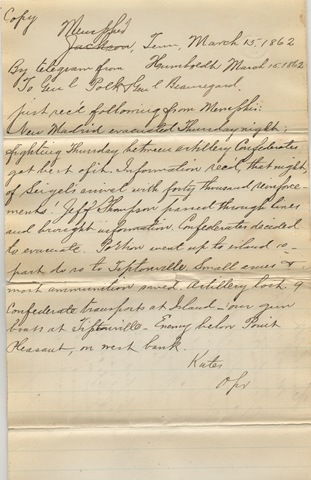
Memphis, Tenn,  March 15. 1862

By telegram from Humboldt March 15, 1862

To Genl Polk + Genl Beauregard

Just sent following from Memphis.

New Madrid evacuated Thursday night

Fighting Thursday between artillery Confederates got best of it

Information read that night of Siegel’s arrival with forty thousand reinforcements Jeff Thompson passed through lines and brought information. Confederates decided to evacuate. Portion went up to island 10 part do so to Tiptonville. Small arms + most ammunition saved. Artillery lost. 9 confederate transports at island our gun boats at Tiptonville. Enemy below Point Pleasant on west Bank.

Kater

Opr

Citation:Kater, telegram to Leonidas Polk and G. T. Beauregard. Humboldt.,15 March 1862. AMs 1168/11

March 14, 1862: M. Harris telegram to G. T. Beauregard

Pierre Gustave Toutant Beauregard was a Louisiana-born general of the Confederate States Army. He had graduated second in his class from West Point in 1838 and was an admirer of Napoleon. He achieved fame early in the Civil War for commanding the Fort Sumter bombardment and as the victor of the first battle of Manassas. He later served in the Western Theater (including Shiloh and Corinth), Charleston, and the defense of Richmond, but his career was hampered by friction with Jefferson Davis and other generals.

This is one of approximately 1000 military telegrams in P.G.T. Beauregard’s papers at the Rosenbach.

AMs 1168-11 1862-03-14

Transcript:

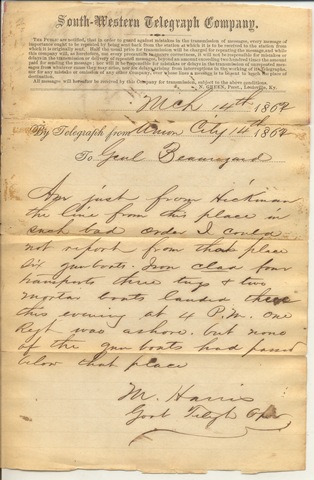
Mch 14 1862

By Telegraph from Union City 14th 1862

To Genl Beauregard

Am just from Hickman the line from this place in such bad order I could not report from that place six gunboats. Iron clad four transports three tugs & two mortar boats landed there this evening at 4 P.M. One Regt was ashore but none of the gun boats had passed below that place.

M. Harris

Govt Telegh Oper.


Citation: M. Harris, telegram to G. T. Beauregard. Union City, [Ga.?]; 14 March 1862. AMs 1168/11

March 13, 1862: Simon Cameron Explains His Resignation

 AMs 527-8-1 p1 Simon Cameron to AT Goodman AMs 527-8-1 p2 Simon Cameron to AT Goodman

Transcript:

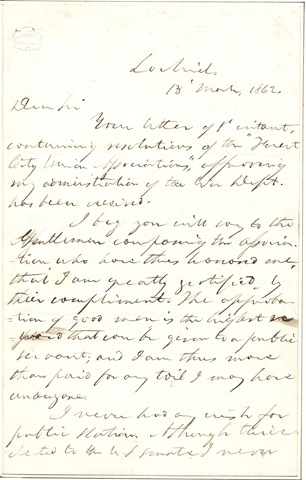
Lockiel

13 March 1862

Dear Sir

Your letter of 8th inst. containing mentions of the “First City Union Associations” approving my administration of the War Dept has been received.

I beg you will say to the Gentlemen composing the Association, who have thus honored me, that I am greatly gratified by their compliment. The approbation of good men is the highest reward that can be given to a public servant; and I am thus more than paid for any toil I may have undergone.

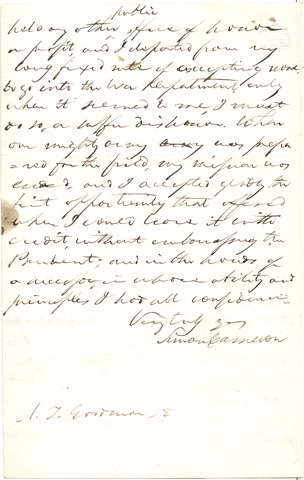
I never had any wish for public Nation. Although I was elected to the U.S. Senate, I never held any other public office of honor or profit and I departed from my long fixed way of accepting none to go into the War Department, only when it seemed to me I must do so, or suffer dishonor. When our mighty army was prepared for the field, my mission was ended and I accepted gladly the first opportunity offered when I could leave it with credit, without embarrassing the President, and in the hands of a successor in whose ability and principles I hold confidence.

Very truly yours

Simon Cameron


Citation: Simon Cameron (1799-1889) autograph letter signed to A.T. Goodman. Lockiel, 13 March 1862. AMs 527/8.1

March 11, 1862: John Henry Brown’s Journal

John Henry Brown was a painter of portrait miniatures, living and working in Philadelphia. He had met Lincoln in August of 1860 when he was commissioned to paint Lincoln’s portrait for a supporter, but although Brown liked Lincoln personally, he did not agree with Republican policies.

1862-03-11

Transcript:

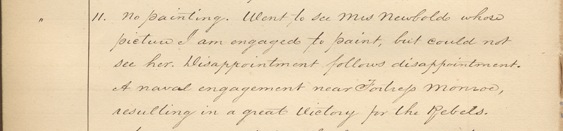
No painting. Went to see Mrs Newbold whose picture I am engaged to paint, but could not see her. Disappointment follows disappointment. A naval engagement near  Fortress Monroe, resulting in a great victory for the Rebels.


Citation: John Henry Brown, autograph journal/account book. Philadelphia, 1844-1890. AMs 573/14.1

March 7, 1862: John Henry Brown’s Journal

John Henry Brown was a painter of portrait miniatures, living and working in Philadelphia. He had met Lincoln in August of 1860 when he was commissioned to paint Lincoln’s portrait for a supporter, but although Brown liked Lincoln personally, he did not agree with Republican policies.

1862-03-07

Transcript:

At Charlotte Kilgours picture, finished it. The war news lately has been very favourable.


Citation: John Henry Brown, autograph journal/account book. Philadelphia, 1844-1890. AMs 573/14.1

March 6, 1862: W. W. Helm telegram to P. G. T. Beauregard

Pierre Gustave Toutant Beauregard was a Louisiana-born general of the Confederate States Army. He had graduated second in his class from West Point in 1838 and was an admirer of Napoleon. He achieved fame early in the Civil War for commanding the Fort Sumter bombardment and as the victor of the first battle of Manassas. He later served in the Western Theater (including Shiloh and Corinth), Charleston, and the defense of Richmond, but his career was hampered by friction with Jefferson Davis and other generals.

This is one of approximately 1000 military telegrams in P.G.T. Beauregard’s papers at the Rosenbach.

AMs 1168-11 1862-03-06


Transcript:

Jackson Mch 6 1862

By Telegraph from Holly Spgs 6 1862

To Genl Beauregard

Do you know Capt W. W. Helm? brother of C. J. Helm—I am suspicioned here as a spy please answer.

W. W. Helm

Ans

Consul Helm’s brother I saw at Manassas I consider true to our cause.

G.T. Beauregard


Citation: W. W. Helm, telegram to G. T. Beauregard. Holly Springs, [Miss.?], 6 March 1862. AMs 1168/11