April 27, 1862: Telegram on Naval Positions in the Lower Mississippi

Pierre Gustave Toutant Beauregard was a Louisiana-born general of the Confederate States Army. He had graduated second in his class from West Point in 1838 and was an admirer of Napoleon. He achieved fame early in the Civil War for commanding the Fort Sumter bombardment and as the victor of the first battle of Manassas. He later served in the Western Theater (including Shiloh and Corinth), Charleston, and the defense of Richmond, but his career was hampered by friction with Jefferson Davis and other generals.

This is one of approximately 1000 military telegrams in P.G.T. Beauregard’s papers at the Rosenbach.

 AMs 1168-11 1862-04-27 AMs 1168-11 1862-04-27 p2


Transcript:

Apl 27, 1862

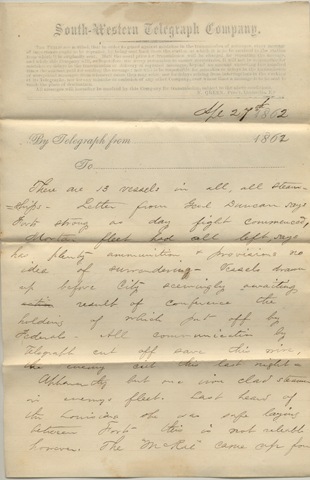
There are 13 vessels in all, all steamships. Letter from Genl Duncan says Forts strong as day fight commenced, Mortar fleet had all left, says has plenty ammunition & provisions no idea of surrendering. Vessels drawn up before City seemingly awaiting result of conference the holding of which put off by Federals. All communication by Telegraph cut off save this wire. The enemy cut this last night.

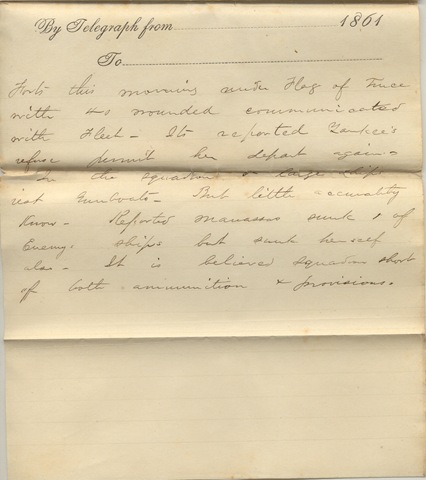
Apparently but one iron clad steamer in enemy fleet. Last heard of the Louisiana she was safe laying between Forts this is not reliable however. The “McRae” came up from Forts this morning under Flag of Truce with 40 wounded communicated with Fleet. It reported Yankee’s refuse permit her depart again.

In the squadron 5 large ships not Gunboats. But little accurately know. Reported Manassas sunk 1 of Enemy’s ships but sunk herself also. It is believed squadron short of both ammunition & provisions”


Citation: Unknown author, telegram on naval positions in the lower Mississippi. 27 April 1862. AMs 1168/11

April 26, 1862: Mansfield Lovell to P. G. T. Beauregard

Pierre Gustave Toutant Beauregard was a Louisiana-born general of the Confederate States Army. He had graduated second in his class from West Point in 1838 and was an admirer of Napoleon. He achieved fame early in the Civil War for commanding the Fort Sumter bombardment and as the victor of the first battle of Manassas. He later served in the Western Theater (including Shiloh and Corinth), Charleston, and the defense of Richmond, but his career was hampered by friction with Jefferson Davis and other generals.

This telegram is from The Telegraphic History of the Civil War; a compiled album of telegrams to Beauregard from Davis, Lee, Johnston and others.

Telegram 4-26-62 Lovell to Beauregard 10 mp

Transcript:

Head Quarters Corinth Apl 26 1862

By Telegraph from Camp Moore via Tangiphoa [sic Tangipahoa] 26 1862

To Genl Beauregard

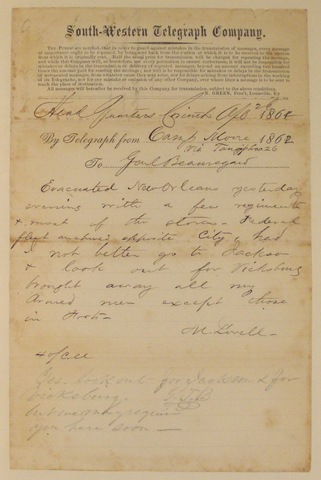
Evacuated New Orleans yesterday evening with a few regiments & most of the stores—Federal fleet anchored outside City, had I not better go to Jackson & look out for Vicksburg brought away all my armed men except those in Forts.

M. Lovell

40/coll

[Written in pencil at bottom] Yes—look out for Jackson & for Vicksburg. G.T.B.

But we may require you here soon—


Citation: Mansfield Lovell (1822-1884), telegram to G.T. Beauregard. 26 April 1862. In The telegraphic history of the Civil War, 1861-1865. AMs 434/16

April 25, 1862: M. Jeff Thompson telegram to P.G. T. Beauregard

Pierre Gustave Toutant Beauregard was a Louisiana-born general of the Confederate States Army. He had graduated second in his class from West Point in 1838 and was an admirer of Napoleon. He achieved fame early in the Civil War for commanding the Fort Sumter bombardment and as the victor of the first battle of Manassas. He later served in the Western Theater (including Shiloh and Corinth), Charleston, and the defense of Richmond, but his career was hampered by friction with Jefferson Davis and other generals.


This is one of approximately 1000 military telegrams in P.G.T. Beauregard’s papers at the Rosenbach.

AMs 1168-11 1862-04-25


Transcript:

Corinth Apl 25 1862

By Telegraph from Memphis Tenn 1862

To Gen Beauregard

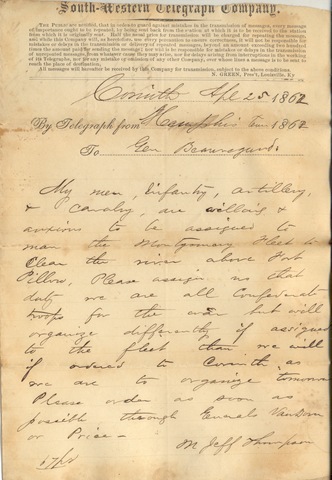
My men, Infantry, artillery,& cavalry, are willing & anxious to be assigned to man the Montgomery Fleet to clear the river above Fort Pillow. Please assign us that duty we are all Confederate troops for the war but will organize differently if assigned to the fleet than we will if ordered to Corinth as we are to organize tomorrow. Please order as soon as possible through Generals Van Dorn or Price.

M Jeff Thompson


Citation: Meriwether Jeff Thompson (1826-1876), telegram to G. T. Beauregard. Memphis, Tenn.; 25 April 1862. AMs 1168/11

April 23, 1862: Unknown Author partial telegram to Thomas Jordan

Pierre Gustave Toutant Beauregard was a Louisiana-born general of the Confederate States Army. He had graduated second in his class from West Point in 1838 and was an admirer of Napoleon. He achieved fame early in the Civil War for commanding the Fort Sumter bombardment and as the victor of the first battle of Manassas. He later served in the Western Theater (including Shiloh and Corinth), Charleston, and the defense of Richmond, but his career was hampered by friction with Jefferson Davis and other generals.

This is one of approximately 1000 military telegrams in P.G.T. Beauregard’s papers at the Rosenbach.

AMs 1168-11 1862-04-23


Transcript:

Apl 23, 1862

By Telegraph from N Orleans 23, 1862

To Col Thos Jordan

Gen Duncan telegraphs Gen Lovell for T. Jackson April 23d 8.15 am. Heavy & continued bombardment all night & still progressing no further casualties excepting 2 men slightly wounded God is certainly protecting us we are still cheerful have an abiding faith ultimate success are making repairs as we can best guns still good working order health troops good Generally better spirits than in more quiet times so much for discipline from 20 to 25. “”” thirteen inch shells have been fired by the enemy


Citation: Unknown author, partial telegram to Thomas Jordan. New Orleans;  23 April 1862. AMs 1168/11

April 22, 1862: Mansfield Lovell to P. G. T. Beauregard

Pierre Gustave Toutant Beauregard was a Louisiana-born general of the Confederate States Army. He had graduated second in his class from West Point in 1838 and was an admirer of Napoleon. He achieved fame early in the Civil War for commanding the Fort Sumter bombardment and as the victor of the first battle of Manassas. He later served in the Western Theater (including Shiloh and Corinth), Charleston, and the defense of Richmond, but his career was hampered by friction with Jefferson Davis and other generals.


This telegram dates one day before Union forces broke the New Orleans defenses. It is one of approximately 1000 military telegrams in P.G.T. Beauregard’s papers at the Rosenbach.

AMs 378-26 Mansfield Lovell to GT Beauregard

Transcript:


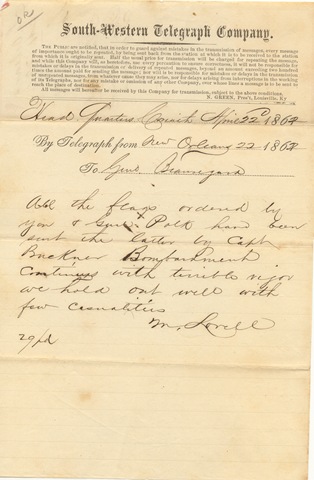
Head Quarters Corinth April 22 1862

By Telegraph from New Orleans 22 1862

To Genl Beauregard

All the flags ordered by you & Genl Polk have been sent the latter by Capt Buckner Bombardments continue with terrible vigor we hold out well with few casualties

M Lovell


Citation: Mansfield Lovell (1822-1884), telegram to G. T. Beauregard. New Orleans, 22 April 1862. AMs 378/26

April 21, 1862: J. M. Fortenberry and John W. Fortenberry telegram to P. G. T. Beauregard

Pierre Gustave Toutant Beauregard was a Louisiana-born general of the Confederate States Army. He had graduated second in his class from West Point in 1838 and was an admirer of Napoleon. He achieved fame early in the Civil War for commanding the Fort Sumter bombardment and as the victor of the first battle of Manassas. He later served in the Western Theater (including Shiloh and Corinth), Charleston, and the defense of Richmond, but his career was hampered by friction with Jefferson Davis and other generals.

This is one of approximately 1000 military telegrams in P.G.T. Beauregard’s papers at the Rosenbach.

AMs 1168-11 1862-04-21

Transcript:

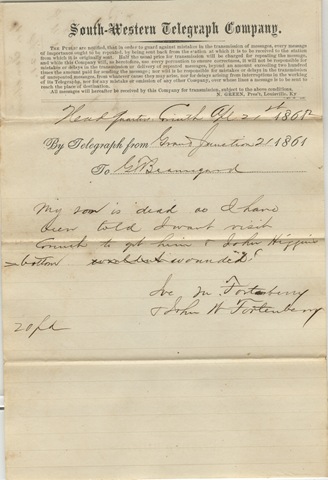
Head Quarters Corinth, Ap. 21 1861

By Telegraph from Grand Junction 21

To G. T. Beauregard

My son is dead as I have been told. I want visit Corinth to get him & John Higgins wounded.

[Joe?] M. Fortenberry

+ John W. Fortenberry

Citation: J. M. Fortenberry and John W. Fortenberry, telegram to G. T. Beauregard. Grand Junction, Tenn.; 21 April 1862. AMs 1168/11

April 20, 1862: J. W. Griffith telegram to G. T. Beauregard

Pierre Gustave Toutant Beauregard was a Louisiana-born general of the Confederate States Army. He had graduated second in his class from West Point in 1838 and was an admirer of Napoleon. He achieved fame early in the Civil War for commanding the Fort Sumter bombardment and as the victor of the first battle of Manassas. He later served in the Western Theater (including Shiloh and Corinth), Charleston, and the defense of Richmond, but his career was hampered by friction with Jefferson Davis and other generals.

This is one of approximately 1000 military telegrams in P.G.T. Beauregard’s papers at the Rosenbach.

 AMs 1168-11 1862-04-20 AMs 1168-11 1862-04-20 p2

Transcript:

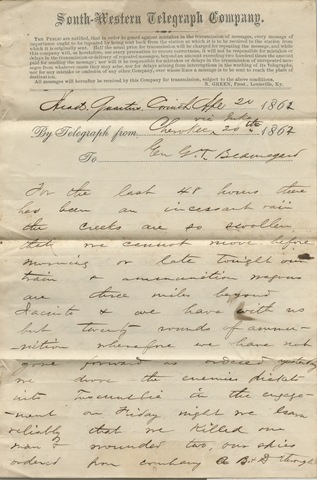
Head Quarters Corinth Ap 20th

By Telegraph from Cherokee via  Iuka 20th 1862

To Gen G.T. Beauregard

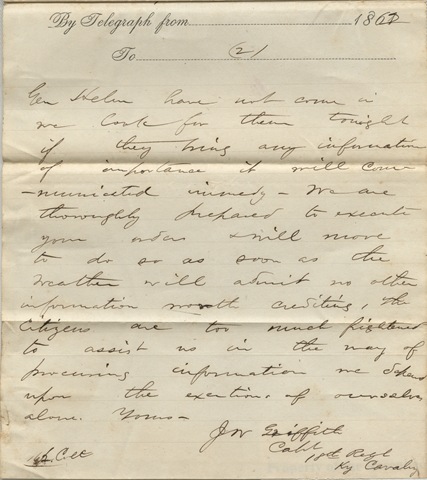
In the last 48 hours there has been an incessant rain the creeks are so swollen that we cannot move before morning or late tonight our train and ammunition wagons are three miles beyond Jacinto & we have with us but twenty rounds of ammunition. wherefore we have not gone forward as ordered yesterday we drove the enemies pickets into Tuscumbia in the engagement on Friday night we learn reliably that we killed one man and wounded two our spies ordered from [illeg.] A B & D through Gen. Helm have not come in we look for them tonight if they bring any information of importance it will communicated [immediately?] we are thoroughly prepared to execute your order & will move to do so as soon as the weather will admit no other information worth writing. The citizens are much too frightened to assist us in the way of procuring information we depend upon the exertions of ourselves alone.

Yours

J W Griffith

Capt

18th Regt.

Ky Cavalry


Citation: J. W. Griffith, telegram to G. T. Beauregard. Cherokee, Miss; 20 April 1862. AMs 1168/11

April 19, 1862: Robert E. Lee to P.G. T. Beauregard

Pierre Gustave Toutant Beauregard was a Louisiana-born general of the Confederate States Army. He had graduated second in his class from West Point in 1838 and was an admirer of Napoleon. He achieved fame early in the Civil War for commanding the Fort Sumter bombardment and as the victor of the first battle of Manassas. He later served in the Western Theater (including Shiloh and Corinth), Charleston, and the defense of Richmond, but his career was hampered by friction with Jefferson Davis and other generals.

This telegram is from The Telegraphic History of the Civil War; a compiled album of telegrams to Beauregard from Davis, Lee, Johnston and others.

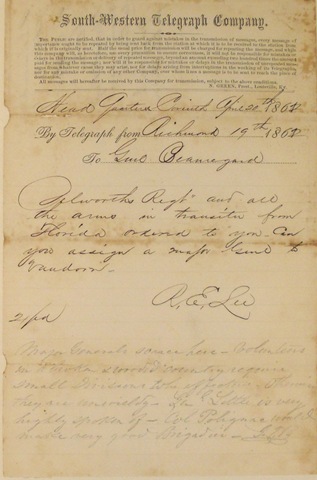
Telegram 4-19-62 Lee to Beauregard 10 mp

Transcript:

Head Quarters Corinth April 20th 1862

By Telegraph from Richmond 19th 1861

To Genl Beauregard

Dilworth’s regt and all the arms in transition from Florida ordered to you—Can you assign a major Genl to van Dorn.

R. E. Lee

21 pd

[Written in pencil at bottom of telegraph form] Major Generals scarce here—volunteers in a broken & wooded country require small Divisions to be effective—Otherwise they are unwieldy—Gen Little is very highly spoken of—Col Polignac would make very good Brigadier—G.T.B.


Citation:Robert E. Lee (1807-1870), telegram to G.T. Beauregard. Richmond, 19 April 1862. In The telegraphic history of the Civil War, 1861-1865. AMs 434/16

April 18, 1862: J. W. Griffith telegram to P. G. T. Beauregard

Pierre Gustave Toutant Beauregard was a Louisiana-born general of the Confederate States Army. He had graduated second in his class from West Point in 1838 and was an admirer of Napoleon. He achieved fame early in the Civil War for commanding the Fort Sumter bombardment and as the victor of the first battle of Manassas. He later served in the Western Theater (including Shiloh and Corinth), Charleston, and the defense of Richmond, but his career was hampered by friction with Jefferson Davis and other generals.

This is one of approximately 1000 military telegrams in P.G.T. Beauregard’s papers at the Rosenbach.

AMs 1168-11 1862-04-18

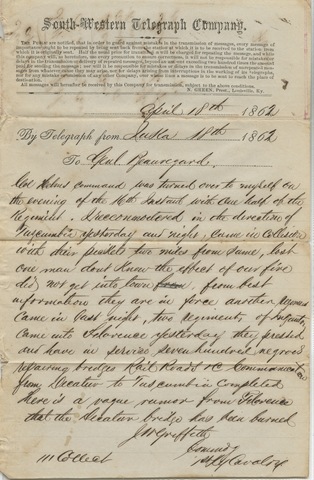
Transcript:

April 18th 1862

By Telegraph from Iuka 18th, 1862

To General Beauregard

Col. Holmes’ command was turned over to myself on the evening of the 16th instant with one half of the Regiment. I reconnoitered in the direction of Tuscumbia yesterday and night came in collision with their pickets two miles from same, lost one man don’t know the effect of our fire did not get into town from best information they are in force another regiment came in last night, two regiment of Infantry came into Florence yesterday they pressed and have in service seven hundred negroes repairing bridges Rail Roads and communications from Decatur to Tuscumbia is completed. There is a vague rumor from Florence that the Decatur bridge had been burned.

J. W. Griffith

Commdg

1st Ky Cavalry


Citation: J. W. Griffith, telegram to G. T. Beauregard. Iuka, Miss; 18 April 1862. AMs 1168/11

April 16, 1862: Henry and Mary Warner to John Warner

Henry and Mary Warner lived in Allegheny City, Pennsylvania, now part of Pittsburgh. They are the great-grandparents of poet Marianne Moore.  By the 1860s they had three surviving children:  John, Henry, and Anne. Their letters to John, a Presbyterian minister living in Gettysburg, are preserved as part of Marianne Moore’s family papers.
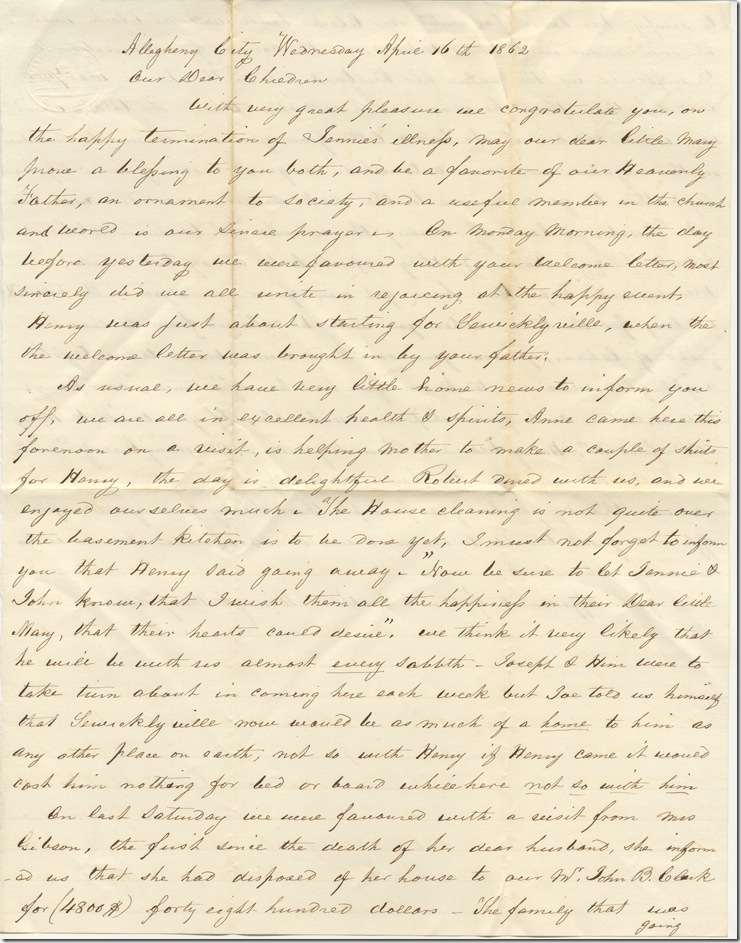
Moore VI-5-5 p1 Henry and Mary Warner to Children 4-16-62


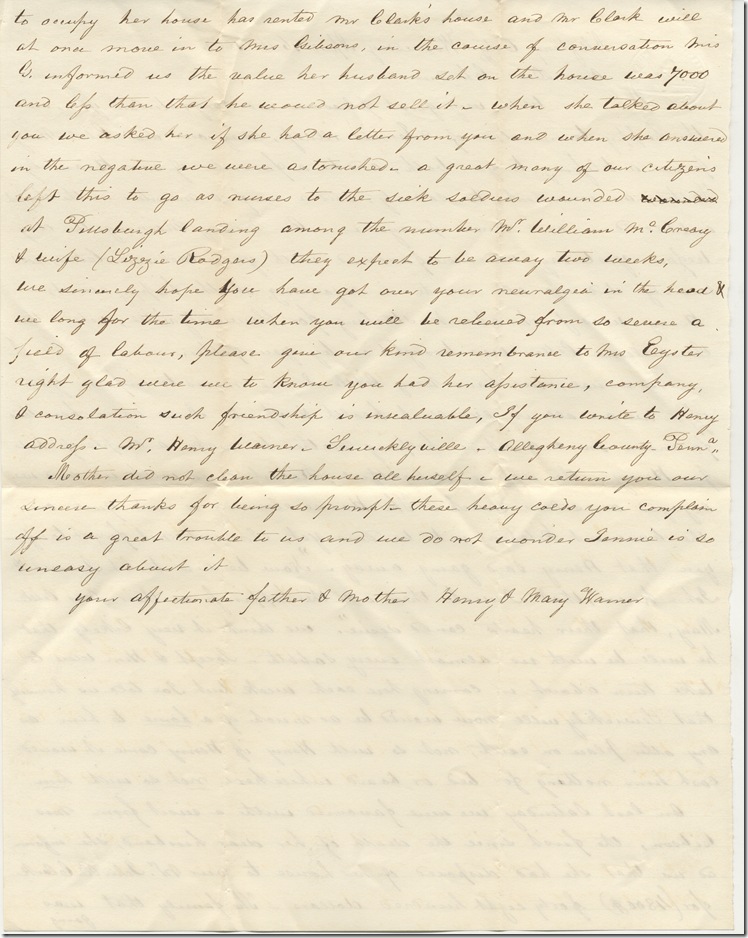
Moore VI-5-5 p2 Henry and Mary Warner to Children 4-16-62

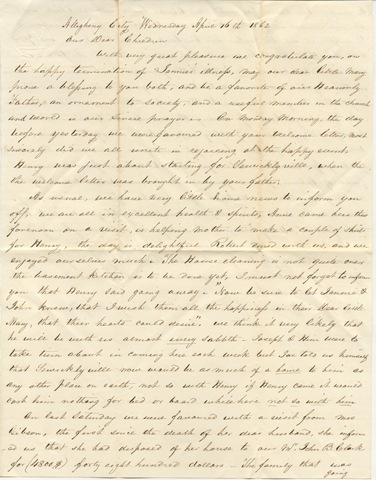
Transcript:

Allegheny City Wednesday April 16th 1862

Our Dear Children

With very great pleasure we congratulate you, on the happy termination of Jennie’s illness, may our dear little Mary prove a blessing to you both, and be a favorite of our Heavenly Father, an ornament to society, and a useful member in the church and world is our sincere prayer—On Monday morning, the day before yesterday we were favoured with your welcome letter, most sincerely did we all unite in rejoicing at the happy event. Henry was just about starting for Sewicklyville, when the the welcome letter was brought in by your father.

As usual, we have very little home news to inform you off. We are all in excellent health & spirits, Anne came here this forenoon on a visit, is helping mother to make a couple of shirts for Henry, the day is delightful. Robert dined with us, and we enjoyed ourselves much. The House cleaning is not quite over the basement kitchen is to be done yet. I must not forget to inform you that Henry said going away—“Now be sure to let Jennie & John know, that I wish them all the happiness in their Dear little Mary, that their hearts could desire.” We think it very likely that he will be with us almost every Sabbath—Joseph & Him were to take turn about in coming here each week but Joe told us himself that Sewickleyville now would be as much of a home to him as any other place on earth, not so with Henry if Henry came it would cost him nothing for bed or board while here not so with him

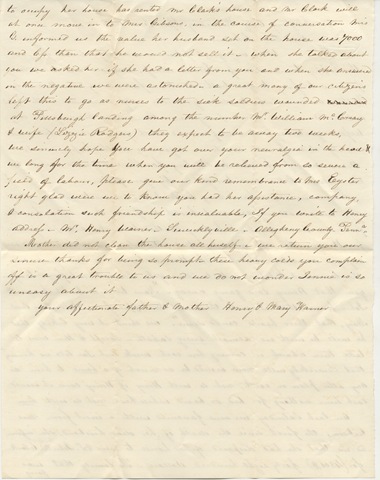
On last Saturday we were favoured with a visit from Mrs Gibson, the first since the death of her dear husband, she informed us that she had disposed of her house to our Mr. John B. Clark for (4800$) forty eight hundred dollars—The family that was going to occupy her house has rented Mr Clark’s house and Mr Clark will at once move into Mrs Gibsons, in the course of conversation Mrs G informed us the value her husband set on the house was 7000 and less than that he would not sell it—when she talked about you we asked her if she had a letter from you and when she answered in the negative we were astonished—a great many of our citizen’s left this to go as nurses to the sick soldiers wounded at Pittsburgh landing among the number Mr William McCreary & wife (Lizzie Rodgers) they expect to be away two weeks, we sincerely hope you have got over your neuralgia in the head & we long for the time when you will be relieved from so severe a field of labour, please give our kind remembrance to Mrs Eyster right glad we were all to know you had her assistance, company, & consolation such friendship is invaluable. If you write to Henry address—Mr. Henry Warner—Sewickleyville—Allegheny County—Penna

Mother did not clean the house all herself—we return you our sincere thanks for being so prompt—these heavy colds you complain off is a great trouble to us and we do not wonder Jennie is so uneasy about it

Your affectionate father & mother Henry & Mary Warner


Citation: Henry and Mary Warner, autograph letter signed to John Riddle Warner. Allegheny City [Pittsburgh], 16 April 1862. Moore VI:05:05