May 7, 1862: Henry and Mary Warner to John Warner

Henry and Mary Warner lived in Allegheny City, Pennsylvania, now part of Pittsburgh. They are the great-grandparents of poet Marianne Moore.  By the 1860s they had three surviving children:  John, Henry, and Anne. Their letters to John, a Presbyterian minister living in Gettysburg, are preserved as part of Marianne Moore’s family papers.

Moore VI-5-6 p1 Henry and Mary Warner to Children 5-7-62

Moore VI-5-6 p2 Henry and Mary Warner to Children 5-7-62

Transcript:

Allegheny City Wednesday May 7th 1862 1 ½ P.M.

Our Dear Children Another week has rolled round and we still find ourselves, all in good health & spirits. Isabella is with Anne, Robert has just left us after partaking of dinner & gone to his place of business Henry is driving away at his business in Sewickleyville; This day Mother has fixed the back parlour fireplace for the summer, no more fire to be there until next fall; Mother has been once with Westby about her teeth he said they were too tender yet, this was about two months since, this day she intended to go over but said she had caught cold, that the gums were tender and would not bear an impression, tomorrow she cannot go as it will be our preparation day previous to a communion Sabbath so that on next Sabbath, if nothing happens to interfere, you and us will be engaged in the same business. On last friday afternoon Miss Mary King & Miss Geddiss called on us as visitors. Mother invited them to take tea but they declined, they stopped about an hour, we were glad to see Mary, had quite a pleasant interview. The wounded soldiers of Pittsburgh landing brought here by Steamboat have caused quite a stir among the benevolent ladies of our cities—In our church we have a society got up for the purpose of administering to the wants of the poor fellows and at the first meeting Mother was appointed as a person to take a leading part in the affair, she at once contended with all her might in opposition but would not be heard and was unanimously forced into compliance—in making purchases such as slippers, domestic muslin for under clothes &c&c—independent of these societies, many ladies go there with delicacies—to the marine hospital, we were told of one lady that killed several chickens and made 3 or 4 gallons of soup took it down with her, gave some of it to those that would have it, who were most grateful for it, said it was the best thing tasted for a long time, a large portion was sent to the kitchen, some few of the patients had not had any and the soup was called for, dont you think the blackguard kitchen girls had gather’d round and drank it, if the animals were hungry there might be some excuse but they were reveling in the midst of plenty, when I heard this, I must confess I was enraged; our ladies carry them dauntless of all descriptions and I am told you never saw creatures so thankful.

I must now tell you an anecdote—Two boats went from Pittsburgh to Pittsburgh landing—brought away a great many—in coming up stream left some at one place & some at another & for instance Lawsville Cincinnati– Marietta, Wheeling, &c&c. A woman from some of the Western states went in quest of her son, visited the field of battle, went to Pittsburgh landing—followed the boats going up stream on the Ohio river, landed at every place on quest of her son where the wounded soldiers were disembarked the whole way up to Pittsburgh the head of navigation, went into our marine hospital looked at the occupants of every bed, in every ward, one after another until she came to the last ward, after looking at several beds came to one, the occupant was laying with his face towards the wall, she gently laid her hand on the bed, still uncertain as to identity, when he turned round & said Oh! Mother—so he will not suffer for a nurse—it almost seems like romance, but true it is: We are in great hopes that by this time Jennie is well, Mother says she will have to be very careful, any cold that ever she gets, will fly to that breast, a great many here has been enquiring about you this spring, remember us most affectionately to Mrs Craig; am happy to inform you house cleaning is over Mother has just been reading the newspaper and is gone to Mrs Kingan for 2 ½ lbs of butter @ 18¢ — 45¢– Dr Rodgers is greatly improved in health but will not be able to speak in publick

Your affectionate father & mother Henry & Mary Warner


Citation: Henry and Mary Warner, autograph letter signed to John Riddle Warner. Allegheny City [Pittsburgh], 30 April 1862. Moore VI:05:06

May 6, 1862: E. J. Gardiner telegram to Sterling Price

Pierre Gustave Toutant Beauregard was a Louisiana-born general of the Confederate States Army. He had graduated second in his class from West Point in 1838 and was an admirer of Napoleon. He achieved fame early in the Civil War for commanding the Fort Sumter bombardment and as the victor of the first battle of Manassas. He later served in the Western Theater (including Shiloh and Corinth), Charleston, and the defense of Richmond, but his career was hampered by friction with Jefferson Davis and other generals.

This is one of approximately 1000 military telegrams in P.G.T. Beauregard’s papers at the Rosenbach.

AMs 1168-11 1862-05-06


Transcript:

Head Quarters, Corinth May 1862

By Telegraph from Grand Junction 1862

To Genl Price

Permit me to go & see my son who is very sick at your Head Qrs.

E. J Gardiner


Respectfully [upward?] to Genl Beauregard

By order of Maj Genl Price


Bg. Gen. Thomas Jordan


Citation: E. J Gardiner, telegram to Sterling Price. Grand Junction, [Tenn.?]; 6 May 1862. AMs 1168/11

May 5, 1862: Pierre Soule telegram to P. G. T. Beauregard

Pierre Gustave Toutant Beauregard was a Louisiana-born general of the Confederate States Army. He had graduated second in his class from West Point in 1838 and was an admirer of Napoleon. He achieved fame early in the Civil War for commanding the Fort Sumter bombardment and as the victor of the first battle of Manassas. He later served in the Western Theater (including Shiloh and Corinth), Charleston, and the defense of Richmond, but his career was hampered by friction with Jefferson Davis and other generals.

This is one of approximately 1000 military telegrams in P.G.T. Beauregard’s papers at the Rosenbach.

AMs 1168-11 1862-05-05

Transcript:

Hd Qrs May 6 1862

Telegram from New Orleans May 5 1862 via Tangipahoa

To Genl. Beauregard,

We desire to know how matters stand with you, and how with the Government at Richmond. What of the battle said to have been fought on Peninsula? I am on the watch. Answer freely. Your dispatches will come to me quite safe.

Pierre Soule

All right here; hope to defeat the Enemy again soon. Nothing new from Richmond. No battle there yet of importance.

G.T. B

Citation: Pierre Soule, telegram to G. T. Beauregard. New Orleans;5 May 1862. AMs 1168/11

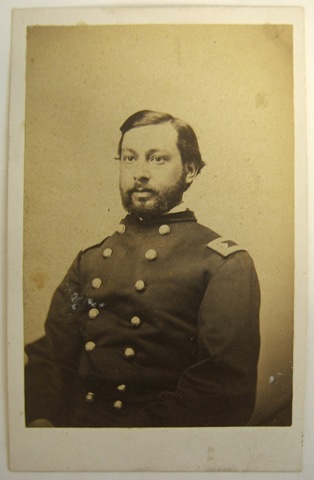
May 4, 1862: Photograph of Adolph Rosengarten

20060674

This photograph was sent by Alexander Biddle to Julia Biddle. Note written on  envelope reads:” Dear Julia the enclosed in a photograph/of Major  Rosengarten Killed at/Murfreesborough–a soldier and  a/friend–put it in your/photographic album/Alexander”

Backmark: “CASH & GODSHAW/Main St. below 3rd/Louisville Ky.”

Ink inscription on reverse “To Major Alexander Biddle/from his friend and in affectionate remembrance of/Major Adolph G. Rosengarten/Killed at Murfreesboro Dec 29, 1862/on his 24th  Birthday/J.G.R./Hs. Qis 1st A.C./March 4.1.3-/Camp near Bell  Plain Va.”


Citation: Cash & Godshaw,carte de visite of Adolph Rosengarten. Louisville, Kentucky, 1862. Rush V:42:03       

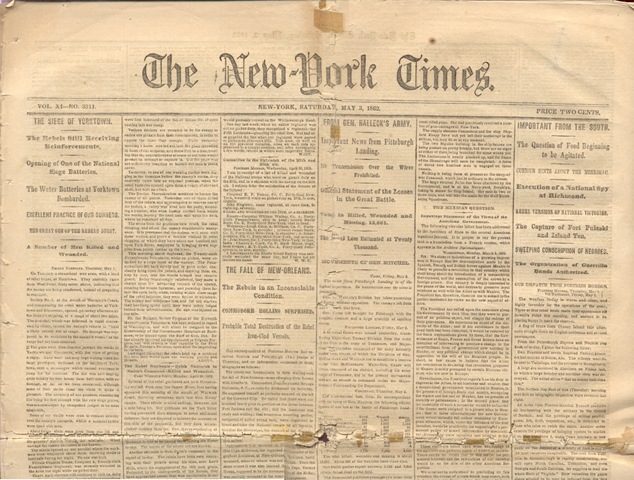
May 3, 1862: New York Times

top

Transcript (excerpt):

Page 1, Upper and Lower Halves

The Fall of New Orleans

The Rebels in an Inconsolable Condition

Commodore Hollins Surprised

Probable Total Destruction of the Rebel Iron-Clad Vessels

Our Correspondent at Fortress Monroe has received Norfolk and Petersburgh (Va.) papers of Thursday, and on information contained in them telegraphs as follows:

The rebels are inconsolable in their wailing over the fall of New-Orleans – some charging Gen Lowell with treachery. Commodore Hollins passed through Columbia, S.C. en route for Richmond on Saturday. He expressed himself as perfectly amazed at the fall of the Crescent City. He stated that there were one hundred heavy guns in position on the levee between Fort Jackson and the city; that the Louisiana was ready and waiting; that numerous boarding parties composed of active young men, were organized to board and take the National vessels at all hazards, and that the Mississippi, the consort of the Virginia [paper ripped along crease] into action.

Information was received at Norfolk, Virginia that Capt. McIntosh, the supposed commander of the gunboat Louisiana, at New-Orleans, had been badly wounded, when or where was not stated. From the same source it was also learned that Capt. Thomas Huger, supposed to be the commander of the McRae, was mortally wounded in the same engagement.

The following are all the additional items regarding the fall of New-Orleans that can be gleaned from the papers:

Commodore Farragut had proposed terms of capitulation to Mayor Monroe, which the latter had accepted, and the City of New-Orleans was at least accounts held by a battalion of marine from the squadron. Gen. Butler’s forces were within a few miles of the city, having landed on Lake Pontchartrain.

Citation: New York Times. 3 May 1862. Gift of Steven and Susan Raab. AN .N5682

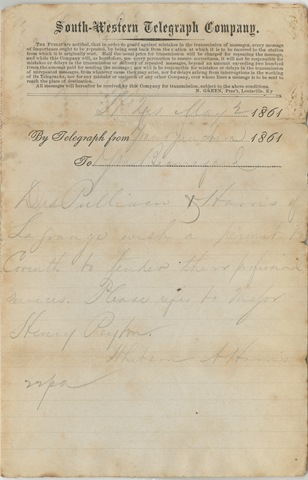
May 2, 1862: Whitson A. Harris telegram to G. T. Beauregard

Pierre Gustave Toutant Beauregard was a Louisiana-born general of the Confederate States Army. He had graduated second in his class from West Point in 1838 and was an admirer of Napoleon. He achieved fame early in the Civil War for commanding the Fort Sumter bombardment and as the victor of the first battle of Manassas. He later served in the Western Theater (including Shiloh and Corinth), Charleston, and the defense of Richmond, but his career was hampered by friction with Jefferson Davis and other generals.

This is one of approximately 1000 military telegrams in P.G.T. Beauregard’s papers at the Rosenbach.

AMs 1168-11 1862-05-02

Transcript:

Hd Qrs May 2 1861 [i.e. 1862]

By telegraph from Grand Junction

To Gnrl Beauregard

Drs. [Pullman?] + Harris of Lagrange wish a permit to Corinth to tender their professional services. Please refer to Major Henry Peyton.

Whitson A. Harris

22pa


Citation: Whitson A. Harris, telegram to G. T. Beauregard. Grand Junction, Tenn.; 2 May 1862. AMs 1168/11

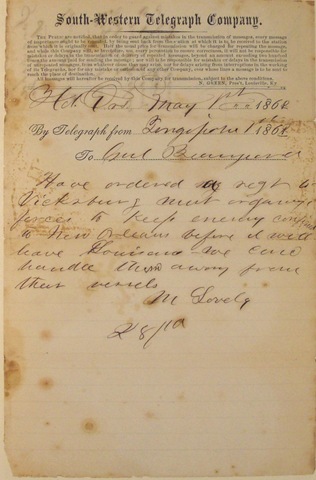
May 1, 1862: Mansfield Lovell to P. G. T. Beauregard

Pierre Gustave Toutant Beauregard was a Louisiana-born general of the Confederate States Army. He had graduated second in his class from West Point in 1838 and was an admirer of Napoleon. He achieved fame early in the Civil War for commanding the Fort Sumter bombardment and as the victor of the first battle of Manassas. He later served in the Western Theater (including Shiloh and Corinth), Charleston, and the defense of Richmond, but his career was hampered by friction with Jefferson Davis and other generals.

This telegram is from The Telegraphic History of the Civil War; a compiled album of telegrams to Beauregard from Davis, Lee, Johnston and others.

Telegram 5-1-62 Lovell to Beauregard 10 mp

Transcript:

Hd. Qrs. May 1st 1862

By Telegraph from Tangipoha 1st 1862

To Gen. Beauregard

Have ordered my a reg’t to Vicksburg. Must organize forces to keep enemy confined to New Orleans before it will leave Louisiana – we can’t handle them away from their vessels.

M. Lovell

28 pd


Citation: Mansfield Lovell (1822-1884), telegram to G.T. Beauregard. 1 May 1862. In The telegraphic history of the Civil War, 1861-1865. AMs 434/16

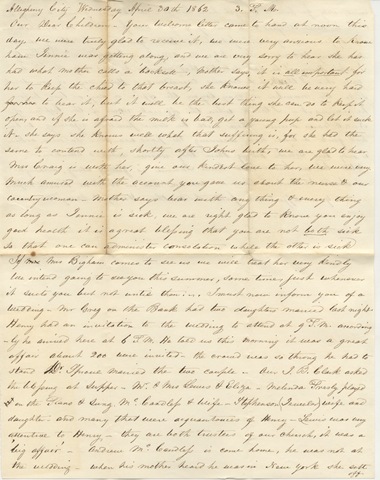
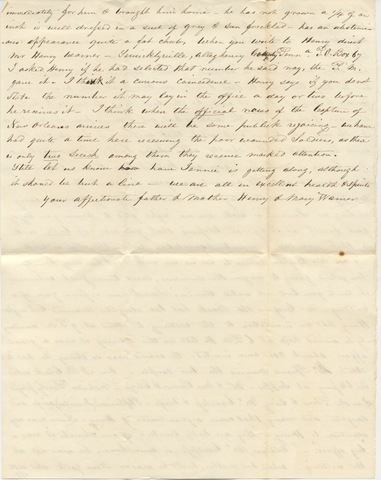
April 30, 1862: Henry and Mary Warner to John Warner

Henry and Mary Warner lived in Allegheny City, Pennsylvania, now part of Pittsburgh. They are the great-grandparents of poet Marianne Moore.  By the 1860s they had three surviving children:  John, Henry, and Anne. Their letters to John, a Presbyterian minister living in Gettysburg, are preserved as part of Marianne Moore’s family papers.

Moore VI-5-5 p1 Henry and Mary Warner to Children 4-30-62

 Moore VI-5-5 p2 Henry and Mary Warner to Children 4-30-62

Transcript:

Allegheny City Wednesday April 30th 1862 3 P.M.

Our Dear Children—Your welcome letter came to hand at noon this day, we were truly glad to receive it, we were very anxious to know how Jennie was getting along, and we are very sorry to hear she has had what mother calls a ‘blacksett,’ Mother says, it is all important for her to keep the child to that breast, she knows it will be very hard to bear it, but it will be the best thing she can do to keep it open, and if she is afraid the milk is bad, get a young pup and let it suck it—she says she knows well what that suffering is, for she had the same to contend with, shortly after Johns birth, we are glad to hear Mrs Craig is with her, give our kindest love to her, we were very much amused with the account you gave us about the nurse & our country woman—Mother says bear with any thing & every thing as long as Jennie is sick, we are right glad to know you enjoy good health ti is a great blessing that you are not both sick so that can administer consolation while the other is sick

If Mrs Bigham comes to see us we will treat her very kindly. We intend going to see you this summer, some time, just whenever it suits you but not until then. –. I must now inform you of a wedding—Mr Greg on the Bank had two daughters married last night. Henry had an invitation to the wedding to attend at 9 P.M. accordingly he arrived here at 6 P.M. He told us this morning it was a great affair about 200 were invited—the crowd was so throng he had to stand Dr. Sproule married the two couple—Our J.B. Clark asked the blessing at Supper—Mr. & Mrs Lewis& Eliza—Melinda Presly played on the Piano & sung. McCandless & wife—Stephenson (Jeweler) wife and daughter—and many that were acquaintances of Henry—Lewis was very attentive to Henry—they are both trustees of our church, it was a ‘big affair’—Andrew McCandless is come home, he was not at the wedding—when his mother heard he was in New York she sent off immediately for him & brought him home—he has not grown a ¼ of an inch is well dressed in a suit of grey & sun freckled—has an abstemious appearance quite a fat chub. When you write to Henry direct Mr Henry Warner—Sewickleyville, Allegheny County Penna P.O. Box 67 I asked Henry if he had selected that number he said nay, the P.M. gave it– I think it is a curious coincidence—Henry says if you do not state the number it may lay in the office a day or two before he receives it—I think when the official news of the Capture of New Orleans arrives there will be some publick rejoicing—we have had quite a time here receiving the poor wounded Soldiers, as there is only two Secesh among them they receive marked attention.

Still let us know how Jennie is getting along, although it should be but a line—we are all in excellent health & spirits

Your affectionate father & mother Henry & Mary Warner


Citation: Henry and Mary Warner, autograph letter signed to John Riddle Warner. Allegheny City [Pittsburgh], 30 April 1862. Moore VI:05:05

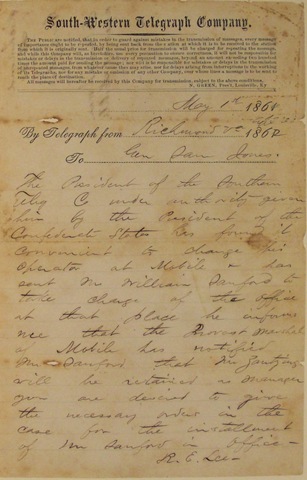
April 30, 1862: Robert E. Lee to P.G.T. Beauregard

Pierre Gustave Toutant Beauregard was a Louisiana-born general of the Confederate States Army. He had graduated second in his class from West Point in 1838 and was an admirer of Napoleon. He achieved fame early in the Civil War for commanding the Fort Sumter bombardment and as the victor of the first battle of Manassas. He later served in the Western Theater (including Shiloh and Corinth), Charleston, and the defense of Richmond, but his career was hampered by friction with Jefferson Davis and other generals.

This telegram is from The Telegraphic History of the Civil War; a compiled album of telegrams to Beauregard from Davis, Lee, Johnston and others.

Telegram 4-30-62 Lee to Beauregard 10 mp

Transcript:

May 1st, 1862

By Telegraph from Richmond Va Apl 30 1862

To Gen Sam Jones

The President of the South Teleg C under authority—given him by the President of of the Confederate States has found it convenient to change his operator at Mobile & has sent Mr William Sanford to take charge of the office at that place he informs me that the provost Provost Marshall of Mobile has notified Jm Sanford that Mr Zantzinger [?] will be retained as manager you are desired to give the necessary order in the case for the installment of Mr Sanford in office—

R.E. Lee


Citation:Robert E. Lee (1807-1870), telegram to G.T. Beauregard. Richmond, 30 April 1862. In The telegraphic history of the Civil War, 1861-1865. AMs 434/16

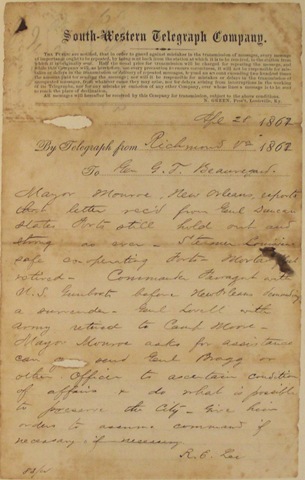
April 28, 1862: Robert E. Lee to P. G. T. Beauregard

Pierre Gustave Toutant Beauregard was a Louisiana-born general of the Confederate States Army. He had graduated second in his class from West Point in 1838 and was an admirer of Napoleon. He achieved fame early in the Civil War for commanding the Fort Sumter bombardment and as the victor of the first battle of Manassas. He later served in the Western Theater (including Shiloh and Corinth), Charleston, and the defense of Richmond, but his career was hampered by friction with Jefferson Davis and other generals.

This telegram is from The Telegraphic History of the Civil War; a compiled album of telegrams to Beauregard from Davis, Lee, Johnston and others.

Telegram 4-28-62 Lee to Beauregard 10 mp

Transcript:

Apl 28 1862

By Telegraph from Richmond Va 1862

To Gen G. T. Beauregard.

Mayor Monroe, New Orleans, reports that letter rec’d from Genl Duncan states Forts still hold out and strong as ever—Steamer Louisiana safe co-operating Forts—Mortar fleet retired—Commander Farragut with U.S. Gunboats before New Orleans demanding a surrender—Genl Lovell with army retired to Camp Moore—Mayor Monroe asks for assistance can y[ou] send Earl Bragg or other officer to ascertain condition of affairs & do what is possible to preserve the City—Give him orders to assume command if necessary if necessary .

R.E. Lee

83 pd


Citation:Robert E. Lee (1807-1870), telegram to G.T. Beauregard. Richmond, 28 April 1862. In The telegraphic history of the Civil War, 1861-1865. AMs 434/16