April 15, 1862: John Henry Brown’s Journal

John Henry Brown was a painter of portrait miniatures, living and working in Philadelphia. He had met Lincoln in August of 1860 when he was commissioned to paint Lincoln’s portrait for a supporter, but although Brown liked Lincoln personally, he did not agree with Republican policies.
1862-04-15

Transcript:

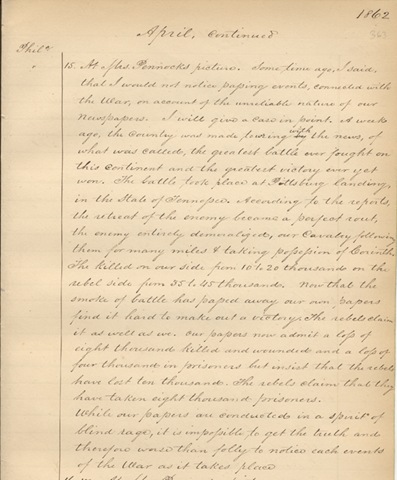
At Miss Pennocks picture. Some time ago I said that I would not notice passing events connected with the War, on account of the unreliable nature of our newspapers. I will give a case in point. A week ago, the country was made [touring?] with the news of what was called the greatest battle ever fought on this continent and the greatest victory ever won. The battle took place at Pittsburg landing, in the State of Tennessee. According to the reports, the retreat of the enemy became a perfect rout, the men entirely demoralized, our Cavalry following them for many miles & taking possession of Corinth. The killed on our side from 10 to 20 thousands on the rebel side from 35 to 45 thousand. Now that the smoke of battle has passed away our own papers find it hard to make out a victory. The rebels claim it as well as we. Our papers now admit a loss of eight thousand killed and wounded and a loss of four thousand in prisoners but insist that the rebels have lost ten thousand. The rebels claim that they have taken eight thousand prisoners.

While our papers are conducted in a spirit of blind rage, it is impossible to get the truth and therefore worse than folly to notice each event of the War as it takes place.


Citation: John Henry Brown, autograph journal/account book. Philadelphia, 1844-1890. AMs 573/14.1
April 15, 1862: Robert E. Lee to P.G.T. Beauregard

Pierre Gustave Toutant Beauregard was a Louisiana-born general of the Confederate States Army. He had graduated second in his class from West Point in 1838 and was an admirer of Napoleon. He achieved fame early in the Civil War for commanding the Fort Sumter bombardment and as the victor of the first battle of Manassas. He later served in the Western Theater (including Shiloh and Corinth), Charleston, and the defense of Richmond, but his career was hampered by friction with Jefferson Davis and other generals.

This telegram is from The Telegraphic History of the Civil War; a compiled album of telegrams to Beauregard from Davis, Lee, Johnston and others.

Telegram 4-15-62 Lee to Beauregard 10 mp

Transcript:

Corinth Apl 15th 1862

By Telegraph from Richmond 15th 1862

To Genl G. T. Beauregard

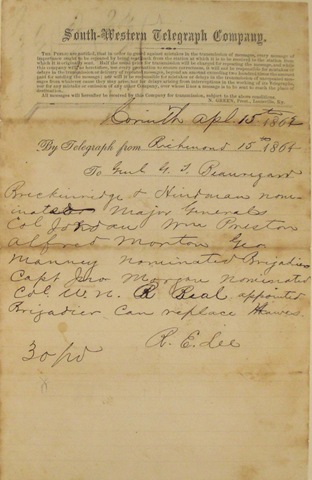
Breckinridge & Hindman nominated Major Generals. Col Jordan Wm Preston Alfred Monton Geo. Manney nominated Brigadiers. Capt Jno. Morgan nominated Col. W.N.R. Beal appointed Brigadier. Can replace Hawes.

R. E. Lee

30 pd


Citation:Robert E. Lee (1807-1870), telegram to G.T. Beauregard. Richmond, 15 April 1862. In The telegraphic history of the Civil War, 1861-1865. AMs 434/16

April 14, 1862: John Henry Brown’s Journal

John Henry Brown was a painter of portrait miniatures, living and working in Philadelphia. He had met Lincoln in August of 1860 when he was commissioned to paint Lincoln’s portrait for a supporter, but although Brown liked Lincoln personally, he did not agree with Republican policies.

1862-04-14

Transcript:

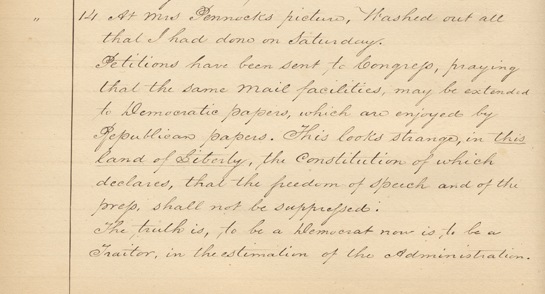
At Miss Pennocks picture, Washed out all that I had done on Saturday.

Petitions have been sent to congress praying that the same mail facilities may be extended to Democratic papers which are enjoyed by Republican papers. This looks strange in this land of liberty, the Constitution of which declares, that the freedom of speech and of the press shall not be abridged. The truth is, to be a Democrat now is to be a Traitor, in the estimation of the Administration.


Citation: John Henry Brown, autograph journal/account book. Philadelphia, 1844-1890. AMs 573/14.1
April 13, 1862: John Adams telegram to Thomas Jordan

Pierre Gustave Toutant Beauregard was a Louisiana-born general of the Confederate States Army. He had graduated second in his class from West Point in 1838 and was an admirer of Napoleon. He achieved fame early in the Civil War for commanding the Fort Sumter bombardment and as the victor of the first battle of Manassas. He later served in the Western Theater (including Shiloh and Corinth), Charleston, and the defense of Richmond, but his career was hampered by friction with Jefferson Davis and other generals.

This is one of approximately 1000 military telegrams in P.G.T. Beauregard’s papers at the Rosenbach.

AMs 1168-11 1862-04-13

Transcript:

Corinth 13th 1862

By Telegraph from Memphis 13 1862

To Col Jordan

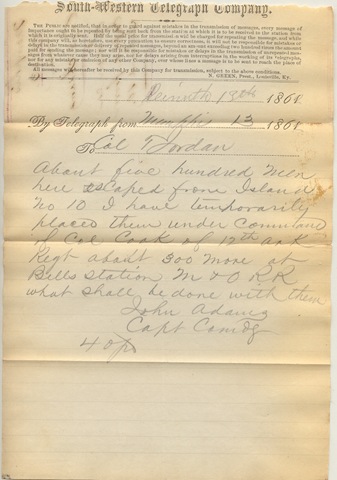
About five hundred men here escaped for Island No 10 I have temporarily placed them under command of Col Cook of 12th Ark Regt about 300 more at Bills station M & O RR What shall be done with them

John Adams

Capt Comdg


Citation: John Adams(1825-1864), telegram to Thomas Jordan. Memphis, Tenn.; 13 April 1862. AMs 1168/11

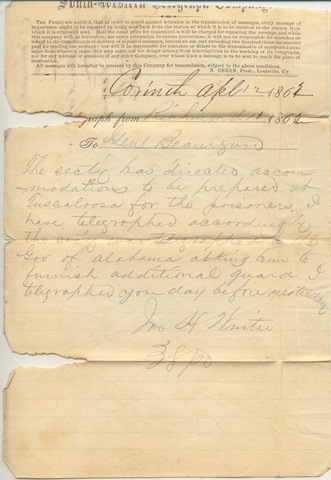
April 12, 1862: John H. Winter telegram to P. G. T. Beauregard

Pierre Gustave Toutant Beauregard was a Louisiana-born general of the Confederate States Army. He had graduated second in his class from West Point in 1838 and was an admirer of Napoleon. He achieved fame early in the Civil War for commanding the Fort Sumter bombardment and as the victor of the first battle of Manassas. He later served in the Western Theater (including Shiloh and Corinth), Charleston, and the defense of Richmond, but his career was hampered by friction with Jefferson Davis and other generals.


This is one of approximately 1000 military telegrams in P.G.T. Beauregard’s papers at the Rosenbach.

AMs 1168-11 1862-04-12


Transcript:

Corinth Apl 12 1862

By telegraph from Richmond 12 1862

To Genl Beauregard

The scty has directed accommodations to be prepared at Tuscaloosa for the prisoners. I have telegraphed accordingly. The secy war telegraphed to the Gov of Alabama asking him to furnish additional guard. I telegraphed you day before yesterday.

Jno H. Winter


Citation:John H. Winter, telegram to G. T. Beauregard. Richmond, 12 April 1862. AMs 1168/11

April 11, 1862: John Henry Brown’s Journal

John Henry Brown was a painter of portrait miniatures, living and working in Philadelphia. He had met Lincoln in August of 1860 when he was commissioned to paint Lincoln’s portrait for a supporter, but although Brown liked Lincoln personally, he did not agree with Republican policies.

1862-04-11

Transcript:

At Miss Pennocks picture.

Congress has abolished Slavery in the District of Columbia.


Citation: John Henry Brown, autograph journal/account book. Philadelphia, 1844-1890. AMs 573/14.1
April 10, 1862: Robert E. Lee to P.G.T. Beauregard

Pierre Gustave Toutant Beauregard was a Louisiana-born general of the Confederate States Army. He had graduated second in his class from West Point in 1838 and was an admirer of Napoleon. He achieved fame early in the Civil War for commanding the Fort Sumter bombardment and as the victor of the first battle of Manassas. He later served in the Western Theater (including Shiloh and Corinth), Charleston, and the defense of Richmond, but his career was hampered by friction with Jefferson Davis and other generals.

This telegram is from The Telegraphic History of the Civil War; a compiled album of telegrams to Beauregard from Davis, Lee, Johnston and others.

Telegram 4-10-62 Lee to Beauregard 10 mp

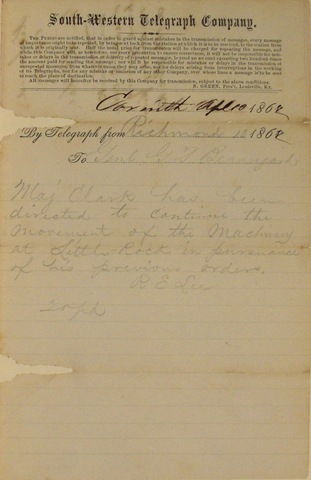
Transcript:

Corinth Apl 10 1862

By Telegraph from Richmond 10 1862

To Genl G. T. Beauregard

Maj Clark has been directed to continue the movement of the Machinery at Little Rock in pursuance of his previous orders.

R E Lee

20 pd


Citation:Robert E. Lee (1807-1870), telegram to G.T. Beauregard. Richmond, 10 April 1862. In The telegraphic history of the Civil War, 1861-1865. AMs 434/16

April 9, 1862: Robert E. Lee to P. G. T. Beauregard

Pierre Gustave Toutant Beauregard was a Louisiana-born general of the Confederate States Army. He had graduated second in his class from West Point in 1838 and was an admirer of Napoleon. He achieved fame early in the Civil War for commanding the Fort Sumter bombardment and as the victor of the first battle of Manassas. He later served in the Western Theater (including Shiloh and Corinth), Charleston, and the defense of Richmond, but his career was hampered by friction with Jefferson Davis and other generals.

This telegram is from The Telegraphic History of the Civil War; a compiled album of telegrams to Beauregard from Davis, Lee, Johnston and others.

Telegram 4-9-62 Lee to Beauregard 10 mp

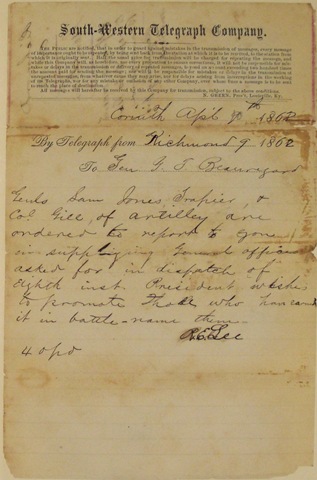
Transcript:

Corinth April 9th [“10” written over “9th” in pencil] 1862

By Telegraph from Richmond 9 1862

To Gen G. T. Beauregard

Genls Sam Jones, Trapier, & Col. Gill, of artillery are ordered to report to you in supplying general officers asked for in dispatch of eighth inst. President wishes to promote those who have earned it in battle—name them.

R. E. Lee

40 pd


Citation:Robert E. Lee (1807-1870), telegram to G.T. Beauregard. Richmond, 9 April 1862. In The telegraphic history of the Civil War, 1861-1865. AMs 434/16

April 8, 1862: John Adams telegram to P. G. T. Beauregard

Pierre Gustave Toutant Beauregard was a Louisiana-born general of the Confederate States Army. He had graduated second in his class from West Point in 1838 and was an admirer of Napoleon. He achieved fame early in the Civil War for commanding the Fort Sumter bombardment and as the victor of the first battle of Manassas. He later served in the Western Theater (including Shiloh and Corinth), Charleston, and the defense of Richmond, but his career was hampered by friction with Jefferson Davis and other generals.

This is one of approximately 1000 military telegrams in P.G.T. Beauregard’s papers at the Rosenbach.

AMs 1168-11 1862-04-08

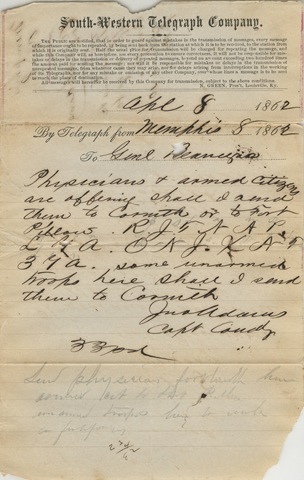
Transcript:

Apl 8, 1862

By Telegram from Memphis 8 1862

To Genl Beauregard

Physicians and armed citizens are offering should I send them to Corinth or Fort Pillow R.J.T.N.A.P.LVA. ONJ.XNTZYA. Some unarmed troops here shall I send them to Corinth.

Jno Adams

Capt. Couldy

33nd


Send physicians forthwith here. Have armed cit to Fort [Rollen?]

unarmed troops here to work on fortifications


Citation: John Adams, telegram to G. T. Beauregard. Memphis, 8 April 1862. AMs 1168/11

April 7, 1862: A.B. Cates telegram to Commander of Post

Pierre Gustave Toutant Beauregard was a Louisiana-born general of the Confederate States Army. He had graduated second in his class from West Point in 1838 and was an admirer of Napoleon. He achieved fame early in the Civil War for commanding the Fort Sumter bombardment and as the victor of the first battle of Manassas. He later served in the Western Theater (including Shiloh and Corinth), Charleston, and the defense of Richmond, but his career was hampered by friction with Jefferson Davis and other generals.

This is one of approximately 1000 military telegrams in P.G.T. Beauregard’s papers at the Rosenbach.

AMs 1168-11 1862-04-07

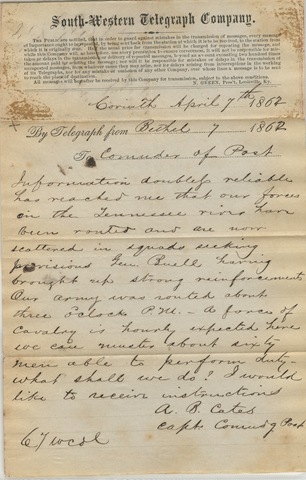
Transcript:

Corinth April 7th 1862

By telegram from Bethel 7 1862

To Commander of Post

Information doubtless reliable has reached me that our forces in the Tennessee River have been routed and are now scattered in squads seeking provisions Gen Buell having brought up strong reinforcements Our army was routed about three o’clock P.M. –a force of cavalry is hourly expected here we can muster about sixty men able to perform duty-what shall we do? I would like to receive instructions.

A.B. Cates

Capt. Commdg Post

67wcol

Citation: A.B. Cates, telegram to Commander of Post. Bethel, 7 April 1862. AMs 1168/11