September 24, 1862: John Henry Brown’s Journal

John Henry Brown was a painter of portrait miniatures, living and working in Philadelphia. He had met Lincoln in August of 1860 when he was commissioned to paint Lincoln’s portrait for a supporter, but although Brown liked Lincoln personally, he did not agree with Republican policies.

1862-09-24 

Transcript:

At Miss Powers picture.

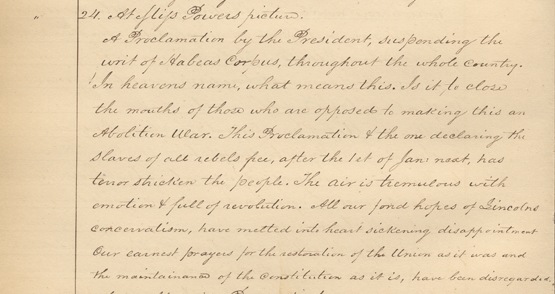
A Proclamation by the President, suspending the writ of habeas Corpus throughout the whole country. In heavens name, what means this. Is it to close the mouths of those who are opposed to making this an Abolition war. This Proclamation & the one declaring the slaves of all rebels free, after the 1st of Jan. next has terror stricken the people. The air is tremulous with emotion & full of revolution. All our fond hopes of Lincolns conservatism, have melted into heart sickening disappointment. Our earnest prayers for the restoration of the Union as it was and the maintenance of the Constitution as it is, have been disregarded.


Citation: John Henry Brown, autograph journal/account book. Philadelphia, 1844-1890. AMs 573/14.1

September 23, 1862: John Henry Brown’s Journal

John Henry Brown was a painter of portrait miniatures, living and working in Philadelphia. He had met Lincoln in August of 1860 when he was commissioned to paint Lincoln’s portrait for a supporter, but although Brown liked Lincoln personally, he did not agree with Republican policies.

1862-09-23

Transcript:

Commenced Miss Powers picture.

The President has issued a Proclamation, declaring the Slaves of all rebels, free, after the 1st of January next, unless they in the mean time, lay down their arms.


Citation: John Henry Brown, autograph journal/account book. Philadelphia, 1844-1890. AMs 573/14.1

September 22, 1862: Alexander Biddle to Julia Williams Rush Biddle

Alexander Biddle was a member of the prominent Philadelphia Biddle family and was married to Julia Williams Rush,  the granddaughter of Dr. Benjamin Rush. A businessman and member of the First Troop Philadelphia City Calvary before the war, Biddle entered Civil War service with the 121st Pennsylvania Volunteer Infantry on  September 1, 1862. Starting out as a a major, he would fight at Fredericksburg and Gettysburg, among other engagements, and would leave the service as a lieutenant colonel. (He was commissioned, but never mustered, as colonel)

[Note: this statement has been updated to reflect that Biddle was not mustered as a colonel. It also originally mistakenly stated Biddle was also at Chancellorsville, but he was on leave]
Rush IV-30-23 p1 A Biddle ALS to Julia William Rush, Sept. 22 Rush IV-30-23 p2 A Biddle ALS to Julia William Rush, Sept. 22Rush IV-30-23 p3 A Biddle ALS to Julia William Rush, Sept. 22

Rush IV-30-23 p4 A Biddle ALS to Julia William Rush, Sept. 22

Transcript [excerpt]:

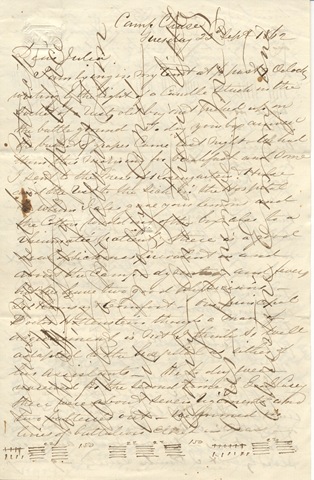
Camp Chase

Tuesday 22nd Sept 1862

Dear Julia

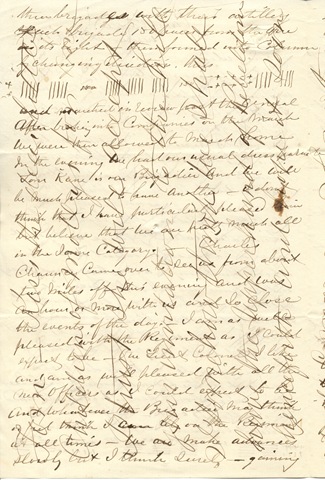
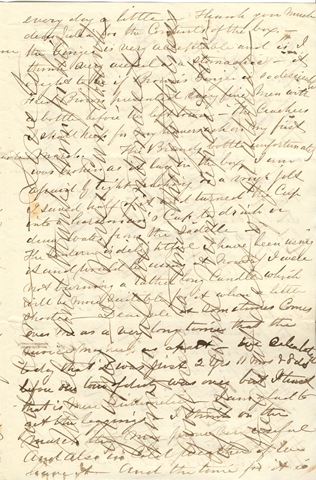
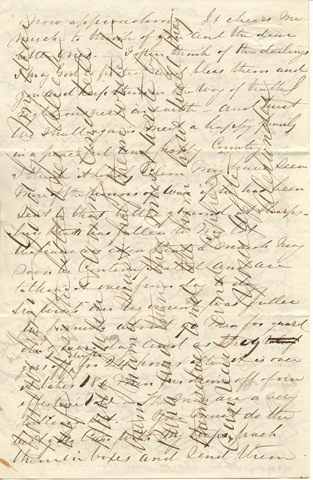
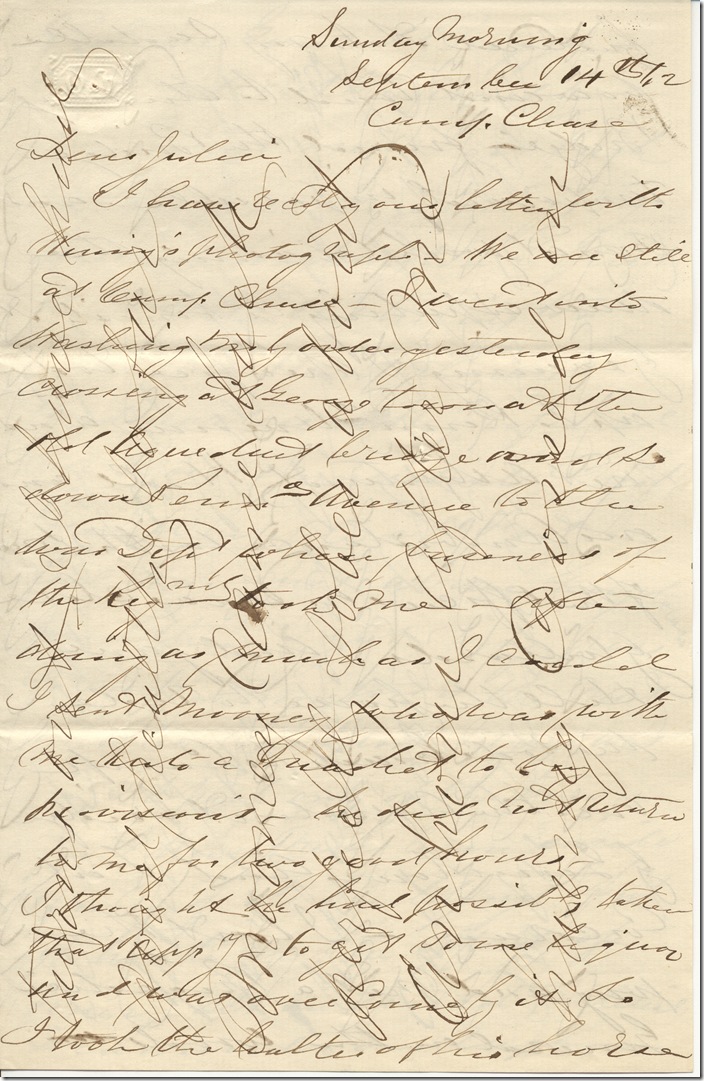
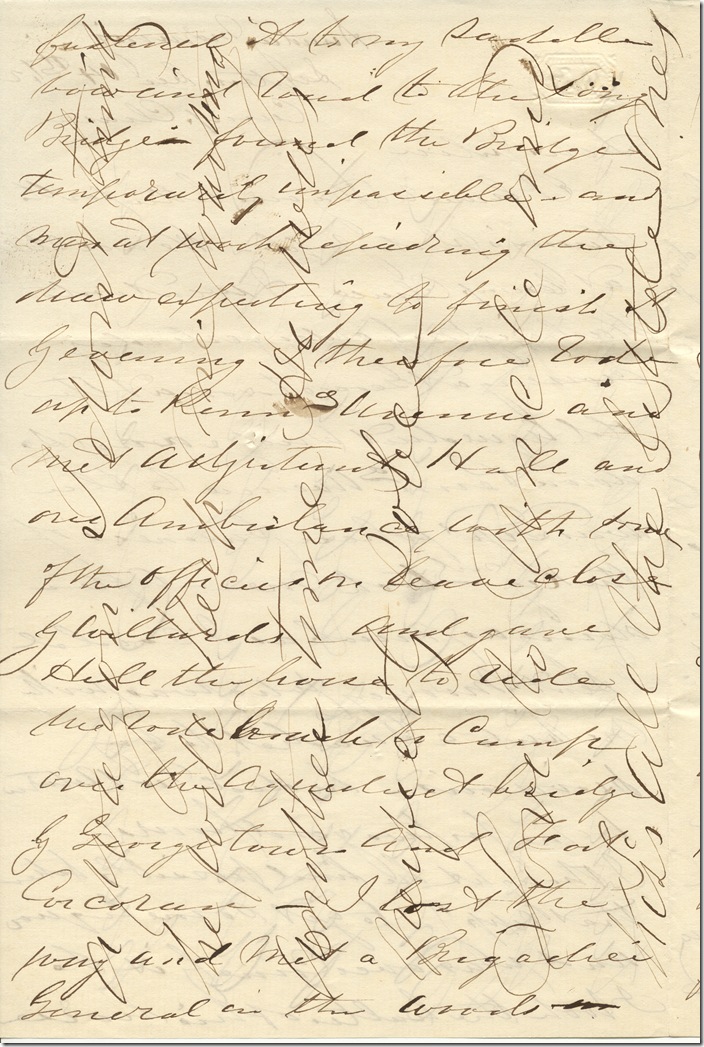
I am lying in my tent at ½ past 9 o’clock writing by the light of a candle stuck in the socket of a rusty old bayonet picked up on the battle ground. Today your box arrived the bushel of grapes came last night – We had them this morning for breakfast and some I sent to the mess of Rosengarten & Hulse and the rest to the sick in the Hospital to whom I also gave your lemons and the cotton surrounding of the box also to a rheumatic patient there is a good deal of sickness prevalent in and about the camp. Dysentery and fevers – but we have two good physicians – Drs Ramsay & Comfort – Our principal Doctor Hottenstein though a man of acquirement is not I think so well adapted to the hospital as either of his assistants. We today were received for the second time by Genl Casey there were about seven regiments and two batteries out.

Citation: Alexander Biddle (1819-1899), autograph letter signed to Julia Williams Rush Biddle. 22 September 1862. Rush:IV:30:23

September 21, 1862: Alexander Biddle letter to Julia Williams Rush Biddle

Alexander Biddle was a member of the prominent Philadelphia Biddle family and was married to Julia Williams Rush,  the granddaughter of Dr. Benjamin Rush. A businessman and member of the First Troop Philadelphia City Calvary before the war, Biddle entered Civil War service with the 121st Pennsylvania Volunteer Infantry on September 1, 1862. Starting out as a major, he would be involved at Fredericksburg and Gettysburg, among other engagements, and would leave the service as a lieutenant colonel. (He was commissioned, but never mustered, as colonel)

[Note: this statement has been updated to reflect that Biddle was not mustered as a colonel. It also originally mistakenly stated Biddle was also at Chancellorsville, but he was on leave]
Rush IV-30-23 p1 A Biddle ALS to Julia William Rush, Sept. 21 Rush IV-30-23 p2 A Biddle ALS to Julia William Rush, Sept. 21 Rush IV-30-23 p3 A Biddle ALS to Julia William Rush, Sept. 21 Rush IV 30-23 Sept 21 1862 p4 Alexander Biddle to Julia Biddle

Transcript:

Dear Julia,

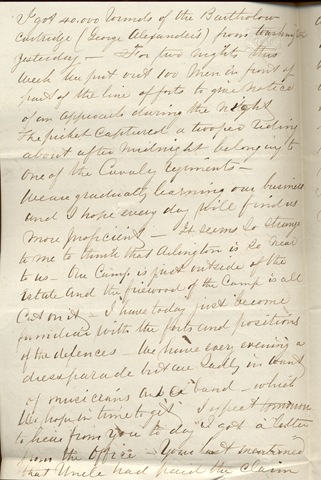
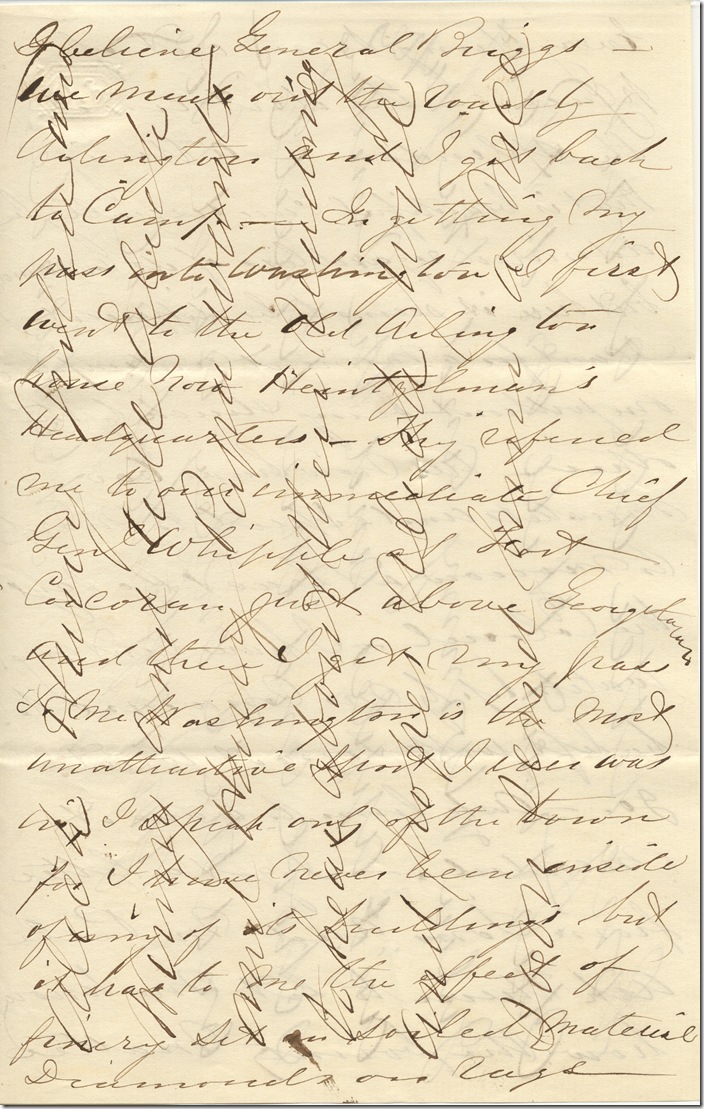
I have had a pretty busy time yesterday and today. We are now in T L Kane’s Brigade who has his tent about 200 yrds from our Camp in the woods. Our regiment and a battery of artillery are the only troops as yet in this Brigade which is the 3rd Brigade, Casey’s Division. The Brigadiers of this Division are I believe Generals Briggs, Paul & T L Kane. Today we were reviewed by Genl Casey on the flat ground beyond the Long Bridge there were Seven Regiments and two batteries of Artillery in line – perhaps 7000 men in all. The line was fairly formed and the Division passed by Genl Casey in quick time paying him all the honors. It must at least have been satisfactory – our men were the only ones who came with knapsacks and overcoats. They did not like it much at first but after the day was over were pleased at it. We now have all out arms and cartridges and are ready to march at short notice. I got 40,000 pounds of the Bartholow Cartridge (George Alexander’s) from Washington yesterday – for two nights this week he put out 100 men in front of part of the line of forts to give notice of an approach during the night

The picket captured a trooper hiding about after midnight belonging to one of the Cavalry regiments.

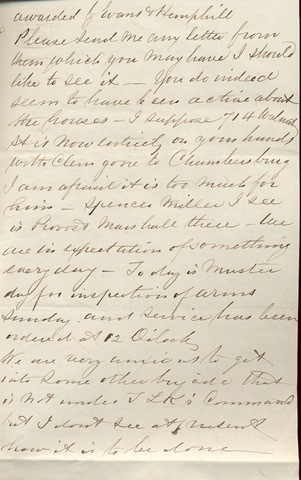
We are gradually learning our business and I hope every day will find us more proficient. It seems so strange to me to think that Arlington is so near to us. One camp is just outside of the estate and the firewood of the camp is all cut on it – I have today just become familiar with the forts and positions of the defences. We have every evening a dress parade but we are sadly in want of musicians and a band which we hope in time to get. I expect tomorrow to hear from you to day I got a letter from the Office, Your last mentioned that Uncle had paid the claim awarded by Evans & Hemphill

Please send me any letter from them which you may have I should like to see it. You so indeed seem to have been active about the houses – I suppose 714 Walnut St is now entirely on your hands Clem gone to Chambersburg I am afraid it is too much for him. Spencer Miller I see is Provost Marshall there. We are in expectations of something every day. Today is Muster day for inspections of arms Sunday and Service has been ordered at 12 o’clock

We are very anxious to get into some other brigade that is not under T L K’s command but I don’t see at present how it is to be done

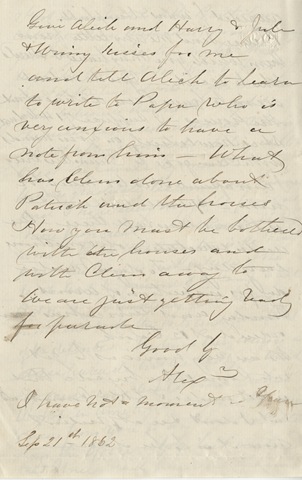
Give Aleck and Harry & Julia & Winny kisses for me and tell Aleck to learn to write to Papa who is very anxious to have a note from him. What has Clem done about Patrick and the houses How you must be bothered with the houses and with Clem away to

We are just getting ready for parade

Good by

Alex

I have not a moment to spare

Sep 21st 1862

Citation: Alexander Biddle (1819-1899), autograph letter signed to Julia Williams Rush Biddle. 21 September 1862. Rush IV:30:23

September 19, 1862: John Henry Brown’s Journal

John Henry Brown was a painter of portrait miniatures, living and working in Philadelphia. He had met Lincoln in August of 1860 when he was commissioned to paint Lincoln’s portrait for a supporter, but although Brown liked Lincoln personally, he did not agree with Republican policies.

1862-09-19

Transcript:

No painting. Gen: McClennan gained a Victory at Sharpsburg. heavy loss on both sides.


Citation: John Henry Brown, autograph journal/account book. Philadelphia, 1844-1890. AMs 573/14.1

September 18, 1862: John Henry Brown’s Journal

John Henry Brown was a painter of portrait miniatures, living and working in Philadelphia. He had met Lincoln in August of 1860 when he was commissioned to paint Lincoln’s portrait for a supporter, but although Brown liked Lincoln personally, he did not agree with Republican policies.

1862-09-18

Transcript:

Finished Mrs. Biddles picture.

Desperate fighting at Sharpsburg, My. The exact result not yet known.


Citation: John Henry Brown, autograph journal/account book. Philadelphia, 1844-1890. AMs 573/14.1

September 17, 1862: Henry and Mary Warner to John Warner

Henry and Mary Warner lived in Allegheny City, Pennsylvania, now part of Pittsburgh. They are the great-grandparents of poet Marianne Moore.  By the 1860s they had three surviving children:  John, Henry, and Anne. Their letters to John, a Presbyterian minister living in Gettysburg, are preserved as part of Marianne Moore’s family papers.

Moore VI-5-10 Henry and Mary Warner to Children 9-17-62

  Transcript:

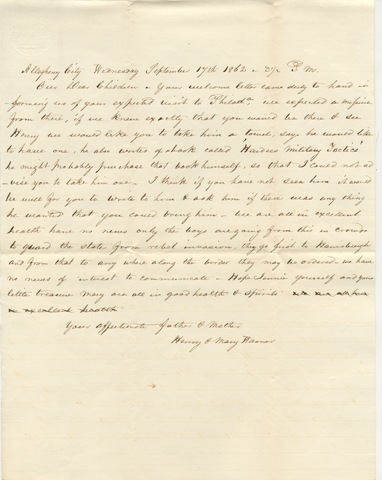
Allegheny City Wednesday September 17th 1862—3 ½ P.M.

Our Dear Children—Your welcome letter came duly to hand informing us of your expected visit to Philada, we expected a missive from there, if we knew exactly that you would be there & see Henry we would like you to take him a towel, says he would like to have one, he also writes of a book called “Hardees Military Tacticts’ he might probably purchase that book himself, so that I could not advise you to take him one—I think if you have not seen him it would be well for you to write to him & ask him if there was any thing he wanted that you could bring him—We are all in excellent health have no news only the boys are going from this in crowds to guard the state from rebel invasion, they go first to Harrisburgh and from that to any where along the border they may be ordered—we have no news of interest to communicate—Hope Jennie & yourself and your little treasure Mary are all in good health & spirits

Your affectionate father & mother

Henry & Mary Warner

Citation: Henry and Mary Warner, autograph letter signed to John Riddle Warner. Allegheny City [Pittsburgh], 17 September 1862. Moore VI:05:10

September 15, 1862: Alexander Biddle to Julia Williams Rush Biddle

Alexander Biddle was a member of the prominent Philadelphia Biddle family and was married to Julia Williams Rush,  the granddaughter of Dr. Benjamin Rush. A businessman and member of the First Troop Philadelphia City Calvary before the war, Biddle entered Civil War service with the 121st Pennsylvania Volunteer Infantry on  September 1, 1862. Starting out as a a major, he would fight at Fredericksburg and Gettysburg, among other engagements, and would leave the service as a lieutenant colonel. (He was commissioned, but never mustered, as colonel)

[Note: this statement has been updated to reflect that Biddle was not mustered as a colonel. It also originally mistakenly stated Biddle was also at Chancellorsville, but he was on leave]
Rush IV-30-23 p1 A Biddle ALS to Julia William Rush, Sept. 15 Rush IV-30-23 p2 A Biddle ALS to Julia William Rush, Sept. 15 Rush IV-30-23 p3 A Biddle ALS to Julia William Rush, Sept. 15 Rush IV-30-23 p4 A Biddle ALS to Julia William Rush, Sept. 15

Transcript:

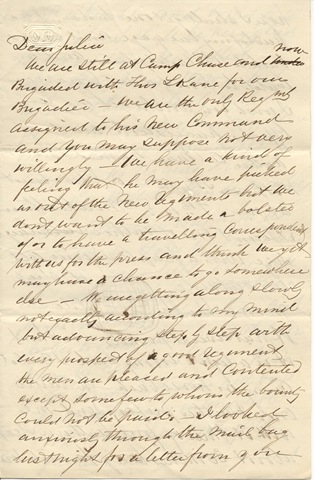
Dear Julia

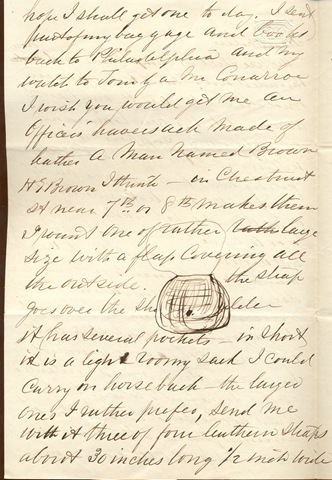
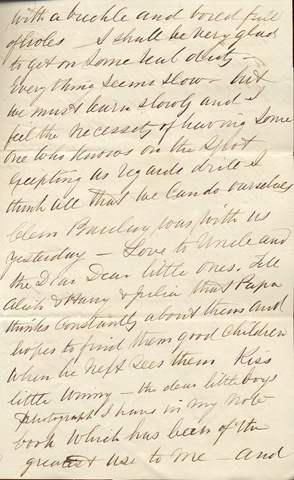
We are still at Camp Chase and now Brigaded with Thor L Kane for our Brigadier. We are the only Regmt assigned to his New Command and you may suppose not very willingly. We have a kind of feeling that he may have picked us out of the New Regiments but we don’t want to be make a bolsted of or to have a traveling correspondent with us for the press and think hee yet may have a chance to go somewhere else. We are getting along slowly not exactly according to my mind but advancing step by step with every prospect of good regiment the men are pleased and contented except some few to whom the bounty could not be paid. I looked anxiously through the mail bag last night for a letter from you hope I shall get one today. I sent part of my baggage and books back to Philadelphia and my watch to Tom by a Mr. Conarroe I wish you would get me an Officer’s knap sack made of leather a man named Brown H S Brown I think, in Chestnut St near 7th or 8th makes them. A round one of leather rather large size with a flap covering all the outside. The strap goes on over the shoulder it has several pockets – in short it is a light roomy sack I could carry on horseback – the larger ones I rather prefer, send me with it three or four leather straps about 30 inches long ½ inch wide with a buckle and bored fully of holes. I shall be very glad to get on some real duty. Everything seems slow but we must learn slowly and I feel the necessity of having some one who knows on the spot excepting as regards drill I think all that we can do ourselves Glenn Bradley was with us yesterday – Love to Uncle and the Dear Dear little ones. Tell Alick & Harry & Julia that Papa thinks constantly about them and hopes to find them good children when he next sees them. Kiss little Winny– the dear little boys photograph I have in my notebook which has been of the greatest use to me – and is always with me

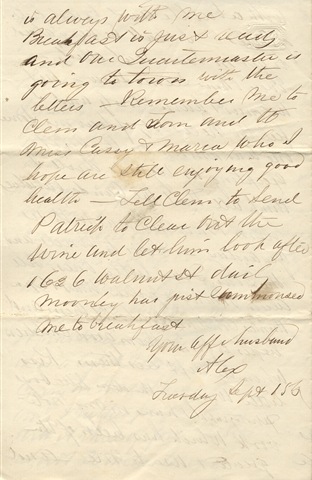
Breakfast is just ready and out Quartermaster is going to town with the letters. Remember me to Clem and Tom and to Miss Cassy & Maria who I hope are still enjoying good health. Tell Clem to send Patrick to clean out the wine and let him look after 1626 Walnut St daily Moonley has just summoned me to breakfast

Your Affec husband

Alex

Tuesday Sept 15th

Citation: Alexander Biddle (1819-1899), autograph letter signed to Julia Williams Rush Biddle. 15 September 1862. Rush:IV:30:23

September 14, 1862: Alexander Biddle letter to Julia Biddle

Alexander Biddle was a member of the prominent Philadelphia Biddle family and was married to Julia Williams Rush,  the granddaughter of Dr. Benjamin Rush. A businessman and member of the First Troop Philadelphia City Calvary before the war, Biddle entered Civil War service with the 121st Pennsylvania Volunteer Infantry on  September 1, 1862. Starting out as a a major, he would fight at Fredericksburg and Gettysburg, among other engagements, and would leave the service as a lieutenant colonel. (He was commissioned, but never mustered, as colonel)

[Note: this statement has been updated to reflect that Biddle was not mustered as a colonel. It also originally mistakenly stated Biddle was also at Chancellorsville, but he was on leave]

Rush IV-30-23 p1 A Biddle ALS to Julia William Rush

Rush IV-30-23 p2 A Biddle ALS to Julia William Rush Rush IV-30-23 p3 A Biddle ALS to Julia William Rush Rush IV-30-23 p4 A Biddle ALS to Julia William Rush

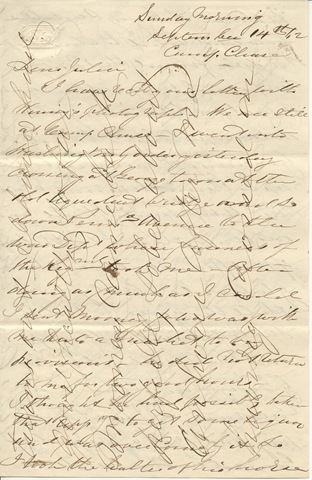
Sunday Morning, September 14th 1862, Camp Chase

Dear Julia,

I have rec’d your letter with Winny’s photograph –We are still at Camp Chase –I went into Washington by order yesterday crossing at Georgetown at the old aqueduct bridge and down Pennsylvania Avenue to the War Dept where business of the Regiment took me– after doing as much as I could I sent Mooney, who was with me into a market to buy provisions–he did not return to me for two good hours–I thought he had possibly taken that opportunity to get some liquor and was over come. So I took the halter of his horse

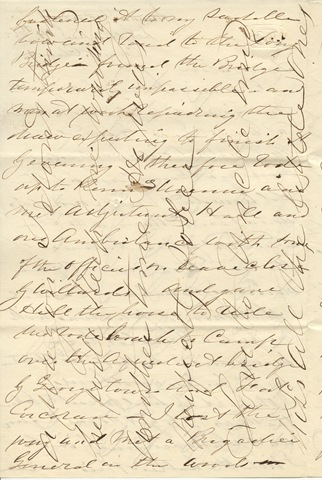
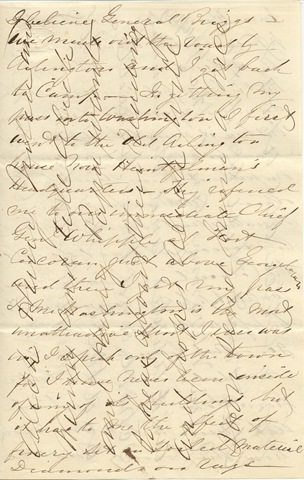
fastened it to my saddle low and lead to the old Bridge—found the bridge temporarily impassible and men at work defilading the draw expecting to finish it I am guessing. I therefore rode up to Pennsylvania Avenue and met Adjutant Hale and our ambulance with some of the officers [illegible] close at G. Willards and gave Hale the horse to ride. We rode back to camp over the Aqueduct Bridge in Georgetown and Fort Corcoran — I lost the way and met a Brigadier General in the woods– I believe General Briggs –we made out the road by Arlington and I got back to Camp–In getting my pass into Washington I first went to the Old Arlington house now Heintzelman’s Headquarters — They referred me to our immediate Chief General Whipple at Fort Corcoran, just above Georgetown, and there I got my pass. To me Washington is the most unattractive spot I ever was in. I speak only of the town for I have never been inside of any of its buildings but it has to me the effect of finery set in soiled material. Diamonds on rags

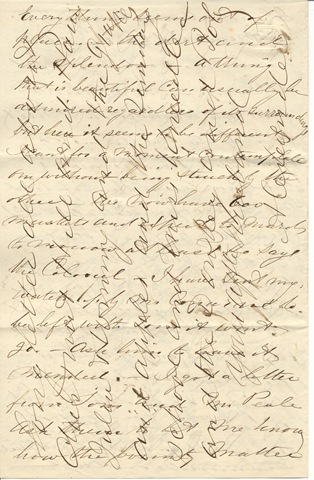
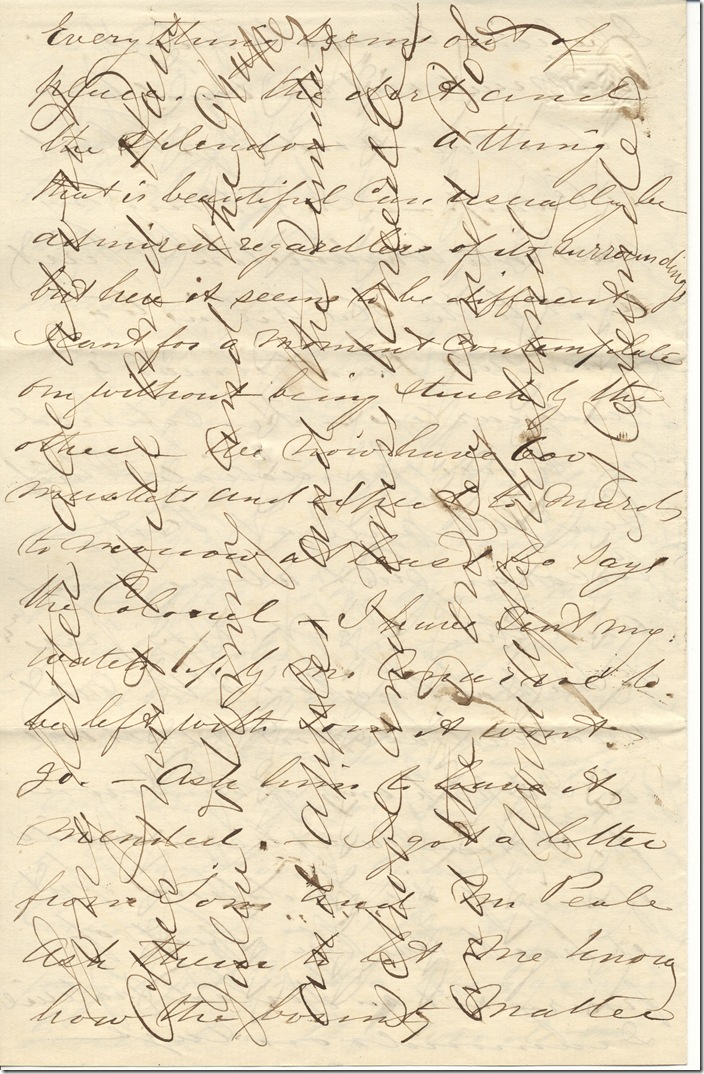
Everything seems out of place — the dirt and the splendor – a thing that is beautiful can usually be admired regardless of its surroundings but here it seems to be different. I cant for a moment contemplate one without being struck by the other – we now have 600 muskets and expect to march tomorrow at least so says the Colonel — I have sent my watch up by Mr. [illegible] to be left with [illegible] for it wont go–Ask him to have it mended. I got a letter from Tom and Mr Peale. Ask them to let me know how the [bounty?] matter Turns out. I have had good health so far Mooney came back perfectly sober about an hour after me having crossed in a wagon. I don’t think he will keep me waiting another time. He was perfectly sober.

Love to Uncle and kiss all the little ones Aleck, Harry, Julia, and Winny and tell Aleck and Harry Papa wants to hear about their reading and hopes Aleck will soon send him a nice long letter all about Chestnut Hill and Harry, Julia, Winny and the grapes and apples and the Sunday school and Miss Kneedle and the [Donkey?] and [Bob?].

Your Aff[illeg.] Husband,

Alexander

Citation: Alexander Biddle (1819-1899), autograph letter signed to Julia Williams Rush Biddle. 14 September 1862. Rush:IV:30:23

September 12, 1862: John Henry Brown’s Journal

John Henry Brown was a painter of portrait miniatures, living and working in Philadelphia. He had met Lincoln in August of 1860 when he was commissioned to paint Lincoln’s portrait for a supporter, but although Brown liked Lincoln personally, he did not agree with Republican policies.

1862-09-12

Transcript:

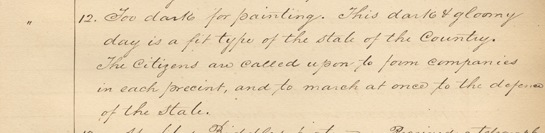
Too dark for painting. This dark & gloomy day is a fit type of the state of the country. The citizens are called upon to form companies in each precinct, and to march at once to the defense of the State.


Citation: John Henry Brown, autograph journal/account book. Philadelphia, 1844-1890. AMs 573/14.1