October 10, 1862: Alexander Biddle to Julia Williams Rush Biddle

Alexander Biddle was a member of the prominent Philadelphia Biddle family and was married to Julia Williams Rush,  the granddaughter of Dr. Benjamin Rush. A businessman and member of the First Troop Philadelphia City Calvary before the war, Biddle entered Civil War service with the 121st Pennsylvania Volunteer Infantry on  September 1, 1862. Starting out as a major, he would fight at Fredericksburg and Gettysburg, among other engagements, and would leave the service as a lieutenant colonel. (He was commissioned, but never mustered, as colonel)

[Note: this statement has been updated to reflect that Biddle was not mustered as a colonel. It also originally mistakenly stated Biddle was also at Chancellorsville, but he was on leave]

Rush IV-30-24 p1 A Biddle ALS to Julia William Rush, Oct 10 Rush IV-30-24 p2 A Biddle ALS to Julia William Rush, Oct 10 Rush IV-30-24 p3 A Biddle ALS to Julia William Rush, Oct 10Rush IV-30-24 p4 A Biddle ALS to Julia William Rush, Oct 10 Rush IV-30-24 p5 A Biddle ALS to Julia William Rush, Oct 10 Rush IV-30-24 p6 A Biddle ALS to Julia William Rush, Oct 10 Rush IV-30-24 p7 A Biddle ALS to Julia William Rush, Oct 10 Rush IV-30-24 p8 A Biddle ALS to Julia William Rush, Oct 10

Transcript:

Camp of Meade’s Division

West of Sharpsburg – Head Quarters of Field Officers of 121st Regt. P. V. Friday Night

Oct. 10th ½ past 10 PM

Dear Julia,

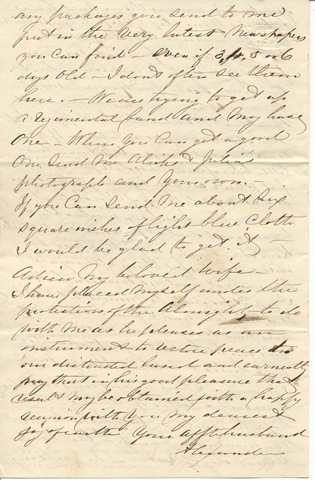
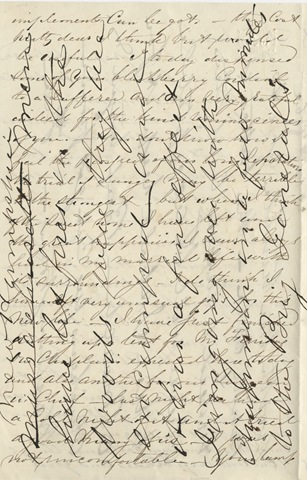
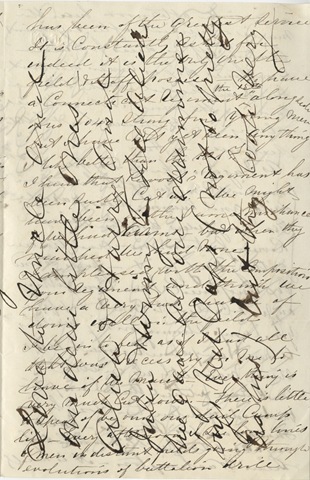
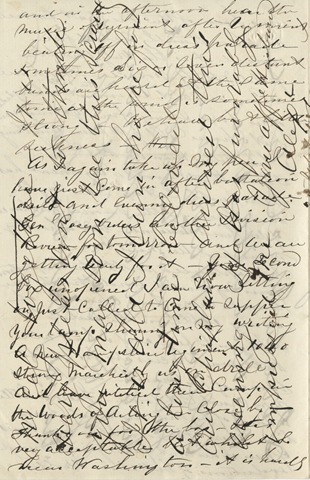
On Wednesday afternoon at ½ past 4 O’clock PM we began to break up our Camp at Frederick. We cut down our baggage turned in quantities of accoutrements muskets &c to the Quartermaster at Frederick leaving a Lieut. in charge and finally got off with the force about 6 Oclock PM. I reported our March to Genl Paul at about that hour. We marched through the night to Jefferson about 8 miles from Frederick and after passing through the town went into a clover field of a Mr. Johnson and bivouacked at midnight – tying our horses to the fences and sleeping on the ground. Our passing through Frederick was received with many loyal greetings and Union flags waving from the level of the people I should think them loyal – although there are some bitter Secessionists in the town. At the west end of Frederick there are two roads, we took the Southern one which again forks and then we took the right hand one marching over a good road all the way. On the morning after our arrival by and Jefferson we breakfasted at Mr. Johnson’s – who is an elder brother to Cost Johnson. They are a regular Maryland family and seemed as if they heartily hated both sides ourselves for being there in the unceremonious way in which we came and the South for having been there. After breakfast we marched a mile and a half down into the valley to Catocton City. We have crossed at the Catocton Ridge during the night on the march to Jefferson. On the banks of the creek we found a few piece of bottom land found where we stacked arms and remained during the heat of the day. We bathed and washed made the men do the same and rested until ½ past 4 O’clock when we again resumed the march…

Citation: Alexander Biddle (1819-1899), autograph letter signed to Julia Williams Rush Biddle. 10 October 1862. Rush:IV:30:24

October 7, 1862: Alexander Biddle to Julia Williams Rush Biddle

Alexander Biddle was a member of the prominent Philadelphia Biddle family and was married to Julia Williams Rush,  the granddaughter of Dr. Benjamin Rush. A businessman and member of the First Troop Philadelphia City Calvary before the war, Biddle entered Civil War service with the 121st Pennsylvania Volunteer Infantry on  September 1, 1862. Starting out as a major, he would fight at Fredericksburg and Gettysburg, among other engagements, and would leave the service as a lieutenant colonel. (He was commissioned, but never mustered, as colonel)

[Note: this statement has been updated to reflect that Biddle was not mustered as a colonel. It also originally mistakenly stated Biddle was also at Chancellorsville, but he was on leave]

Rush IV-30-24 p1 A Biddle ALS to Julia William Rush, Oct 7 Rush IV-30-24 p2 A Biddle ALS to Julia William Rush, Oct 7 Rush IV-30-24 p3 A Biddle ALS to Julia William Rush, Oct 7 Rush IV-30-24 p4 A Biddle ALS to Julia William Rush, Oct 7

Transcript (excerpt):

Camp New Frederick Md

October 7. 1862

Dear Julia

We are still here endeavoring to get ourselves in marching order – all are ordered positively to march tomorrow. And expect to go on tomorrow afternoon to Sharpsburg. We are to report to the first Army Corps. I wish we were in better order but I cannot perceive that there is much judgment exercised any where as yet. Many Red tape obstacles and Red tape forms required not to be had at the proper offices. We have less than 700 men but I think pretty good ones. I wish we had some genuine army man nearer to us who could speak more from experience but fear that I am in error when I suppose that they possess the experience I expect. We want very much some officer to tell the men what to do, what to carry with them, and what to leave and how and where to leave it. An army inspecting officer does go round to visit the camps but in our case instead of getting information from him his inquiries were merely directed to the ordinary discipline usually enforced in the Army by the Sergeants who receive recruits – but which in our case as the sergeants are comparatively new men and the men entirely green, it is very difficult to enforce in a body of 700 if every sergeant is not constantly on the watch…

Citation: Alexander Biddle (1819-1899), autograph letter signed to Julia Williams Rush Biddle. 7 October 1862. Rush:IV:30:24

October 6, 1862: M’Clellan and Victory!!

The exact date for this songsheet is unknown, but it references the Battles of South Mountain and Antietam, which occurred in September 1862.

A 862mc McClellan & Victory

Transcript:

M’CLELLAN AND VICTORY!!
OR THE BATTLE OF SOUTH MOUNTAIN AND THE UPRISING OF THE KEYSTONE STATE,

TUNE–“DAN TUCKER.”

I’ll sing a song, how brave MCCLELLAN
Gave the rebel foe a drilling,
And made them beat retreat in fear,
With this tune ringing in their ear,

Clear the way “Little MAC’s” advancing,
To set your Stonewall Jackson dancing.’

The rebels driven to theft and plunder,
Thought to scare us by their thunder,
They crossed the Potomac to Hagerstown,
To scare the women up and down.

Clear the way, “Little MAC’s” coming, &c

They plundered barns and fields of corn,

Of Maryland whiskey, took a horn,
They seized each union patriot there,
But Freedom’s Eagle sung in the air.

Oh! clear the way, for “MAC’s” advancing.

Stonewall Jackson and “Brag Lee,”

Now thought their course was clear and free,
To take Pennsylvania right off hand,
And carry Philadelphia to Dixey’s Land.

Clear the way “Little MAC” is coming.

So on they marched for their grand attack,
But the mighty mind of “Little MAC,”
Their plans and dodges kept his eye on,
As still as a mouse but as cool as a lion.

Clear the way, &c.

While the Keystone boys rushed nobly forth,
To stand by the state–the prop of the North,
Brave MAC gave the foe a blow in the rear,
Which made their Stonewall quake with fear.

Singing, clear the way, brave MAC is advancing

Upon the heights of old “South Mountain,’
He made their blood flow like a fountain,
Till old secession’s wings were clipt,
And Lee confessed himself “well whipped,’

Singing, clear the way, &c.

With HOOKER, FRANKLIN, and brave BURNSIDE,
He nobly turned the battle’s tide,
And drove them across the blue Potomac,
With battered heads and an empty stomach.

Singing, clear the way, &c.

The gallant RENO nobly fell,
But millions of brave hearts toll his knell,
And honor and glory crown the pall,
Of those who for the Union fall.

Singing, clear the way, &c

At Sharpsburg next, our gallant “MAC,”
Quickly followed suit and beat them back,
He seized their Longstreet by the knob,
And shelled the corn from Howell Cobb.

Singing, clear the way, &c.

At Harpers Ferry next he sold them,
And made the place “too hot to hold them.”
He bound by death or victory,
To set old Maryland safe and free.

Singing, clear the way, &c.

Three cheers for our glorious hero, “MAC,”
And the gallant army at his back,
He’s bound to march to victory forth,
Till the Union Flag floats South and North.

Singing, clear the way, &c.

Entered according to Act of Congress in the year 1862, by J. MAGEE, 316 Chestnut St, Phila., in the District of the U.S., for the Eastern District of Penn’a.


Citataion: M’Clellan and victory!!. Philadelphia: J. Magee, 1862. A f.862mc

October 5, 1862: Alexander Biddle to Julia Williams Rush Biddle

Alexander Biddle was a member of the prominent Philadelphia Biddle family and was married to Julia Williams Rush,  the granddaughter of Dr. Benjamin Rush. A businessman and member of the First Troop Philadelphia City Calvary before the war, Biddle entered Civil War service with the 121st Pennsylvania Volunteer Infantry on  September 1, 1862. Starting out as a a major, he would fight at Fredericksburg and Gettysburg, among others engagements, and would leave the service as a lieutenant colonel. (He was commissioned, but never mustered, as colonel)

[Note: this statement has been updated to reflect that Biddle was not mustered as a colonel. It also originally mistakenly stated Biddle was also at Chancellorsville, but he was on leave]

Rush IV-30-24 p1 A Biddle ALS to Julia William Rush, Oct 5 Rush IV-30-24 p2 A Biddle ALS to Julia William Rush, Oct 5

Transcript (excerpt):

Camp New Frederick. Md

Sunday Oct 5th 1862

Dear Julia

We are yet in Camp near Frederick. I write from our camp on a rather chilly evening – living under the canvas fly of a hospital tent which accommodates all the field officers of the regiment open to all the winds. We had our usual Sunday inspection of arms accoutrements and Cartridges. We have to ride about ¾ of a mile to dinner – the inspection was pretty long and brought us near to 12 Oclock – after dinner at 2 O’clock we had service on the ground of a regiment adjoining (the 29th Ohio) were there was some shade. We sang several hymns and had a fine sermon. In the evening we had a Union prayer meeting at which the men sang several hymns (Guide Me Oh Thou Ve) (“There’ll be no more sorrow there”) – Our chaplain has so far had the effect of showing the men that all such ceremonials would be cherished by the officers and I think the influence of why it will be more openly acknowledged by all in the corps because they know it will be respected. Our wagons arrived tonight – I think we will probably start tomorrow for Sharpsburg – distant we understand 22 miles we march and hope to get through soon after 24 hours. Our men are new and don’t know what marching is but I think will do very well…

Citation: Alexander Biddle (1819-1899), autograph letter signed to Julia Williams Rush Biddle. 5 October 1862. Rush:IV:30:24

October 3, 1862: Alexander Biddle to Julia Williams Rush Biddle

Alexander Biddle was a member of the prominent Philadelphia Biddle family and was married to Julia Williams Rush,  the granddaughter of Dr. Benjamin Rush. A businessman and member of the First Troop Philadelphia City Calvary before the war, Biddle entered Civil War service with the 121st Pennsylvania Volunteer Infantry on  September 1, 1862. Starting out as a a major, he would fight at Fredericksburg and Gettysburg, among others engagements, and would leave the service as a lieutenant colonel. (He was commissioned, but never mustered, as colonel)

[Note: this statement has been updated to reflect that Biddle was not mustered as a colonel. It also originally mistakenly stated Biddle was also at Chancellorsville, but he was on leave]

Rush IV-30-24 p1 A Biddle ALS to Julia William Rush, Oct 3 Rush IV-30-24 p2 A Biddle ALS to Julia William Rush, Oct 3 Rush IV-30-24 p3 A Biddle ALS to Julia William Rush, Oct 3 Rush IV-30-24 p4 A Biddle ALS to Julia William Rush, Oct 3

Transcript:

Camp New Frederic

Friday October 3rd 1862

Dear Julia

We are still in camp just South of Frederic. We are in want of our teams and everything we expected to be supplied with they seem to be short of. We have barely got kettles and food enough to prepare. The daily food of the men and have just twenty axes and spades in the whole regiment. Our teams were expected today but they have not yet arrived. There are and to be some 7000 wounded men still in the churches and hospitals in the town. We get our meals daily at a private house who prepare meals for the Union people. I have not seen anything Secesh. as yet Although I have heard of one or two instances of such expressions We have been ordered to march to Sharpsburg about 27 miles distant over two ranges of hills north & west of us. As soon as our teams arrive we will march and they ought to be here now. We may march tomorrow but hardly before night if then. Our men are all in shelter tents that is one tent of which two men each carry one side. They cut a couple of forked sticks and wedge pole and stretch the tent over it [picture] these tents are about 3 feet high and about 5 feet long. Just enough to be shelter from rain and sun. Sometimes a third man uses his piece to make a back to the tent. We have a fly of a hospital tent stretched over a stake on two mashed boxes for props and the corners stretched on poled held out by gags [diagram] it makes a queer looking tent and it accommodates the Colonel Lieut Col. – Major – Adjutant Chaplain and sometimes another I don’t believe any other regiment has such limited accommodation We have just returned from a two mile ride to the Monocacy to bathe. We had a delightful bath, I suppose we shall not get a mail for sometime and I shall therefore be deprived the pleasure of hearing from you. I begin to appreciate something of the devastation which an army creates, I see whole fences go for firewood and a regiment opposite to us on a hillside we can see making a covering to their fence rail tents with corn stalks cut in a farmer’s close by. I met Cadwalader Biddle yesterday in the street. He had been over to our Camp but came up here on business. He had no idea of meeting us. Clem Baudey was also in out Camp. He seems to have earned innumerable friends by his services which have been great beyond question. I have given you all I have to say pretty thoroughly. Camp life is monotonous enough when I don’t hear from home We have the battalion drill in the afternoon from 3 to 5. My wing was not under my Command for two hours. The Right Wing with Chapman. Afterwards we had the usual Dress parade. Rush’s Cavalry I hear are about 3 miles off – they passed through Frederic today. Averill has been made a Brigadier General. He is the other promising Cavalry officer and I fear his appointment is not very pleasant to your cousin Richard. It is I think a step over his head. We are ordered to form the first Army Corps I think it is Hooker’s. He is said to be “the Coming Man” – At least he is the one we understand to be most in favor in Washington – McClellan not excepted. Love to Uncle and to all the darling little ones show Alick my pictures of the tents and tell him that is all we have to sleep under not larger than the sheet you have every night. Give love to Clem and tell him I want to hear all his experience from him. Kiss darling Harry Julia and sweet Winny. Remember me to Cassy and Maria.

Your aff. Husband

Alexander

Citation: Alexander Biddle (1819-1899), autograph letter signed to Julia Williams Rush Biddle. 3 October 1862. Rush:IV:30:24

October 2, 1862: Alexander Biddle to Julia Williams Rush Biddle

Alexander Biddle was a member of the prominent Philadelphia Biddle family and was married to Julia Williams Rush,  the granddaughter of Dr. Benjamin Rush. A businessman and member of the First Troop Philadelphia City Calvary before the war, Biddle entered Civil War service with the 121st Pennsylvania Volunteer Infantry on  September 1, 1862. Starting out as a a major, he would fight at Fredericksburg and Gettysburg, among others engagements, and would leave the service as a lieutenant colonel. (He was commissioned, but never mustered, as colonel)

[Note: this statement has been updated to reflect that Biddle was not mustered as a colonel. It also originally mistakenly stated Biddle was also at Chancellorsville, but he was on leave]

Rush IV-30-24 p1 A Biddle ALS to Julia William Rush, Oct 2

Rush IV-30-24 p2 A Biddle ALS to Julia William Rush, Oct 2 Rush IV-30-24 p3 A Biddle ALS to Julia William Rush, Oct 2

Transcript [excerpt]:

Camp New Frederick

Oct. 2nd 1862

We are in Camp a little South & East of Frederick on the highest ground near the town/ We pitched out shelter tents last night these tents are comprised of three pieces of canvas duck. Three men to a tent each taking one piece on his shoulders. Last night we got orders to march to Sharpsburg and report to the First Army Corps (I believe it is Hookers) Sharpsburg is about 25 miles off above Harpers Ferry. We shall cook two days rations today and march towards night. Last night we really bivouacked. We had nothing but the fly of a hospital and for all the field and staff. It rained moderately during the night but we were comfortable. There is a very large number of troops here and more hourly arriving, they are sent forward without the means of cooking oftentimes we well do. They say you will get all you want when you arrive but we don’t find it so. We have a regiment alongside of us with 125 men in it which came out 18 mos ago 960 strong and they tell us that the new regiments look like whole divisions. So far everything seems to be going along well. Some of the men seem to be falling off with the trial they have had but they don’t know how much worse off others are. We expect our teams which came by turnpike to meet us today and therefore think we can get along. We yesterday drew 306 rations for our force…

Citation: Alexander Biddle (1819-1899), autograph letter signed to Julia Williams Rush Biddle. 2 October 1862. Rush:IV:30:24

October 1, 1862: Henry and Mary Warner to John Warner

Henry and Mary Warner lived in Allegheny City, Pennsylvania, now part of Pittsburgh. They are the great-grandparents of poet Marianne Moore.  By the 1860s they had three surviving children:  John, Henry, and Anne. Their letters to John, a Presbyterian minister living in Gettysburg, are preserved as part of Marianne Moore’s family papers.

Moore VI-5-11 Henry and Mary Warner to Children 10-1-62

  Transcript:

Allegheny City Wednesday October 1st 1862

Our Dear Children

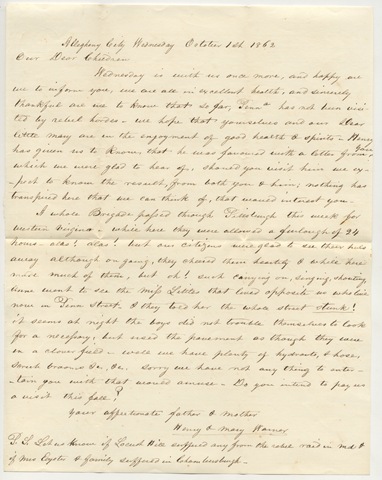
Wednesday is with us once more, and happy are we to inform you, we are all in excellent health, and sincerely thankful are we to know that so far, Penna has not been visited by rebel hordes—we hope that yourselves and our Dear little Mary are in the enjoyment of good health & spirits—Henry has given us to know, that he was favoured with a letter from you which we were glad to hear of, should you visit him we expect to know the result, from both you & him; nothing has transpired here that we can think of, that would interest you—

A whole Brigade passed through Pittsburgh this week for Western Virginia—while here they were allowed a furlough of 24 hours—alas! alas! but our citizens were glad to see their heels away although on going, they cheered them heartily & while here made much of them, but oh! such carrying on, singing, shouting, Anne went to see the Miss Littles that lived opposite us who live now in Penn Street– & they told her the whole street stunk! it seems at night the boys did not trouble themselves to look for a necessary, but used the pavement as though they were in a clover field—well we have plenty of hydrants, & hose, scrub brooms &c &c. Sorry we have not any thing to entertain you with that would amuse—Do you intend to pay us a visit this fall?

Your affectionate father & mother

Henry & Mary Warner

P.S. Let us know if Locust Hill suffered any from the rebel raid in Md & if Mrs Eyster & family suffered in Chambersburgh


Citation: Henry and Mary Warner, autograph letter signed to John Riddle Warner. Allegheny City [Pittsburgh], 1 October 1862. Moore VI:05:11

September 30, 1862: Abraham & Mary Lincoln Letters of Recommendation for Thomas Stackpole

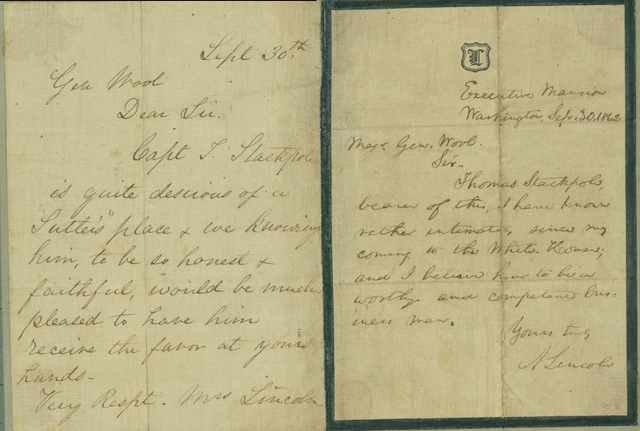
These two letters are recommendations for Thomas Stackpole to receive a sutler position in the army. Stackpole was a White House doorkeeper and watchman and was a favorite of Mrs. Lincoln.

AMs 353-12_4 copy

Transcription:

Executive Mansion

Washington, Sep. 30. 1862

Majr. Gen. Wool.
Sir—

Thomas Stackpole, bearer of this, I have known rather intimately since my coming to the White-House; and I believe him to be a worthy and competent business man. Yours truly

A Lincoln

Sept. 30th

Gen. Wool

Dear Sir

Capt. T. Stackpole is quite desirous of a “Sutler’s” place + we knowing him, to be honest + faithful, would be much pleased to have him receive the favor at your. Hands.

Very Resp. Mrs. Lincoln

Citation: Abraham Lincoln and Mary Lincoln, autograph letters signed to John E. Wool. 30 Sept. 1862. AMs 353/12

September 28, 1862: Alexander Biddle to Julia Williams Biddle

Alexander Biddle was a member of the prominent Philadelphia Biddle family and was married to Julia Williams Rush,  the granddaughter of Dr. Benjamin Rush. A businessman and member of the First Troop Philadelphia City Calvary before the war, Biddle entered Civil War service with the 121st Pennsylvania Volunteer Infantry on  September 1, 1862. Starting out as a a major, he would fight at Fredericksburg and Gettysburg, among other engagements, and would leave the service as a lieutenant colonel. (He was commissioned, but never mustered, as colonel)

[Note: this statement has been updated to reflect that Biddle was not mustered as a colonel. It also originally mistakenly stated Biddle was also at Chancellorsville, but he was on leave]

Rush IV-30-23 p1 A Biddle ALS to Julia William Rush, Sept. 28 Rush IV-30-23 p2 A Biddle ALS to Julia William Rush, Sept. 28 Rush IV-30-23 p3 A Biddle ALS to Julia William Rush, Sept. 28

Rush IV-30-23 p4 A Biddle ALS to Julia William Rush, Sept. 28

Transcript [excerpt]:

Sunday evening 28th September

Camp Chase Virginia

Dearly loved Wife

I date my letter this evening to tell you all the events of the day. At ten Oclock this morning we had the usual movements of the men for inspections of accoutrements across knapsacks all then present to the hospital. Ordinance tent tents of the field and stuff – line officers-Men sutlers shop & Commissary – much of it was unexpected but they passed the examination well. I thought the arms particularly good. But it took nearly three hours to get through it all and immediately after I had a detail made to pitch a large fly (the covering of an officer’s tent very much like a sheet stretched tight over a clothes line) to have church under. We had several hymns – “Welcome sweet day of rest” – “There is a land of pure delight” “When I can read my title clear” and prayers with a short sermon, this brought us to near three O’clock. I then got notice that I was to be “Brigade Field Officer of the Day” tomorrow and looked over my books to get them together. At ½ past 5 we had evening parade and at 6 I went by appointment to talk over Brigade with Genl Kane – I returned at seven and went to out proper meeting. We had six or seven hymns…

Citation: Alexander Biddle (1819-1899), autograph letter signed to Julia Williams Rush Biddle. 28 September 1862. Rush:IV:30:23

September 25, 1862: Alexander Biddle to Julia Williams Rush Biddle

Alexander Biddle was a member of the prominent Philadelphia Biddle family and was married to Julia Williams Rush,  the granddaughter of Dr. Benjamin Rush. A businessman and member of the First Troop Philadelphia City Calvary before the war, Biddle entered Civil War service with the 121st Pennsylvania Volunteer Infantry on  September 1, 1862. Starting out as a a major, he would fight at Fredericksburg and Gettysburg, among other engagements, and would leave the service as a lieutenant colonel. (He was commissioned, but never mustered, as colonel)

[Note: this statement has been updated to reflect that Biddle was not mustered as a colonel. It also originally mistakenly stated Biddle was also at Chancellorsville, but he was on leave]

Rush IV 30-23 9-25-1862 p1-4 Alexander Biddle to Julia Biddle

Rush IV 30-23 9-25-1862 p2-3 Alexander Biddle to Julia Biddle Rush IV 30-23 9-25-1862 p2-3 Alexander Biddle to Julia Biddle Rush IV 30-23 9-25-1862 p1-4 Alexander Biddle to Julia Biddle

Transcript:

Dear Julia,

Your fruit basket of grapes apples and pears came last night. We shall have them this morning at breakfast. Yesterday afternoon it rained and we had no drill but in the evening we had our usual evening parade. We are anxious to get away from here but I presume that I will be here for some time yet. If you can send me the next time you pack up any things for me, a tin lunch box about six inches long by four wide. I had one in the back room of the 3rd story back on a shelf in the closet but you may not be able to find that. It is useful to carry a piece of meat in in one’s pocket. If you can send me that and a good knife. One of those [illeg.] gathering things if one with large blades and good implements can be got. They cost pretty dear I think but would be useful. I today dispensed some of your blackberry cordial to a sufferer and am very grateful indeed for the kind reminiscences of you. You don’t know how I feel the prospect of our long separation. The trial of danger may be terrible to the strongest, but when I think of the sweet home I have left and the great happiness I have always had in my married life with its surroundings I do think I have left very unusual joys for this new life. I have just finished putting up a tent for Mr. Ferriday our Chaplain expected here today. And also another for our surgeon in chief. Last night we had a cold night of it and it tried a good many of us. I was not uncomfortable. Your lamp has been of the greatest service. It is consistently asked for indeed it is the only one the field & staff possess. We have a Connecticut regiment alongside of us 1040 strong for young men but I have not yet seen anything I like better than the 121st.

I heard that [Revost’s?] regiment has been sadly cut up. We might have been in the same mischance if we had [illeg.] but when they marched we had none.

I am pleased with the composition of our regiment and think we have a very fair chance of doing well on the field. I begin to feel as if I had all that was necessary for me to have if we march. Everything is very much cut down. There is little to speak of beyond our daily camp life. Every afternoon I see long lines of men in distant fields going through evolutions of battalion drill. And in the afternoon hear the music of regiment after regiment beating off in dress parade sometimes six or seven distinct bands are heard at the same time or the wind is sometimes strong. We have but little silences.

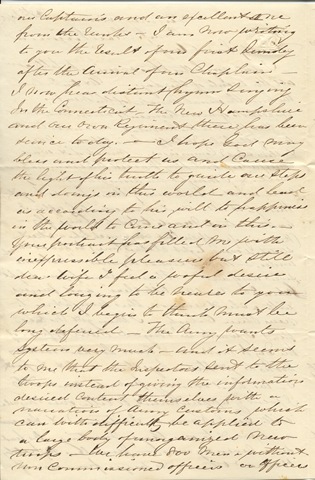
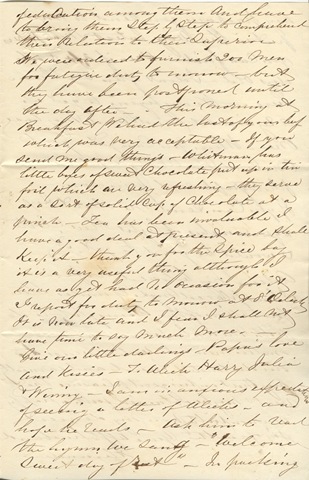
As I again take up my pen I have just come in after battalion drill and evening dress parade. Gen. Casey orders another Division Review for tomorrow and we are getting ready for it. Your box unopened, I am now getting just called to come to supper. Your lamp shining on my writing  New Hampshire Regiment 1040 strong marched us on drill and have pitched their camp in the woods of Arlington close by. Thank you for the box-It was very acceptable but whilst near Washington it is hardly worth the trouble you so kindly take. The butter is indeed a luxury and the cheese will be acceptable to us. I shall keep it for a march. Beef tongue and chickens we can get from Washington. The New Hampshire Massachusetts men have lit fires in the woods where they are encamped and it has a fine effect I am going over with Chapman in a few minutes to the Serg. Generals. Love to Uncle and our dear little ones, Alec + Harry and Julia + Irving. Tell Alec we gave all our drummer boys red capes (not so pretty as his.) but they look very nicely together. It is very pleasant to think you may soon see this scrawl. It is all I can hope for a long time + beloved. Our Chaplain arrived this evening. He has favorably impressed me.

Your affectionate husband

Alex

Citation: Alexander Biddle (1819-1899), autograph letter signed to Julia Williams Rush Biddle. 25 September 1862. Rush:IV:30:23