October 25, 1862: Alexander Biddle to Julia Williams Rush Biddle

Alexander Biddle was a member of the prominent Philadelphia Biddle family and was married to Julia Williams Rush,  the granddaughter of Dr. Benjamin Rush. A businessman and member of the First Troop Philadelphia City Calvary before the war, Biddle entered Civil War service with the 121st Pennsylvania Volunteer Infantry on  September 1, 1862. Starting out as a a major, he would fight at Fredericksburg and Gettysburg, among other engagements, and would leave the service as a lieutenant colonel. (He was commissioned, but never mustered, as colonel)

[Note: this statement has been updated to reflect that Biddle was not mustered as a colonel. It also originally mistakenly stated Biddle was also at Chancellorsville, but he was on leave]
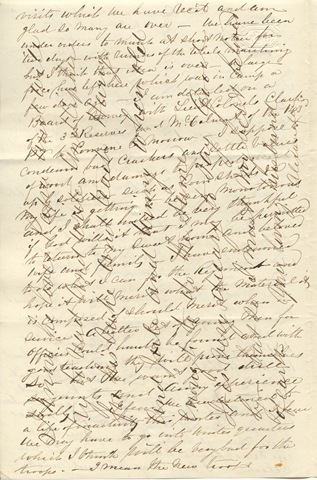
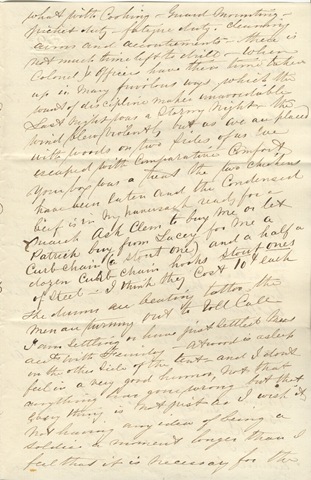
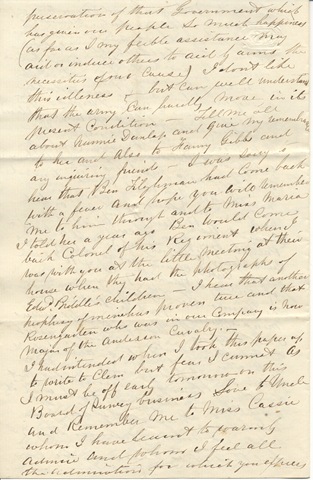
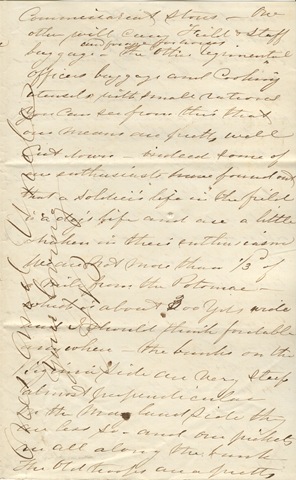
Rush IV-30-24 p1 A Biddle ALS to Julia William Rush, Oct 25 Rush IV-30-24 p2 A Biddle ALS to Julia William Rush, Oct 25 Rush IV-30-24 p3 A Biddle ALS to Julia William Rush, Oct 25 Rush IV-30-24 p4 A Biddle ALS to Julia William Rush, Oct 25

Transcript (excerpt):

Oct 25. 1862 Saturday

Camp near Sharpsburg

Dear Julia

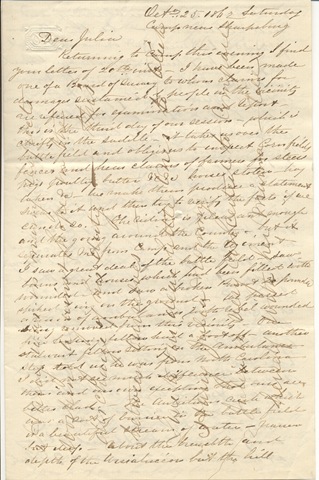
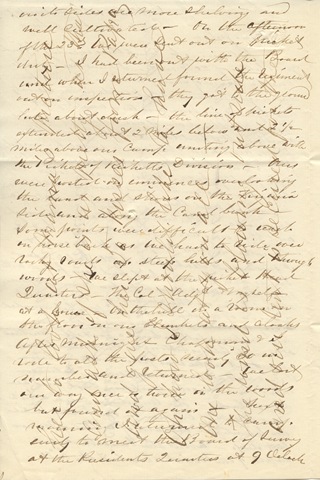
Returning to camp this evening I find your letter of 20th inst. I have been made one of a Board of [Query ?] to whom claims for damages sustained by people in the vicinity are referred for examination and report. This is the third day of our session – which is chiefly in the saddle. It takes us over the battle field and obliges us to inspect Corn fields fences and hear claims of farmers for steers pigs poultry butter &c &c houses stolen – hay taken &c – we make them produce a statement swear to it and then try to verify the facts if we can do so. The riding is pleasant enough and the going around the country – but it separates me from the camp and the regiment I saw a great deal of the battle field – saw wounded and saw a broken Parrot 20 pounder spiked lying on the ground. We passed a train of ambulances carrying rebel wounded being removed from the vicinity. One fine looking fellow had a foot off – another stalwart fellow sitting on the ambulance step told us he was from North Carolina I did not see much difference between them and our men excepting that ours are better clad…

Citation: Alexander Biddle (1819-1899), autograph letter signed to Julia Williams Rush Biddle. 25 October 1862. Rush:IV:30:24

October 24, 1862: Charles Jones Colcock telegram to P. G. T. Beauregard

Pierre Gustave Toutant Beauregard was a Louisiana-born general of the Confederate States Army. He had graduated second in his class from West Point in 1838 and was an admirer of Napoleon. He achieved fame early in the Civil War for commanding the Fort Sumter bombardment and as the victor of the first battle of Manassas. He later served in the Western Theater (including Shiloh and Corinth), Charleston, and the defense of Richmond, but his career was hampered by friction with Jefferson Davis and other generals.

This is one of approximately 1000 military telegrams in P.G.T. Beauregard’s papers at the Rosenbach.

1168-11 1862-10-24

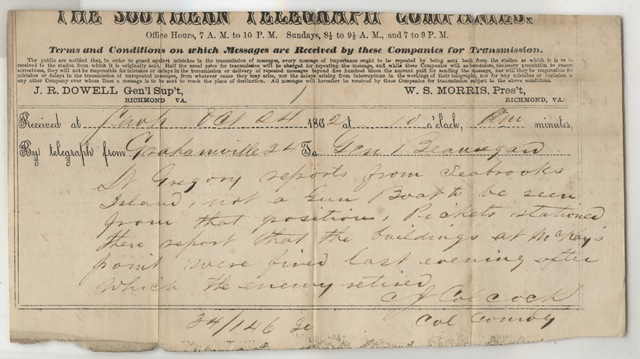
Received at  [illeg.] Oct 24 1862 at 10 o’clock PM

By telegraph from Grahamville 24 to Genl Beauregard

Lt Gregory reports from Seabrooks Island, not a Gun Boat to be seen from that position. Pickets stationed there report that the buildings at McKay’s point were fired last evening after which the enemy retired.

C. G. Colcock

Col Cmdg

Citation: Charles Jones Colcock, telegram to G. T. Beauregard. Grahamville, S.C., 24 October 1862. AMs 1168/11

October 23, 1862: J. Packer Miles telegram to P. G. T. Beauregard

Pierre Gustave Toutant Beauregard was a Louisiana-born general of the Confederate States Army. He had graduated second in his class from West Point in 1838 and was an admirer of Napoleon. He achieved fame early in the Civil War for commanding the Fort Sumter bombardment and as the victor of the first battle of Manassas. He later served in the Western Theater (including Shiloh and Corinth), Charleston, and the defense of Richmond, but his career was hampered by friction with Jefferson Davis and other generals.


This is one of approximately 1000 military telegrams in P.G.T. Beauregard’s papers at the Rosenbach.

AMs 1168-11 1862-10-23


Transcript:

Received at Oct 23 1862 at 3 o’clock pm

By telegraph from Richmond Va To Gen GT Beauregard

Do you mean Mitchell the Irish Patriot. Congratulate you on brilliant affair at Pocotaglio—Secty will allow accumulation of rice for subsistence—make your application for it. Getting ten in guns made now more rapidly.

J Packer Miles


Citation: J. Packer Miles, telegram to G. T. Beauregard. Richmond, 23 October 1862. AMs 1168/11

October 22, 1862: Alexander Biddle to Julia Williams Rush Biddle

Alexander Biddle was a member of the prominent Philadelphia Biddle family and was married to Julia Williams Rush,  the granddaughter of Dr. Benjamin Rush. A businessman and member of the First Troop Philadelphia City Calvary before the war, Biddle entered Civil War service with the 121st Pennsylvania Volunteer Infantry on  September 1, 1862. Starting out as a a major, he would fight at Fredericksburg and Gettysburg, among other engagements, and would leave the service as a lieutenant colonel. (He was commissioned, but never mustered, as colonel)

[Note: this statement has been updated to reflect that Biddle was not mustered as a colonel. It also originally mistakenly stated Biddle was also at Chancellorsville, but he was on leave]
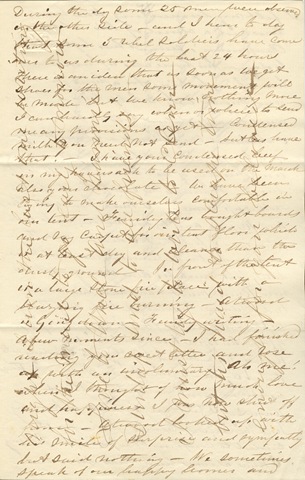
Rush IV-30-24 p1 A Biddle ALS to Julia William Rush, Oct 22 Rush IV-30-24 p2 A Biddle ALS to Julia William Rush, Oct 22 Rush IV-30-24 p3 A Biddle ALS to Julia William Rush, Oct 22 Rush IV-30-24 p4 A Biddle ALS to Julia William Rush, Oct 22

Transcript (excerpt):

Camp near Sharpsburg

Oct 22nd 1862

Wednesday

Dear Julia

I am lying in my tent having taken out my writing materials to write to Clem but I cannot do so without first writing to you. You must tell him that I got his letter along with yours on the 13th in the box. I have today rec’d. yours of the 18th. We have never been at Alexandria. Rush’s lancers were about two miles from us when we were at Fredrick I saw Capt Stars of the Lancers and sent remembrance to him and Charley Cadwilde when there. His Regiment is not well spoken of – it seems to be considered a failure I was told today that their little [frennens ?] are called “hospital flags derisively I say this entre nous. – For I am sorry to hear it. Averill’s cavalry seems to be the most esteemed cavalry of the Army – I rode today to see the 12th Infantry (Regulars) on Battalion drill was too late but saw guard mounting and  and some Squad drilling. I saw also William Sergeant and Frank Wister Captain’s in that Regiment passed today John Parter’s Head Quarters and a {?] of camps. General Reynolds took tea with us a few evenings since he came over to see our dress parade and remained until ten Oclock. I have now returned most visits which we have rec’d and am glad so many are over.

Citation: Alexander Biddle (1819-1899), autograph letter signed to Julia Wiliams Rush Biddle. 22 October 1862. Rush:IV:30:24

October 19, 1862: Alexander Biddle to Julia Williams Rush Biddle

Alexander Biddle was a member of the prominent Philadelphia Biddle family and was married to Julia Williams Rush,  the granddaughter of Dr. Benjamin Rush. A businessman and member of the First Troop Philadelphia City Calvary before the war, Biddle entered Civil War service with the 121st Pennsylvania Volunteer Infantry on  September 1, 1862. Starting out as a a major, he would fight at Fredericksburg and Gettysburg, among other engagements, and would leave the service as a lieutenant colonel. (He was commissioned, but never mustered, as colonel)

[Note: this statement has been updated to reflect that Biddle was not mustered as a colonel. It also originally mistakenly stated Biddle was also at Chancellorsville, but he was on leave]
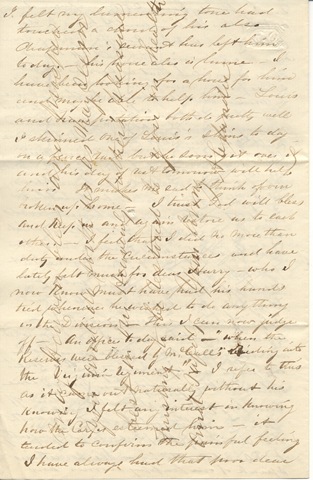
Rush IV-30-24 p1 A Biddle ALS to Julia William Rush, Oct 19 Rush IV-30-24 p2 A Biddle ALS to Julia William Rush, Oct 19 Rush IV-30-24 p3 A Biddle ALS to Julia William Rush, Oct 19 Rush IV-30-24 p4 A Biddle ALS to Julia William Rush, Oct 19

Transcript (excerpt):

Camp New Sharpsburg

Oct 19th 1862

Head Quarters of 121st Reg. P. V.

1st Brigade, 1st Division

Dear Julia

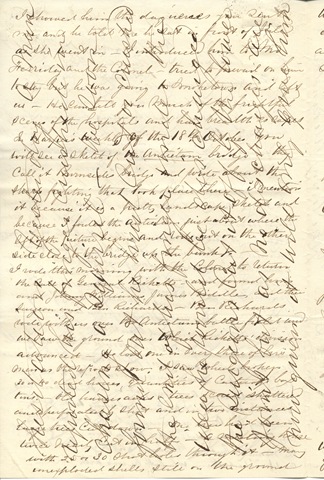
It is afternoon just after the day’s service has been broken of by a devilish shower. I have been endeavoring to write to you for the last two days but have hardly had time. One of our Captain’s (Captain Wrigly) goes back to Philadelphia on Wednesday next on a weeks furlough and anything you can send me of a portable character he will bring. I will ask him to call at the office and let you know / He is from Manayunk and poor fellow has lost his wife since he has been away / A few spermaceti candles, the little silver watch repaired, any late newspaper, a fine toothed comb a small box of dried ginger, some ginger nuts bread, another large flask with some good brandy in it and anything else you think of. Say two pair of colored flannel drawers, my measure round the waist is 36 inches, length of drawers 3 ft 3 inches. It is very difficult for me to say what I want but every now and then I think of some of our little home comforts which would be very acceptable Above all dearest I want your photograph. I like to have it by me – you cannot conceive how I long to see you and how tiresome and lonely it is to think how long it may be before I get a chance of being with you. Yesterday our Owen very unexpectedly walked into my tent. I was delighted to see him. I was at the moment busy in making out some requisitions and finished them out while he was with me. I showed him the day news you sent me and he told me he sat in from of Julie as she went in. I introduced him to Mo Ferriday and the Colonel – tried to prevail on him to stay but he was going to [Donoketown?] and left us. He can tell you much of the frightful scenes of the hospitals and hair breadth escapes. In Harper’s Weekly of the 18th October you will see a sketch of the Antietam bridge – they Call it Burnsides bridge and write about the sharp fighting that took place there – I mention it because I forded the Antietam first about where the left of the picture begins and rode out on the other side close to the bridge up the banks.

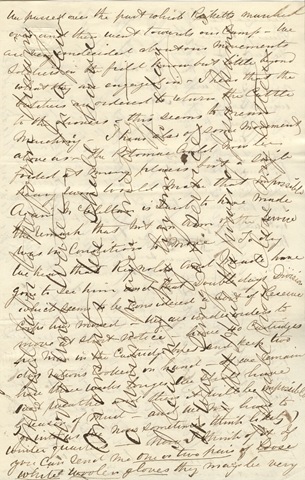
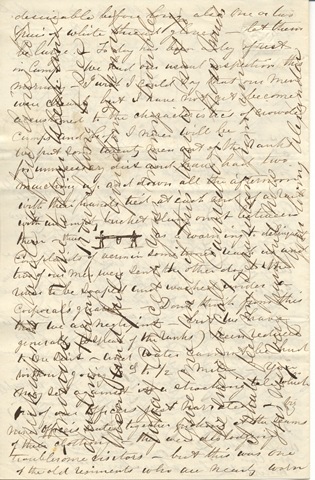
I rode this morning with the Colonel to return the call of General Ricketts and found him and Johnny Williams, James Biddle, and their surgeon and Ben Richards – Ben Richards rode with us over the Antietam battle field and we saw the ground over which Ricketts division advanced/ He lost one in every three of his men as the reports show. I saw wheels broken 30 or 40 dead horses, quantities of cartridge box tins. Old haversacks, trees scored shattered and perforated by4, shot and in two instances large trees cut down. One tree had been twice nearly cut in half. A meeting house with 25 or 30 shot holes through it. Many unexploded shells still on the ground We passed over the part which Ricketts marched over and then went towards our Camp. We all very undecided about our movements soldiers in the field know but little beyond what they are engaged in. I hear that the butchers are ordered to return the cattle to the drovers, this seems to mean marching…

Citation: Alexander Biddle (1819-1899), autograph letter signed to Julia Wiliams Rush Biddle. 19 October 1862. Rush:IV:30:24
October 18, 1862: John Henry Brown’s Journal

John Henry Brown was a painter of portrait miniatures, living and working in Philadelphia. He had met Lincoln in August of 1860 when he was commissioned to paint Lincoln’s portrait for a supporter, but although Brown liked Lincoln personally, he did not agree with Republican policies.


1862-10-18

Transcript:

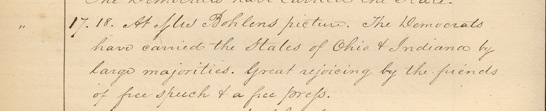
At Mrs Bohlens picture. The Democrats have carried the States of Ohio & Indiana by large majorities. Great rejoicing by the friends of free speech & a free press.


Citation: John Henry Brown, autograph journal/account book. Philadelphia, 1844-1890. AMs 573/14.1

October 17, 1862: Alexander Biddle to Julia Williams Rush Biddle

Alexander Biddle was a member of the prominent Philadelphia Biddle family and was married to Julia Williams Rush,  the granddaughter of Dr. Benjamin Rush. A businessman and member of the First Troop Philadelphia City Calvary before the war, Biddle entered Civil War service with the 121st Pennsylvania Volunteer Infantry on  September 1, 1862. Starting out as a a major, he would fight at Fredericksburg and Gettysburg, among other engagements, and would leave the service as a lieutenant colonel. (He was commissioned, but never mustered, as colonel)

[Note: this statement has been updated to reflect that Biddle was not mustered as a colonel. It also originally mistakenly stated Biddle was also at Chancellorsville, but he was on leave]

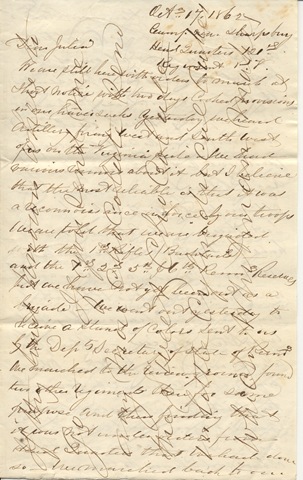
Rush IV-30-24 p1 A Biddle ALS to Julia William Rush, Oct 17 Rush IV-30-24 p2 A Biddle ALS to Julia William Rush, Oct 17 Rush IV-30-24 p3 A Biddle ALS to Julia William Rush, Oct 17 Rush IV-30-24 p4 A Biddle ALS to Julia William Rush, Oct 17

Transcript (excerpt):

Oct. 17. 1862

Camp Near Sharpsburg

Head Quarters 121st

Regiment 1st D

Dear Julia

We are still here with orders to march at short notice with two days cooked provisions in our haversacks. Yesterday we heard artillery firing west and south west of us on the Virginia side. We had various rumors about it but I believe that the most reliable is that it was a reconnaissance in force by our troops We are told that we are brigaded with the 1st Rifles / Brigades and the 1st, 2nd, 5th, & 6th Penna Reserves but we have not yet been out as a brigade. We went out yesterday to receive a stand of colors sent to us by the Depty Secretary of State of [Penn?]. We marched to the review ground found two other regiments there for some purpose and these finding that it was not under orders from Head Quarters that we had done so – we marched back to our camp. In the afternoon the gentleman made his appearance he had been kept at one of the General’s quarters and presented the colors at our dress parade made a pretty speech declined an invitation to supper and went over to the Coin exchange Reg close by. We have had all our wall tents taken from us but these. The Colonel & Hall one the Lieut Col being absent Atwood Feuidy and I another and the three doctors the third. Our line officers have a fly to every three officers – the men are all in shelter tents – Our wagons are reduced to four two with the ams and ammunition having been sent over to the Ordinance Officer…

Citation: Alexander Biddle (1819-1899), autograph letter signed to Julia Williams Rush Biddle. 17 October 1862. Rush:IV:30:24

October 16, 1862: U.S. Grant to His Sister

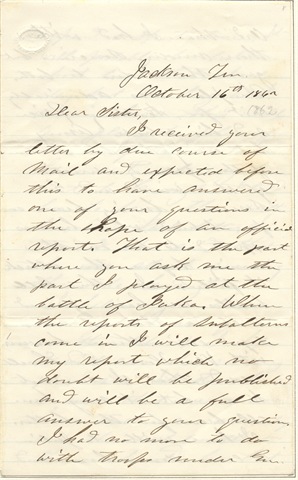
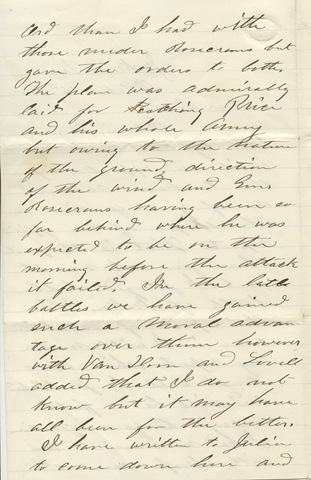
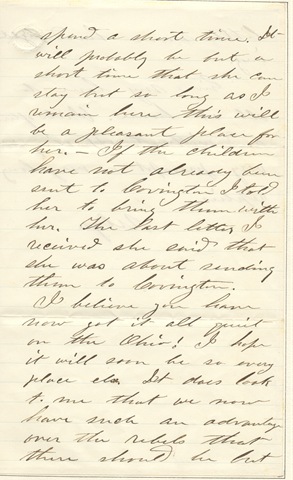
AMs 357-9 p1 U.S. Grant to Mary Grant Cramer AMs 357-9 p2 U.S. Grant to Mary Grant Cramer AMs 357-9 p3 U.S. Grant to Mary Grant Cramer AMs 357-9 p4 U.S. Grant to Mary Grant Cramer

Transcript:

Jackson Ten.

October 16th 1862

Dear Sister,

I received your letter by due course of mail and expected before this to have answered one of your questions in the shape of an official report. That is the part where you ask me the part I played at the battle of Iuka. When the reports of Subalterns come in I will make my report which no doubt will be published and will be a full answer to your question. I had no more to do with troops under Gen. Ord. than I had with those under Rosecrans but gave the order to both. The plan was admirably laid out for catching Price and his whole Army but owing to the nature of the ground, direction of the wind and Gen. Rosecrans having been so far behind where he was expected to be on the morning before the attack it failed. In the late battles we have gained such a moral advan-tage over them, however, with Van Dorn and Lovell added,  that I do not know but it may have been for the better.

I have written to Julia to come down here and spend a short time. It will probably be but a short time that she can stay but so long as I remain here this will be a pleasant place for her. If the children have not already been sent to Covington I told her to bring them with her. The last letter I received she said that she was about sending them to Covington.

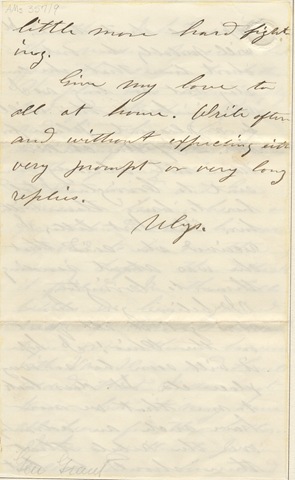
I believe you have now got it all quiet on the Ohio! I hope it will soon be so every place else. It does look to me that we now have such an advantage over the rebels that there should be but little more hard fighting.

Give my love to all at home. Write often and without expecting either very prompt or very long replies.

Ulys.

Citation:Ulysses S. Grant (1822-1885), autograph letter signed to Mary Grant Cramer. Jackson, Tenn., 16 October 1862. AMs 357/9

October 14, 1862: John Henry Brown’s Journal

John Henry Brown was a painter of portrait miniatures, living and working in Philadelphia. He had met Lincoln in August of 1860 when he was commissioned to paint Lincoln’s portrait for a supporter, but although Brown liked Lincoln personally, he did not agree with Republican policies.

1862-10-14

1862-10-14(2)

Transcript:

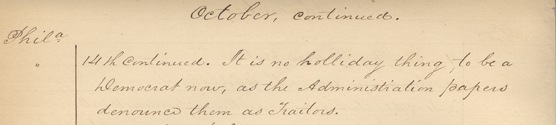
At Mrs Bohlens picture. The 14th general Election day, for members of Congress, legislature & county offices. I voted the Democratic ticket. It is no holliday thing to be a Democrat now, as the Administration papers denounce them as Traitors.


Citation: John Henry Brown, autograph journal/account book. Philadelphia, 1844-1890. AMs 573/14.1

October 13, 1862: Alexander Biddle to Julia Williams Rush Biddle

Alexander Biddle was a member of the prominent Philadelphia Biddle family and was married to Julia Williams Rush,  the granddaughter of Dr. Benjamin Rush. A businessman and member of the First Troop Philadelphia City Calvary before the war, Biddle entered Civil War service with the 121st Pennsylvania Volunteer Infantry on  September 1, 1862. Starting out as a a major, he would fight at Fredericksburg and Gettysburg, among other engagements, and would leave the service as a lieutenant colonel. (He was commissioned, but never mustered, as colonel)

[Note: this statement has been updated to reflect that Biddle was not mustered as a colonel. It also originally mistakenly stated Biddle was also at Chancellorsville, but he was on leave]

Rush IV-30-24 p1 A Biddle ALS to Julia William Rush, Oct 13 Rush IV-30-24 p2 A Biddle ALS to Julia William Rush, Oct 13 Rush IV-30-24 p3 A Biddle ALS to Julia William Rush, Oct 13 Rush IV-30-24 p4 A Biddle ALS to Julia William Rush, Oct 13

Transcript: (excerpt)

Oct. 13th 1862

Camp Near Sharpsburg

Meade’s Division

Dear Julia

I got a letter from you this morning and have been thinking of writing to you and Clem and Tom all day long but have had but little time. I woke early and let to work to get our ammunition put into two wagons to be sent to Lieut Harding the Division Ordinance Officer – this took some time after breakfast and I found I would be obliged to be in camp whilst the Colonel went out on Battalion drill – hardly had he gone when an orderly came with orders for the Quartermaster who was absent. To those I replied. Then came another orderly with a circular to know if general order No. 217 had been complied with. This I endorsed as fulfilled. Shortly after came another saying with an order from the Brigade Commander stating that two wagons sent with ammunition had only two mules each and that four was meant and that the meaning of order No 217 must be strictly complied with. So I ordered the mules to go. Soon after the Colonel returned he had dinner and after dinner got notice to get ready for immediate inspection. We did so marched the regiment out passed in review before Colonel Magilton and were then ordered to execute a number of movements by having all of what we did without difficulty but not as well as we shall hereafter do them. The ranks were then opened and knapsacks inspected and the Regiment dismissed.

Citation: Alexander Biddle (1819-1899), autograph letter signed to Julia Williams Rush Biddle. 13 October 1862. Rush:IV:30:24