September 11, 1862: George Eyster to John Riddle Warner

John Riddle Warner was the grandfather of the poet Marianne Moore and during the Civil War he lived in Gettysburg, Pennsylvania. George Eyster was his brother-in-law and lived in Chambersburg. These letters are preserved as part of Marianne Moore’s family papers.
 Moore VI-5-10 p1 George Eyster to John Riddle Warner 9-11-62 Moore VI-5-10 p2 George Eyster to John Riddle Warner 9-11-62


   Transcript:

Chambersburg September 11th 1862

Post Office—12 o’clock, at night

Dear John,

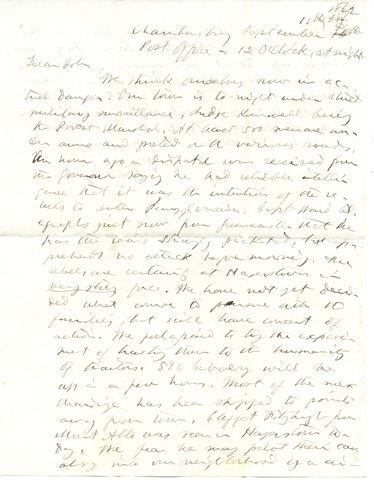
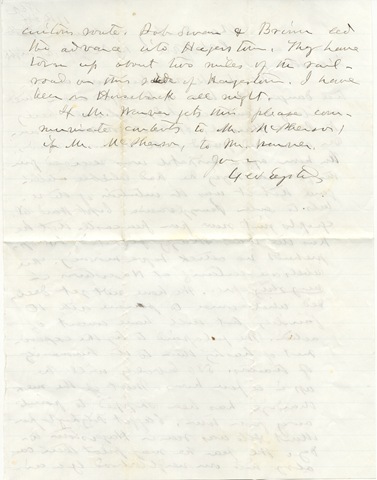
We think ourselves now in actual danger. Our town is to-night under strict military surveillance. Judge Kinwell being the Provost Marshall. At least 500 men are under arms and posted on the various roads. An hour ago a dispatch was received from the government saying we had reliable intelligence that it was the intention of the rebels to enter Pennsylvania. Capt Ward telegraphs just now from Greencastle that he has the roads strongly picketed, but apprehends no attack before morning. The rebels are certainly at Hagerstown in very strong force. We have not yet decided what course to proceed with 10 families, but will have concert of action. We feel afraid to try the experiment of hasty [illeg.] to the humanity of traitors. 580 Cavalry will be up in a few hours. Most of the merchandise has been shipped to points away from town. Clegget Fitzhugh from Mount Alto was seen in Hagerstown today. We fear he may pilot their cavalry into our neighborhood by a circuitous route. Dob Sinan & Brimm led the advance into Hagerstown. They have torn up about two miles of the rail-road on the side of Hagerstown. I have been on Horseback all night.

If Mr. Weaver gets this please communicate contents to M. McPherson/if Mr. McPherson, to Mr. Weaver.

Yours

Geo Eyster

Citation: George Eyster, autograph letter signed to John Riddle Warner.  Chambersburg, Pa.; 11 September 1862. Moore VI:05:10
September 10, 1862: George Eyster to John Riddle Warner

John Riddle Warner was the grandfather of the poet Marianne Moore and during the Civil War he lived in Gettysburg, Pennsylvania. George Eyster was his brother-in-law and lived in Chambersburg. These letters are preserved as part of Marianne Moore’s family papers.

Moore VI-5-10 p1 George Eyster to John Riddle Warner 9-10-62 Moore VI-5-10 p2 George Eyster to John Riddle Warner 9-10-62

Transcript:

Chambersburg

Sept 10, 1862

Dear John,

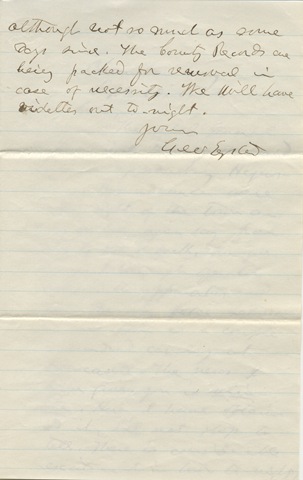
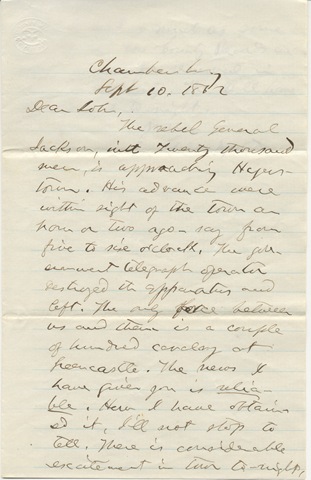
The rebel General Jackson, with Twenty thousand men, is approaching Hagerstown. His advance were within sight of the town an hour or two ago—say from five to six o’clock. The government telegraph operator destroyed its apparatus and left. The only force between us and them is a couple of hundred cavalry at Greencastle. The news I have given you is reliable. How I have obtained it, I’ll not stop to tell. There is considerable excitement in town to-night, although not so much as some say now. The County Records are being packed for removal in case of necessity. We will have [cadettes?] out to-night.

Yours

Geo Eyster

Citation: George Eyster, autograph letter signed to John Riddle Warner.  Chambersburg, Pa.; 10 September 1862. Moore VI:05:10
September 9, 1862: George Eyster to John Riddle Warner

John Riddle Warner, a Presbyterian minister, was the grandfather of the poet Marianne Moore and during the Civil War he lived in Gettysburg, Pennsylvania. George Eyster was his brother-in-law and lived in Chambersburg. These letters are preserved as part of Marianne Moore’s family papers.

   Moore VI-5-10 p1 George Eyster to John Riddle Warner 9-9-62

Moore VI-5-10 p2 George Eyster to John Riddle Warner 9-9-62 Moore VI-5-10 p3 George Eyster to John Riddle Warner 9-9-62 Moore VI-5-10 p4 George Eyster to John Riddle Warner 9-9-62 

Transcript:

Chambersburg, Sept. 9th 1862

Dear John,

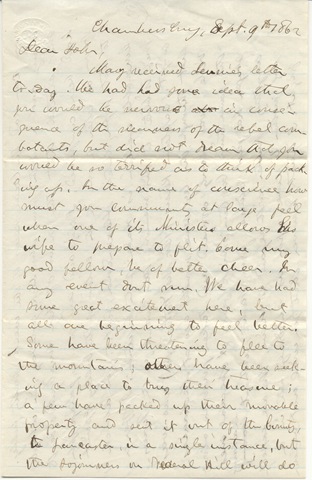
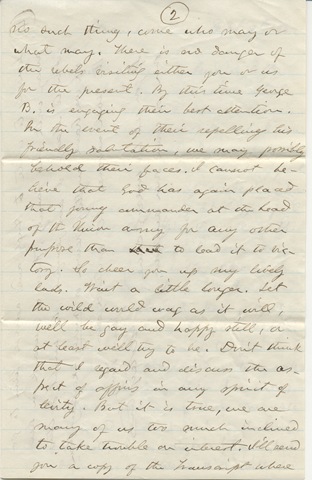
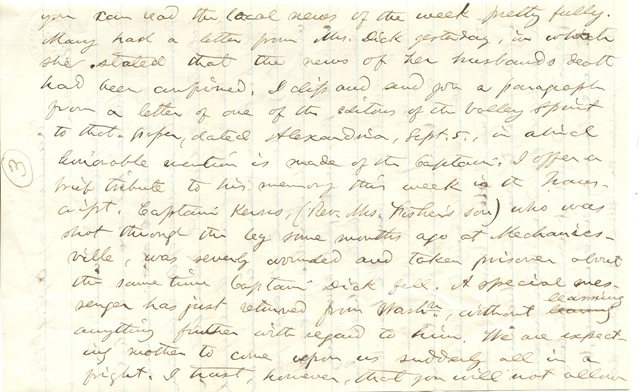
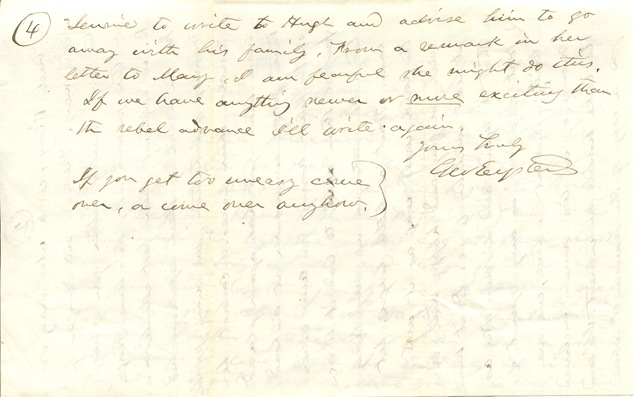
Mary received Jennie’s letter to-day. We had had some idea that you would be nervous in consequence of the nearness of the rebel combatants, but did not dream that you would be so terrified as to think of packing up. In the name of conscience how must your community at large feel when one of its Ministers allows his wife to prepare to flit. John my good fellow, be of better cheer. In any event dont run. We have had some great excitement here, but all are beginning to feel better. Some have been threatening to flee to the mountains; others have been seeking a place to bring their treasure; a few have packed up their movable property and sent it out of the County, to Lancaster, in a single instance, but the sojourners in Federal Hill will do no such thing, come who may or what may. There is no danger of the rebels visiting either you or us for the present. By this time George B. is engaging their best attention. In the event of their repelling his friendly salutation, we may possibly behold their faces. I cannot believe that God has again placed that young commander at the head of the Union Army for any other purpose than to lead it to victory. So cheer you up my lively lads. Wait a little longer. Let the wild world wag as it will, we’ll be gay and happy still, or at least we’ll try to be. Don’t think that I regard and disown the aspect of affairs in any spirit of levity. But it is true, we are many of us too much inclined to take trouble on interest. I’ll send you a copy of the Transcript where you can read the local news of the week pretty fully. Mary had a letter from Mrs. Dick yesterday, in which she stated that the news of her husbands death had been confirmed. I clip and send you a paragraph from a letter of one of the editors of the Valley Spirit to that paper, dated Alexandria, Sept. 5, in which honorable mention is made of the Captain. I offer a brief tribute to his memory this week in the Transcript. Captain Kerns, (Rev. Mrs. Fisher’s son) who was shot through the leg some months ago at Mechanicsville, was severely wounded and taken prisoner about the same time Captain Dick fell. A special messenger has just returned from Washn, without learning anything further with regard to him. We are expecting mother to come upon us suddenly all in a fright. I trust, however, that you will not allow Jennie to write to Hugh and advise him to go away with his family. From a remark in her letter to Mary, I am fearful she might do this. If we have anything newer or more exciting than the rebel advance I’ll write again.

Yours truly

Geo Eyster

If you get too weary come over, a come over anyhow.


Citation: George Eyster, autograph letter signed to John Riddle Warner.  Chambersburg, Pa.; 9 September 1862. Moore VI:05:10
September 8, 1862: John Henry Brown’s Journal

John Henry Brown was a painter of portrait miniatures, living and working in Philadelphia. He had met Lincoln in August of 1860 when he was commissioned to paint Lincoln’s portrait for a supporter, but although Brown liked Lincoln personally, he did not agree with Republican policies.

1862-09-08

Transcript:

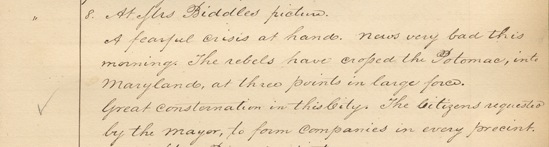
At Mr Biddles picture.

A fearful crisis at hand. News very bad this morning. The rebels have crossed the Potomac into Maryland, at three points in large force. Great consternation in this City. The Citizens requested by the mayor to form companies in every precinct.


Citation: John Henry Brown, autograph journal/account book. Philadelphia, 1844-1890. AMs 573/14.1

September 7, 1862: Thomas Jordan to P. G. T. Beauregard

Pierre Gustave Toutant Beauregard was a Louisiana-born general of the Confederate States Army. He had graduated second in his class from West Point in 1838 and was an admirer of Napoleon. He achieved fame early in the Civil War for commanding the Fort Sumter bombardment and as the victor of the first battle of Manassas. He later served in the Western Theater (including Shiloh and Corinth), Charleston, and the defense of Richmond, but his career was hampered by friction with Jefferson Davis and other generals.

 AMs 359-16 p1 Thomas Jordan to Beauregard AMs 359-16 p2 Thomas Jordan to Beauregard AMs 359-16 p3 Thomas Jordan to Beauregard AMs 359-16 p4 Thomas Jordan to Beauregard AMs 359-16 p5 Thomas Jordan to Beauregard AMs 359-16 p6 Thomas Jordan to Beauregard

Transcript:

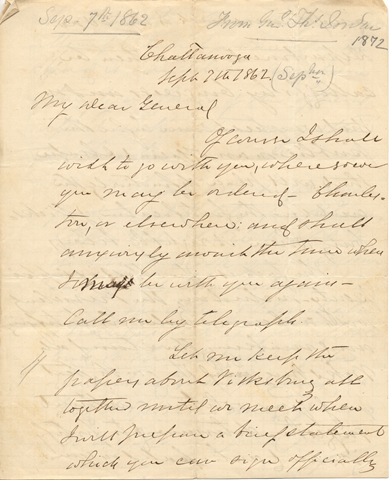
Chattanooga

Sept 7th 1862

My Dear General

Of course I shall wish to go with you, wheresoever you may be ordered—Charleston, or elsewhere; and shall anxiously await the time when I may be with you again—Call me by telegraph.

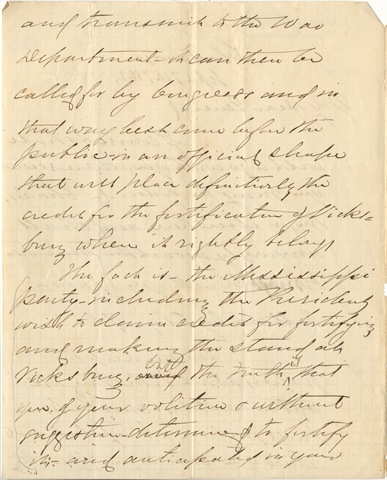
Let me keep the papers about Vicksburg all together until a week when I will present a brief statement which you can sign officially and transmit to the War Department—it can then be called for by Congress and in that way best come before the public in an official shape that will place definitively the credit for the fortification of Vicksburg where it rightfully belongs.

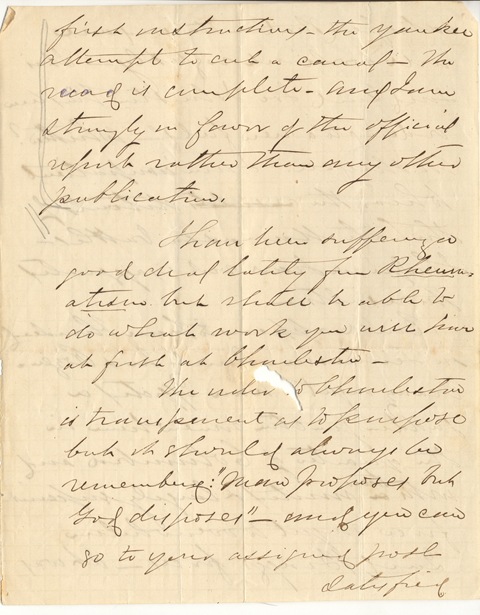
The fact is—the Mississippi party including the President wish to claim credit for fortifying and making the stand at Vicksburg, but the truth is that you, of your volition & without suggestion determined to fortify it—and anticipated in your first instructions—the Yankee attempt to cut a canal—the record is complete—and I am strongly in favor of the official report rather than any other publications.

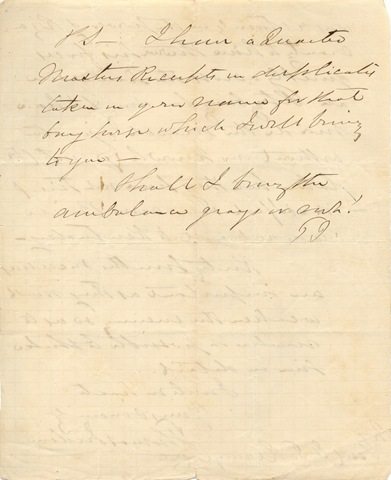
I have been suffering a good deal lately from Rheumatism but shall be able to do what work you will have at first at Charleston.

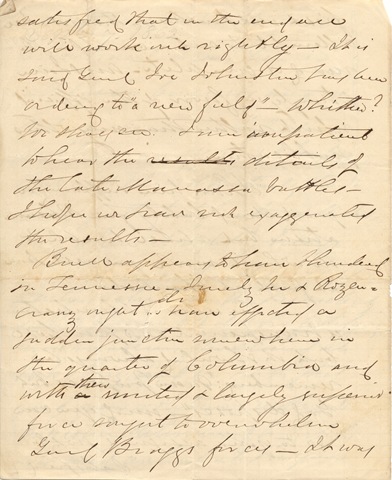
The [illeg.] to Charleston is transparent to purpose but it should always be remembered: “Man proposes but God disposes”—and you can go to your assignment post satisfied that in the end all will work out rightly—This inst. Genl Joe Johnston has been ordered to “a new field”—Whither? We shall see. I am impatient to hear the details of the last Manassa battle—I hope we have not exaggerated the results.

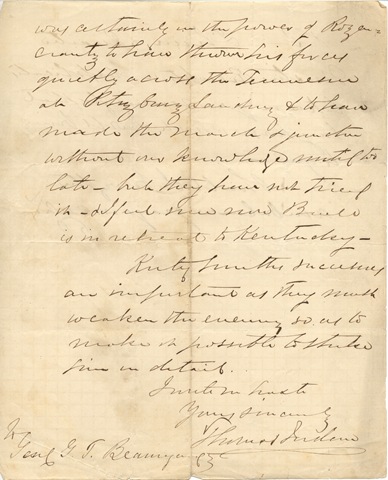
Buell appears to have blundered in Tennessee—surely he and& Rozencranz might have effected a sudden junction somewhere in the quarter of Columbia and with these united & largely superior force [illeg.] to overwhelm Genl. Braggs forces—It was certainly in the power of Rozencrantz to have thrown his forces quietly across the Tennessee at Pittsburg Landing & to have made the March & junction without our knowledge until too late—but they have not tried it– & I feel now Buell is in retreat to Kentucky.

Kirby [illeg.] successes are important as they must weaken the enemy so as to make it possible to strike him in detail.

I write in haste

Yours sincerely

Thomas Jordan


Citation: Thomas Jordan (1819-1895), autograph letter signed to G. T. Beauregard. Chattanooga, 7 September 1862. AMs 359/16

September 6, 1862: John Henry Brown’s Journal

John Henry Brown was a painter of portrait miniatures, living and working in Philadelphia. He had met Lincoln in August of 1860 when he was commissioned to paint Lincoln’s portrait for a supporter, but although Brown liked Lincoln personally, he did not agree with Republican policies.

1862-09-06

Transcript:

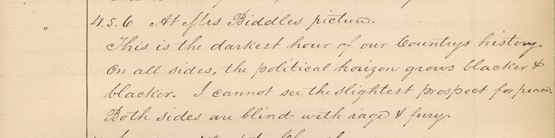
At Mr Biddles picture.

This is the darkest hour of our Country’s history. On all sides, the political horizon grows blacker & blacker. I cannot see the slightest prospect for peace. Both sides are blind with rage & fury.


Citation: John Henry Brown, autograph journal/account book. Philadelphia, 1844-1890. AMs 573/14.1

September 5, 1862: George Eyster to John Riddle Warner

John Riddle Warner was the grandfather of the poet Marianne Moore and during the Civil War he lived in Gettysburg, Pennsylvania. George Eyster was his brother-in-law and lived in Chambersburg. These letters are preserved as part of Marianne Moore’s family papers.  

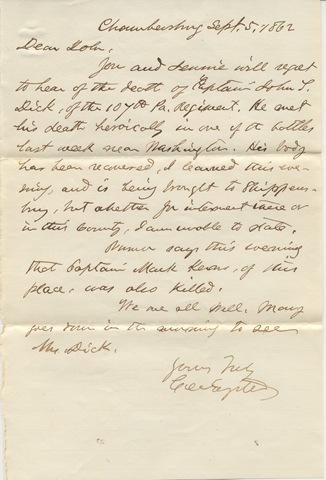
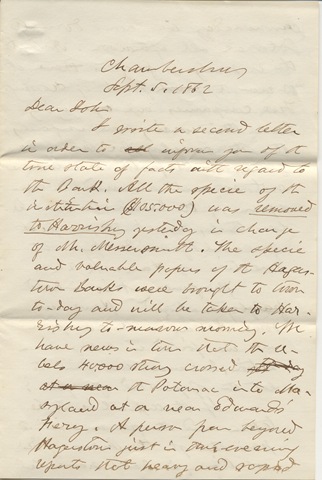
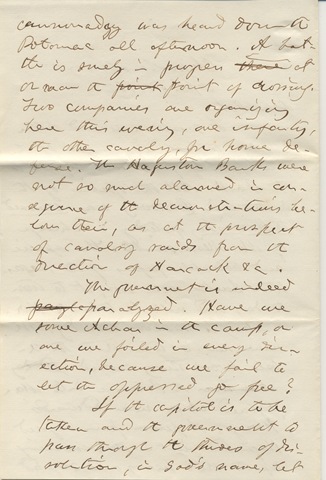
Moore VI-5-10 p4 George Eyster to John Riddle Warner 9-5-62 Moore VI-5-10 p1 George Eyster to John Riddle Warner 9-5-62 Moore VI-5-10 p2 George Eyster to John Riddle Warner 9-5-62 Moore VI-5-10 p3 George Eyster to John Riddle Warner 9-5-62

Transcript:

Chambersburg Sept. 5, 1862

Dear John,

You and Jennie will regret to hear of the death of Captain John Dick, of the 107th Pa. Regiment. He met his death heroically in one of the battles last week near Washington. His body has been recovered, I learned this evening, and is being brought to Shippensburg, but whether for interment there or in this county, I am unable to state.

Rumor says this evening that Captain Mack Kerns, of this place, was also killed.

We are all well. Mary goes down in the morning to see Mr. Dick.

Yours Truly

Geo Eyster


Chambersburg

Sept. 5, 1862

Dear John

I write a second letter in order to inform you of a true tale of facts with regard to the Bank. All the specie of the institution ($105,000) was removed to Harrisburg yesterday in charge of Mr. Menemsmith. The specie and valuable papers of the Hagerstown Banks were brought to town to-day and will be taken to Harrisburg to-morrow morning. We have news in town that the rebels 40,000 strong crossed the Potomac into Maryland and at a near Edwards’ Ferry. A person from beyond Hagerstown just in this evening reports that heavy and rapid cannonage was heard down the Potomac all afternoon. A battle is surely in progress at or near it. [illeg] Two companies are organizing here this evening, one infantry, the other cavalry, for home defense. The Hagerstown Banks were no so much alarmed in consequence of the documentations between them, as at the prospect of cavalry raids from the direction of Hancock &c.

The government is indeed paralyzed. Have we some Achan in the camp or are we foiled in every direction, because we fail to let the oppressed go free?

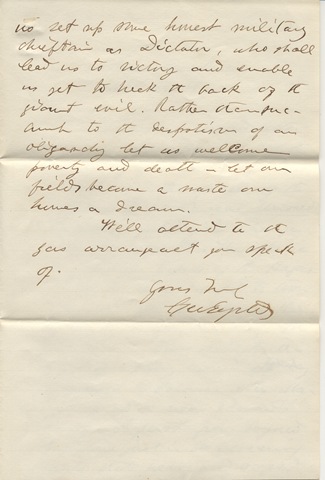
If the capitol is to be taken and the government to pan through the throes of dissolution, in God’s name, let us set up honest military chieftain as Dictator, who shall lead us to victory and enable us set to hack the back of the giant evil. Rather than succumb to the despotism of an oligarchy let us welcome poverty and death—let our fields become a waste and homes a dream.

We’ll attend to the gas arrangement you speak of.

Yours truly

Geo Eyster

Citation: George Eyster, autograph letter signed to John Riddle Warner.  Chambersburg, Pa.; 5 September 1862. Moore VI:05:10
September 3, 1862: Henry and Mary Warner to John Warner

Henry and Mary Warner lived in Allegheny City, Pennsylvania, now part of Pittsburgh. They are the great-grandparents of poet Marianne Moore.  By the 1860s they had three surviving children:  John, Henry, and Anne. Their letters to John, a Presbyterian minister living in Gettysburg, are preserved as part of Marianne Moore’s family papers.

Moore VI-5-10 p1 Henry and Mary Warner to Children 9-3-62

Moore VI-5-10 p2 Henry and Mary Warner to Children 9-3-62

Moore VI-5-10 p3 Henry and Mary Warner to Children 9-3-62  


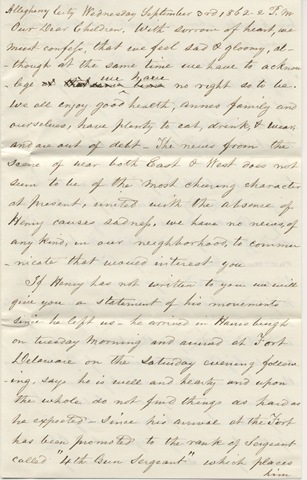
Allegheny City Wednesday September 3rd 1862—2 P.M.

Our Dear Children, With sorrow of heart, we must confess, that we feel sad & gloomy, although at the same time we have to acknowledge we have no right to be. We all enjoy good health; Annes family and ourselves, have plenty to eat, drink, & wear, and are out of debt—The news from the scene of war both East & West does not seem to be of the most cheering character at present, united with the absence of Henry causes sadness. We have no news, of any kind, in our neighborhood, to communicate that would interest you

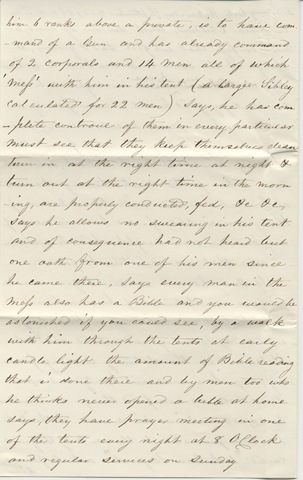
If Henry has not written to you we will give you a statement of his movements since he left us—he arrived in Harrisburgh on tuesday morning and arrived at Fort Delaware on the Saturday evening following, says he is well and hearty and upon the whole do not find things as hard as he expected—since his arrival at the Fort has been promoted to the rank of Sergeant called “4th Gun Sergeant” which places him 6 ranks above a private, is to have command of a Gun and has already command of 2 corporals and 14 men all of which ‘mess’ with him in his tent (a large Sibley calculated for 22 men) Says, he has complete controul of them in every particular must see that they keep themselves clean turn in at the right time in the morning, are properly conducted, fed, &c &c, says he allows no swearing in his tent and of consequence had not heard but one oath from one of his men since he came there, says every man in the mess also has a Bible and you would be astonished if you could see, by a walk with him through the tents at early candle light the amount of Bible reading that is done there and by men too who he thinks never opened a bible at home says, they have prayer meeting in one of the tents every night at 8 oclock and regular services on Sunday

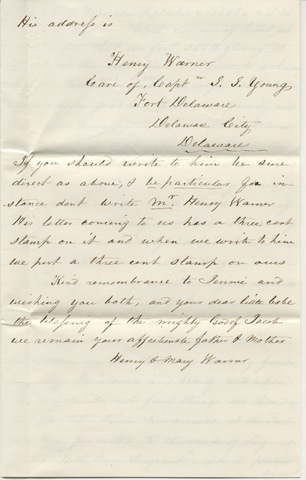
His address is

Henry Warner

Care of, Captn J.J. Young

Fort Delaware

Delaware City

Delaware

If you should write to him be sure direct as above, & be particular for instance dont write Mr. Henry Warner His letter coming to us has a three cent stamp on it and when we write to him we put a three cent stamp on ours

Kind remembrance to Jennie and wishing you both, and your dear little babe the blessing of the mighty God of Jacob

We remain your affectionate father & mother

Henry & Mary Warner


Citation: Henry and Mary Warner, autograph letter signed to John Riddle Warner. Allegheny City [Pittsburgh], 3 September 1862. Moore VI:05:10
September 2, 1862: John Henry Brown’s Journal

John Henry Brown was a painter of portrait miniatures, living and working in Philadelphia. He had met Lincoln in August of 1860 when he was commissioned to paint Lincoln’s portrait for a supporter, but although Brown liked Lincoln personally, he did not agree with Republican policies.

1862-09-02

Transcript:

At Mr Biddles picture.

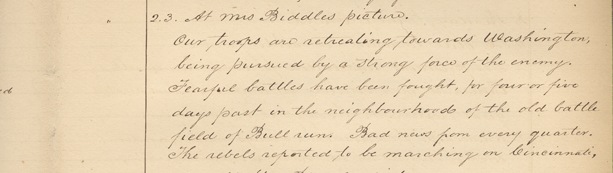
Our troops are retreating towards Washington, being pursued by a strong force of the enemy. Fearful battles have been fought for four or five days past in the neighborhood of the old battle field of Bull Run. Bad news from every quarter. The rebels reported to be marching on Cincinnati.


Citation: John Henry Brown, autograph journal/account book. Philadelphia, 1844-1890. AMs 573/14.1

August 30, 1862: John Henry Brown’s Journal

John Henry Brown was a painter of portrait miniatures, living and working in Philadelphia. He had met Lincoln in August of 1860 when he was commissioned to paint Lincoln’s portrait for a supporter, but although Brown liked Lincoln personally, he did not agree with Republican policies.

1862-08-30

Transcript:

At Mr Biddles picture. Fearful battles near Washington for some days.


Citation: John Henry Brown, autograph journal/account book. Philadelphia, 1844-1890. AMs 573/14.1