November 24, 1862: Alexander Biddle to Julia Williams Rush Biddle

Alexander Biddle was a member of the prominent Philadelphia Biddle family and was married to Julia Williams Rush,  the granddaughter of Dr. Benjamin Rush.  Biddle served with the 121st Pennsylvania Volunteer Infantry, beginning in September 1862. Starting out as a major, he would participate at Fredericksburg and Gettysburg, among other engagements, and would leave the service as a lieutenant colonel. (He was commissioned, but never mustered, as colonel)
Rush IV-30-25 p1 A Biddle ALS to Julia William Rush, Nov 24 Rush IV-30-25 p2 A Biddle ALS to Julia William Rush, Nov 24 Rush IV-30-25 p3 A Biddle ALS to Julia William Rush, Nov 24 Rush IV-30-25 p4 A Biddle ALS to Julia William Rush, Nov 24

Transcript (excerpt):

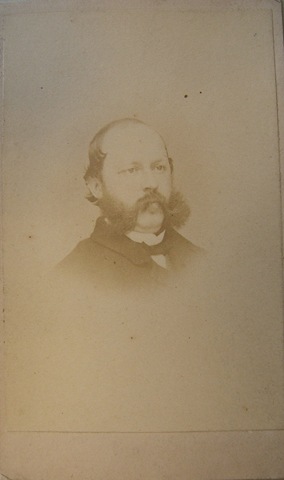
Gen McMahon 1404 North 15th Street

Monday Nov. 24th 1862

Camp near Brooks Station on

Fredericksburg & Potomac RR

Head Quarters 121st Reg. P.V.

Dear Julia,

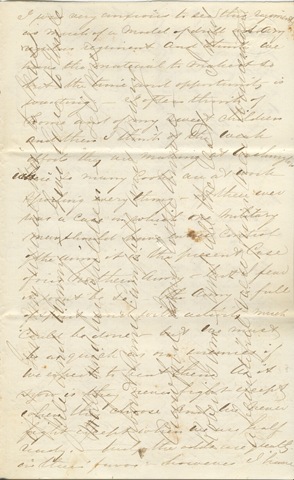
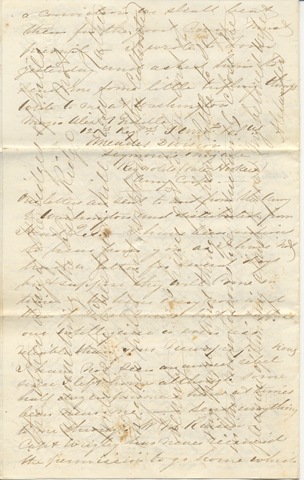
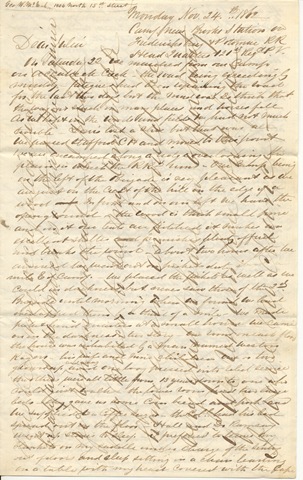
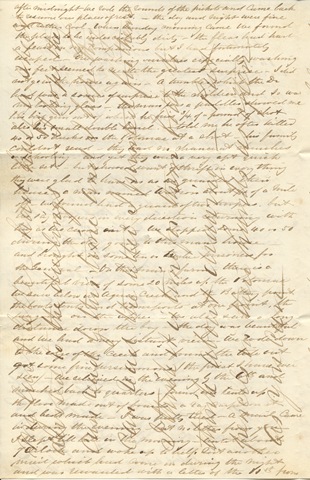
On Saturday 22nd we marched from our Camp on Accekeck Creek – the road being exceedingly muddy – fatigues had been repaving the road for the last two days but the mud was so thick that the wagons stuck in many places and horses fell As we kept in the woods and fields we had not much trouble – Louis lost a shoe but that was all. We passed Stafford CH and moved to this point. We are encamped along a ridge over looking the plains in which the RR runs. Our camp being on the left of the Brigade is very pleasant as we are just on the crest of the hill on the edge of a wood. In front and on our left we have the open ground the wood is thick small pine and in it most of our tents are pitched it makes an excellent shelter furnishes plenty of fuel and breaks the wind – about two hours after we arrived we went out on picket duty about a mile E of camp. We placed the pickets as well as we could in darkness but scarce saw those of the 2nd Brigade until morning when we found we had overlapped them by a third of a mile. We made picket & found quarters at a small house we came on in the darkness two story – one room on each floor the house was inhabited by a man named Weston Rogers his wife and nine children, one or two grown up and away and one boy pressed into rebel service the others were all little from 13 years down to one who could just walk…

Citation: Alexander Biddle (1819-1899), autograph letter signed to Julia Williams Rush Biddle.24 November 1862. Rush:IV:30:25

November 23, 1862: U.S. Grant to His Father

AMs 357-10 p1 U.S. Grant to Jesse Root Grant AMs 357-10 p2 U.S. Grant to Jesse Root Grant

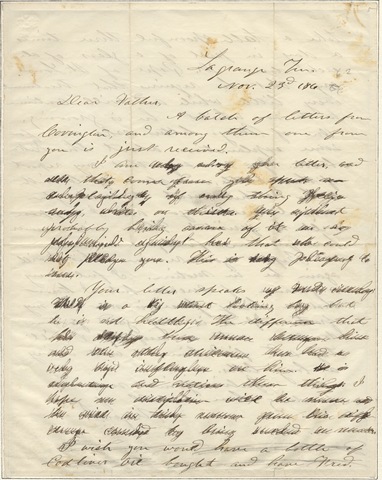
Transcript (excerpt) [Most of the first page is scribbled over, apparently to discourage casual readers, since it deals with sensitive family matters.  Grant takes his father to task for his condescending attitude toward his wife, Julia, and reminds him that his son is sensitive ]:

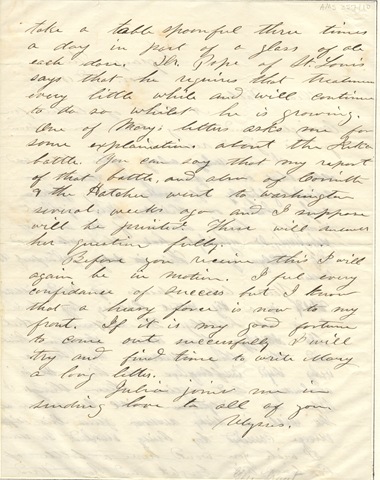
I wish you would have a bottle of Cod liver oil bought and have Fred. take a table spoonful three times a day in part of a glass of ale each dose. Dr. Pope of St. Louis says that he requires that treatment every little while and will continue to do so whilst he is growing…

Before you receive this I will again be in motion. I feel every confidence of success but I know that a heavy force is not to my front. If it is my good fortune to come out successfully I will try and find time to write Mary a long letter.

Citation: Ulysses S. Grant (1822-1885), autograph letter signed to Jesse Root Grant. La Grange, Tenn., 23 November 186[2]. AMs 357/10.

November 21, 1862: Alexander Biddle to Harry and Aleck Biddle

Alexander Biddle was a member of the prominent Philadelphia Biddle family and was married to Julia Williams Rush,  the granddaughter of Dr. Benjamin Rush.  Biddle served with the 121st Pennsylvania Volunteer Infantry, beginning in September 1862. Starting out as a major, he would participate at Fredericksburg and Gettysburg, among other engagements, and would leave the service as a lieutenant colonel. (He was commissioned, but never mustered, as colonel)
Rush IV-30-25 p1 A Biddle ALS to Julia William Rush, Nov 21

Transcript:

Camp near Stafford CD

Friday November 21st 1862

Head Quarters 121st Reg. PV

Dear Harry and Dear Aleck

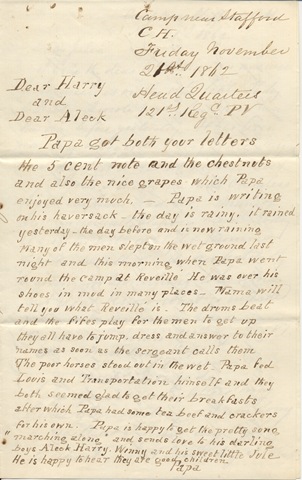
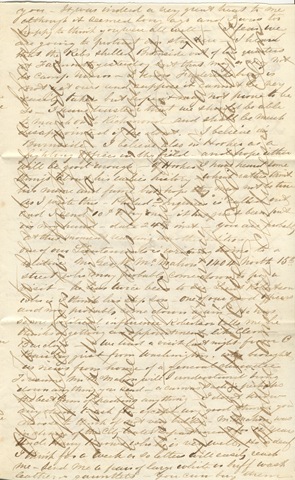
Papa got both your letters the 5 cent note and the chestnuts and also the nice grapes which Papa enjoyed very much. Papa is writing to you on his haversack – the day is rainy it rained yesterday, the day before and is now raining Many of the men slept on the wet ground last night and this morning when Papa went round the camp at Reveille He was over his shoes in mud in many places. Mama will tell you what Reveille is. The drums beat and the fifes play for the men to get up they all have to jump dress and answer to their names as soon as the sergeant calls them. The poor horses stood out in the wet. Papa fed Louis and Transportation himself and they both seemed glad to get their breakfasts after which Papa had some tea beef and crackers for his own. Papa is happy to get the pretty song “marching along” and sends love to his Aleck, Harry, Winny and his sweet little Jule He is happy to hear they are good children

Papa

Citation: Alexander Biddle (1819-1899), autograph letter signed to Julia Williams Rush Biddle.21 November 1862. Rush:IV:30:25

November 20, 1862: George B. Pickett telegram to G. T. Beauregard

Pierre Gustave Toutant Beauregard was a Louisiana-born general of the Confederate States Army. He had graduated second in his class from West Point in 1838 and was an admirer of Napoleon. He achieved fame early in the Civil War for commanding the Fort Sumter bombardment and as the victor of the first battle of Manassas. He later served in the Western Theater (including Shiloh and Corinth), Charleston, and the defense of Richmond, but his career was hampered by friction with Jefferson Davis.

This is one of approximately 1000 military telegrams in P.G.T. Beauregard’s papers at the Rosenbach.

1168-11 1862-11-20 1168-11 1862-11-20 p2

Transcript:

Charleston Nov 20 6

By telegraph from Savannah to Genl Beauregard

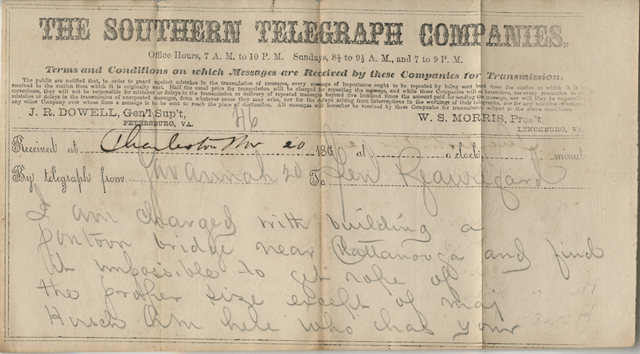
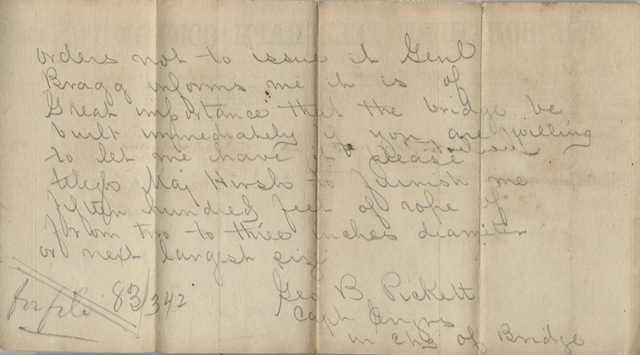
I am charged with building a pontoon bridge near Chattanooga and find it impossible to get rope of the proper size except of Maj Hirsh QM here who has your orders not to issue it. Genl Bragg informs me it is of great importance that the bridge be built immediately if you are willing to let me have it please telegh maj Hirsch to furnish me fifteen hundred feet of rope from two to three inches diameter or next largest size.

Geo B Pickett

Capt  Engrs in chg of bridge

Citation:George B. Pickett, telegram to G. T. Beauregard. Savannah, 20 November 1862. AMs 1168/11

November 19, 1862: Henry and Mary Warner to John Warner

Henry and Mary Warner lived in Allegheny City, Pennsylvania, now part of Pittsburgh. They are the great-grandparents of poet Marianne Moore.  By the 1860s they had three surviving children:  John, Henry, and Anne. Their letters to John, a Presbyterian minister living in Gettysburg, are preserved as part of Marianne Moore’s family papers.

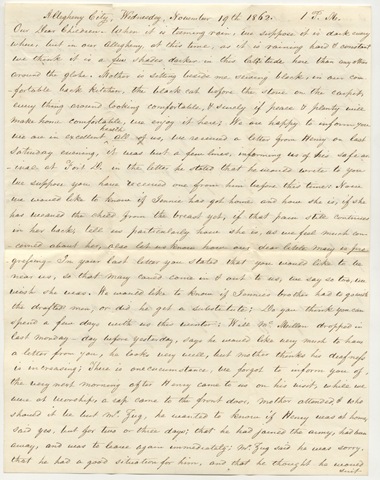
Moore VI-5-12 p1 Henry and Mary Warner to Children 11-19-62

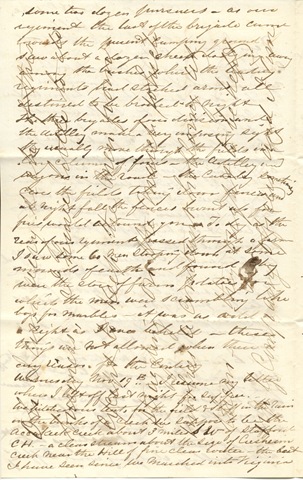
 Moore VI-5-12 p2 Henry and Mary Warner to Children 11-19-62 

  Transcript:

Allegheny City, Wednesday, November 19th 1862. 1 P.M.

Our Dear Children—When it is teeming rain, we suppose it is dark every where, but in our Allegheny, at this time, as it is raining hard & constant we think it is a few shades darker in this latitude here than any other around the globe. Mother is sitting beside me sewing black, in our comfortable back kitchen, the black cat before the stove on the carpet, every thing around looking comfortable, & surely if peace & plenty will make home comfortable, we enjoy it here; We are happy to inform you we are in excellent health all of us, we received a letter from Henry on last Saturday evening, it was but a few lines, informing us of his safe arrival at Fort D. in the letter he stated that he would write to you we suppose you have received one from him before this time; Now we would like to know if Jennie has got home and how she is, if she has weaned the child from the breast yet, if that pain still continues in her back, tell us particularly how she is, as we feel much concerned about her, also let us know how our dear little Mary is progressing—In your last letter you stated that you would like to be near us, so that Mary could come in & out to us, we say so too, we wish she was. We would like to know if Jennies brother had to go with the drafted men, or did he get a substitute; Do you think you can spend a few days with us this winter: Will McMillen dropped in last Monday—day before yesterday, says he would like very much to have a letter from you, he looks very well, but Mother thinks his deafness is increasing; There is one circumstance, we forgot to inform you of, the very next morning after Henry came to us on his visit, while we were at worship, a rap came to the front door, Mother attended, & who should it be but Mr. Zug, he wanted to know if Henry was at home, said yes, but for two or three days; that he had joined the army, had been away, and was to leave again immediately; Mr. Zug said he was sorry, that he had a good situation for him, and that he thought he would suit it very well. Mother says now, how happy she would feel if he was in a situation like that, coming in and out every day, like many a young fellow here, and not be in the army—as we have had no draft in this country—Allegheny having given over her quota for this war: Mother says Will McMillen insisted very much on her, not to forget giving his love to you. I wonder if we forgot to tell you Richard Bard was married, he has been married about two months, to a widow lady whose name was Clarke from New Castle; Jonnie goes to school regularly every day, gets a No. 1 report every week, for which his grandmother gives him one cent according to a promise she made him when he commenced going to school; Sis is a fine little girl, she went to school with Jonnie until a few days ago; now the weather has changed to winter, Anne will keep her at home we think, for two or three months until the severity of winter is over. Robert is still doing very well. All communication has been cut off, between Archy and us for the last two months; We hope our countrywoman Mary has got over the fright the rebels gave her—remember us to her—we would like very much to chat with Mrs Coburn about the rebel times you have had out there—there are several more as well as Mrs Coburn would like to chat with—Miss Rebecca Campbell &c &c &c

Your affectionate father & mother

Henry & Mary Warner

Citation: Henry and Mary Warner, autograph letter signed to John Riddle Warner. Allegheny City [Pittsburgh], 19 November 1862. Moore VI:05:12

November 19, 1862: Alexander Biddle to Julia Williams Rush Biddle

Alexander Biddle was a member of the prominent Philadelphia Biddle family and was married to Julia Williams Rush,  the granddaughter of Dr. Benjamin Rush.  Biddle served with the 121st Pennsylvania Volunteer Infantry, beginning in September 1862. Starting out as a major, he would participate at Fredericksburg and Gettysburg, among other engagements, and would leave the service as a lieutenant colonel. (He was commissioned, but never mustered, as colonel)
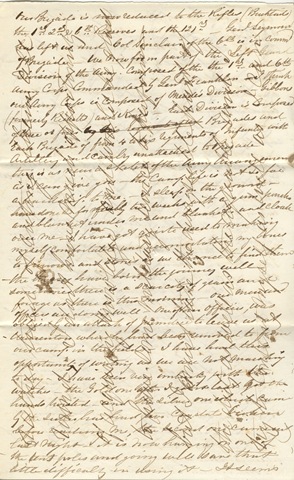
Rush IV-30-25 p2 A Biddle ALS to Julia William Rush, Nov 18 Rush IV-30-25 p3 A Biddle ALS to Julia William Rush, Nov 18 Rush IV-30-25 p4 A Biddle ALS to Julia William Rush, Nov 18

Transcript (excerpt):

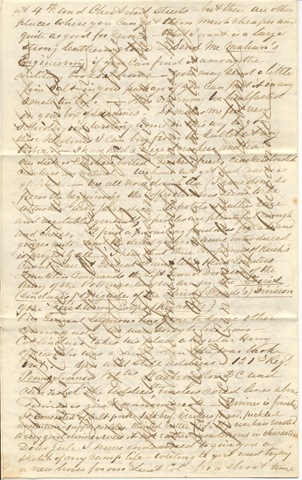
Wednesday Nov. 19th – I resume my letter where I left off last nights for supper. We pitched our tents for the field & staff in the rain on the banks of a creek we suppose to be the Accukeck Creek about 3 miles W of Stafford CH. A clean stream about the size of [Cushiem?] Creek near the Hill of fine clear water – the best I have seen since we marched into Virginia our Brigade is now reduced to the Rifles (Bucktails) the 1st, 2nd & 6th Reserves and the 121st. Genl. Seymour has left us and Col Sinclair of the 6th in command of Brigade. We now form part of the Left Guard Division of the Army. Composed of the 1st and 6th Army Corps Commanded by Genl. Franklin I think our Army Corps is comprised of Meade’s division Gibbon (formerly Ricketts) and King’s – Each Division is composed of these or four Brigades and each Brigade of four to six regiments of military units Artillery and Cavalry unattached to Brigade. This is as near a sketch of the Army Amalgam as I can give you.

Citation: Alexander Biddle (1819-1899), autograph letter signed to Julia Williams Rush Biddle.18-19 November 1862. Rush:IV:30:25

November 18, 1862: Alexander Biddle to Julia Williams Rush Biddle

Alexander Biddle was a member of the prominent Philadelphia Biddle family and was married to Julia Williams Rush,  the granddaughter of Dr. Benjamin Rush.  Biddle served with the 121st Pennsylvania Volunteer Infantry, beginning in September 1862. Starting out as a major, he would participate at Fredericksburg and Gettysburg, among other engagements, and would leave the service as a lieutenant colonel. (He was commissioned, but never mustered, as colonel)

Rush IV-30-25 p1 A Biddle ALS to Julia William Rush, Nov 18 Rush IV-30-25 p2 A Biddle ALS to Julia William Rush, Nov 18 Rush IV-30-25 p3 A Biddle ALS to Julia William Rush, Nov 18 Rush IV-30-25 p4 A Biddle ALS to Julia William Rush, Nov 18

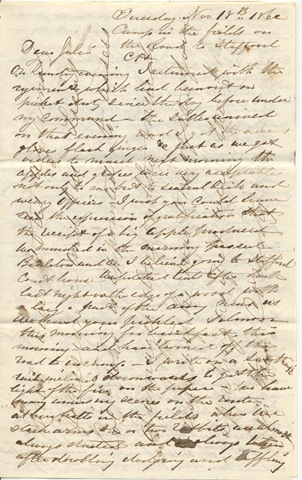
Transcript (excerpt):

Tuesday Nov 18th 1862

Camp in the fields on the Road to Stafford CH

Dear Julia

On Sunday evening I returned with the regiment which had been out on picket duty since the day before under my command – the Sutler arrived on that evening and I got the drawers gloves flash ginger &c just as we got orders to march next morning the apples and grapes were very acceptable not only to me but to several sick and weary officers. I wish you could have seen the expression of gratitude that the receipt of a big apple produced. We marched in the morning passed Bealeton and are I believe going to Stafford Court House. We pitched tents after dusk last night on the edge of a wood with a large part of the army near us. We had your pickled salmon this morning and have turned off the road to encamp. I write on a [Swootings? suit?] inclined downwards to get the light of the fire on the paper…

Citation: Alexander Biddle (1819-1899), autograph letter signed to Julia Williams Rush Biddle.18 November 1862. Rush:IV:30:25

November 14, 1862: Alexander Biddle to Julia Williams Rush Biddle

Alexander Biddle was a member of the prominent Philadelphia Biddle family and was married to Julia Williams Rush,  the granddaughter of Dr. Benjamin Rush.  Biddle served with the 121st Pennsylvania Volunteer Infantry, beginning in September 1862. Starting out as a major, he would participate at Fredericksburg and Gettysburg, among other engagements, and would leave the service as a lieutenant colonel. (He was commissioned, but never mustered, as colonel) [Note: this statement has been updated to reflect that Biddle was not mustered as a colonel]

Rush IV-30-25 p1 A Biddle ALS to Julia William Rush, Nov 14 Rush IV-30-25 p2 A Biddle ALS to Julia William Rush, Nov 14 Rush IV-30-25 p3 A Biddle ALS to Julia William Rush, Nov 14 Rush IV-30-25 p4 A Biddle ALS to Julia William Rush, Nov 14

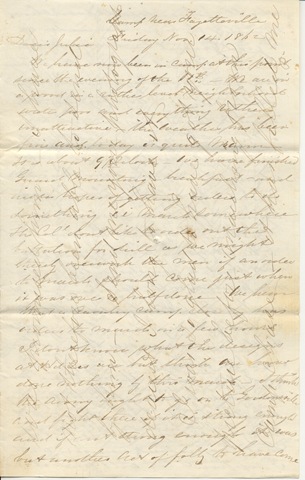
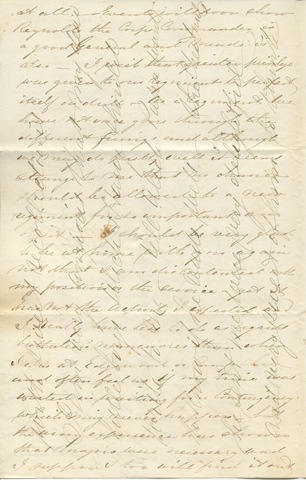
Transcript (excerpt):

Camp near Fayetteville

Friday Nov. 14. 1862

Dear Julia

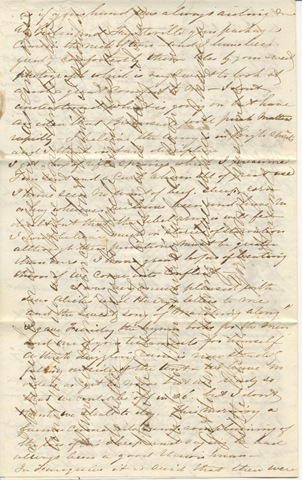
We have now been in camp at this point since the evening of the 11th. We are in a wood in a rather level neighborhood water poor and everything rather unattractive – the weather has been fine and today is quite warm. It is about 9 ½ O’clock – We have finished Guard Mounting – breakfast and are in hopes of getting orders to do something or march somewhere The Col don’t like to order out the battalion for drill as we might thereby overwork the men if an order to march should come just when it was over or half done. We hear that a cavalry camp close by has orders to march in a few hours I don’t know what the designs at Hd Qrs are but think we have done nothing by this march. I think the army ought to go on to Gordonville and fight there if it if strong enough and if not strong enough it was but another act of folly to have come at all. Events will soon show Reynolds the Corps Commander is a good General and Meade is also. I wish that greater privilege was given to our Regiment to perfect itself on drill. As a Regiment we have not once gone through the different  firings and although we may do justly well it seems strange to me that no chance should be allowed to a new regiment for so important an object. I should be very glad to get home with you again not that I am discontented with my position or the service –

Citation: Alexander Biddle (1819-1899), autograph letter signed to Julia Williams Rush Biddle.14 November 1862. Rush:IV:30:25
November 13, 1862: New York Evening Express

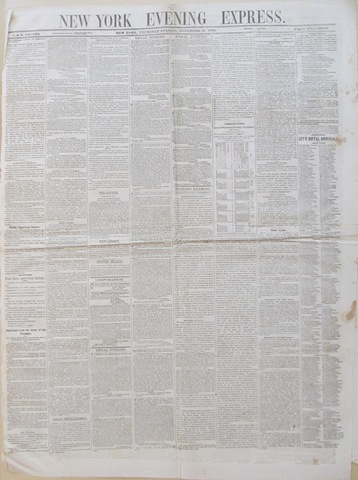
New York Evening Express

Thursday Evening, November 13, 1862

Important from the Army of the Potomac.

The Army-Rappahanock Station-Rebel Intentions- Tired of Secession.

“Gainsville, Va..Nov. 10th.-The armies of Sigel and Mc Clellan are closely pressing upon the enemy. Hardly a day passes but one of more of their strongholds fall into our possession. They are either driven out or compelled to retreat before us.

The rebels had placed Rappahannock Station in a defiant attitude; but on Friday afternoon our troops entered, the secesh having just cleverly vacated.

To them this was rather humiliating, and accordingly they thought they would drive the Unionists out. They brought up force infinitely larger than ours, and commenced an artillery fire.

The superiority of numbers did not intimidate our men, and they replied from their guns. The effect of the fire was evidently unhealthy, as the rebels retired without accomplishing their purpose. We still hold the place, and will continue to do so as our army moves forward to Richmond, which it is undoubtedly doing with success. It, at present, looks as though the rebels will make a temporary stand at Gordonsville, but they fear us too much now and to make one last struggle for their illegitimate cause , they will fall back to the Confederate Capital, and it then will, in turn fall back upon them.

The people of Virginia are getting tired of the war. Many who a year ago were violent secessionists now acknowledge that t hey would be glad if their state would return to their allegiance…”


Citation: New York Evening Express.  New York, 13 November 1862. Gift of Steven and Susan Raab.