December 6, 1862: Alexander Biddle to Julia Williams Rush Biddle

Alexander Biddle was a member of the prominent Philadelphia Biddle family and was married to Julia Williams Rush,  the granddaughter of Dr. Benjamin Rush.  Biddle served with the 121st Pennsylvania Volunteer Infantry, beginning in September 1862. Starting out as a major, he would participate at Fredericksburg and Gettysburg, among other engagements, and would leave the service as a lieutenant colonel. (He was commissioned, but never mustered, as colonel)

Rush IV-30-26 p1 A Biddle ALS to Julia William Rush, Dec. 6 Rush IV-30-26 p2 A Biddle ALS to Julia William Rush, Dec. 6 Rush IV-30-26 p3 A Biddle ALS to Julia William Rush, Dec. 6 Rush IV-30-26 p4 A Biddle ALS to Julia William Rush, Dec. 6

Transcript (excerpt):

Head Qrs 121st Regt P. V.

Camp near Brooks Station

Saturday Dec. 6th 1862

Dear Julia

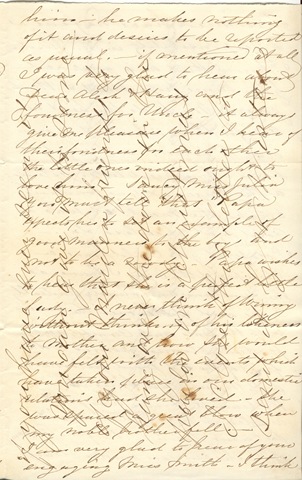
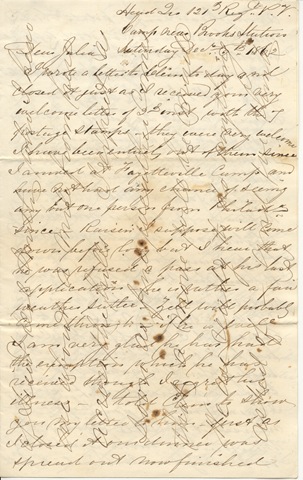
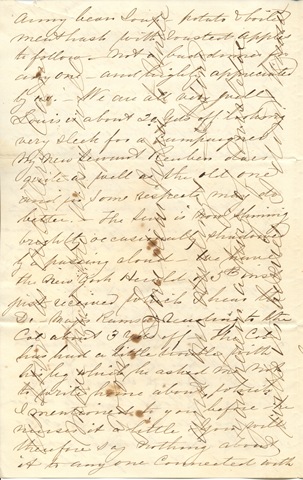
I wrote a letter to Clem to day and closed it just as I received your very welcome letter of 2nd inst with the 7 postage stamps – they were very welcome I have been entirely out of them since I arrived at Fayetteville Camp and have not had any chance of seeing any but one person from Philad. since Raisin I suppose will come down before long but I hear that he was refused a pass at his last application – he is rather a fair weather sutler – Zell will probably come through – if he is well I am very glad he has had the exemption which he has received though I regret his illness. I told Clem to show you my letter to him. First as I closed it our dinner was spread out now finished army bean soup – potato & boiled meat hash with roasted apples to follow. Not a bad dinner for anyone – and highly appreciated by us. We are all very well Louis is about 20 yds off looking very sleek for a campaigner – my new servant Reuben does quite as well as the old one and in some respects may do better. The sun is not shining brightly occasionally shadowed by a passing cloud – We have the New York Herald of 5th inst just received which I hear the Dr. Major Ramsay reading to the Col about 3 yds off. The Col had a little trouble with his leg which he asked me not to write home about, which I mentioned to you before – he nurses it a little. You will therefore say nothing about it to any one connected with him – he makes nothing of it and desires to be reported of as usual – if mentioned at all…

Citation: Alexander Biddle (1819-1899), autograph letter signed to Julia Williams Rush Biddle. 6 December 1862. Rush:IV:30:26

December 4, 1862: Alexander Biddle to Julia Williams Rush Biddle

Alexander Biddle was a member of the prominent Philadelphia Biddle family and was married to Julia Williams Rush,  the granddaughter of Dr. Benjamin Rush.  Biddle served with the 121st Pennsylvania Volunteer Infantry, beginning in September 1862. Starting out as a major, he would participate at Fredericksburg and Gettysburg, among other engagements, and would leave the service as a lieutenant colonel. (He was commissioned, but never mustered, as colonel)

Rush IV-30-26 p1 A Biddle ALS to Julia William Rush, Dec. 4 Rush IV-30-26 p2 A Biddle ALS to Julia William Rush, Dec. 4 Rush IV-30-26 p3 A Biddle ALS to Julia William Rush, Dec. 4 Rush IV-30-26 p4 A Biddle ALS to Julia William Rush, Dec. 4

Transcript (excerpt):

Camp near Brooks Station

Head Quarters 121st Regt P.V.

Thursday December 4th 1862

Dear Julia

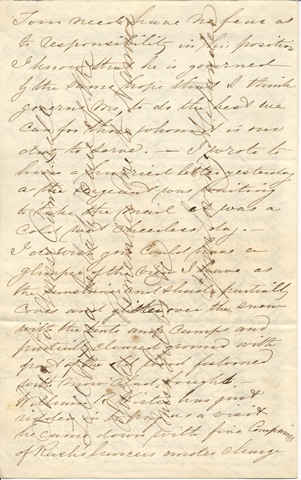
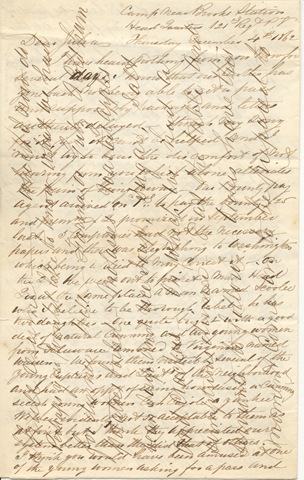
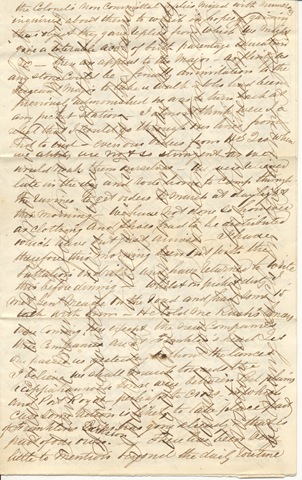
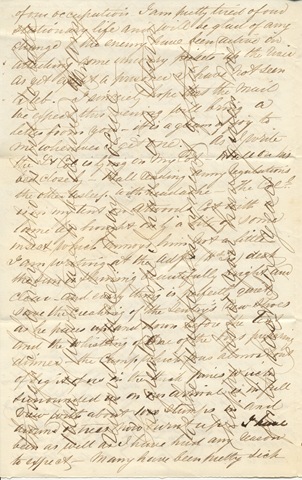
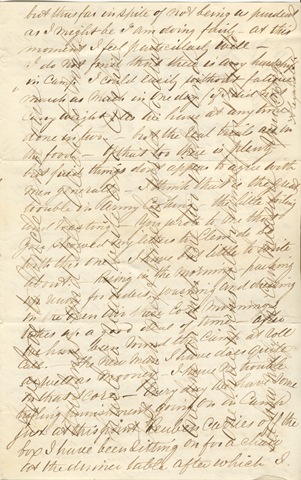
I have heard nothing from you now for several days. I know that our Sutler has gone back not being able to get a pass and suppose my package and letters are thereby delayed. Though very sorry for it yet it cannot be helped and I must try to bear the discomfort of not hearing from you which alone alleviates the pain of being away. Our Bounty pay agent arrived on 1st to pay the bounty of $25 and [premium?] of $2 promised in September last. 3 Companies had not the necessary papers and there was telegraphing to Washington which being replied to may correct it. On the 2nd we went out to picket – made Head Qrs at the same place a man named Scooler who I believe to be thorough Rebel – he has two daughters – one quite bright with a good deal of natural cunning and two young women from Delaware removed to Virginia named Warren. We found them visited by several of the young captains and Lieuts of the neighborhood and had an oppy of seeing how easily a cunning secesh young woman can cajole a yankee We were evidently not so acceptable to them as at first but I think they appreciated our system better than they did that of others. I think you would have been amused at one of the young women asking for a pass and the Colonel’s non committal replies mixed with numerous inquiries about them to which in hopes of gaining their object they gave replies from which we might give a tolerable acc. of birth parentage education &c – then an appeal to the major – as flinty as any stone could be – finally an invitation to the Sergeant Major to take a walk who had been previously admonished he was to turn back at any picket station. I almost think were I a rebel that I could go through our lines from end to end – even our riders from Hd Qrs when we apply are not so stringent as we would make them ourselves. We were relieved late in the day and rode home to camp through the ravines to get orders to march at daylight this morning. We have not done so however as clothing and shoes had to be distributed which have but just arrived…

Citation: Alexander Biddle (1819-1899), autograph letter signed to Julia Williams Rush Biddle. 4 December 1862. Rush:IV:30:26

December 3, 1862: New York Herald

Top for web

Transcript (excerpt):

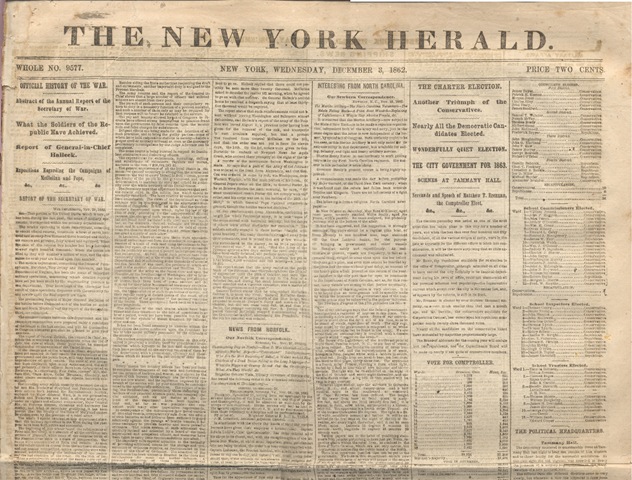
Interesting from North Carolina.

Our Newbern Correspondence.

Newbern, N.C., Nov. 18, 1862.

The Marine Artillery – The North Carolina Volunteers – The Rebels Falling Back – A Pilot Boat Wanted – Replacing of Lighthouses – A Way to Stop Abusive People, &c.

It is rumored that the Marine Artillery – now subject to the State of New York – is to be made a separate organization, independent both of the army and navy, just in the same degree that the latter is now independent of the former, by special act of Congress. Such certainty ought to be the case, as this Marine Artillery is not only noted for its extreme utility in this department, but available for sailing, infantry, and light and heavy artillery service.

Charles Henry Foster is meritoriously to work getting recruits for our first North Carolina regiment. His success is particularly astonishing.

Caption: New York Herald. 3 December 1862. Gift of Steven and Susan Raab. AN .N56792

December 2, 1862: Henry and Mary Warner to John Warner

Henry and Mary Warner lived in Allegheny City, Pennsylvania, now part of Pittsburgh. They are the great-grandparents of poet Marianne Moore.  By the 1860s they had three surviving children:  John, Henry, and Anne. Their letters to John, a Presbyterian minister living in Gettysburg, are preserved as part of Marianne Moore’s family papers.

Moore VI-5-13 p1 Henry and Mary Warner to Children 12-2-62 Moore VI-5-13 p2 Henry and Mary Warner to Children 12-2-62

Transcript:

Allegheny City Tuesday December 2nd 1862 11 A.M.

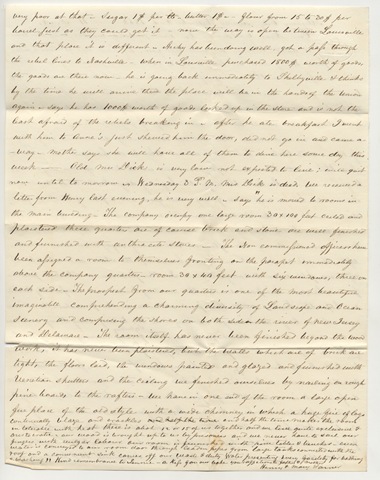
Our Dear Children—You will probably wonder why our letter is dated tuesday, we will tell you, we have not received a letter from Henry since we last wrote to you, in all probability we will receive one from him this evening, if we do, we would like to answer it on tomorrow, in our last, we stated to him, that, on the day after the receipt of his letter we would answer it, except that day happened to be on Sabbath, in that case we would answer it on Monday, if possible, to write two letters in one day is, now, more than we can conveniently do, without slighting one of them, and that is what we do not like to do, however we will not close this until tomorrow afternoon, our usual time of mailing our letter to you. On last thursday thanksgiving day Mother & I dined with Anne, we had a very nice young roast goose and a pair of chickens for dinner with all the et ceteras connected with such a meal, spent the afternoon there, took tea, and remained until bed time—kept worship at Annes request, during the afternoon and evening enjoyed ourselves much—after the old couple returned home, heated up the stove and returned to rest after we felt warm & comfortable—In the forenoon a student preached for us, he done his part well, the meetinghouse was comfortably heated, we hope the hearers acted their part as well as the preacher—the audience was not as large as it might, or ought to be, taking every thing into consideration—so ended thanksgiving day. On Saturday morning about 7 ½ oclock a rap came to the front door, your father attended, who should it be but Archy Armstrong—not having heard from him, for the last three months, we were astonished, he looked well, is in good health, and well dressed, not in rags, although from the South, had his carpet bag, good comfortable overcoat &c &c. Mother jumped round, and in less than no time had him seated before a comfortable breakfast, pork steak fresh &c &c. he ate hearty, seemed to enjoy his meal, told us of the wonderful things going on South, boarding in Nashville 15$ per week and diet very poor at that—sugar 1$ per lb, butter 1$– flour from 15 tp 30$ per barrel, just as they could get it—now the way is open between Louisville and that place it is different—Archy has been doing well, got a pass through the rebel lines to Nashville—when in Louisville purchased 1800$ worth of goods, the goods are there now—he is going back immediately to Shelbyville & thinks by the time he will arrive the place will be in the hands of the Union again—says he has 1000$ worth of goods locked up in the store and is not the least afraid of the rebels breaking in—after he ate breakfast I went with him to Anne’s just shewed him the door, did not go in and came away—Mother says she will have all of them to dine here some day this week—Old Mrs Dick is very low not expected to live; will quit now until to-morrow—Wednesday 3 P.M. Mrs Dick is dead. We received a letter from Henry last evening, he is very well—says “he is moved to rooms in the main building—The company occupy one large room 30 x 100 feet ceiled and plaistered these quarters are of course brick and stone are well finished and furnished with anthracite stoves—The non commissioned officers have been assigned a room to themselves fronting on the parapet immediately above the company quarter—room 30 x 40 feet with six windows, three on each side—The prospect from our quarters is one of the most beautiful imaginable comprehending a charming diversity of Landscape and Ocean scenery and comprising the shores on both sides the river of New Jersey and Delaware—The room itself has never been finished beyond the wood work, it has never been plaistered, but the walls which are of brick are tight, the floor laid, the windows painted and glazed and furnished with Venetian shutters and the ceiling we finished ourselves by nailing on rough pine boards, to the rafters—we have in one end of the room a large open fire place of the old style with a wide chimney in which a huge fire of logs continually blaze and crackles and half the time makes the room intolerable with heat there is about 12 or 15 of us together and we live quite exclusive & aristocratic—our wood is brought up to us by prisoners and we never have to soil our fingers with vulgar labour our room is furnished with pine tables & benches—even water is conveyed to our room door through leaden pipes from large tanks connected with the roof and a convent sink carries off our waste & dirty water presenting every facility for bathing & washing” Kind remembrance to Jennie—a kiss for our babe Your affectionate father & mother

Henry & Mary Warner

Citation: Henry and Mary Warner, autograph letter signed to John Riddle Warner. Allegheny City [Pittsburgh], 2 December 1862. Moore VI:05:13

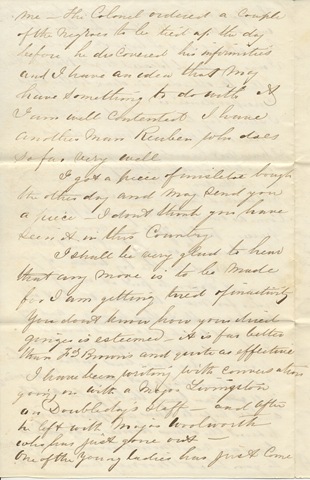
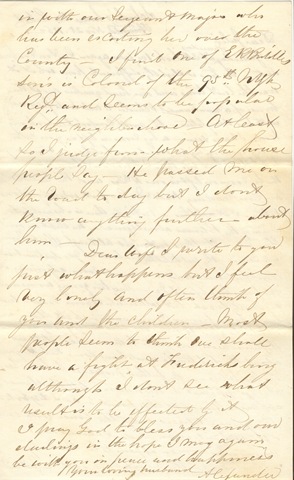
December 1, 1862: Alexander Biddle to His Children

Alexander Biddle was a member of the prominent Philadelphia Biddle family and was married to Julia Williams Rush,  the granddaughter of Dr. Benjamin Rush.  Biddle served with the 121st Pennsylvania Volunteer Infantry, beginning in September 1862. Starting out as a major, he would participate at Fredericksburg and Gettysburg, among other engagements, and would leave the service as a lieutenant colonel. (He was commissioned, but never mustered, as colonel)

Rush IV-30-26 p3 A Biddle ALS to Julia William Rush, Dec. 1 Rush IV-30-26 p4 A Biddle ALS to Julia William Rush, Dec. 1

Transcript:

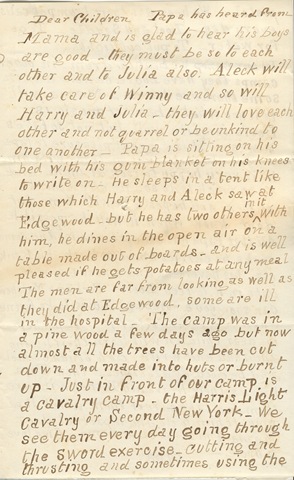
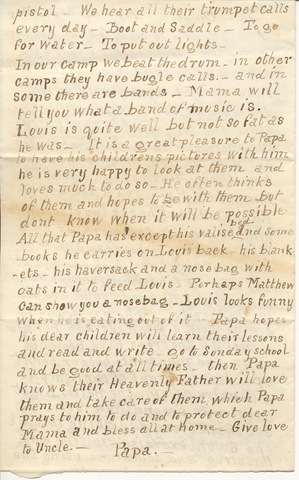
Dear Children Papa has heard from Mama and is glad to hear his boys are good – they must be so to each other and to Julia also. Aleck will take care of Winny and so will Harry and Julia – they will love each other and not quarrel or be unkind to one another – Papa is sitting on his bed with his gum blanket on his knees to write on. He sleeps in a tent like those which Harry and Aleck saw at Edgewood – but he has two others in it with him, he dines in the open air on a table made out of boards, and is well pleased if he gets potatoes at any meal The men are far from looking as well as they did at Edgewood, some are ill in the hospital. The camp was in a pine wood a few days ago but now almost all the trees have been cut down and made into huts or burnt up. Just in front of our camp is a cavalry camp, the Harris Light Cavalry or Second New York. We see them every day going through the sword exercise, cutting and thrusting and sometimes using the pistol. We hear all their trumpet calls every day – Boot and Saddle – To go for water – To put out lights – In our camp we beat the drum, in other camps they have bugle calls. and in some others there are bands – Mama will tell you what a band of music is. Louis is quite well but not so fat as he was. It is a great pleasure to Papa to have his childrens pictures with him he is very happy to look at them and loves much to do so. He often thinks of them and hopes to be with them but don’t know when it will be possible. All that Papa has except his valise bed and some books he carries on Louis’ back – his blank-ets – his haversack and a nose bag with oats in it to feed Louis. Perhaps Matthew can show you a nosebag. Louis looks funny when he is eating out of it Papa hopes his dear children will learn their lessons and read and write – go to Sunday school and be good at all times – then Papa knows their Heavenly Father will love them and take care of them which Papa prays to him to do and to protect dear Mama and bless all at home. Give love to Uncle. –

Papa. –

Citation: Alexander Biddle (1819-1899), autograph letter signed to his children. 1 December 1862. Rush:IV:30:26

November 29, 1862: Alexander Biddle to Julia Williams Rush Biddle

Alexander Biddle was a member of the prominent Philadelphia Biddle family and was married to Julia Williams Rush,  the granddaughter of Dr. Benjamin Rush.  Biddle served with the 121st Pennsylvania Volunteer Infantry, beginning in September 1862. Starting out as a major, he would participate at Fredericksburg and Gettysburg, among other engagements, and would leave the service as a lieutenant colonel. (He was commissioned, but never mustered, as colonel)

Rush IV-30-25 p1 A Biddle ALS to Julia William Rush, Nov 29 Rush IV-30-25 p2 A Biddle ALS to Julia William Rush, Nov 29

Transcript:

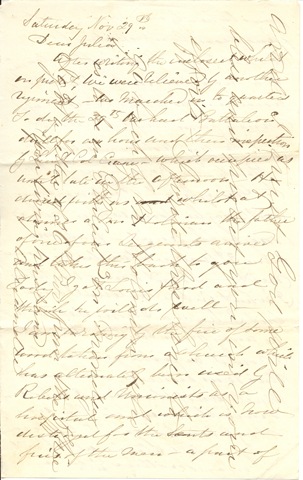
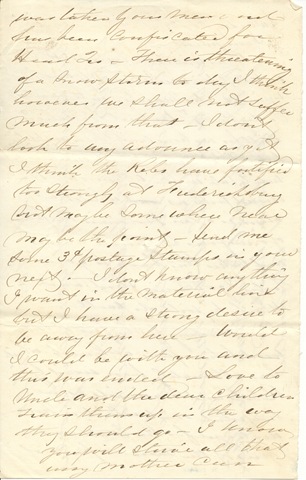
Saturday Nov 29th

Dear Julia

After writing the enclosed whilst on picket we were relieved by another regiment. We marched in to quarters To day the 29th We had Battalion drill for an hour and then inspection by Lieut Col Crane which occupied us until late in the afternoon. He dined with us whilst at dinner a Mr Holman the father of one of our Sergeants arrived and takes this back to you. Today I got Louis shod and think he will do well. I am writing by the fire of some wood taken from a church which has alternately been used by Rebels and Unionists as a hospital and which is now destroyed for the tents and fires of the men – a part of was taken by our men and has been confiscated for Head Qrs. There is threatening of a snow storm to day I think however we shall not suffer much from that. I don’t look to any advance as yet I think the Rebs have fortified too strongly at Fredericksburg but maybe somewhere near may be the point – Send me some 3¢ postage stamps in your next. I don’t know anything I want in the material line but I have a strong desire to be away from here. Would I could be with you and this war ended. Love to Uncle and the dear children. Train them up in the way they should go. I know you will strive all that any mother can and I trust God will bless and protect you in your efforts.

I write these lines to go back by Mr. Holman who is to be in Philad. in Monday I got a letter of 26th Nov from the Office

Your loving husband

Alexander

Citation: Alexander Biddle (1819-1899), autograph letter signed to Julia Williams Rush Biddle.29 November 1862. Rush:IV:30:25

November 28, 1862: Alexander Biddle to Julia Williams Rush Biddle

Alexander Biddle was a member of the prominent Philadelphia Biddle family and was married to Julia Williams Rush,  the granddaughter of Dr. Benjamin Rush.  Biddle served with the 121st Pennsylvania Volunteer Infantry, beginning in September 1862. Starting out as a major, he would participate at Fredericksburg and Gettysburg, among other engagements, and would leave the service as a lieutenant colonel. (He was commissioned, but never mustered, as colonel)

Rush IV-30-25 p1 A Biddle ALS to Julia William Rush, Nov 28 Rush IV-30-25 p2 A Biddle ALS to Julia William Rush, Nov 28 Rush IV-30-25 p3 A Biddle ALS to Julia William Rush, Nov 28 Rush IV-30-25 p4 A Biddle ALS to Julia William Rush, Nov 28

Transcript (excerpt):

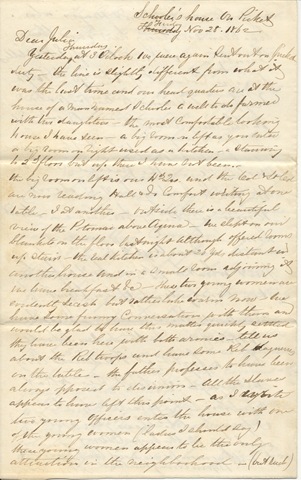
Schooler’s house on Picket

Thursday Friday Nov. 28. 1862

Dear Julia

Yesterday Thursday at 3 O’clock we were again sent on Picket duty. The line is slightly different from what it was the last time and our head quarters are at the houses of a man named Schooler a well to do farmer with his daughters – the most comfortable looking house I have ever seen – a big room on left as you enter a big room on right used as a kitchen – a stairway to 2nd floor but up there I have not been.

[…]

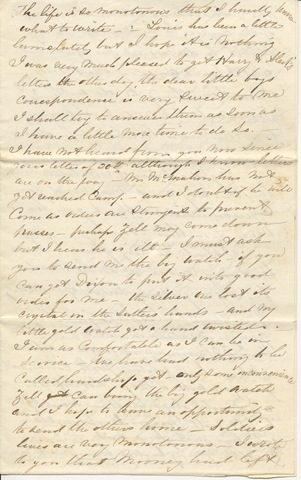
The life is so monotonous that I hardly know what to write. Louis has been a little lame lately but I hope it is nothing. I was very much pleased to get Harry & Aleck’s letters the other day, the dear little boys correspondence is very sweet to me. I shall try to answer them as soon as I have a little more time to do so. I have not heard from you now since your letter of 20th although I know letters are on the way. Mr. McMahon has not yet reached camp – and I doubt if he will come as orders are stringent to present passes – perhaps Zell may come down but I hear he is ill. I must ask you to send me the big watch if you can get Dixon to put it into good order for me…

Citation: Alexander Biddle (1819-1899), autograph letter signed to Julia Williams Rush Biddle.28 November 1862. Rush:IV:30:25

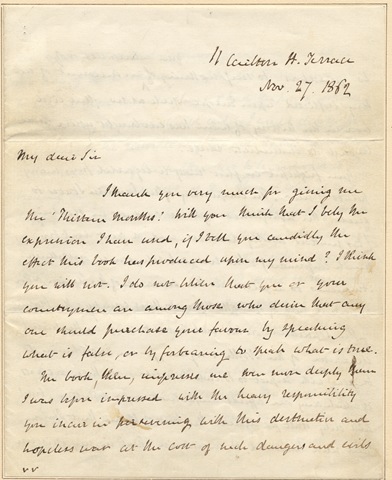
November 27, 1862: William Gladstone to Cyrus Field

Cyrus Field was the founder of the Atlantic Telegraph Company, which laid the first trans-Atlantic telegraph cable; a project which gave him close ties with British politicians and businessmen.AMs 375-14 p1 William E Gladstone to Cyrus W Field AMs 375-14 p2 William E Gladstone to Cyrus W Field AMs 375-14 p3 William E Gladstone to Cyrus W Field AMs 375-14 p4 William E Gladstone to Cyrus W Field AMs 375-14 p5 William E Gladstone to Cyrus W Field AMs 375-14 p6 William E Gladstone to Cyrus W Field AMs 375-14 p7 William E Gladstone to Cyrus W Field
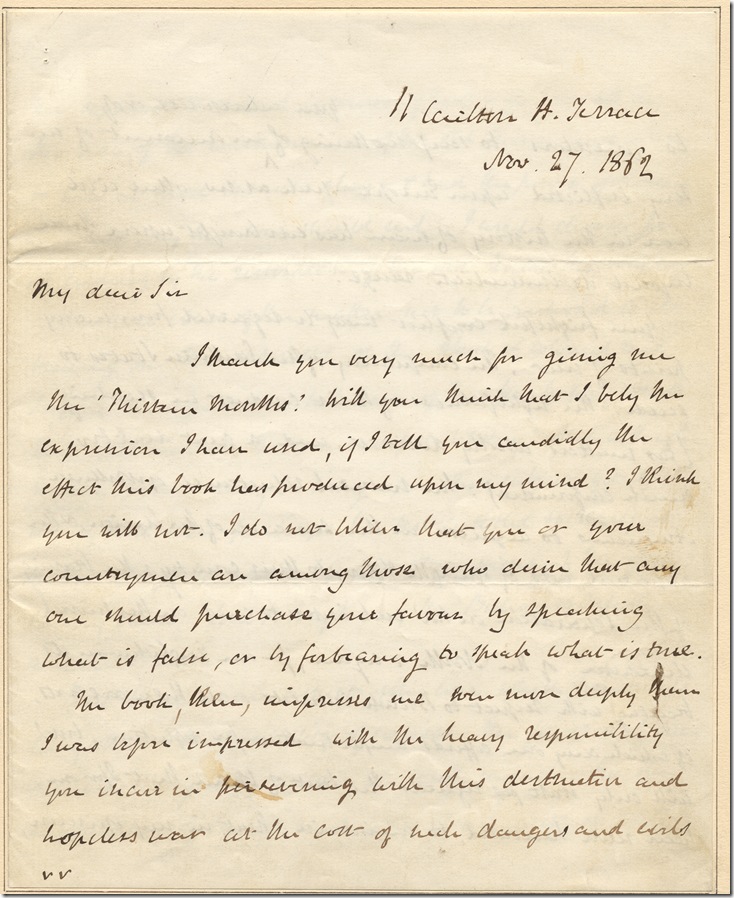
11 Wilton H. Terrace

Nov. 27. 1862

My dear Sir

I thank you very much for giving me the Thirteen Months. Will you think that I bely the expression I have used, if I tell you candidly the effect this book has produced upon my mind? I think you will not. I do not believe that you or your countrymen are among those who desire that any one should purchase your favour by speaking what is false, or by forbearing to speak what is true.

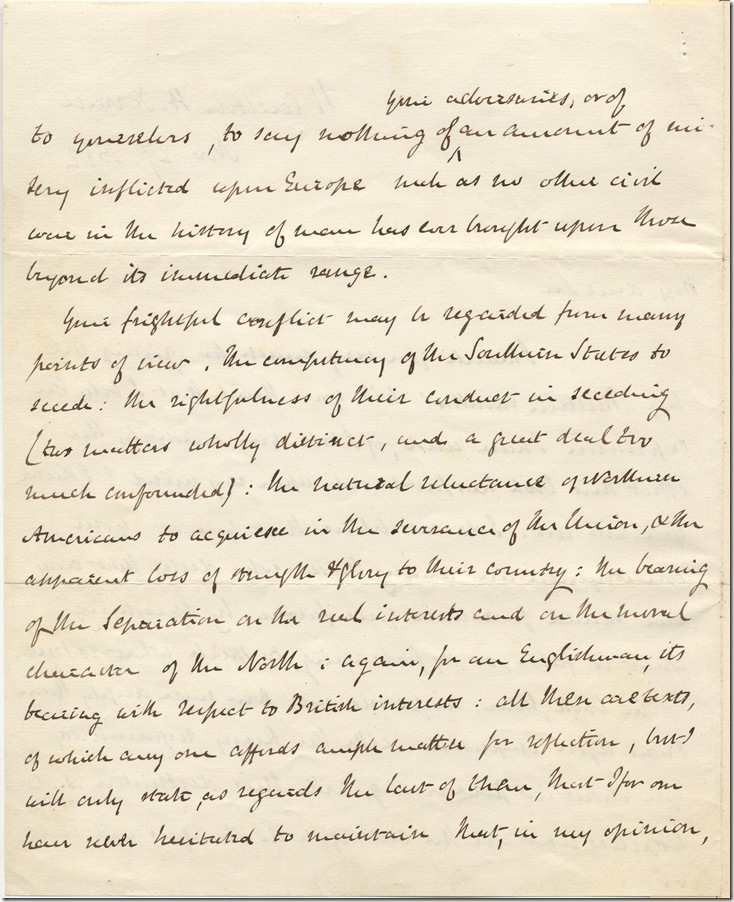
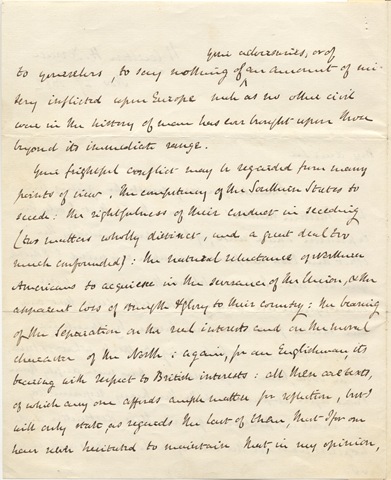
The book, then, impresses me even more deeply than I was before impressed with the heavy responsibility you incur in persevering with this destructive and hopeless war at the cost of much dangers and evils to yourselves, to say nothing of your adversaries, or of an account of misery inflicted upon Europe much as no other civil war in the history of men has brought upon men beyond its immediate range.

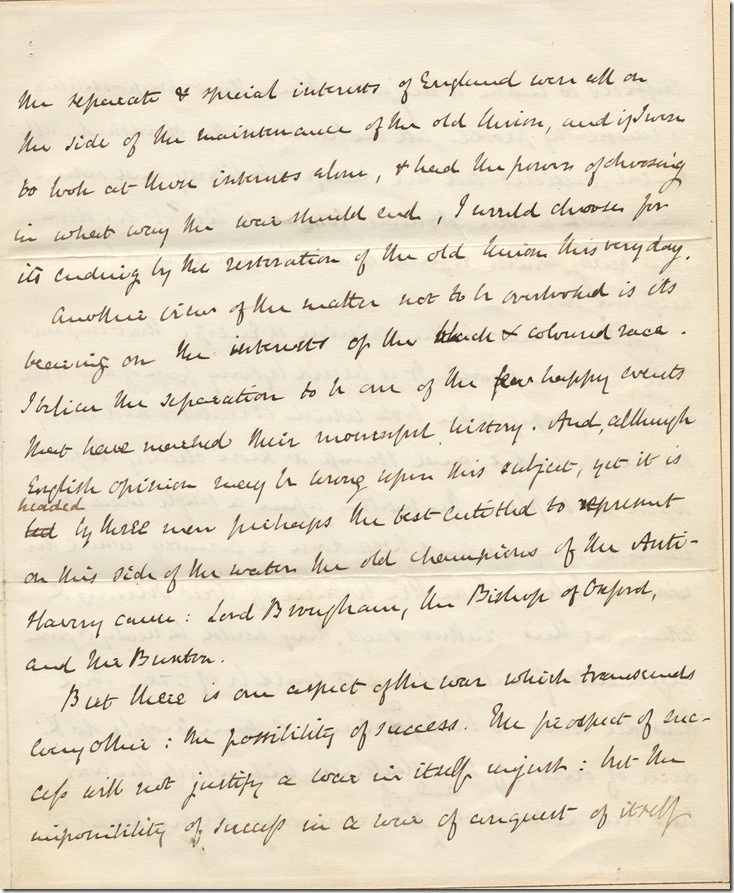
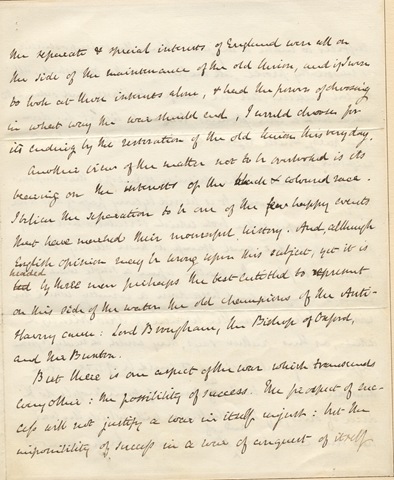
Your frightful conflict may be regarded from many points of view. The competency of the Southern States to secede: the rightfulness of their conduct in seceding (two matters wholly distinct, and a great deal too much confounded): the natural reluctance of Northern Americans to acquiesce in the severance of the Union, & the apparent loss of strength & glory to their country: the bearing of the Separation on the real interests and on the moral character of the North: again, for an Englishman, its bearing with respect to British interests: all these are texts, of which any one affords ample matter for reflection, but I will only note, as regards the last of them, that I for one have never hesitated to maintain that, in my opinion, the separate & special interests of England were all on the side of the maintenance of the old Union, and if I were to look at those interests alone, & had the power of choosing in what way the war should end, I would choose for its ending by the restoration of the old Union this very day.

Another view of the matter not to be overlooked is its bearing on the interests of the black & coloured race. I believe the separation to be one of the happy events that have reached this mournful history. And, although English opinion may be wrong upon this subject, yet it is headed by those men perhaps the best entitled to represent on this side of the water the old champions of the Anti-Slavery cause: Lord Brougham, the Bishop of Oxford, and Mr Burton.

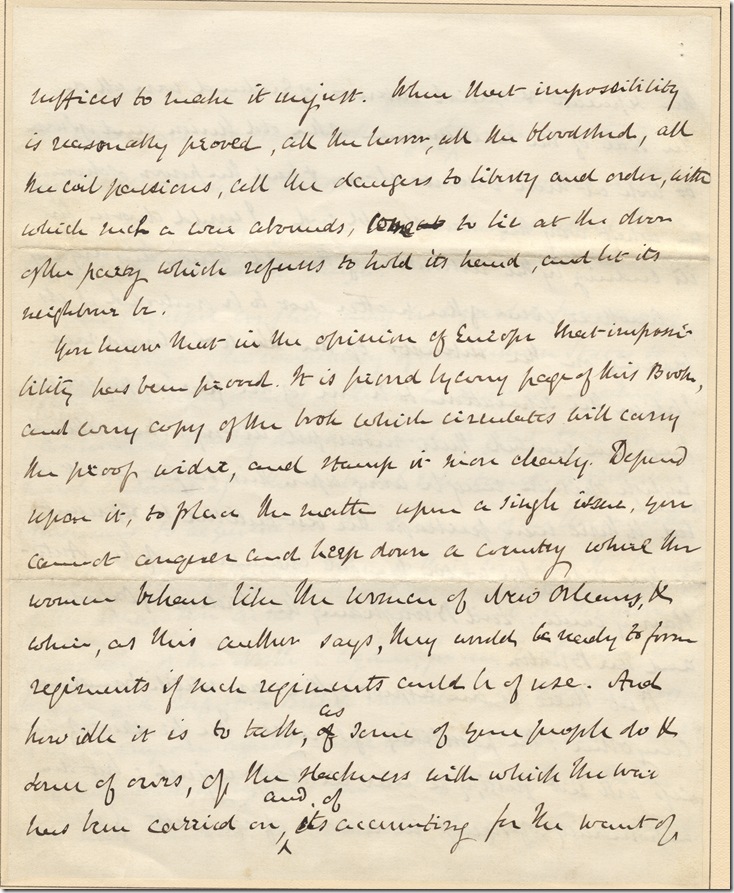
But there is one aspect of the war which transcends every other: the possibility of success. The prospect of success will not justify a war in itself unjust: but the impossibility of success in a war of conquest of itself suffices to make it unjust. When that impossibility is reasonably proved, all the terror [horror?], all the bloodshed, all the evil passions, all the dangers to liberty and order, with which such a war abounds, come to lie at the door of the party which refuses to hold its hand, and let its neighbour be.

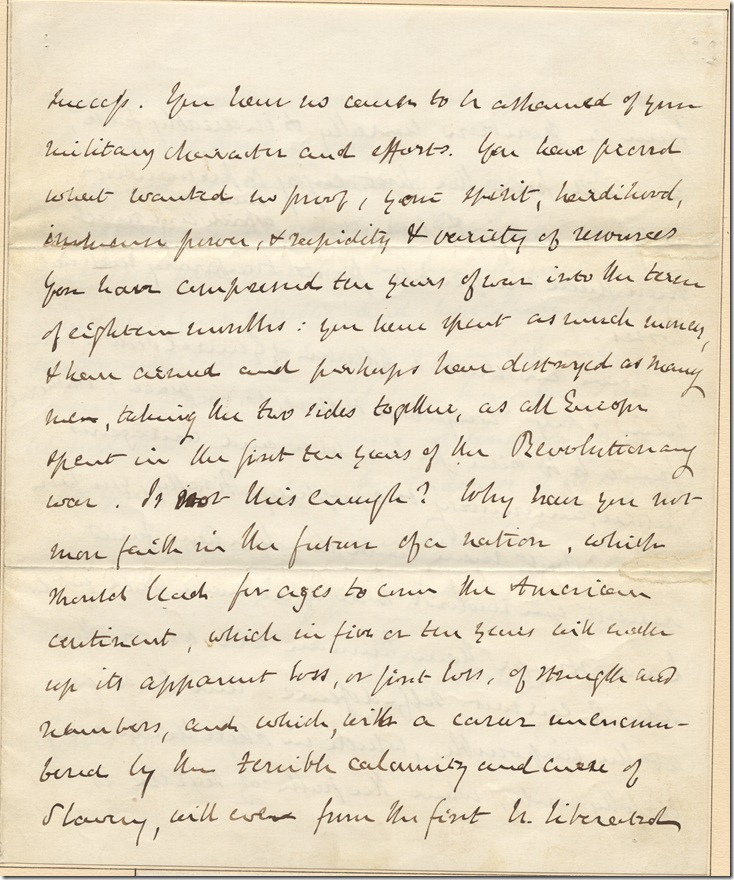
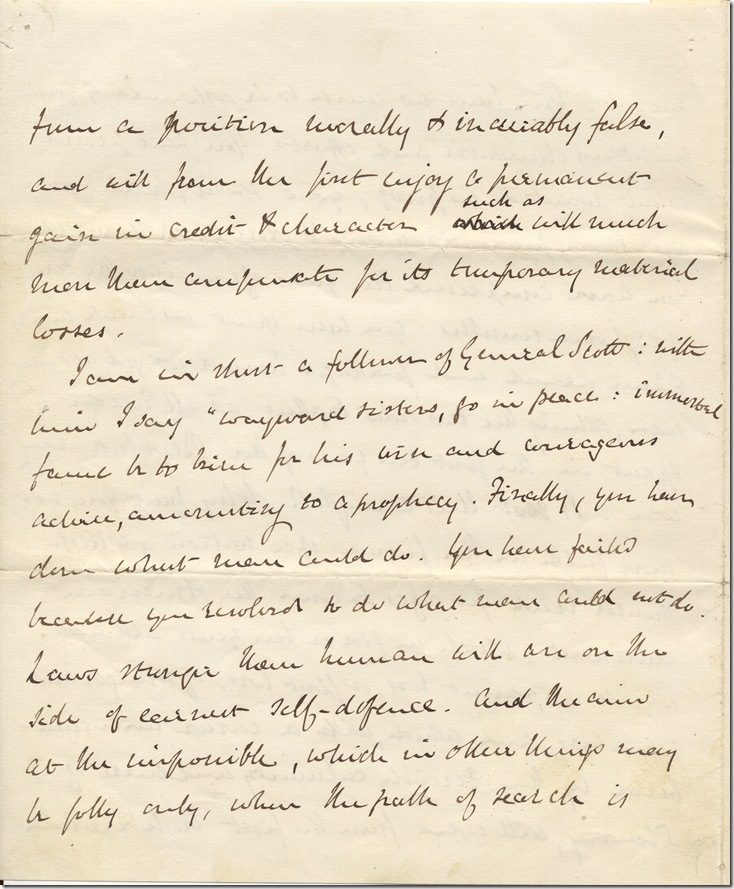
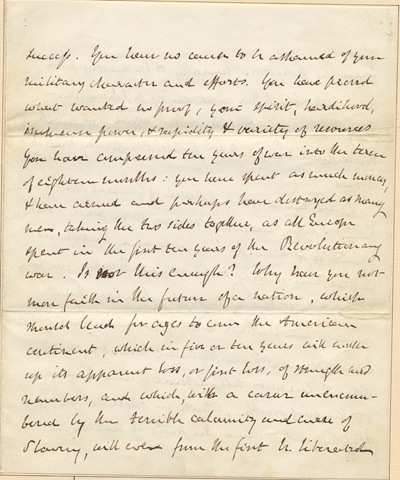
You know that in the opinion of Europe that impossibility has been proved. It is found by every page of this Book, and every copy of the book which circulates will carry the proof wider, and stamp it more clearly. Depend upon it, to place the matter upon a single issue, you cannot conquer and keep down a country when the women behave like the women of New Orleans, & which, as this author says, they would be ready to form regiments if such regiments could be of use. And how idle it is to talk, as some of your people do & some of ours, of the slackers with which the war has been carried on, and of its accounting for the want of success. You have no cause to be ashamed of your military character and efforts. You have proved what wanted no proof, your spirit, hardihood, [illeg.] power, & rapidity & veracity of resources. You have condensed the years of war into the term of eighteen months: you have spent as much money, & have armed and perhaps have destroyed as many men, taking the two sides together, as all Europe spent in the first ten years of the Revolutionary war. Is not this enough? Why have you not more faith in the future of a nation, which should lead for ages to come the American continent, which in five or ten years will even up its apparent loss, or first loss, of strength and numbers, and which, with a career unencumbered by the terrible calamity and curse of slavery, will even from the first be liberated from a position generally & invariably false, and will from the first enjoy & permanent gain in credit & character such as will much more than compensate for its temporary material losses.

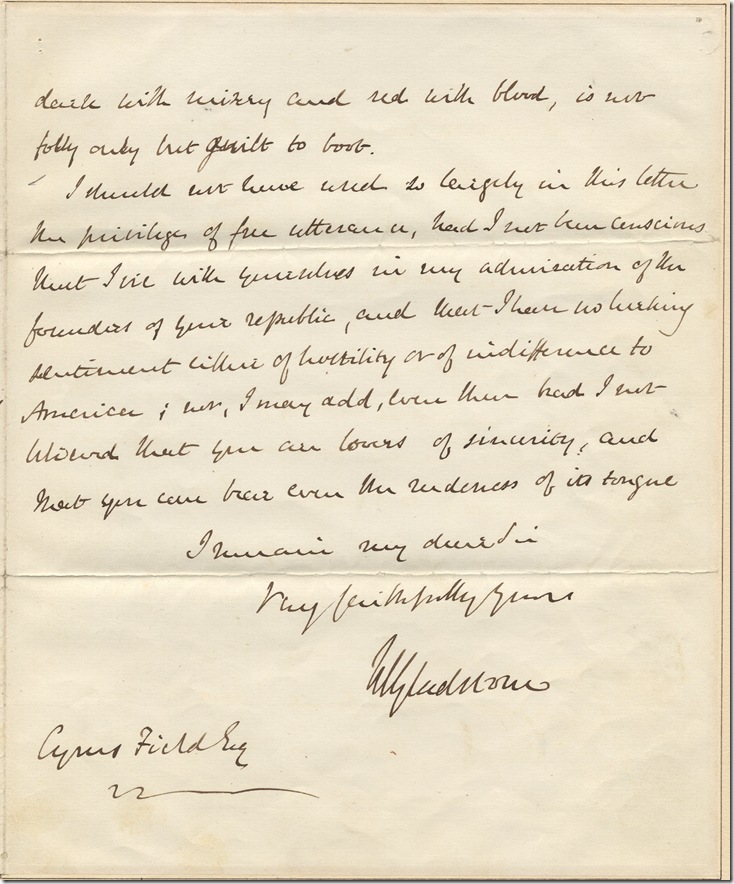
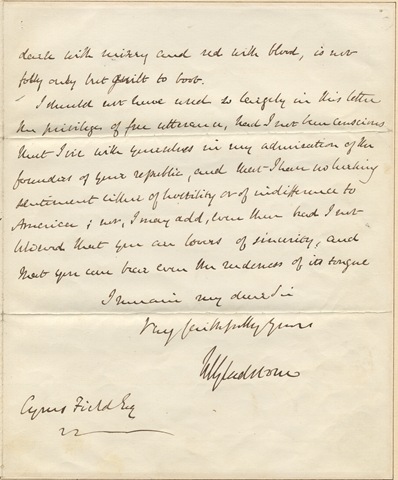
I am in short a follower of General Scott: with him I say “wayward sisters, go in peace”: immortal fame to him for his will and courageous advice, amounting to a prophecy. Finally, you have done what man could do. You have failed because you failed to do what men could not do. Laws stronger than human will are on the side of easiest self-defence. And the aim at the impossible, which in other times very be folly only, when the path of search is dealt with misery and red with blood, is not folly only but guilt to boot.

I should not leave used so largely in this letter the privilege of free utterance, had I not been conscious that I am with yourselves in my admiration of the founders of your republic, and that I have no lurking sentiment either of hostility or of indifference to America & her, I may add, even then had I not believed that you are lovers of sincerity, and that you can bear even the rudeness of its tongue

I remain […]

Very faithfully yours

W E Gladstone

Citation: W. E. (William Ewart) Gladstone (1809-1898), autograph letter signed to Cyrus W. Field. London,27 November 1862.
November 26, 1862: Henry and Mary Warner to John Warner

Henry and Mary Warner lived in Allegheny City, Pennsylvania, now part of Pittsburgh. They are the great-grandparents of poet Marianne Moore.  By the 1860s they had three surviving children:  John, Henry, and Anne. Their letters to John, a Presbyterian minister living in Gettysburg, are preserved as part of Marianne Moore’s family papers.

Moore VI-5-12 p1 Henry and Mary Warner to Children 11-26-62

Moore VI-5-12 p2 Henry and Mary Warner to Children 11-26-62

Transcript:

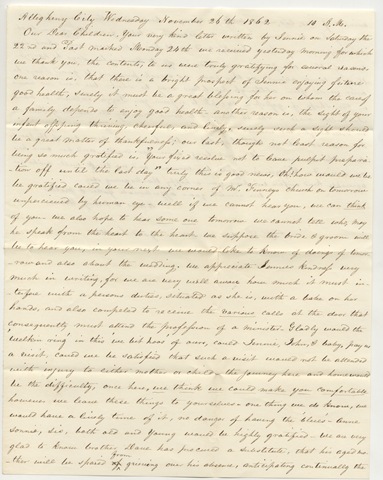
Allegheny City Wednesday November 26th 1862 10 A.M.

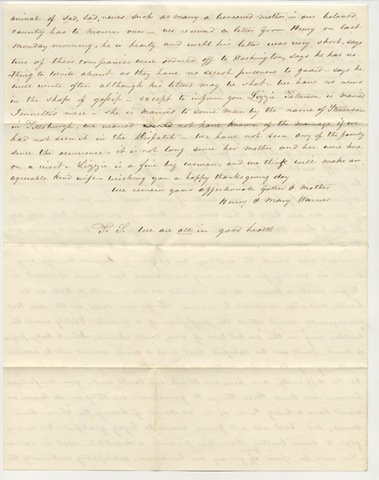
Our Dear Children, Your very kind letter written by Jennie on Saturday the 22nd and Post Marked Monday 24th we received yesterday morning for which we thank you, the contents, to us were truly gratifying for several reasons. One reason is, that there is a bright prospect of Jennie enjoying future good health, surely it must be a great blessing for her on whom the care of a family depends to enjoy good health—another reason is, the sight of your infant offspring thriving, cheerful, and lively, surely such a sight should be a great matter of thankfulness; our last, though not least reason for being so much gratified is, “Your fixed resolve not to leave pulpit preparation off until the last day” truly this is good news, Oh! how would we be gratified could we be in any corner of Mr. Finneys church on tomorrow—unperceived by human eye—well if we cannot hear you, we can think of you—we also hope to hear some one tomorrow we cannot tell who, may he speak from the heart to the heart—we suppose the bride & groom will be to hear you, in your next we would like to know of doings of tomorrow and also about the wedding. We appreciate Jennies kindness very much in writing, for we are very well aware how much it must interfere with a persons duties, situated as she is, with a babe on her hands, and also compeled to receive the various calls at the door that consequently must attend the profession of a minister—Gladly would the ‘welkin ring’ in this ‘we bit hoos’ of ours, could Jennie, John, & baby, pay us a visit, could we be satisfied that such a visit would not be attended with injury to either mother or child—the journey here and home would be the difficulty, once here, we think we could make you comfortable however we leave these things to yourselves—one thing we do know, we would have a lively time of it, no danger of having the ‘blues’—Anne, sonnie, Sis, both old and young would be highly gratified—we are very glad to know brother Dave has procured a substitute, that his aged mother will be spared from grieving over his absence, anticipating continually the arrival of sad, sad news such as many a bereaved mother in our beloved country has to mourn over—we received a letter from Henry on last Monday morning, he is hearty and well his letter was very short, says two of their companies were ordered off to Washington, says he has nothing to write about as they have no secesh prisoners to guard—says he will write often although is letters may be short—we have no news in the shape of gossip—except to inform you Lizzie Patterson is married Jennettes niece—she is married to some man by the name of Stevenson in Pittsburgh, we would not have known of the marriage if we had not seen it in the Dispatch—we have not seen any of the family since the occurrence—it is not long since her mother and her were on a visit—Lizzie is a fine big woman, and we think will make an agreeable kind wife—wishing you a happy thanksgiving day

We remain your affectionate father & mother

Henry & Mary Warner

P.S. We are all in good health

Citation: Henry and Mary Warner, autograph letter signed to John Riddle Warner. Allegheny City [Pittsburgh], 26 November 1862. Moore VI:05:12

November 25, 1862: Alexander Biddle to Julia Williams Rush Biddle

Alexander Biddle was a member of the prominent Philadelphia Biddle family and was married to Julia Williams Rush,  the granddaughter of Dr. Benjamin Rush.  Biddle served with the 121st Pennsylvania Volunteer Infantry, beginning in September 1862. Starting out as a major, he would participate at Fredericksburg and Gettysburg, among other engagements, and would leave the service as a lieutenant colonel. (He was commissioned, but never mustered, as colonel)

Rush IV-30-25 p1 A Biddle ALS to Julia William Rush, Nov 25 Rush IV-30-25 p2 A Biddle ALS to Julia William Rush, Nov 25 Rush IV-30-25 p3 A Biddle ALS to Julia William Rush, Nov 25 Rush IV-30-25 p4 A Biddle ALS to Julia William Rush, Nov 25

Transcript:

Tuesday Nov. 25. 1862.

Dear Julia,

I yesterday received your letter of Nov 20th after I had written to you

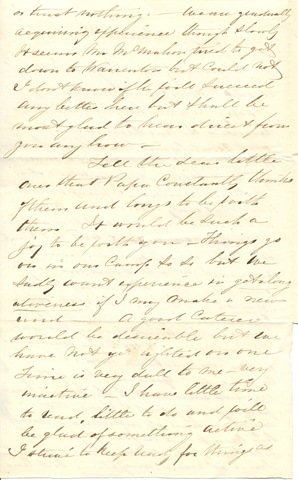
Today Mooney has left me to go home. He has been rather poorly and complains that he is shattered but I fancy he finds life in a marching regiment different from what it is at Head Quarters. I have done every thing that duty requires me to as regards his being an old servant and if I only get one as good will not think it a loss. I have a man from the Regiment who scalded his foot the other day now attending to the horse. The servants of the other officers are chiefly contrabands and I rather think Mooney thought himself too good for them and indeed bad as you may think him I believe he was. Yesterday two of the servants were sent to the Guard house for being too noisy and I think that too may have had its influence. Mooney has been paid in full at parting. Tell Tom if D Hottenstern calls on him to receive anything but lend or trust nothing. We are gradually acquiring experiences through slowly it seems Mr. McMahon tried to get down to Warrenton but could not I don’t know if he will succeed any better here but shall be most glad to hear direct from you any how.

Tell the dear little ones that Papa constantly thinks of them and longs to be with them. It would be such a joy to be with you. Things go on in our camp so so but we sadly want experiences in getalong activeness if I may make a new word. A good [caterer?] would be desirable but we have not yet lighted on one Time is very dull to me – very inactive – I have little time to read little to do and will be glad of something active…

Citation: Alexander Biddle (1819-1899), autograph letter signed to Julia Williams Rush Biddle.25 November 1862. Rush:IV:30:25