July 1, 1863: Alexander Biddle to Julia Williams Rush Biddle

Alexander Biddle was a member of the prominent Philadelphia Biddle family and was married to Julia Williams Rush,  the granddaughter of Dr. Benjamin Rush.  Biddle served with the 121st Pennsylvania Volunteer Infantry, beginning in September 1862. Starting out as a major, he would participate in Fredericksburg and Gettysburg, among other engagements, and would leave the service as a colonel.
Rush IV-30-32 p3 A. Biddle ALS to Julia William Rush, June 30

Rush IV-30-32 p4 A. Biddle ALS to Julia William Rush, June 30

Rush IV-30-32 p5 A. Biddle ALS to Julia William Rush, June 30 Rush IV-30-33 Alexander Biddle to JWR 6-30-1863 p6 Rush IV-30-33 Alexander Biddle to JWR 6-30-1863 p7Rush IV-30-32 p8 A. Biddle ALS to Julia William Rush, June 30

Transcript:

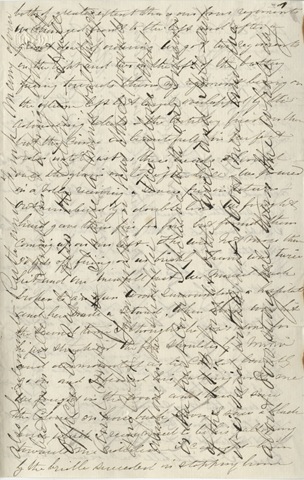
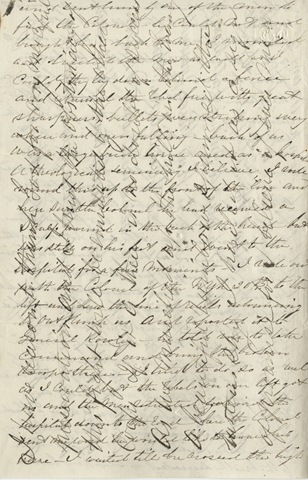
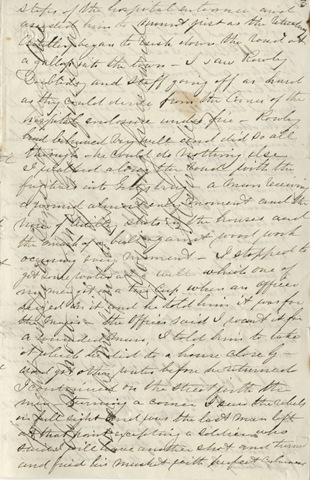
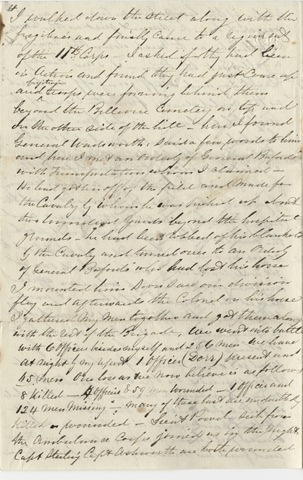
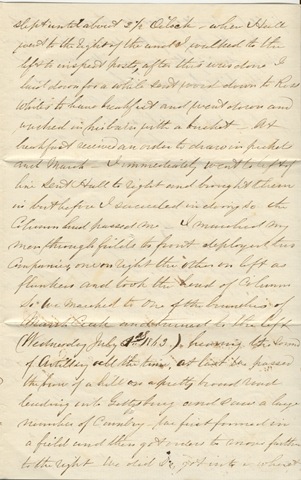
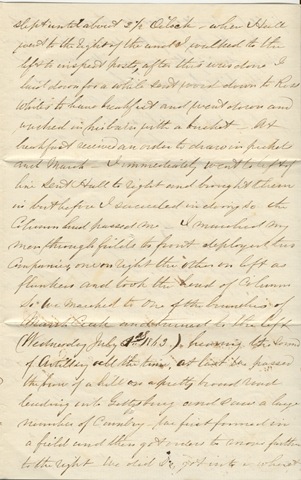
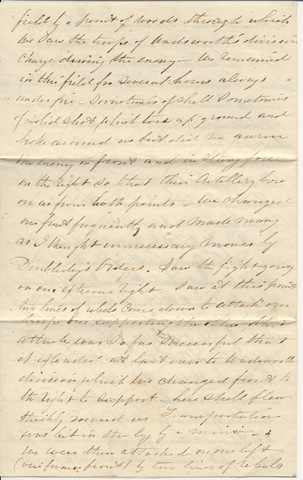
(Wednesday July 1st 1863) hearing the sound of Artillery all the time.at last we passed the brow of a hill on a pretty broad road leading into Gettysburg and saw a large number of Cavalry – we first formed in a field and then got orders to move further to the right– We did so, got into a wheat field by a point of woods through which we saw the troops of Wadsworth’s division charge driving the enemy – we remained in this field for several hours always under fire – sometimes of shell sometimes of solid shot which tore up ground and broke around us but did no harm the enemy in front and in strong force on the right so that their Artillery bore on us from both points– We changed our front frequently and made many as I thought unnecessary moves by Doubleday’s orders. Saw the fighting on our extreme right– Saw at this point two lines of rebels come down to attack our troops one supporting the other, this attack was so far successful that it extended at last over to Wadsworths division, which we changed front to the right to support – here shell flew thickly round us Transportation was hit in the leg by a minie– we were then attacked on our left (our former front) by two lines of rebels, both of greater extent than our four regiments. we changed front to the left and after a great deal of ordering we got two regiments on the right and two on the left of the battery firing towards them, my regiment being on the extreme left but largely overlapped by the advancing rebels – the Artillery fired on them but they came on beautifully in perfect order until just as their heads showed over the grain on top of the hill – we poured in a volley receiving a severe fire in return – outnumbered by a double line we fought hard gave them fire for fire but found them coming up on our left. The[y] were not more than 30 yds off firing on us briskly Trans was twice hit and our men fell fast we moved back broken to an open wood surrounding a hospital and here made a stand. When Trans was hit the second time I thought he was done for he was struck in the fore shoulder by a minie and [I] dismounted as he could hardly go on and I feared his falling with me. We fought in the wood and here I saw the Colonel on horseback, Soon I saw a black horse which I recognized to be his galloping towards me riderless– I caught him by the bridle succeeded in stopping him and sent him by one of the men to find the Colonel – he could not and brought him back to me. I mounted and directed the men as well as I could, they lay down behind a fence and returned the rebel fire with great sharpness, bullets were striking everywhere and men falling – back of us was a large brick house used as a hospital a theological seminary I believe I rode round this up to the front of the line and here saw the Colonel he had received a scalp wound in the back of the head but was still on his feet and went to the hospital for a few moments– I rode out with the Colonel of the NYk 20th to the left and saw the line of rebels advancing to outflank us and reported it to General Rowley – he told me to take command and bring the broken troops there– I tried to do so as well as I could but the rebels on our left got in and the men retreated behind the hospital down to the road here the Colonel sent me word he would like to have his horse– I waited till he crossed the high steps of the hospital entrance and assisted him to mount just as the retreating Artillery began to rush down the road at a gallop into the town– I saw Rowley, Doubleday and staff going off as hard as they could drive from the Corner of the hospital enclosure under fire– Rowley had behaved very well and did so all through – he could do nothing else. I walked along the road with the fugitives into Gettysburg – a man receiving a wound almost every moment and the noise of Artillery shots in the houses and the smack of a ball against wood work occurring every moment– I stopped to get some water at a well which one of my men got in a tin cup, when an officer seized on it and he told him it was for the major – the officer said I want it for a wounded man, I told him to take it which he did to a house close by – and got other water before he returned. I continued on the street with the men – turning a corner I saw the rebels in full sight and was the last man left at that point excepting a soldier who said I will have another shot and turned and fired his musket with perfect calmness. I walked down the street along with the fugitives and finally came to a regiment of the 11th Corps– I asked if they had been in action and found they had just come up and fugitive troops were forming behind them beyond the Bellevue Cemetery on top and on the other side of the hill– here I found General Wadsworth, said a few words to him and here I met an orderly of General Buford’s with Transportation, whom I claimed– He had gotten off of the field and made for the Cavalry by whom he was picked up about two hundred yards beyond the hospital grounds – he had been robbed of his blankets by the Cavalry and turned over to an orderly of General Buford’s who had lost his horse. I mounted him soon saw our division flag and afterwards the Colonel on his horse. I gathered my men together and got them along with the rest of the Brigade. We went into battle with 6 officers besides myself and 256 men we have at night by my report 1 officer (Dorr) present and 65 men Our loss as we now believe is as follows 8 killed– 4 officers & 59 men wounded—1 officer and 124 men missing– many of these are undoubtedly killed or wounded – Lieut Powel sick from the Ambulance Corps joined us in the night. Capt Sterling Capt Ashworth are both wounded, also Lieutenants Ruth and Funk, many of our best men killed. Lambdin & Etting, both staff officers, are safe, also the Colonel – Hall and myself. I have a minie ball through my Coat. Transportation has three wounds and one in the shoulder – we alone that is the first Corps I believe with one Division of the 11th fought both Ewell and Hill – each it is said with About 16000 men and we about 8000 strong held them the whole day. I have reason to thank God for my merciful preservation and I trust the obstinacy of the fight will be emulated by the other Corps. If it is there is no doubt of success. As we marched up the hill in the Evening a beautiful rainbow spanned the Eastern sky. I hailed it as a sign of promise for I believe if ever men fought under a sense of duty all do so now. May God guide us and be merciful to us.

Your loving husband

Alexander

Citation: Alexander Biddle (1819-1899), autograph letter signed to Julia Williams Rush Biddle, 1 July 1863. Rush IV:30:33
June 30, 1863: Alexander Biddle letter to Julia Williams Rush Biddle

Alexander Biddle was a member of the prominent Philadelphia Biddle family and was married to Julia Williams Rush,  the granddaughter of Dr. Benjamin Rush.  Biddle served with the 121st Pennsylvania Volunteer Infantry, beginning in September 1862. Starting out as a major, he would participate in Fredericksburg and Gettysburg, among other engagements, and would leave the service as a lieutenant colonel. (He was commissioned, but never mustered, as colonel)Rush IV-30-32 p1 A. Biddle ALS to Julia William Rush, June 30 Rush IV-30-32 p2 A. Biddle ALS to Julia William Rush, June 30 Rush IV-30-32 p3 A. Biddle ALS to Julia William Rush, June 30

Rush IV-30-32 p4 A. Biddle ALS to Julia William Rush, June 30

Transcript:

On Picket about 6 miles from

Gettysburg and 3 miles from

Fairfield or Millerstown

Tuesday June 30th 1863

Dear Julia

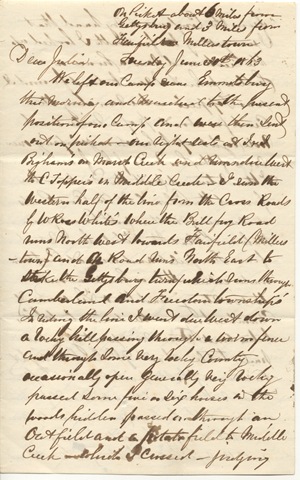
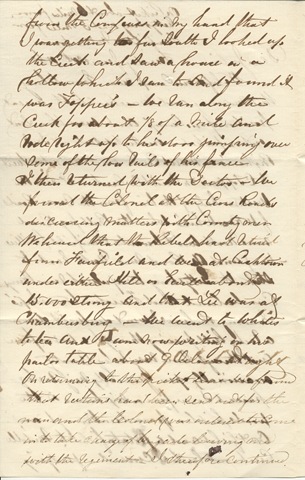
We left our Camp near Emmitsburg this morning and marched to the present position of our Camp and were then sent out on picket – our right rests at I & I Brigham’s on Marsh Creek and runs due west to C Toppers on Middle Creek- I ran the western half of the line from the Cross Roads by W Ross White’s where the Bullfrog Road runs north west towards Fairfield (Millerstown) and the Road runs North East to strike the Gettysburg turnp which runs through Cumberland and Freedom townships. In riding the line I went due West down a rocky hill passing through a worm fence and through some very rocky Country occasionally open generally very rocky passed Some five or six horses in the woods hidden, passed on through an oatfield and a potato field to Middle Creek which I crossed – judging from the Compass in my hand that I was getting too far south I looked up the Creek and saw a house in a hollow which I ran to and found it was Topper’s – we ran along the Creek for about 1/8 of a mile and rode right up to his door jumping over some of the low rails of his fence. I then returned with the Doctor – we found the Colonel at the Cross Roads discussing matters with Country men. We heard that the Rebels had retired from Fairfield and were at Cashtown under either Hill or Ewell about 15,000 strong and that Lee was at Chambersburg – we went to White’s to tea and I am now writing on his parlor table about 9 Oclock at night. on returning to the picket line we found that rations had been sent out for the men and the Colonel was ordered to come in to take charge of brigade, leaving me with the regiment- I therefore continued slept until about 2 1/2 O’clock- when Hall went to the right of the line and I walked to the left to inspect posts, after this was done I laid down for a while, sent word down to Ross White’s to have breakfast and went down and washed in his barn with a bucket- . At breakfast I received an order to draw in pickets and march- I immediately went to the left of the line, sent Hall to the right and brought them in but before I succeeded in doing so the [Column?] had passed me- I marched my men through fields to the front, deployed two Companies, one on the right, the other on the left as flankers and took the head of the column. So we marched to one of the branches of Marsh Creek and turned to the left

Citation: Alexander Biddle (1819-1899), autograph letter signed to Julia Williams Rush Biddle. 30 June 1863 Rush:IV:30:33

June 29, 1863: Belle Boyd’s Album

This autograph book/scrapbook belonged to Belle Boyd, a Confederate spy. Only 17 years old at the start of the war, Boyd used her looks and charm to gain information from Union troops stationed near her Virginia home. Her most significant action was providing information to Turner Ashby and Stonewall Jackson about Union activities in Front Royal during the 1862 Valley campaign. Boyd was arrested multiple times and was held in Union prisons from July 29, 1862 to August  28, 1862 and again from August to December 1863.

Transcription:

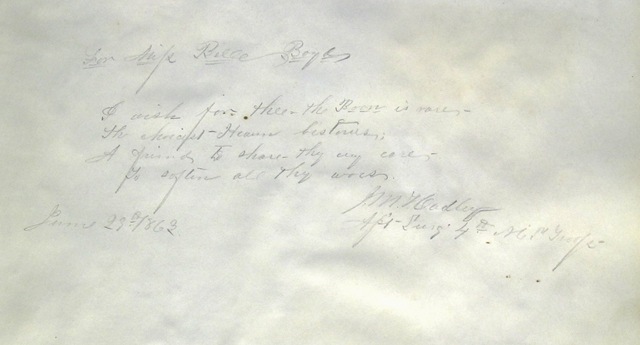
For Miss Belle Boyd

I wish for thee the Boon is rare

the mercies Heaven bestows

A friend to share they every care

To suffer all thy woes

J.M. Hadley

Apl-[illeg] 4th N.[J?] Troops

June 29th 1862

Citation: Belle Boyd (1844-1900), Album: 1859-1903 [bulk 1862-1900]. AMs 1296/16

June 29, 1863: Alexander Biddle to Julia Williams Rush Biddle

Alexander Biddle was a member of the prominent Philadelphia Biddle family and was married to Julia Williams Rush,  the granddaughter of Dr. Benjamin Rush.  Biddle served with the 121st Pennsylvania Volunteer Infantry, beginning in September 1862. Starting out as a major, he would participate in Fredericksburg and Gettysburg, among other engagements, and would leave the service as a lieutenant colonel. (He was commissioned, but never mustered, as colonel)

Rush IV-30-32 p1 A. Biddle ALS to Julia William Rush, June 29 Rush IV-30-32 p2 A. Biddle ALS to Julia William Rush, June 29

Transcript:

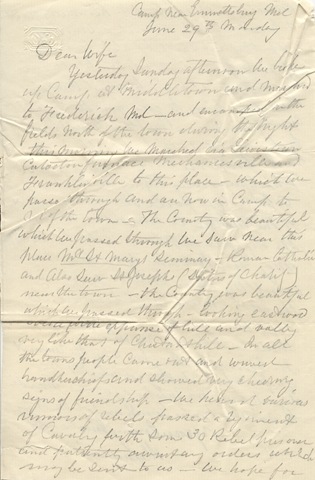
Camp near Emmittsburg  Md
June 29th Monday

Dear Wife
Yesterday Sunday afternoon we broke up Camp at Middletown and marched to Frederick Md – and encamped in the fields North of the town during the night. this morning we marched via Lewistown, Catoctin furnace, Mechanicsville and Franklinville to this place – which we passed through and are now in camp to NE of the town – The Country was beautiful which we passed through we saw near this place Mt St Marys Seminary – Roman Catholic and Also saw st Josephs (Sisters of Charity) near the town – the Country was beautiful which we passed through – looking eastward over a wide expanse of hill and valley very like that of Chestnut hill – In all the towns people Came out and waved handkerchiefs and showed very cheering signs of friendship – we heard various rumors of rebels passed a regiment of Cavalry with some 30 Rebel prisoner and patiently awaiting orders which may be sent to us – we hope for success and may God in his mercy grant it to us and give us such a sense of right that we shall be able to govern all our actions with justice to all our countrymen I have hurried through these few lines to give you the latest news from me – we have marched to day about 25 miles Chiefly in the rain but over a very muddy road which was very trying to the men. A few days will bring our part of the Matter to an issue and then the different plans will be developed. may God preserve you dear wife and my dear Uncle and all the little ones and lead us all safe through all danger and trials to a happy reunion. In Emmittsburg we saw the remnants of a fire which destroyed about two dozen houses two weeks ago – Meade is said to have Command of the Army.
Your loving husband
Alexander

Citation: Alexander Biddle (1819-1899), autograph letter signed to Julia Williams Rush Biddle, 29 June 1863. Rush IV:30:32

June 28, 1863: Alexander Biddle to Julia Williams Rush Biddle

Alexander Biddle was a member of the prominent Philadelphia Biddle family and was married to Julia Williams Rush,  the granddaughter of Dr. Benjamin Rush.  Biddle served with the 121st Pennsylvania Volunteer Infantry, beginning in September 1862. Starting out as a major, he would participate in Fredericksburg and Gettysburg, among other engagements, and would leave the service as a lieutenant colonel. (He was commissioned, but never mustered, as colonel)

Rush IV-30-32 p1 A. Biddle ALS to Julia William Rush, June 28 Rush IV-30-32 p2 A. Biddle ALS to Julia William Rush, June 28 Rush IV-30-32 p3 A. Biddle ALS to Julia William Rush, June 28 Rush IV-30-32 p4 A. Biddle ALS to Julia William Rush, June 28

Transcript:

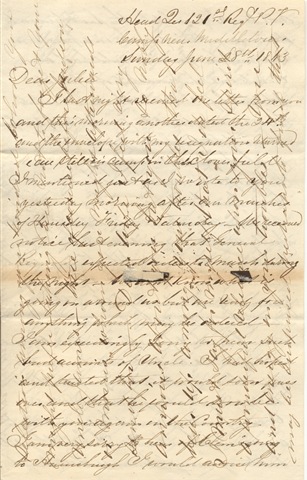
Head Qrs 121st Regt P.V.
Camp near Middletown
Sunday June 28th 1863

Dear Julia
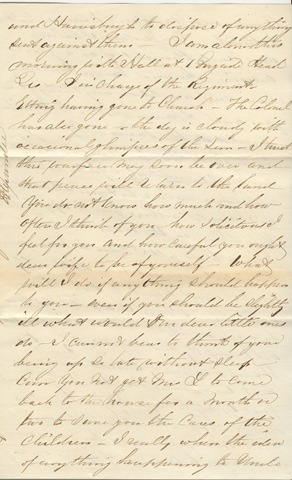
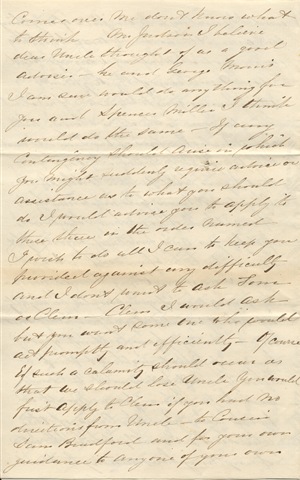
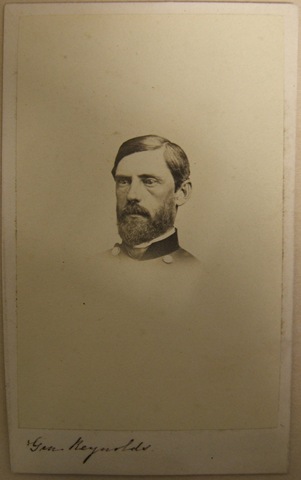
I last night received one letter from you and this morning another dated the 24th and the envelope with my resignation returned. We are still in camp in the clover field I mentioned just and wrote to you yesterday morning after our marches of Thursday Friday & Saturday – We received notice last evening that General Reynolds expected orders to march during the night- We dont Know what is going on around us but are ready for anything which may be ordered – I am exceedingly sorry to hear such bad accounts of Uncle. I had hoped and trusted that it would soon pass over and that he would soon be with you again in the Country. I am very sorry to hear of Clem’s going to Harrisburgh. I would advise him not to – I would be the last person to discourage his services were he in a position in which his services would be of any avail, but the hardship of a private Soldier’s life I do not think he could long endure and he would only sacrifice himself through an exposure which would be productive of no good. Many of our strongest and best men have been broken down by our marches. We have marched indeed pretty faithfully and I know I never could have endured the burdens of the fatigue which our men have born – our officers, who generally march as lightly as they Can, are almost all broken down. We now have but four effective line officers out of the 30 we took into service, A few others invalided Keep up with us but just get along and no more. A very few days must bring matters to an issue of some kind – I hope they will be strong enough towards Pittsburgh and Harrisburgh to dispose of anything sent against them – I am alone this morning, with Hall at Brigade Head Qrs – . I’m in charge of the Regiment – Etting having gone to Church – The Colonel has also gone – the day is cloudy with occasional glimpses of the sun – I trust this warfare may soon be over and that peace will return to the land. You do not know how much and how often I think of you – how solicitous I feel for you and how careful you ought dear wife to be of yourself – what will I do if anything should happen to you – even if you should be slightly ill what would our dear little ones do – I cannot bear to think of your being up so late without sleep – Can you not get Mrs L to come back to the house for a month or two to save you the Cares of the children – I really when the idea of anything happening to Uncle Comes over me dont know what to think – Mr Judson I believe dear Uncle thought of as a good adviser – he and George Morris I am sure would do anything for you and Spencer Miller I think would do the same – If any Contingency should arise in which you might suddenly require advice or assistance as to what you should do I would advise you to apply to these three in the order named. I wish to do all I can to keep you provided against any difficulty and I dont want to ask Tom or Clem – Clem I would ask but you want some one who would act promptly and efficiently – Of course if such a calamity should occur as that we should lose Uncle you would first apply to Clem if you had no directions from Uncle – to Cousin Sam Bradford and for your own guidance to any one of your own selection among your kindred whom you might prefer – taking Care not to forget your Uncle James – these of course before Judson or Morris whom you might afterwards send for – Dear wife I feel very anxious about you but you so nobly bear up among your troubles that I must say for myself that I do feel a wonderful reliance upon your spirit and energy in your troubles – You may be surprised perhaps to find that meekly of past days is so spoken of by one who first loved and adored her for her quiet virtues but so it is – My Jule is indeed a pearl beyond price – God bless and preserve you and soon grant us a speedy restoration to each other in health and happiness with dear Uncle restored to his health again at La Noraye. Kiss our darlings and tell Aleck & Harry that Papa would so like to have a letter from them.
Your Loving Husband
Alexander

Citation: Alexander Biddle (1819-1899), autograph letter signed to Julia Williams Rush Biddle, 28 June 1863. Rush IV:30:32

June 27, 1863: Alexander Biddle to Julia Williams Rush Biddle

Alexander Biddle was a member of the prominent Philadelphia Biddle family and was married to Julia Williams Rush,  the granddaughter of Dr. Benjamin Rush.  Biddle served with the 121st Pennsylvania Volunteer Infantry, beginning in September 1862. Starting out as a major, he would participate in Fredericksburg and Gettysburg, among other engagements, and would leave the service as a lieutenant colonel. (He was commissioned, but never mustered, as colonel)

Rush IV-30-32 p1 A. Biddle ALS to Julia William Rush, June 27 Rush IV-30-32 p2 A. Biddle ALS to Julia William Rush, June 27 Rush IV-30-32 p3 A. Biddle ALS to Julia William Rush, June 27

Transcript:

Head Qrs 121st Regt P.V.
Camp North of Middletown
maryland
Saturday June 27th 1863

Dear Julia

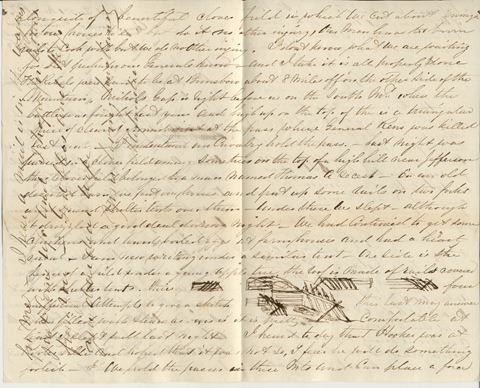
I wrote to you yesterday morning from Camp to south East of Jefferson after having marched from Broad Run through Edward’s ferry at mouth of Goose Creek Poolesville to Barnesville thence Across Monocacy Creek,round the face of Sugar loaf Mt to Adamstown on the Baltimore RRd and so on to Jefferson – this morning we left Camp near Jefferson, marched to the town, through it and turned off to the North – we saw about 400 Yrds west of us Johnson’s house where we breakfasted in our first march through Maryland a year since – we marched to the north about 8 miles to Middletown and are now in Camp N N E of it about one mile – we are in an open field alongside of a beautiful clover field in which we cut about enough for our horses to eat but do it no other injury, our men have to burn rails to cook with but we do no other injury. I dont know what we are waiting for but perhaps our Generals know – and I take it is all properly done. The Rebels were said to be at Boonsboro about 8 miles off on the other side of the Mountain. Nichols Gap is right before us on the South Mt where the battle was fought last year and high up on the top of the is a triangular piece of cleared ground just at the pass where General Reno was killed last year – I understand our cavalry hold the pass. – last night was passed in a clover field among some trees on the top of a high hill near Jefferson. this clover field belonged to a man named Thomas, a secesh – in an old deserted barn we put our horses and put up some rails on two forks and spread shelter tents over them – Under there we slept – although it drizzled a good deal during night – We had Continued to get some chickens and hard boiled eggs at farm houses and had a hearty meal – I am now writing under a similar tent – one side is the fence of a field under a young apple tree, the roof is made of rails covered with shelter tents. thus four ineffectual Attempts to give a sketch this last may answer. when filled with straw as ours is it is pretty comfortable. at least I slept well last night. I hear to day that Hooker was at Poolesville and hoped that it was not so. I fear he will do something foolish – If we hold the passes in these Mts and Can place a force between the Rebels and the Potomac, if they move that way – If they Come towards Baltimore I think they can also be met – I hope if no other result is attained that new efforts and greater unanimity of opinion will characterize the northern people and the Government – from where I am lying on my bed of straw covered with my india rubber poncho I see the spires of the two churches of Middletown peering over the hill SSW of us, one white, the other Brown – all around I see Camps – packs of wagons, ambulances and Artillery. Infantry are moving – whilst an occasional troop of Cavalry makes its appearance going out or Coming in from picket duty – I have scribbled this off on my rubber bed, rather a difficult place to write on. we dined to day at a farm house and such hungry men I think you have rarely seen or men more glad to see something of comfort and civilization. one thing was particularly noticed by many of us – the great number of streams of beautifully clear fresh water in Maryland whilst on the Virginia side they were few in number and almost always muddy.  Good bye beloved – give lasting love to Uncle and Kiss our darlings for me – I hear a mail is in the wagons just Come up and I hope for letters from you – God bless and Keep you dear dear wife
Your loving husband
Alexander

Citation: Alexander Biddle (1819-1899), autograph letter signed to Julia Williams Rush Biddle, 27 June 1863. Rush IV:30:32

June 26, 1863: Alexander Biddle to Julia Williams Rush Biddle

Alexander Biddle was a member of the prominent Philadelphia Biddle family and was married to Julia Williams Rush,  the granddaughter of Dr. Benjamin Rush.  Biddle served with the 121st Pennsylvania Volunteer Infantry, beginning in September 1862. Starting out as a major, he would participate in Fredericksburg and Gettysburg, among other engagements, and would leave the service as a lieutenant colonel. (He was commissioned, but never mustered, as colonel)

Rush IV-30-32 p1 A. Biddle ALS to Julia William Rush, June 26 Rush IV-30-32 p2 A. Biddle ALS to Julia William Rush, June 26 Rush IV-30-32 p3 A. Biddle ALS to Julia William Rush, June 26 Rush IV-30-32 p4 A. Biddle ALS to Julia William Rush, June 26

Transcript:

Camp on the hill near to
Jefferson       Maryland
Head Qrs 121st Regt P.V.
Friday June 26, 1863

Dear Julia
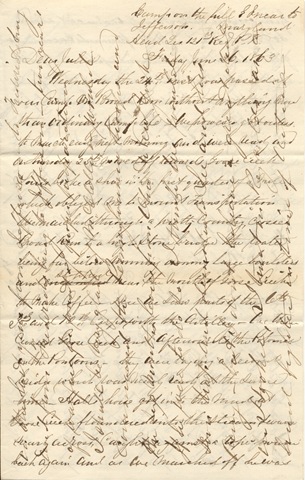
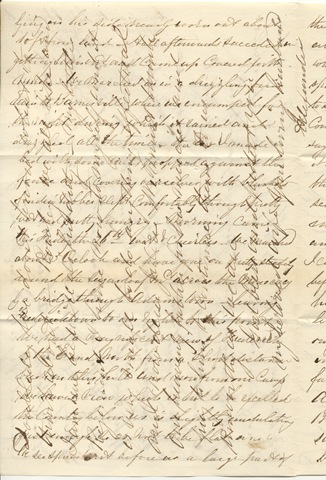
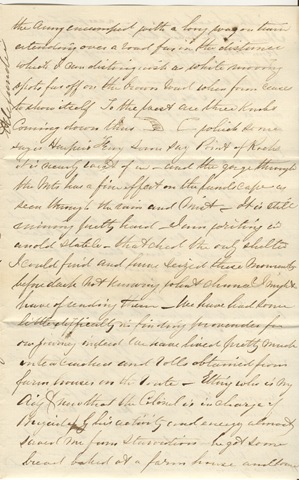
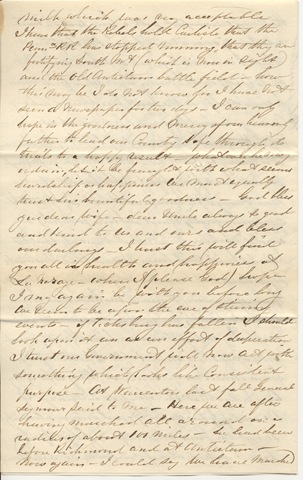
Wednesday the 24th inst was passed at our Camp on Broad Run without anything more than ordinary Camp life – We however got orders to march early next morning and were ready and on Thursday 25th moved off towards Goose Creek. Louis broke a shoe in the first quarter of a mile which obliged me to mount Transportation. We marched through a pretty country, crossed Broad Run by a high stone bridge, the water being far below running among large boulders, and stopped near the mouth of Goose Creek to make Coffee Here we saw parts of the 6th, 3rd and 10th Corps with the Artillery – we then Crossed Goose Creek and afterwards the Potomac on the Pontoons – they were laying a second bridge, which was nearly ready, nearly at the same time- Hall’s horse got into the mud at Goose Creek, floundered into the stream, swam nearly across, Caught against a rope – swam back again and as we marched off he was lying on his side nearly worn out, about 10 ft from land- Hall afterwards succeeded in getting him out and Came up Covered with mud – We marched on in a drizzling fine rain to Barnesville where we encamped for the night during which it rained and drizzled all the time – the Dr & I made a bed with some rails propped against the fence and covering ourselves with blankets of india rubber, slept comfortably though pretty wet and pretty hungry- Morning came this Friday the 26th – wet and cheerless – we marched about 5 Oclock and have gone on pretty steadily round the Sugarloaf Mt across the Monocacy by a bridge through Adamstown – having Fredericktown to our right to this point. We had a magnificent view of Frederick to the E and North from a short distance back on this hill and now from our Camp we have a view which is not to be excelled. the Country below us is slightly undulating just enough so as not to be flat and we see spread out before us a large part of the Army encamped with a long wagon train extending over a road far in the distance which I can distinguish as white moving spots far off on the brown road when form ceases to show itself To the west are three Knobs Coming down thus which some say is Harper’s Ferry some say Point of Rocks. it is nearly west of us – and the gorge through the Mts has a fine effect on the landscape as seen through the rain and Mist- It is still raining pretty hard- I am writing in an old stable – thatched, the only shelter I could find and have seized these moments before dark not knowing what chance I might have of sending them – we have had some little difficulty in finding provender for our journey; indeed, we have lived pretty much on tea crackers and rolls obtained from farm houses on the route- Etting, who is my adjt now that the Colonel is in charge of Brigade by his activity and energy, almost saved me from starvation – he got some bread baked at a farm house and some milk which was very acceptable. I hear that the Rebels hold Carlisle, that the Penna RR has stopped running, that they are fortifying South Mt (which is now in sight) and the old Antietam battle field – how this may be I do not know for I have not seen a newspaper for two days- I can only hope in the goodness and mercy of our heavenly father to lead our Country safe through its trials to a happy result – whatever he may ordain, let it be fraught with what seems hardship or happiness we must equally trust his bountiful goodness- God bless you dear wife – dear Uncle always so good and Kind to us and ours and bless our darlings – I trust this will find you all in health and happiness at La Noraye – where I (please God) hope I may again be with you before long. we seem to be upon the eve of stirring events – if Vicksburg has fallen I should look upon it as an effort of desperation. I trust our Government will now act with something which looks like Consistent purpose- At Warrenton last fall General Seymour said to me – Here we are after having marched all around on a radius of about 100 miles – he had been before Richmond and at Antietam – now again- I could say we have marched in the last year from Jefferson to Fredricksburg and from Fredericksburg to Jefferson – two years of warfare for want of proper preparation. I should be very glad if McClellan would command the Pennsylvania troops and the six months levies from Ohio & New York. If he were to do so I think we would soon trap and demolish Lee and his Army – but I dont believe a great deal in Hooker,3 I trust in Reynolds as a hard fighter in time of Action. Doubleday we dont know what to think about- Rowley we all like and I am sure he will do his duty – my little Regiment I have now to myself and it is very small to do anything effectual and now dear Julia We must thank our heavenly father for his mercies and pray to him to Continue them to us, unworthy as we are.
God bless and protect you my beloved wife.
Your loving husband
Alexander

Citation: Alexander Biddle (1819-1899), autograph letter signed to Julia Williams Rush Biddle, 26 June 1863. Rush IV:30:32

June 24, 1863: Henry and Mary Warner to John Warner

Henry and Mary Warner lived in Allegheny City, Pennsylvania, now part of Pittsburgh. They are the great-grandparents of poet Marianne Moore.  By the 1860s they had three surviving children:  John, Henry, and Anne. Their letters to John, a Presbyterian minister living in Gettysburg, are preserved as part of Marianne Moore’s family papers.

 Moore VI-5-20 p1 Henry and Mary Warner to Children 6-24-63 Moore VI-5-20 p2 Henry and Mary Warner to Children 6-24-63

Transcript:

Allegheny City Wednesday June 24th 1863 1 P.M.

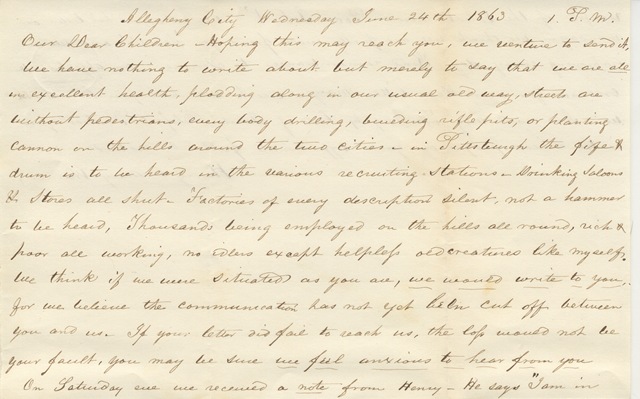
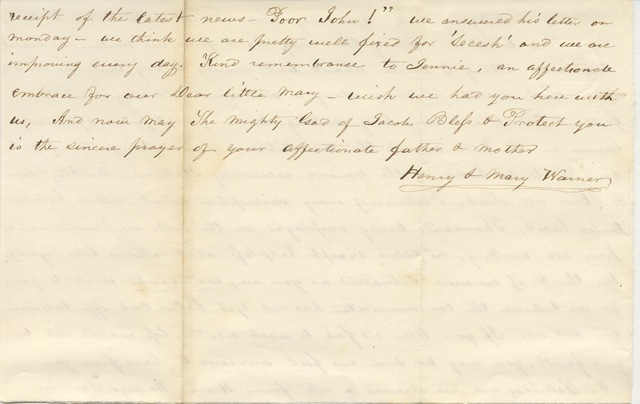
Our Dear Children—Hoping this may reach you, we venture to send it. We have nothing to write about but merely to say that we are all in excellent health, plodding along in our usual old way, streets are without pedestrians, every body drilling, building rifle pits, or planting cannon on the hills around the two cities—in Pittsburgh the fife & drum is to be heard in the various recruiting stations—Drinking saloons & Stores all shut—Factories of every description silent, not a hammer to be heard, Thousands being employed on the hills all round, rich & poor all working, no idlers except helpless old creatures like myself. We think if we were situated as you are, we would write to you, for we believe the communication has not yet been cut off between you and us. If your letter did fail to reach us, the loss would not be your fault, you may be sure we feel anxious to hear from you

On Saturday eve we received a note from Henry—He says “I am in receipt of the latest news—Poor John!” We answered his letter on Monday—we think we are pretty well fixed for ‘Secesh’ and we are improving every day. Kind remembrance to Jennie, and affectionate embrace for our Dear little Mary—wish we had you here with us, And now may The Might God of Jacob Bless & Protect you is the sincere prayer of your affectionate father & mother

Henry & Mary Warner


Citation: Henry and Mary Warner, autograph letter signed to John Riddle Warner. Allegheny City [Pittsburgh], 24 June 1863. Moore VI:05:20

June 23, 1863: John Riddle Warner to George Eyster

John Riddle Warner was the grandfather of the poet Marianne Moore and during the Civil War he lived in Gettysburg, Pennsylvania. George Eyster was his brother-in-law and lived in Chambersburg, where he served as Provost Marshal for the 16th district of Pennsylvania from April 1863 to June 1865.  These letters are preserved as part of Marianne Moore’s family papers.

Moore VI-5-20 p1 John Riddle Warner to George Eyster 6-23-63 Moore VI-5-20 p2 John Riddle Warner to George Eyster 6-23-63 Moore VI-5-20 p3 John Riddle Warner to George Eyster 6-23-63 Moore VI-5-20 p4 John Riddle Warner to George Eyster 6-23-63

Transcript:

Gettysburg Tuesday

June 23d 1863

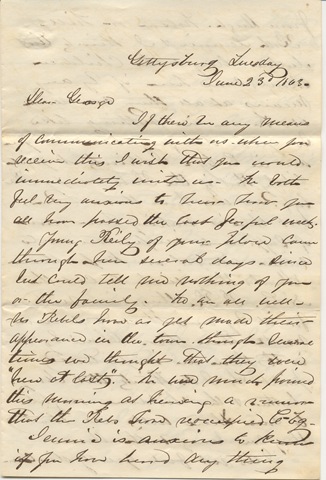
Dear George

If there be any means of communicating with us when you receive this I wish that you would immediately write us—We both feel very anxious to hear from you all how passed the last fearful weeks.

Young Reily of your place came through here several days since but could tell us nothing of you or the family. We are all well—no Rebels have as yet made their appearance in the town though several times we thought that they were “here at last”. We were much pained this morning at hearing a rumor that the Rebs have reoccupied C-bg—Jennie is anxious to know if you have heard any thing from Hugh Watson or hill. Both Jennie & I think that Mother, Mary & the children should come here if by any means at all they can reach us—We are in nothing like so great danger here as you are in C-bg—I think it quite likely that if the Rebs occupy Pa long we will have them here, but there is nothing here now of sufficient importance to either attract or keep them. Should they wish to cut the N.C.R.R. they will make for it by another & nearer route than this. Chambg. too is to them an important point. So I do think that Mary, Mother & the children ought to come here with all that they can bring with them.

I do not feel greatly discouraged, I am confident that in the Lord, a great triumph awaits us. He is just bringing us to that point in which His sovereignty in our deliverance will be made manifest. So manifest that the mouths of infidelity will not dare to speak.

His appointed time may be further-off than we think—but it cant be far off. And when it comes both we and our enemies will wonder.

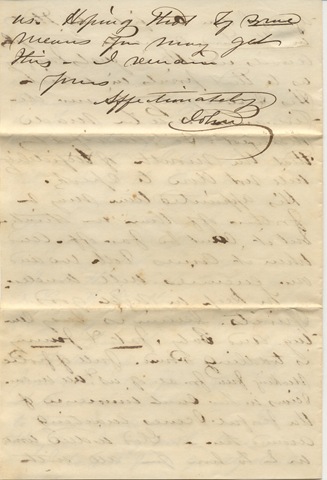
We keep in right good spirits. Jennie is busy sewing and Baby, fat & funny, is toddling round. Full of frolic making fun for all of us & all unconscious in her sweet innocence of the fearful scenes enacting around her—Glad indeed would we be to have you all with us. Hoping that by some means you may get this—I remain

Yours

John

Citation: John Riddle Warner, autograph letter signed to George Eyster.  Gettysburg, Pa.; 23 June 1863. Moore VI:05:20