June 21, 1863: Mary Craig Eyster to Jennie Craig Warner

Jennie Craig Warner was the grandmother of the poet Marianne Moore and during the Civil War, she lived in Gettysburg, Pennsylvania. Mary Craig Eyster was her sister and lived in Chambersburg. These letters are preserved as part of Marianne Moore’s family papers.
Moore VI-5-20 p1 Mary to Jennie Craig Warner 6-21-63 Moore VI-5-20 p2 Mary to Jennie Craig Warner 6-21-63 Moore VI-5-20 p3 Mary to Jennie Craig Warner 6-21-63 Moore VI-5-20 p4 Mary to Jennie Craig Warner 6-21-63

Transcript:

Sabbath morning, June 21st 1863

Dear Jennie

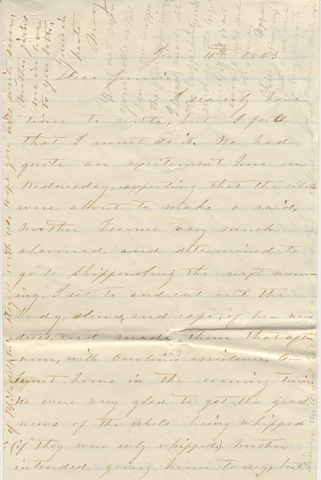
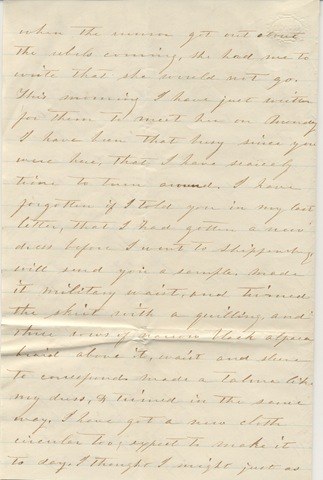
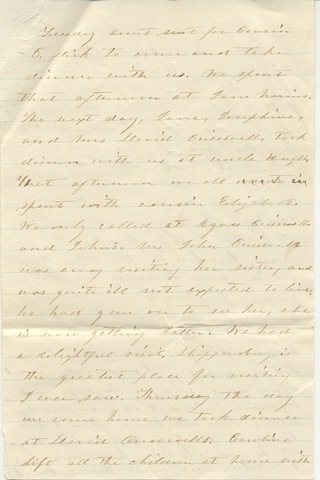
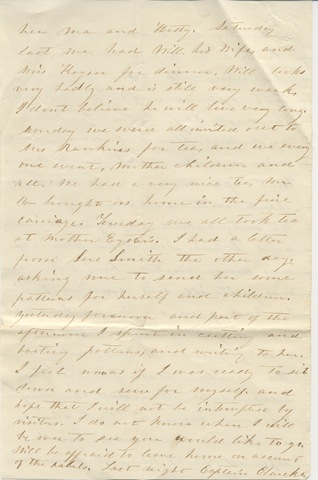
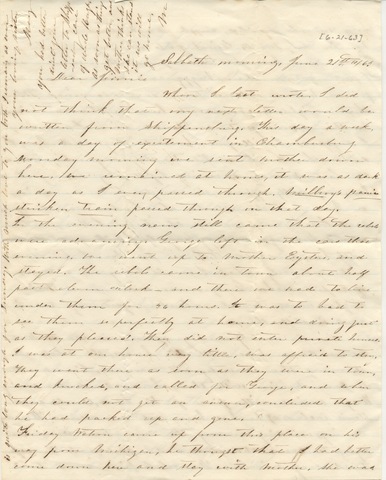
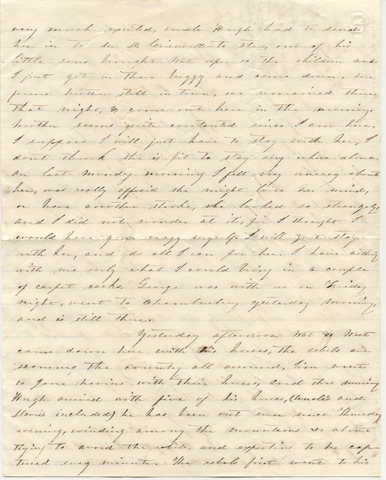
When I last wrote, I did not think that my next letter would be written from Shippensburg. This day a week, was a day of excitement in Chambersburg. Monday morning we sent Mother down here. We remained at home, it was as dark a day as I ever passed through. Millroy’s panic stricken train passed through on that day, In the evening news still came that the rebels were advancing. George left in the cars that evening. We went up to Mother Eysters, and stayed. The rebels came in town about half past eleven o’clock—and there we had to live under them for 36 hours. It was to bad to see them so perfectly at home, and doing just as they pleased. They did not enter private houses. I was at our house very little, was afraid to stay. They went there as soon as they were in town, and knocked, and called for George, and when they could not get an answer, concluded that he had packed up and gone.

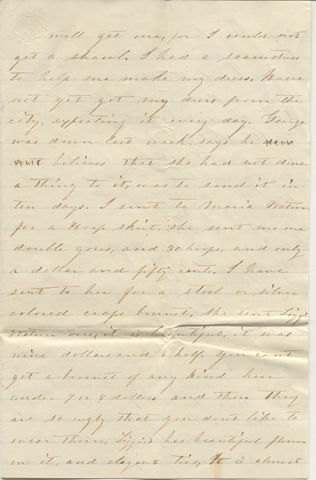
Friday Watson came up from this place on his way from Michigan, he thought that I had better come down here and stay with Mother. She was very much excited, Uncle Hugh had to send her in to see D. [Cornwall?] to stay, one of his little sons brought Wat up, so the children and I just got in their buggy and came down. We found brother still in town, we remained there that night, & came out here in the morning. Mother seems quite contented since I am here, I suppose I will just have to stay with her. I dont think she is fit to stay any where alone. On last Monday morning I felt very uneasy about her, was really afraid she might loose her mind, or have another stroke, she looked so strangely, and I did not wonder at it, for I thought I would have gone crazy myself. I will just stay with her, and do all I can for her. I have nothing with me only what I could bring in a couple of carpet sacks. George was with us on Friday night, went to Chambersburg yesterday morning, and is still there.;

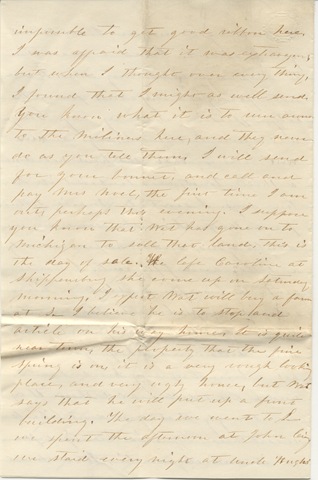
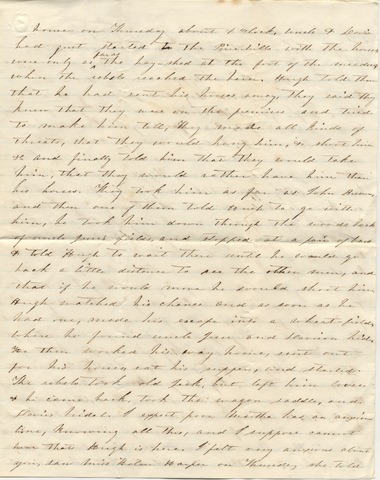
Yesterday afternoon Watson West came down here with his horses, the rebels are securing the country all around. Tim went to Gene Nevins with their horses, and this morning Hugh arrived with five of his horses, (Uncle’s and Davies’ included) he has been out ever since Thursday evening, winding among the mountains & above trying to avoid the rebels, and expecting to be captured every minute. The rebels first went to his home on Thursday about 1 o’clock Uncle & Davie had just started to the Pine-hills with the horses were only as far as the hay-shed at the foot of the meadow, when the rebels reached the barn. Hugh told them that he had sent his horses away, they said they knew that they were on the premises and tried to make him tell. They made all kinds of threats, that they would hang him, & shoot him &c and finally told him that they would take him, that they would rather have him than his horses. They took him as far as John Brewers, and then one of them told Hugh to go with him, he took him down through the woods back of uncle Jesse’s fields, and stopped at a pair of barns & told Hugh to wait there until he would go back a little distance to see the other men, and that if he would move he would shoot him. Hugh watched his chance and as soon as he had one, made his escape into a wheat field, where he found uncle Jesse and Davies hid. He then worked his way home, sent out for his horses, eat his supper, and started. The rebels took old Jack, but left him loose & he came back, took the wagon saddle, and Davies bridal. I expect poor Martha has an anxious time, knowing all this, and I suppose cannot bear that Hugh is here. I felt very anxious about you, saw Miss Helen Harper on Thursday she told me that she had seen young Crawford from Gettysburg, and that there were no rebels there. There is quite an excitement in town this morning it is reported that the rebels are coming down the Strasburg road, and they are preparing to meet them. Hope you will write as soon as you get this! Mother is anxious to hear from you. I would have written last week, but we were in such a state of excitement, and there was no way of sending letters. Allison Eysters family, and Maggie and her children went to Philadelphia. There were very few families went away, we did not think of going, little Jennie was terribly frightened, we hardly knew what to do with her on Monday morning. I believe it is as well to stand your ground—but it is not very pleasant to be shut up as we were in Chambersburg, and not know any thing that is going on. They behaved better than we expected—but I dont give them any credit for it—they just did as they pleased, and made us do as they wanted us. They generally paid for what they got, but with confederate scrip. They got over five hundred dollars worth out of Nixons store. I tell you old Mrs Nixon is mad at them. I guess you hear all the news through the papers, and more thans true.The evening after the rebels left, it was reported that they were coming back. The men in town formed in company’s and went out to meet them (but did not see any) Mr Nicolls & Mr Reeves shouldered their muskets too. I think this letter is quite long enough for Sunday. With much love to you both I remain as ever

Your loving sister

Mary

You had better direct your letter to Shippensburg care of Uncle Hugh. As soon as things get better, and Mother thinks she can stand it we will go home.

M

Citation: Mary Craig Eyster, autograph letter signed to Jennie Craig Warner.  Shippensburg, Pa.; 21 June 1863. Moore VI:05:20

June 20, 1863: John Henry Brown’s Journal

John Henry Brown was a painter of portrait miniatures, living and working in Philadelphia. He had met Lincoln in August of 1860 when he was commissioned to paint Lincoln’s portrait for a supporter, but although Brown liked Lincoln personally, he did not agree with Republican policies.

1863-06-20


Transcript:

At Gen: Bohlens picture. It is now reported that the Confederates have left the state.


Citation: John Henry Brown, autograph journal/account book. Philadelphia, 1844-1890. AMs 573/14.1

June 19, 1863: Alexander Biddle to Julia Williams Rush Biddle

Alexander Biddle was a member of the prominent Philadelphia Biddle family and was married to Julia Williams Rush,  the granddaughter of Dr. Benjamin Rush.  Biddle served with the 121st Pennsylvania Volunteer Infantry, beginning in September 1862. Starting out as a major, he would participate in Fredericksburg and Gettysburg, among other engagements, and would leave the service as a lieutenant colonel. (He was commissioned, but never mustered, as colonel)

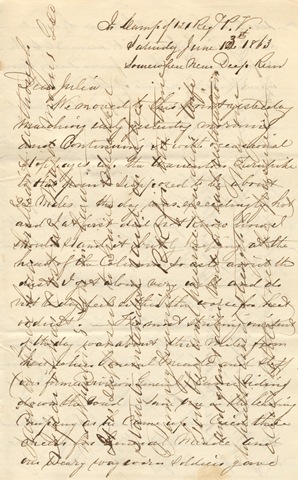
Rush IV-30-32 p1 A. Biddle ALS to Julia William Rush, June 19 Rush IV-30-32 p2 A. Biddle ALS to Julia William Rush, June 19 Rush IV-30-32 p3 A. Biddle ALS to Julia William Rush, June 19 Rush IV-30-32 p4 A. Biddle ALS to Julia William Rush, June 19

Transcript:

Camp of the 121st Regt P.V.
On Broad Run Virginia
June 19th 1863

Dear Julia

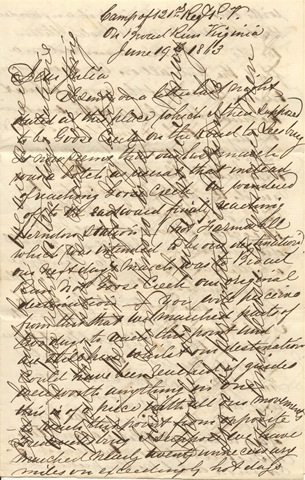
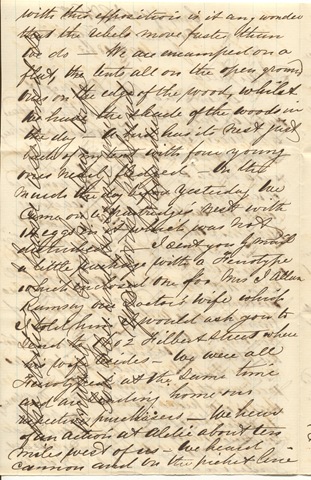
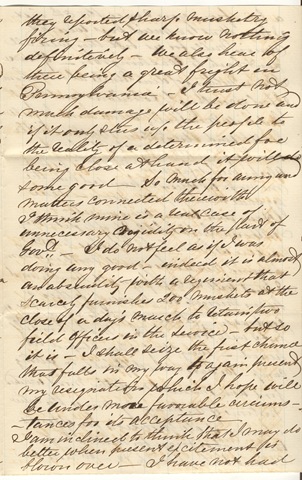
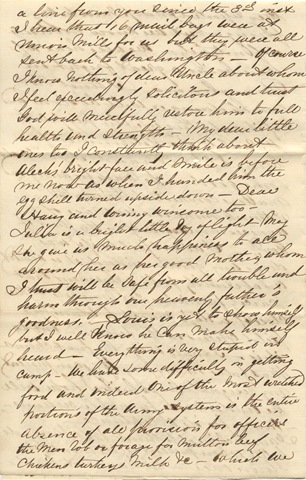
I sent on a letter last night dated at the place which I then supposed to be Goose Creek on the Road to Leesburg. It now seems that our last march was a botch as usual, that instead of reaching Goose Creek we wandered off to the eastward, finally reaching Herndon Station (not Farmwell which was intended to be our destination). our next day’s march was to Broad Run not Goose Creek, our original destination – you will perceive from this that we marched parts of two days to reach this point and are still here whilst our destination could have been reached if guides were worth anything, in one. this is of a piece with all our movements – to reach this point from opposite Fredericksburg I suppose we have marched nearly twenty unnecessary miles on exceedingly hot days. with this exposition is it any wonder that the rebels move faster than we do – We are encamped on a flat, the tents all on the open ground, ours on the edge of the wood whilst we have the shade of the woods in the day – a bird had its nest just back of my tent, with four young ones nearly fledged – on the march the day before yesterday we Came on a partridge’s nest with 14 eggs in it, which was not disturbed – I sent by mail a little package with a Ferrotype which enclosed one for Mrs J Allan Ramsay, our Doctor’s wife, which I told him I would ask you to send to 1602 Filbert Street where his wife resides – we were all Ferrotyped at the same time and are sending home our respective purchases – We heard of an action at Aldie about ten miles west of us – we heard cannon and on the picket line they reported sharp musketry firing – but we know nothing definitively – We also hear of there being a great fright in Pennsylvania – I trust not much damage will be done and if it only stirs up the people to the reality of a determined foe being close at hand it will do some good So much for army and matters connected therewith. I think mine is a real case of unnecessary rigidity on the part of Govt – I do not feel as if I was doing any good – indeed it is almost an absurdity with a regiment that scarcely furnishes 200 muskets at the close of a day’s march to retain two field officers in the service – but so it is – I shall seize the first chance that falls in my way to again present my resignation which I hope will be under more favorable circumstances for its acceptance. I am inclined to think that I may do better when present excitement is blown over – I have not had a line from you since the 3rd inst. I hear that 16 mail bags were at Union Mills for us but that they were all sent back to Washington – Of course I know nothing of dear Uncle about whom I feel exceedingly solicitous and trust God will mercifully restore him to health and strength – my dear little ones too I constantly think about. Aleck’s bright face and smile is before me now as when I handed him the egg shell turned upside down – Dear Harry and Winny winsome too – Julia is a bright little ray of light may she give as much happiness to all around her as he good mother, whom I trust will be safe from all trouble and harm through our heavenly father’s goodness. Louis is yet to show himself but I well know he Can make himself heard – Everything is very stupid in camp – we have some difficulty in getting food and indeed one of the most wretched portions of the Army system is the entire absence of all provision for officers. the men rob or forage for mutton beef chickens turkeys milk &c – which we can hardly buy. We are ordered often to take eight or ten days rations and then have no means of getting it – were it not for my extra horse I dont know what I should do – but I hope I may soon be permitted to return to you and leave to younger men the duties I have assumed so unwisely.

Good bye dear wife.

God bless and preserve you.
Your loving husband
Alexander

Citation: Alexander Biddle (1819-1899), autograph letter signed to Julia Williams Rush Biddle, 19 June 1863. Rush IV:30:32

June 18, 1863: John Henry Brown’s Journal

John Henry Brown was a painter of portrait miniatures, living and working in Philadelphia. He had met Lincoln in August of 1860 when he was commissioned to paint Lincoln’s portrait for a supporter, but although Brown liked Lincoln personally, he did not agree with Republican policies.

1863-06-18


Transcript:

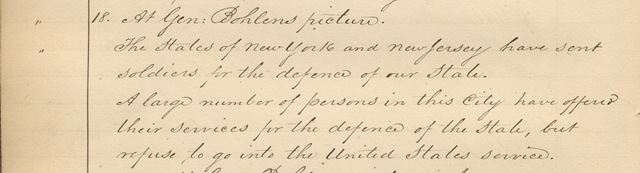
At Gen. Bohlens picture.

The States of New York and New Jersey have sent soldiers for the defence of the State.

A large number of persons in this City have offered their services for the defence of the State, but refuse to go into the United States service.


Citation: John Henry Brown, autograph journal/account book. Philadelphia, 1844-1890. AMs 573/14.1

June 17, 1863: Henry and Mary Warner to John Riddle Warner

Henry and Mary Warner lived in Allegheny City, Pennsylvania, now part of Pittsburgh. They are the great-grandparents of poet Marianne Moore.  By the 1860s they had three surviving children:  John, Henry, and Anne. Their letters to John, a Presbyterian minister living in Gettysburg, are preserved as part of Marianne Moore’s family papers.
  

Moore VI-5-20 Henry and Mary Warner to Children 6-17-63

Transcript [excerpt]:

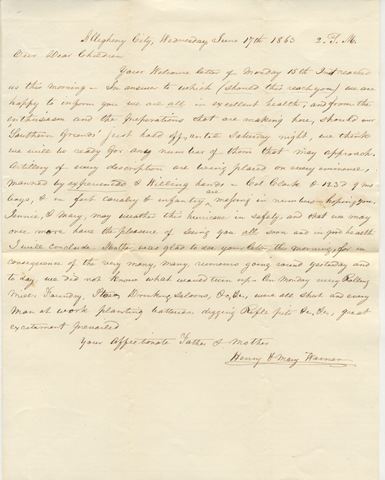
Allegheny City, Wednesday, June 17th 1863 2 P.M.

Our Dear Children

Your Welcome letter of Monday 15th Inst. reached us this morning—In answer to which (should this reach you) we are happy to inform you we are all in excellent health, and from the enthusiasm and the preparations that are making here, should our ‘Southern friends’ just hold off, until Saturday night, we think we will be ready for any number of them that may approach. Artillery of every description are being placed on every eminence, manned by experienced & Willing hands—Col Clark & 123 9 mo boys, & in fact cavalry & infantry are massing in numbers—hoping you, Jennie, & Mary, may weather this hurricane in safety, and that we may once more have the pleasure of seeing you all soon and in good health I will conclude—Mother was glad to see your letter this morning, for in consequence of the very many, many, rumours going round yesterday and to day, we did not know what would turn up—On Monday every Rolling Mill, Foundry, Store, Drinking Saloons, &c &c, were all shut and every man at work planting batteries, digging Rifle pits, &c &c, great excitement prevailed

Your Affectionate Father & Mother

Henry & Mary Warner


Citation: Henry and Mary Warner, autograph letter signed to John Riddle Warner.  Allegheny City [Pittsburgh],17 June 1863. Moore VI:05:20
June 16, 1863: John Henry Brown’s Journal

John Henry Brown was a painter of portrait miniatures, living and working in Philadelphia. He had met Lincoln in August of 1860 when he was commissioned to paint Lincoln’s portrait for a supporter, but although Brown liked Lincoln personally, he did not agree with Republican policies.

1863-06-16


Transcript:

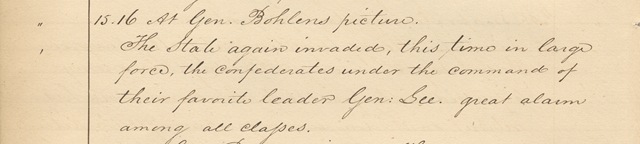
At Gen. Bohlens picture.

The State again invaded, this time in large force, the confederates under the command of their favorite leader Gen: Lee. great alarm among all classes.


Citation: John Henry Brown, autograph journal/account book. Philadelphia, 1844-1890. AMs 573/14.1

June 15, 1863: U.S. Grant to His Father

AMs 357-15 p1 U.S. Grant to Jesse Root Grant AMs 357-15 p2 U.S. Grant to Jesse Root Grant

Transcript:

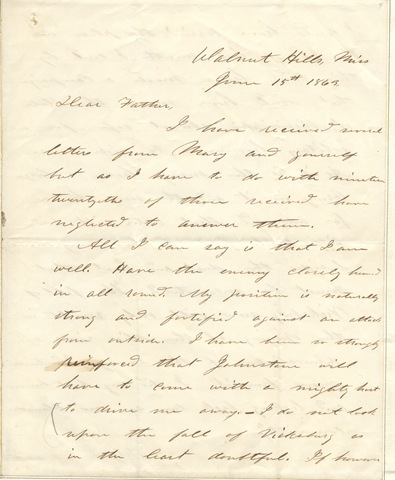
Walnut Hills, Miss

June 15th 1863

Dear Father,

I have received several letters from Mary and yourself but as I have to do with nineteen twentieths of them received have neglected to answer them.

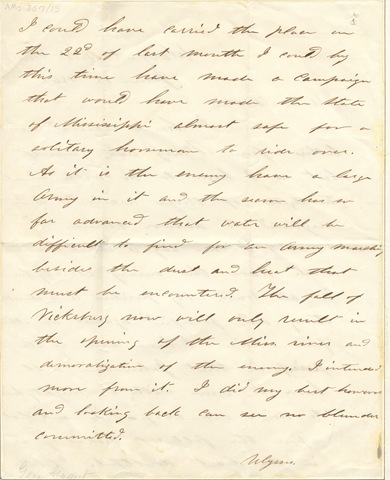
All I can say is that I am well. Have the enemy closely hemmed in all round. My position is naturally strong and fortified against an attack from outside. I have been so strongly reinforced that Johnston will have to come with a mighty host to drive me away. I do not look upon the fall of Vicksburg as in the least doubtful. If however I could have carried the place on the 22nd of last month I could by this time have made a campaign that would have made the state of Mississippi almost safe for a solitary horseman to ride over. As it is the enemy have a large army in it and the season has so far advanced that water will be difficult to find for an army marching besides the dust and heat that must be encountered. The fall of Vicksburg now will only result in the opening of the Miss. River and demoralization of the enemy. I intended more from it. I did my best however and looking back can see no blunder committed.

Ulysses.

Citation: Ulysses S. Grant (1822-1885), autograph letter signed to Jesse Root Grant. Walnut Hills, Miss., 15 June 1863. AMs 357/15

June 14, 1863: William T. Sherman to David Porter

AMs 532-6 p1 William T Sherman to David D Porter AMs 532-6 p2 William T Sherman to David D Porter AMs 532-6 p3 William T Sherman to David D Porter AMs 532-6 p4 William T Sherman to David D Porter

Transcript (excerpt):

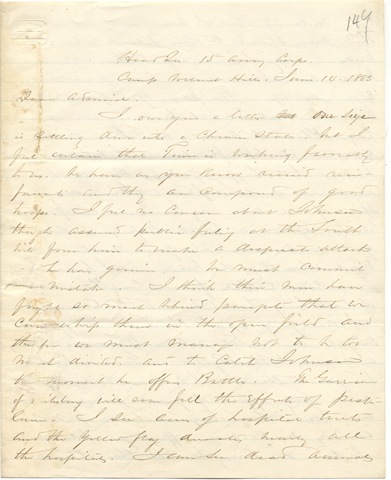
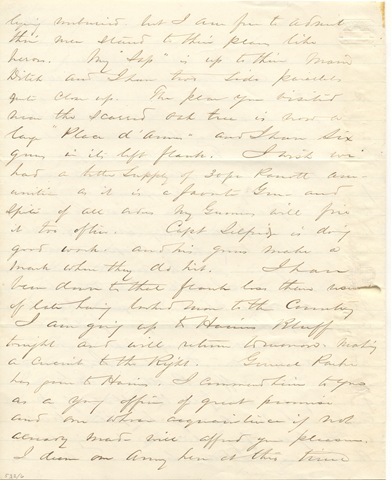
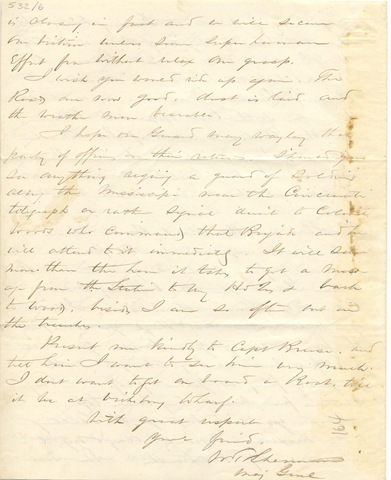
Our siege is settling down into a chronic state, but I feel certain that Time is working favorably to us. We have as you know received reinforcements and they are composed of good troops. I feel no concern about Johnson though assured public feeling, as the South will force him to make a desperate attack, [but he has genius?]. We must commit no mistake. I think their men have fought so much behind parapets that we can whip them in the open field and therefore we must manage not to be too much divided and to catch Johnson the moment he offers Battle. The Garrison of Vicksburg will soon feel the effects of pestilence. I see acres of hospital tents and the yellow flag denotes nearly all the hospitals. I can see dead animals lying unburied, but I am free to admit their men stand to their places like heroes. My “sap” is up to their Main Ditch and I have two side parallels quite close up…

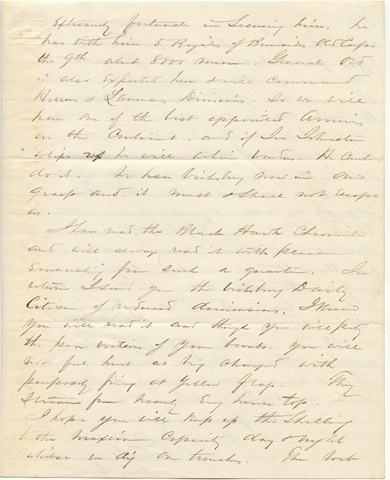
I have read the Black Hawk Chronicles and will always read it with pleasure emanating from such a quarter. In return I send you the Vicksburg Daily Citizen of reduced dimensions. I know you will read it and though you will pity the poor victims? of your bombs, you will not feel hurt as they charged with purposely firing at yellow flags. They stream from nearly every house top.

I hope you will keep up the Shelling in the maximum capacity day & night whilst we dig our trenches. The web is closing in fast and we will secure our victim unless some superhuman effort from without relax our grasp…

Citation: William T. Sherman (1820-1891), autograph letter signed to David D. Porter. Camp, Walnut Hills, Miss., 14 June 1863. AMs 532/6

June 13, 1863: Alexander Biddle to Julia Williams Rush Biddle

Alexander Biddle was a member of the prominent Philadelphia Biddle family and was married to Julia Williams Rush,  the granddaughter of Dr. Benjamin Rush.  Biddle served with the 121st Pennsylvania Volunteer Infantry, beginning in September 1862. Starting out as a major, he would participate in Fredericksburg and Gettysburg, among other engagements, and would leave the service as a lieutenant colonel. (He was commissioned, but never mustered, as colonel)

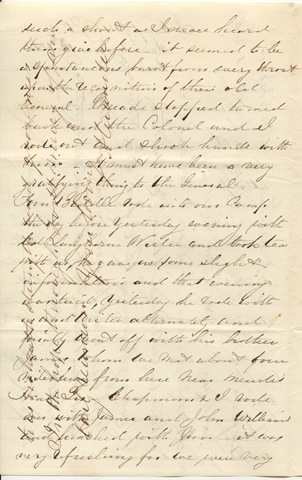
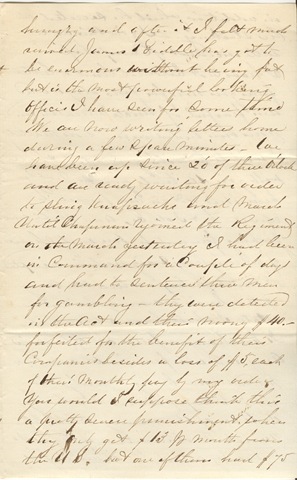
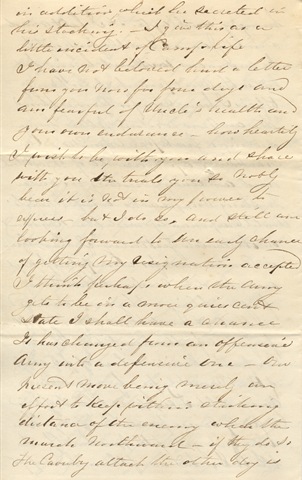
Rush IV-30-32 p1 A. Biddle ALS to Julia William Rush, June 13 Rush IV-30-32 p2 A. Biddle ALS to Julia William Rush, June 13 Rush IV-30-32 p3 A. Biddle ALS to Julia William Rush, June 13 Rush IV-30-32 p4 A. Biddle ALS to Julia William Rush, June 13

Transcript:

In Camp of 121 Regt P.V.
Saturday June 13th 1863
Somewhere near Deep Run

Dear Julia
We moved to this point yesterday, marching early yesterday morning and Continuing it with occasional stoppages up the Warrenton Turnpike to this point, supposed to be about 22 miles – the day was exceedingly hot and I at first did not Know how I should stand it but by keeping at the head of the Column so as to avoid the dust I got along very well and do not today feel either the worse for heat or dust. The most striking incident of the day was about three miles from here when General Meade and staff (our former Division General) came riding down the road – someone in the leading Company as he came up Cried three cheers for General Meade and our weary way-worn soldiers gave such a shout as I never heard them give before – it seemed to be a spontaneous burst from every throat upon the recognition of their old General. Meade stopped, turned back and the Colonel and I rode out and shook hands with him – It must have been a very gratifying thing to the General. Tom Biddle rode into our Camp the day before yesterday evening with Col Langhorne Wister and took tea with us, he gave us some slight information and that evening was tired, yesterday he rode with us and Wister alternately and finally went off with his brother James whom we met about four miles away from here near Meade’s Head Qrs- Chapman & I rode over with James and John Williams and lunched with Jim- it was very refreshing for we were very hungry and after it I felt much revived James Biddle has got to be enormous without being fat but is the most powerful looking officer I have seen for some time. We are now writing letters home during a few spare minutes – we have been up since 20′ of three o’clock and are ready waiting order to sling knapsacks and march. Until Chapman rejoined the Regiment on the march yesterday I had been in Command for a Couple of days and had to sentence three men for gambling – they were detected in the act and their money $40. – forfeited for the benefit of their Companies besides a loss of $5. each of their monthly pay by my order. You would I suppose think this a pretty severe punishment when they only get $13 [illeg.] month from the US, but one of them had $75 in addition which he secreted in his stocking – I give this as a little incident of Camp life. I have not beloved had a letter from you now for four days and am fearful of Uncle’s health and your own endurance – how heartily I wish to be with you and share with you the trials you so nobly bear it is not in my power to express – but I do so, and still am looking forward to an early chance of getting my resignation accepted. I think perhaps when the army gets to be in a more quiescent state I shall have a chance. It has changed from an offensive Army into a defensive one – our present move being merely an effort to Keep within striking distance of the enemy when the[y] march northward – if they do so. The Cavalry attack the other day is said to have been brilliant although I fear it has cost us Major Morris, Geo [M?] Wharton’s son in law. It is supposed to have checked Stuarts intended raid on the Pennsylvania RR for the time. God bless and preserve you dear wife and grant dear Uncle an early restoration to health and strength – May our dear little ones be preserved to us in health, strength and goodness. In the hope through Gods mercy of an early reunion,
Your loving
Alexander

Citation: Alexander Biddle (1819-1899), autograph letter signed to Julia Williams Rush Biddle, 13 June 1863. Rush IV:30:32

June 11, 1863: Mary Craig Eyster to Jennie Craig Warner

Jennie Craig Warner was the grandmother of the poet Marianne Moore. During the Civil War she lived in Gettysburg, Pennsylvania. Mary Craig Eyster was her sister and lived in Chambersburg. These family letters are preserved as part of the Marianne Moore family papers.Moore VI-5-20 p1 Hugh to Jennie Craig Warner 6-11-63 Moore VI-5-20 p2 Hugh to Jennie Craig Warner 6-11-63 Moore VI-5-20 p3 Hugh to Jennie Craig Warner 6-11-63 Moore VI-5-20 p4 Hugh to Jennie Craig Warner 6-11-63 Moore VI-5-20 p5 Hugh to Jennie Craig Warner 6-11-63 Moore VI-5-20 p6 Hugh to Jennie Craig Warner 6-11-63

Transcript [excerpt]:

June 11th 1863

Dear Jennie

I scarcely have time to write, but I felt that I must do it. We had quite an excitement here on Wednesday, expecting that the rebels were about to make a raid. Mother became very much alarmed, and determined to go to Shippensburg the next morning. I set to and cut out the body, sleeves, and cape, of her new dress, and made them that afternoon, with Caroline’s assistance. C [illeg.] home in the evening trains. We were very glad to get the good news of the rebels being whipped (if they were only whipped.) Mother intended going home to-day, but when the rumor got out about the rebels coming, she had me to write that she would not go. This morning I have just written for them to meet her on Monday. I have been that busy since you were here, that I have scarcely time to turn around…


Citation: Mary Craig Eyster, autograph letter signed to Jennie Craig Warner. [Chambersburg, Pa.?]; 11 June 1863. Moore VI:05:21