July 8, 1863: George Eyster to John Riddle Warner

John Riddle Warner was the grandfather of the poet Marianne Moore and during the Civil War he lived in Gettysburg, Pennsylvania. George Eyster was his brother-in-law and lived in Chambersburg, where he served as Provost Marshal for the 16th district of Pennsylvania from April 1863 to June 1865. These letters are preserved as part of Marianne Moore’s family papers.
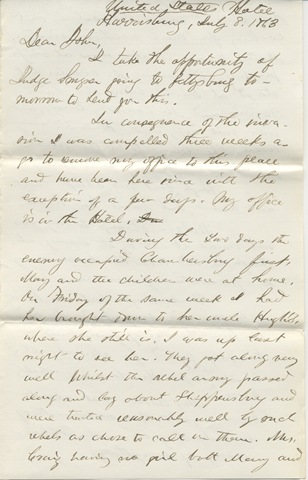
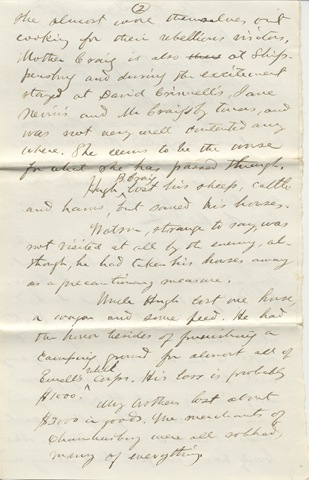
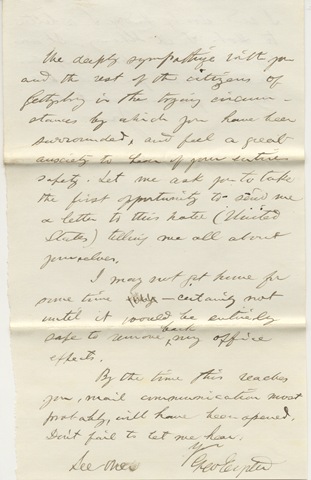
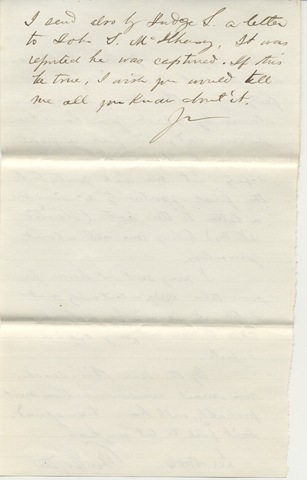
Moore VI-5-21 p1 George Eyster to John Riddle Warner 7-8-63 Moore VI-5-21 p2 George Eyster to John Riddle Warner 7-8-63 Moore VI-5-21 p3 George Eyster to John Riddle Warner 7-8-63 Moore VI-5-21 p4 George Eyster to John Riddle Warner 7-8-63

Transcript:

United States Hotel

Harrisburg, July 8, 1863

Dear John,

I take the opportunity of Judge [Longen?] going to Gettysburg to-morrow to send you this.

In consequence of the invasion I was compelled three weeks ago to remove my office to this place and have been here since with the exception of a few days. My office is in the Hotel.

During the two days the enemy occupied Chambersburg first, Mary and the children were at home. On Friday of the same week I had her brought down to her uncle Hugh’s, where she still is. I was up last night to see her. They got along very well whilst the rebel army passed along and lay about Shippensburg and were treated reasonably well by such rebels as chose to call on them. Mrs. Craig having no girl both Mary and she almost wore themselves out cooking for their rebellious visitors. Mother Craig is also at Shippensburg and during the excitement stayed at David Griswell’s, Jove Nervis’ and Mr. Craig’s by turns, and was not very well contented any where. She seems to be the worse for what she has passed through.

Hugh B. Craig lost his sheep, cattle, and hams, but saved his horses.

Watson, strange to say, was not visited at all by the enemy, although, he had taken his horses away as a precautionary measure.

Uncle Hugh lost one horse, a wagon and some feed. He had the horror besides of furnishing a camping ground for almost all of Ewells rebel corps. His loss is probably $1000. My brothers lost about $3000 in goods. The merchants of Chambersburg were all robbed, many of everything.

We deeply sympathize with you and the rest of the citizens of Gettysburg in the trying circumstances by which you have been surrounded, and feel a great anxiety to hear of your entire safety. Let me ask you to take the first opportunity to send me a letter to this hotel (United States) telling me all about yourselves.

I may not get home for some time—certainly not until it would be entirely safe to remove back my office effects.

By the time this reaches you, mail communication most probably, will have been opened. Don’t fail to let me hear.

Yours

See over Geo Eyster

I send also by Judge L. a letter to John S. [McShany?]. It was printed he was captured. If this be true, I wish you would tell me all you know about it.

Citation: George Eyster, autograph letter signed to John Riddle Warner. Harrisburg, Pa.; 8 July 1863. Moore VI:05:21

July 7, 1863: John Henry Brown’s Journal

John Henry Brown was a painter of portrait miniatures, living and working in Philadelphia. He had met Lincoln in August of 1860 when he was commissioned to paint Lincoln’s portrait for a supporter, but although Brown liked Lincoln personally, he did not agree with Republican policies.

1863-07-07


Transcript:

At Major Rosengartens picture.

Vicksburg surrendered by the rebels on the 4th inst. great rejoicing in consequence. The rebellion again considered as crushed.


Citation: John Henry Brown, autograph journal/account book. Philadelphia, 1844-1890. AMs 573/14.1

July 6, 1863: Alexander Biddle to Julia Williams Rush Biddle

Alexander Biddle was a member of the prominent Philadelphia Biddle family and was married to Julia Williams Rush,  the granddaughter of Dr. Benjamin Rush.  Biddle served with the 121st Pennsylvania Volunteer Infantry, beginning in September 1862. Starting out as a major, he would participate in Fredericksburg and Gettysburg, among other engagements, and would leave the service as a lieutenant colonel. (He was commissioned, but never mustered, as colonel)

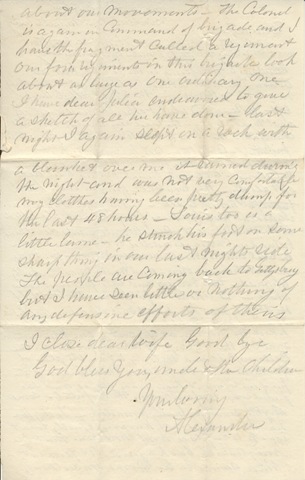
Rush IV-30-32 p1 A. Biddle ALS to Julia William Rush, July 6 Rush IV-30-32 p2 A. Biddle ALS to Julia William Rush, July 6

Transcript

Monday July 6th 1863
Bivouac near Emmittsburg

Dear wife
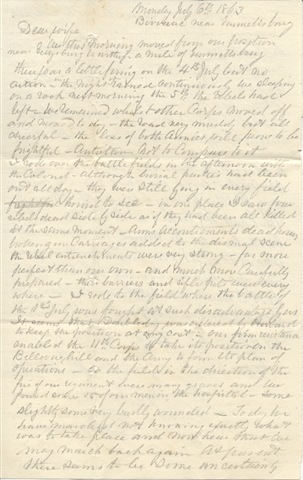
We this morning moved from our position near Gettysburg to within a mile of Emmittsburg. there was a little firing on the 4th July but no action – in the night it rained continuously, we sleeping on a rock next morning the 5th the rebels had left – we remained whilst other Corps moved off and moved to day – the road very muddy but all cheerful – the loss of both Armies will prove to be frightful – Antietam not to Compare to it. I rode over the battle fields in the afternoon with the Colonel – Although burial parties had been out all day – they were still lying in every field horrid to see – in one place I saw four rebels dead side by side as if they had been all killed at the same moment – arms, accoutrements, dead horses, broken gun Carriages added to the dismal scene. the rebel entrenchments were very strong – far more perfect than our own – and much more Carefully prepared – their barriers and rifle pits were everywhere. I rode to the field where the battle of the 1st July was fought at such disadvantage by us. It seems that Doubleday was ordered by Howard to keep the position at any cost – our firm resistance enabled the 11th Corps to take its position on the Bellevue hill and the Army to form its plan of operations – on the field in the direction of the fire of our regiment were many graves and we found some 15 of our men in the hospital – some slightly, some very badly wounded – To day we have marched not knowing exactly what was to take place and now hear that we may march back again. At present there seems to be some uncertainty about our movements – The Colonel is again in Command of brigade and I have the fragment called a regiment.our four regiments in this brigade look about as large as one ordinary one. I have dear Julia endeavored to give a sketch of all we have done – last night I again slept on a rock with a blanket over me it rained during the night and was not very comfortable, my clothes having been pretty damp for the last 48 hours – Louis too is a little lame – he struck his foot on some sharp thing in our last nights ride. The people are Coming back to Gettysburg but I have seen little or nothing of any defensive efforts of theirs. I close dear wife. Good bye. God bless you, Uncle & the children.
Your loving
Alexander

Citation: Alexander Biddle (1819-1899), autograph letter signed to Julia Williams Rush Biddle, 6 July 1863. Rush IV:30:33

July 5, 1863: John Henry Brown’s Journal

John Henry Brown was a painter of portrait miniatures, living and working in Philadelphia. He had met Lincoln in August of 1860 when he was commissioned to paint Lincoln’s portrait for a supporter, but although Brown liked Lincoln personally, he did not agree with Republican policies.

1863-07-05


Transcript:

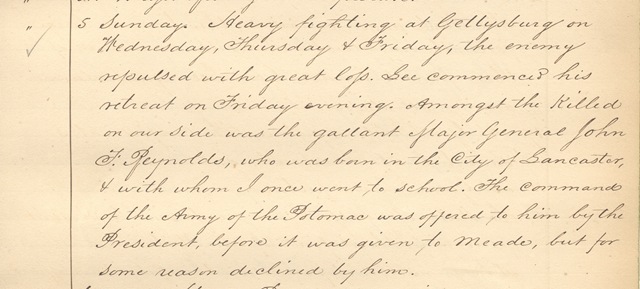
Sunday. Heavy fighting at Gettysburg on Wednesday, Thursday, & Friday, the enemy repulsed with great loss. Lee commenced his retreat on Friday evening. Amongst the killed on our side was the gallant Major General John F. Reynolds, who was born in the City of Lancaster & with whom I once went to school. The command of the Army of the Potomac was offered to him by the President, before it was given to Meade, but for some reason declined by him.


Citation: John Henry Brown, autograph journal/account book. Philadelphia, 1844-1890. AMs 573/14.1

July 5, 1863: George Meade to William Farrar Smith

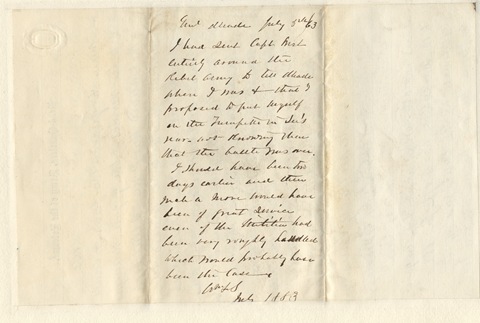
AMs 365-15 p1 Meade to William Farrar Smith  300 dpi AMs 365-15 p2-3 Meade to William Farrar Smith  300 dpi AMs 365-15 p4Meade to William Farrar Smith  300 dpi

Transcript:

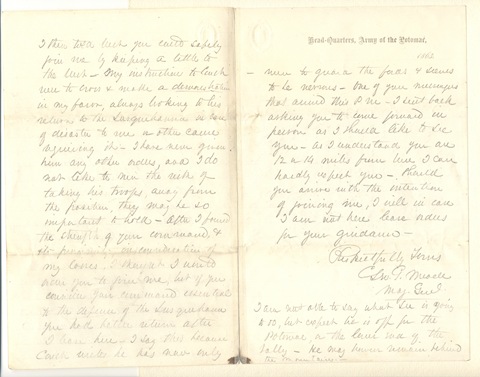
Head-Quarters, Army of the Potomac

Gettysburg July 5. 8 P.M. 1863

Genl. W. F. Smith

Dear Genl.-

West left here this morning. When he arrived last night the enemy were apparently in full force before my centre & left, but had withdrawn from my right—I knew he was in a strong position awaiting my attack, which I declined to make in consequence of the bad example he had set me, in ruining himself in attacking a strong position—at the same time I feel a little nervous about your position as Couch telegraphed you were going to Cashtown, where I could not have helped you—I therefore retained but till morning, when we found the enemy had retired on the Cashtown & Fairfield walls. I then told Couch you could safely join me by keeping a little to the left—my instructions to Couch were to cross & make a demonstration in my favor, always looking to his return to the Susquehanna in case of disaster to me or other cause requiring it—I have never given him any other orders, and I do not like to run the risk of taking his troops away from the position they may be so important to hold—After I found the strength of your command, & its proximity, in consideration of my lines, I thought I invited you to join me, but if you consider your command essential to the defence of the Susquehanna you had better return after I leave here—I say this because Couch insists he has now only men to guard the forces & seems to be nervous—One of your messengers that arrived this P.M—I sent back asking you to come forward in person as I should like to see you—As I understand you are 12 or 14 miles from here I can hardly expect you—Should you arrive with the intention of joining me, I will in case I am not here leave notes for your guidance—

Respectfully yours

Geo. G. Meade

Maj. Genl.

I am not able to say what Lee is going to do, but expect he is off for the Potomac,a the lower [illeg.] of the valley. He may however remain behind the mountains.

July 4, 1863: Alexander Biddle to Julia Williams Rush Biddle

Alexander Biddle was a member of the prominent Philadelphia Biddle family and was married to Julia Williams Rush,  the granddaughter of Dr. Benjamin Rush.  Biddle served with the 121st Pennsylvania Volunteer Infantry, beginning in September 1862. Starting out as a major, he would participate in Fredericksburg and Gettysburg, among other engagements, and would leave the service as a lieutenant colonel. (He was commissioned, but never mustered, as colonel) Rush IV-30-32 p1 A. Biddle ALS to Julia William Rush, July 4 Rush IV-30-32 p2 A. Biddle ALS to Julia William Rush, July 4

Transcript:

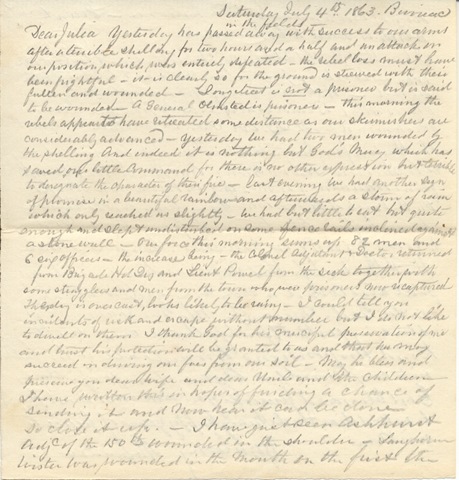
Saturday July 4th 1863. Bivouac in the field —

Dear Julia
Yesterday has passed away with success to our arms after a terrible shelling for two hours and a half and an attack on our position which was entirely defeated – the rebel loss must have been frightful – it is clearly so for the ground is strewed with their fallen and wounded – Longstreet is not a prisoner but is said to be wounded – A General Olmstead is prisoner– This morning the rebels appear to have retreated some distance as our skirmishers are considerably advanced – yesterday we had two men wounded by the shelling and indeed it is nothing but God’s Mercy which has saved our little command for there is no other expression but terrible to designate the character of their fire – last evening we had another sign of promise in a beautiful rainbow and afterwards a storm of rain which only reached us slightly – We had but little to eat but quite enough and slept undisturbed on some fence rails inclined against a stone wall – Our force this morning sums up 82 men and 6 officers – the increase being – the Colonel, Adjutant & Doctor returned from Brigade Hd Qrs and Lieut Powel from the sick, together with some stragglers and men from the town who were prisoners now recaptured. The day is overcast, looks likely to be rainy – I could tell you incidents of risk and escape without number but I do not like to dwell on them I thank God for his merciful preservation of me and trust his protection will be granted to us and that we may succeed in driving our foes from our soil– May he bless and preserve you dear wife and dear Uncle and the children. I have written this in hopes of finding a chance of sending it and now hear it can be done so close it up.– I have just seen Ashhurst, Adjt of the 150th, wounded in the shoulder – Langhorne Wister was wounded in the mouth on the first the day of our repulse he is a prisoner– Frank Webster is said to be killed–

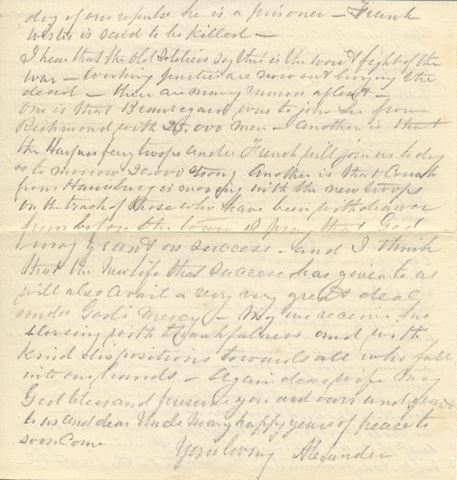
I hear that the old soldiers say this is the worst fight of the war – working parties are now out burying the dead – there are many rumors afloat – one is that Beauregard was to join Lee from Richmond with 25,000 men – another is that the Harpers ferry troops under French will join us to day or to morrow, 20,000 strong, another is that Couch from Harrisburg is moving with the new troops on the track of those who have been withdrawn from before the town I pray that God may grant us success – and I think that the new life that success has given to us will also avail a very very great deal under God’s mercy– May we receive due blessing with thankfulness and with kind dispositions to avail all who fall into our hands– Again dear wife may God bless and preserve you and ours and grant to us and dear Uncle many happy years of peace to soon come
Your loving Alexander

Citation: Alexander Biddle (1819-1899), autograph letter signed to Julia Williams Rush Biddle, 4 July 1863. Rush IV:30:33

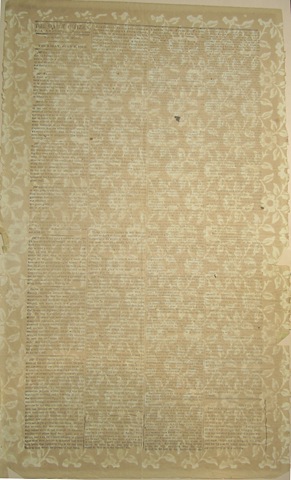
July 4, 1863: Vicksburg Daily Citizen—Souvenir Wallpaper Copy

Apart from the last column, this paper is a reprinting of the July 2, 1863 edition, which the Union troops found still in standing type when they arrived.

Transcript (excerpt):

July 4th, 1863.

Two days bring about great changes, the banner of the Union flows over Vicksburg. Gen. Grant has “caught the rabbit;” he has dined in Vicksburg, and he did bring his dinner with him. The “Citizen” lives to see it. For the last time it appears on “wall-paper.” No more will it eulogize the luxury of mule-meat and fricassed kitten-urge Southern warriors to each diet never more. This is the last wallpaper edition, and is, excepting this note, from the types as we found them. It will be valuable hereafter as a curiosity.

Citation: The Daily Citizen.  Vicksburg, Miss., 4 July 1863. AN .D133

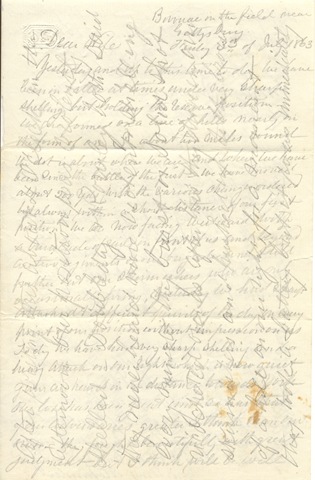
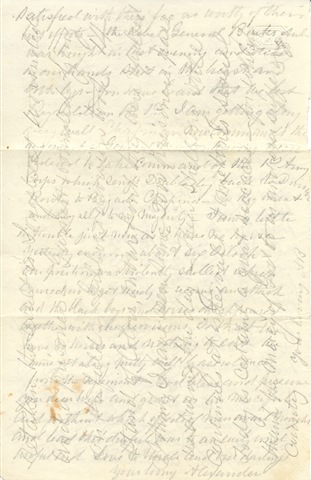
July 3, 1863: Alexander Biddle to Julia Williams Rush Biddle

Alexander Biddle was a member of the prominent Philadelphia Biddle family and was married to Julia Williams Rush,  the granddaughter of Dr. Benjamin Rush.  Biddle served with the 121st Pennsylvania Volunteer Infantry, beginning in September 1862. Starting out as a major, he would participate in Fredericksburg and Gettysburg, among other engagements, and would leave the service as a lieutenant colonel. (He was commissioned, but never mustered, as colonel)

Rush IV-30-32 p1 A. Biddle ALS to Julia William Rush, July 3 Rush IV-30-32 p2 A. Biddle ALS to Julia William Rush, July 3

Transcript:

Bivouac on the field near Gettysburg
Friday 3rd of July 1863

Dear Julia
Yesterday and up to this time to day we have been in battle, at times under very sharp shelling but holding the reserve position – we are formed on a line of hills nearly in the form of a “U” about two miles round. the dot is about where we are and where we have been since the battle of the first – we have moved about 200 yds with the various changes ordered but always within a short distance of our first position We are now facing westward with a barricade of rails in front of us and beyond are two regiments of our brigade and still further out our skirmishers, who are only occasionally firing. Yesterday we had sharp attacks at 4 different periods of the day on every point of our position without impression on us. To day we have had very sharp shelling and a heavy attack on our right which is now quiet. guns are heard in the distance towards York. Our loss has been great and so has that of our adversaries greater I think than our own – they fought beautifully with great judgment but I think will be well satisfied with their foe as worthy of their best efforts – the Rebel general Barksdale was brought in last evening and died in our hands, shot in the breast and both legs – You have heard that we lost Reynolds on the 1st I am getting along very well Chapman now commands the regiment – General Newton having been ordered to take command of the 1st Army Corps which sends Doubleday back to Division Rowley to Brigade Chapman to Regiment and myself to my Majority– I am a little in trouble just now as I have no horse. yesterday evening about six Oclock our position was violently shelled which caused us to get ready to receive an attack and black boys and horses disappeared together with the provisions so that we have no horses and nothing to eat we have got along pretty well by assistance from other regiment God bless and preserve you dear wife and grant us his merciful aid without which efforts of men avail naught and lead this awful war to an early and useful end Love to Uncle and our darlings.
Your loving Alexander

After writing this, about 4 O’clock in the afternoon our position was violently shelled – Doubleday & Rowley both said they never heard more violent shelling. every minute they burst or solid shot ricocheted over us After this they drove in our skirmishers and pushed up to the brow of a hill on our right, for a moment they took a battery but it was immediately retaken. the result is Longstreet wounded and a prisoner – Garrett wounded lying on the field.Gibbons division took 14 stand of Colors, on our front they were repulsed. I think I have seen some 2000 prisoners pass us during the day Their shelling still continues at intervals, sometimes severely. To day is certainly a great success – for which thank the mercy of God to us and our suffering Country.

Your loving AB

Citation: Alexander Biddle (1819-1899), autograph letter signed to Julia Williams Rush Biddle, 3 July 1863. Rush IV:30:33

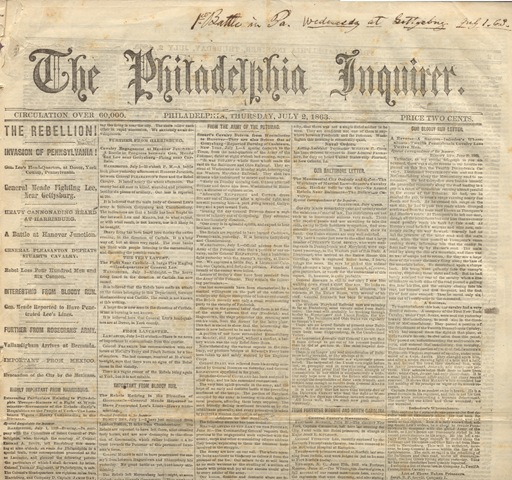
July 2, 1863: Philadelphia Inquirer

top

Transcript (excerpt):

Page 1, Upper Half

Further From Harrisburg.

Cavalry Engagement at Hanover Junction – A Battle in Progress between Gen. Meade and Lee near Gettysburg – Firing near Carlisle.

Harrisburg, July 1-10 o’clock P.M. – A battle took place yesterday afternoon at Hanover Junction, between General Pleasanton’s force and the Rebel Cavalry. It lasted nearly the whole afternoon. The enemy lost 400 men in killed, wounded, and prisoners, besides six pieces of artillery. Our loss is reported at 200.

It is believed that the main body of General Lee’s army is between Gettysburg and Chambersburg. The indications are that a battle has been fought today between Lee and Meade, but to what extent, or with what result, is not known, nor is it likely to be to-night.

Heavy firing has been heard here during the entire evening in the direction of Carlisle. It is a long way off, but at times very rapid. The river banks are lined with people listening to the cannonading and discussing the possible results.

Citation: Philadelphia Inquirer. 2 July 1863. Gift of Steven and Susan Raab. AN .P5546

July 1, 1863: John Henry Brown’s Journal

John Henry Brown was a painter of portrait miniatures, living and working in Philadelphia. He had met Lincoln in August of 1860 when he was commissioned to paint Lincoln’s portrait for a supporter, but although Brown liked Lincoln personally, he did not agree with Republican policies.

1863-07-01


Transcript:

At Major Rosengartens picture.

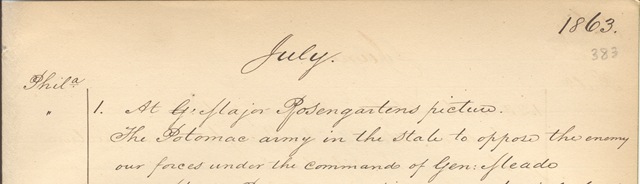
The Potomac army in the State to oppose the enemy our forces under the command of Gen: Meade.


Citation: John Henry Brown, autograph journal/account book. Philadelphia, 1844-1890. AMs 573/14.1