December 8, 1860: John Henry Brown’s Journal

John Henry Brown was a miniature painter, living and working in Philadelphia. Politically he was a Democrat, but he had met Lincoln in August of 1860 when he was commissioned to paint a portrait of Lincoln for a supporter.

1860-12-08

Transcription:

At Miss Rogers picture.

The news from Washington is gloomy.

Citation: John Henry Brown (1818-1891), autograph journal/account book. Philadelphia, 1844-1890. AMs 574/14.1

December 5, 1860: Letter from H. S. Lansing to Elmer Ellsworth

Col. Elmer Ellsworth was a lawyer and soldier and friend of Abraham Lincoln who would become one of the first casualties of the Civil War. As a colonel of the Chicago National Guard Cadets before the war, Ellsworth introduced French-inspired Zouave uniforms and drills to the unit. He worked in Lincoln’s law office in August 1860 and assisted him during the fall campaign. After Lincoln’s election he helped organize troops, including the 11th New York Volunteer Infantry Regiment. He was shot and killed on May 24, 1861 while removing a large Confederate flag from a tavern in Alexandria, Virginia.
AMs 811-2-5 p1 HS Lansing to Ellsworth (Large)

AMs 811-2-5 p2 HS Lansing to Ellsworth (Large)

AMs 811-2-5 p3 HS Lansing to Ellsworth (Large)

Transcription:

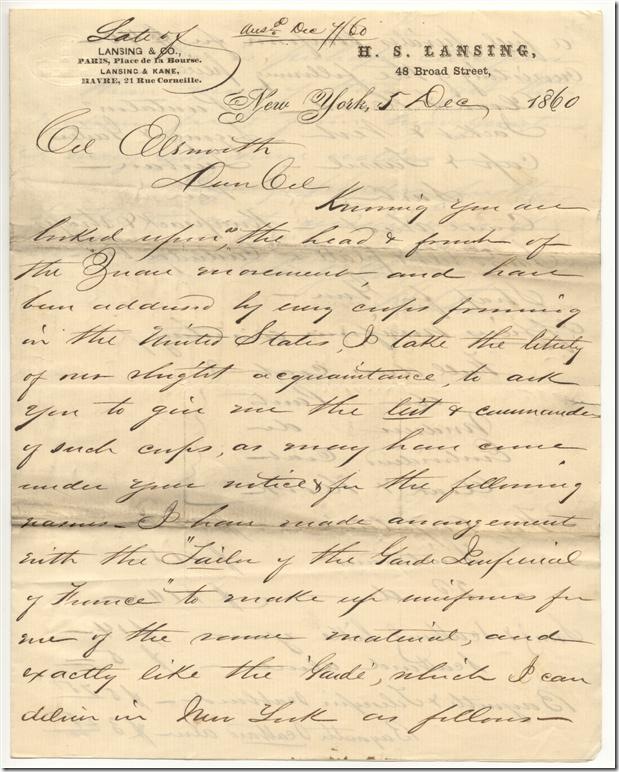
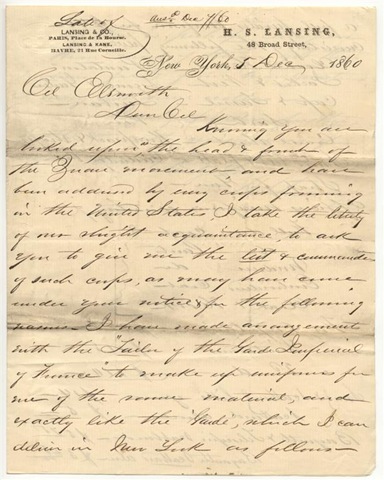
New York, 5 Dec 1860

Col Ellsworth

Dear Col

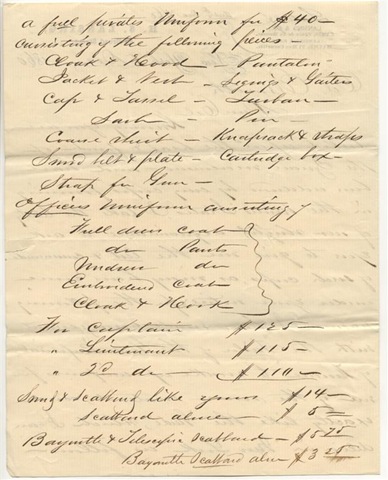
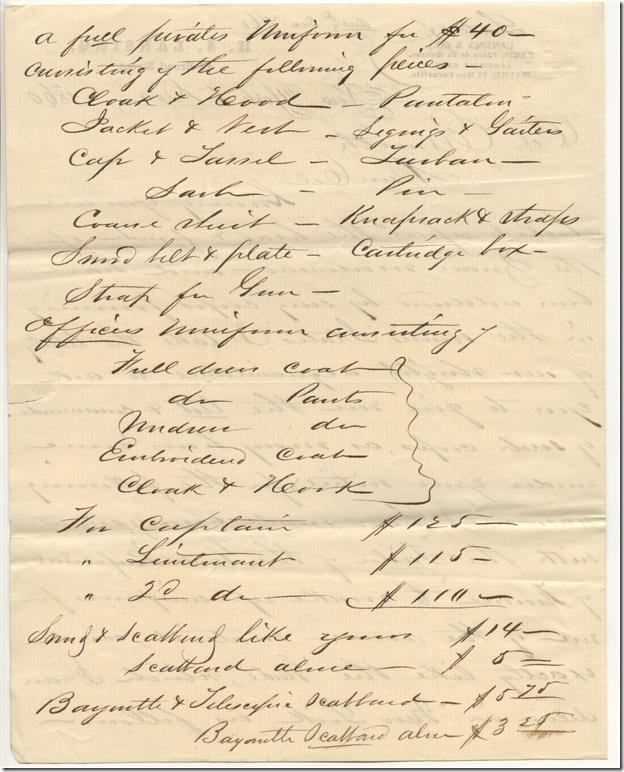
Knowing you are looked upon as the head & front of the Zuave [sic] movement, and have been addressed by every corps forming in the United States, I take the liberty of our slight acquaintance, to ask you to give me the list & commanders of such corps, as may have come under your notice & for the following names- I have made arrangements with the “Tailor of the Garde Imperial of France” to make up uniforms for me of the reserve material, and exactly like the “Garde” which I can deliver in New York as follows- a full privates uniform for $40- consisting of the following pieces-

Cloak & Hood – Pantaloon

Jacket & Vest- Leggings & Garters

Cap & Tassel – Turban

Sash – Pin

Coarse shirt – Knapsack & straps

Sword[?] belt & plate – Cartridge box –

Strap for gun –

Officers uniform consisting of

Full dress coat

do pants

Undress do

Embroidered coat

Cloak & [illeg.]

For Captain $125

Lieutenant $115

2nd do $110

Sword & scabbard like yours $14

Scabbard alone $5

Bayonette & Telescopic scabbard $5.70

Bayonette scabbard alone $3.20

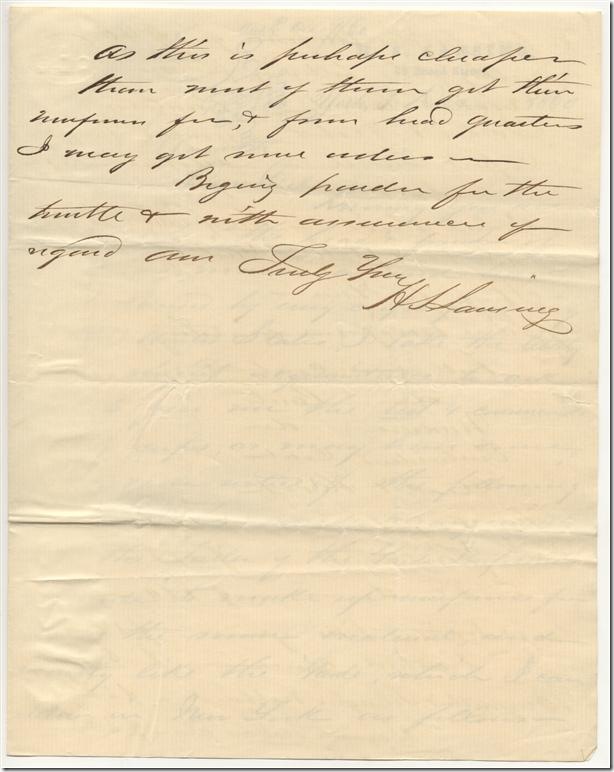
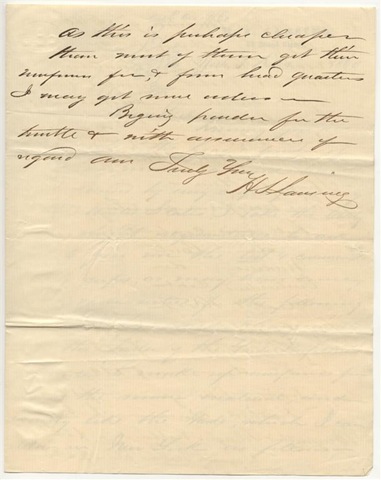
As this is perhaps cheaper than most of them got this uniform for, & from head quarters I may get some orders-

Begging pardon for the trouble & with assurances of regard am

Truly Yours

H. S. Lansing


Citation: H.S Lansing, autograph letter signed to Elmer Ellsworth. New York, 5 December 1860. AMs 811/2.5

December 3, 1860: John Henry Brown’s Journal

John Henry Brown was a painter of portrait miniatures, living and working in Philadelphia. He had met Lincoln in August of 1860 when he was commissioned to paint Lincoln’s portrait for a supporter, but although Brown liked Lincoln personally, he did not agree with Republican policies.

1860-12-03

Transcription:

Had a Daguerre taken of Miss Rogers.

The Congress of the United States convened today.

Citation: John Henry Brown (1818-1891), autograph journal/account book. Philadelphia, 1844-1890. AMs 574/14.1

November 30, 1860: John Henry Brown’s Journal

John Henry Brown was a painter of portrait miniatures, living and working in Philadelphia. He had met Lincoln in August of 1860 when he was commissioned to paint Lincoln’s portrait for a supporter, but although Brown liked Lincoln personally, he did not agree with Republican policies.

1860-11-30

Transcription:

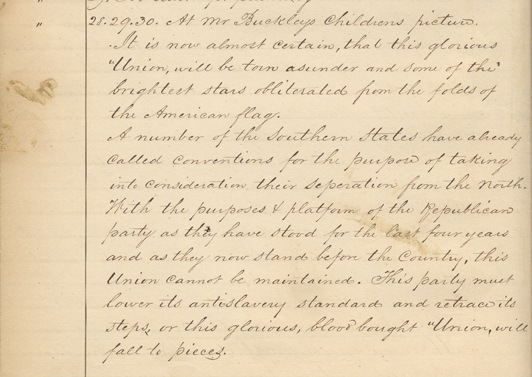
At Mr Buckleys childrens picture.

It is now almost certain, that this glorious union, will be torn asunder and some of the brightest stars obliterated from the folds of the American flag.

A number of the Southern States have already called conventions for the purpose of taking into consideration their separation from the north. With the purpose & platform of the Republican party as they have stood for the last four years and as they now stand before the Country, this Union cannot be maintained. This party must lower its antislavery standard and retrace its steps, or this glorious, blood bought Union, will fall to pieces.

Citation: John Henry Brown (1818-1891), autograph journal/account book. Philadelphia, 1844-1890. AMs 574/14.1

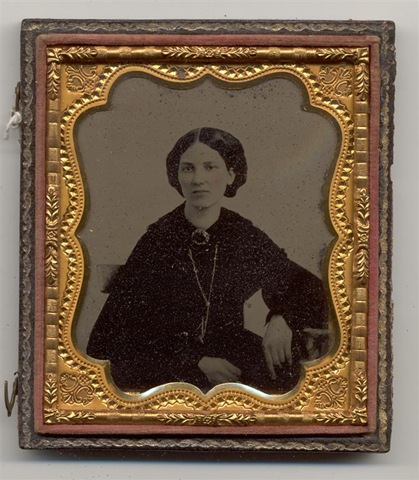
November 27, 1860: Ambrotype of Jennie Craig Warner

2006.7644 Jennie Craig Warner (Large)

Jennie Craig Warner lived in Gettysburg with her husband Rev. John Riddle Warner. She would be the grandmother of poet Marianne Moore. The photograph is undated, but her hairstyle and bodice suggest a date in the early 1860s. Jennie would die of typhoid in 1863.

Citation: Unknown photographer, photograph of Jennie Craig Warner.  ca. 1860. 2006.7644

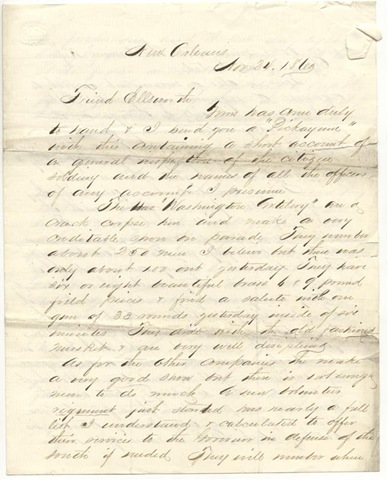
November 24, 1860: Letter from J.A. Hendson to Elmer Ellsworth

Col. Elmer Ellsworth was a lawyer and soldier and friend of Abraham Lincoln who would become one of the first casualties of the Civil War. As a colonel of the Chicago National Guard Cadets before the war, Ellsworth introduced French-inspired Zouave uniforms and drills to the unit. He worked in Lincoln’s law office in August 1860 and assisted him during the fall campaign. After Lincoln’s election he helped organize troops, including the 11th New York Volunteer Infantry Regiment. He was shot and killed on May 24, 1861 while removing a large Confederate flag from a tavern in Alexandria Virginia.

AMs 811-2-5 p1 JA Henderson to Ellsworth (Large)

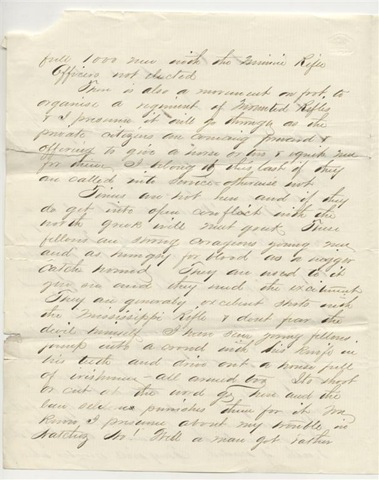
AMs 811-2-5 p2 JA Henderson to Ellsworth (Large)

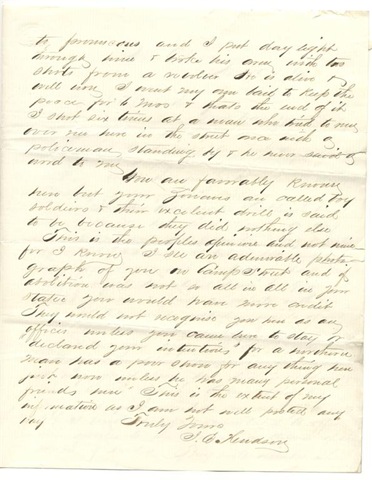
AMs 811-2-5 p3 JA Henderson to Ellsworth (Large)

Transcript (excerpt):

New Orleans

Nov 24. 1860

[Excerpt middle of p2]

Times are hot here and if they do get into open conflict with the north Greek will meet Greek. These fellows are strong courageous young men and as hungry for blood as a nigger catching hound. They are used to it you see and they need the excitement. They are generally excellent shots with the Mississippi Rifle & dont fear the devil himself. I have seen young fellows jump into a crowd with his knife in his teeth and drive out a house full of irishmen—all around too. Its shoot or cut at the word go here and the law seldom punishes them for it.

[Excerpt p3, last paragraph]

You are favorably known here but your Zouaves are called boy soldiers & their excellent drill is said to be because they did nothing else. This is the peoples opinion and not nice for I know I see an admirable photograph of you on Camp Street  and if abolition was not so all in all in your state you would have more credit. They would not recognise you here as an officer unless you came here to stay or “declared your intentions” for a northern man has a poor show for anything here just now unless he has many personal friends here. This is the extent of my information as I am not well posted anyway

Truly Yours

J. A. Hendson
Citation. J.A. Hendson, autograph letter signed to Elmer Ellsworth. New Orleans, 24 November 1860. AMs 811/2.5

November 22, 1860: John Henry Brown’s Journal

John Henry Brown was a painter of portrait miniatures, living and working in Philadelphia. He had met Lincoln in August of 1860 when he was commissioned to paint Lincoln’s portrait for a supporter, but although Brown liked Lincoln personally, he did not agree with Republican policies.

1860-11-22

Transcription:

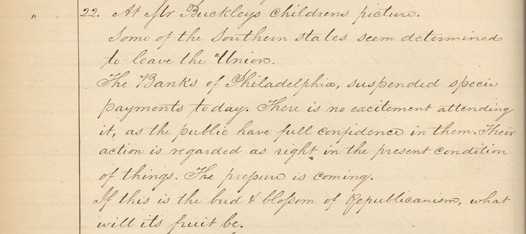
At Mr Buckleys childrens picture.

Some of the Southern States seem determined to leave the Union.

The Banks of Philadelphia, suspended specie payments today. There is no excitement attending, it, as the public have full confidence in them. Their action is regarded as right in the present condition of things. The pressure is coming.

If this is the bud &blossom of Republicanism, what will its fruit be.

Citation: John Henry Brown (1818-1891), autograph journal/account book. Philadelphia, 1844-1890. AMs 574/14.1

November 19, 1860: John Henry Brown’s Journal

John Henry Brown was a painter of portrait miniatures, living and working in Philadelphia. He had met Lincoln in August of 1860 when he was commissioned to paint Lincoln’s portrait for a supporter, but although Brown liked Lincoln personally, he did not agree with Republican policies.

1860-11-19

Transcription:

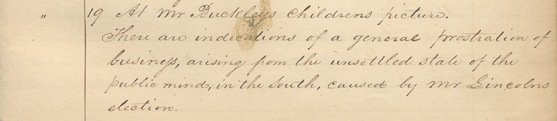
At Mr Buckleys childrens picture. There are indication of a general prostration of business, arising from the unsettled state of the public mind, in the South, caused by Mr. Lincolns election.


Citation: John Henry Brown (1818-1891), autograph journal/account book. Philadelphia, 1844-1890. AMs 574/14.1

November 17, 1860: John Henry Brown’s Journal

John Henry Brown was a painter of portrait miniatures, living and working in Philadelphia. He had met Lincoln in August of 1860 when he was commissioned to paint Lincoln’s portrait for a supporter, but although Brown liked Lincoln personally, he did not agree with Republican policies.

1860-11-17

Transcription:

At Mr Buckleys childrens picture. The news from the South is worse & worse.


Citation: John Henry Brown (1818-1891), autograph journal/account book. Philadelphia, 1844-1890. AMs 574/14.1

November 15, 1860: Daguerreotype of Henry Warner (?) and John Riddle Warner

2006.7637  John & Henry Warner (Large)

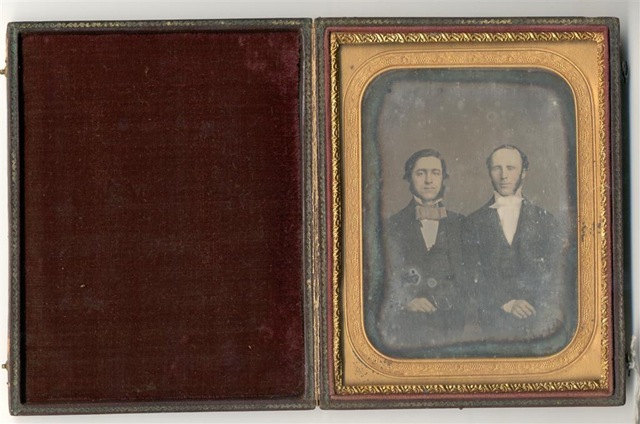
The man on the right is the Rev. John Riddle Warner. He was the grandfather of the poet Marianne Moore and during the Civil War, he lived in Gettysburg, Pennsylvania. The man at the left is probably his brother, Henry Warner. The photograph is undated, but the ages of the sitters suggest late 1850s or early 1860s.  Warner family letters will feature later on in Today in the Civil War.

Citation: Unknown photographer, daguerreotype of Henry Warner(?) and John Riddle Warner. 2006.7637