December 28, 1860: John Henry Brown’s Journal

John Henry Brown was a painter of portrait miniatures, living and working in Philadelphia. He had met Lincoln in August of 1860 when he was commissioned to paint Lincoln’s portrait for a supporter, but although Brown liked Lincoln personally, he did not agree with Republican policies.

1860-12-28 Transcription:

Commenced Master John Lees picture.

Two engagements for work have been countermanded or broken lately in consequence of the times. No new engagements making.

Citation: John Henry Brown (1818-1891), autograph journal/account book. Philadelphia, 1844-1890. AMs 574/14.1

December 27, 1860: John Henry Brown’s Journal

John Henry Brown was a painter of portrait miniatures, living and working in Philadelphia. He had met Lincoln in August of 1860 when he was commissioned to paint Lincoln’s portrait for a supporter, but although Brown liked Lincoln personally, he did not agree with Republican policies.

1860-12-27

Transcription:

The general feeling in regard to the aspect of affairs at the South, is one of unrelieved despondency.

The belief is rapidly gaining ground that before long all of the Cotton States will be out of the Union and that before the 4th of March all the Slave States will be inclined to follow them.


Citation: John Henry Brown (1818-1891), autograph journal/account book. Philadelphia, 1844-1890. AMs 574/14.1

December 22, 1860: The Sun [Baltimore]

Baltimroe Sun 12-22-60

Transcript (excerpt, p1):

By Telegraph for the Baltimore Sun.

South Carolina Sovereign Convention.

Signing of the Secession Ordinance – Address to the Southern States – Secret Session of the Convention – Reports of Committees – Commissioners Elected to go to Washington – Grand Torchlight Procession and Illumination in Charleston – Rejoicing in Other Southern States, etc.

Charleston, Dec. 20th – The members of the convention assembled at Institute Hall at half-past 6 o’clock this evening and proceeded to sign this ordinance of secession, which was beautifully engrossed on parchment. The president signed first and was followed by all the members.
Citation: The Sun. Baltimore, 22 December 1860. Gift of Steven and Susan Raab. AN .S955

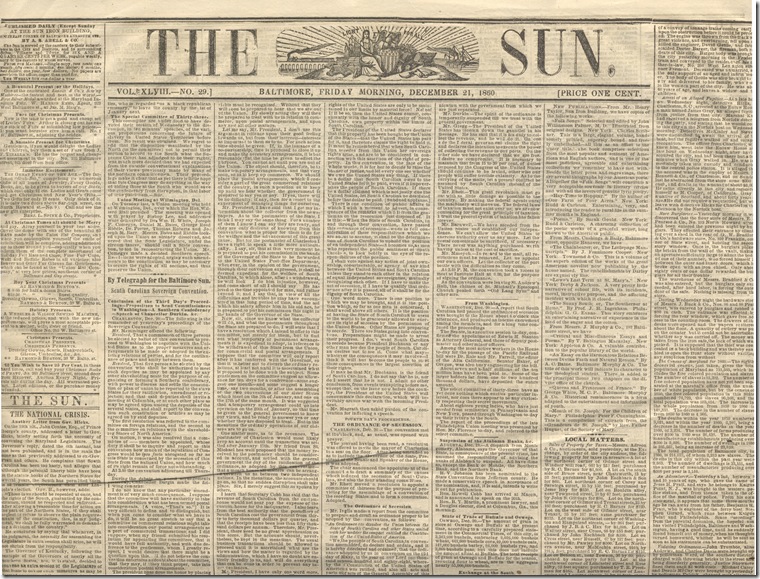
December 21, 1860: The Sun [Baltimore]

Baltimore Sun 12-21-60

Transcript [excerpt, p1]:

The Ordinance of Secession

Mr. Inglis made a report to the committee to prepare and draft an ordinance proper to be adopted by the convention as follows:

“An Ordinance to dissolve the Union between the State of South Carolina and other States united with her under the compact entitled the Constitution of the United States of America.

“We the people of South Carolina convention assembled, do declare and ordain, and it is hereby declared and ordained that the ordinance adopted by us in convention on the 23rd day of May, in the year of our Lord one thousand seven hundred and eighty-eight, whereby the Constitution of the United States of America was ratified, and also all acts and parts of acts of the General Assembly of this State ratifying the amendments of the said Constitution are hereby repealed.

“And that the Union now subsisting between South Carolina and other States, under the name of the United States of America, is hereby dissolved.”

The ordinance having been read was taken up and passed by a unanimous vote of one hundred and sixty-nine members.
Citation:The Sun. Baltimore, 21 December 1860. Gift of Steven and Susan Raab. AN .S955

December 20, 1860: John Henry Brown’s Journal

John Henry Brown was a painter of portrait miniatures, living and working in Philadelphia. He had met Lincoln in August of 1860 when he was commissioned to paint Lincoln’s portrait for a supporter, but although Brown liked Lincoln personally, he did not agree with Republican policies.

1860-12-20

Transcription:

At Miss Rogers picture.

At 1 O clock this day the 20th, this glorious Union was disrupted, South Carolina having at that time passed an ordinance of Secession.


Citation: John Henry Brown (1818-1891), autograph journal/account book. Philadelphia, 1844-1890. AMs 574/14.1

December 19, 1860: Henry & Mary Warner to John Warner

Henry and Mary Warner lived in Allegheny City, Pennsylvania, now part of Pittsburgh. They are the great-grandparents of poet Marianne Moore.  By the 1860s they had three surviving children:  John, Henry, and Annie. Their letters to John, a Presbyterian minister living in Gettysburg, are preserved as part of Marianne Moore’s family papers.

Moore VI-4-13 Henry and Mary Warner to Children 12-19-1860

Transcript (excerpt):

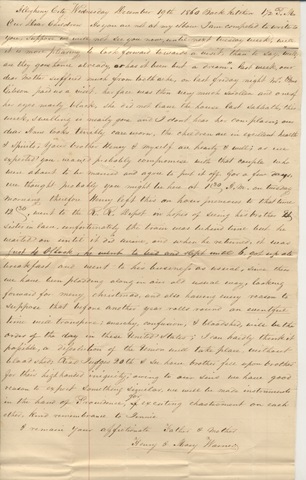
“We have been plodding along in our old usual way, looking forward for merry Christmas, and also having every reason to suppose that before another year rolls around an eventful time will transpire: anarchy, confusion & bloodshed, will be the order of the day in these United States; I can hardly think it possible, a dissolution of the Union will take place without bloodshed; Read Judges 20th &  see how brother fell upon brother for this high handed iniquity, owing to our sins we have good reason to expect something similar, we will be made instruments in the hand of Providence for executing chastisement on each other.

Citation: Henry & Mary Warner,autograph letter to John Riddle Warner. Allegheny City, 19 December 1860. Moore VI:04:13

December 17, 1860: John Henry Brown’s Journal

John Henry Brown was a painter of portrait miniatures, living and working in Philadelphia. He had met Lincoln in August of 1860 when he was commissioned to paint Lincoln’s portrait for a supporter, but although Brown liked Lincoln personally, he did not agree with Republican policies.

1860-12-17 Transcription:

At Miss Rogers picture.

The South Carolina Convention meets today, to act upon secession.

Citation: John Henry Brown (1818-1891), autograph journal/account book. Philadelphia, 1844-1890. AMs 574/14.1

December 15, 1860: John Henry Brown’s Journal

John Henry Brown was a miniature painter, living and working in Philadelphia. Politically he was a Democrat, but he had met Lincoln in August of 1860 when he was commissioned to paint a portrait of Lincoln for a supporter.

1860-12-15

Transcription:

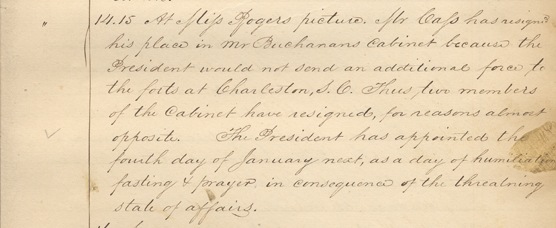
At Miss Rogers picture. Mr. Cass has resigned his place in Mr. Buchanan’s Cabinet because the President would not send and additional force to the forts at Charleston, S. C. Thus, two members of the Cabinet have resigned, for reasons almost opposite. The President has appointed the fourth day of January next, as a day of humiliation, fasting & prayer in consequence of the threatening state of affairs.


Citation: John Henry Brown (1818-1891), autograph journal/account book. Philadelphia, 1844-1890. AMs 574/14.1

December 13, 1860: John Henry Brown’s Journal

John Henry Brown was a painter of portrait miniatures, living and working in Philadelphia. He had met Lincoln in August of 1860 when he was commissioned to paint Lincoln’s portrait for a supporter, but although Brown liked Lincoln personally, he did not agree with Republican policies.

1860-12-13Transcription:

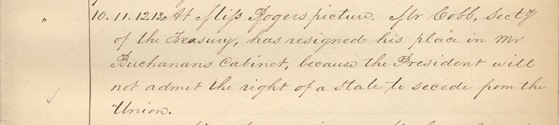
At Miss Rogers picture. Mr. Cobb, Secty of the Treasury, has resigned his place in Mr. Buchanan’s cabinet, because the President will not admit the right of a state to secede from the Union.

Citation: John Henry Brown (1818-1891), autograph journal/account book. Philadelphia, 1844-1890. AMs 574/14.1

December 11, 1860: Photograph of Elmer Ellsworth

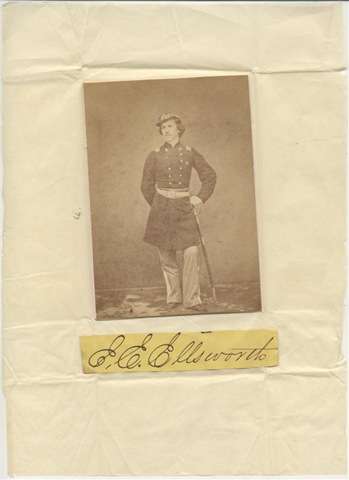
Col. Elmer Ellsworth was a lawyer and soldier and friend of Abraham Lincoln who would become one of the first casualties of the Civil War. As a colonel of the Chicago National Guard Cadets before the war, Ellsworth introduced French-inspired Zouave uniforms and drills to the unit. He worked in Lincoln’s law office in August 1860 and assisted him during the fall campaign. After Lincoln’s election he helped organize troops, including the 11th New York Volunteer Infantry Regiment. He was shot and killed on May 24, 1861 while removing a large Confederate flag from a tavern in Alexandria, Virginia.

AMs 811-2_1 Ellsworth photograph (Large)

Citation:  Matthew Brady, carte de visite photograph of Col. Elmer Ellsworth. 1860. AMs 811/2.1