January 15, 1861: John Henry Brown’s Journal

John Henry Brown was a painter of portrait miniatures, living and working in Philadelphia. He had met Lincoln in August of 1860 when he was commissioned to paint Lincoln’s portrait for a supporter, but although Brown liked Lincoln personally, he did not agree with Republican policies.

1861-01-15

Transcript:

At Miss Roger’s picture. Lost another engagement today, owing to the condition of the times. This makes six hundred & seventy five dollars, lost thus far, by broken engagements and no new engagements making. This is the time of year, engagements were generally made, which gave me work for a year.

Andrew G. Curtin, (Republican) inaugurated Governor of Pennsylvania, for three years. His address is moderate in tone.


Citation: John Henry Brown (1818-1891), autograph journal/account book. Philadelphia, 1844-1890. AMs 574/14.1
January 12, 1861: Letter from C. C. Farnham to Elmer Ellsworth

Col. Elmer Ellsworth was a lawyer and soldier and friend of Abraham Lincoln who would become one of the first casualties of the Civil War. As a colonel of the Chicago National Guard Cadets before the war, Ellsworth introduced French-inspired Zouave uniforms and drills to the unit. He worked in Lincoln’s law office in August 1860 and assisted him during the fall campaign. After Lincoln’s election he helped organize troops, including the 11th New York Volunteer Infantry Regiment. He was shot and killed on May 24, 1861 while removing a large Confederate flag from a tavern in Alexandria, Virginia.

 AMs 811-2-6 Farmingham to Ellsworth

Transcript:

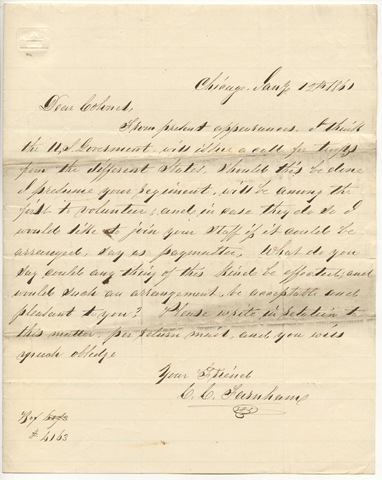
Chicago Jany 12th 1861

Dear Colonel,

From present appearances I think the U.S. Government will issue a call for troops from the different States. Should this be done I presume your regiment will be among the first to volunteer, and in case they do so I would like to join your staff if it could be arranged, say as paymaster. What do you say could anything of this kind be effected; and would such an arrangement, be acceptable and pleasant to you? Please write in relation to this matter, per return mail, and you will much oblige

Your Friend

C. C. Farnham


Citation: C.C. Farnham, autograph letter signed to Elmer Ellsworth. Chicgao, 12 January 1861. AMs 811/2.6

January 11, 1861: John Henry Brown’s Journal

John Henry Brown was a painter of portrait miniatures, living and working in Philadelphia. He had met Lincoln in August of 1860 when he was commissioned to paint Lincoln’s portrait for a supporter, but although Brown liked Lincoln personally, he did not agree with Republican policies.

1861-01-111861-01-11(2)

Transcript:

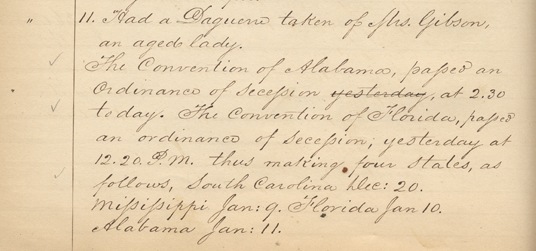
Had a Daguerre taken of Mrs. Gibson, an aged lady.

The Convention of Alabama, passed an Ordinance of Secession yesterday, at 2:30 today. The Convention of Florida, passed an ordinance of Secession, yesterday at 12.20 P.M. thus making four states, as follows, South Carolina Dec: 20. Mississippi Jan: 9. Florida Jan 10. Alabama Jan: 11.

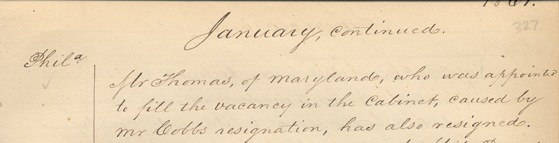
Mr. Thomas, of Maryland, who was appointed to fill the vacancy in the cabinet, caused by Mr Cobb’s resignation, has also resigned.


Citation: John Henry Brown (1818-1891), autograph journal/account book. Philadelphia, 1844-1890. AMs 574/14.1
January 10, 1861: John Henry Brown’s Journal

John Henry Brown was a painter of portrait miniatures, living and working in Philadelphia. He had met Lincoln in August of 1860 when he was commissioned to paint Lincoln’s portrait for a supporter, but although Brown liked Lincoln personally, he did not agree with Republican policies.

1861-01-10

Transcript:

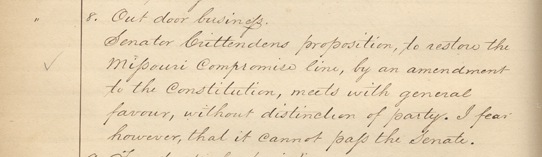
The Convention of Mississippi passed the ordinance of Secession yesterday.

Mr. Thompson, of Miss, resigned from Mr. Buchanans Cabinet a few days ago, this makes the fourth who has left. Cass, Cobb, Floyd & Thompson.


Citation: John Henry Brown (1818-1891), autograph journal/account book. Philadelphia, 1844-1890. AMs 574/14.1
January 8, 1861: John Henry Brown’s Journal

John Henry Brown was a painter of portrait miniatures, living and working in Philadelphia. He had met Lincoln in August of 1860 when he was commissioned to paint Lincoln’s portrait for a supporter, but although Brown liked Lincoln personally, he did not agree with Republican policies.

1861-01-08Transcript:

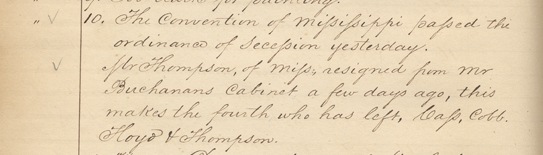
Out door business.

Senator Crittendens proposition, to restore the Missouri Compromise line, by an amendment to the Constitution, meets with general favour, without distinction of party. I fear however, that it cannot pass the Senate.


Citation: John Henry Brown (1818-1891), autograph journal/account book. Philadelphia, 1844-1890. AMs 574/14.1
January 7, 1861: John Henry Brown’s Journal

John Henry Brown was a painter of portrait miniatures, living and working in Philadelphia. He had met Lincoln in August of 1860 when he was commissioned to paint Lincoln’s portrait for a supporter, but although Brown liked Lincoln personally, he did not agree with Republican policies.

1861-01-07

Transcript:

Finished Master Lees picture.

The Conventions of Alabama & Mississippi meet today.


Citation: John Henry Brown (1818-1891), autograph journal/account book. Philadelphia, 1844-1890. AMs 574/14.1

January 5, 1861: John Henry Brown’s Journal

John Henry Brown was a painter of portrait miniatures, living and working in Philadelphia. He had met Lincoln in August of 1860 when he was commissioned to paint Lincoln’s portrait for a supporter, but although Brown liked Lincoln personally, he did not agree with Republican policies.

1861-01-05

Transcription:

At Master Lees picture.

Political affairs still gloomy, though there are some slight indications, that the Republicans may yield.


Citation: John Henry Brown (1818-1891), autograph journal/account book. Philadelphia, 1844-1890. AMs 574/14.1

December 31, 1860: John Henry Brown’s Diary

John Henry Brown was a painter of portrait miniatures, living and working in Philadelphia. He had met Lincoln in August of 1860 when he was commissioned to paint Lincoln’s portrait for a supporter, but although Brown liked Lincoln personally, he did not agree with Republican policies.

1860-12-31 1860-12-31(2)

Transcription:

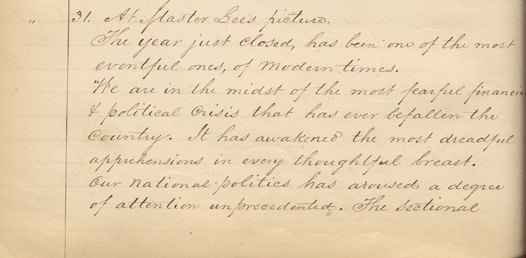
At Master Lees picture.

The year just closed, has been one of the most eventful ones, of modern times.

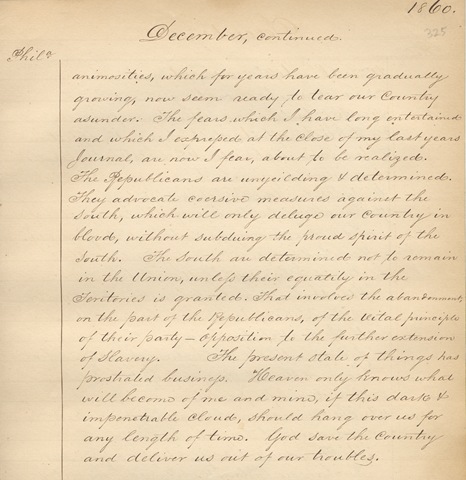
We are in the midst of the most fearful financial & political Crisis that has ever befallen the country. It has awakened the most dreadful apprehensions in every thoughtful breast. Out national politics has aroused a degree of attention unprecedented. The sectional animosities, which for years have been gradually growing, now seem ready to tear our country asunder. The fears which I have long entertained and which I expressed at the close of my last years Journal, are now I fear, about to be realized. The Republicans are unyielding & determined. They advocate coercive measures against the South, which will only deluge our country in blood, without subduing the proud spirit of the South. The South are determined not to remain in the Union, unless their equality in the Territories is granted. That involves the abandonment on the part of the Republicans, of the vital principle of their party—opposition too the further extension of slavery. The present state of things has prostrated business. Heaven only knows what will become of me and mine, if this dark & impenetrable cloud, should hang over us for any length of time. God save the country and deliver us out of our trouble.


Citation: John Henry Brown (1818-1891), autograph journal/account book. Philadelphia, 1844-1890. AMs 574/14.1
December 29, 1860: John Henry Brown’s Journal

John Henry Brown was a painter of portrait miniatures, living and working in Philadelphia. He had met Lincoln in August of 1860 when he was commissioned to paint Lincoln’s portrait for a supporter, but although Brown liked Lincoln personally, he did not agree with Republican policies.

1860-12-29

Transcription:

At Master Lees picture

Mr. Floyd, Secretary of War, has resigned from Mr. Buchanan’s Cabinet. This makes the third that has left within a few weeks.

Citation: John Henry Brown (1818-1891), autograph journal/account book. Philadelphia, 1844-1890. AMs 574/14.1
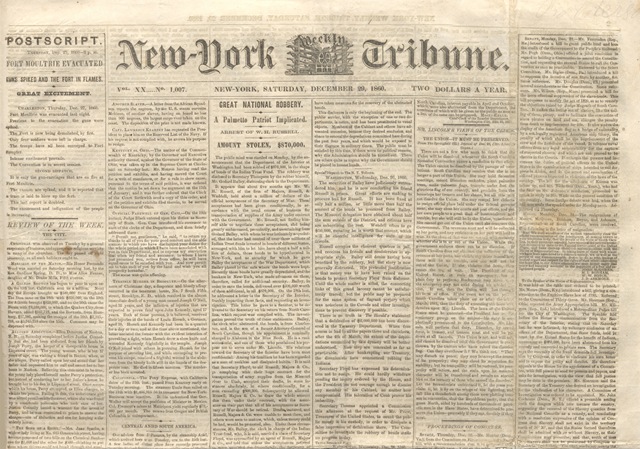
December 29, 1860: New York Tribune

top

Transcription (excerpt p1):

Mr. Lincoln’s Views of the Crisis.

The Union – It Must Be Preserved.

From the Springfield (Ill.) Journal of Dec. 20 (Mr. Lincoln’s Organ)

There are not a few who seem to think that the Union will be dissolved whenever the South Carolina Secession Convention passes a resolution to that effect. The Union cannot be dissolved by the passage of resolutions. South Carolina may resolve that she is no longer a part of this Union. She may hold Secession meetings, mount Disunion cockades, plant palmetto trees, make palmetto flags. Trample under foot the glorious flag of our country and proclaim from the housetops her treason and her shame, but all this will not dissolves the Union. She may compel her citizens to resign official place held under the federal government, she may close her courts and post offices, and put her own people to a great deal of inconvenience and trouble, but she will still be in the Union, unmolested. She cannot get out of the Union until she conquers this Government.


Citation: New York Weekly Tribune. New York, 29 December 1860. Gift of Steven and Susan Raab.