November 12, 1860: Letter from H.D. Laflin to Elmer Ellsworth

Col. Elmer Ellsworth was a lawyer and soldier and friend of Abraham Lincoln who would become one of the first casualties of the Civil War. As a colonel of the Chicago National Guard Cadets before the war, Ellsworth introduced French-inspired Zouave uniforms and drills to the unit. He worked in Lincoln’s law office in August 1860 and assisted him during the fall campaign. After Lincoln’s election he helped organize troops, including the 11th New York Volunteer Infantry Regiment. He was shot and killed on May 24, 1861 while removing a large Confederate flag from a tavern in Alexandria, Virginia.

AMs 811-2-5 p1 HD Laflin to Ellsworth (Large)

AMs 811-2-5 p2 HD Laflin to Ellsworth (Large)

AMs 811-2-5 p3 HD Laflin to Ellsworth (Large)

Transcript:

Col E E Ellsworth

Springfield, Ill

Dear Col

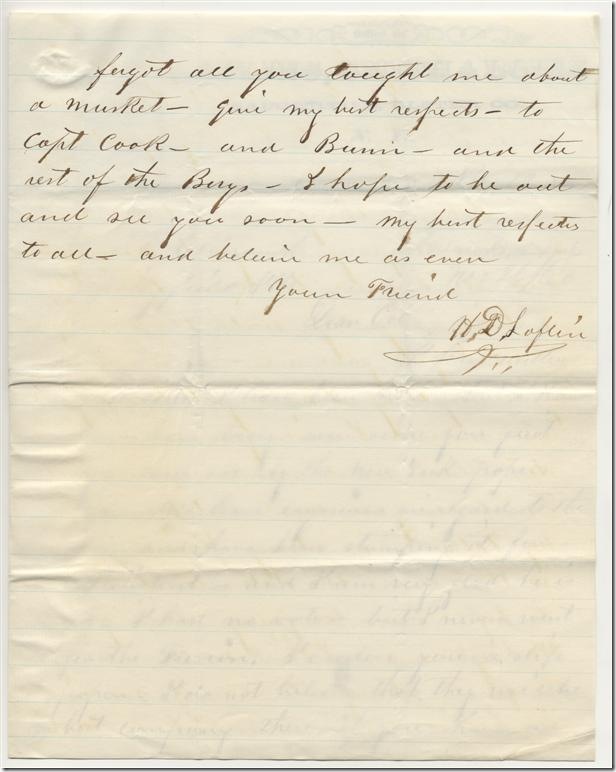
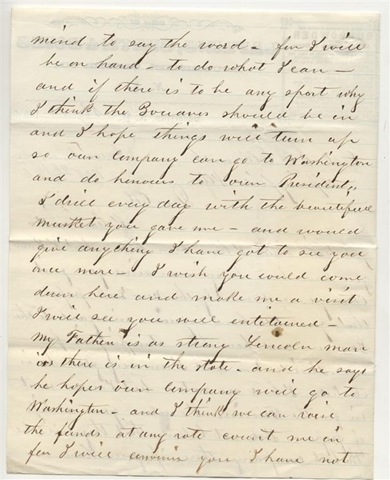
I have written you twice since I have been here— but I know you have been busy- ever since you quit Chicago—and see by the New York papers that you still have enquiries in regard to the Zouaves—and have been stumping it for our President—and I am very glad he is elected—I had no vote—but I never went in for the Fusion. I enclose you a slip of paper— I do not believe that they will be the best company there—if you have a mind to say the word—for I will be on hand—to do what I can—and if there is to be any sport why I think the Zouaves should be in and I hope things will turn up so our company can go to Washington and do honour to our President. I drill every day with the beautifull musket you gave me—and would give anything I have got to see you once more—I wish you could come down here and make me a visit I will see you well entertained. My Father is as strong Lincoln man as there is in the state- and he says he hopes our company will go to Washington- and I think we can raise the funds, at any rate count me in for I will convince you I have not forgot all you taught me about a musket—give my best respects—to Capt Cook—and Bunn—and the rest of the Boys. I hope to be out and see you soon—my best respects to all— and believe me as ever

Your Friend

H. D. Laflin
Citation: H. D.  Laflin, autograph letter signed to Elmer Ellsworth. Springfield, Illinois, 12 November 1860. AMs 811/2.5
November 10, 1860: John Henry Brown’s Journal

John Henry Brown was a painter of portrait miniatures, living and working in Philadelphia. He had met Lincoln in August of 1860 when he was commissioned to paint Lincoln’s portrait for a supporter, but although Brown liked Lincoln personally, he did not agree with Republican policies.

1860-11-10

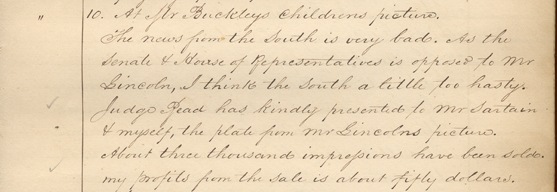
Transcription: At Mr Buckleys childrens picture.The news from the South is very bad. As the Senate + House of Representatives is opposed to Mr. Lincoln, I think the South a little too hasty. Judge Read has kindly presented to Mr. Sartain + myself, the plate from Mr. Lincoln’s picture. About three thousand impressions have been sold. My profits from the sale is about fifty dollars.


Citation: John Henry Brown (1818-1891), autograph journal/account book. Philadelphia, 1844-1890. AMs 574/14.1

November 9, 1860: Charleston Mercury

top

Transcription (excerpt):

(p1 top center column)

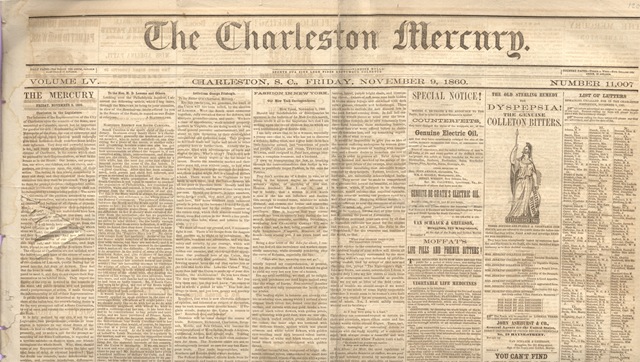
Fashion in New York.

Our New York Correspondence

New York, November 5, 1860

Should any incoherencies or discrepancies be apparent in the bulletin of La Mode for this month, please credit it all to the important fact that I am writing upon the eve of election day, to which my own restlessness gives double zest.

I am fully aware that to be a woman, especially a young one – that is, one who has yet to discover a wrinkle, fading roses, and a gray hair – is to be a little feminine animal, just “conscious of pearls and purple,” chicken and cream, Tennyson and Bulwer, until resigned to Point lace, orange blossoms, a complete trousseau, and a husband.

I own to transgressing the law, to breaking through the conventialities that hedge in woman, to positively forget Fashion, in the rage for Politics.

Pray don’t accuse me of a desire to vote, or of being in the faintest degree an advocate of woman’s rights, or anything of that sort. Heaven forefend! But I say it, and I say it boldly, that a woman is not worth a sous if she has not influence and fascination enough to control votes, minister to minds diseased, and cleanse the brains and masculine hearts of that foul black dye threatening us like a pestilence. Thus is happens that your correspondent has been excessively busy during the last month, making converts, sacrificing friendships, wondering how Charlotte Corday felt once upon a time, and, in fact being accused of downright haughtiness. N’importe, Messieurs of the South – born among you, I am yours heart and soul.

Being a dear lover of the dolce far niente, I cannot but feel all this turbulence and warfare excessively annoying, while dreamily pondering over the curse of Kehama, especially the line:

“Days after days, unvarying come and go.”

utterly beyond my comprehension, at present, but for the realization of which I would be glad to yield my very last new love of a bonnet.
Citation: Charleston Mercury, 9 November 1860. Gift of Steven and Susan Raab. AN .C477

November 9, 1860: John Henry Brown’s Journal

John Henry Brown was a painter of portrait miniatures, living and working in Philadelphia. He had met Lincoln in August of 1860 when he was commissioned to paint Lincoln’s portrait for a supporter, but although Brown liked Lincoln personally, he did not agree with Republican policies.

1860-11-09

Transcription:

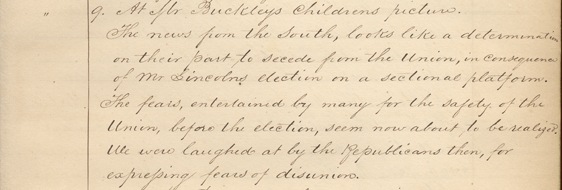
At Mr Buckleys childrens picture. The news from the South, looks like a determination on their part to secede from the Union, in consequence of Mr. Lincolns election on a sectional platform. The fears, entertained by many for the safety of the Union, before the election, seem now about to be realized. We were laughed at by the Republicans then, for expressing fears of disunion.


Citation: John Henry Brown (1818-1891), autograph journal/account book. Philadelphia, 1844-1890. AMs 574/14.1

November 7, 1860: John Henry Brown’s Journal

John Henry Brown was a painter of portrait miniatures, living and working in Philadelphia. He had met Lincoln in August of 1860 when he was commissioned to paint Lincoln’s portrait for a supporter, but although Brown liked Lincoln personally, he did not agree with Republican policies.

1860-11-07 1860-11-07(2)

Transcription:

At Mr Buckleys childrens picture.

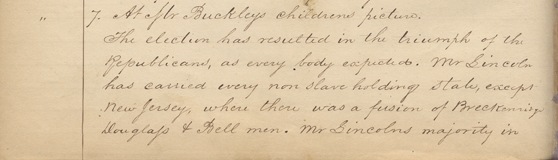
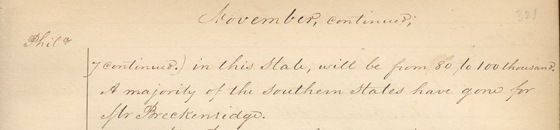
The election has resulted in the triumph of the Republicans, as every body expected. Mr. Lincoln has carried every non slave holding state, except New Jersey, where there was a fusion of Breckenridge, Douglas, + Bell men. Mr. Lincolns majority in this State, will be from 80 to 100 thousand. A majority of the Southern States have gone for Mr. Breckenridge.

Citation: John Henry Brown (1818-1891), autograph journal/account book. Philadelphia, 1844-1890. AMs 574/14.1

November 6, 1860: John Henry Brown’s Journal

John Henry Brown was a painter of portrait miniatures, living and working in Philadelphia. He had met Lincoln in August of 1860 when he was commissioned to paint Lincoln’s portrait for a supporter, but although Brown liked Lincoln personally, he did not agree with Republican policies.

1860-11-06

Transcription:

At Mr Buckleys childrens picture.

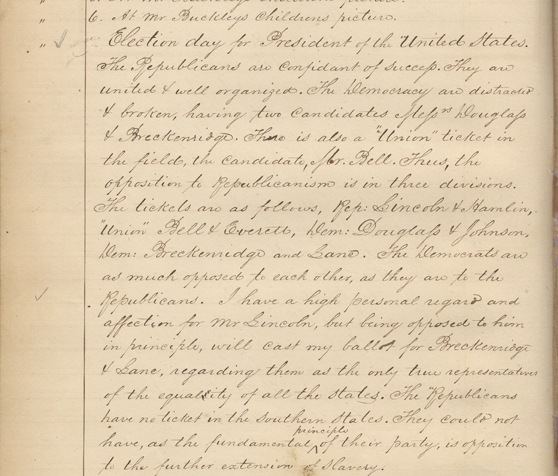
Election Day for President of the United States. The Republicans are confidant of success. They are united + well organized. The Democracy are distracted + broken, having two candidates Messrs Douglass + Breckenridge. There is also a “Union” ticket in the field, the candidate Mr. Bell. Thus, the opposition to Republicanism is in three divisions. The ticket are as follows, Rep: Lincoln + Hamlin, “Union” Bell + Everett, Dem: Douglass + Johnson, Dem: Breckenridge and Lane. The Democrats are as much opposed to each other as they are to the Republicans. I have a high personal regard and affection for Mr. Lincoln, but being opposed to him in principle, will cast my ballot for Breckenridge +Lane, regarding them as the only true representatives of the equality of all the states. The Republicans have no ticket in the southern states. They could not have, as the fundamental principle of their party is opposition to the further extension of slavery.

Citation: John Henry Brown (1818-1891), autograph journal/account book. Philadelphia, 1844-1890. AMs 574/14.1

Welcome

Welcome to Today in the Civil War: Dispatches from the Rosenbach Collection, part of the Rosenbach Museum & Library’s celebration of the Civil War 150. Beginning November 6, 2010, the 150th anniversary of the election of Abraham Lincoln, we will be posting Civil War-era documents, including manuscripts, newspapers, photos, and printed books from the Rosenbach collection 150 years after they were originally created. The site will run through April 2015.

Check back November 6 to follow the unfolding conflict through the words of the people who lived it.