July 20, 1861: John Henry Brown’s Journal

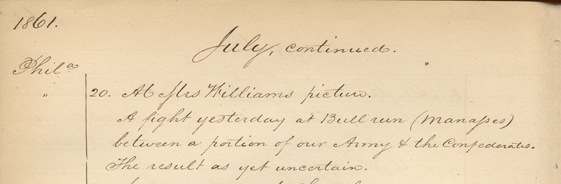
John Henry Brown was a painter of portrait miniatures, living and working in Philadelphia. He had met Lincoln in August of 1860 when he was commissioned to paint Lincoln’s portrait for a supporter, but although Brown liked Lincoln personally, he did not agree with Republican policies.

1861-07-20

Transcript:

At Mrs. Williams picture.

A fight yesterday at Bull Run (Manasses) between a portion of our Army & the Confederates. The results as yet uncertain.


John Henry Brown, autograph journal/account book. Philadelphia, 1844-1890. AMs 573/14.1

July 18, 1861: John Henry Brown’s Journal

John Henry Brown was a painter of portrait miniatures, living and working in Philadelphia. He had met Lincoln in August of 1860 when he was commissioned to paint Lincoln’s portrait for a supporter, but although Brown liked Lincoln personally, he did not agree with Republican policies.

1861-07-18

Transcript:

At Mrs. Williams picture.

Our Army of 60,000 men under Gen McDowell, are moving toward Manassas junction, where the enemy are entrenched in large force.


John Henry Brown, autograph journal/account book. Philadelphia, 1844-1890. AMs 573/14.1

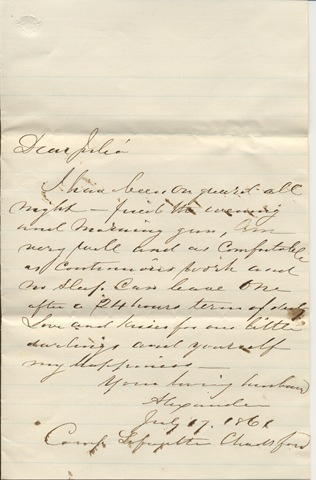
July 17, 1861: Alexander Biddle to Julia Williams Rush Biddle

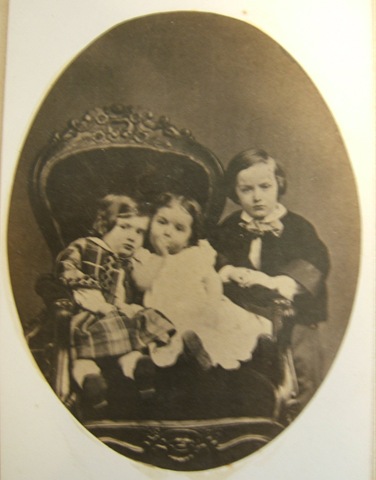
Alexander Biddle was a member of the prominent Philadelphia Biddle family and was married to Julia Williams Rush,  the granddaughter of Dr. Benjamin Rush. A businessman and member of the First Troop Philadelphia City Calvary before the war, Biddle entered Civil War service with the 121st Pennsylvania Volunteer Infantry on  September 1, 1862. Starting out as a  major, he would participate in Fredericksburg and Gettysburg, among other engagements, and would leave the service as a lieutenant colonel. (He was commissioned, but never mustered, as colonel) [Note: this statement originally mistakenly stated Biddle was also at Chancellorsville but he was on leave]

Rush IV-30-22 p1 A Biddle ALS to Julia William Rush

Transcript:

Dear Julia

I have been on guard all night. Fired the evening and morning guns. Am very well and am comfortable on continuous work and no sleep. Can [leave one?] after a 24 hours term of duty. Love and kisses for our little darlings and yourself my happiness.

Your loving husband,

Alexander

July 17, 1861

Camp Lafayette Chads ford

Citation: Alexander Biddle (1819-1899), autograph letter signed to Julia Williams Rush Biddle. Chadds Ford, Pa, 17 July 1861. Rush:IV:30:22

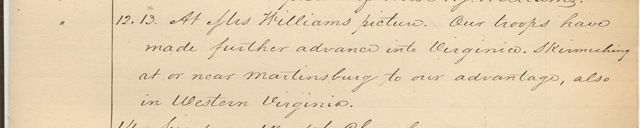
July 13, 1861: John Henry Brown’s Journal

John Henry Brown was a painter of portrait miniatures, living and working in Philadelphia. He had met Lincoln in August of 1860 when he was commissioned to paint Lincoln’s portrait for a supporter, but although Brown liked Lincoln personally, he did not agree with Republican policies.

1861-07-12

Transcript:

At Mrs Williams picture. Our troops have made further advance into Virginia. Skirmishing at or near Martinsburg to our advantage, also in Western Virginia.


Citation: John Henry Brown, autograph journal/account book. Philadelphia, 1844-1890. AMs 574/14.1

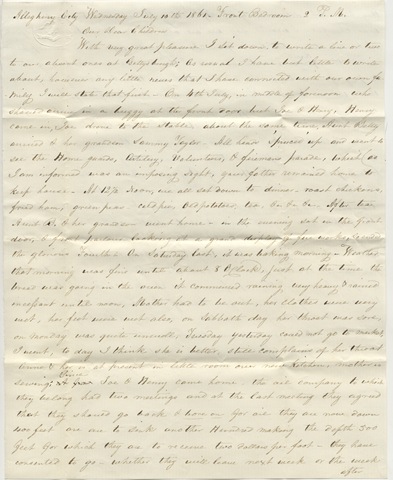
July 10, 1861: Henry and Mary Warner Letter to John Warner

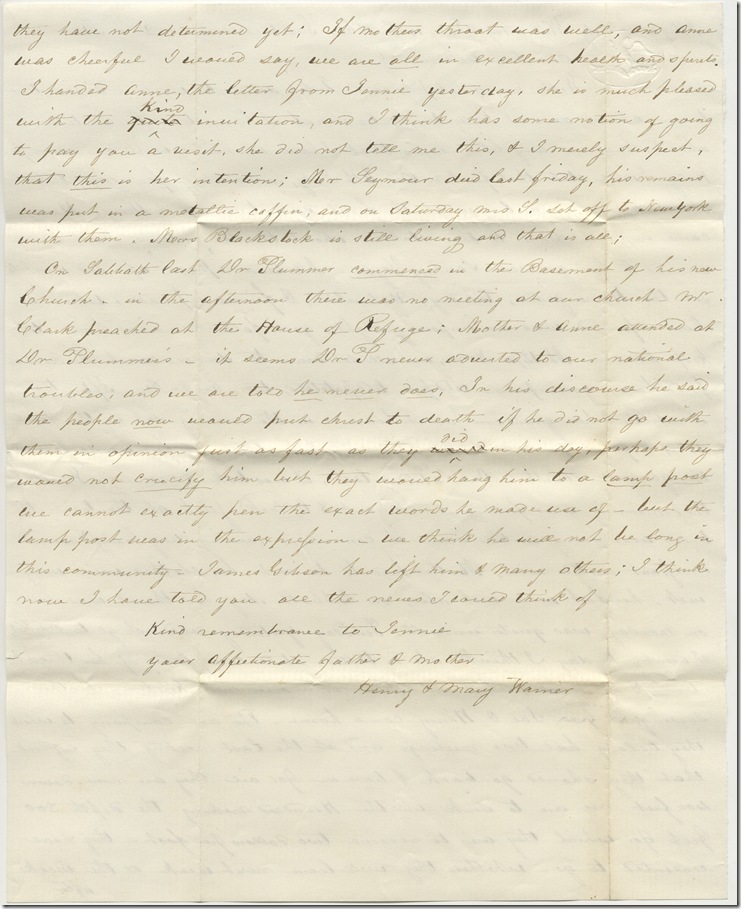
Henry and Mary Warner lived in Allegheny City, Pennsylvania, now part of Pittsburgh. They are the great-grandparents of poet Marianne Moore.  By the 1860s they had three surviving children:  John, Henry, and Annie. Their letters to John, a Presbyterian minister living in Gettysburg, are preserved as part of Marianne Moore’s family papers.
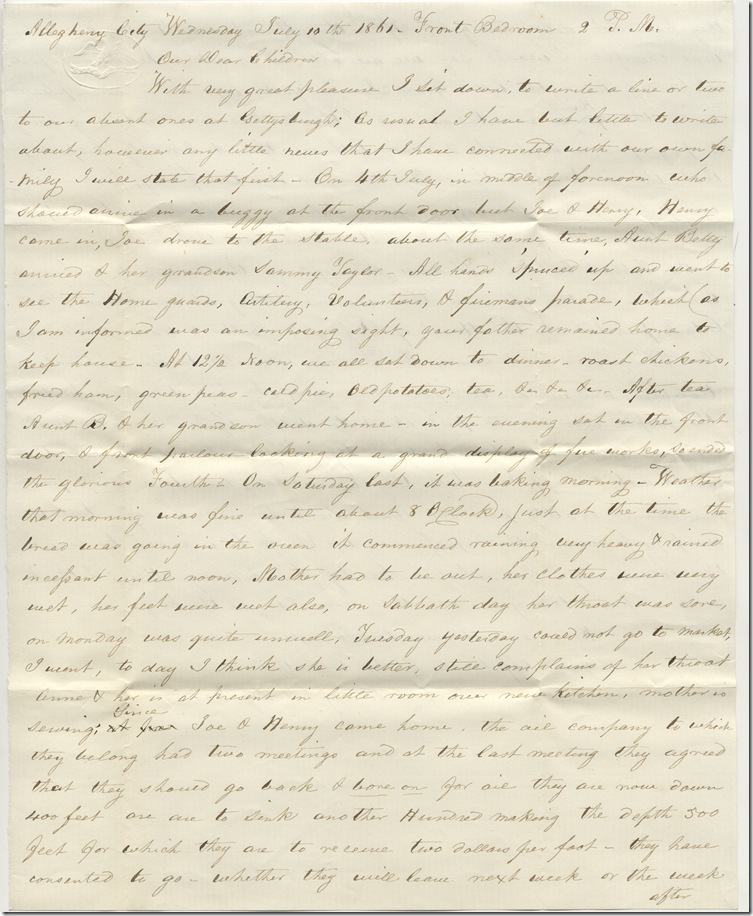
Moore VI-4-20 p1 Henry and Mary Warner to Children 7-10-61

Moore VI-4-20 p2 Henry and Mary Warner to Children 7-10-61

Transcript:

Allegheny City Wednesday July 10th 1861—Front Bedroom 2 P.M.

Our Dear Children

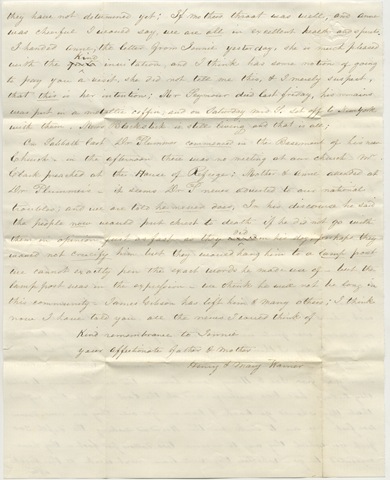
With very great pleasure I sit down, to write a line or two to our absent ones at Gettysburgh; As usual I have but little to write about, however any little news that I have connected with our own family I will state that first—On 4th July, in middle of forenoon who should arrive in a buggy at the front door but Joe & Harry. Harry came in, Joe drove to the stable, about the same time, Aunt Betty arrived & her grandson Sammy Taylor—All hands ‘spruced’ up and went to see the Home guards, Artillery, Volunteers, & firemans parade, which (as I am informed was an imposing sight, your father remained home to keep house—At 12 ½ Noon, we all sat down to dinner—roast chickens, fried ham, green peas—cold pie, old potatoes, tea, &c&c&c—After tea Aunt B. & her grandson went home—in the evening sat on the front door, & front parlour looking at a grand display of fire works, so ended the glorious Fourth. On Saturday last, it was baking morning—Weather that morning was fine until about 8 oclock, just at the time the bread was going in the oven it commenced raining very heavy & rained incessant until noon. Mother had to be out, her clothes were very wet, her feet were wet also, on Sabbath day her throat was sore, on Monday was quite unwell, Tuesday yesterday could not go to market, I went, to day I think she is better, still complains of her throat. Anne & her is at present in little room over new kitchen, mother is sewing; Since Joe & Harry came home, the oil company to which they belong had two meetings and at the last meeting they agreed that they should go back & bore on for oil they are now down 400 feet are to sink another Hundred making the depth 500 feet for which they are to receive two dollars per foot—they have consented to go—whether they will leave next week or the week after they have not determined yet; If mothers throat was well, and Anne was cheerful I would say, we are all in excellent health and spirits. I handed Anne, the letter from Jennie yesterday, she is much pleased with the kind invitation, and I think has some notion of going to pay you a visit, she did not tell me this, & I merely suspect, that this is her intention; Mr Seymour died last friday, his remains was put in a metallic coffin, and on Saturday Mrs S set off to New York with them. Mrs Blackstock is still living and that is all;

On Sabbath last Dr Plummer commenced in the Basement of his new Church—in the afternoon there was no meeting at our church—Mr Clark preached at the House of Refuge; Mother & Anne attended at Dr Plummer’s—it seems Dr P never adverted to our national troubles, and we are told he never does, In his discourse he said the people now would put Christ to death if he did not go with them in opinion just as fast as they did in his day, perhaps they would not crucify him but they would hang him to a lamp post we cannot exactly pen the exact words he made us of—but the lamp post was in the expression—we think he will not be long in this community—James Gibson has left him & many others; I think now I have told you all the news I could think of

Kind remembrance to Jennie

Your affectionate father & mother

Henry & Mary Warner

Citation: Henry and Mary Warner, autograph letter signed to John Riddle Warner. Allegheny City [Pittsburgh], 10 July 1861. Moore VI:04:20
July 8, 1861: Carrie Spafford letter to Mrs. Ellsworth

Carrie Spafford had been the fiancée of Col. Elmer Ellsworth. Col. Elmer Ellsworth was a lawyer and soldier and friend of Abraham Lincoln who was one of the first casualties of the Civil War. He was shot and killed on May 24, 1861 while removing a large Confederate flag from a tavern in Alexandria, Virginia.

 AMs 811-2-7 p1 Connie Spafford to Mrs Ellsworth AMs 811-2-7 p2 Connie Spafford to Mrs Ellsworth

Transcript:

Rockford. July 8th

My dear Mrs. Ellsworth,

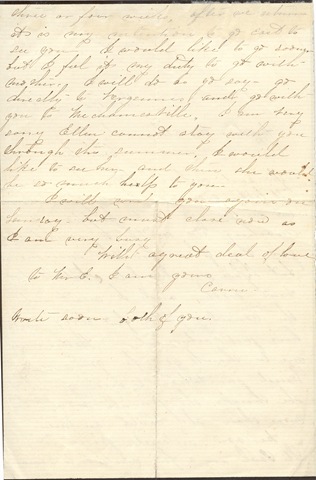
Your long looked for and welcome letters have come at last- I answered one of them two weeks ago- but postponed mailing it until I could tell you my plans for the summer- but before we decided what to do then Mother and I went unto the country for a few days, and have just returned. Mother wishes me to thank you for your very kind invitation to visit you, but she thinks the journey would be more than she could endure.

We now intend going to St. Paul in a few weeks to remain three or four weeks, after we return it is my inclination to go East to see you- I would like to go sooner but I feel it my duty to go with Mother. I will do so you say- go directly to [illeg.] and go with you to Mechanicsville. I am very sorry Ellen cannot stay with you through the summer. I would like to see her- and then she would be so much help to you.

I will write you again on Sunday- but must close now as I am very busy.

With a great deal of love to Mr. E. I am yours

Carrie

Write soon- both of you


Citation: Carrie Spafford, autograph letter signed to Mrs. Ellsworth. Rockford, Ill; 8 July 1861. AMs 811/2.7

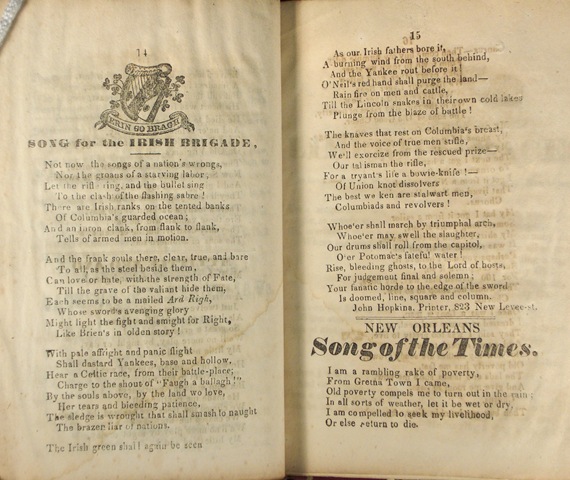
July 7, 1861: Hopkins’ New Orleans Songbook

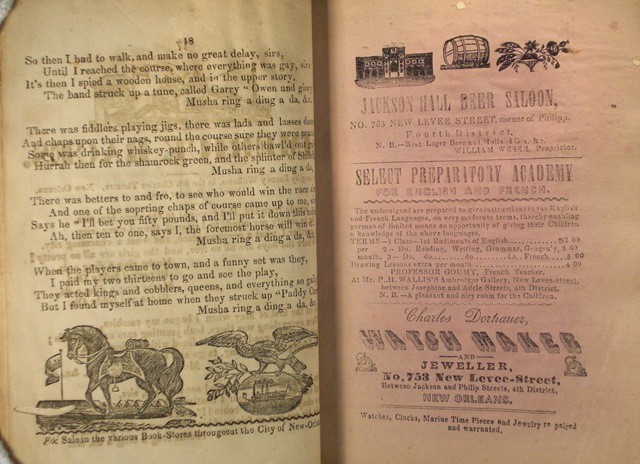
The Civil War spawned an outpouring of music of all kinds, from sentimental parlor songs, to stirring patriotic tunes, to soldier’s campfire ditties. Hopkins’ 5 Cent Song-book, probably published in 1861, was one of the three most popular “songsters” carried by Confederate troops.


A 861h p10


Citation: Hopkins’ New Orleans 5 cent song-book. [New Orleans, John Hopkins, 1861?] A 861h

July 6, 1861: Hopkins’ New Orleans Songbook

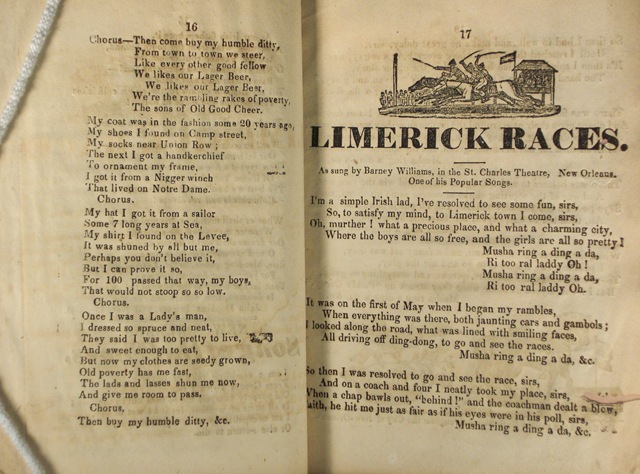
The Civil War spawned an outpouring of music of all kinds, from sentimental parlor songs, to stirring patriotic tunes, to soldier’s campfire ditties. Hopkins’ 5 Cent Song-book, probably published in 1861, was one of the three most popular “songsters” carried by Confederate troops.


A 861h p9


Citation: Hopkins’ New Orleans 5 cent song-book. [New Orleans, John Hopkins, 1861?] A 861h

July 5, 1861: Hopkins’ New Orleans Songbook

The Civil War spawned an outpouring of music of all kinds, from sentimental parlor songs, to stirring patriotic tunes, to soldier’s campfire ditties. Hopkins’ 5 Cent Song-book, probably published in 1861, was one of the three most popular “songsters” carried by Confederate troops.

A 861h p8


Citation: Hopkins’ New Orleans 5 cent song-book. [New Orleans, John Hopkins, 1861?] A 861h