July 11, 1862: Belle Boyd’s Album

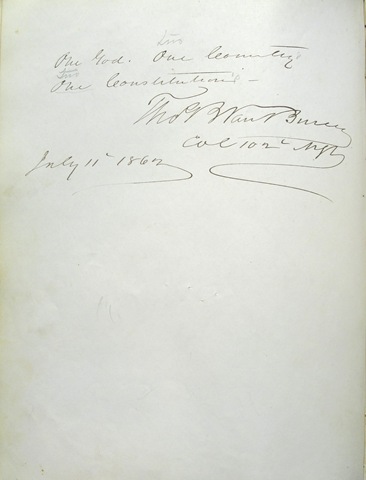
This autograph book/scrapbook belonged to Belle Boyd, a Confederate spy. Only 17 years old at the start of the war, Boyd used her looks and charm to gain information from Union troops stationed near her Virginia home. Her most significant action was providing information to Turner Ashby and Stonewall Jackson about Union activities in Front Royal during the 1862 Valley campaign. Boyd was arrested multiple times and was held in Union prisons from July 29, 1862 to August  28, 1862 and again from August to December 1863.

Transcription:

One God. One country

One Constitution


[amended to read]

One God. Two countries

Two Constitutions


[Thos Brant Burren?]

Col. 102 NY


July 111, 1862

Citation: Belle Boyd (1844-1900), Album: 1859-1903 [bulk 1862-1900]. AMs 1296/16

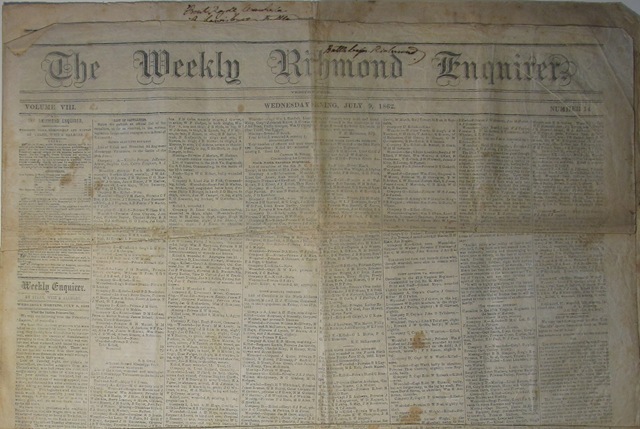
July 9, 1862: Richmond Enquirer

Transcript (excerpt):

“Cruelty to Confederate Officers”

“Our readers have doubtless noted the severity practiced by the Yankees upon Generals Buckner and Tilghman now confined in Fort Warren. We understand from a perfectly authentic source that Brig. Gen. Pettigrew, who was recently severely wounded and taken prisoner by the enemy, has been inhumanely removed from Baltimore, where he had the attention of friends, to Fort Delaware. His right arm is paralyzed and he is very feeble, and unfit for any exertion. In this condition he has been consigned to prison, and even refused permission to take a servant to assist him in his helplessness. The effect of this harshness is to retard Gen. Pettigrew’s recovery, and it may cost him his life. Yankee Generals in our hands have been treated heretofore by us with the greatest liberality, but unless Buckner, Tilghman and Pettigrew shall receive another sort of usage, they must prepare for prompt retaliation.”


Citation:The Weekly Richmond Enquirer. Richmond, 9 July 1862. AN .R532

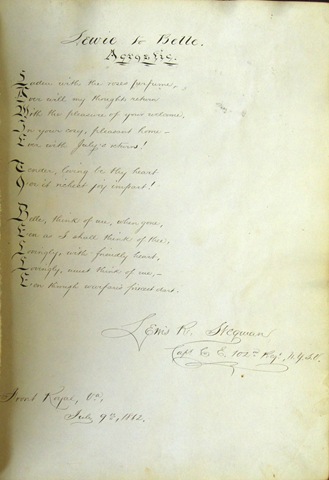
July 9, 1862: Belle Boyd’s Album

This autograph book/scrapbook belonged to Belle Boyd, a Confederate spy. Only 17 years old at the start of the war, Boyd used her looks and charm to gain information from Union troops stationed near her Virginia home. Her most significant action was providing information to Turner Ashby and Stonewall Jackson about Union activities in Front Royal during the 1862 Valley campaign. Boyd was arrested multiple times and was held in Union prisons from July 29, 1862 to August  28, 1862 and again from August to December 1863.

Transcript:

Lewie to Belle

Laden with the roses perfume

Ever will my thoughts return

With the pleasure of your welcome

In your cozy pleasant home

Ever with July’s returns!


Tender, loving be thy heart

O’er it richest joy impart


Belle, think of me, when gone,

Even as I shall think of thee,

Lovingly, with friendly heart.

Lovingly, must think of me,

Even through warfare’s fiercest dart


Lewis R. Stegman

Capt. Co E. 102nd Reg’t, N.Y.S.V.

Front Royal, Va,

July 9th 1862


Citation: Belle Boyd (1844-1900), Album: 1859-1903 [bulk 1862-1900]. AMs 1296/16

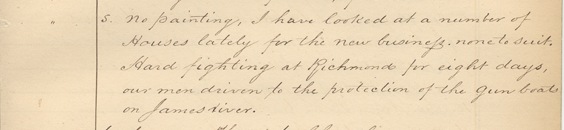
July 5, 1862: John Henry Brown’s Journal

John Henry Brown was a painter of portrait miniatures, living and working in Philadelphia. He had met Lincoln in August of 1860 when he was commissioned to paint Lincoln’s portrait for a supporter, but although Brown liked Lincoln personally, he did not agree with Republican policies.

1862-07-05

Transcript:

No painting. I have looked at a number of Houses lately for the new business. none to suit. Hard fighting at Richmond for eight days, our men driven to the protection of the gunboats on James river.


Citation: John Henry Brown, autograph journal/account book. Philadelphia, 1844-1890. AMs 573/14.1

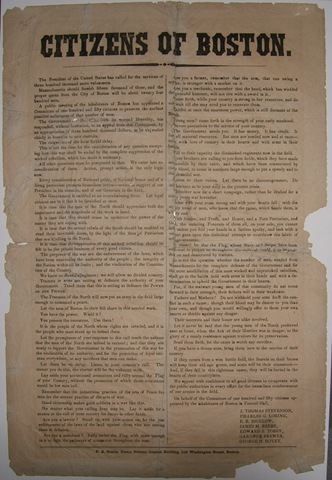
July 3, 1862: Call For Troops

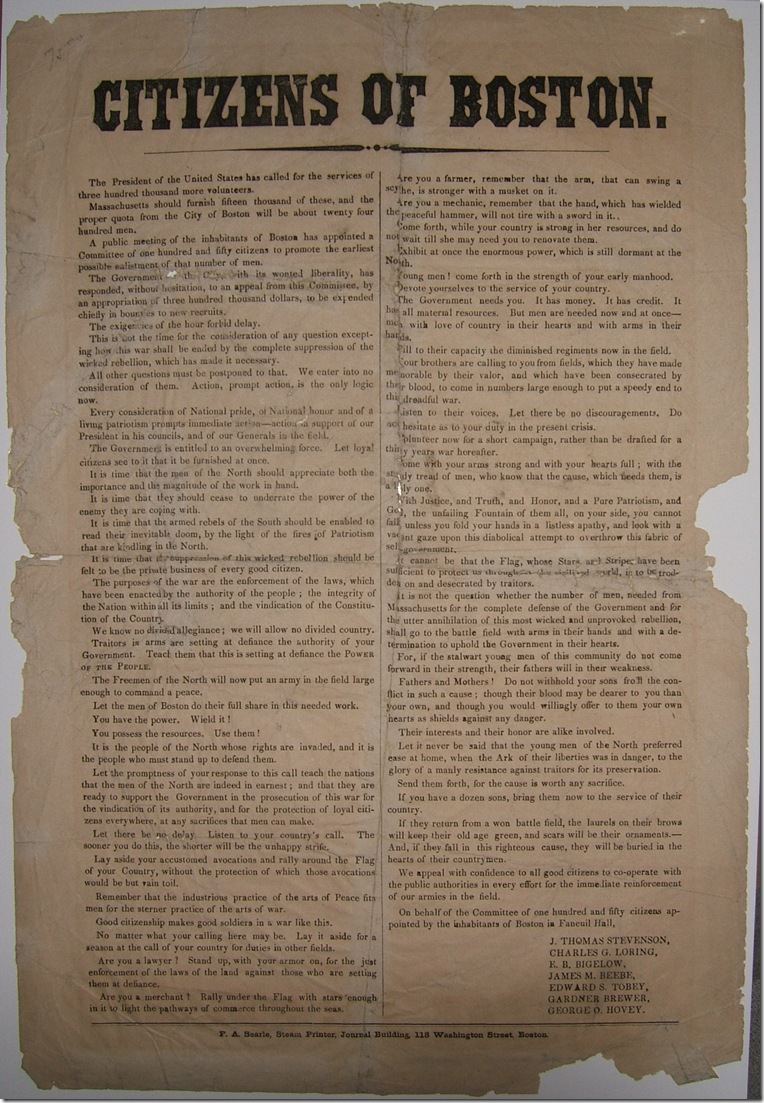
This broadside is undated but is in response to President Lincoln’s July 2, 1862 call for 300,000 troops.
A 862ci

Transcript:

Citizens of Boston

The President of the Unites States has called for the services of three hundred thousand more volunteers.

Massachusetts should furnish fifteen thousand of these, and the proper quota from the City of Boston will be about twenty four hundred men.

A public meeting of the inhabitants of Boston has appointed a Committee of one hundred and fifty citizens to promote the earliest possible enlistment of that number of men.

The Government of the City, with its wonted liberality, has responded, without hesitation, to an appeal from this Committee, by an appropriation of three hundred thousand dollars, to be expended chiefly in bounties to new recruits.

The exigencies of the jour forbid delay.

This is not the time for the consideration of any question excepting how this war shall be ended by the complete suppression of the wicked rebellion, which has made it necessary.

All other questions must be postponed to that. We enter into no consideration of them. Action, prompt action, is the only logic now.

Every consideration of National pride, of National honor and of a living patriotism prompts immediate action-action in support of our President in his councils, and of our Generals in the field.

The Government is entitled to an overwhelming force. Let loyal citizens see to it that it be furnished at once.

It is time that the men of the North should appreciate both the importance and the magnitude of the work in hand.

It is time that they should cease to underrate the power of the enemy they are coping with.

It is time that the armed rebels of the South should be enabled to read their inevitable doom, by the light of the fires of Patriotism that are kindling in the North.

It is time that the suppression of this wicked rebellion should be felt to be the private business of every good citizen.

The purpose of the war are the enforcement of the laws, which have been enacted by the authority of the people; the integrity of the Nation within all its limits; and the vindication of the Constitution of the County.

We know no divided allegiance; we will allow no divided country,

Traitors in arms are setting at defiance the authority of your Government. Teach them that this is setting a defiance of Power of the People.

The Freemen of the North will now put an army in the fields large enough to command a peace.

Let the men of Boston do their full share in this needed work.

You have the power. Wield it!

You possess the resources. Use them!

It is the people of the North whose rights are invaded, and it is the people who must stand up to defend them.

Let the promptness of your response to this call teach the nations that the men of the North are indeed in earnest; and that they are ready to support the Government in the prosecution of this way for the vindication of its authority, and for the protection of loyal citizens everywhere, at any sacrifices that men can make.

Let there be no delay. Listen to your country’s call. The sooner you do this, the shorter will be the unhappy strife.

Lay aside your accustomed avocations and rally around the Flag of your country, without the protection of which those avocations would be but vain toil.

Remember that the industrious practice of the arts of Peace fits men for the sterner practice of the arts of war.

Good citizenship makes good soldiers in a war like this.

No matter what tour calling here may be. Lay it aside for a season at the call of your country for duties in other fields.

Are you a lawyer? Stand up, with tour armor on, for the just enforcement of the laws of the land against those who are setting them at defiance.

Are you a merchant? Rally under the Flag with stars enough in it to light the pathways of commerce throughout the seas.

Are you a farmer, remember that the arm, that can swing a scythe, is stronger with a musket on it.

Are you a mechanic, remember that the hand, which has wielded the peaceful hammer, will not tire with a sword in it.

Come forth, while tour country is strong in her resources, and do not wait till she may need you to renovate them.

Exhibit at once the enormous power, which is still dormant at the North.

Young men! Come forth in the strength of your early manhood. Devote yourselves to the service of your country.

The Government needs you. It has credit. It has all material resources. But men are needed now and at once-men with love of country in their hearts and with arms in their hands. Will to their capacity the diminished regiments now in the field. Your brothers are calling you from fields, which they have made memorable by their valor, and which have been consecrated by their blood, to come in numbers large enough to put a speedy end to this dreadful war.

Listen to their voices. Let there be no discouragements. Do not hesitate as to your duty in the present crisis.

Volunteer now for a short campaign, rather than be drafted for thirty years hereafter.

Come with your arms strong and with tour hearts full; with the steady tread of men, who know that the cause, which needs them, is a holy one.

With justice, and Truth and Honor, and a Pure Patriotism, and God, the unfailing Fountains of them all, on your side, you cannot fail unless you fold your hands in a listless apathy and look with a vacant gaze upon this diabolical attempt to overthrow this fabric of self-government.

It cannot be that the Flag, whose Stars and Stripes have been sufficient to protect us through the civilized world, is to be trodden upon and desecrated by traitors.

It is not the question whether the number of men, needed from Massachusetts for the complete defense of the Government and for the utter annihilation of this most wicked an unprovoked rebellion, shall go to the battle field with arms in their hands and with a determination to uphold the Government in their hearts.

For, if the stalwart young men of this community do not come forward in their strength, their fathers will in their weakness.

Fathers and Mothers! Do not withhold your sons from the conflict in such a cause; though their blood may be dearer to you than your own, and though you would willingly offer them your own hearts as shield against any danger.

Their interests and their honor are alike involved.

Let it never be said that young me of the North preferred ease at home, when the Ark of their liberties was in danger, to the glory of a manly resistance against traitors for its preservation

Send them forth, for the cause is worth any sacrifice.

If you have a dozen sons, bring them now to the service if their country.

If they return from a won battlefield, the laurels on their brows will keep their old age green, and scars will be their ornaments.-And, if they fall in the righteous cause, they will be buried in the hearts of their countrymen.

We appeal the confidence to all good citizens to co-operate with the public authorities in every effort for the immediate reinforcement of our armies in the field.

On behalf of the Committee of one hundred and fifty citizens appointed by the inhabitants of Boston in Faneuil Hall,

J. Thomas Stevenson,

Charles G. Loring,

E.B. Bigelow

James M. Beebe,

Edward S. Tobey,

Gardner Brewer,

George O. Hovey.


Citation: Citizens of Boston. Boston, F. A. Searle, [1862]. A 862ci
July 2, 1862: George Eyster to John Riddle Warner

John Riddle Warner was the grandfather of the poet Marianne Moore and during the Civil War he lived in Gettysburg, Pennsylvania. George Eyster was his brother-in-law and lived in Chambersburg. These letters are preserved as part of Marianne Moore’s family papers.  

 Moore VI-5-8 p1 George Eyster to John Riddle Warner 7-2-62 Moore VI-5-8 p2 George Eyster to John Riddle Warner 7-2-62 Moore VI-5-8 p3 George Eyster to John Riddle Warner 7-2-62

Transcript:

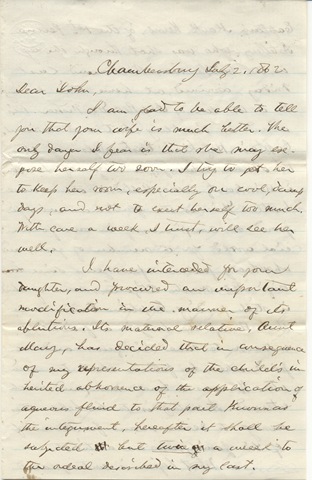
Chambersburg July 2, 1862

Dear John,

I am glad to be able to tell you that your wife is much better. The only danger I fear is that she may expose herself too soon. I try to get her to keep her room, especially on cool, damp days, and not to exert herself too much. With care a week, I trust, will see her well.

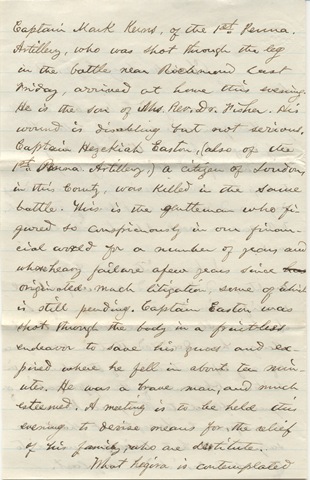
I have interceded for your daughter, and procured an important modification in the manner of its ablutions. Its maternal relative, Aunt Mary, has decided that in consequence of my representations of the child’s inherited abhorrence of the application of aqueous fluid to that part known as the integument, hereafter it shall be subjected but twice a week to the ordeal described in my last. Captain Mark Kerns, of the 1st Penna. Artillery, who was shot through the leg in the battle near Richmond, last Friday, arrived at home this evening. He is the son of Mrs. Rev. Dr. Fisher. His wound is disabling but not serious. Captain Hezekiah Easton, (also of the 1st Penna Artillery,) a citizen of Condon, in this county, was killed in the same battle. This is the gentleman who figured so conspicuously in our financial world for a number of years and whose heavy failure a few years since originated much litigation, some of which is still pending. Captain Easton was shot through the body in a fruitless endeavour to save his guns and expired where he fell in about ten minutes. He was a brave man, and much esteemed. A meeting is to be held this evening to devise means for the relief of his family, who are destitute.

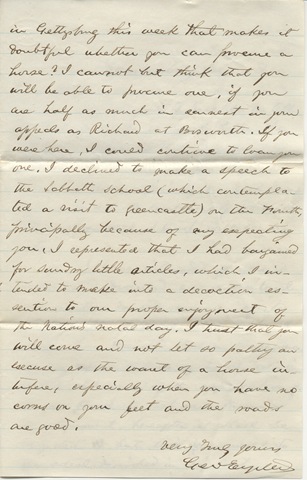
What hegira is contemplated in Gettysburg this week that makes it doubtful whether you can procure a horse? I cannot but think that you will be able to procure one, if you are half as much in earnest in your appeals as Richard at Bosworth. If you were here, I could continue to loan you one. I declined to make a speech to the Sabbath school (which contemplated a visit to Greencastle) on the Fourth, principally because of my expecting you, I represented that I had bargained for sundry little articles, which I intended to make into a decoction essential to our proper enjoyment of the Nation’s natal day. I trust that you will serve and not let so paltry an excuse as the want of a horse interfere, especially when you have no corns on your feet and the roads are good.

Very truly yours

Geo Eyster


Citation: George Eyster, autograph letter signed to John Riddle Warner.  Chambersburg, Pa.; 2 July 1862. Moore VI:05:08

June 30, 1862: Philadelphia Inquirer

top

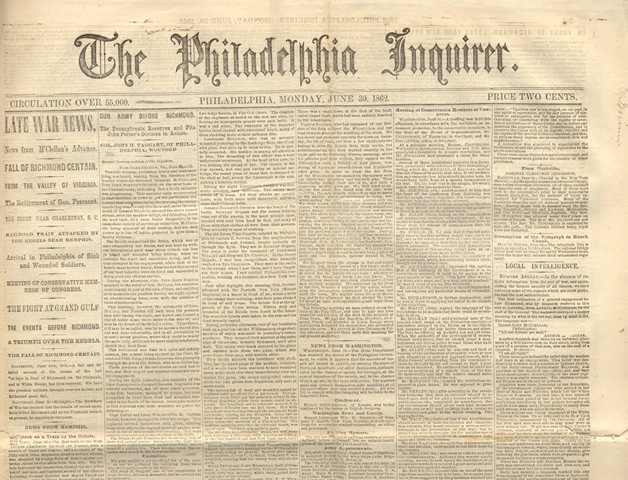
Transcript (excerpt):

Page 1, Upper Half

The Fall of Richmond Certain.

Baltimore, June 29th, 1862. – A full and detailed account of the events of the last [f]our days in front of Richmond, on the Peninsula, and at White House, has been received. We have the grandest military triumph over the Rebels, and Richmond must fall.

Baltimore, June 29 – Midnight. – The Secretary of War has decided that the details of recent operations before Richmond and on the Peninsula cannot, at present, be supplied to the press.

Citation: Philadelphia Inquirer. 30 June 1862. Gift of Steven and Susan Raab. AN .P5546

June 28, 1862: George Eyster to John Riddle Warner

John Riddle Warner was the grandfather of the poet Marianne Moore and during the Civil War he lived in Gettysburg, Pennsylvania. George Eyster was his brother-in-law and lived in Chambersburg. These letters are preserved as part of Marianne Moore’s family papers.

Moore VI-5-7 p1 George Eyster to John Riddle Warner 6-28-62 Moore VI-5-7 p2 George Eyster to John Riddle Warner 6-28-62 Moore VI-5-7 p3 George Eyster to John Riddle Warner 6-28-62 Moore VI-5-7 p4 George Eyster to John Riddle Warner 6-28-62

Transcript:

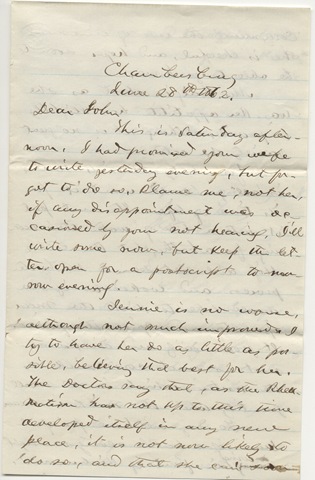
Chambersburg

June 28th 62

Dear John

This is Saturday afternoon. I had promised your wife to write yesterday evening, but forgot to do so. Blame me, not her, if any disappointment was occasioned by your not hearing. I’ll write some now, but keep the letter open for a postscript tomorrow evening.

Jennie is now worse, although not much improved. I try to have her do as little as possible, believing that best for her. The Doctors say that, as the Rheumatism has not up to this time developed itself in any new place, it is not now likely to do so, and that she can soon commence the use of liveliment.

Mrs. Craig is about as she was. Her appetite has slightly improved, although it is no great variety she eats.

Your baby, bless its soul, is all you could want it for its time of life. Its aunt put it into a tub of water this morning for a bath, but the little Miss did not seem to relish the process and looked as if she would like to kick the manipulator and spill the fluid. It grows daily and drinks almost as much cow’s milk as the writer, which is no small quantity when the milk is cream.

To day we have painful tremors of a battle along our right wing in front of Richmond, Colonels Black and Sweitzer, both of Pittsburg, are among the killed, dead to life, but born to glory, victims of this accursed rebellion. Anxiety is here to learn the fate of our fellow-citizens of the Reserves, who were in the fight.

I’ll endeavour to write you more frequently in coming week.

Yours truly

Geo Eyster

Sunday Evening

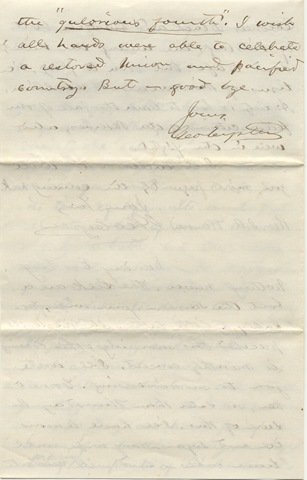
Nothing newer. The Sick are about the same—your wife, probably, a little better. Mr. Nicholls preached this morning; this evening is monthly concert. I’ll write you to-morrow evening. Come over, no later than Thursday. Be sure of this. I’ll have lemons, ice, and sugar—my wife will have cakes—and we’ll celebrate the “glorious fourth.” I wish all hands were able to celebrate a restored Union and pacified country. But—good bye

Yours

Geo Eyster

Citation: George Eyster, autograph letter signed to John Riddle Warner.  Chambersburg, Pa.; 28 June 1862. Moore VI:05:07

June 27, 1862: Charles M. Graham telegram to Thomas Jordan

Pierre Gustave Toutant Beauregard was a Louisiana-born general of the Confederate States Army. He had graduated second in his class from West Point in 1838 and was an admirer of Napoleon. He achieved fame early in the Civil War for commanding the Fort Sumter bombardment and as the victor of the first battle of Manassas. He later served in the Western Theater (including Shiloh and Corinth), Charleston, and the defense of Richmond, but his career was hampered by friction with Jefferson Davis and other generals.

This is one of approximately 1000 military telegrams in P.G.T. Beauregard’s papers at the Rosenbach.

AMs 1168-11 1862-06-27


Transcript:

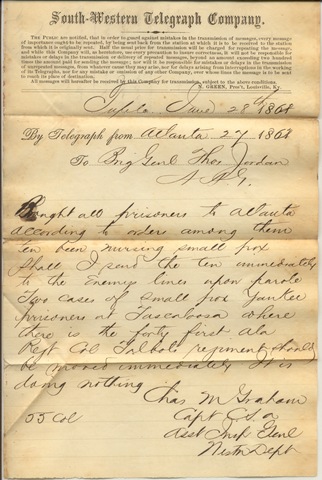
Tupelo, June 28 1862

By Telegraph from Atlanta 27 1862

To Brig Genl Thos Jordan AAG

Brought all prisoners to Atlanta according to orders among them ten have been nursing small pox shall I send the ten immediately to the enemies lines upon parle. Two cases of small pox Yankee prisoners at Tuscaloosa where there is the forty first Ala Regt Col Talbots regiment should be moved immediately. It is doing nothing.

Chas M Graham

Capt. CSA

Asst Insp Genl

Western Dept.


Citation: Charles M. Graham, telegram to Thomas Jordan. Atlanta, 27 June 1862. AMs 1168/11

June 26, 1862: A. Gerard telegram to Thomas Jordan

Pierre Gustave Toutant Beauregard was a Louisiana-born general of the Confederate States Army. He had graduated second in his class from West Point in 1838 and was an admirer of Napoleon. He achieved fame early in the Civil War for commanding the Fort Sumter bombardment and as the victor of the first battle of Manassas. He later served in the Western Theater (including Shiloh and Corinth), Charleston, and the defense of Richmond, but his career was hampered by friction with Jefferson Davis and other generals.

This is one of approximately 1000 military telegrams in P.G.T. Beauregard’s papers at the Rosenbach.

1168-11 1862-6-26

  Transcript:

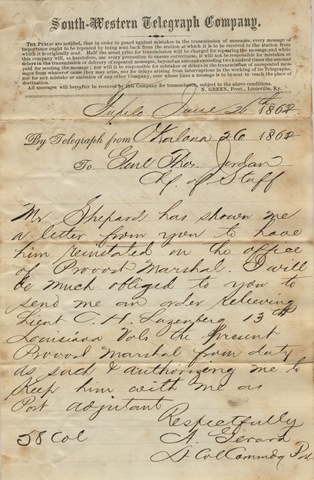
Tupelo, June 26th 1862

By telegraph from Okalona 26 1862

To Genl Thos. Jordan

Chf. of Staff

Mr. Shepard has shown me a letter from you to have him reinstated in the office of Provost Marshal. I will be much obliged to you to send me an order relieving Lieut. C. H. Luzenberg 13th Louisiana Vols  the present Provost Marshal from duty as such & authorizing me to keep him with me as Post adjutant.

Respectfully

A Gerard

Lt Col Commdg Post


Citation:A. Gerard, telegram to Thomas Jordan. Okolona, Miss.; 26 June 1862. AMs 1168/11