August 5, 1862: John Henry Brown’s Journal

John Henry Brown was a painter of portrait miniatures, living and working in Philadelphia. He had met Lincoln in August of 1860 when he was commissioned to paint Lincoln’s portrait for a supporter, but although Brown liked Lincoln personally, he did not agree with Republican policies.
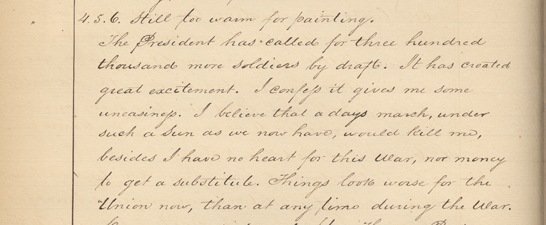
1862-08-05

Transcript:

Still too warm for painting.

The President has called for three hundred thousand more soldiers by draft. It has created great excitement. I confess it gives me some uneasiness. I believe that a days march, under such a Sun as we now have, would kill me, besides I have no heart for this War, nor money to get a substitute. Things look worse for the Union now, than at any time during the War.


Citation: John Henry Brown, autograph journal/account book. Philadelphia, 1844-1890. AMs 573/14.1
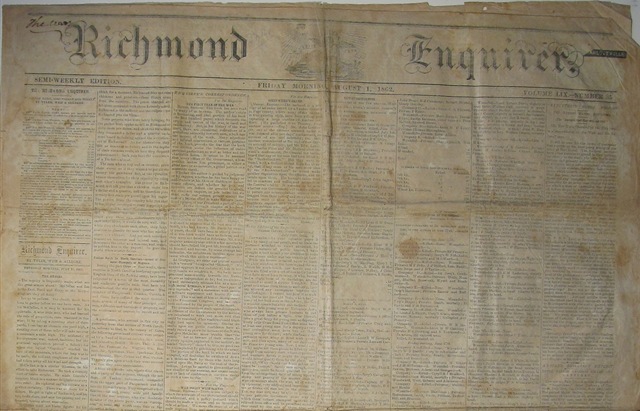
August 1, 1862: Richmond Enquirer

Transcript (excerpt):

“Another Brilliant Exploit”

Entire Yankee Garrison Killed and Captured

Lynchburg, July 30.-A special dispatch to the “Republican,” dated Narrows of New river, July 28th, via. Dublin, July 29th says The gallant Major Bailey , commanding four companies of cavalry, in all about one hundred and fifty men, sent to the rear of the enemy by Col. McCausland, stormed Summersville, the county seat of Nicholas, Friday morning at daylight and killed and captured the entire garrison including the Lieut colonel commanding , named Starr, three other commissioned officers, and sixty-two non-commissioned and privates-killing a large number

A few prisoners were paroled, not being able to bring away the large quantities of Commissary, Quartermaster, and Ordnance stores found at the place, Major Bailey committed them to the flames. Major B. brought to this place a large number of Enfield rifles and mules. The prisoners arrived this morning at the Salt Sulpher Springs.

The notorious renegade and spy, Dr. Wm. Rucker, is among the prisoners. The telegraph office was destroyed, and the government operator captured. This affair is regarded as the most brilliant exploit of the war in this section. Its successful execution spread the wildest consternation and dismay throughout the Yankee army in the neighborhood.


Citation: Richmond Enquirer. Richmond, 1 August 1862. AN .R532

July 26, 1862: John Henry Brown’s Journal

John Henry Brown was a painter of portrait miniatures, living and working in Philadelphia. He had met Lincoln in August of 1860 when he was commissioned to paint Lincoln’s portrait for a supporter, but although Brown liked Lincoln personally, he did not agree with Republican policies.

1862-07-26

Transcript:

At Mr Smiths picture.

The President has called for 300,000 additional troops. Things look very bad at present.


Citation: John Henry Brown, autograph journal/account book. Philadelphia, 1844-1890. AMs 573/14.1
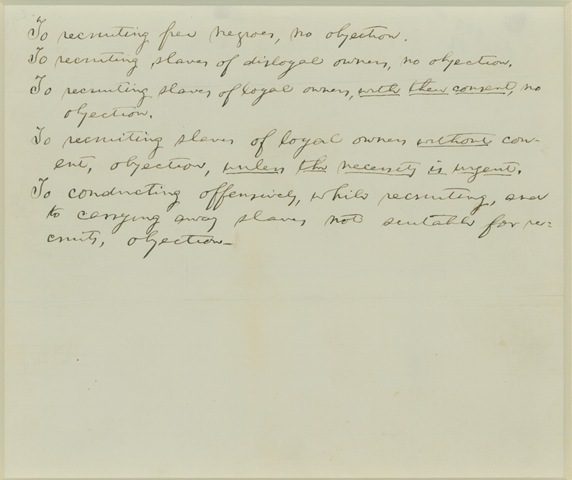
July 22, 1862: Abraham Lincoln’s Notes on Recruiting Black Soldiers

Basler suggests these undated notes may have been written around the time of the July 22 cabinet meeting.

AMs 354-10_1

Transcript:

To recruiting free negroes, no objection.

To recruiting slaves of disloyal owners, no objection.

To recruiting slaves of loyal owners, with their consent, no objection.

To recruiting slaves of loyal owners without consent, objection, unless the necessity is urgent.

To conducting offensively, while recruiting, and to carrying away slaves not suitable for recruits, objection.

Citation: Abraham Lincoln, notes on recruiting Negroes: autograph manuscript. Washington, D.C., [1862 July 22?].  AMs 354/10

July 20, 1862: Henry J. Biddle Death letter

Capt. Henry Jonathan Biddle was the older brother of Alexander Biddle. He was Assistant Adjutant General of the Pennsylvania Reserves and was fatally wounded at the battle of New Market Cross Roads on June 30, 1862.

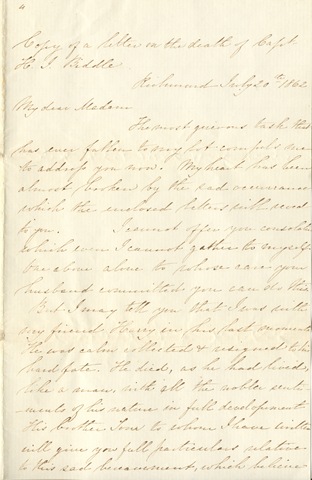
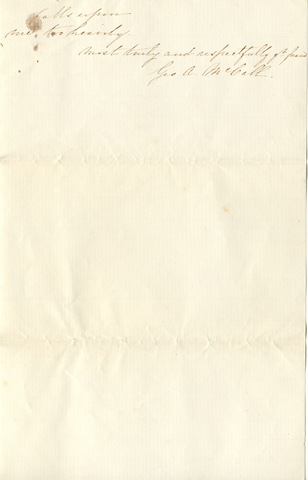
Rush IV-37-40 p1 McCall death letter enclosure 300dpi Rush IV-37-40 p2 McCall death letter enclosure 300dpi

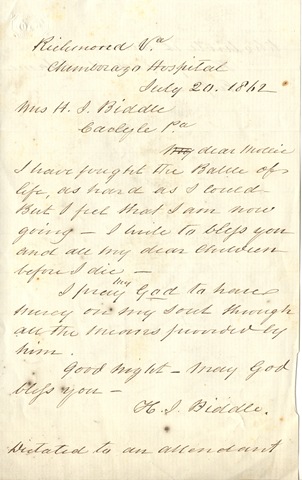
Rush IV-37-40 p1 Biddle death letter 200dpi

Rush IV-37-40 p2 Biddle death letter 200dpi

Transcript:

Copy of a letter on the death of Capt. H.J. Biddle

Richmond July 20th 1862

My dear Madame

The most grievous task that has ever fallen my lot compels me to address you now. My heart has been almost broken by the sad occurrences which the enclosed letters will reveal to you.

I cannot offer you consolation which even I cannot gather to myself. The above alone to whose care your husband committed you can do this.

But I may tell you I was with my friend Harry in his last moments. He was calm collected + resigned to his hard fate. He died, as he had lived, like a man, with all the noble sentiments of his nature in full development. His brother Tom to whim I have written will give you full particulars relative to this sad bereavement which believe falls upon me too heavily.

Most truly and respectfully your friend

Gen. A McCall

Richmond V.

Chimborazo Hospital

July 20th 1862

Mrs. H. J. Biddle

Carlyle Pa

Dear Mollie

I have fought the battle of life, as hard as I could, but I feel that I am now going. I write to bless you and all my dear children before I die.

I pray my God to have mercy on my soul through all the means provided by him.

Good night. May God bless you.

H.J. Biddle

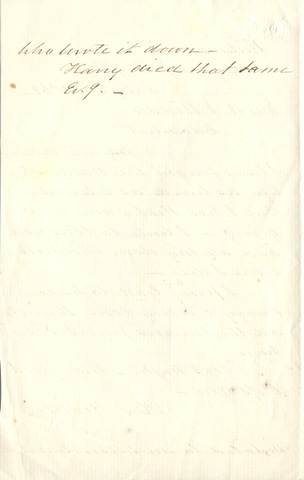
Dictated to an attendant who wrote it down

Harry died that same Evg

Citation: Henry Jonathan Biddle, letter to Mary D. Biddle. Richmond, 20 July 1862. Rush IV:37:40

July 20, 1862: Gideon Pillow to His Brother

Gideon Pillow of Tennessee had been President James K. Polk’s law partner and was a brigadier general in the Confederate Army. He is best remembered for his role in the loss of Fort Donelson in February 1862, where he was second  but turned the Fort over to Simon Bolivar Buckner, so as not to be the one to surrender it to U.S Grant.

AMs 779-6 p1 Gideon Johnson Pillow to his brother AMs 779-6 p2 Gideon Johnson Pillow to his brother

Transcript:

July 20th 1862—

My Dear Brother,

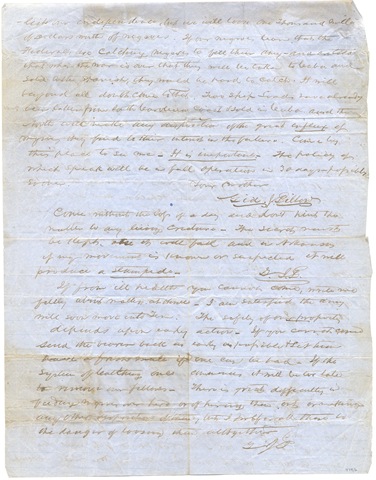
The Northern Gov’t is alarmed— the people there are not volunteering as they expected. I am satisfied they will ultimately adopt the policy of seizing our Negro men wherever they can be had—with the aid of their Army—that they will arm these Negroes and place them in their Army. I am not afraid of these Negroes in the Field, but all Negroes so taken off will be lost forever to us. That this Policy is certain to be adopted in the future I entertain in no sort of doubt. I think our only safety for our men is to bring them to the Interior of the South. The women & children and old men they will not take for this use. Whenever they shall have settled their Policy, they will go to catching & gathering Negroes. From the great number to be found in Mississippi Bottom and from the facility of reaching them and of transporting them North to camps of Instruction, they will have armed bodies of men in operation in less than 30 days & they will secure the River Bottom. I intend, as soon as Cartis gets out of the way, to make an effort to get my Negroes across the River & have them brought to this Region of country.

I send this to you by [illeg]. I wrote you a few days since to send down wagons for my Family to move home. That had better be deferred until Fall and until our Army enters Tennessee and drives back the Federals.

In the mean time you had better look to your Ferry Negro men—I greatly want your services to aid me in getting men out, but I do not know if it will be safe to wait until you can come. We will accomplish our independence, but we will lose one thousand milla of Dollars worth of Negroes. If our negroes learn that the Federals are collecting Negroes to fill their Army—and are told that when the war is over that they will be taken to Cuba and sold to the Spanish, they would be hard to catch. It will beyond all doubt come to that. Two ship loads have already been taken from South Carolina coast & sold in Cuba. And the North will make any deportation of the great influx of Negroes they find to their interest in the future. Come by this place to see me—It is important. The policy of which speak well be in full operation in 3 days—possibly sooner.

Your brother

Gid. J. Pillow

Come without the loss of a day and don’t hint the matter to any living creature—The secret must be kept or will fail and in Arkansas if my movement is known or suspected it will produce a stampede— G.J.P.

If from ill health you cannot come, write me fully about matters at Home—I am satisfied the Army will soon move into Tenn. The safety of our property depends upon early action—If you cannot come send the bearer back as early as possible & let him take a fresh mule if one can be had—If the system of catching ones commences it will be too late to warn our fellows—There is great difficulty in feeding Negroes over here or of hiring them out or making any other deportation of them, but I prefer all them to the danger of loosing them altogether. G.J.P.


Citation: Gideon Johnson Pillow (1806-1878), autograph letter signed to his brother. 20 July 1862. AMs AMs 779/6