October 6, 1863: William T. Sherman to James B. McPherson

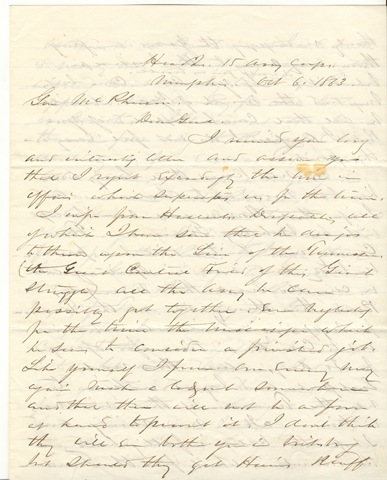
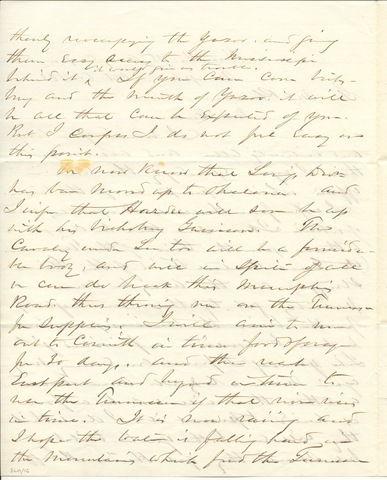
At he end of this military letter,  Sherman writes about the death of his nine-year-old son Willie from typhoid on October 3. Willie and the rest of Sherman’s family had been visiting him in Vicksburg and traveled with him to Memphis on the steamboat Atlantic, after which they planned to continue home. Willie took sick on the boat and died shortly after reaching Memphis.
 AMs 360-16 p1  Sherman to Mcpherson 300dpi AMs 360-16 p2  Sherman to Mcpherson 300dpi AMs 360-16 p3  Sherman to Mcpherson 300dpiAMs 360-16 p4  Sherman to Mcpherson 300dpi

Transcript [excerpt—p4 to end]

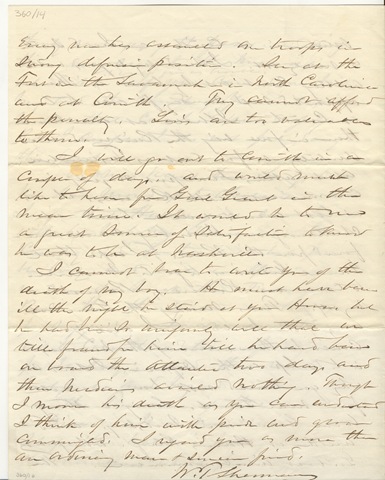
I will go out to Corinth in a couple of days and would much like to hear from Genl. Grant in the mean time. It would be to me a great service of satisfaction to know he was to be at Nashville.

I cannot bear to write you of the death of my boy. He must have been ill the night he staid at your House. but he had been so uniformly well that we little heard from him till he had been on board the Atlantic two days and then Medicine availed nothing. Though I mourn his death as you can understand I think of him with pain and grace commingled. I regard you as more than an ordinary man & sincere friend.

W. T. Sherman


Citation: William T. Sherman (1820-1891), autograph letter signed to James B. McPherson. Memphis, 6 October 1863. AMs 360/16

October 5, 1863: New York Tribune

top

Transcript (excerpt):

Page 1, Upper Half

Army of the Cumberland, Saturday, Oct. 3, 1863

The present and future prospect of success for this army is not only brightening but at this time is really good. If the enemy now makes an attack, even in very heavy force, he will in all probability be badly defeated. Each day’s delay but makes out commanders more confident of holding their position. There is no cause for alarm in the matter of flank movements.

The flag of truce sent out by Gen. Rosecrans was recognized. Our ambulances were driven to the enemy’s lines, there our drivers got off, when those appointed by the enemy took the ambulances within their lines. In a short time the ambulances returned with some portion of their wounded. They, as a generality, are very seriously injured.

The whole of Chattanooga is now a hospital, hardly a house but contains they unfortunate.

The enemy still continues in sight. Skirmishing is kept up. The enemy, each time he presses a little too hard, gets much the worst of it.


Citation: New York Semi-weekly Tribune. 5 October 1863. Gift of Steven and Susan Raab.

October 4, 1863: Alexander Biddle to Julia Williams Rush Biddle

Alexander Biddle was a member of the prominent Philadelphia Biddle family and was married to Julia Williams Rush,  the granddaughter of Dr. Benjamin Rush.  Biddle served with the 121st Pennsylvania Volunteer Infantry, beginning in September 1862. Starting out as a major, he would participate in Fredericksburg and Gettysburg, among other engagements, and would leave the service as a lieutenant colonel. (He was commissioned, but never mustered, as colonel)Rush IV-30-36 Oct 4, 1863 p1 A Biddle ALS to JWR Rush IV-30-36 Oct 4, 1863 p2-3 A Biddle ALS to JWR Rush IV-30-36 Oct 4, 1863 p2-3 A Biddle ALS to JWR Rush IV-30-36 Oct 4, 1863 p4 A Biddle ALS to JWR

Transcript:

Camp SW of [Perry?] Mt

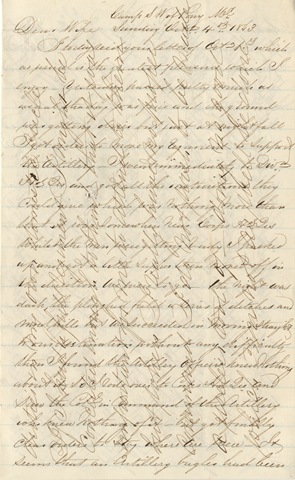
Sunday Oct 4th 1863

Dear Wife,

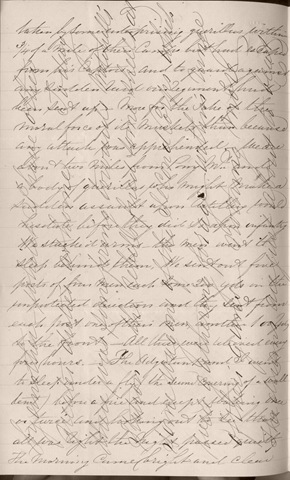
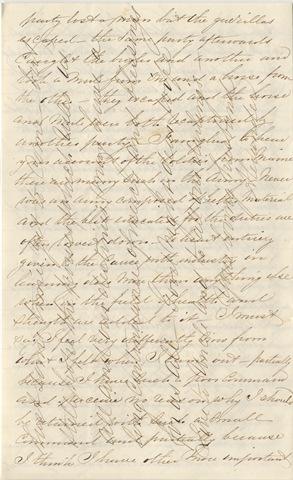
I today rec’d your letter of Oct 1 which as usual is the greatest pleasure which I enjoy—Yesterday passed pretty much as usual, the day was fine and the ground was getting drier but wet at nightfall. I got orders to move my regiment to support the Artillery. I went immediately to Div. Hd Qts and got all the instructions they could give, which was nothing more than that it was somewhere near Corps Hd Qts. Whilst the men were getting ready I packed up and got a little supplies then moved off in the direction we were to go. The night was dark, the ploughed field a series of ditches and mud hills but we succeeded in moving straight to our destination without any difficulty. Then I found the Artillery officers knew nothing about it, so I rode over to Corps HdQts and saw the Col. in command of the Artillery, who knew nothing of it—but got finally clear orders to stay where we were. It seems that an Artillery bugle had been taken by some enterprising guerrilla within ¾ mile of the camps but had escaped from his captors and to guard against any sudden raid our regiment had been sent up- more for the sake of the moral of if its muskets than because any attach was apprehended. We are about two miles from [Perry?] Mt and a body of guerrillas who might make a sudden assault upon Artillery would hesitate before they did so upon infantry. We stacked arms- the men went to sleep behind them. We sent out five posts of four men each some 200 yds in the unprotected direction and they sent from each post one of their men another 100 yds to the front. All these were changed every four hours. The Adjutant and I went to sleep under a fly, the second covering of a wall tent before a fire and except waking once or twice and looking out to see that all was right the night passed quietly. The morning came bright and clear. I made an inspection of the neighborhood and pitched upon two spots where I thought the guards ought to be posted and wrote my impressions to the Colonel- instead of being relieved I found (as I expected) the whole brigade –our two little regiments- assigned to guard the batteries- which were posted between them and the unprotected side when the other Regiment came up. We are now altogether again and upon the crest of low hills which are above fog’s miasma and I think much the best camp sites we have had since we left Middleburg. We have clean ground, good water, a good drainage and everything in order. We send out 60 men to the front as an advanced guard every night but we are comparatively comfortable. The bugler of whom I spoke lost his horse the men who caught him had met and had a fight with an equal number of Reb soldiers who were out without arms marauding- each party lost a man but the guerrillas escaped- the same party afterwards caught the bugler and another and took a mule from one and a horse from the other. They escaped and the horse and mule were both recaptured by another party. I am glad to hear your account of the soldier from Maine. There are many such in the army- never was an army composed of better material and the best educated for the duties are often lowest down. A heart entirely given to the cause with modesty in learning does more than anything else when in the field if health and strength are added to it. I must say I feel very differently now from what I felt when I came out- partially because I have such a poor command and perceive no reason why I should be returned with such a small command and partially because I think I have other more important duties in my own domestic circle. If I had a full Regiment I might be conceited enough to think that it was important for me to attend to them but when I really have no proper commands I do not wish to be made a useless fool of—doing no good which can not as well be done by another whilst I have other greater duties at home. Today there was some firing toward Mitchell’s station- The Rebels fired some shells at some wagon of the Second Corps which were gathering forage within range of their guns- nothing more. The drums are about to beat the tattoo which infantry and artillery bugles have been sounding. Remember me to Tom and all his family when you see him or them again. May it please God to bless us with an early termination of war and give peace and prosperity with perfect ? to our whole Country—I fear much that our troubles may last some time yet to come but still hope the power which rules us all and our destinies may have a long continuance of mercy and blessings for us all. Good night dear Wife. Love to Uncle and all our darlings—

Your loving husband

Alexander

Citation: Alexander Biddle (1819-1899), autograph letter signed to Julia Williams Rush Biddle, 4 October 1863. Rush IV:30:36

October 3, 1863: Henry Warner to his Father

Henry Warner was the youngest son of Henry and Mary Warner, the great-grandparents of the poet Marianne Moore.  Henry served in the Pennsylvania  Independent Artillery, Battery G from August 1862 until June 1865. In this letter he has just heard of the death of his sister-in-law Jennie Craig Warner, who died of typhoid. These family letters are preserved as part of the Marianne Moore family papers.

     Moore VI-5-24 p1 Henry Warner to Father 10-3-63 Moore VI-5-24 p2 Henry Warner to Father 10-3-63


Transcript:

Fort Delaware Oct. 3/63

Dear Father

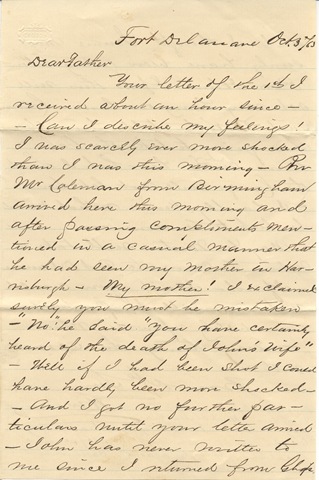
Your letter of the 1st I received about an hour since—Can I describe my feelings! I was scarcely ever more shocked than I was this morning—Rev Mr Coleman from Birmingham arrived here this morning and after passing compliments mentioned in a casual manner than he had seen my mother in Harrisburgh—My mother! I exclaimed surely you must be mistaken—“No!” he said “you have certainly heard of the death of John’s wife”—Well if I had been shot I could have hardly been more shocked—And I got no further particulars until your letter arrived—John has never written to me since I returned from Shp—and I thought Jennie must surely have been getting better—Poor John I fear this will sit very heavy on him—Coleman said Mother told him she was going to take the babe home with her—but I think the Craigs will not let her—I hardly know what would be best to be done—

May-be Mother will take a notion to come to Fort Delaware—If not—I wish you would write me all the particulars immediately upon her return—Every thing the same with me

Your affc Son

Henry

Maxwell & Jane is just in from seeing Hugh & Isabella are just gone to East Liberty will leave for Cambridge at noon next Monday, is in a great hurry to vote against Vallandignham


Citation: Henry Warner, autograph letter to John Riddle Warner. Fort Delaware,3 October 1863. Moore VI:5:24

October 2, 1863: Alexander Biddle letter to Julia Williams Rush Biddle

Alexander Biddle was a member of the prominent Philadelphia Biddle family and was married to Julia Williams Rush,  the granddaughter of Dr. Benjamin Rush.  Biddle served with the 121st Pennsylvania Volunteer Infantry, beginning in September 1862. Starting out as a major, he would participate in Fredericksburg and Gettysburg, among other engagements, and would leave the service as a lieutenant colonel. (He was commissioned, but never mustered, as colonel)

Rush IV-30-36 Oct 2, 1863 p1 A Biddle ALS to JWR Rush IV-30-36 Oct 2, 1863 p2-3 A Biddle ALS to JWR Rush IV-30-36 Oct 2, 1863 p2-3 A Biddle ALS to JWR

Rush IV-30-36 Oct 2, 1863 p4 A Biddle ALS to JWR

October 2 was a Friday, not a Thursday, so Biddle got either the day or the date wrong

Transcript:

can you send me a bunch of envelopes by post?

Camp near Raccoon Ford

Oct 2d 1863, Thursday

Dear Wife,

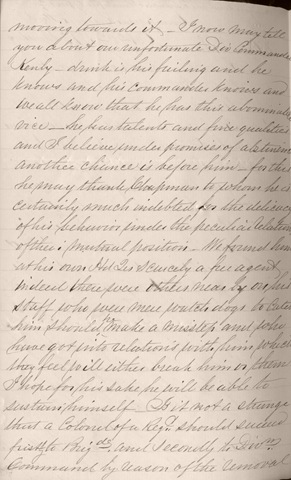
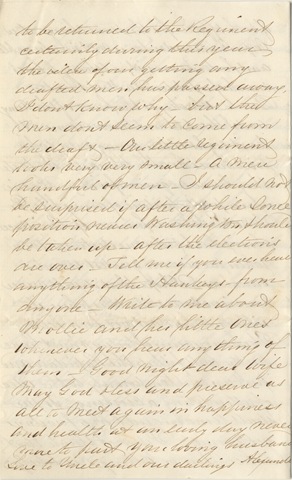
I yesterday wrote to dear Uncle thanking him for the [Siphonia?] he has so kindly lent me- It is admirably adapted to the field. Today Kenly was reinstated in his command and we left Div Head Qts to return to the Brigade. It has been raining hard all the day and the shifting of the tents and unpitching them has all been done in the rain– the ground in some places being pretty well flooded. It is now eight O’clock at night and we have got things again partially to rights and are not uncomfortable. Today there was an execution in the Second division of our Corps within sight of our Hd Qts. The troops passed us going to and coming back from it and for a moment I saw the long lines of the three sides of the Square and guessed their import but no more- although I could see the curious army attendants moving towards it. I now may tell you about our unfortunate Div Commander Kenly- drink is his failing and he knows and his commander knows and we all know that he has this abominable vice—he has talents and fine qualities and I believe under promises of abstinence another chance is before him.- for this he may thank Chapman to whom he is certainly very much indebted for the delicacy of his behavior under the peculiar relations of their mutual position. We found him at his own Hd Qts scarcely a free agent. Indeed there were others near by on his staff who were mere watch dogs to catch him should he make a misstep, and who have got into relations with him which they feel will either break him or them. I hope for his sake he will be able to sustain himself. Is it not strange that a Colonel of the Reg. should succeed firstly to Brigade and secondly to Div Command by reason of the removal of both officers for the same charge. Our Corps Commander too is not invulnerable and he knows it, although he is much of a soldier and a West Pointer. Drink—whiskey is the bane of the army and I think I would now name at least eight or ten young men who will never be able to master the taste they have acquired for it. I give you a pretty picture of army life, Do I not? There is however Providence above which rules our destinies even when we are our greatest enemies ourselves. I hope that it will never be a vice at our Head Qts where its influence has not yet been felt. The heavy rain of today must have pretty well filled the Rapidan and put an end temporarily to the idea of attempting a crossing. So we shall remain quiet for a few days yet to come. I do not think that either Don or Etting are likely to be returned to the Regiment certainly during this year the idea of our getting any drafted men has passed away. I don’t know why- but the men don’t seem to come from the drafts—Our little Regiment looks very very small—a mere hundred of men. I should not be surprised if after a while some position nearer Washington should be taken up—after the elections are over. Tell me if you ever hear anything of the Hankeys from anyone. Write to me about Mollie and her little ones whenever you hear anything of them. Good night dear Wife. May God bless and preserve us all to meet again in happiness and health at an early day never more to past. Love to Uncle and our darlings

Your loving husband

Alexander

Citation: Alexander Biddle (1819-1899), autograph letter signed to Julia Williams Rush Biddle, 2? October 1863. Rush IV:30:36

October 1, 1863: New York Tribune.

top

Transcript (excerpt):

Page 1, Upper Half

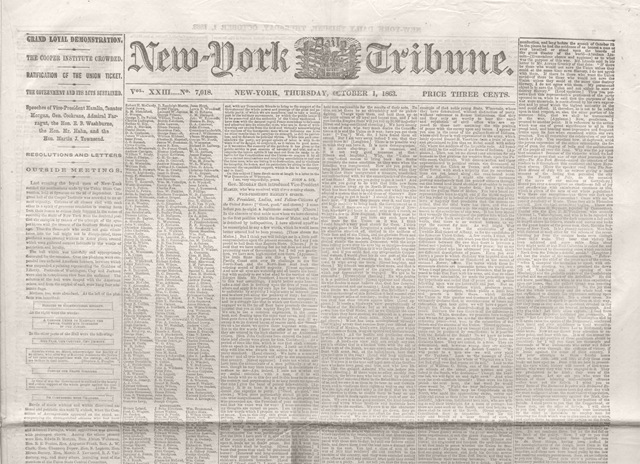
Last evening the loyal men of New York ratified the nominations made by the Union State Convention, held at Syracuse on the 2d of September. The great hall of the Cooper Institute was crowded to its utmost capacity. Citizens of all classes vied with each other in a spirit of generous emulation in coming forth from their homes to evince their interest in the cause of rescuing the State of New York from the doubtful position she occupies by reason of the triumph of the sympathizers with the treason of the Southern States a year ago. That the thousands who could not gain admittance into the hall might not be disappointed, three platforms were erected without in Astor place, around which were gathered earnest listeners to the words of patriotism and loyalty.

The hall within was tastefully and appropriately decorated for the occasion. Over the platform were suspended two unfurled American banners, between which was suspended a painting representing the Goddess of Liberty. Portraits of Washington, Clay and Jackson were also in conspicuous view from the audience. The columns of the hall were draped with the American colors, and from the capital of each were hung four miniature flags.


Citation: New York Semi-weekly Tribune. 1 October 1863. Gift of Steven and Susan Raab.

September 30, 1863: Alexander Biddle to Julia Williams Rush Biddle

Alexander Biddle was a member of the prominent Philadelphia Biddle family and was married to Julia Williams Rush,  the granddaughter of Dr. Benjamin Rush.  Biddle served with the 121st Pennsylvania Volunteer Infantry, beginning in September 1862. Starting out as a major, he would participate in Fredericksburg and Gettysburg, among other engagements, and would leave the service as a lieutenant colonel. (He was commissioned, but never mustered, as colonel)

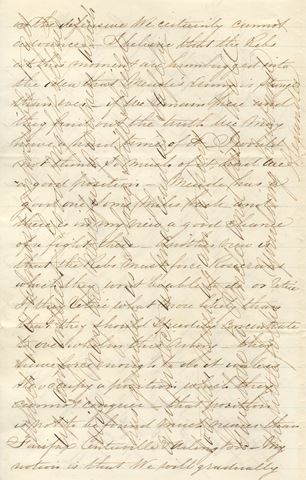
Rush IV-30-35 p1 A. Biddle ALS to Julia William Rush, Sept 30 Rush IV-30-35 p2 A. Biddle ALS to Julia William Rush, Sept 30 Rush IV-30-35 p3 A. Biddle ALS to Julia William Rush, Sept 30 Rush IV-30-35 p4 A. Biddle ALS to Julia William Rush, Sept 30

Transcript (excerpt):

Camp near Raccoon Ford

September 30th 1863

Dear Wife

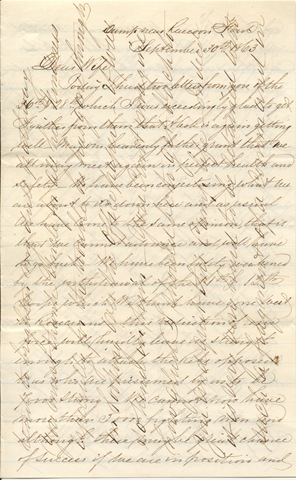
Today I had two letters from you of the 26th & 28th which I was exceedingly glad to get I gather from them that Aleck is again getting well – May our heavenly father grant that we all may meet again in perfect health and safety – We have been conjecturing what we are about to do down here and as usual we have come to the same opinion, that is that we cannot advance and will have to go back. We have been lately weakened by the withdrawal of the 11th & 12th Corps which we think have gone West to Rosecrans this redirection of our force will hardly leave us strength enough to attack the Rebs opposed to us who are presumed by us to be 7000 strong – We cannot now have more than 5000 fighting men and although there maybe great chance of success if we are in position and on the defensive We certainly cannot advance. I believe that the Rebs at this moment are humbugged into the idea that Meade’s Army is stronger than ever – if we remain here and they find out the truth we may have a hard time of it…

Citation: Alexander Biddle (1819-1899), autograph letter signed to Julia Williams Rush Biddle, 30 September 1863. Rush IV:30:35

September 29, 1863: Alexander Biddle to Julia Williams Rush Biddle

Alexander Biddle was a member of the prominent Philadelphia Biddle family and was married to Julia Williams Rush,  the granddaughter of Dr. Benjamin Rush.  Biddle served with the 121st Pennsylvania Volunteer Infantry, beginning in September 1862. Starting out as a major, he would participate in Fredericksburg and Gettysburg, among other engagements, and would leave the service as a lieutenant colonel. (He was commissioned, but never mustered, as colonel)

Rush IV-30-35 p1 A. Biddle ALS to Julia William Rush, Sept 29 Rush IV-30-35 p2 A. Biddle ALS to Julia William Rush, Sept 29

Transcript (excerpt):

At Head Qrs Div 1st AC

Camp near Raccoon ford at Crossroads to Culpeper

In eight of Clark’s M Cedar Run M – Mitchell’s

September 29, 1863 Tuesday

Dear Wife

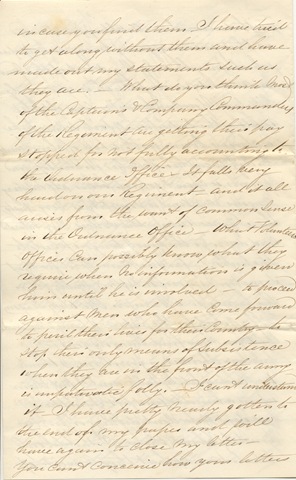
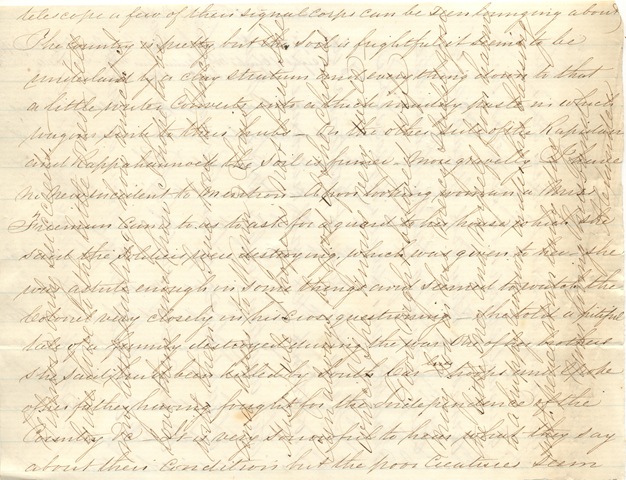
I have just gotten through a long piece of writing in relation to Ordinance papers – a sort of taking the bull by the horns, it had to be done some time and now is one of the stated periods when Settlements are required This morning at a little after midnight We got orders to move at 6 O’Clock AM but as the Col had a conversation with Genl Newton in the evening and understood him to decide not to move he supposed it to be a mistake So the hour came and past and no move was made until an aid arrived who informed us the Genl had expected to find us on the new ground selected. We finally got off and marched about three miles through the woods and came to out new place of rest. We are on the road to Culpeper about three miles to Raccoon ford and in sight of the high hills on the other side of the river One of which Clark’s [illeg.] is a Rebel Signal Station where through the telescope a few of their signal corps can be seen lounging about…

Citation: Alexander Biddle (1819-1899), autograph letter signed to Julia Williams Rush Biddle, 29 September 1863. Rush IV:30:35

September 28, 1863: Alexander Biddle to Julia Williams Rush Biddle

Alexander Biddle was a member of the prominent Philadelphia Biddle family and was married to Julia Williams Rush,  the granddaughter of Dr. Benjamin Rush.  Biddle served with the 121st Pennsylvania Volunteer Infantry, beginning in September 1862. Starting out as a major, he would participate in Fredericksburg and Gettysburg, among other engagements, and would leave the service as a lieutenant colonel. (He was commissioned, but never mustered, as colonel)

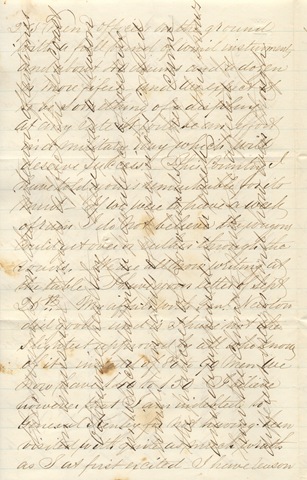
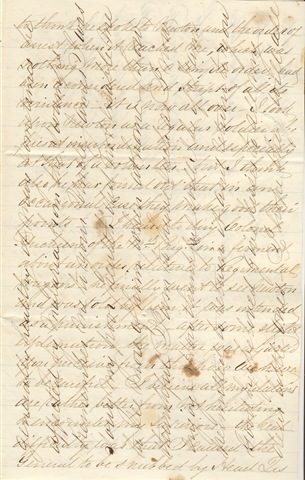
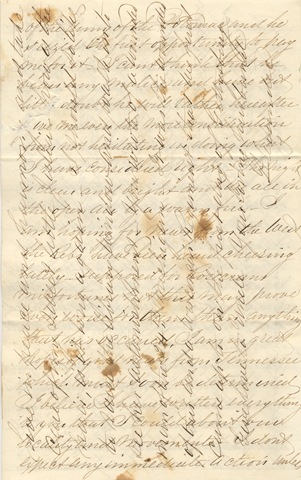
Rush IV-30-35 p1 A. Biddle ALS to Julia William Rush, Sept 28 Rush IV-30-35 p2 A. Biddle ALS to Julia William Rush, Sept 28 Rush IV-30-35 p3 A. Biddle ALS to Julia William Rush, Sept 28 Rush IV-30-35 p4 A. Biddle ALS to Julia William Rush, Sept 28

Transcript (excerpt):

Camp near Byran’s plantation

Monday Sept 28. 1863

Head Qrs Div

Dear Wife

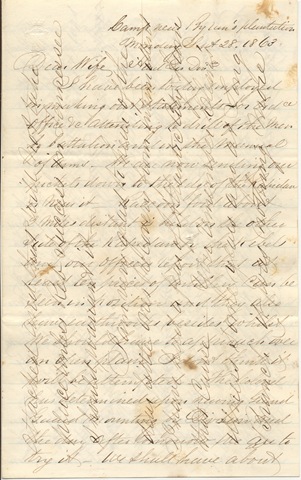
I have been today employed in making out statements for Ord Office &c attending to drill of the men by battalion and in the manual of Arms – We are now sending out pickets down to the edge of the Rapidan or near it – Raccoon ford about 2 miles distant is held on the other side of the Rapidan by the Rebels and our officers report that at least ten pieces of artillery can be seen in position and they also have earthworks besides whilst We should have to approach well on open plain. I don’t think it will be attempted The Colonel has determined upon having General Guard mounting by Division and the day after tomorrow we are to try it. We shall have about 275 men & officers on the ground with a full band of wind instruments and about 40 drums and a dozen or more fifers and we expect it to be something of a display. At any rate it will be an effort in a military way which will deserve success…

Citation: Alexander Biddle (1819-1899), autograph letter signed to Julia Williams Rush Biddle, 28 September 1863. Rush IV:30:35

September 27, 1863: Alexander Biddle to Julia Williams Rush Biddle

Alexander Biddle was a member of the prominent Philadelphia Biddle family and was married to Julia Williams Rush,  the granddaughter of Dr. Benjamin Rush.  Biddle served with the 121st Pennsylvania Volunteer Infantry, beginning in September 1862. Starting out as a major, he would participate in Fredericksburg and Gettysburg, among other engagements, and would leave the service as a lieutenant colonel. (He was commissioned, but never mustered, as colonel)

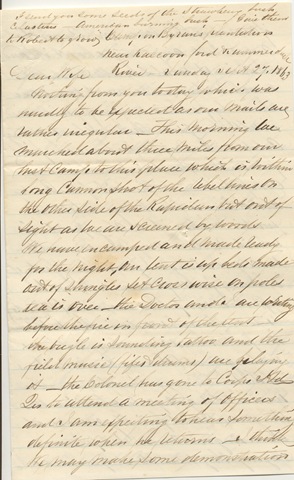
Rush IV-30-35 p1 A. Biddle ALS to Julia William Rush, Sept 27 Rush IV-30-35 p2 A. Biddle ALS to Julia William Rush, Sept 27 Rush IV-30-35 p3 A. Biddle ALS to Julia William Rush, Sept 27

Transcript (excerpt):

Camp on Byran’s plantation

near Raccoon ford [illeg.]

River – Sunday Sept 27.1863

Dear Wife

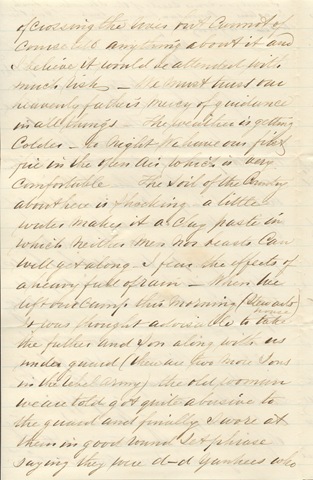
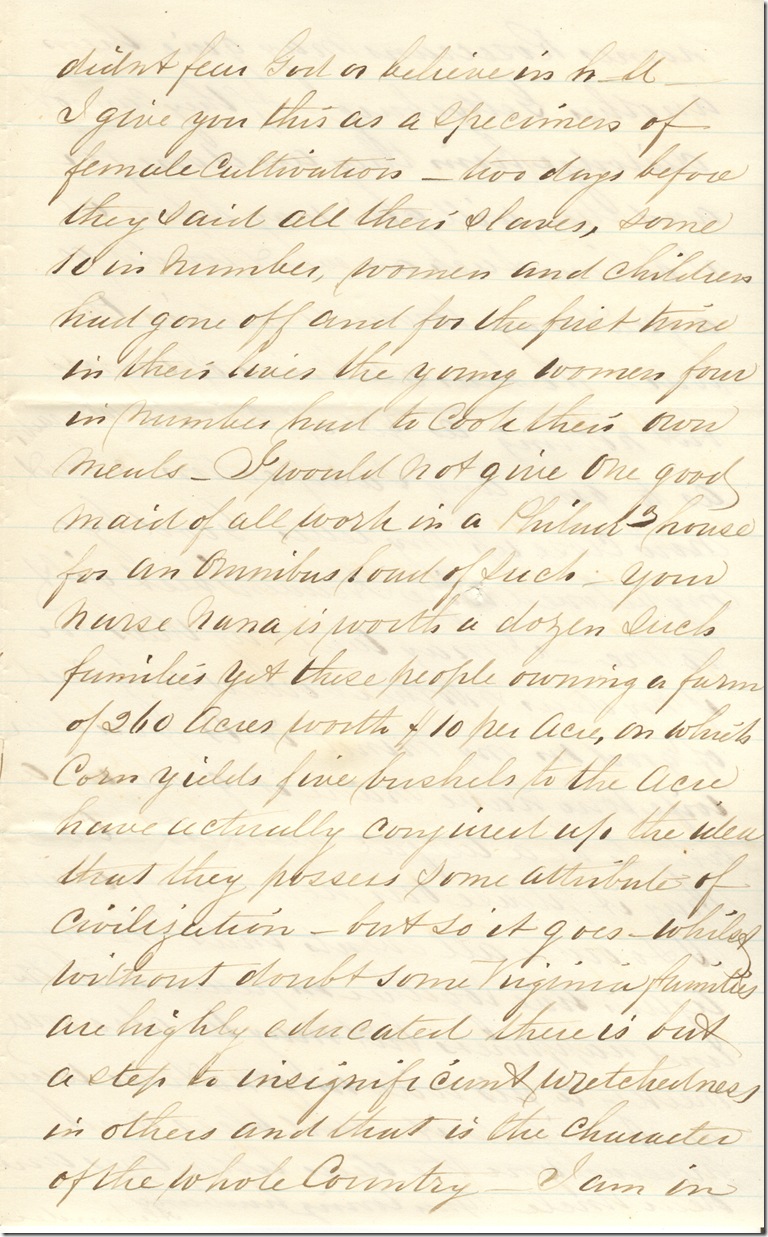
Nothing from you today which was hardly to be expected as our mails are rather irregular – This morning we marched about three miles from our last camp to this place which is within long cannon shot of the rebel lines on the other side of the Rapidan but out of sight as we are screened by woods We have encamped and made ready for the night, our tent is up, beds made out of shingles set crosswise on poles. tea is over – the Doctor and I are writing before the fire in front of the tent the bugle is sounding tattoo and the field music (fifes & drums) are playing it – the Colonel has gone to Corps Hd Qrs to attend a meeting of Officers and I am expecting to hear something definite when he returns – I think We may make some demonstration of crossing the river but cannot of course tell anything about it and I believe it would be attended with much risk – We must trust our heavenly father’s mercy of guidance in all things – The weather is getting Colder – to night We have our first fire in the open air which is very comfortable…

Citation: Alexander Biddle (1819-1899), autograph letter signed to Julia Williams Rush Biddle, 27 September 1863. Rush IV:30:35