Alexander Biddle was a member of the prominent Philadelphia Biddle family and was married to Julia Williams Rush, the granddaughter of Dr. Benjamin Rush. Biddle served with the 121st Pennsylvania Volunteer Infantry, beginning in September 1862. Starting out as a major, he would participate in Fredericksburg and Gettysburg, among other engagements, and would leave the service as a lieutenant colonel. (He was commissioned, but never mustered, as colonel)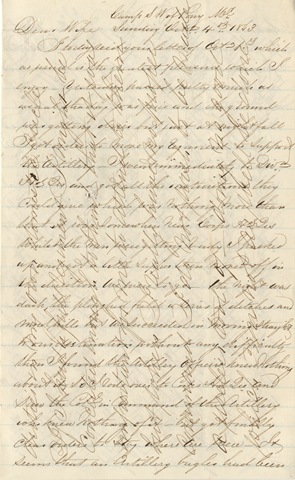

Transcript:
Camp SW of [Perry?] Mt
Sunday Oct 4th 1863
Dear Wife,
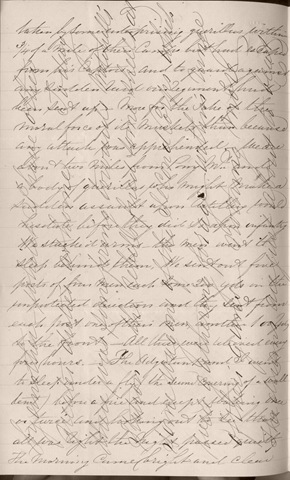
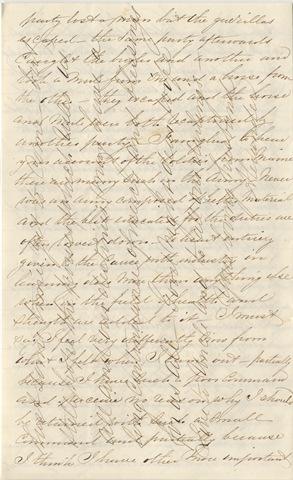
I today rec’d your letter of Oct 1 which as usual is the greatest pleasure which I enjoy—Yesterday passed pretty much as usual, the day was fine and the ground was getting drier but wet at nightfall. I got orders to move my regiment to support the Artillery. I went immediately to Div. Hd Qts and got all the instructions they could give, which was nothing more than that it was somewhere near Corps Hd Qts. Whilst the men were getting ready I packed up and got a little supplies then moved off in the direction we were to go. The night was dark, the ploughed field a series of ditches and mud hills but we succeeded in moving straight to our destination without any difficulty. Then I found the Artillery officers knew nothing about it, so I rode over to Corps HdQts and saw the Col. in command of the Artillery, who knew nothing of it—but got finally clear orders to stay where we were. It seems that an Artillery bugle had been taken by some enterprising guerrilla within ¾ mile of the camps but had escaped from his captors and to guard against any sudden raid our regiment had been sent up- more for the sake of the moral of if its muskets than because any attach was apprehended. We are about two miles from [Perry?] Mt and a body of guerrillas who might make a sudden assault upon Artillery would hesitate before they did so upon infantry. We stacked arms- the men went to sleep behind them. We sent out five posts of four men each some 200 yds in the unprotected direction and they sent from each post one of their men another 100 yds to the front. All these were changed every four hours. The Adjutant and I went to sleep under a fly, the second covering of a wall tent before a fire and except waking once or twice and looking out to see that all was right the night passed quietly. The morning came bright and clear. I made an inspection of the neighborhood and pitched upon two spots where I thought the guards ought to be posted and wrote my impressions to the Colonel- instead of being relieved I found (as I expected) the whole brigade –our two little regiments- assigned to guard the batteries- which were posted between them and the unprotected side when the other Regiment came up. We are now altogether again and upon the crest of low hills which are above fog’s miasma and I think much the best camp sites we have had since we left Middleburg. We have clean ground, good water, a good drainage and everything in order. We send out 60 men to the front as an advanced guard every night but we are comparatively comfortable. The bugler of whom I spoke lost his horse the men who caught him had met and had a fight with an equal number of Reb soldiers who were out without arms marauding- each party lost a man but the guerrillas escaped- the same party afterwards caught the bugler and another and took a mule from one and a horse from the other. They escaped and the horse and mule were both recaptured by another party. I am glad to hear your account of the soldier from Maine. There are many such in the army- never was an army composed of better material and the best educated for the duties are often lowest down. A heart entirely given to the cause with modesty in learning does more than anything else when in the field if health and strength are added to it. I must say I feel very differently now from what I felt when I came out- partially because I have such a poor command and perceive no reason why I should be returned with such a small command and partially because I think I have other more important duties in my own domestic circle. If I had a full Regiment I might be conceited enough to think that it was important for me to attend to them but when I really have no proper commands I do not wish to be made a useless fool of—doing no good which can not as well be done by another whilst I have other greater duties at home. Today there was some firing toward Mitchell’s station- The Rebels fired some shells at some wagon of the Second Corps which were gathering forage within range of their guns- nothing more. The drums are about to beat the tattoo which infantry and artillery bugles have been sounding. Remember me to Tom and all his family when you see him or them again. May it please God to bless us with an early termination of war and give peace and prosperity with perfect ? to our whole Country—I fear much that our troubles may last some time yet to come but still hope the power which rules us all and our destinies may have a long continuance of mercy and blessings for us all. Good night dear Wife. Love to Uncle and all our darlings—
Your loving husband
Alexander
Citation: Alexander Biddle (1819-1899), autograph letter signed to Julia Williams Rush Biddle, 4 October 1863. Rush IV:30:36