May 12, 1864: Braxton Bragg to P. G. T. Beauregard

Pierre Gustave Toutant Beauregard was a Louisiana-born general of the Confederate States Army. He had graduated second in his class from West Point in 1838 and was an admirer of Napoleon. He achieved fame early in the Civil War for commanding the Fort Sumter bombardment and as the victor of the first battle of Manassas. He later served in the Western Theater (including Shiloh and Corinth), Charleston, and the defense of Richmond, but his career was hampered by friction with Jefferson Davis and other generals.

This is one of approximately 1000 military telegrams to and from Beauregard in the Rosenbach collection.
AMs 1168-11 1864-05-12 p1 AMs 1168-11 1864-05-12 p2

AMs 1168-11 1864-05-12 p3

Transcript:

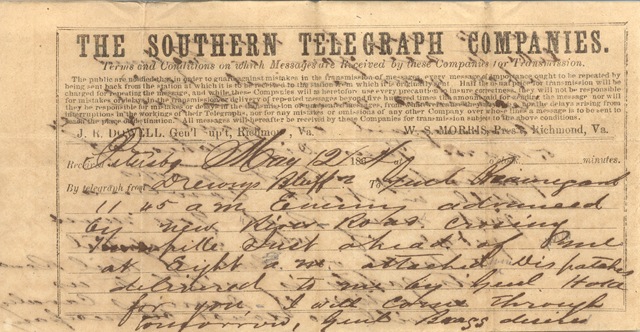
Received Petersbg May 12 1864

By telegraph from Drewry’s Bluff to Genl Beauregard

11 45 AM Enemy advanced by New River Road crossing [Thomasville?] Just ahead of [illeg.]

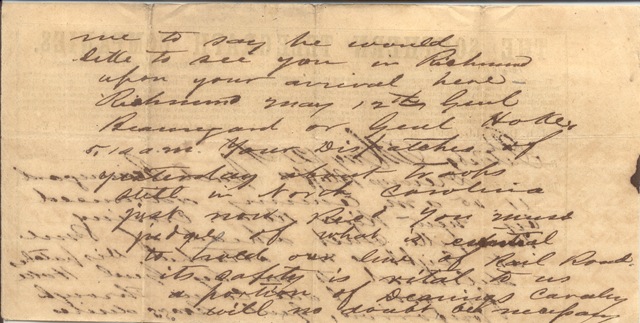
At Eight a.m. attacked. Dispatches delivered to me by Genl Hoke for you. I will come through tomorrow, Genl Bragg desires me to say he would like to see you in Richmond upon your arrival here.

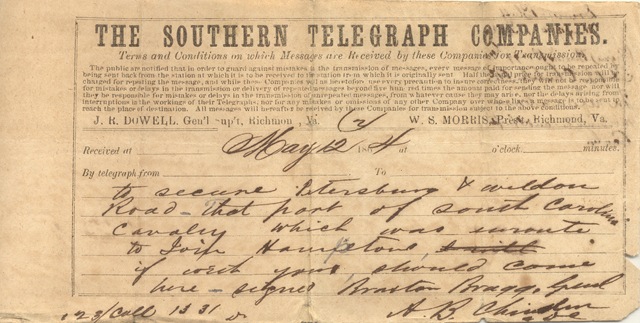
Richmond May 12th Genl Beauregard or  Genl Hoke 5.10 a.m. Your Dispatches of yesterday about troops still in North Carolina just now Rec.d You must judge of what is essential to hold our line of rail road its safety is vital to us . Position of [Dearings?] Cavalry will no doubt be necessary to secure Petersburg & Weldon Road_That part of South Carolina Cavalry which was en route to join Hamptons if with you should come here. Signed Braxton Bragg Genl

Citation: Braxton Bragg (1817-1876), telegram to G. T. Beauregard. Drewry’s Bluff, Va.; 12 May 1864. AMs 1168/11

May 11, 1864: Jeb Stuart to Braxton Bragg

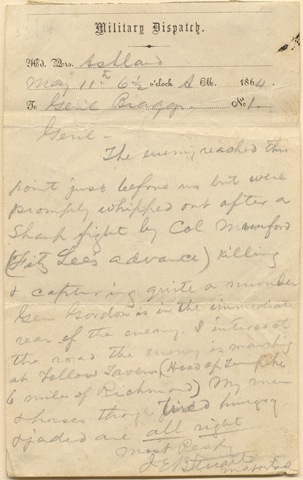
This dispatch was written from Ashland, several miles north of Yellow Tavern, where Stuart would be fatally wounded later that day.

AMs 532-14 Jeb Stuart to Braxton Bragg

Transcript:

Military Dispatch

Hd. Qrs. Ashland

May 11th 6 ½ o’clock A.M. 1864

To Gen’l Bragg No 1.

Gen’l—

The enemy reached the point just before us but were promptly whipped out after a sharp fight by Col. Mumford (Fitz Lee’s advance) killing & capturing quite a number. Gen Gordon is in the immediate rear of the enemy. I intersect the road the enemy is marching at Yellow Tavern (Head of the Turnpike 6 miles of Richmond). My men & horses though tired hungry & jaded are all right.

Most Respy

JEB Stuart


Citation: Jeb Stuart (1833-1864), autograph letter signed to Braxton Bragg. Ashland, Va., 11 May 1864. AMs 532/14

May 9, 1864: Samuel B. Paul telegram to G. T. Beauregard

Pierre Gustave Toutant Beauregard was a Louisiana-born general of the Confederate States Army. He had graduated second in his class from West Point in 1838 and was an admirer of Napoleon. He achieved fame early in the Civil War for commanding the Fort Sumter bombardment and as the victor of the first battle of Manassas. He later served in the Western Theater (including Shiloh and Corinth), Charleston, and the defense of Richmond, but his career was hampered by friction with Jefferson Davis and other generals.

This is one of approximately 1000 military telegrams in P.G.T. Beauregard’s papers at the Rosenbach.

AMs 1168-11 1864-05-09 AMs 1168-11 1864-05-09 verso

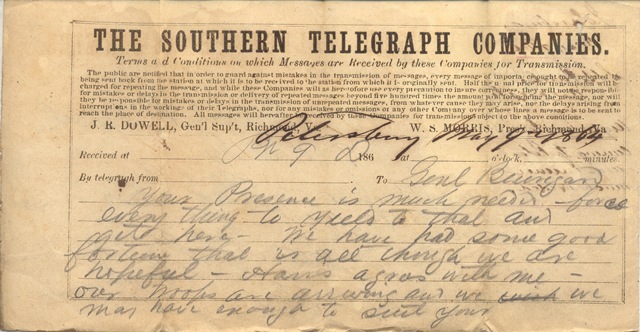
Transcript:

Petersburg May 9th, 1864

To Genl Beauregard

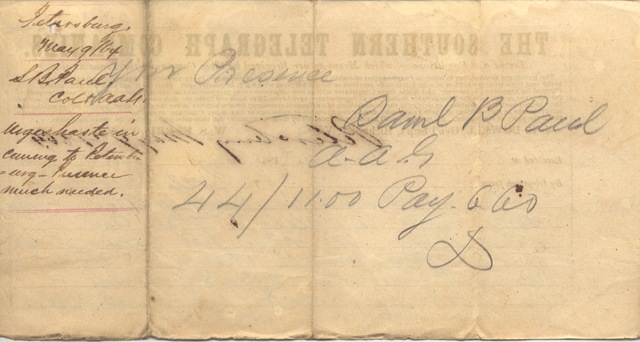
Your presence is much needed—force everything to yield to that and get here—We have had some good fortune that is all though we are hopeful—Harris agrees with me—our troops are arriving but we may have enough to suit your presence.

Saml B Paul

A.A.G.

Citation: Samuel B. Paul, telegram to G. T. Beauregard. Petersburg, 9 May 1864. AMs 1168/11

May 8, 1864: P. R. Page telegram to P. G. T. Beauregard

Pierre Gustave Toutant Beauregard was a Louisiana-born general of the Confederate States Army. He had graduated second in his class from West Point in 1838 and was an admirer of Napoleon. He achieved fame early in the Civil War for commanding the Fort Sumter bombardment and as the victor of the first battle of Manassas. He later served in the Western Theater (including Shiloh and Corinth), Charleston, and the defense of Richmond, but his career was hampered by friction with Jefferson Davis and other generals.

This is one of approximately 1000 military telegrams in P.G.T. Beauregard’s papers at the Rosenbach.

AMs 1168-11 1864-05-08

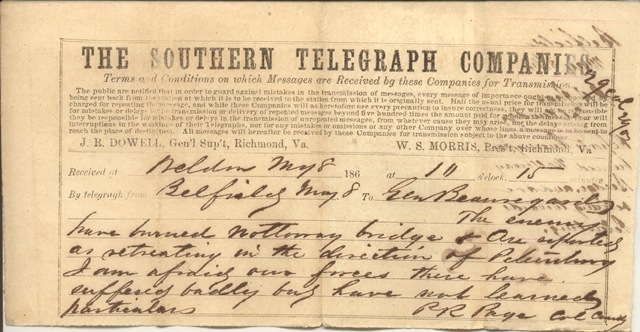
Transcript:

Received at Weldon May 8 at 11 o’clock 15 minutes

By telegraph from Belfield May 8 To Gen Beauregard

The enemy have burned Nottoway bridge & are reported as retreating in the direction of Petersburg. I am afraid our troops there have suffered badly but have not learned particulars.

P. R. Page Col. Cmdg


Citation: P. R. Page, telegram to G. T. Beauregard. Belfield, 8 May 1864. AMs 1168/11

May 7, 1864: John Henry Brown’s Journal

John Henry Brown was a painter of portrait miniatures, living and working in Philadelphia. He had met Lincoln in August of 1860 when he was commissioned to paint Lincoln’s portrait for a supporter, but although Brown liked Lincoln personally, he did not agree with Republican policies.

1864-05-07


Transcript:

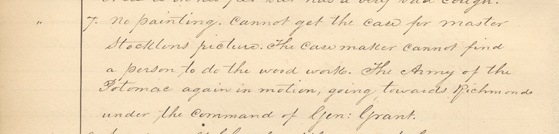
No painting. Cannot get the case for Master Stocktons picture. The casemaker cannot find a person to do the wood work. The Army of the Potomac again in motion, going towards Richmond under the command of Gen: Grant.


Citation: John Henry Brown, autograph journal/account book. Philadelphia, 1844-1890. AMs 573/14.1

May 5, 1864: Order of Sailing off Fort Morgan

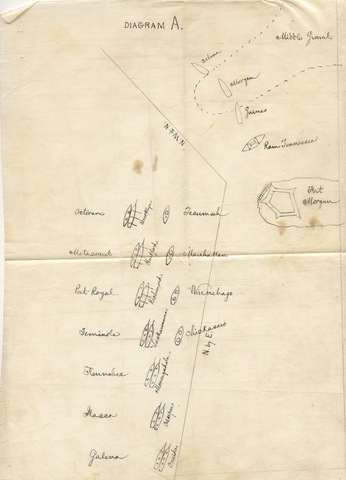
AMs 1168-11 p1 order of sailing off Fort Morgan

This map is one of twenty-four military maps and drawings  in a collection of papers from Confederate General P.G.T. Beauregard. It is undated but it relates to the Battle of Mobile Bay, which took place on May 5, 1864.

Citation: Unknown artist, diagram of the order of sailing off Fort Morgan. [1864]. AMs 1168/11

May 4, 1864: Henry and Mary Warner to John Warner

Henry and Mary Warner lived in Allegheny City, Pennsylvania, now part of Pittsburgh. They are the great-grandparents of poet Marianne Moore.  By the 1860s they had three surviving children:  John, Henry, and Anne. Their letters to John, a Presbyterian minister living in Gettysburg, are preserved as part of Marianne Moore’s family papers.

Moore VI-6-5 p1 letter to John from Henry and Mary 5-4-64 300 dpi Moore VI-6-5 p2 letter to John from Henry and Mary 5-4-64 300 dpi

Transcript [excerpt]:

Allegheny City, Wednesday, May 4. 1864. Afternoon

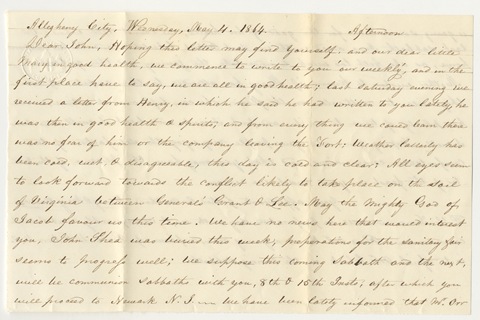
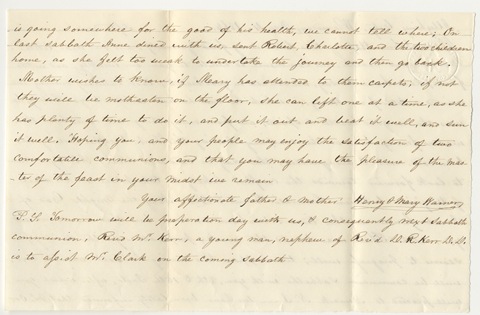
Dear John, Hoping this letter may find yourself, and our dear little Mary in good health, we commence to write to you ‘our weekly’ and in the first place have to say, we are all in good health; last Saturday evening we received a letter from Henry, in which he said he had written to you lately, he was then in good health & spirits; and from everything we could learn there was no fear of him or the company leaving the Fort; Weather latterly has been cold, wet, & disagreeable, this day is cold and clear; All eyes seem to look forward towards the conflict likely to take place on the soil of Virginia between Generals’ Grant & Lee. May the Mighty God of Jacob favour us this time. […]

Your affectionate father & mother Henry & Mary Warner


Citation: Henry and Mary Warner, autograph letter signed to John Riddle Warner.  Allegheny City [Pittsburgh],4 May 1864. Moore VI:06:5

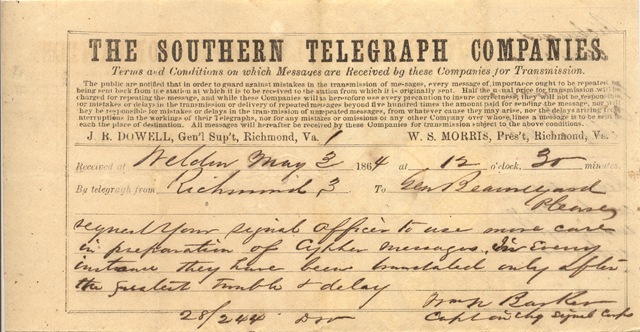
May 3, 1864: Frank Barker telegram to P. G. T. Beauregard

Pierre Gustave Toutant Beauregard was a Louisiana-born general of the Confederate States Army. He had graduated second in his class from West Point in 1838 and was an admirer of Napoleon. He achieved fame early in the Civil War for commanding the Fort Sumter bombardment and as the victor of the first battle of Manassas. He later served in the Western Theater (including Shiloh and Corinth), Charleston, and the defense of Richmond, but his career was hampered by friction with Jefferson Davis and other generals.

This is one of approximately 1000 military telegrams in P.G.T. Beauregard’s papers at the Rosenbach.

AMs 1168-11 1864-05-03

Transcript:

Received at Weldon May 3 1864 at 12 o’clock 30 minutes

By telegraph from Richmond 3 To Gen Beauregard

Please request your signal officer to use more care in preparation of cipher messages. In every instance they have been translated only after the greatest trouble & delay.

Frank Barker

Capt. in chg signal corps


Citation: Frank Barker, telegram to G. T. Beauregard. Richmond, 3 May 1864. AMs 1168/11

May 2, 1864: Randolph A. DeLancey to John Riddle Warner.

Rev. John Riddle Warner was the grandfather of the poet Marianne Moore and during the Civil War, he lived in Gettysburg, Pennsylvania. These letters are preserved as part of Marianne Moore’s family papers.

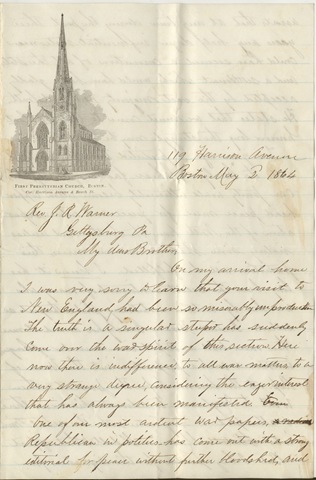
 Moore VI-6-5 p1,4 letter to John from RDelancey 5-2-64 300 dpi Moore VI-6-5 p2,3 letter to John from RDelancey 5-2-64 300 dpiMoore VI-6-5 p2,3 letter to John from RDelancey 5-2-64 300 dpiMoore VI-6-5 p1,4 letter to John from RDelancey 5-2-64 300 dpi

Transcript [excerpt]”:

119 Harrison Avenue

Boston May 2 1864

Rev. J.R. Warner

Gettysburg Pa

My dear Brother,

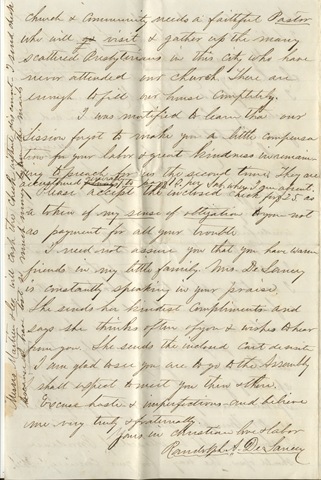
On my arrival home I was very sorry to learn that your visit to New England had been so miserably unproductive. The truth is a singular stupor has suddenly come over the war spirit of this section. Here now there is indifference to all war matters, to a very strange degree, considering the eager interest that has always been manifested.

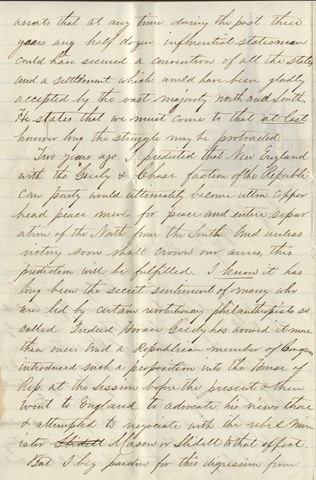
One of our most ardent war papers, Republican in politics, has come out with a strong editorial for peace without further bloodshed, and asserts that at any time during the past three years any half dozen influential statesmen could have secured a convention of all the states, and a settlement which would have been gladly accepted by the vast majority North and South. He states that we must come to that at last however long the struggle may be protracted.

Two years ago I predicted that New England with the Greely & Chase faction of the Republican party would ultimately become ultra copper head peace men – for peace and entire separation of the North from the South. And unless victory shall soon crown our arms, this prediction will be fulfilled. I know it has long been the secret sentiment of many who were led by certain revolutionary philanthropists so called. Indeed Horace Greely has avowed it more than once. And a Republican member of Congress introduced such a proposition into the House of Rep. at the Session before the present & then went to England to advocate his views there & attempted to negociate [sic] with the rebel Minister Mason or Slidell to that effect.

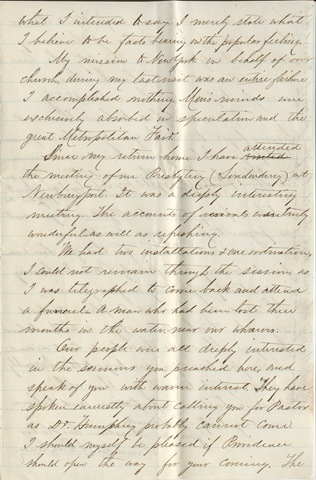
But I beg pardon for this digression from what I intended to say. I merely state what I believe to be facts bearing on the popular feeling.

[…]

Yours in Christian love & labor

Randolph A. DeLancey


Citation: Randolph A. DeLancey, autograph letter signed to John Riddle Warner. Boston, 2 May 1864. Moore VI:6:5

April 30, 1864: John Oley to P. G. T. Beauregard

Pierre Gustave Toutant Beauregard was a Louisiana-born general of the Confederate States Army. He had graduated second in his class from West Point in 1838 and was an admirer of Napoleon. He achieved fame early in the Civil War for commanding the Fort Sumter bombardment and as the victor of the first battle of Manassas. He later served in the Western Theater (including Shiloh and Corinth), Charleston, and the defense of Richmond, but his career was hampered by friction with Jefferson Davis and other generals.


This is one of approximately 1000 military telegrams to and from Beauregard in the Rosenbach collection.
 

AMs 1168-11 1864-04-30

Transcript:

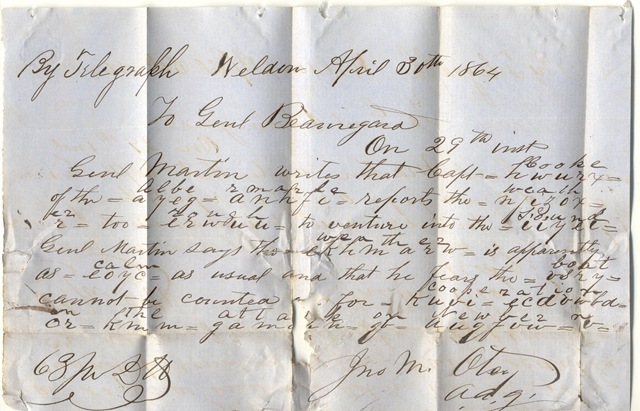
By Telegraph Weldon April 30th 1864

To Genl Beauregard

On 29th inst Genl Martin writes that Capt=hwury [Cooke]= of the=ayeg [Albe]=anhfi [rmarhe]=reports that the njezoxr [weather]=too=lrwuu [rough]=to venture into the=iiyll [sound]=Genl Martin says the =lkhmarw [weather]=is apparently as=loyc [calm]=as usual and that he fears tho=vsry [boat]=cannot be counted on for kuvi-ecdvwbd [cooperation]=or knm [the]=gam…n [attack]=gb [on] augfvw [Newbez]= v [n]=

Jno M. Oley

A.D.G.


Citation: John M. Oley, telegram to G. T> Beauregard. 30 April 1864. AMs 1168/11