May 25, 1864: J. T. Coldwell telegram to P. G. T. Beauregard

Pierre Gustave Toutant Beauregard was a Louisiana-born general of the Confederate States Army. He had graduated second in his class from West Point in 1838 and was an admirer of Napoleon. He achieved fame early in the Civil War for commanding the Fort Sumter bombardment and as the victor of the first battle of Manassas. He later served in the Western Theater (including Shiloh and Corinth), Charleston, and the defense of Richmond, but his career was hampered by friction with Jefferson Davis and other generals.
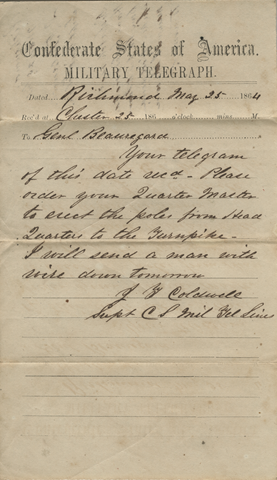
This is one of approximately 1000 military telegrams in P.G.T. Beauregard’s papers at the Rosenbach.

1168-11 1864-5-25

Transcript:

Dated Richmond May 25 1864

Rec’d at Chester 25

To Genl Beauregard

Your telegram of this date rec”d. Please order your Quarter Master to erect the poles from Head Quarters to the turnpike. I will send a man with wire down tomorrow.

J. T. Coldwell

Supt CS Mili Tel Lines


Citation: J. T. Coldwell, telegram to G. T. Beauregard. Richmond, 25 May 1864. AMs 1168/11

May 24, 2014: J. T. Coldwell telegram to P. G. T. Beauregard

Pierre Gustave Toutant Beauregard was a Louisiana-born general of the Confederate States Army. He had graduated second in his class from West Point in 1838 and was an admirer of Napoleon. He achieved fame early in the Civil War for commanding the Fort Sumter bombardment and as the victor of the first battle of Manassas. He later served in the Western Theater (including Shiloh and Corinth), Charleston, and the defense of Richmond, but his career was hampered by friction with Jefferson Davis and other generals.
This is one of approximately 1000 military telegrams in P.G.T. Beauregard’s papers at the Rosenbach.

1168-11 1864-5-24

Transcript:

Dated Richmond May 24 1864

Rec’d at Chester 1864

To Genl Beauregard

The operator at Goldsboro has charge of the office at that point and cannot be spared at this time but I will take great pleasure in sending you one to-day equally as good.

J. T. Coldwell

Supt. C S Mil Tel Lines


Citation: J. T. Coldwell, telegram to G. T. Beauregard. Richmond, 24 May 1864. AMs 1168/11

May 23, 1864: J. F. Milligan telegram to John M. Oley

Pierre Gustave Toutant Beauregard was a Louisiana-born general of the Confederate States Army. He had graduated second in his class from West Point in 1838 and was an admirer of Napoleon. He achieved fame early in the Civil War for commanding the Fort Sumter bombardment and as the victor of the first battle of Manassas. He later served in the Western Theater (including Shiloh and Corinth), Charleston, and the defense of Richmond, but his career was hampered by friction with Jefferson Davis and other generals.

This is one of approximately 1000 military telegrams in P.G.T. Beauregard’s papers at the Rosenbach.


1168-11 1864-5-23

Transcript:

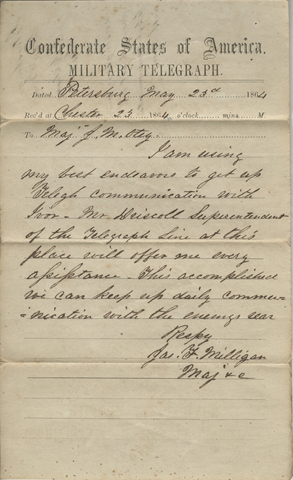
Petersburg May 23 1864

To Maj. J. M. Oley

I am using my best endeavors get up Telegh communication. Mr. Driscoll superintendent of the telegraph line at this place will offer me every assistance. This accomplished we can keep up daily communication with the enemy near.

Respy,

J. F. Milligan

Maj. &c


Citation:J. F. Milligan , telegram to John M. Oley. Petersburg, Va., 23 May 1864. AMs 1168/11

May 20, 1864: John A. Baker telegram to John M. Oley

Pierre Gustave Toutant Beauregard was a Louisiana-born general of the Confederate States Army. He had graduated second in his class from West Point in 1838 and was an admirer of Napoleon. He achieved fame early in the Civil War for commanding the Fort Sumter bombardment and as the victor of the first battle of Manassas. He later served in the Western Theater (including Shiloh and Corinth), Charleston, and the defense of Richmond, but his career was hampered by friction with Jefferson Davis and other generals.

This is one of approximately 1000 military telegrams in P.G.T. Beauregard’s papers at the Rosenbach.

1168-11 1864-5-20

Transcript:

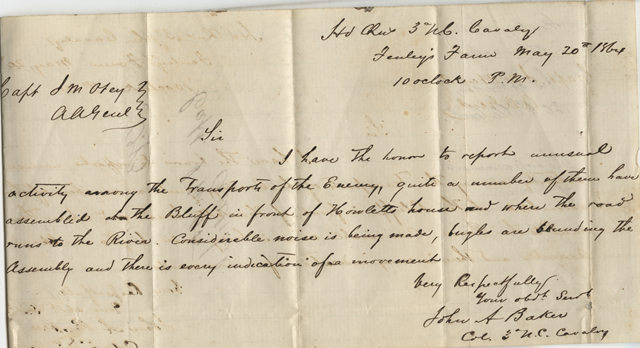
Hd Qrs 3d C. C. Cavalry

Fenley’s Farm May 20th 1864

10 oclock P.M.

Capt JM Oley

AA Genl

Sir

I have the honor to report unusual activity among the transports of the enemy. Quite a number of them have assembled at the Bluff in front of Howlett’s house and where the road runs to the river. Considerable noise is being made. Bugles are blowing the Assembly and there is every indication of a movement.

Very Respectfully,

Your obt servt

John A. Baker

Col. 3 N.C. Cavalry

Citation:John A Baker, telegram to John M. Oley. Fenley Farm, 20 May 1864. AMs 1168/11

May 18, 1864: Fundraising Letter for the Sanitary Fair

Rev. John Riddle Warner was a Presbyterian minister and the grandfather of the poet Marianne Moore. During the Civil War, he lived in Gettysburg, Pennsylvania. His letters are preserved as part of Marianne Moore’s family papers.

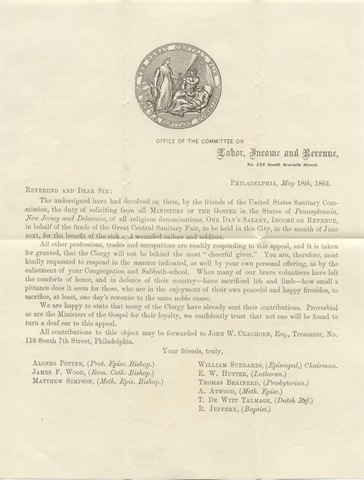
Moore VI-6-5 p1 letter from Labor, Income, Revenue 5-18-64 300 dpi

Citation: Office of the Committee on Labor, Income, an  revenue, typed form letter to “Reverend and Dear Sir.” Philadelphia, 18 May 1864. Moore VI:06:05

May 17 1864: James H. Mullyan Telegram About Enemy Troop Strength

Pierre Gustave Toutant Beauregard was a Louisiana-born general of the Confederate States Army. He had graduated second in his class from West Point in 1838 and was an admirer of Napoleon. He achieved fame early in the Civil War for commanding the Fort Sumter bombardment and as the victor of the first battle of Manassas. He later served in the Western Theater (including Shiloh and Corinth), Charleston, and the defense of Richmond, but his career was hampered by friction with Jefferson Davis and other generals.

This is one of approximately 1000 military telegrams in P.G.T. Beauregard’s papers at the Rosenbach.

AMs 1168-11 1864-05-17

Transcript:

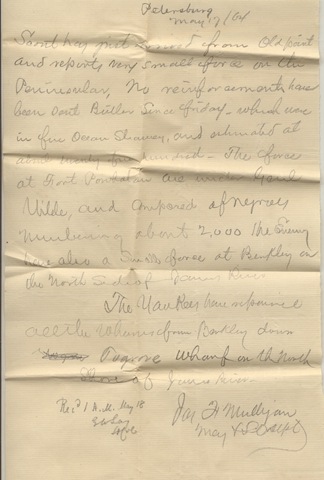
Petersburg

May 17/64

Scout has just arrived from Old Point and reports very small force on the Peninsula. No reinforcements have been sent Butler since Friday—which were in five Ocean Steamers and estimated at about twenty five hundred. The force at Fort Powhatan are under Genl [Wilde?] and composed of negroes numbering about 2,000. The Enemy have also a small force at Berkley on the North Side of James River.

The Yankees have repaired all the wharves from Berkley down To grove Wharf on the North Shore of James River.

Jas H. Mullyan

Citation:James H. Mullyan, telegram about enemy troop strength. Petersburg, 17 May 1864. AMs 1168/11

May 16, 1864: J. W. Hill to John Riddle Warner

Rev. John Riddle Warner was the grandfather of the poet Marianne Moore and during the Civil War, he lived in Gettysburg, Pennsylvania. These letters are preserved as part of Marianne Moore’s family papers.

 Moore VI-6-5 p1 letter to John from JW Hill 5-16-64 300 dpi

Moore VI-6-5 p2,3 letter to John from JW Hill 5-16-64 300 dpiMoore VI-6-5 p2,3 letter to John from JW Hill 5-16-64 300 dpi

Transcript [excerpt]:

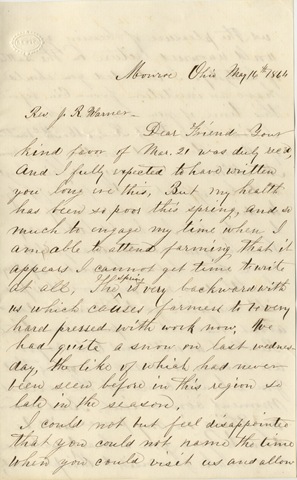
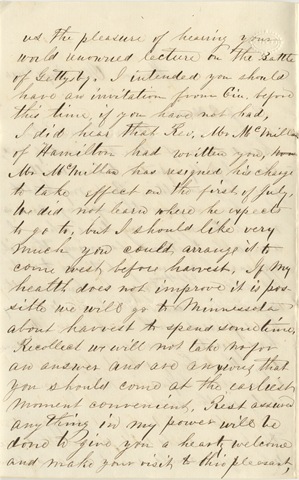
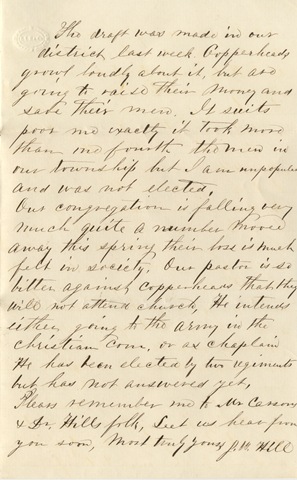
Rev J. R. Warner –

The draft was made in our district last week. Copperheads growl loudly about it, but are going to raise their money and save their men. It suits poor me exactly it took more than one fourth the men in our township but I am unpopular and was not elected.

Our congregation is falling very much quite a number moved away this spring, their loss is much felt in society. Our pastor is so bitter against copperheads that they will not attend church. He intends either going to the army in the Christian Comm., or as chaplain. He has been elected by two regiments but has not answered yet. […]

Most truly yours, J.W. Hill


Citation: J. W. Hill, autograph letter signed to John Riddle Warner. Monroe, Ohio, 16 May 1864. Moore VI:6:5

May 14, 1864: John Henry Brown’s Journal

John Henry Brown was a painter of portrait miniatures, living and working in Philadelphia. He had met Lincoln in August of 1860 when he was commissioned to paint Lincoln’s portrait for a supporter, but although Brown liked Lincoln personally, he did not agree with Republican policies.

1864-05-14


Transcript:

Commenced Lillie Newbolds picture. Terrible fighting in Va. this week.


Citation: John Henry Brown, autograph journal/account book. Philadelphia, 1844-1890. AMs 573/14.1

May 14, 1864: P. G. T. Beauregard telegram to Braxton Bragg

Pierre Gustave Toutant Beauregard was a Louisiana-born general of the Confederate States Army. He had graduated second in his class from West Point in 1838 and was an admirer of Napoleon. He achieved fame early in the Civil War for commanding the Fort Sumter bombardment and as the victor of the first battle of Manassas. He later served in the Western Theater (including Shiloh and Corinth), Charleston, and the defense of Richmond, but his career was hampered by friction with Jefferson Davis and other generals.

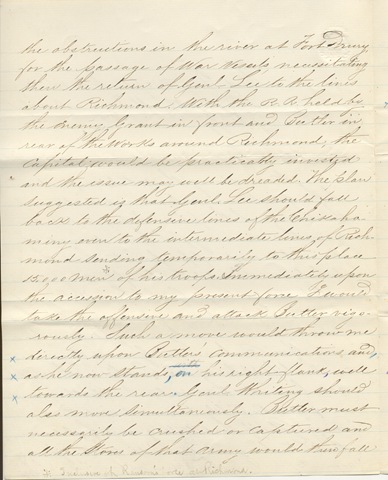
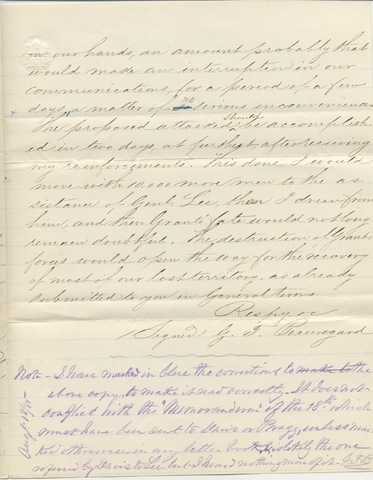
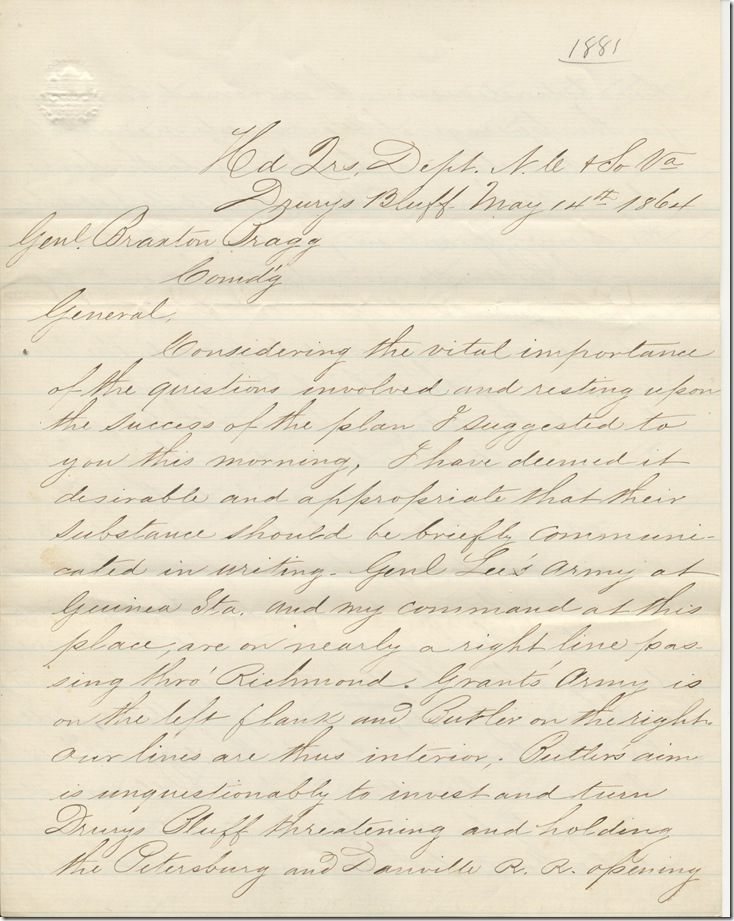
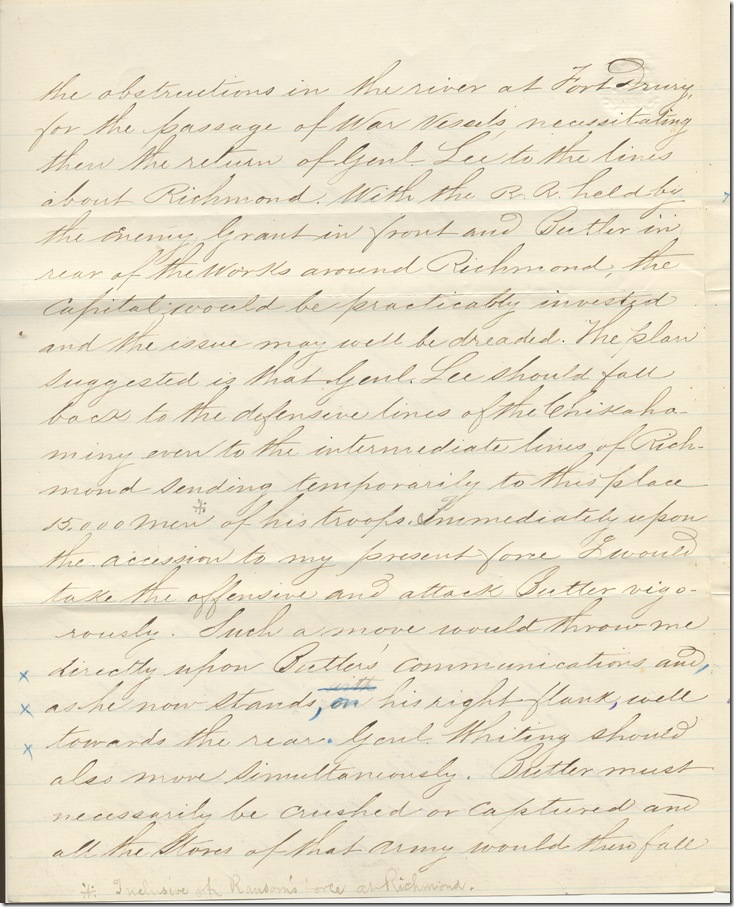
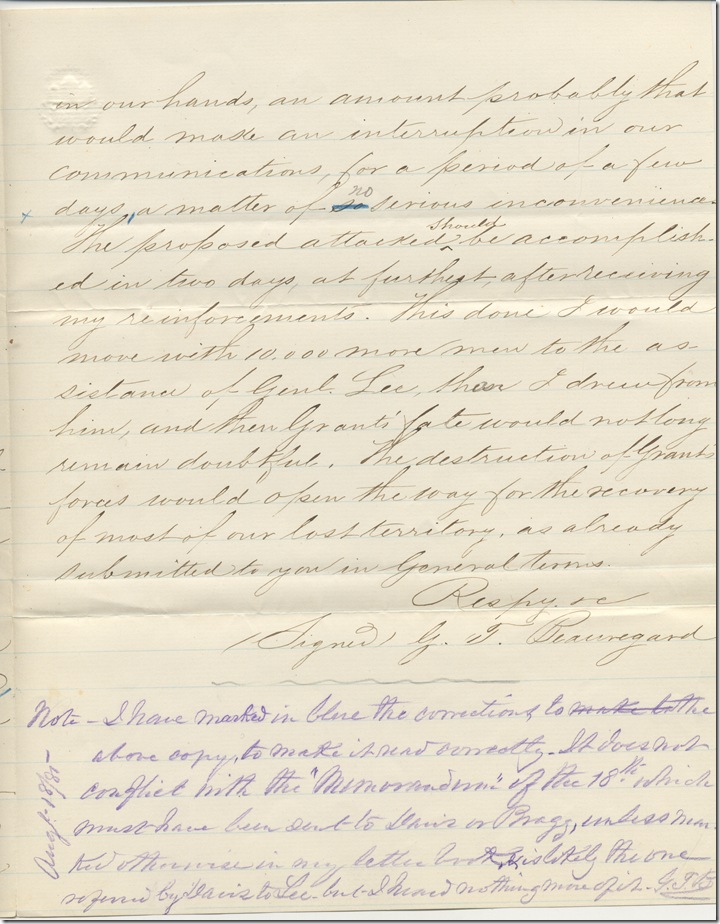
AMs 358-26 p1 Beauregard G. T. to Braxton Brigg AMs 358-26 p2 Beauregard G. T. to Braxton Brigg AMs 358-26 p3 Beauregard G. T. to Braxton Brigg

Transcript:

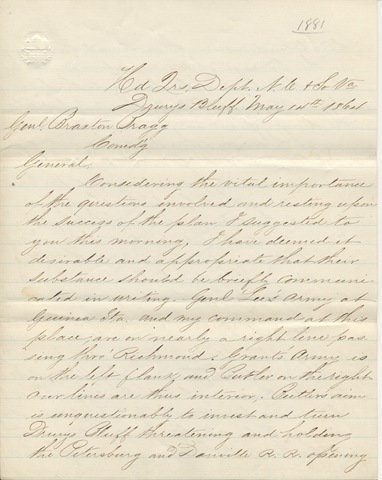
Hd. Qrs. Dept N.C. & So Va.

Drurys Bluff. May 14th 1864

Genl. Braxton Bragg

Comd’g

General,

Considering the vital importance of the questions involved and resting upon the success of the plan I suggested to you this morning, I have deemed it desirable and appropriate that their substance should be briefly communicated in writing. Genl. Lee’s Army at Guinea Sta. and my command at this place are on nearly a right line passing thro’ Richmond. Grant’s Army is on the left flank and Butler on the right. Our lines are thus interior; Butler’s aim in unquestionably to invest and turn Drury’s Bluff threatening and holding the Petersburg and Danville R.R. opening the obstructions in the river at Fort Drury, for the passage of War Vessels, necessitating then the return of Genl. Lee to the lines about Richmond. With the R.R. held by the enemy Grant in front and Butler in rear of the works around Richmond, the Capitol would be practically invested and the issue may well be dreaded. The plan suggested is that Genl. Lee should fall back to the defensive lines of the Chikahominy even to the intermediate lines of Richmond sending temporarily to this place 15,000 men of his troops. Immediately upon the accession to my present force I would take the offensive and attack Butler vigorously. Such a move would throw me directly upon Butler’s communications and as he now stands, on his right flank, well towards the rear. Genl. Whiting should also move simultaneously. Butler must necessarily be crushed or captured and all the stores of that Army would then fall in our hands, an amount probably that would make an interruption in our communications, for a period of a few days, a matter of no serious inconvenience. The proposed attacks should be accomplished in two days at furthest, after receiving my reinforcements. This done I would move with 10,000 more men to the assistance of Genl. Lee, that I drew from him, and then Grant’s fate would not long remain doubtful. The destruction of Grant’s forces would open the way for the recovery of most of our lost territory, as already submitted to you in General terms.

Respy. &c

Signed G. T. Beauregard

Citation: G. T. Beauregard (1818-1893), telegram to Braxton Bragg. Drewry’s Bluff, Va.; 14 May 1864. AMs 358/26
May 13, 1864: E. Willis to John M. Oley

Pierre Gustave Toutant Beauregard was a Louisiana-born general of the Confederate States Army. He had graduated second in his class from West Point in 1838 and was an admirer of Napoleon. He achieved fame early in the Civil War for commanding the Fort Sumter bombardment and as the victor of the first battle of Manassas. He later served in the Western Theater (including Shiloh and Corinth), Charleston, and the defense of Richmond, but his career was hampered by friction with Jefferson Davis and other generals.

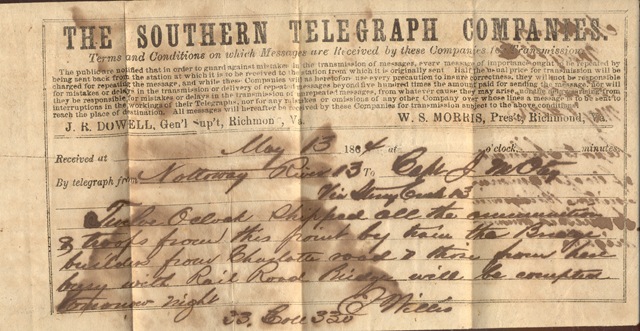
This is one of approximately 1000 military telegrams in the Rosenbach’s collection of papers from P.G.T. Beauregard.

AMs 1168-11 1864-05-13

Transcript:

Received at May 13 1864

By telegraph from Nottoway River to Capt. J M Oley

Twelve O clock shipped all the ammunition & troops from this point by train[. T]he Bridge builders from Charlotte road & those from here busy with Rail Road Bridge will be [illeg.] tomorrow night.

E. Willis

Citation: E. Willis, telegram to John M. Oley. 13 May 1864. AMs 1168/11