March 13, 1862: Simon Cameron Explains His Resignation

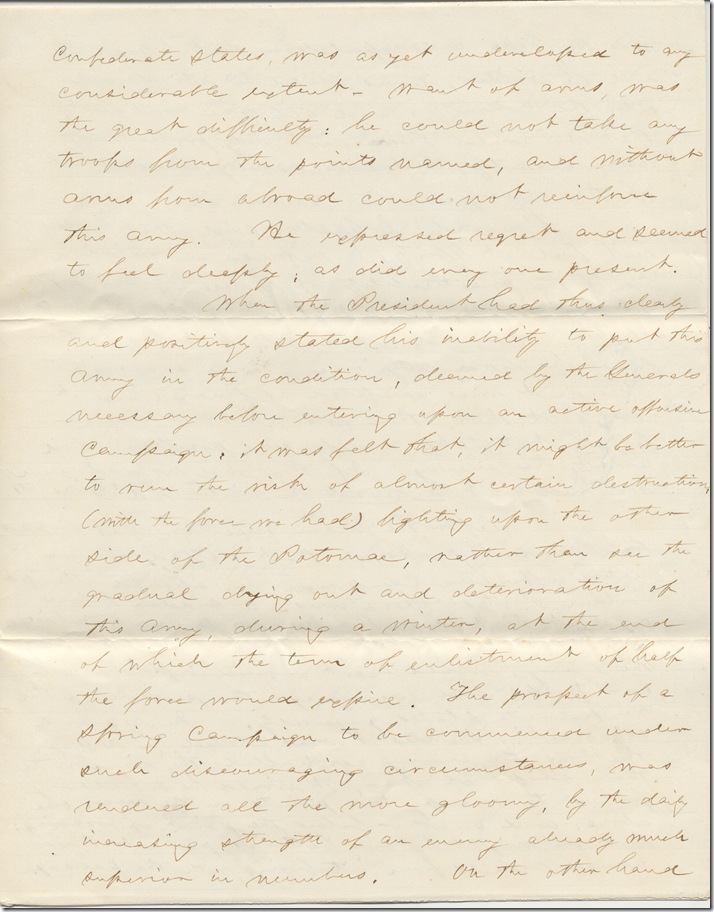
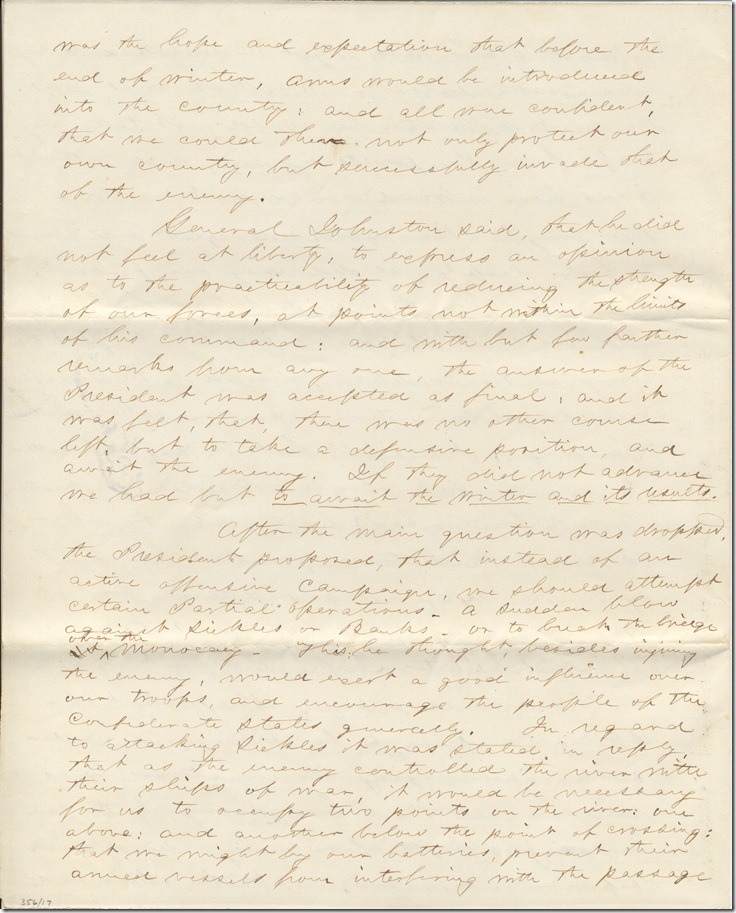
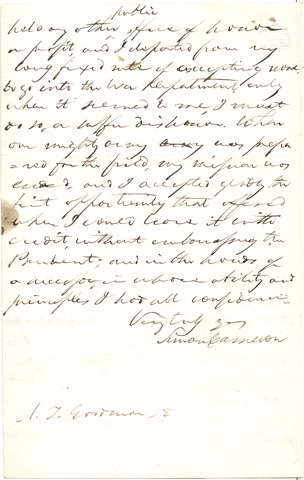
 AMs 527-8-1 p1 Simon Cameron to AT Goodman AMs 527-8-1 p2 Simon Cameron to AT Goodman

Transcript:

Lockiel

13 March 1862

Dear Sir

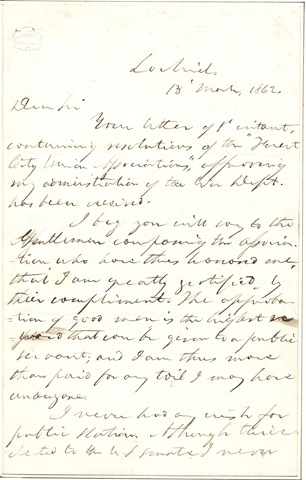
Your letter of 8th inst. containing mentions of the “First City Union Associations” approving my administration of the War Dept has been received.

I beg you will say to the Gentlemen composing the Association, who have thus honored me, that I am greatly gratified by their compliment. The approbation of good men is the highest reward that can be given to a public servant; and I am thus more than paid for any toil I may have undergone.

I never had any wish for public Nation. Although I was elected to the U.S. Senate, I never held any other public office of honor or profit and I departed from my long fixed way of accepting none to go into the War Department, only when it seemed to me I must do so, or suffer dishonor. When our mighty army was prepared for the field, my mission was ended and I accepted gladly the first opportunity offered when I could leave it with credit, without embarrassing the President, and in the hands of a successor in whose ability and principles I hold confidence.

Very truly yours

Simon Cameron


Citation: Simon Cameron (1799-1889) autograph letter signed to A.T. Goodman. Lockiel, 13 March 1862. AMs 527/8.1

March 5, 1862: John Adams telegram to Thomas Jordan

Pierre Gustave Toutant Beauregard was a Louisiana-born general of the Confederate States Army. He had graduated second in his class from West Point in 1838 and was an admirer of Napoleon. He achieved fame early in the Civil War for commanding the Fort Sumter bombardment and as the victor of the first battle of Manassas. He later served in the Western Theater (including Shiloh and Corinth), Charleston, and the defense of Richmond, but his career was hampered by friction with Jefferson Davis and other generals.

This is one of approximately 1000 military telegrams in P.G.T. Beauregard’s papers at the Rosenbach.

AMs 1168-11 1862-03-05


Transcript:

By telegraph from Memphis 5 1861

To Col T. Jordan A.A.G.

A Cavalry Company aggregate ninety armed with shot guns distance thirty seven miles on RR. Shall I muster it in for twelve months.

Jno Adams


March 5, 62

Muster in the Compy.

By order of Genl B

Thomas Jordan


Citation: John Adams, telegram to Thomas Jordan. Memphis, 5 March 1862. AMs 1168/11

February 16, 1862: Telegram to Leonidas Polk

Pierre Gustave Toutant Beauregard was a Louisiana-born general of the Confederate States Army. He had graduated second in his class from West Point in 1838 and was an admirer of Napoleon. He achieved fame early in the Civil War for commanding the Fort Sumter bombardment and as the victor of the first battle of Manassas. He later served in the Western Theater (including Shiloh and Corinth), Charleston, and the defense of Richmond, but his career was hampered by friction with Jefferson Davis and other generals.

This is one of approximately 1000 military telegrams in P.G.T. Beauregard’s papers at the Rosenbach.

AMs 1168-11 1862-02-16


Transcript:

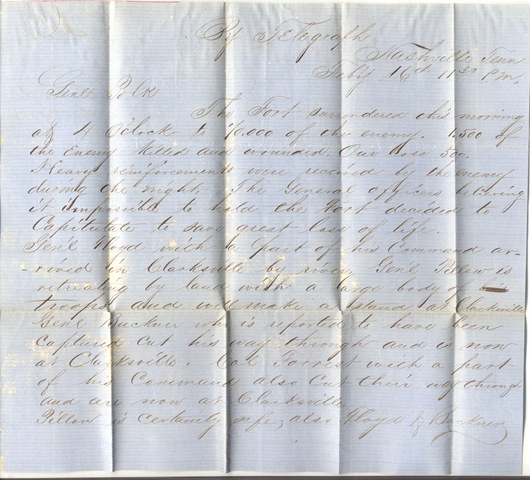
By Telegraph

Nashville Tenn

Feby 16th 11:30 PM

Genl Polk

The Fort surrendered this morning at 4 O’clock to 70,000 of the enemy. 1,500 of the Enemy killed and wounded. Our loss 500. Heavy reinforcement were received by the enemy during the night. The General officers believing it impossible to hold the Fort decided to Capitulate to save great loss of life.

Genl’ Floyd with a part of his Command arrived in Clarksville by river. Gen’l Pillow is retreating by land with a large body of troops and will make a stand at Clarksville. Genl Buckner who is reported to have been captured cut his way through and is now at Clarksville. Col. Forrest with a part of his Command also cut their way through and are now at Clarksville. Pillow is certainly safe, also Floyd & Buckner


Citation: Unknown author, telegram to Leonidas Polk. Nashville,16 February 1862. AMs 1168/11

January 30, 1862: Report of the Home Guard of the City of Philadelphia

A 862r 001

This pamphlet was published in 1862, but the exact date is uncertain.

Excerpt:

The assault upon Fort Sumpter and its subsequent capture in April last, awakened the loyal people of the North from their political lethargy, and disclosed to them the fact that rebellion was a reality, and not a menace.

The President of the United States issued his proclamation on the 15th of April, calling into activity 75,000 volunteers; and thereupon the Gov. of Pennsylvania ordered into service, among others, Major Gen. Patterson and the volunteer regiments of the First Division of Pennsylvania Militia. This requisition stripped Philadelphia of its organized military force; and the sense of insecurity which the departure of the troops of the First Division aroused, prompted the municipal authorities to encourage and direct the immediate organization of a special military force that would be adequate to the protection of the City, and that should not be liable to be withdrawn from it, except for its own defence upon any of the approaches thereto.

Citation: Report of Brigadier Gen’l A. J. Pleasonton, commanding the Home guard of the city of Philadelphia, to the Hon. Alexander Henry, mayor … for the year 1861. Philadelphia: Ringwalt & Brown, 1862. A 862r

January 24, 1862: Edwin Stanton to Charles Dana

AMs 780-11 p1 Edwin M Stanton to Charles A Dana AMs 780-11 p2 Edwin M Stanton to Charles A Dana

Transcript:

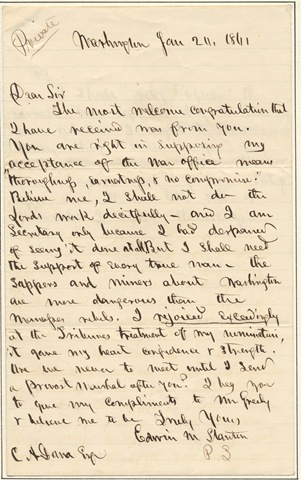
Washington Jan 24, 1861 [i.e. 1862]

Dear Sir

The most welcome congratulations that I have received were from you. You are right in supposing my acceptance of the War office means “thoroughness, earnestness, & no compromise.” Believe me, I shall not do the Lords work deceitfully—and I am Secretary only because I had despaired of seeing it done at all. But I shall need the support of every true man—the sappers and miners about Washington are more dangerous than the Manassas rebels. I rejoiced exceedingly at the Tribunes treatment of my nomination, it gave my heart confidence & strength. Are we never to meet until I send a Provost Marshal after you? I beg you to give my compliments to Mr Greely & believe me to be Truly Yours

Edwin M Stanton

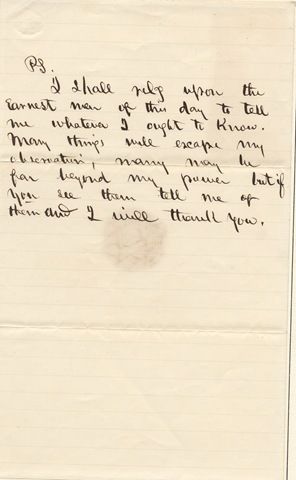
PS

I shall rely upon the earnest men of the day to tell me whatever I ought to know. Many things will escape my observation, many may be far beyond my power but if you see them tell me of them and I will thank you.

Citation: Edwin McMasters Stanton (1814-1869), autograph letter signed to Charles A. Dana. Washington, D.C., 24 Jan. 1861 [i.e., 1862]. AMs 780/11

January 14, 1862: Florida Constitution

A f. 862c 001

Excerpt:


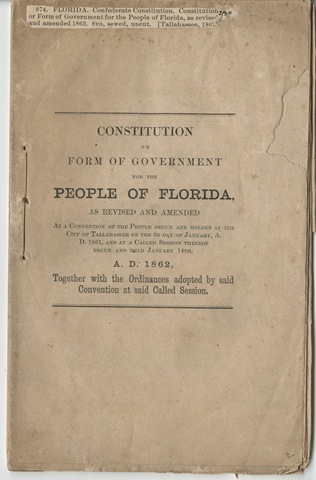
Constitution, Article VI Sec. 19:

No citizen of any of the states or territories of the United States, which are now at war with the Confederate States, shall ever be admitted to the rights of citizenship in this state…


Resolution No. 44 (adopted 1/22/1863)

Whereas his Excellency the Governor has laid before this convention a communication from the General Assembly of the State of Georgia, expressive of the sentiments of the people in that State in reference to the principle for which we are contending, and the struggle in which we are engaged:

Be it therefore resolved by the people of the state of Florida in convention assembled, that Florida heartily responds to every sentiment and feeling of Georgia in this struggle for our rights, and is deliberately prepared to adopt as her motto, “Annihilation if it must be, Reconstruction never.”

Resolved, that in prosecuting our common defense against this unrighteous and Vandal war of the Federal States, Florida pledges to her sister states of the Confederacy her last dime and her last man.”


Citation: Constitution or form of government of the people of Florida…  [Tallahassee,1862]. A f.862c

October 19, 1861: Home Importation for the Troops vs. Imports

AMs 356-1 p1 John Andrew to unknown 300 dpi AMs 356-1 p2 John Andrew to unknown 300 dpi AMs 356-1 p3 John Andrew to unknown 300 dpi

Transcript:

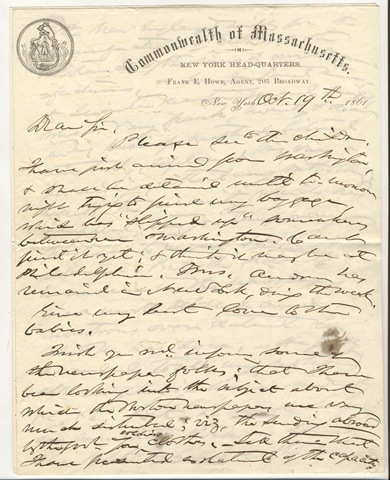
New York Oct. 19th 1861

Dear Sir

Please see to the children. I have just arrived from Washington, & shall be detained until to-morrow night trying to  to find my baggage, which has “slipped up” somewhere between here & Washington. Cant find it yet; & think it may be at Philadelphia. Mrs. Andrew has remained in New York, during the week. Give my best love to the babies.

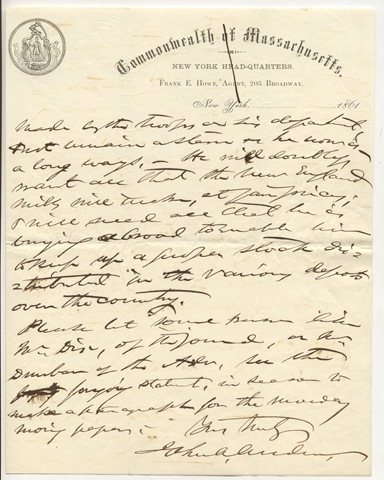
I wish you would inform some of the newspaper folks; that I have been looking into the subject about which the Northern newspapers are very much disturbed; viz. the sending abroad by the gov’t for soldiers clothes. Tell them that I have presented a statement of the capacity of the New England mills for the manufacture of these clothes, & the insistence of the views of our manufacturers of clothes and the substance of the views of our manufacturer or [illeg.] men to Quartermaster General Meigs, who is very frank, manly & clear in his business methods, listened attentively, explained his views & proceedings, without any withholding: regrets the necessity which has compelled him for temporary purposes to invest some money abroad. But the statements I have seen in the newspapers are a most absurd and monstrous over statement of what he has done. He fully acceded to all my notions of employing home manufacturing &c &c. But he must have an immediate stock on hand, & be kept ahead of the demands made by the troops on his department [& not] remain [astern?] [or he would] a long ways. He will doubtless want all that the New England mills will make, at fair prices; & will need all that he is buying abroad to enable him to keep up a proper stock distributed in the various depots over the country.

Please let some person like Wm Din of the Journal, or Mr. Dunbar of the Adv, see the foregoing statement, in order to make a letter agreeable for the Monday morn’g papers.

Yours Truly,

John A. Andrew

October 4, 1861: James Garfield to J. H. Jones

Future U.S. President Garfield was lieutenant-colonel and then colonel of the 42nd Ohio Volunteers; he would become a brigadier general in 1862 before resigning to serve as a Congressman in 1863.

AMs 774-4 James A Garfield to JH Jones

Transcript:

Camp Chase, Oct. 4, 1861

Dear Rev. Jones,

Jefferson is here—has been mustered into the Hiram company & is well—I expect a large deputation of friends & brethren here—from Hiram—to visit us next Saturday week—and to spend Lord’s Day—how I want you to come with them—and preach to our boys on Sunday—I will pay your Expenses at least—

The friends will leave on the first train from Cleveland Saturday morning—and you must come down with them—I presume they will buy some thing in the Eating way– & want you all to have a touch of camp life—May be you will conclude to stay—

Cant the Dr come down also & bring some others with him?

Truly Your Brother

J. A. Garfield

P.S. Answer me soon—J.A.G.

Citation: James A. Garfield (1831-1881), autograph letter signed to J. H. Jones. Camp Chase, Ohio; 4 October 1861. AMs 774/4

September 26, 1861: Statement of a Conference at Fairfax Court House

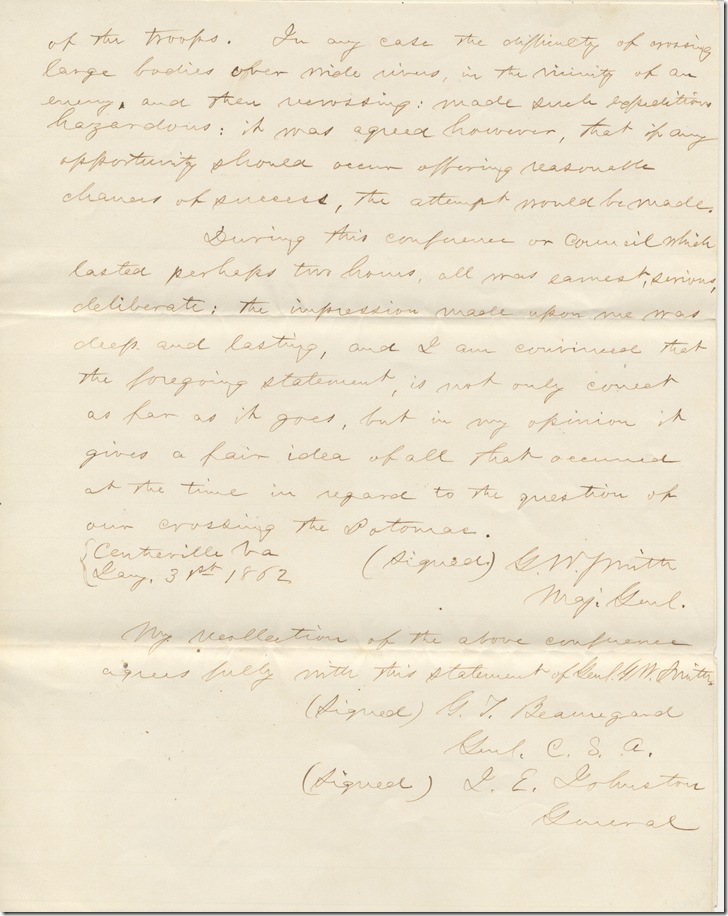
 AMs 356-17 p1  Gustavus Smith 300 dpi AMs 356-17 p2  Gustavus Smith 300 dpi AMs 356-17 p3  Gustavus Smith 300 dpi AMs 356-17 p4  Gustavus Smith 300 dpi AMs 356-17 p5  Gustavus Smith 300 dpi AMs 356-17 p6  Gustavus Smith 300 dpi AMs 356-17 p7 Gustavus Smith 300 dpi AMs 356-17 p8  Gustavus Smith 300 dpi AMs 356-17 p9  Gustavus Smith 300 dpi

Transcript:

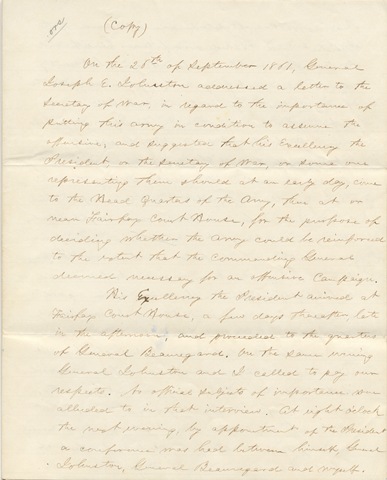
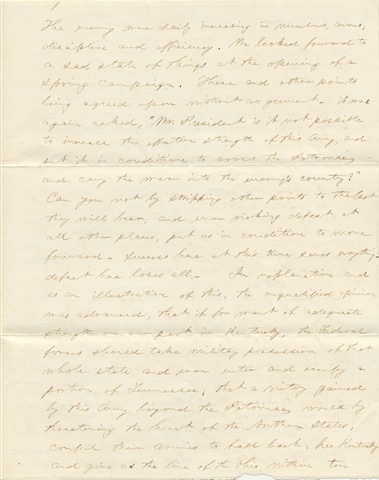
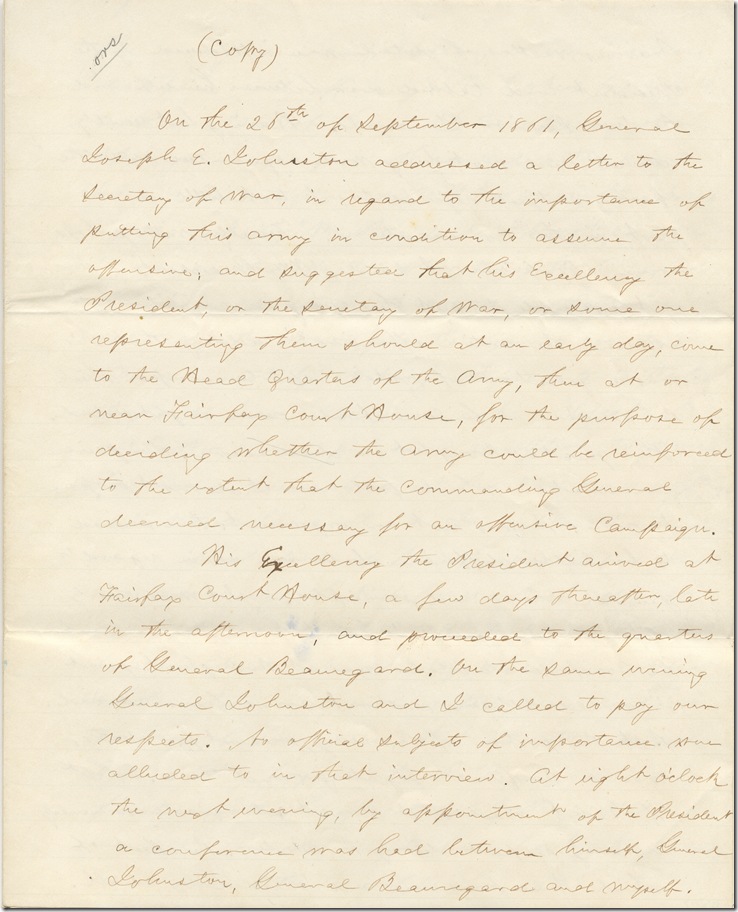
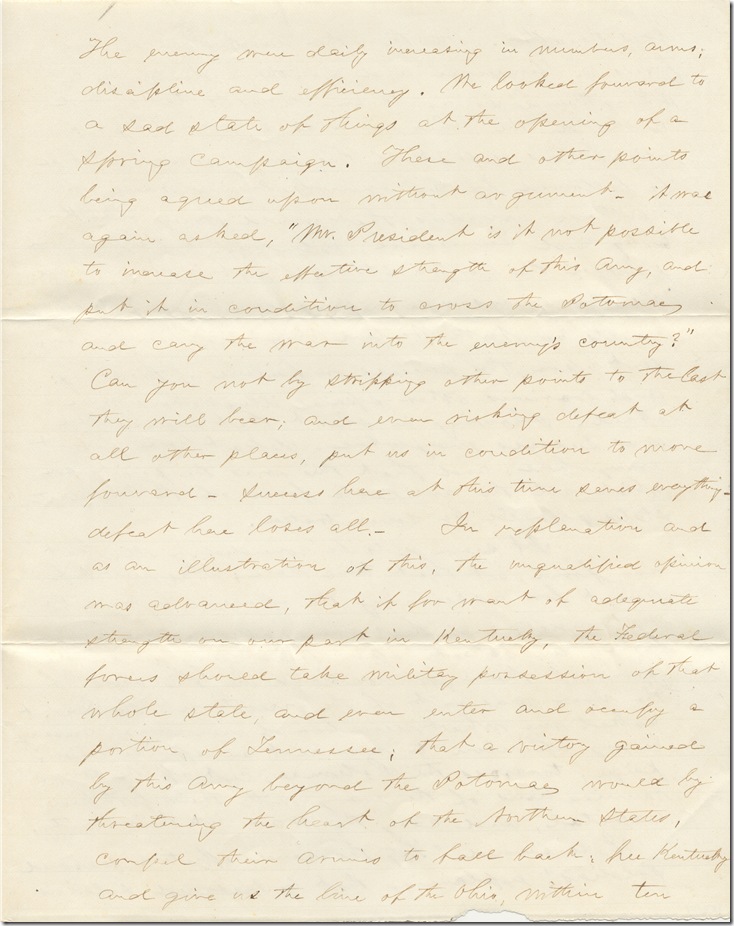
On the 26th of September 1861, General Joseph E. Johnston addressed a letter to the Secretary of War, in regard to the importance of putting this army in condition to assume the offensive; and suggested that his Excellency the President, or the Secretary of War, or some one representing them should at an early day, come to the Head Quarters of the Army, then at or near Fairfax Court House, for the purpose of deciding whether the Army could be reinforced to the extent that the Commanding General deemed necessary for an offensive Campaign.

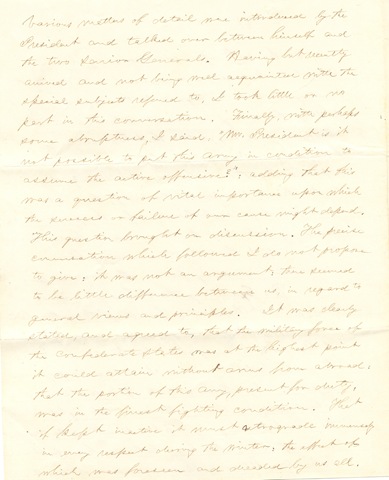
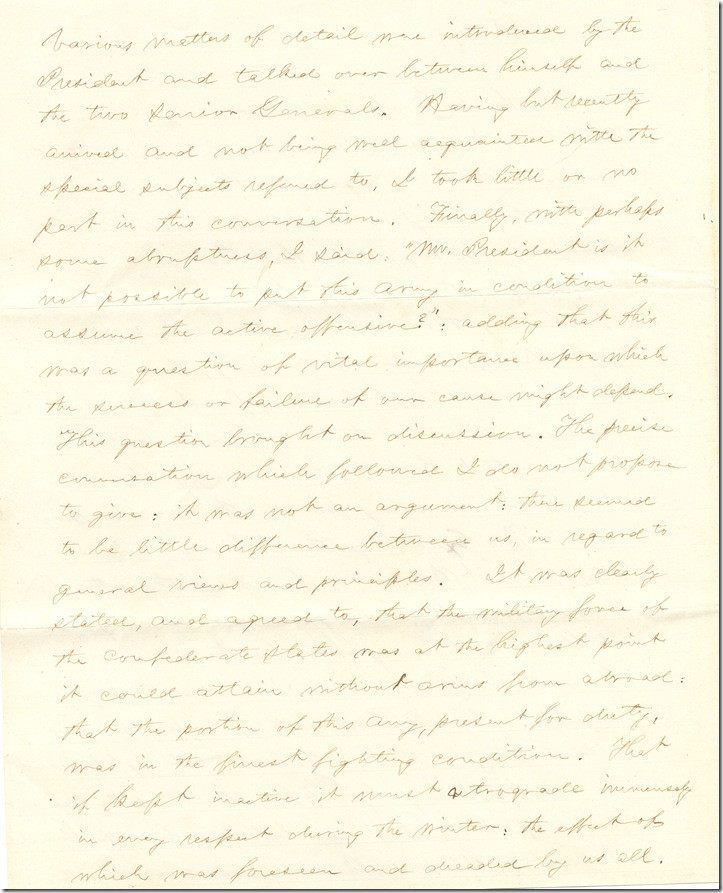
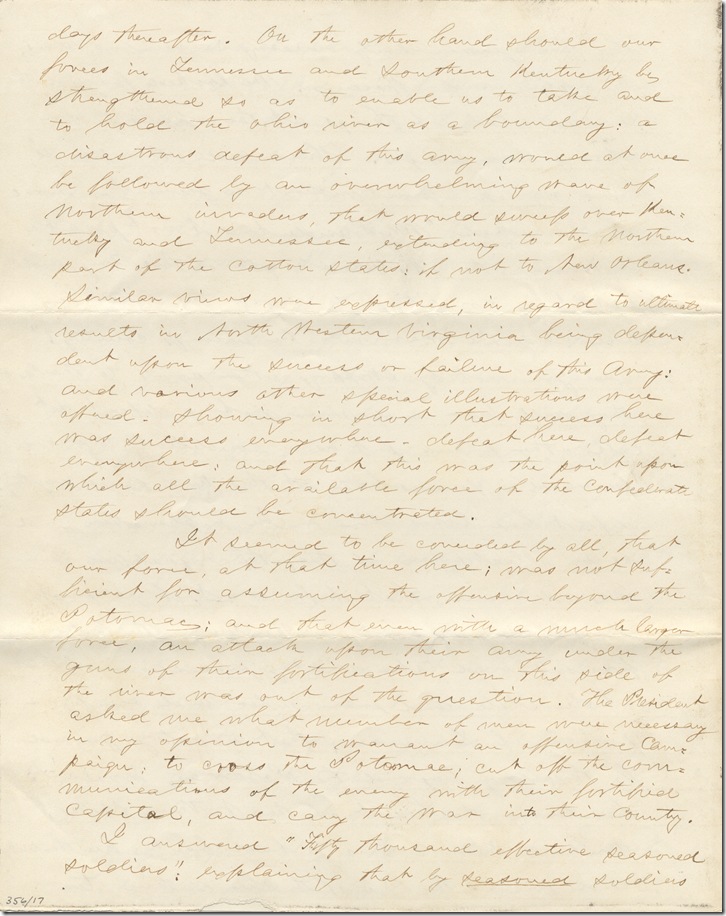
His Excellency the President arrived at Fairfax Court House, a few days thereafter, late in the afternoon, and proceeded to the quarters of General Beauregard. On the same evening General Johnston and I called to pay our respects. No official subjects of importance were alluded to in that interview. At eight o’clock the next evening, by appointment of the President a conference was had between himself, General Johnston, General Beauregard, and myself. Various matters of detail were introduced by the President and talked over between himself and the two senior Generals. Having but recently arrived and not being well acquainted with the special subjects referred to, I took little or no part in this conversation. Finally, with perhaps some abruptness, I said: “Mr. President is it not possible to put this Army in condition to assume the active offensive?”: adding that this was a question of vital importance upon which the success or failure of our cause might depend. This question brought on discussion. The precise conversation which followed I do not propose to give: it was not an argument: there seemed to be little difference between us, in regard to general views and principles. It was clearly stated, and agreed to, that the military force of the Confederate States was at the highest point it could attain without arms from abroad: that the portion of this Army, present for duty, was in the finest fighting condition. That it kept inactive it must retrograde immensely in every respect during the winter: the effect of which was foreseen and dreaded by us all. The enemy were daily increasing in numbers, arms, discipline and efficiency. We looked forward to a sad state of things at the opening of a spring campaign. These and other points being agreed upon without argument- it was again asked, “Mr. President is it not possible to increase the effective strength of this Army, and put it in condition to cross the Potomac and carry the men into the enemy’s country?” Can you not by stripping other points to the least they will bear; and even risking defeat at all other places, put us in condition to move forward- success here at this time saves everything- defeat here loses all.- In explanation and as an illustration of this, the unqualified opinion was addressed, that if for want of adequate strength on our part in Kentucky, the Federal forces should take military possession of that whole state, and even enter and occupy a portion of Tennessee; that a victory gained by this Army beyond the Potomac would by threatening the heart of the Northern States, compel their Armies to fall back: free Kentucky, and give us the line of the Ohio, within ten days thereafter. On the other hand should our forces in Tennessee and Southern Kentucky be strengthened so as to enable us to take and to hold the Ohio river as a boundary: a disastrous defeat of this Army, would at once be followed by an overwhelming share of Northern invaders, that would sweep over Kentucky and Tennessee, extending to the Northern part of the cotton states: if not to New Orleans. Similar views were expressed, in regard to ultimate results in North Western Virginia being dependent upon the success or failure of this Army: and various other special illustrations were offered. Showing in short that success here was success everywhere- defeat here, defeat everywhere: and that this was the point upon which all the available force of the Confederate States should be concentrated.

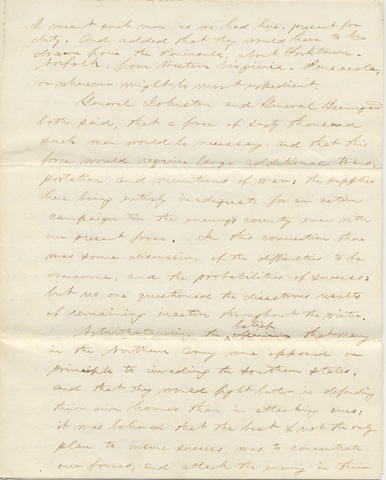
It seemed to be considered by all, that our force, at that time here; was not sufficient for assuming the offensive beyond the Potomac; and that even with a much larger force, an attack upon their Army under the guard of their fortifications on this side of the river was out of the question. The President asked me what number of men were necessary in my opinion to mount an offensive campaign: to cross the Potomac; cut off the communications of the enemy with their fortified capitol; and carry the men into their country.

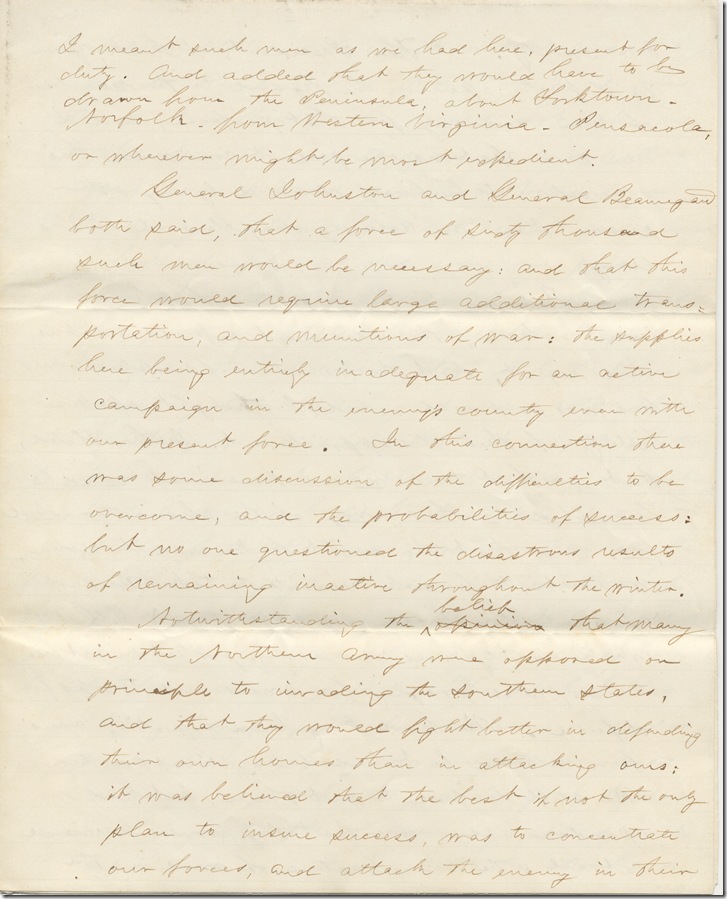
I answered “Fifty thousand effective seasoned soldiers”: explaining that by seasoned soldiers I meant such men as we had here, present for duty. And added that they would have to be drawn from the Peninsula, about Yorktown- Norfolk- from Western Virginia- Pensacola, or wherever might be most expedient.

General Johnston and General Beauregard both said, that a force of sixty thousand such men would be necessary: and that this force would require large additional transportation, and munitions of war: the supplies here being entirely inadequate for an active campaign in the enemy’s country even with our present force. In this connection there was some discussion of the difficulties to be overcome, and the probabilities of success: but no one questioned the disastrous results of remaining inactive throughout the winter.

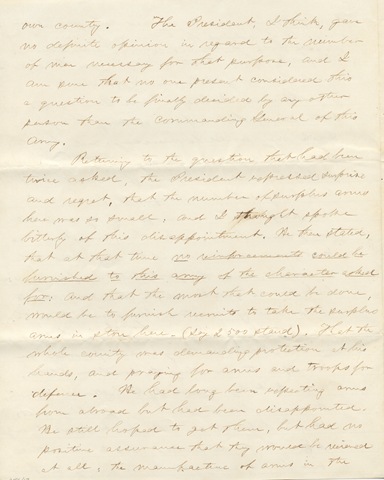
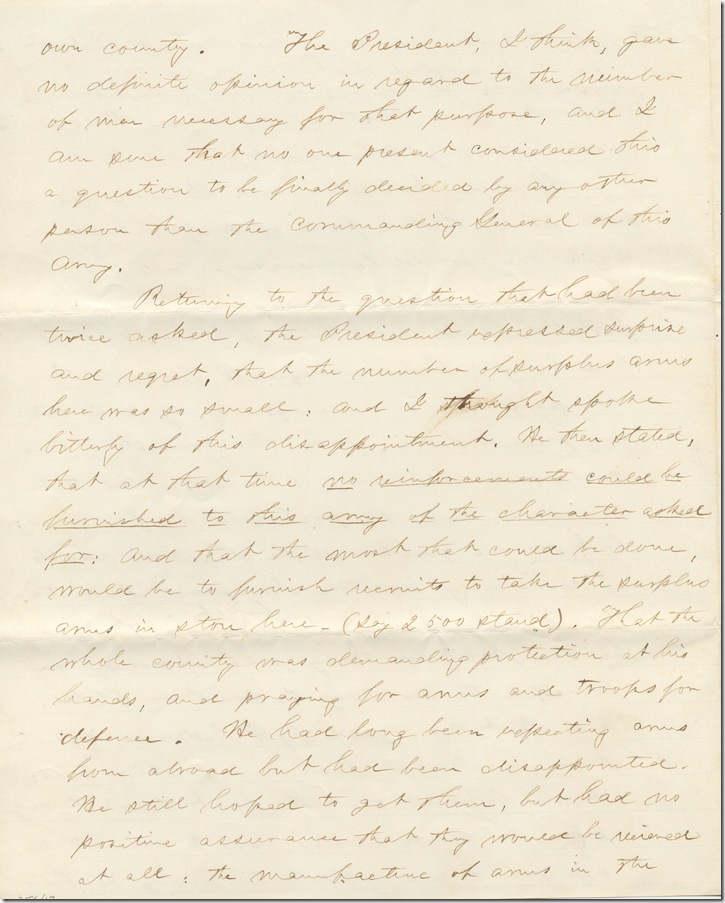
Notwithstanding the belief that many in the Northern Army were opposed on principle to invading the Southern States, and that they would fight better in defending their own homes than in attacking arms: it was believed that the best is not the only plan to insure success, was to concentrate our forces, and attack the enemy in their own country. The President, I think, gave no definite opinion in regard to the number of men necessary for that purpose, and I am sure that no one present considered this a question to be finally decided by any other person than the commanding General of this Army.

Returning to the question that had been twice asked, the President expressed surprise and regret, that the number of surplus arms here was so small: and I thought spoke bitterly of this disappointment. He then stated, that at that time no reinforcements could be furnished to this army of the character asked for: And that the most that could be done, would be to furnish recruits to take the surplus arms in store here (say 2500 stand). That the whole country was demanding protection at his hands, and praying for arms and troops for defence. He had long been expecting arms from abroad but had been disappointed. He still hoped to get them, but had no positive assurances that they would be received at all: the manufacture of arms in the Confederate States, was as yet undeveloped to any considerable extent- want of arms, was the great difficulty: he could not take any troops from the points named, and without arms from abroad could not reinforce this Army. He expressed regret and seemed to feel deeply: as did every one present.

When the President had thus clearly and positively stated his inability to put the Army in the condition, deemed by the Generals necessary before entering upon an active offensive campaign: it was felt that, it might be better to run the risk of almost certain destruction, (with the force we had) fighting upon the other side of the Potomac, rather than see the gradual dying out and deterioration of this Army, during a winter, at the end of which the term of enlistment of half the force would expire. The prospect of a spring campaign to be commenced under such discouraging circumstances, was rendered all the more gloomy, by the daily increasing strength of an enemy already much superior in numbers. On the other hand was the hope and expectation that before the end of winter, arms would be introduced into the country: and all were confident, that we could then not only protect our own country, but successfully invade that of the enemy.

General Johnston said, that he did not feel at liberty, to express an opinion as to the practicality of reducing the strength of our forces, at points not within the limits of his command: and with but few further remarks from any one, the answer of the President was accepted as final, and it was fact, that, there was no other course left, but to take a defensive position, and await the enemy. If they did not advance we had but to await the winter and its results.

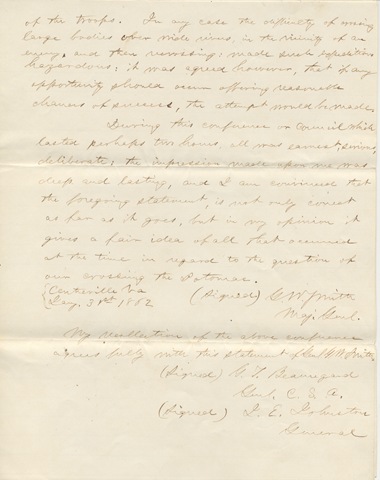
After the main question was dropped, the President proposed, that instead of an active offensive campaign, we should attempt certain Partial operations- a sudden blow against Sickles or Banks- or to break the siege over the Monocacy- This he thought, besides injuring the enemy, would exert a good influence over our troops, and encourage the people of the Confederate States generally. In regard to attacking Sickles it was stated in reply, that as the enemy controlled the river with their ships of war, it would be necessary for us to occupy two points on the river: one above: and another below the point of crossing: that we might by our batteries, prevent their unused vessels from interfering with the passage of the troops. In any case the difficulty of crossing large bodies over wide rivers, in the vicinity of an enemy and then recrossing: made such expedition hazardous: it was agreed however, that if any opportunity should occur offering reasonable chances of success, the attempt would be made.

During this conference or council which lasted perhaps two hours, all was earnest, serious, deliberate; the impression made upon me was deep and lasting, and I am convinced that the foregoing statement, is not only correct as far as it goes, but in my opinion it gives a fair idea of all that occurred at the time in regard to the question of our crossing the Potomac.

Centreville Va

May 31st 1862

Signed G. W. Smith

Maj. Genl.

My recollection of the above conference agrees fully with the statement of Genl. G. W. Smith

Signed G. T. Beauregard

Genl. C. S. A.

Signed J. E. Johnston

General


Citation:  Gustavus Woodson Smith (1822-1896), Statement of a conference at Fairfax C.H. Sept. 26th 1861. Centreville, Va, 31 May 1862. AMs 356/17
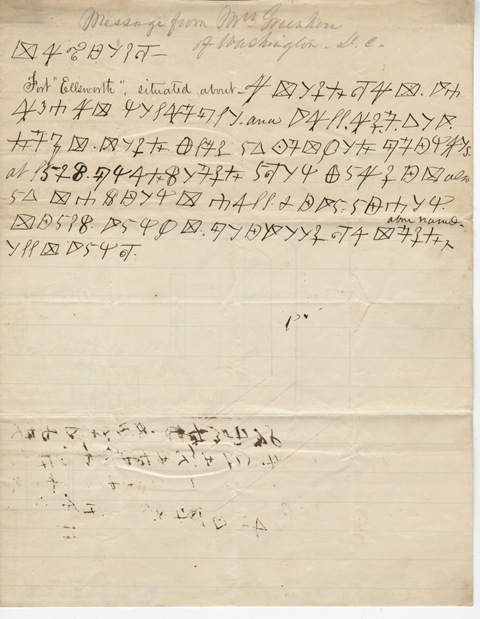
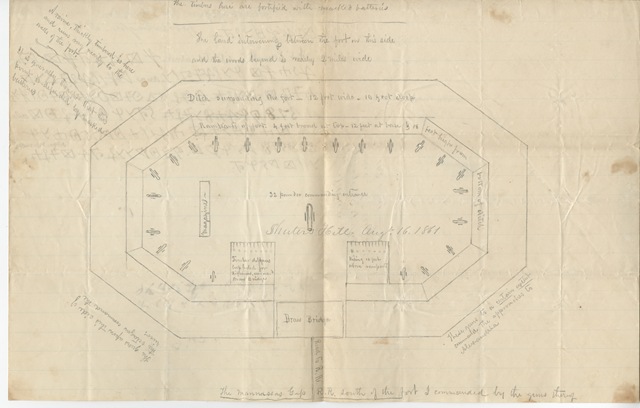
August 16, 1861: Sketch of the Defenses of Shuter’s Hill, with Coded Message from Rose Greenhow

Confederate spy Rose O’Neal Greenhow was a well-connected Washington society woman who used those connections to obtain intelligence information at the beginning of the war. She was placed under house arrest on August 23, 1861 and served time in Old Capitol Prison in 1862, after which she was deported to Richmond.


AMS 1168-11 Note from Rose Greenhow

1168-11 defense of shuters mill 8-16-1861


This sketch of defenses of Shuter’s Hill Va, which bears the coded message on the front, is one of twenty-four military maps and drawings  in a collection of papers from Confederate General P.G.T. Beauregard. The map is dated August 16, 1861.


Citation: Sketch of the defenses of Shuter’s Hill, Va. 16 August 1861 AMs 1168/11