June 4, 1862: Henry and Mary Warner to John Warner

Henry and Mary Warner lived in Allegheny City, Pennsylvania, now part of Pittsburgh. They are the great-grandparents of poet Marianne Moore.  By the 1860s they had three surviving children:  John, Henry, and Anne. Their letters to John, a Presbyterian minister living in Gettysburg, are preserved as part of Marianne Moore’s family papers.
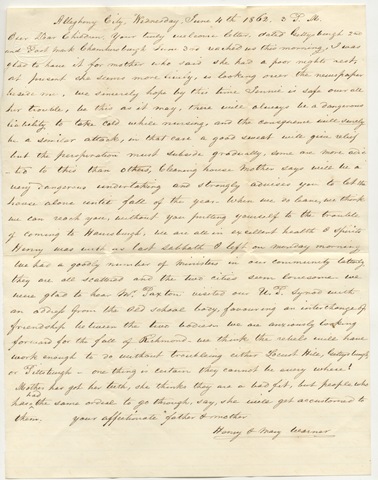
 Moore VI-5-7 Henry and Mary Warner to Children 6-4-62

  Transcript:

Allegheny City, Wednesday, June 4th 1862, 3 P.M.

Our Dear Children, Your truly welcome letter, dated Gettysburgh 2nd and Post mark Chambursburgh June 3rd reached us this morning. I was glad to have it for mother who said she had a poor nights rest, at present she seems more lively, is looking over the newspaper beside me, we sincerely hope by this time Jennie is safe over all her trouble, be this as it may, there will always be a dangerous liability to take cold while nursing, and the consequence will surely be a similar attack, in that case a good sweat will give relief but the perspiration must subside gradually, some are more adicted to this than others. Cleaning house mother says will be a very dangerous undertaking and strongly advises you to let the house alone until fall of the year—When we do leave, we think we can reach you, without you putting yourself to the trouble of coming to Harrisburgh, we are all in excellent health & spirits Henry was with us last Sabbath & left on monday morning We had a goodly number of ministers in our community latterly they are all scattered and the two cities seem lonesome—we were glad to hear Mr. Paxton visited our U.P. synod with an address from the old school body, favouring an interchange of friendship between the two bodies—we are anxiously looking forward for the fall of Richmond—we think the rebels will have work enough to do without troubling either Locust Hill, Gettysburgh, or Pittsburgh—one thing is certain they cannot be every where!

Mother has got her teeth, she thinks they are a bad fit, but people who have had the same ordeal to go through, say, she will get accustomed to them.

Your affectionate father & mother

Henry & Mary Warner

Citation: Henry and Mary Warner, autograph letter signed to John Riddle Warner. Allegheny City [Pittsburgh], 4 June 1862. Moore VI:05:07
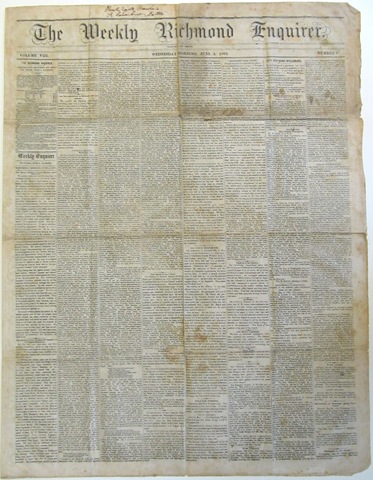
June 4, 1862: The Weekly Richmond Enquirer

Richmond Enquirer 6-4-1862

Transcript:

Wednesday Morning, June 4, 1862

Call # AN.R532

“The Evil which Jackson hath Wrought”

“The Philadelphia “Inquirer” argues that our Confederacy has lost, instead of gaining, by Jackson’s capture and expulsion of Bank’s army in the Valley of Virginia. Its theory is that the North will be exasperated and roused by it, and put forth greater efforts.

The argument of the “Inquirer” is based upon an idea which in the commencement of the war, found some to entertain it even in our Confederacy. The idea is, that in our war with the North we should moderate our blows so as not to offend the pride of our enemies. We must strike easy. After the battle of Manassas there were some who even supposed that a victory by the North sufficient to soothe the pain of that affront, would tend to restore peace.

These weak conceits have long ago been banished from the minds of our people. They have seen that every ray of success that favored our enemies’ cause has but made them more arrogant, intolerant and insufferable than before…” “…We must belabor them as with the club, and courage of Hercules. In pugilist’s phrase, we must “plant each blow right between the two eyes,” and with our whole strength.”

“…But the North is rushing to arms, says the “Inquirer,” to avenge the reverse. We will rush to arms, too, and try to give them another. But the rush to arms spoken of, seems to consist of a call on a number of New York Militia regiments to hurry to the defence of the Capitol; so that Lincoln is reduced to seeking his safety at the bayonets of the “Melish!” There is nothing so terrifying to us in that!”

Citation: The Weekly Richmond Enquirer. Richmond, 4 June 1862. AN .R532

June 3, 1862: James M. Ganaway telegram to P. G. T. Beauregard

Pierre Gustave Toutant Beauregard was a Louisiana-born general of the Confederate States Army. He had graduated second in his class from West Point in 1838 and was an admirer of Napoleon. He achieved fame early in the Civil War for commanding the Fort Sumter bombardment and as the victor of the first battle of Manassas. He later served in the Western Theater (including Shiloh and Corinth), Charleston, and the defense of Richmond, but his career was hampered by friction with Jefferson Davis and other generals.

This is one of approximately 1000 military telegrams in P.G.T. Beauregard’s papers at the Rosenbach.


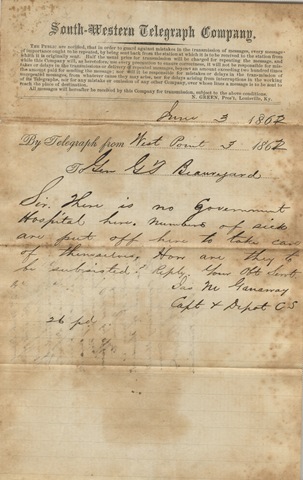
AMs 1168-11 1862-06-03

Transcript:

June 3 1862

By telegraph from West Point 3 1862

To Gen G. T. Beauregard

Sir. There is no Government Hospital here. numbers of sick are put off here to take care of themselves. How are they to be subsisted? Reply. Your obt Servt.

Jas. M. Ganaway

Captain and Depot  CS


Citation:James. M. Ganaway, telegram to G. T. Beauregard. West Point, 3 June 1862. AMs 1168/11

May 30, 1862: John Bordenave Villepigue telegram to P. G. T. Beauregard

Pierre Gustave Toutant Beauregard was a Louisiana-born general of the Confederate States Army. He had graduated second in his class from West Point in 1838 and was an admirer of Napoleon. He achieved fame early in the Civil War for commanding the Fort Sumter bombardment and as the victor of the first battle of Manassas. He later served in the Western Theater (including Shiloh and Corinth), Charleston, and the defense of Richmond, but his career was hampered by friction with Jefferson Davis and other generals.

This is one of approximately 1000 military telegrams in P.G.T. Beauregard’s papers at the Rosenbach.

AMs 1168-11 1862-05-30

Transcript:

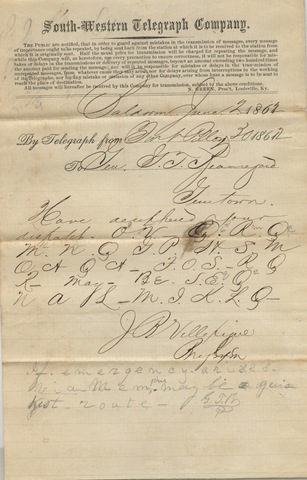
Baldwin June 2, 1862

By telegraph from Fort Pillow 30 1862

To Gen. G. T. Beauregard

Gemtown

Have deciphered four dispatch.O.V.Q.R.Q.M.N.Q.G.P.H. S. M. O S Q A-F.O.S.R Q R_ May_ BE. S.E. Q R. N. A L_M.i.k.l.Q.

J B Villepigue


If emergency arrives via Memphis may be quickest route  G.T.B.


Citation: John Bordenave Villepigue, telegram to G. T. Beauregard. Fort Pillow, Tenn.; 30 May 1862. AMs 1168/11

May 28, 1862: Henry and Mary Warner to John Warner

Henry and Mary Warner lived in Allegheny City, Pennsylvania, now part of Pittsburgh. They are the great-grandparents of poet Marianne Moore.  By the 1860s they had three surviving children:  John, Henry, and Anne. Their letters to John, a Presbyterian minister living in Gettysburg, are preserved as part of Marianne Moore’s family papers.

Moore VI-5-6 Henry and Mary Warner to Children 5-28-62

Transcript:

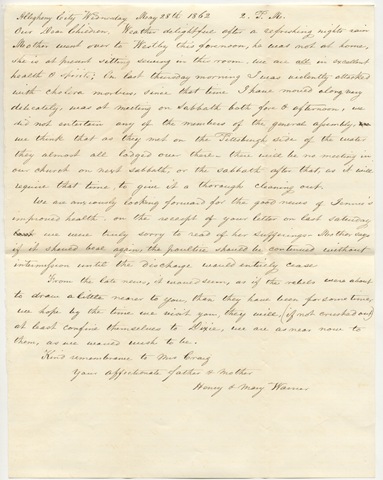
Allegheny City Wednesday May 28th 1862 2 P.M.

Our Dear Children, Weather delightful after a refreshing nights rain

Mother went over to Westby this forenoon, he was not at home, she is at present sitting sewing in this room. We are all in excellent health & spirits; On last thursday morning I was violently attacked with cholera morbus, since that time I have moved along very delicately, was at meeting on Sabbath both fore & afternoon, we did not entertain any of the numbers of the general assembly, we think that as they met on the Pittsburgh side of the water they almost all lodged over there—there will be no meeting in our church on next Sabbath, or the Sabbath after that, as it will require that time, to give it a thorough cleaning out.

We are anxiously looking forward for the good news of Jennie’s improved health, on the receipt of your letter on last saturday we were truly sorry to read of her sufferings—Mother says if it should beal again, the poultice should be continued without intermission until the discharge would entirely cease

From the late news, it would seem, as if the rebels were about to draw a little nearer to you, than they have been for some time, we hope by the time we visit you, they will, (if not crushed out) at least confine themselves to Dixie, we are as near now to them, as we would wish to be.

Kind remembrance to Mrs Craig

Your affectionate father & mother

Henry & Mary Warner

Citation: Henry and Mary Warner, autograph letter signed to John Riddle Warner. Allegheny City [Pittsburgh], 28 Mayl 1862. Moore VI:05:06

May 28, 1862: George Eyster to John Riddle Warner

John Riddle Warner was the grandfather of the poet Marianne Moore and during the Civil War he lived in Gettysburg, Pennsylvania. George Eyster was his brother-in-law and lived in Chambersburg. These letters are preserved as part of Marianne Moore’s family papers.

 Moore VI-5-6 p1 George Eyster to Mary 5-28-62 Moore VI-5-6 p2 George Eyster to Mary 5-28-62

  Moore VI-5-6 p3 George Eyster to Mary 5-28-62

   Transcript:

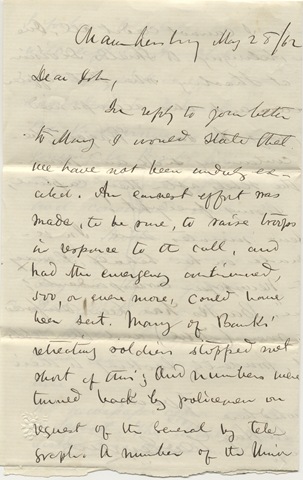
Chambersburg May 28/62

Dear John,

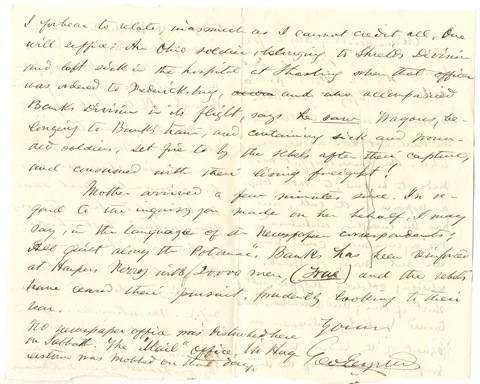
In reply to your letter to Mary I would state that we have not been unduly excited. An earnest effort was made, to be sure, to raise troops in response to a call, and had the emergency continued, 500, or even more, could have been sent. Many of Banks’ retreating soldiers stopped not short of here; And numbers were turned back by policemen on request of the general by telegraph. A number of the Union citizens of Winchester are so joining here, whilst hundreds of negroes fleeing from the sacred soil have passed through. Of the latter quite a number have tarried. Many are women and are offering themselves as house-servants. Most seem to have fled from terror; few, inspired by the hope of freedom. The scene in Winchester on Sabbath morning is described as terrific. The atrocities of the rebels, perpetrated in the pursuit, as related to me by professed eye-witnesses, I forbear to relate, inasmuch as I cannot credit all. One will suffice: An Ohio soldier, belonging to Shield’s Division and left sick in the hospital at Strasburg when that officer was ordered to Fredericksburg, and also accompanied Banks Division in its flight, says he saw Wagons, belonging to Banks’ train, and containing sick and wounded soldiers, set fire to by the rebels after their capture, and consumed with their living freight!

Mother arrived a few minutes since. In regard to the inquiry you made on her behalf; I may say, in the language of the Newspaper correspondents: “All quiet along the Potomac.” Banks has been reinforced at Harpers Ferry with 20000 men, (True) and the rebels have ceased their pursuit, prudently looking to their rear

Yours

Geo Eyster

No newspaper office was disturbed here on Sabbath. The “Mail” office, in Hagerstown was robbed on that day.


Citation: George Eyster, autograph letter signed to John Riddle Warner. Chambersburg, Pa.; 28 May 1862. Moore VI:05:06

May 26, 1862: Robert E. Lee to P. G. T. Beauregard

Pierre Gustave Toutant Beauregard was a Louisiana-born general of the Confederate States Army. He had graduated second in his class from West Point in 1838 and was an admirer of Napoleon. He achieved fame early in the Civil War for commanding the Fort Sumter bombardment and as the victor of the first battle of Manassas. He later served in the Western Theater (including Shiloh and Corinth), Charleston, and the defense of Richmond, but his career was hampered by friction with Jefferson Davis and other generals.

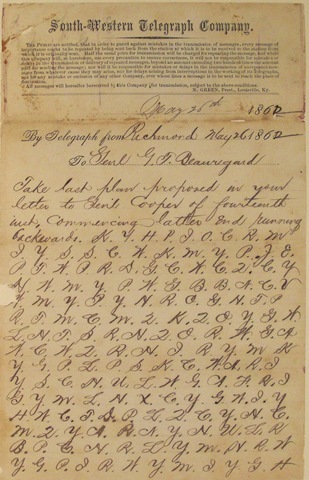
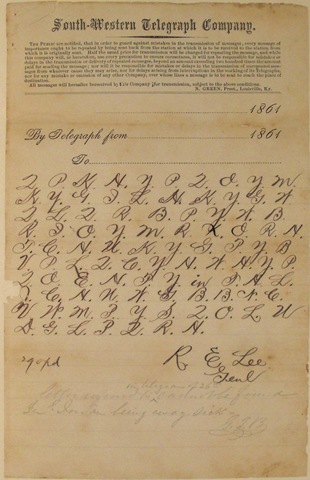
This telegram is from The Telegraphic History of the Civil War; a compiled album of telegrams to Beauregard from Davis, Lee, Johnston and others.

Telegram 5-26-62 p.1 Lee to Beauregard 10 mp Telegram 5-26-62 p.2 Lee to Beauregard 10 mp

Transcript:

May 26th 1862

By Telegraph from Richmond May 26 1862

To Genl G.T. Beauregard

Take last plan proposed in your letter to Gen’l Cooper of fourteenth inst. Commencing latter End running backwards.

K Y H P I O C R M/I Y S S C W K M YP J E/P T W P R D G C W C Q C Y/N W M Y P W G B B A C V/W M Z P Y H R O G H T P/R T M C M Q K Q O Y G W/L N T S R N Q O R W G A/W C W Q R N I R Y M K/Y G P L P S K C W A R I/Y S C N U L W G A F R I/G Y M L H X C Y G W I Y/H W C T D P L Q C Y N C/M Q Y A R A Y N U L R/B P C N R L Y M ? R W/Y G P I R W Y M I Y G H/Q P K N Z P Q O Y M/K Y G I L H K Y G W/Q L Q R B P Z W B/R I O Z M R X I R H/T C H U K Y G P Z B/V P L Q C Z H W H Z P/Q O E H P Z in T H L/J C H ? W G B B A C/V W M P Y S Q O L U/D G L P Q R H

R. E. Lee

Genl

290 pd

16 pd

Citation:Robert E. Lee (1807-1870), telegram to G.T. Beauregard. Richmond, 26 May 1862. In The telegraphic history of the Civil War, 1861-1865. AMs 434/16

Many thanks to David Kaminski and Nan Barchowsky for their assistance with the transcription.

May 25, 1862: Carrie Spafford to her Friends

Carrie Spafford had been the fiancée of Col. Elmer Ellsworth. Col. Elmer Ellsworth was a lawyer and soldier and friend of Abraham Lincoln who was one of the first casualties of the Civil War. He was shot and killed on May 24, 1861 while removing a large Confederate flag from a tavern in Alexandria, Virginia.

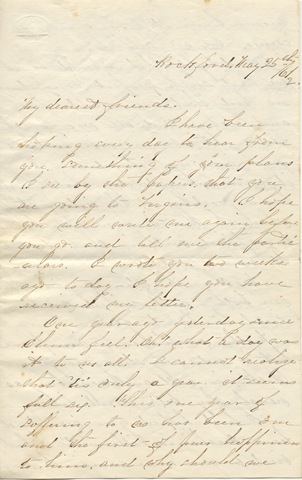
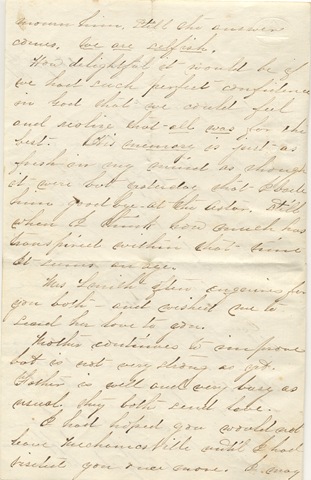
AMs 811-2-7 p1 Connie Spafford to friends AMs 811-2-7 p2 Connie Spafford to friends AMs 811-2-7 p3 Connie Spafford to friends

Transcript:

Rockford. May 25th/62

My dearest friends,

I have been hoping every day to hear from you. Something of your plans. I see by the papers that you are going to [Fargrins?]. I hope you will write me again before you go. and tell me the particulars. I wrote you two weeks ago today- I hope you have received my letter!

One year ago yesterday since Elmer fell. Oh! what a day was it to us all. I cannot realize that ‘tis only a year. it seems full six. This one year of suffering to us has been one and the first of pure happiness to him, and why should we mourn him. Still the answer comes, we are selfish.

How delightful it would be if we had such perfect confidence in God that we could feel and realize that all was for the best. His memory is just as fresh in my mind as though it were but yesterday that I bade him goodbye at the Astor. Still when I think how much has transpired within that time it seems an age.

Mrs. Lunish [?] often enquires for you both- and wished me to send her love to you.

Mother continues to improve, but is not very strong as yet. Father is well and very busy as usual. They both send love.

I had hoped you would not leave Mechanicsville until I had visited you once more. I may go East the last of the summer and if I do, shall want to go to Mechanicsville. And if you are not too far away will visit you. I have had company ever since I came home from Chicago and am now about tired. There are two young bodies with me now, but they heave this week.

Please write me soon. I am very anxious to hear from you. You dont know how much I think of you or how well I love you. if I dont write often, but when we are settled once again I will do better. I must go now.

Good bye- your aff

Carrie


Citation: Carrie Spafford, autograph letter signed to her friends. Rockford, Ill; 25 May 1862. AMs 811/2.7

May 24, 1862: W. R. Hunt telegram to Thomas Jordan

Pierre Gustave Toutant Beauregard was a Louisiana-born general of the Confederate States Army. He had graduated second in his class from West Point in 1838 and was an admirer of Napoleon. He achieved fame early in the Civil War for commanding the Fort Sumter bombardment and as the victor of the first battle of Manassas. He later served in the Western Theater (including Shiloh and Corinth), Charleston, and the defense of Richmond, but his career was hampered by friction with Jefferson Davis and other generals.

This is one of approximately 1000 military telegrams in P.G.T. Beauregard’s papers at the Rosenbach.

 AMs 1168-11 1862-05-24

  AMs 1168-11 1862-05-24 p2

Transcript:

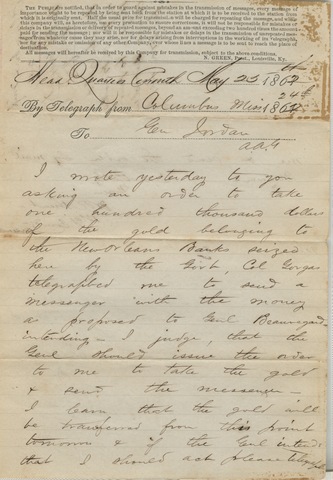
  Head Quarters Corinth May 25th 1862

By Telegraph from Columbus Miss 24th 1862

To Gen. Jordan A. A. G.

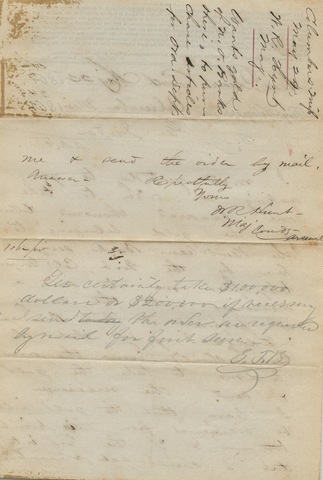
I wrote yesterday to you asking an order to take one hundred thousand dollars of the gold belonging to the New Orleans Banks seized here by the gov’t, Col Gorgas telegraphed me to send a messenger with the money as proposed to Gen. Beauregard intending-I judge, that the genl should issue the order to me to take the gold & send the messenger—I learn that the gold will be transferred from this point tomorrow & if the Genl intends that I should act please telegraph me & send me the order by mail. Answer_

Respectfully,

Yours

W R Hunt

Maj Cmdg Arsenal


Yes certainly take $100,000 dollars or $200,000 if necessary. I send the order as requested by mail for [first service]. G.T. B. 


Citation:W. R. Hunt, telegram to Thomas Jordan. Corinth, Miss., 25 May 1862. AMs 1168/11

May 21, 1862: Henry and Mary Warner to John Warner

Henry and Mary Warner lived in Allegheny City, Pennsylvania, now part of Pittsburgh. They are the great-grandparents of poet Marianne Moore.  By the 1860s they had three surviving children:  John, Henry, and Anne. Their letters to John, a Presbyterian minister living in Gettysburg, are preserved as part of Marianne Moore’s family papers.


Moore VI-5-6 p1 Henry and Mary Warner to Children 5-21-62

  Moore VI-5-6 p2 Henry and Mary Warner to Children 5-21-62

Transcript:

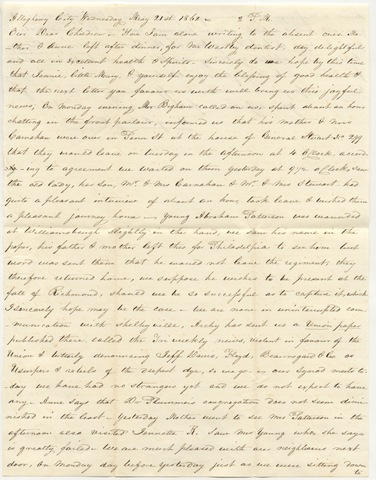
Allegheny City Wednesday May 21st 1862 2 P.M.

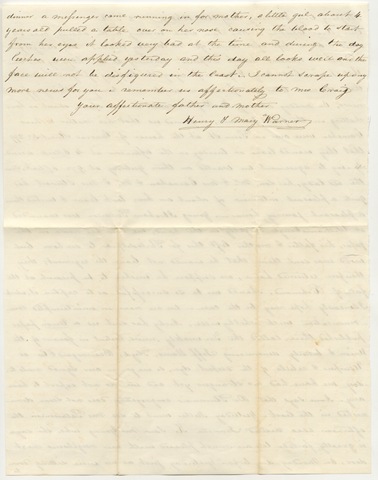
Our Dear Children—Here I am writing to the absent ones—Mother & Anne left after dinner, for Mr Westby dentist, day delightful and all in excellent health & spirits—sincerely do we hope by this time that Jennie, little Mary, & yourself enjoy the blessings of good health & that the next letter you favour us with will bring us this joyful news; On Monday evening Mr Bigham called on us, spent about an hour chatting in the front parlour, informed us that his mother & Mrs Carnahan were over in Penn St at the house of General Stuart No. 299 that they would leave on tuesday in the afternoon at 4 oclock, according to agreement we waited on them yesterday at 9 ½ oclock, saw the old lady, her son, Mr. & Mrs Carnahan & Mr. & Mrs Stewart—had quite a pleasant interview of about an hour, took leave & wished them a pleasant journey home—young Abraham Patterson was wounded at Williamsburgh slightly in the hand, we saw his name in the paper, his father & mother left this for Philadelphia to see him but word was sent them that he would not leave the regiment, they therefore returned home, we suppose he wishes to be present at the fall of Richmond, should we be so successful as to capture it, which I sincerely hope may be the case—We are now in uninterrupted communication with Shelbyville, Archy has sent us a Union paper published there, called the Tri weekly news, violent in favour of the Union & bitterly denouncing Jeff Davis, Floyd, Beauregard & CO as Usurpers & rebels of the deepest dye, so we go—our synod meets today we have had no strangers yet and we do not expect to have any—Anne says that Dr Plummer’s congregation does not seem diminished in the least—Yesterday Mother went to see Mrs Patterson in the afternoon also visited Jennette K. Saw Mrs Young who, she says, is greatly failed—We are much pleased with our neighbours next door. On Monday day before yesterday just as we were sitting down to dinner a messenger came running in for mother, a little girl about 4 years old pulled a table over her nose causing the blood to start from her eyes it looked very bad at the time and during the day leeches were applied yesterday and this day all looks well and the face will not be disfigured in the least—I cannot scrape up any more news for you—remember us affectionately to Mrs Craig

Your affectionate father and mother

Henry & Mary Warner

Citation: Henry and Mary Warner, autograph letter signed to John Riddle Warner. Allegheny City [Pittsburgh], 30 April 1862. Moore VI:05:06