January 3, 1863: Alexander Biddle to His Children

Alexander Biddle was a member of the prominent Philadelphia Biddle family and was married to Julia Williams Rush,  the granddaughter of Dr. Benjamin Rush.  Biddle served with the 121st Pennsylvania Volunteer Infantry, beginning in September 1862. Starting out as a major, he would participate at Fredericksburg and Gettysburg, among other engagements, and would leave the service as a lieutenant colonel. (He was commissioned, but never mustered, as colonel)

Rush IV-30-27 p9 A Biddle ALS to Julia William Rush, Jan. 3 Rush IV-30-27 p10 A Biddle ALS to Julia William Rush, Jan. 3

Transcript:

Dear Children

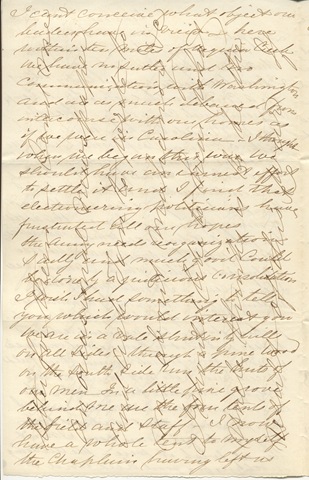
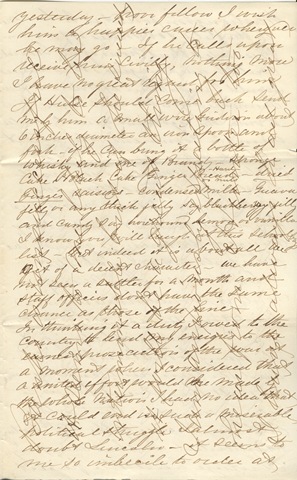
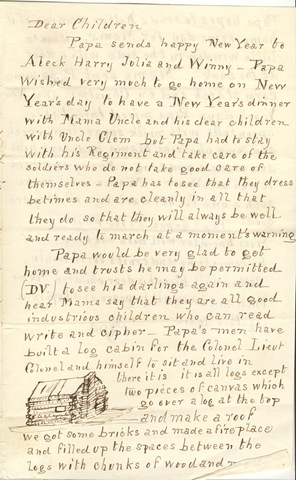
Papa sends happy New Year to Aleck Harry Julia and Winny – Papa wished very much to go home on New Year’s day to have a New Year’s dinner with Mama Uncle and his dear children with Uncle Clem but Papa had to stay with his Regiment and take care of the soldiers who do not take good care of themselves – Papa has to see that they dress betimes and are cleanly in all that they do so that they will always be well and ready to march at a moment’s warning.

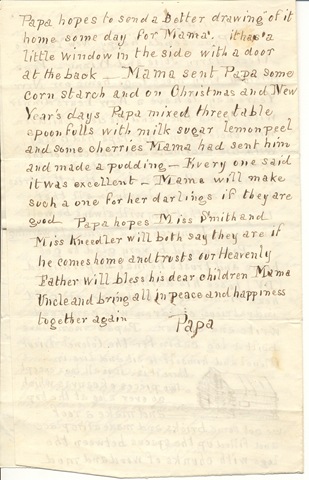
Papa would be very glad to get home and trusts he may be permitted (DV) to see his darlings again and hear Mama say that they are all good industrious children who can read write and cipher. Papa’s men have built a log cabin for the Colonel Lieut Colonel and himself to sit and live in [drawing] there it is it is all logs except two pieces of canvas which go over a log at the top and make a roof we got some bricks and made a fireplace and filled up the spaces between the logs with chunks of wood and mud Papa hopes to send a better drawing of it home some day for Mama. it has a little window in the side with a door at the back. Mama sent Papa some corn starch and on Christmas and New Year’s days Papa mixed three table spoon fulls with milk sugar lemon peel and some cherries Mama had sent him and made a pudding – Every one said it was excellent – mama will make such a one for her darlings if they are good.

Papa hopes Miss Smith and Miss Kneedler will both say they are if he comes home and trusts our Heavenly Father will bless his dear children Mama Uncle and bring all in peace and happiness together again

Papa

Citation: Alexander Biddle (1819-1899), autograph letter signed to his children. 3 January 1863. Rush:IV:30:27

January 2, 1863: Print of Libby Prison

19540795

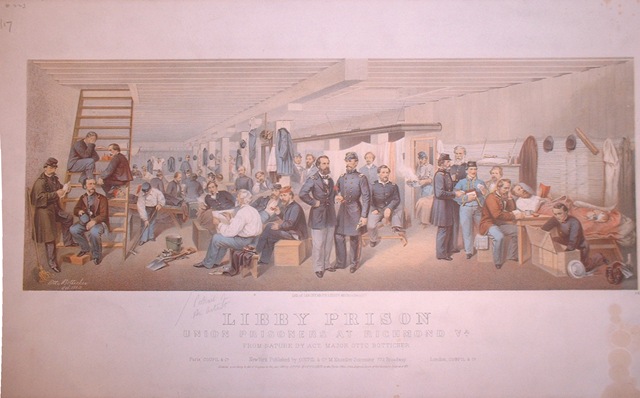
This image of Libby Prison was published in 1863.

Citation: Sarony, Major, & Knapp, lithographers, after a drawing by Otto Botticher, Libby Prison, Union prisoners at Richmond, Va from nature by Act. Major Otto Botticher. New York, 1863. 1954.795

January 1, 1863: Emancipation Proclamation

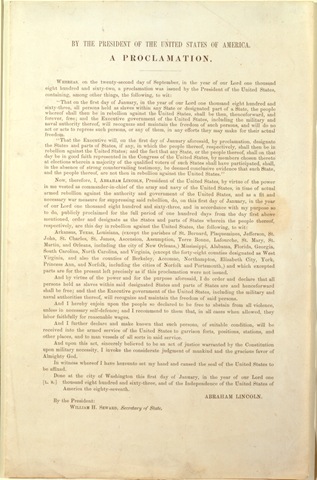
The Emancipation Proclamation took effect on January 1, 1863.
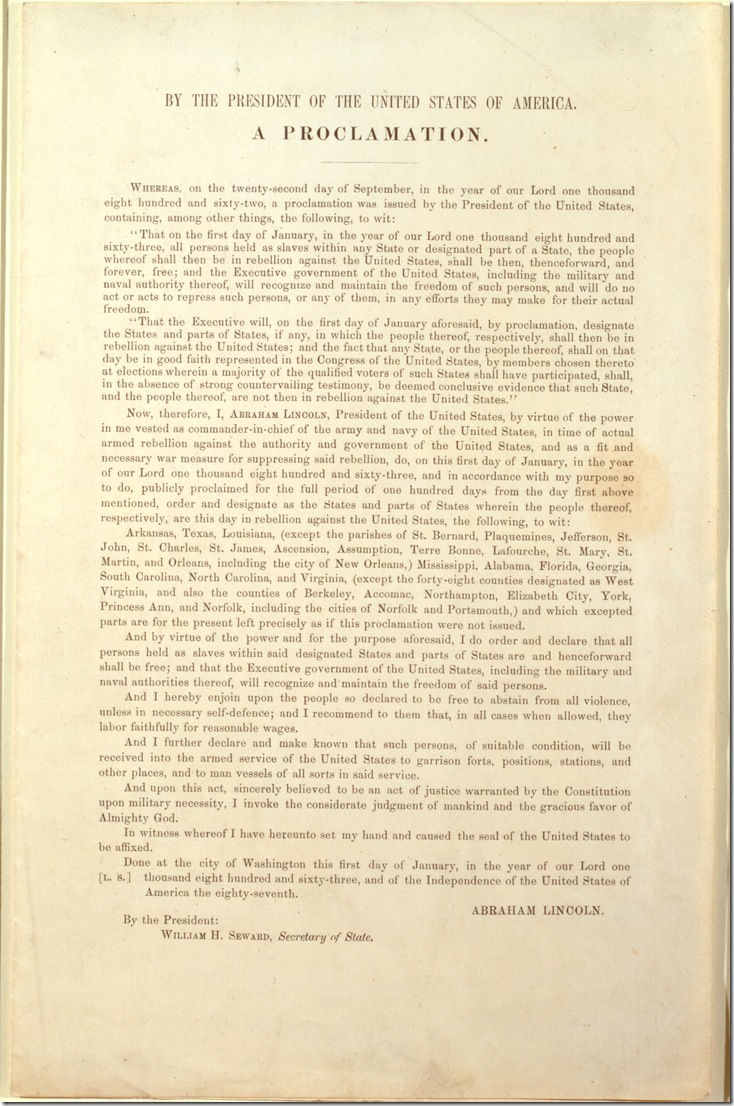
A 863b Emancipation Proc

Transcription:

By the President of the United States of America.

A Proclamation.

Whereas, on the twenty-second day of September, in the year of our Lord one thousand eight hundred and sixty-two, a proclamation was issued by the President of the United States, containing, among other things, the following, to wit:

“That on the first day of January, in the year of our Lord one thousand eight hundred and sixty-three, all persons held as slaves within any State or designated part of a State, the people whereof shall then be in rebellion against the United States, shall be then, thenceforward, and forever free; and the Executive Government of the United States, including the military and naval authority thereof, will recognize and maintain the freedom of such persons, and will do no act or acts to repress such persons, or any of them, in any efforts they may make for their actual freedom.

“That the Executive will, on the first day of January aforesaid, by proclamation, designate the States and parts of States, if any, in which the people thereof, respectively, shall then be in rebellion against the United States; and the fact that any State, or the people thereof, shall on that day be, in good faith, represented in the Congress of the United States by members chosen thereto at elections wherein a majority of the qualified voters of such State shall have participated, shall, in the absence of strong countervailing testimony, be deemed conclusive evidence that such State, and the people thereof, are not then in rebellion against the United States.”

Now, therefore I, Abraham Lincoln, President of the United States, by virtue of the power in me vested as Commander-in-Chief, of the Army and Navy of the United States in time of actual armed rebellion against the authority and government of the United States, and as a fit and necessary war measure for suppressing said rebellion, do, on this first day of January, in the year of our Lord one thousand eight hundred and sixty-three, and in accordance with my purpose so to do publicly proclaimed for the full period of one hundred days, from the day first above mentioned, order and designate as the States and parts of States wherein the people thereof respectively, are this day in rebellion against the United States, the following, to wit:

Arkansas, Texas, Louisiana, (except the Parishes of St. Bernard, Plaquemines, Jefferson, St. John, St. Charles, St. James Ascension, Assumption, Terrebonne, Lafourche, St. Mary, St. Martin, and Orleans, including the City of New Orleans) Mississippi, Alabama, Florida, Georgia, South Carolina, North Carolina, and Virginia, (except the forty-eight counties designated as West Virginia, and also the counties of Berkley, Accomac, Northampton, Elizabeth City, York, Princess Ann, and Norfolk, including the cities of Norfolk and Portsmouth,) and which excepted parts, are for the present, left precisely as if this proclamation were not issued.

And by virtue of the power, and for the purpose aforesaid, I do order and declare that all persons held as slaves within said designated States, and parts of States, are, and henceforward shall be free; and that the Executive government of the United States, including the military and naval authorities thereof, will recognize and maintain the freedom of said persons.

And I hereby enjoin upon the people so declared to be free to abstain from all violence, unless in necessary self-defence; and I recommend to them that, in all cases when allowed, they labor faithfully for reasonable wages.

And I further declare and make known, that such persons of suitable condition, will be received into the armed service of the United States to garrison forts, positions, stations, and other places, and to man vessels of all sorts in said service.

And upon this act, sincerely believed to be an act of justice, warranted by the Constitution, upon military necessity, I invoke the considerate judgment of mankind, and the gracious favor of Almighty God.

In witness whereof, I have hereunto set my hand and caused the seal of the United States to be affixed.

Done at the City of Washington, this first day of January, in the year of our Lord one [L.S.] thousand eight hundred and sixty three, and of the Independence of the United States of America the eighty-seventh.

By the President: ABRAHAM LINCOLN
WILLIAM H. SEWARD, Secretary of State.

Citation: U. S. President, 1861-1865 (Lincoln). By the president of the United States of America. A proclamation. [Washington, D.C., 1863]. A 863b
December 31, 1862: Alexander Biddle to Julia Williams Rush Biddle

Alexander Biddle was a member of the prominent Philadelphia Biddle family and was married to Julia Williams Rush,  the granddaughter of Dr. Benjamin Rush.  Biddle served with the 121st Pennsylvania Volunteer Infantry, beginning in September 1862. Starting out as a major, he would participate at Fredericksburg and Gettysburg, among other engagements, and would leave the service as a lieutenant colonel. (He was commissioned, but never mustered, as colonel)

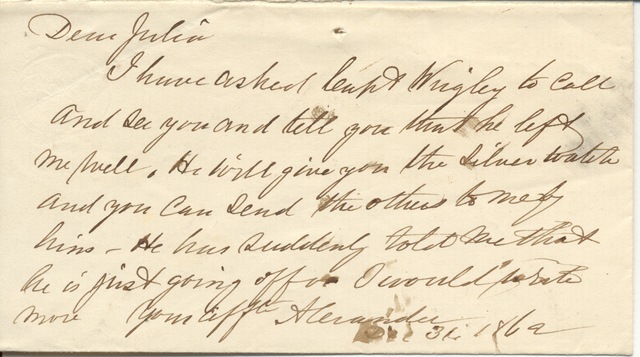
Rush IV-30-26 p1 A Biddle ALS to Julia William Rush, Dec. 31

Transcript:

Dear Julia

I have asked Capt Wrigley to call and see you and tell you that he left me well. He will give you the silver watch and you can send the other to me by him. He has suddenly told me that he is just going off or I would write more

Your aff

Alexander

Dec 31 1862

Citation: Alexander Biddle (1819-1899), autograph letter signed to Julia Williams Rush Biddle. 31 December 1862. Rush:IV:30:26

December 30, 1862: William T. Sherman to David Porter

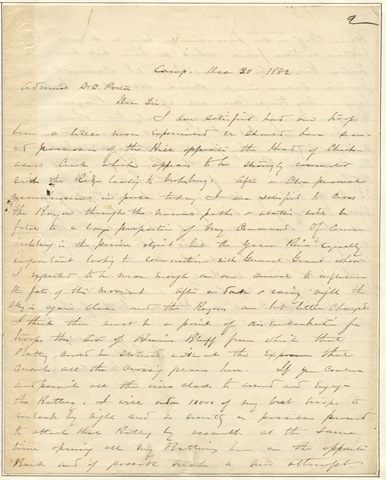
AMs 360-9 p1 William T Sherman to David D Porter AMs 360-9 p2 William T Sherman to David D Porter

Transcript:

Camp. Dec 30 1862.

Admiral D. D. Porter

Dear Sir,

I am satisfied had our troops been a little more experienced we should have secured possession of the Hill opposite the Head of Chickasaw Creek which appears to be strongly connected with the Ridge leading to Vicksburg. After a close reconnaissance in person today I am satisfied to cross the Bayou through the narrow path & attack will be fatal to a large proportion of my Command. Of course Vicksburg is the principle object but the Yazoo River is equally important looking to [connection?] with General Grant whom I expected to be near enough on our arrival to influence the fate of this movement. After a dark & stormy night the sky is again clear and the Bayou are but little changed. I think there must be a point of disembarkation for troops this side of Haines Bluff from which that Battery could be stormed with out the exposure that marks all the crossing places here. If you concur and permit all the iron clads to ascend and engage the Battery, I will order 10 000 of my best troops to embark by night and as secretly as possible proceed to attack that Battery by assault. At the same time opening all my Battery here at the opposite Bank and if possible make a new attempt. Haines Bluff in our possession we have a second footing on terra firma which we have not here. Unless Grant be near at hand I cannot promise success in a direct assault on Vicksburg. My troops are all up to the Bayou with guns covering the crossings only two which are practicables, but I have not succeeded so in making a [illeg.] . My pickets on the right reach the Mississippi River near the Bend from which they have a plain view of all the Forts. [illeg.] &c but the intervening span is one mingled web of fallen trees of giant size filled with sharpshooters with whom we are constantly skirmishing. The enemy has thrown some shells but manifestly spares his ammunition. We do the same.

I would solicit a speedy answer, as we must act with great expedition, if unsupported in this move by either Grant or Banks, both of whom should now be heard from.

I am with great respect

W. T. Sherman

Citation: William T. Sherman (1820-1891), autograph letter signed to David D. Porter. 30 December 1862. AMs 360/9

December 29, 1862: Alexander Biddle to Julia Williams Rush Biddle

Alexander Biddle was a member of the prominent Philadelphia Biddle family and was married to Julia Williams Rush,  the granddaughter of Dr. Benjamin Rush.  Biddle served with the 121st Pennsylvania Volunteer Infantry, beginning in September 1862. Starting out as a major, he would participate at Fredericksburg and Gettysburg, among other engagements, and would leave the service as a lieutenant colonel. (He was commissioned, but never mustered, as colonel)

Rush IV-30-26 p1 A Biddle ALS to Julia William Rush, Dec. 29 Rush IV-30-26 p2 A Biddle ALS to Julia William Rush, Dec. 29 Rush IV-30-26 p3 A Biddle ALS to Julia William Rush, Dec. 29 Rush IV-30-26 p4 A Biddle ALS to Julia William Rush, Dec. 29

Transcript:

Monday Dec. 29th 1862

Dear Wife,

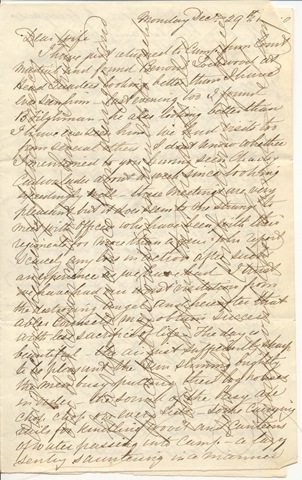
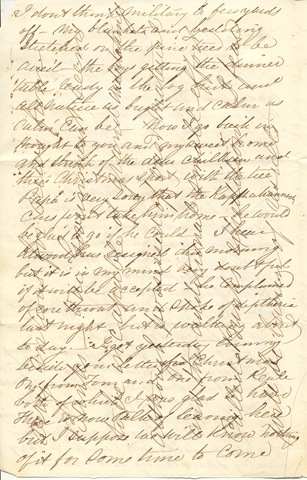
I have just returned to camp from Court Martial and found Benoni Lockwood at Head Quarters looking better than I have ever seen him – last evening too I found B Tilghman – he also looking better than I have ever seen him. We had visits too from several others I don’t know whether I mentioned to you having seen Charley Cadwalader about a week since looking exceedingly well – these meetings are very pleasant but it does seem to me strange to meet with officers who have been with their regiments who report scarcely any loss in action after such an experience as we have had. I trust we have had our worst visitation from the destroying angel and hereafter that abler counsels may obtain success with less sacrifice of life. The day is beautiful – the air just sufficiently sharp to be pleasant the sun shining brightly the men busy putting their log houses in order – the sound of the busy axe chop, chop on every side – some carrying rails for kindling wood and canteens of water passing into camp – a lazy sentry sauntering in a manner I don’t think military a few yards off. My blankets and bedding stretched on the pine trees to be aired – the boys getting the dinner table ready in the log hut and all nature as bright and calm as calm can be. Now I go back in thought to you and my sweet home and think of the dear children and their Christmas sport with the tree Papa is very sorry that the Rappahannock cars won’t take him home – he would be glad to go if he could…

Citation: Alexander Biddle (1819-1899), autograph letter signed to Julia Williams Rush Biddle. 29 December 1862. Rush:IV:30:26

December 28, 1862: Alexander Biddle to Julia Williams Rush Biddle

Alexander Biddle was a member of the prominent Philadelphia Biddle family and was married to Julia Williams Rush,  the granddaughter of Dr. Benjamin Rush.  Biddle served with the 121st Pennsylvania Volunteer Infantry, beginning in September 1862. Starting out as a major, he would participate at Fredericksburg and Gettysburg, among other engagements, and would leave the service as a lieutenant colonel. (He was commissioned, but never mustered, as colonel) Rush IV-30-26 p1 A Biddle ALS to Julia William Rush, Dec. 28 Rush IV-30-26 p2 A Biddle ALS to Julia William Rush, Dec. 28 Rush IV-30-26 p3 A Biddle ALS to Julia William Rush, Dec. 28 Rush IV-30-26 p4 A Biddle ALS to Julia William Rush, Dec. 28

Transcript:

Sunday Dec. 28th, 1862

Dear Julia,

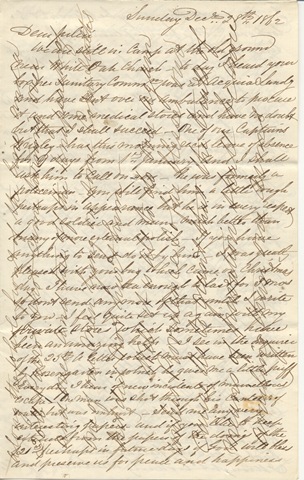
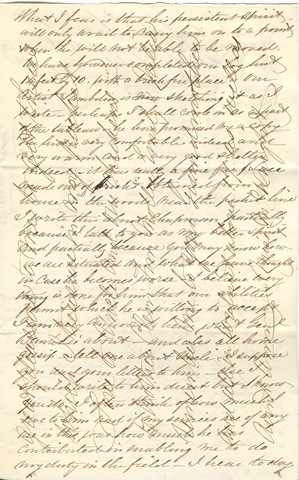
We are all in Camp at the old ground near White Oak Church – to day I heard your box per Sanitary Comm. was at Acquia Landg. and have sent over out ambulance to procure it and some medical stores and have no doubt but that I shall succeed. One of our Captains Wrigley has this morning recd. leave of absence for 9 days from 1st January and I shall ask him to call on you. He was formerly a policeman. You will find him a little rough perhaps in appearance but he is in every respect a good soldier and man –much better than many of more external polish. If you have anything to send do it by him. I was greatly pleased with your bag which came on Christmas so don’t send me anymore of that until I write to you. I feel quite set up again with my private store which sometimes have been an amazing help. I see in the Inquirer of the 25th a letter which must have been written by Rosengarten in which he gives me a little puff Everyday I hear of new incidents of marvelous escape – one man was shot through his canteen of water but was unhurt. Send me any interesting papers and if you like to keep extracts from the papers of the doing of the 121st perhaps in future days if God will bless and preserve us for peace and happiness here on earth they may be pleasant to look over..

Citation: Alexander Biddle (1819-1899), autograph letter signed to Julia Williams Rush Biddle. 28 December 1862. Rush:IV:30:26

December 25, 1862: Alexander Biddle to Julia Williams Rush Biddle

Alexander Biddle was a member of the prominent Philadelphia Biddle family and was married to Julia Williams Rush,  the granddaughter of Dr. Benjamin Rush.  Biddle served with the 121st Pennsylvania Volunteer Infantry, beginning in September 1862. Starting out as a major, he would participate at Fredericksburg and Gettysburg, among other engagements, and would leave the service as a lieutenant colonel. (He was commissioned, but never mustered, as colonel)

Rush IV-30-26 p1 A Biddle ALS to Julia William Rush, Dec. 25 Rush IV-30-26 p2 A Biddle ALS to Julia William Rush, Dec. 25 Rush IV-30-26 p3 A Biddle ALS to Julia William Rush, Dec. 25 Rush IV-30-26 p4 A Biddle ALS to Julia William Rush, Dec. 25

Rush IV-30-26 p5 A Biddle ALS to Julia William Rush, Dec. 25 Rush IV-30-26 p6 A Biddle ALS to Julia William Rush, Dec. 25 Rush IV-30-26 p7 A Biddle ALS to Julia William Rush, Dec. 25 Rush IV-30-26 p8 A Biddle ALS to Julia William Rush, Dec. 25

Transcript [excerpt]:

Camp Near White Oak Church

Christmas Day. 1862

Dear Julia

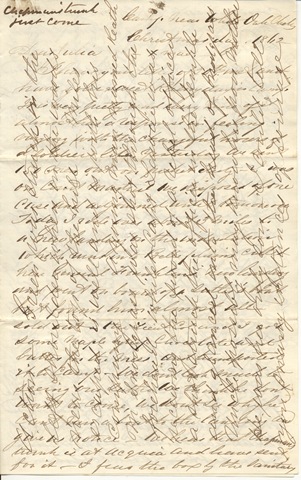
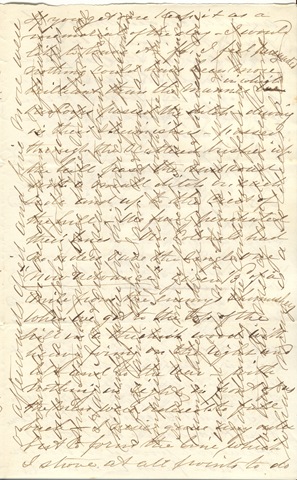
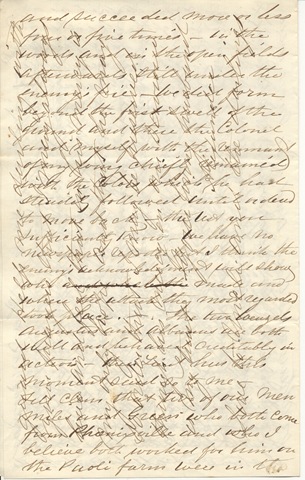
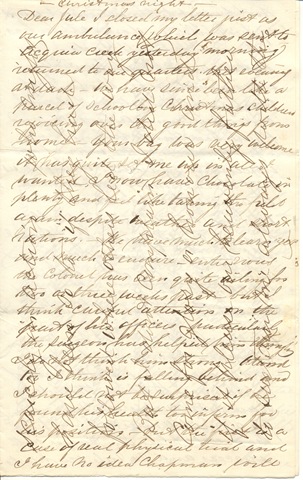
I have your letter of 20th inst. and have your sweet Rainy day in Camp. It is very pretty and every line of it almost has a response in feeling surging with the changeful hours of a soldier’s life. Yesterday we sent 150 men out on picket duty – I was on court martial we disposed of one case and adjourned until tomorrow Today I rode over about 3 miles to a new landing on the indentation which runs into Belle Plains called here General Franklin’s new landing and went on board of a sutler’s boat but found him almost all sold out – the Lieut Col and I got some maple syrup chocolate and butter for the mess and transported it to camp – We don’t look much to seeing our sutler we think he don’t want to come, we don’t see why he can’t run a boat to the landing and give us notice – We hear that Chapman’s trunk is at Acquia and have sent for it – I fear the box of the sanitary commission will not get farther than Washington or at most than Acquia – Lewis might send it but unless there is someone to send it forward at every depot it stands but little chance. The best way to send me anything will be by Hulse – Zell – Lloyd – if they come back well – but don’t let it be large. Hulse you may trespass on most – A man named Daniel Holland I told to call on you who is going to return in 2nd January an officer’s servant – you may send a small pckge by him. Dear Wife I can say to you that you cant conceive how grateful I feel to our Heavenly Father for his merciful preservation of me on the 13th inst. Read the Herald of Tuesday the 23rd You will there find extracts from the Richmond paper and what they think of the attack on their right made by our left.

– Christmas Night –

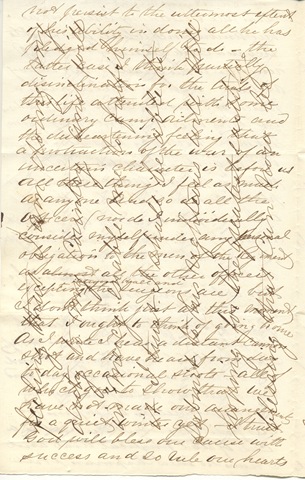
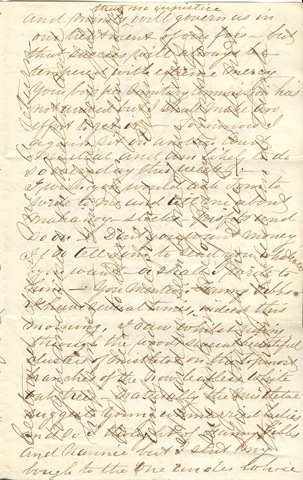
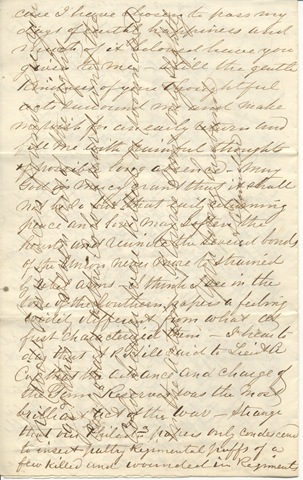
Dear Julia I closed my letter just as our ambulance (which was sent to Acquia Creek yesterday morning) returned to our quarters this evening at dark. We have since been like a parcel of Christmas schoolboy children rejoicing over the good things from home. Your bag was very welcome it has quite set me up in all I wanted, I now have chocolate in plenty and feel like taking the field again despite weather and short rations. We have much to learn yet and much to endure – entre nous the Colonel has been quite ailing for two or three weeks past – but I think careful attention on the part of his officers particularly the surgeon has helped him thoroughly. I do not think him strong – Atwood too I think is falling behind and I should not be surprised if he found his health too infirm for his position – but the first is a case of real physical trial and I have no idea how Chapman will not persist to the uttermost extent of his ability in doing all he has pledged himself to do – the latter case I think partially disinclination for the trials of this life attended with some ordinary camp ailments and the disheartening feeling that a protraction of the war of an uncertain character is before us all these things I feel as much as anyone and so do all the officers (nor do I individually consider myself under any personal obligation to the men of the Regiment as almost all the other officers excepting Atwood, Hall and the Surgeons all) but I don’t think just at this moment that I ought to think of going home. As I write I hear a distant cannon shot and have heard from day to day occasional shots – all of which goes to show that we have not made our arrangements for a quiet winter yet – I trust God will bless our cause with success and so rule our hearts and minds that no injustice will govern us in our treatment of our foes – but that success will always be tempered with extreme mercy…

Citation: Alexander Biddle (1819-1899), autograph letter signed to Julia Williams Rush Biddle. 25 December 1862. Rush:IV:30:26

December 24, 1862: Alexander Biddle to Julia Williams Rush Biddle

Alexander Biddle was a member of the prominent Philadelphia Biddle family and was married to Julia Williams Rush,  the granddaughter of Dr. Benjamin Rush.  Biddle served with the 121st Pennsylvania Volunteer Infantry, beginning in September 1862. Starting out as a major, he would participate at Fredericksburg and Gettysburg, among other engagements, and would leave the service as a lieutenant colonel. (He was commissioned, but never mustered, as colonel)Rush IV-30-26 p1 A Biddle ALS to Julia William Rush, Dec. 24 Rush IV-30-26 p2 A Biddle ALS to Julia William Rush, Dec. 24 Rush IV-30-26 p3 A Biddle ALS to Julia William Rush, Dec. 24 Rush IV-30-26 p4 A Biddle ALS to Julia William Rush, Dec. 24

Transcript (excerpt):

Wednesday 24th Dec

Camp near White Oak Ch

Dear Julia

Again I seize a free moment from this tedious life to write to you –

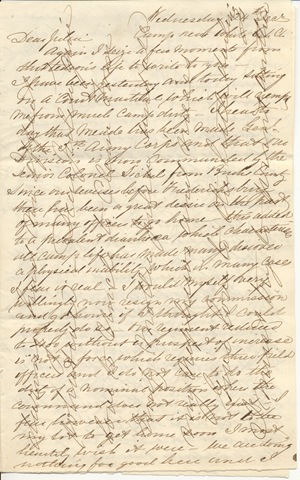
I have been yesterday and today sitting on a court martial which will exempt me from much camp duty. I hear to day that Meade has been made Genl. of the 5th Army Corps and that our Division is now commanded by the Senior Colonel Sickel from Bucks County Since our service before Fredericksburg there has been a great desire of many officers to go home – this added to a prevalent diarrhea which characterizes all camp life has made many discover a physical [inability?] which in many cases I fear is real – I would myself very willingly now resign my commission and go home if I thought I could properly do so. Our regiment reduced to 400 without a prospect of increase is not a force which requires three field officers and I do not care to do the duty of a nominal position where the command does not really exist I fear however that it is not to be my lot to get home soon I most heartily wish it were – We are doing nothing for good here and I  can’t conceive what object our leaders have in view here within ten miles of Acquia Creek…

Citation: Alexander Biddle (1819-1899), autograph letter signed to Julia Williams Rush Biddle. 24 December 1862. Rush:IV:30:26

December 22, 1862: William T. Sherman to David Porter

AMS 360-10 p1 William T. Sherman to David D. Porter

Transcript:

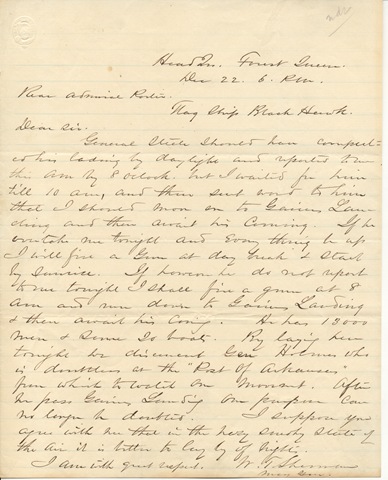
Head Qu. Forest Queen.

Dec 22. 6. PM.

Rear Admiral Porter.

Flag Ship Black Hawk.

Dear Sir.

General Steele should have [completed?] his lading by daylight and reported to me this AM by 8 oclock. but I waited for him till 10 AM, and then sent word to him that I should move on to [Gaines?] Landing and then await his coming. If he overtake me tonight and everything be up I will fire a gun at day break & start by sunrise. If however he do not report to me tonight I shall fire a gun at 8 am and run down to [Gaines?] Landing & then await his coming. He has 13000 men & some 20 boats. By laying here tonight we [discovered?] Gen. Holmes who is doubtless at the “Port of Arkansas” from which to watch our movement. After we pass [Gaines?]  Landing our purpose can no longer be doubted. I suppose you agree with me that in the heavy smoky state of the air it is better to lay by of nights.

I am with great respect. W. T. Sherman

Maj. Gen.

Citation: William T. Sherman (1820-1891), autograph letter signed to David D. Porter. aboard the Forest Queen, 22 December  [1862]. AMs 360/10