May 27, 1863: Henry and Mary Warner to John Warner

Henry and Mary Warner lived in Allegheny City, Pennsylvania, now part of Pittsburgh. They are the great-grandparents of poet Marianne Moore.  By the 1860s they had three surviving children:  John, Henry, and Anne. Their letters to John, a Presbyterian minister living in Gettysburg, are preserved as part of Marianne Moore’s family papers.
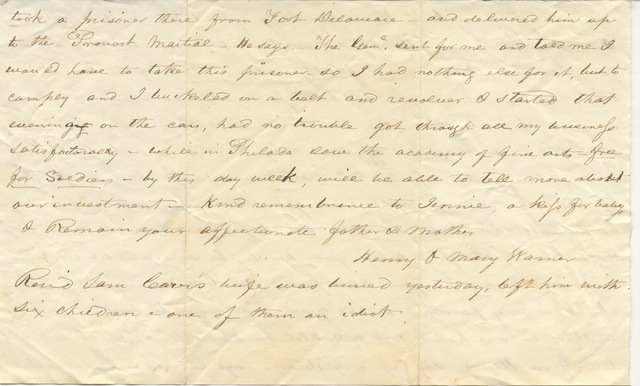
Moore VI-5-19 p1 Henry and Mary Warner to Children 5-22-63

Moore VI-5-19 p2 Henry and Mary Warner to Children 5-22-63

Transcript:

Allegheny City Wednesday May 27th 1863 4 P.M.

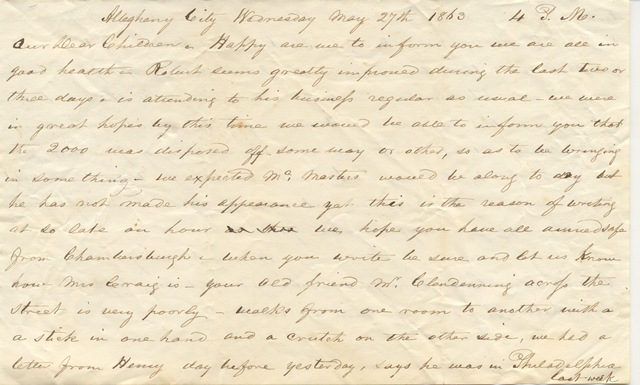
Our Dear Children—Happy are we to inform you we are all in good health—Robert seems greatly improved during the last two or three days & is attending to his business regular as usual—we were in great hopes by this time we would be able to inform you that the 2000 was disposed off some way or other, so as to be bringing in something—we expected McMasters would be along to day but he has not made his appearance yet this is the reason of writing at so late an hour we hope you have all arrived safe from Chambersburgh—when you write be sure and let us know how Mrs Craig is—your old friend Mr. Clendenning across the street is very poorly—walks from one room to another with a stick in one hand and a crutch on the other side. We had a letter from Henry day before yesterday, says he was in Philadelphia last week took a prisoner there from Fort Delaware—and delivered him up to the Provost Martial—He says—The Genl. sent for me and told me I would have to take this prisoner—so I had nothing else for it, but to comply and I buckled on a belt and revolver & started that evening on the cars, had no trouble got through all my business satisfactorily—while in Philada saw the academy of fine arts—free for soldiers—by the day week, will be able to tell more about our investment—kind remembrance to Jennie, a kiss for baby

& Remain your affectionate father & mother

Henry & Mary Warner

Revd Sam Carvis wife was buried yesterday, left him with six children—one of them an idiot

Citation: Henry and Mary Warner, autograph letter signed to John Riddle Warner.  Allegheny City [Pittsburgh], 27 May 1863. Moore VI:05:19
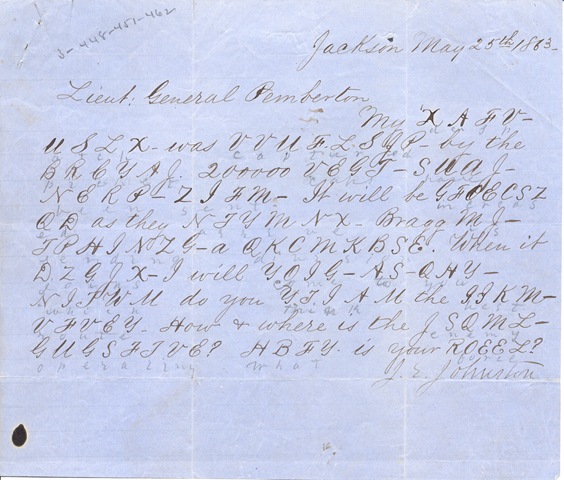
May 25, 1863: Joseph Johnston Coded Message to John Pemberton

AMs 357-14.2 p1 Joseph E. Johnston to John Clifford Pemberton

Transcript:

Jackson May 25th 1863.

Lieut: General Pemberton

My XAFVUSLX [dispatch] was VVUFLSJP[captured] by the BRCYAJ[picket]. 200000 VEGT[caps] SUAJ[have] NERP [been]ZJFM [sent]It will be GFOECSZQD [increased] as they NTYMNX[arrive] Bragg MJ [is] TPHINZG[sending] a QKCMKBSE[division]. When it DZGJX [joins] I will YOJG [come] AS [to] QHY [you] NJTWM [which]do you YTJAM [think] the JJKM [best] VFVEY [route] How & where is the JSQML[enemy] GUGSFJVE[operating]? HBFY [what] is your ROEEL [force]?

J. E. Johnston


Citation: Joseph E. Johnston (1807-1891), letter signed(cipher). Jackson, Miss; 25 May 1863. AMs 357/14.2

May 24, 1863: Henry Warner to John Riddle Warner

Henry Warner Jr. was the younger brother of John Riddle Warner, the grandfather of the poet Marianne Moore.  Henry served in  Independent Battery G from August 1862 until June 1865.These family letters are preserved as part of the Marianne Moore family papers.

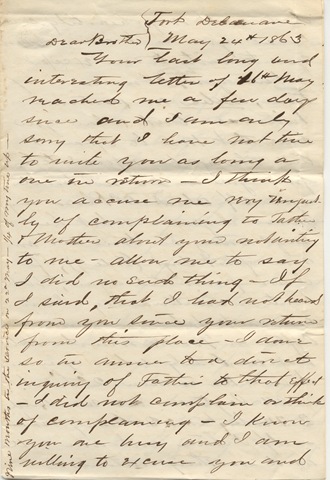
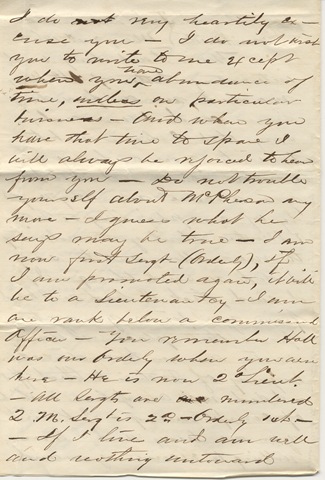
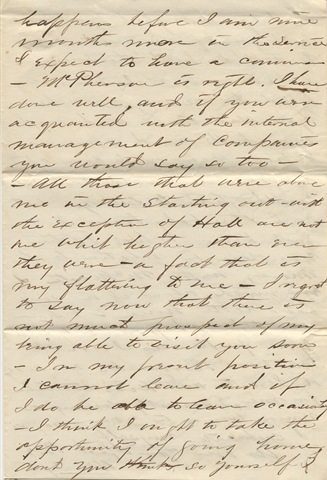
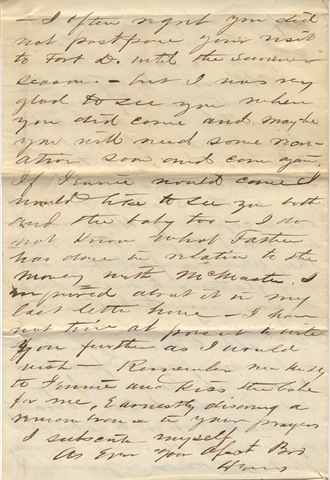
Moore VI-5-19 p1 Henry Warner to John Riddle Warner 5-24-63 Moore VI-5-19 p2 Henry Warner to John Riddle Warner 5-24-63 Moore VI-5-19 p3 Henry Warner to John Riddle Warner 5-24-63Moore VI-5-19 p4 Henry Warner to John Riddle Warner 5-24-63

Transcript:

Fort Delaware

May 24th 1863

Nine months in the service on 22d May– ¼ of my time up—

Dear Brother

Your last long and interesting letter of 16th May reached me a few days since and I am only sorry that I have not time to write you as long a one in return—I think you accuse me very unjustly of complaining to Father & Mother about your not writing to me—allow me to say I did no such thing—If I said, that I had not heard from you since your return from this place—I done so in answer to a direct inquiry of Father’s to that effect—I did not complain or think of complaining—I know you are busy and I am willing to excuse—you and I do not very heartily excuse you—I do not wish you to write to me except when you have abundance of time, unless on particular business—And when you have that time to spare I will always be rejoiced to hear from you—Do not trouble yourself about McPherson any more—I guess what he says may be true—I am now first Sergt (Orderly), If I am promoted again, it will be to a Lieutenantcy—I am one rank below a commissioned officer—You remark Hall was our Orderly when you were here—He is now 2 Lieut.—All Sergts are numbered 2.M. Sergt is 2nd Orderly 1st—If I live and am well and nothing untoward happens before I am nine months more in the Service. I expect to have a commission—McPherson is right. I have done well and if you were acquainted with the internal management of Companies you would say so too—All those that were above me in the starting out—with the exception of Hall are not one whit higher than ever they were—a fact that is very flattering to me—I regret to say now that there is not much prospect of my being able to visit you soon—In my present position I cannot leave and if I do be able to leave occasionally—I think I ought to take the opportunity of going home dont you think so yourself? – I often regret you did not postpone your visit to Fort D. until the summer season—but I was very glad to see you when you did come and maybe you will need some vacation soon and can again. If Jennie would come I would like to see you both. And the baby too—I do not know what Father has done in relation to the money with McMaster. I enquired about it in my last letter home—I have not time at present to write you further as I would wish—Remember me kindly to Jennie and kiss the babe for me, Earnestly desiring a remembrance in your prayers

I subscribe myself

As Ever Your Affect Bro

Henry

Citation: Henry Warner Jr., autograph letter to John Riddle Warner. Fort Delaware,24 May 1863. Moore VI:5:19

May 17, 1862: Charles Dahlgren telegram to Thomas Jordan

Pierre Gustave Toutant Beauregard was a Louisiana-born general of the Confederate States Army. He had graduated second in his class from West Point in 1838 and was an admirer of Napoleon. He achieved fame early in the Civil War for commanding the Fort Sumter bombardment and as the victor of the first battle of Manassas. He later served in the Western Theater (including Shiloh and Corinth), Charleston, and the defense of Richmond, but his career was hampered by friction with Jefferson Davis and other generals.

This is one of approximately 1000 military telegrams in P.G.T. Beauregard’s papers at the Rosenbach.

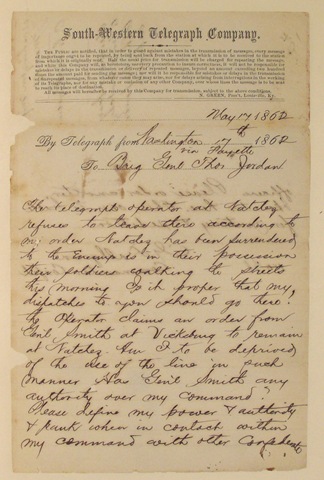
Telegram 5-17-62 Dahlgreen to Jordan 10 mp


Transcript:

May 17 1862

By Telegraph from Washington via Fayette 17th 1862

To Brig Genl Tho Jordan

The telegraph operator at Natchez refuses to leave there according to my order. Natchez has been surrendered to. the Enemy is in their possession. their soldiers walking the streets this morning. Is it proper that my dispatches to open should go there? the Operator claims an order from Gen’l Smith at Vicksburg to remain at Natchez. Am I to be deprived of the use of the line in such manner. Has Gen’l Smith any authority over my command? Please define my power & authority & rank when in contact within my command with other Confederate officers. Please order another operator here. This one is liable for mutiny & sedition.

C. Dahlgreen

Commander Confe


Citation: Charles G. Dahlgren (1811-1888), telegram to Thomas Jordan. 17 May 1862. AMs 434/16

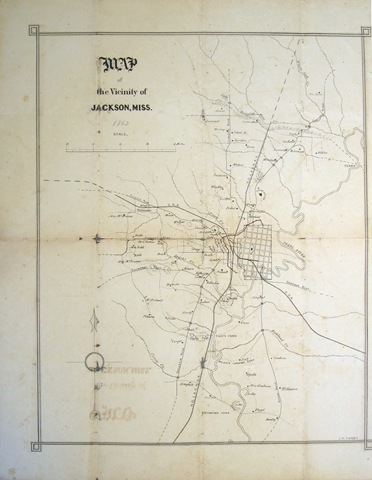
May 14, 1863: Map of Jackson, Mississippi

This map is one of twenty-four military maps and drawings in a collection of papers from Confederate General P.G.T. Beauregard. The map is dated only 1863, but the Battle of Jackson took place on May 14, 1863.


Citation:  Map of the vicinity of Jackson, Miss. [1863]. AMs 1168/11

May 13, 1863: U.S. Grant to John Alexander McClernand

AMs 813-23 p1 Grant to John Alexander McClernand AMs 813-23 p2 Grant to John Alexander McClernand

Transcript:

Head Qrs. Dept of the W.

Raymond Miss. May 13th/63

Maj. Gen. J.A. McClernand

Comdr. 13th Army Corps

Sir,

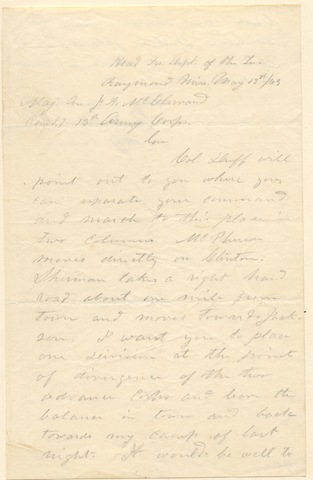
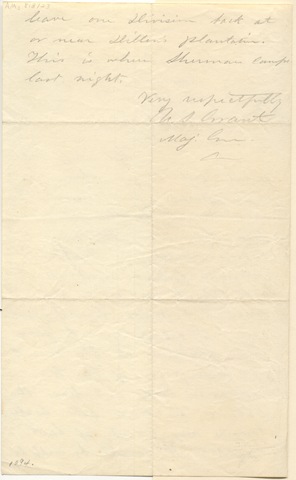
Col. Duff will point out to you where you can separate your command and march to this place in two columns. McPherson moves directly on Clinton. Sherman takes a right hand road about one mile from town and moves towards Jackson. I want you to place one Division at the point of divergence of the two advance corps and leave the balance in town and back towards my camp of last night. It would be well to leave one Division back at or near Dillon’s plantation. This is where Sherman camped last night.

Very respectfully

U.S. Grant

Maj. Gen

Citation: Grant, Ulysses S. (Ulysses Simpson), 1822-1885.ALS, [18]63 May 13, to John Alexander McClernand. AMs 813/23

May 10, 1863: Geographical Reader for the Dixie Children

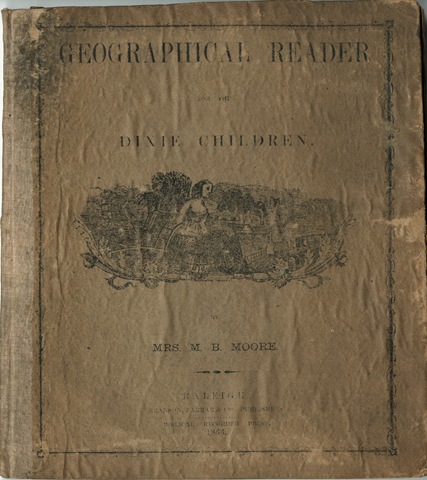
A 863 Geographical reader for Dixie Children

Excerpt:

Lesson XII

North America

The United States

  1. This was once the most prosperous country in the word. Nearly a hundred years ago it belonged to England; but the English made such hard laws that the people said they would not obey them. After a long, bloody war of seven years, they gained their independence; and for many years were prosperous and happy.
  2. In the mean time both English and American ships went to Africa and brought away many of those poor heathen negroes, and sold them for slaves. Some people said it was wrong and asked the King of England to stop it. He replied that “he knew it was wrong; but that slave trade brought much money into his treasury, and it should continue.” But both countries afterwards did pass laws to stop this trade. In a few years, the Northern States finding their climate too cold for the negro to be profitable, sold them to the people living farther South. Then the Northern States passed laws to forbid any person owning slaves in their borders.
  3. Then the northern people began to preach, to lecture, and to write about the sin of slavery. The money for which they sold their slaves, was now partly spent in trying to persuade the Southern States to send their slaves back to Africa. And when the territories were settled they were not willing for any of them to become slaveholding. This would soon have made the North much stronger than the South; and many of the men said they would vote for a law to free all the negroes in the country. The Southern men tried to show them how unfair this would be, but still they kept on.

Citation: Miss M. B. Moore, Geographical reader for the Dixie children. Raleigh, N.C.: Branson, Farrar, & Co, 1863. A 863g