November 28, 1863: Alexander Biddle to Julia Williams Rush Biddle

Rush IV 30-37 Nov 28 1863 letter 1 p1 Alexander Biddle to Julia Biddle Rush IV 30-37 Nov 28 1863 letter 1 p2 Alexander Biddle to Julia Biddle Rush IV 30-37 Nov 28 1863 letter 1 p3 Alexander Biddle to Julia Biddle Rush IV 30-37 Nov 28 1863 letter 1 p4 Alexander Biddle to Julia Biddle

Transcript:

Camp at Cedar Run Bridge

Nov. 29th [i.e. 28], 1863. Saturday

Dear Wife,

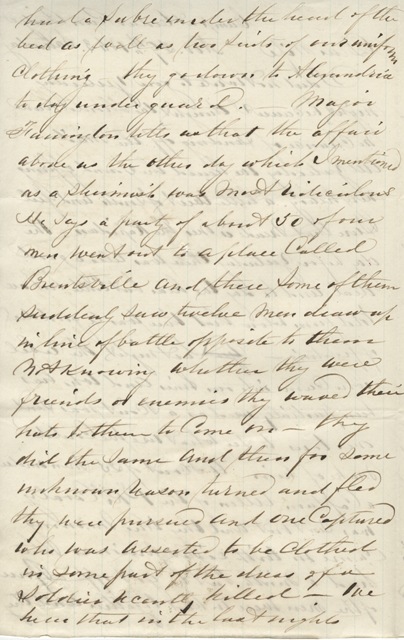
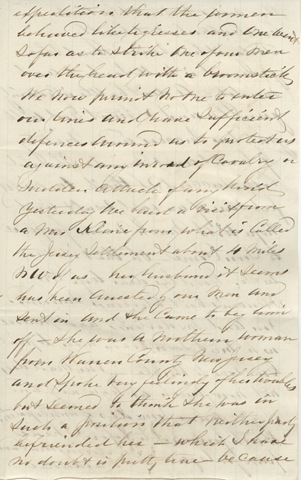
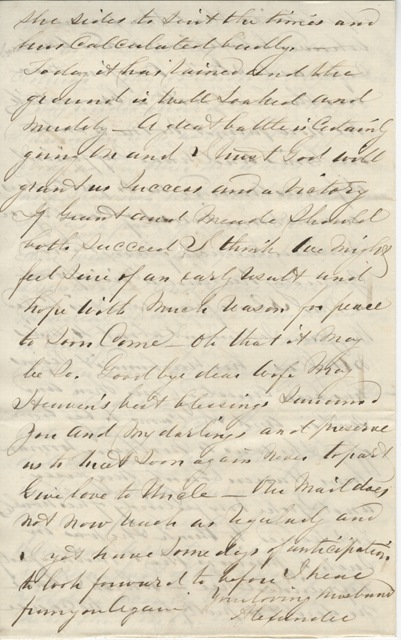
I did not write to you yesterday night because I thought we should have no chance of sending off the mail. All yesterday we heard the sound of firing very heavy, a little west of south and feel that Meade is near the Rapidan. The day before yesterday there was also a good deal and today we hear but little but are told from below that there was a good deal of fighting. Last night the rebel who came into our lines and who has been partially used as a court was sent over to us to see what use we could make of him. A court of 23 men under a Captain Allen of the 1st RI cavalry was sent out and they this morning came in with eight prisoners they had a ninth but he got off. Four of the men were in bed together and they had a saber under the head of the bed as well as two suits of our uniform clothing. They go down to Alexandria today under guard. Major Farrington tells us that the affair above as the other day which I mentioned as a skirmish was most ridiculous. He says a party of about 50 of our men went out to a place called Brentsville and there some of them suddenly saw twelve men draw up in line of battle opposite to them not knowing whether they were friends or enemies they waved there hats to them to come over. They did the same and then for some unknown reason turned and fled. They were pursued and one captured who was asserted to be clothed in some part of the dress of a soldier recently killed. We hear that in the last nights expedition that the women behaved like tigresses and one went so far as to strike one of our men over the head with a broomstick. We now permit no one to enter our lines and have sufficient defenses around us to protect us against any inroad of cavalry or soldier attack of any kind. Yesterday we had a visit from a Mrs. Kline from what is called the Jersey Settlement about 4 miles NW of us. Her husband it seems has been arrested by our men and sent in and she came to beg him off. She was a northern woman from Warren County New Jersey and spoke very feelingly of her troubles but seemed to think she was in such a position that neither party befriended her, which I have no doubt is pretty true because she sides to suit the times and has calculated badly. Today it has rained and the ground is well soaked and muddy. A great battle is certainly going on and I trust God will grant us success and victory. G Grant and Meade should both succeed I think we might feel sure of an early result and hope with much reason for peace to soon come. Oh that it may be so. Good bye dear wife, may heaven’s best blessings surround you and my darlings and preserve us to [meet?] soon again never to part. Give love to uncle, our mail does not now reach us regularly and I yet have some days of anticipation to look forward to before I hear from you again.

Your loving husband, Alexander

Citation: Alexander Biddle (1819-1899), autograph letter signed to Julia Williams Rush Biddle, 28 November 1863. Rush IV:30:37
November 27, 1863: John Henry Brown’s Journal

John Henry Brown was a painter of portrait miniatures, living and working in Philadelphia. He had met Lincoln in August of 1860 when he was commissioned to paint Lincoln’s portrait for a supporter, but although Brown liked Lincoln personally, he did not agree with Republican policies.

1863-11-27


Transcript:

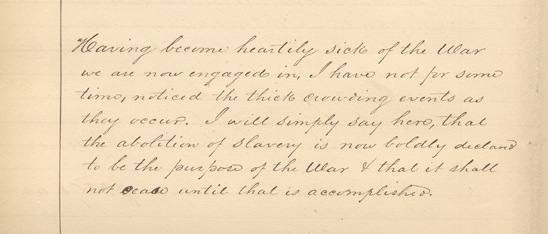
Having become heartily sick of the War we are now engaged in, I have not for some time noticed the thick crowding events as they occur. I will simply say here, that the abolition of slavery is now boldly declared to be the purpose of the War & that it shall not cease until that is accomplished.


Citation: John Henry Brown, autograph journal/account book. Philadelphia, 1844-1890. AMs 573/14.1

November 26, 1863: Alexander Biddle to Julia Williams Rush Biddle

Alexander Biddle was a member of the prominent Philadelphia Biddle family and was married to Julia Williams Rush,  the granddaughter of Dr. Benjamin Rush.  Biddle served with the 121st Pennsylvania Volunteer Infantry, beginning in September 1862. Starting out as a major, he would participate in Fredericksburg and Gettysburg, among other engagements, and would leave the service as a lieutenant colonel. (He was commissioned, but never mustered, as colonel)

Rush IV 30-37 Nov 26 1863 p1 Alexander Biddle to Julia Biddle Rush IV 30-37 Nov 26 1863 p2 Alexander Biddle to Julia Biddle Rush IV 30-37 Nov 26 1863 p3 Alexander Biddle to Julia Biddle Rush IV 30-37 Nov 26 1863 p4 Alexander Biddle to Julia Biddle

Transcript:

Camp at Cedar Run Bridge

Thanksgiving Day

Dear Wife,

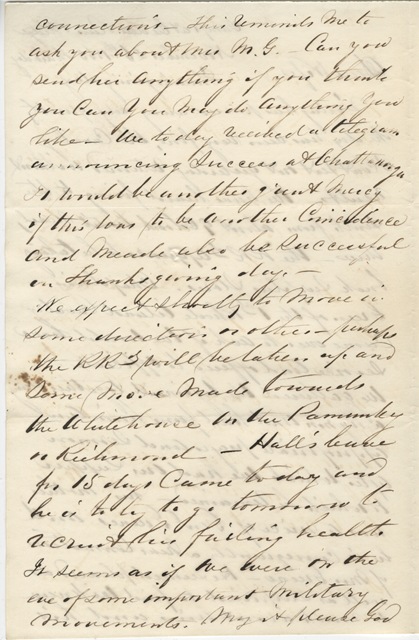
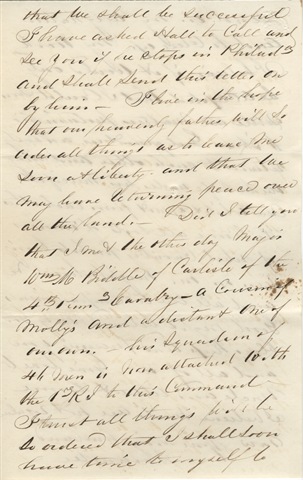
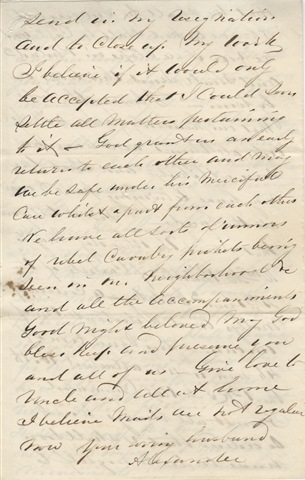
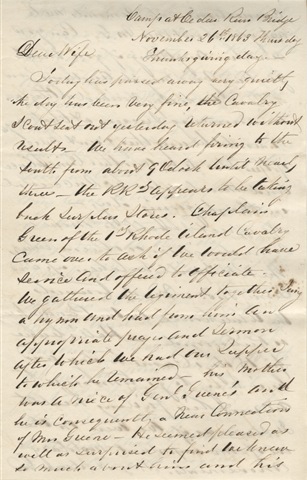
Today has passed away very quietly, the day has been very fine, the cavalry scount sent out yesterday returned without results. We have heard firing to the south from about 9 o’clock until nearly three. The RR appears to be taking back surplus stores. Chaplain Green of the 1st Rhode Island cavalry came over to ask if we would have service and offered to officiate. We gathered the regiment together, sung a hymn and had from him an appropriate prayer and sermon, after which we had our supper to which he remained. His mother was a niece of Gen Greene’s and he is consequently a near connection of Mr. Greene. He seemed pleased as well as surprised to find we knew so much about him and his connections. This reminds me to ask you about Mrs. M G. Can you send her anything if you think you can you may do anything you like. We today received a telegram announcing success at Chattanooga. It would be another great mercy if this was to be another coincidence and Meade also be successful on Thanksgiving Day. We expect shortly to move in some direction or other, perhaps the RR will be taken up and some move made towards the white house on the [Pammunky?] in Richmond. Hall’s leave of 15 days came today and he is to try to go tomorrow to recruit his failing health. It seems as if we were on the eve of some important military movements. May it please God that we shall be successful. I have asked Hall to call and see you if he stops in Philadelphia and shall send this letter on by him. I live in the hope that our heavenly father will so order things as to leave me soon at liberty and that we may have returning peace over all the land. Did I tell you that I met the other day Major Wm M Biddle of Carlisle of the 4th Cavalry. A cousin of Molly’s and a distant one of our own, his squadron of men is now attached with the 1st RI to this command. I trust all things will be so ordered that I shall soon have time to myself to send in my resignation and to close up. My work I believe if it would only be accepted that I could soon settle all matters pertaining to it. God grant us an early return to each other and may we be safe under his merciful care whilst apart from each other. We have all sorts of rumors of rebel cavalry pickets being seen in our neighborhood and all the accompaniments. Good night beloved, may God bless, keep, and preserve you and all of us. Give love to uncle and all at home. I believe mails are not regular now.

Your loving husband, Alexander

Citation: Alexander Biddle (1819-1899), autograph letter signed to Julia Williams Rush Biddle, 26 November 1863. Rush IV:30:37
November 25, 1863: Alexander Biddle to Julia Williams Rush Biddle

Alexander Biddle was a member of the prominent Philadelphia Biddle family and was married to Julia Williams Rush,  the granddaughter of Dr. Benjamin Rush.  Biddle served with the 121st Pennsylvania Volunteer Infantry, beginning in September 1862. Starting out as a major, he would participate in Fredericksburg and Gettysburg, among other engagements, and would leave the service as a lieutenant colonel. (He was commissioned, but never mustered, as colonel)

Rush IV 30-37 Nov 25 1863 p1 Alexander Biddle to Julia Biddle Rush IV 30-37 Nov 25 1863 p2 Alexander Biddle to Julia Biddle Rush IV 30-37 Nov 25 1863 p3 Alexander Biddle to Julia Biddle Rush IV 30-37 Nov 25 1863 p4 Alexander Biddle to Julia Biddle

Transcript:

B 53.334

Camp at Cedar Run Bridge 53.338

Dear Wife,

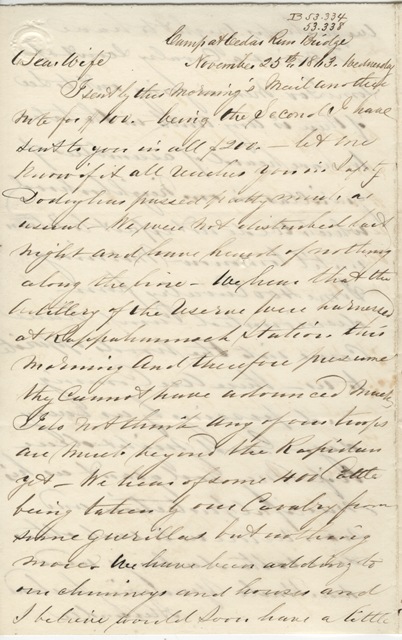
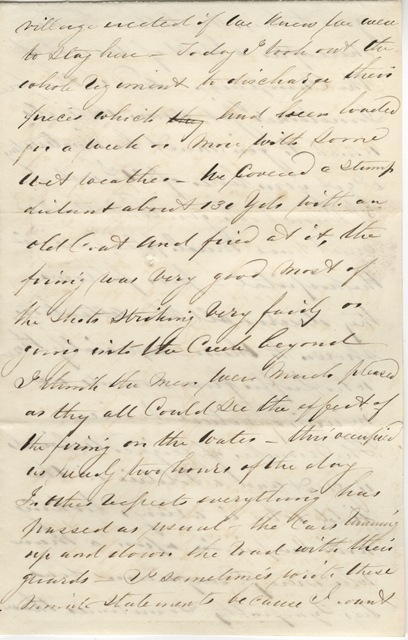
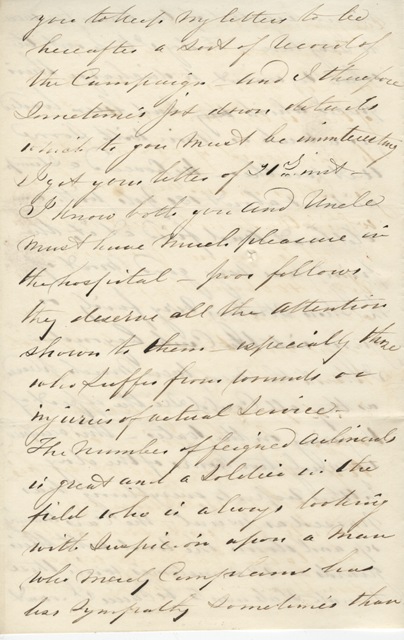
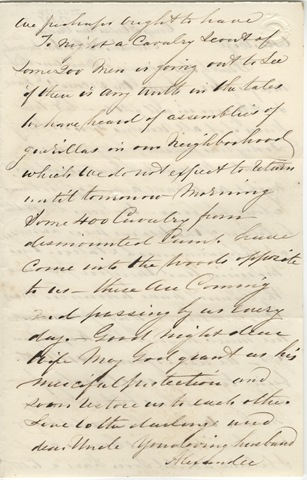
I sent by the morning’s mail another note for $100, being the second I have sent you in all $200. Let me know if it all reaches you in safety. Today has passed by pretty much as usual. We were not disturbed last night and have heard of nothing along the line. We hear that the artillery of the reserve have harnessed at Rappahannock Station this morning and therefore presume they cannot have advanced much. I do not think any of our troops are much beyond the Rapidan yet. We hear of some 400 cattle being taken by our cavalry from some guerillas but nothing more. We have been adding to our chimneys and houses and I believe would soon have a little village erected if we knew we were to stay here. Today I took out the whole regiment to discharge their pieces which had been loaded for a week or more… We covered a stump distant about 130 yds with an old coat and fired at it, the firing was very good most of the shots striking very fairly or going into the creek beyond. I think the men were much pleased as they all could see the effect of the firing on the water; this occupied us nearly two hours of the day. In other respects everything has passed as usual, the cars running up and down the road with their guards. I sometimes write these nominal statements because I count you to keep my letters to be hereafter a sort of record of the campaign and I therefore sometimes jot down details which to you must be uninteresting. I got your letter of [21st?] inst. I know both you and uncle must have much pleasure in the hospital. Poor felloes they deserve all the attention should to them, especially those who suffer from wounds of injuries of actual service. The number of feigned ailments is great and a soldier in the field who is always looking with suspicion upon a man who merely complains has less sympathy sometimes than we perhaps ought to have. To night a cavalry scout of some 200 men is going out to see if there is any worth in the tales we have heard of assemblies of guerillas in our neighborhood which we do not expect to return until tomorrow morning. Some 400 cavalry from dismounted [Camp] have come into the woods opposite to us. These are coming  and passing by us every day. Good night dear wife may God grant us his merciful protection and soon restore us to each other. Love to the darlings and dear uncle.

Your loving husband, Alexander

Citation: Alexander Biddle (1819-1899), autograph letter signed to Julia Williams Rush Biddle,25 November 1863. Rush IV:30:37
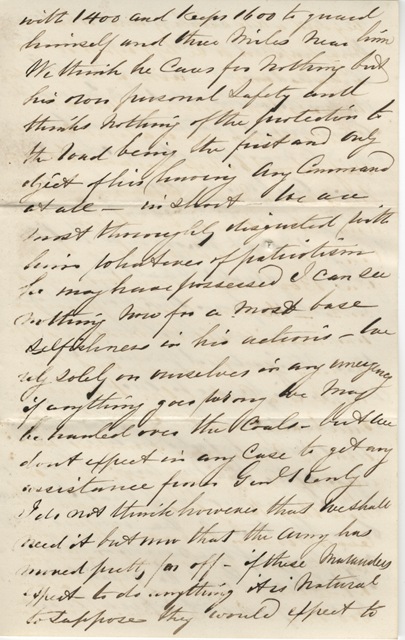
November 24, 1863: Alexander Biddle to Julia Williams Rush Biddle

Alexander Biddle was a member of the prominent Philadelphia Biddle family and was married to Julia Williams Rush,  the granddaughter of Dr. Benjamin Rush.  Biddle served with the 121st Pennsylvania Volunteer Infantry, beginning in September 1862. Starting out as a major, he would participate in Fredericksburg and Gettysburg, among other engagements, and would leave the service as a lieutenant colonel. (He was commissioned, but never mustered, as colonel)

Rush IV 30-37 Nov 24 1863 p1 Alexander Biddle to Julia Biddle Rush IV 30-37 Nov 24 1863 p2 Alexander Biddle to Julia Biddle Rush IV 30-37 Nov 24 1863 p3 Alexander Biddle to Julia Biddle Rush IV 30-37 Nov 24 1863 p4 Alexander Biddle to Julia Biddle

Transcript:

Camp at Cedar Run Bridge

November 24th, 1863 Tuesday

Dear Wife,

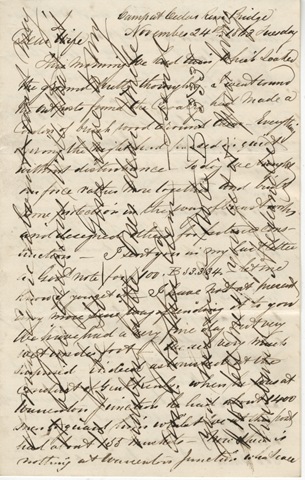
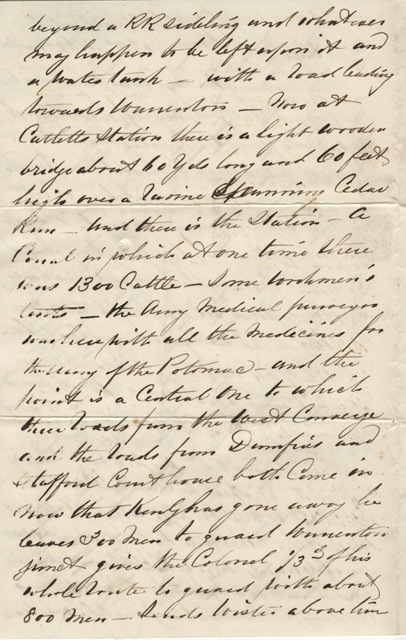
This morning we had rain which soaked the ground pretty thoroughly. I went round the outposts found the cavalry had made a cordon of brush wood around them. Everything during the night had passed in quiet without disturbance. Today we brought our force rather more together and built some protection in the way of breast work and designed others for future construction. I sent you in my last letter a good note for $100. B53.334 Let me know if you get it. I have not at present any more sure way of sending it to you. We have had a very fine day but very wet under foot. We all very much surprised indeed astonished at the conduct of Gen Kenly when he was at Warrenton Junction he had about 1400 men to guard him whilst we at the post had about 155 muskets. Now there is nothing at Warrenton Junction whatever beyond a RR sideling and whatever may happen to be left upon it and a water tank with a road leading towards Warrenton. Now at Catlett’s Station there is a light wooden bridge about 10 yds long and 60 feet high over a ravine spanning Cedar Run, and there is the station. A corral in which at one time there was 1300 cattle, some workmen’s tents. The army medical purveyor was here with all the medicines for the army of the Potomac, and the point is a central one to which three roads from the west converge and the roads from Dumfries and Stafford Court house both came in now that Kenly has gone away he leaves 300 men to guard Warrenton Junction gives the Colonel 1/3 of his whole route to guard with about 800 men. Sends Wister above him with 1400 and keeps 1600 to guard himself and three miles near him. We think he cares for nothing but his own personal safety and thinks nothing of the protection to the road being the first and only object of his having any command at all. In short we are most thoroughly disgusted with him whatever of patriotism he may have possessed I can see nothing now for a most base selfishness in his actions. We rely solely on ourselves in any emergency if anything goes wrong we may be handed over the [coals] but we don’t expect in any case to get any assistance from Gen Kenly. I do not think however that we shall need it but now that the army has moved pretty far off, if these marauders expect to do anything it is natural to suppose they would expect to act on some weak part of the line. We have that the army intended to cross the Rapidan at Germania ford, our two divisions the 1st, 2nd of our Corps have moved further on and soon expect to hear of something which will cause our troop to move also. I have nothing more to say about self in the army. I don’t known how to tell you how glad I shall be for any exemptions from this sort of life, may it please God soon to end this strife and permit us to return in peace to our homes. I have heard the view expressed that peace would be arranged soon after the meeting of Congress but I cannot say that I perceived how that is to be unless by the yielding of the South. Should it please God to grant success to our present operations it may come about and may it be his gracious will that it is to be so. Give love to my darling little ones, dear uncle, and brother Clem. I send you herein a note B 53338 $100. Tell me if you get it.

Your loving husband, Alexander

Citation: Alexander Biddle (1819-1899), autograph letter signed to Julia Williams Rush Biddle, 24 November 1863. Rush IV:30:37
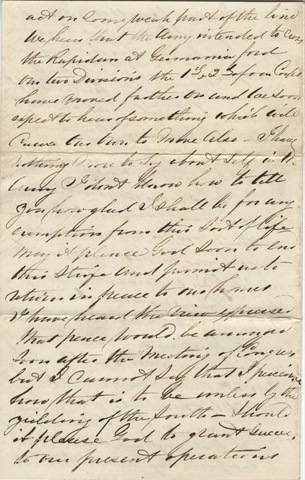
November 23, 1863: Alexander Biddle to Julia Williams Rush Biddle

Alexander Biddle was a member of the prominent Philadelphia Biddle family and was married to Julia Williams Rush,  the granddaughter of Dr. Benjamin Rush.  Biddle served with the 121st Pennsylvania Volunteer Infantry, beginning in September 1862. Starting out as a major, he would participate in Fredericksburg and Gettysburg, among other engagements, and would leave the service as a lieutenant colonel. (He was commissioned, but never mustered, as colonel)Rush IV 30-37 Nov 23 1863 p1 Alexander Biddle to Julia Biddle Rush IV 30-37 Nov 23 1863 p2 Alexander Biddle to Julia Biddle Rush IV 30-37 Nov 23 1863 p3 Alexander Biddle to Julia Biddle Rush IV 30-37 Nov 23 1863 p4 Alexander Biddle to Julia Biddle

Transcript:

I send you herein $100, tell me if you get it

Camp at Cedar Run Bridge

Dear Wife,

I have nothing from you today. Just after midnight a man was brought up by the guard to my tent. I went out, asked him where he came from. He said he did not want to speak in presence of so many men. I took him inside of the tent. He told me he came from the Rebs that he left them at sundown, that they were about 500 strong. That they intended to make an attack this Monday evening on the trains, to attack it in the rear and run after another party who would put obstructions in front and so capture it and get horses. He said he had specimens of the goods they got from Alexandria which were smuggled through from house to house. He showed us some cloth. His shawl also his grey [round?] about and had on a blue army coat with a New York Excelsior brigade buttons, dark pantaloons. He called his buttons State buttons but they were not so. He said his name was John Deshea formerly of the 6th Kentucky Col John McClung that he came from Ohio County, Ky and was anxious to get out. He told us that there were several Confederate Captain’s and some men who with scouts (guerillas) would make into full 500 men. He said one of the Captain’s was a former Representative from Texas named Smith. Another named Delaware [Delashiels?] Cooper who had commanded a battery. His own Captain whom he came out with was named Davis. Now his Captain was a man named Kinchella and the 1st Lient Rich Shepard. He named three places [Tremmis?] cross roads. [Mr. Botts?] Kings [Evans?] Smiths, where parties of these men congregated they were badly off for horses and wanted them badly. He said they could be captured with a strong force without difficulty but it would require care to do it he said he had been suspected for some time and had been trying to get off. Was anxious to be farther to Meade’s Hd Qts. Spoke of some of our men who were deserting being robbed. Spoke of a Sergeant who was deserting who refused to give up his arms whom they shot and robbed said they gave him 175 of his money, no he had been long without pay and he now had about 50 left. Spoke of a Lieutenant who had been wounded in both shoulders whom he interceded for and whom he believed they killed. He put him in charge of the guard and the Colonel having to meet General Kenly this morning at the station Junction  took him with him. He said speaking to General Kenly that he had done this thing to better his condition. He slept by our guard fire during the night. We did not fully trust him. The Colonel distrusted more than I did. During the day an old negro and his family of 4 or 5 women and children who came in. They had walked to the junction during the night from a place called Bristoes bridge and this man who was coming up with some things to sell brought him over. I enquired carefully of this old fellow who told me exactly the whereabouts of most of the names I have set down, said he thought these men could gather together 50 to 100 to 200 or 300 men that [Aringtons?] cross roads was the place they met at that they had a tent in a piece of woods near his house and every day something could be found there. I also found out the position on the map of the places indicated (just here I was interrupted by the sound of a carbine shot, turned out the regiment under arms, it was a cavalry man on a picket remained about 20 under arms and have now got back to my letter) I found out also that the man refused to tell his news to the Colonel of the Regiment who apprehended him. He was also very anxious to be considered as having come in, not a deserter apprehended. Later in the day we had more applications from people for passes and heard from a neighbor some more information in confirmation of what we heard. Some men were seen later in the day and a party of 20 were sent out to see about them. They brought in a country man under slightly suspicious circumstances so he was kept under guard for several hours nearby where the men were putting up a breast work. At dinner time as I went over to the dining tent past the guard I saw a rope hanging from a tree and found the men as they passed this fellow would say jokingly, oh you’ve got the rope ready for him, hehe. We finally released the poor fellow who I thought might have a little sickness about him to. We have just heard that it was a conscript who fired at the cavalry outpost which he had been starring at for half an hour. He however hit no one. Kenly has left us today, he gives us 8 miles to guard from Bealeton to Walnut [Run]. Our force at this point to night being 214 infantry and 191 cavalry, we have to protect 8 miles with another regiment. Whilst Kenly with 1600 men protects himself and three miles of some RR, he has two pieces of artillery also and 50 cavalry. We think his conduct akin to shameful cowardice. Nice condition is it not to be in to think your division is so weak and know that he gets so drunk. Truly I have many reasons for desiring to get out of this division. I have thus given you a day’s life in camp excepting my ride over to the 150th at the Warrenton Junction to see Major Chamberlain and also seeing Major Farrington of the 1st Rhode Island and Tom Biddle of the 4th Penn. Molly’s my cousin. Good night dear wife may God in his mercy watch over us and lead us in happiness to each other never to part. Love to children and dear uncle.

Your loving husband, Alexander

Citation: Alexander Biddle (1819-1899), autograph letter signed to Julia Williams Rush Biddle,23 November 1863. Rush IV:30:37
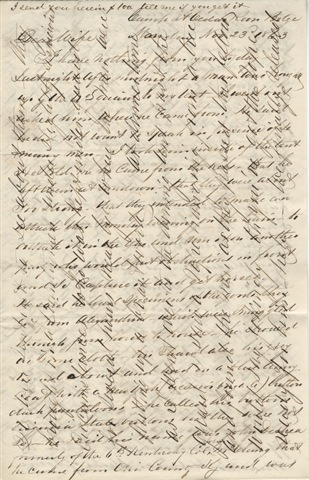
November 22, 1863: Alexander Biddle to Julia Williams Rush Biddle

Alexander Biddle was a member of the prominent Philadelphia Biddle family and was married to Julia Williams Rush,  the granddaughter of Dr. Benjamin Rush.  Biddle served with the 121st Pennsylvania Volunteer Infantry, beginning in September 1862. Starting out as a major, he would participate in Fredericksburg and Gettysburg, among other engagements, and would leave the service as a lieutenant colonel. (He was commissioned, but never mustered, as colonel)

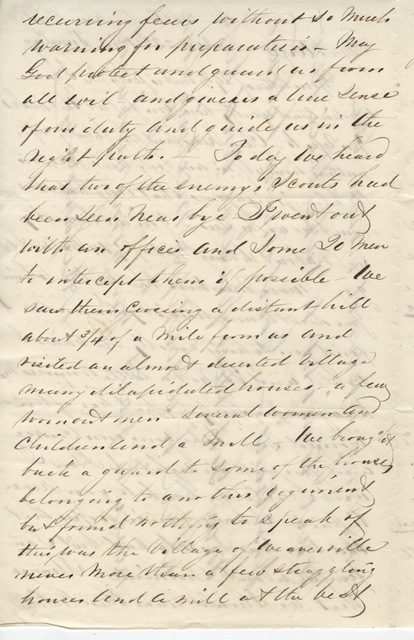
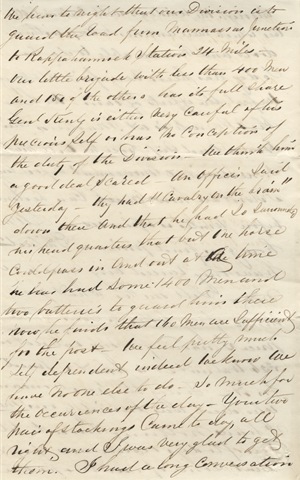
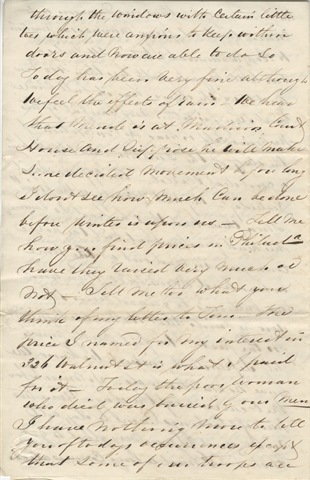
Rush IV 30-37 Nov 22 1863 p1 Alexander Biddle to Julia Biddle Rush IV 30-37 Nov 22 1863 p2 Alexander Biddle to Julia Biddle Rush IV 30-37 Nov 22 1863 p3 Alexander Biddle to Julia Biddle

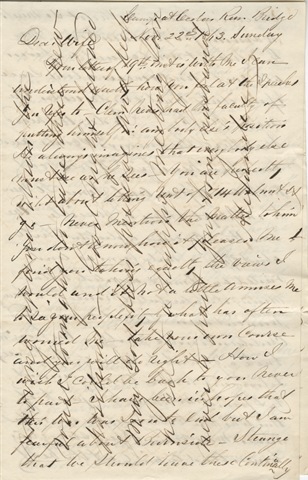
Rush IV 30-37 Nov 22 1863 p4 Alexander Biddle to Julia Biddle

Transcript:

Camp at Cedar Run Bridge

Dear Wife,

Your letter of 19th is with me. I can understand exactly how you feel at the speeches you refer to. Clem has had the faculty of putting himself in anybody else’s position. He always imagines that everybody else must see as he sees. You are perfectly right about letting rent of 714 Walnut St. go. Never mention the matter to him, you don’t know how it pleases me to find you taking exactly the views I would and it not a little amuses me to see your perplexity by what has often worried me. Take your own course and you will do right. How I wish I could be back to you never to part. I have been in hopes that this war was soon to end but I am fearful about Burnside. Strange that we should have these continually recurring fears without so much warning for preparations. May God protect and guard us from all evil and give us a sense of our duty and guide us in the right path. Today we heard two of the enemy’s scouts had been seen near bye. I went out with an officer and some 20 men to intercept them if possible. We saw them crossing a distant hill about ¾ of a mile from us and visited an almost deserted village many dilapidated houses, a few worn out men, several women and children and a mill. We brought back a guard to come of the houses belonging to another regiment but found nothing to speak of, this was the village of [Weaverville?] never more than a few straggling houses and a mill at the best we hear tonight that our Division is to guard the road from Manassas Junction to Rappahannock Station 24 miles. Our little brigade with less than 400 men and 150 of the others has its full share. Gen. Kenly is either very careful of his precious self or has no conception of the duty of the Division. We think him a good deal scared. An officer said yesterday they had “Cavalry on the brain” down there and that he has so surrounded his head quarters that but one horse could pass in and out at the time he has had some 1400 men and two batteries to guard him there now he finds that 110 men are sufficient for the post. We feel pretty much self dependent indeed we know we have no one else to do. So much for the occurrences of the day. Your two pairs of stockings came today all right and I was very glad to get them. I had a long conversation through the windows with certain little toes which were anxious to keep within doors and now are able to do so. Today has been very fine although we feel the effects of rain. We hear that Meade is at Madison’s Country House and suppose he will make some decided movement before long. I don’t see how much can be done before winter is upon us. Tell me how you find prices in Philadelphia, have they raised very much or not. Tell me too what you think of my letter to Tom. The price I named for my interest in 326 Walnut St. is what I paid for it. Today the poor woman who died was buried by our men. I have nothing more to tell you of today’s occurrences except that some of our troops are moving up and down the road tonight to take their new positions. Good night beloved may God bless, preserve, and keep us all to a happy meeting soon never to part.

Your loving husband, Alexander

Citation: Alexander Biddle (1819-1899), autograph letter signed to Julia Williams Rush Biddle,22 November 1863. Rush IV:30:37
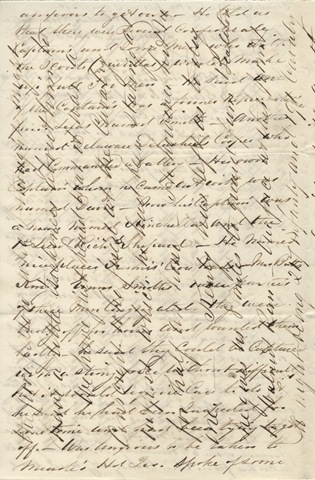
November 21, 1863: Alexander Biddle to Julia Williams Rush Biddle

Alexander Biddle was a member of the prominent Philadelphia Biddle family and was married to Julia Williams Rush,  the granddaughter of Dr. Benjamin Rush.  Biddle served with the 121st Pennsylvania Volunteer Infantry, beginning in September 1862. Starting out as a major, he would participate in Fredericksburg and Gettysburg, among other engagements, and would leave the service as a lieutenant colonel. (He was commissioned, but never mustered, as colonel)

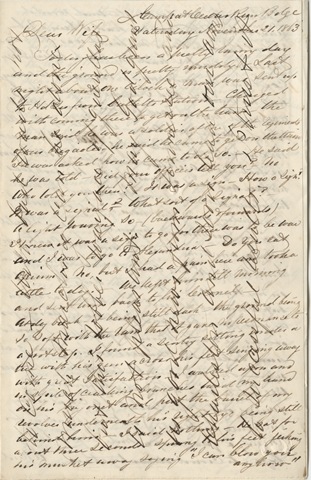
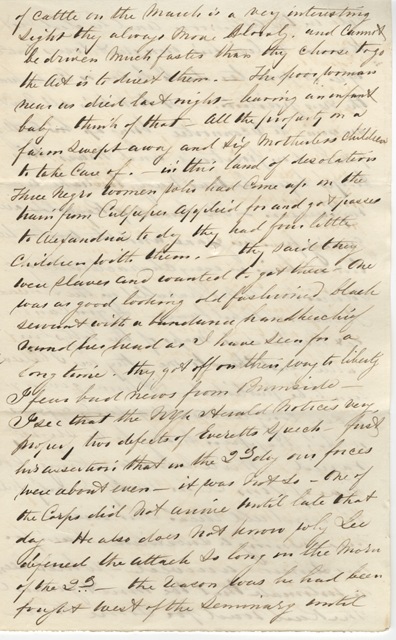
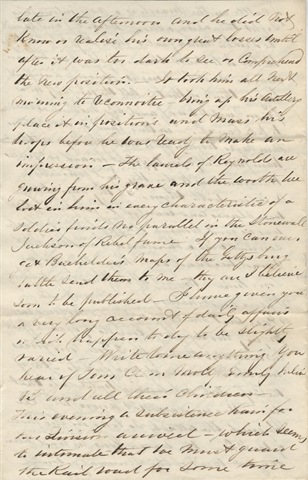
Rush IV 30-38 Nov 21 1863 p1 Alexander Biddle to Julia Biddle Rush IV 30-37 Nov 21 1863 p2 Alexander Biddle to Julia Biddlel Rush IV 30-37 Nov 21 1863 p3 Alexander Biddle to Julia Biddle Rush IV 30-37 Nov 21 1863 p4 Alexander Biddle to Julia Biddle

Transcript:

Camp at Cedar Run Bridge

Dear Wife,

Today has been a pretty rainy day and the ground is pretty muddy. Last night about one o’clock a man was sent up to Hd Qts from Catlett’s station. Charged with coming there to get on the train, the man said he was a soldier of the regiments of our brigades, he said he came to get on the train. He was asked how he came to do so. He said he was told. Did your officers tell you? No. Who told you then? It was a sign. How a sign? It was a signal. What sort of a signal? A light [waving?] so (backwards & forwards) It was a sign to go for there was to be war and I was to go to Alexandria. Do you eat opium? No, but I had a pain here and took a little today. We kept him till morning and sent him back to his Colonel. At day break, it being still dark, the ground being so soft with the rain that it gave no resonance to a footstep. I found a sentry sitting under a tree with his gun across his feet singing away with great satisfaction. I walked upon and in spite of cracking branches  had my hand on his bayonet and put the barrel of my revolver underneath his right eye being still behind him. I said nothing. He sat for about three seconds sprung to his feet jerking his musket away saying “I can blow you anyhow.” I believe he was desperate and would have taken the chance had I been a Reb. I don’t think he knew me for it was the gray morning and I had my black indiarubber coat over my uniform. He came to a charge with his musket and I believe then just clearly recognized me. I said to him, you see what sort of a sentry you are. He held up the little book in his hand whilst a big tear of I believe of partial fright, agitation, & desperation rolled down his face and said it was that his book was the soldier’s devotional song book and he had been whiling away his hour of duty on post by singing his morning hymn of praise. I could not say anything more to him but cautioning him to let no one come so close to him. It was my duty to scold him but I know I scared him about as much as was possible and felt half sorry for it as he really though frightened would have taken the chances rather than give up. This morning the cattle heard left us 1300 cattle with a Cavalry regiment, they passed out of the Coral (a coral is any enclosure for beasts) in twos extending for nearly a quarter of a mile before they began to crowd together. A herd of cattle on the march is a very interesting sight, they always move slowly and cannot be driven much faster than they choose to go, the Act is to direct them. The poor woman near us died last night bearing an infant baby, think of that, all the profit on a farm swept away and six motherless children to take care of. In this land of desolation three Negro women who had come up on the train from Culpeper applied for and got passes to Alexandria today they had four little children with them. They said they were slaves and wanted to get there, one was as good looking old fashioned black servant with a bandana handkerchief around her hand as I have seen for a long time, they got off on their way to liberty. I have bad news from Burnside. I see that the NYk Herald notices very proper two defects of Everett’s speech. First his assertion that in the 2nd day our forces were about even, it was not so. One of the Corps did not arrive until late that day. He also does not know why Hd Qts defended the attack so long on the morn of the 2nd. The reason was he had been fought west of the seminary until late in the afternoon and he did not know or realize his own great losses until after it was too dark to see or comprehend the new position. It took him all next morning to reconnoiter, bring up his artillery, place it in positions and mass his troops before he was ready to make an impression. The laurels of Reynolds are growing from his grave and the worth we lost in him in every characteristic of a soldier finds no parallel in the Stonewall Jackson of Rebel fame. If you can ever get Bachelder’s maps of the Gettysburg battle send them to me, they are I believe soon to be published. I have given you a very long account of daily affairs which happen today to be slightly varied. Write home anything you hear of Tom, Clem, Molly, Emily and all their children. This evening a subsistence train for our division arrived which seems to intimate that we must guard the Railroad for some time to come. with bad roads not much marching can be done but this robber war was of guerillas is not pleasant. May God grant us good news from Tennessee and Charleston and soon [give?] our arms to successful results. I trust it  may be so and this cruel war soon ended. Give love to Uncle and all my darlings, good night beloved.

Your loving husband, Alexander

Citation: Alexander Biddle (1819-1899), autograph letter signed to Julia Williams Rush Biddle,21 November 1863. Rush IV:30:37
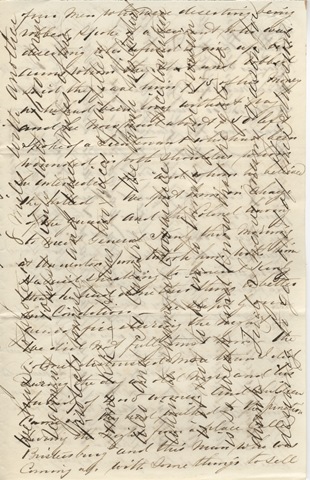
November 20, 1863: Alexander Biddle to Julia Williams Rush Biddle

Alexander Biddle was a member of the prominent Philadelphia Biddle family and was married to Julia Williams Rush,  the granddaughter of Dr. Benjamin Rush.  Biddle served with the 121st Pennsylvania Volunteer Infantry, beginning in September 1862. Starting out as a major, he would participate in Fredericksburg and Gettysburg, among other engagements, and would leave the service as a lieutenant colonel. (He was commissioned, but never mustered, as colonel)

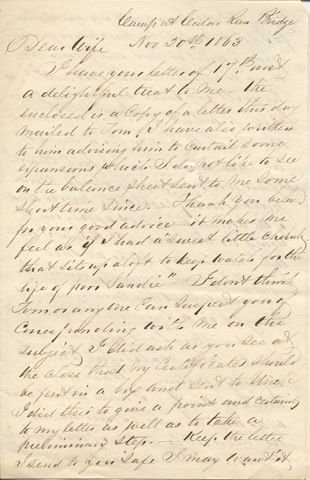
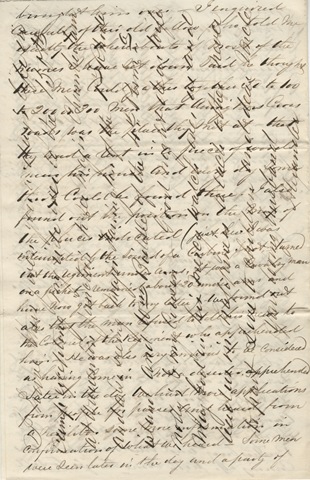
Rush IV-30-37 p1 A Biddle ALS to Julia William Rush, Nov. 20, 1863 Rush IV-30-37 p2 A Biddle ALS to Julia William Rush, Nov. 20, 1 Rush IV-30-37 p3 A Biddle ALS to Julia William Rush, Nov. 20, 1863 Rush IV-30-37 p4 A Biddle ALS to Julia William Rush, Nov. 20, 1863 Rush IV-30-37 p5 A Biddle ALS to Julia William Rush, Nov. 20, 1863 Rush IV-30-37 p6 A Biddle ALS to Julia William Rush, Nov. 20, 1863

Transcript:

Camp at Cedar Run Bridge

Dear Wife,

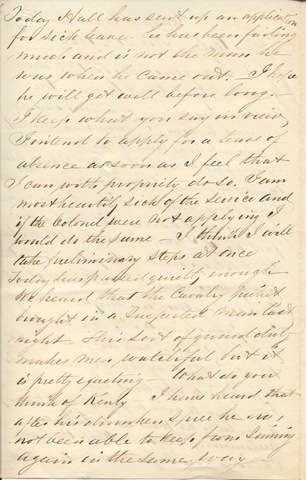
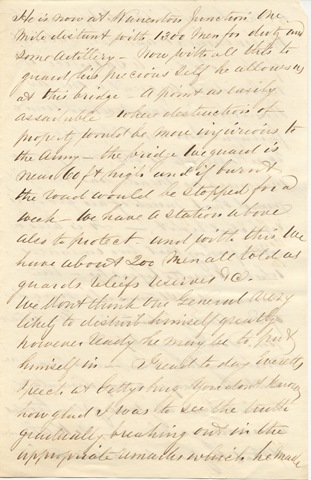
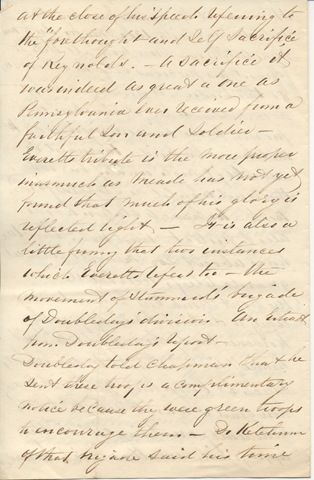
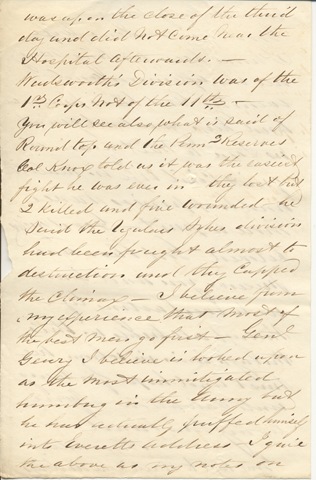
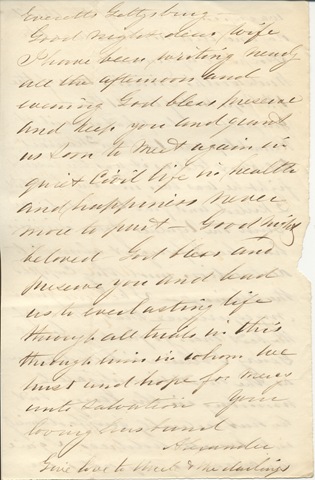
I have your letter of 17th a delightful treat to me. The enclosed is a copy of a letter this day mailed to Tom. I have also written to him advising him to curtail some expansions which I do not like to see on the balance sheet sent to me some short time since. Thank you beloved for your good advice, it makes me feel as if I had a “sweet little cherub that sits up aloft to keep watch for the life of poor Sandie.” I don’t think Tom or anyone can suspect you of corresponding with me on the subject. I did ask as you said at the close that my certificates should be put in a box and sent to Uncle. I did this to give a point and certainty to my letter as well as to take a preliminary step. Keep the letter I send to you safe, I may want it. Today Hall has sent up an application for sick leave, he has been failing much and is not the man he was when he came out. I hope he will get well before long. I keep what you say in view. I intend to apply for a leave of absence as soon as I feel that I can with propriety do so. I am most heartily sick of the service and if the colonel were not applying I would do the same. I think I will take preliminary steps at once. Today has passed quietly enough. We heard that the Cavalry regiment brought in an unexpected man last night. This sort of guard duty makes men watchful but it is pretty exacting. What do you think of Kenly. I have heard that after his drunken spree he has not been able to keep from sinning again in the same way. He is now at Warrenton Junction one mile distant with 1300 men for duty and some artillery. Now with all this to guard his precious self he allows us at this bridge. A point as easily assailable where destruction of property would be more injurious to the Army, the bridge we guard is nearly 60 ft high and if burnt the road would be stopped for a week. We have a station above also to protect and with this we have about 200 men all told as guard’s reliefs reserves &c. We don’t think one General very likely to disturb himself greatly however ready he may be to put himself in. I read today Everett’s speech at Gettysburg; you don’t know how glad I was to see the truth gradually breaking out in the appropriate remarks which he made at the close of his speech. Referring to the “forethought and self sacrifice of Reynolds, a sacrifice it was indeed as great a one as Pennsylvania ever received from a faithful son and soldier. Everett’s tribute is the more proper in as much as Meade has not yet found that much of his glory is reflected light. It is also a little funny that two instances which Everett refers too, the movement of Stammard’s brigade of Doubleday’s division. An extract from Doubleday’s report: Doubleday told Chapman that he sent these troops a complimentary notice because they were green troops to encourage them. [Dr. Ketchman?] of that brigade said his time was upon the close of the third day and did not come near the Hospital afterwards. Wadsworth’s Division was of the 1st Corps not of the 11th. You will see also what is said of Round top and the Penn Reserves. Knox told us it was the easiest fight he was ever in, they lost but 2 killed and five wounded. He said the Regulars of his division had been fought almost to destruction and they  capped the climax. I believe from my experience that most of the best men go first. Gen Geary I believe is looked upon as the most unmitigated humbug in the Army, but he has actually puffed himself into Everett’s address. I give the above as my notes on Everett’s Gettysburg. Good night dear wife, I have been writing nearly all the afternoon and evening. God bless, preserve, and keep you and grant us soon to meet again in quiet civil life in health and happiness never more to part. Good night beloved. God bless and preserve you and guide us to everlasting life through all trials in this through him in whom we trust and hope for mercy unto salvation.

Your loving husband, Alexander

Give love to Uncle and the darlings

Citation: Alexander Biddle (1819-1899), autograph letter signed to Julia Williams Rush Biddle,20 November 1863. Rush IV:30:37
November 19, 1863: Order of Procession at Gettysburg Cemetery

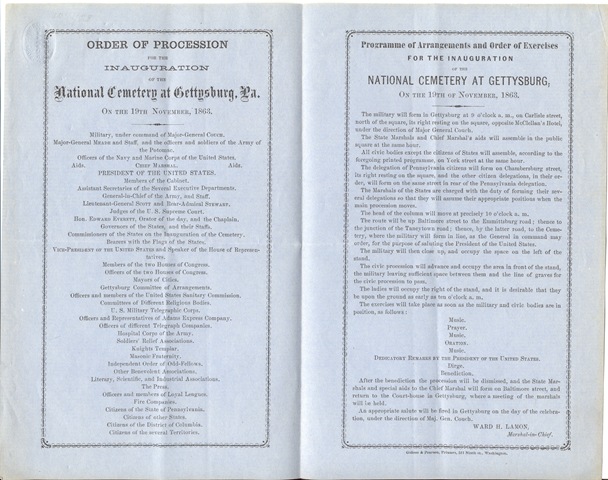
Faced with the death of over 3100 Union soldiers at Gettysburg, the north responded with the creation of a national cemetery, inaugurated on November 19, 1863. This leaflet for the inauguration gives the order for the procession to the cemetery and a brief outline of the program, including an “Oration” (to be given by Edward Everett) and Lincoln’s “Dedicatory Remarks” (the soon-to-be-famous Gettysburg Address). The participant list underscores the scope and scale of the occasion—it includes not only military but also Masons, Oddfellows, benevolent organizations, and citizens (including women) from numerous states.

A 863or 600dpi


Citation: Order of procession for the inauguration of the National Cemetery at Gettysburg Pennsylvania. Washington, D.C.: Gideon & Pearson, [1863]. A 863or