June 15, 1864: Lee Telegram to Beauregard

Pierre Gustave Toutant Beauregard was a Louisiana-born general of the Confederate States Army. He had graduated second in his class from West Point in 1838 and was an admirer of Napoleon. He achieved fame early in the Civil War for commanding the Fort Sumter bombardment and as the victor of the first battle of Manassas. He later served in the Western Theater (including Shiloh and Corinth), Charleston, and the defense of Richmond, but his career was hampered by friction with Jefferson Davis and other generals.


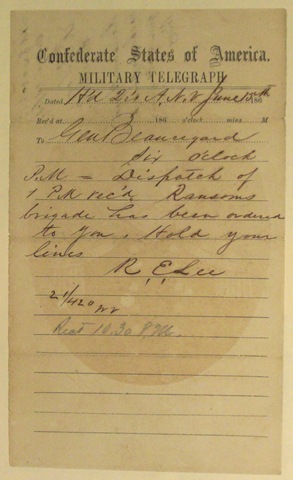
This telegram is from The Telegraphic History of the Civil War; a compiled album of telegrams to Beauregard from Davis, Lee, Johnston and others.

Telegram 6-15-64 Lee to Beauregard 10 mp

Transcript:

Dated H’d Q’s A. N. V. June 15th 186

To Gen. Beauregard

Six o’clock P.M – Dispatch of 1 PM rec’d. Ransoms brigade has been ordered to you. Hold your lines

R. E. Lee

21/420 wv

Recd 10.30 P. M.


Citation:Robert E. Lee (1807-1870), telegram to G.T. Beauregard. 15 June 1864. In The telegraphic history of the Civil War, 1861-1865. AMs 434/16

June 14, 1864: Lee Telegram to Beauregard

Pierre Gustave Toutant Beauregard was a Louisiana-born general of the Confederate States Army. He had graduated second in his class from West Point in 1838 and was an admirer of Napoleon. He achieved fame early in the Civil War for commanding the Fort Sumter bombardment and as the victor of the first battle of Manassas. He later served in the Western Theater (including Shiloh and Corinth), Charleston, and the defense of Richmond, but his career was hampered by friction with Jefferson Davis and other generals.


This telegram is from The Telegraphic History of the Civil War; a compiled album of telegrams to Beauregard from Davis, Lee, Johnston and others.

Telegram 6-14-64 Lee to Beauregard 10 mp

Transcript:

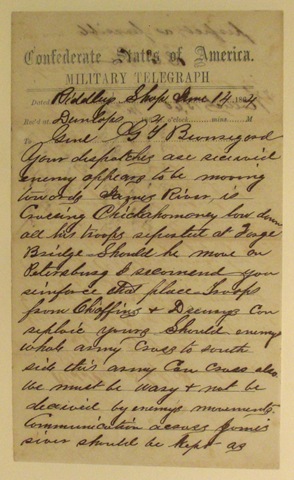
Dated Riddleys Shop June 14 1864

Rec’d at Dunlop 1864

To Genl G T Beauregard

Your dispatches are received. enemy appears to be moving towards James River, is crossing Chickahomoney low down all his troops reposted at Forge Bridge. Should he move on Petersburg I recommend you reinforce that place. Troops from Chaffins & [Deeneys?] can replace yours. Should enemys whole army cross to south side this army can cross also. We must be wary & not be deceived by enemys movements. Communication across James river should be kept as perfect as possible.

R. E. Lee

78/Called 15.60 McS


Citation:Robert E. Lee (1807-1870), telegram to G.T. Beauregard. 14 June 1864. In The telegraphic history of the Civil War, 1861-1865. AMs 434/16

June 12, 1864: New Book of Nonsense

The New Book of Nonsense was published for sale at the Philadelphia Great Central Sanitary Fair, which ran from June 7-29, 1864. It’s an imitation of Edward Lear’s Book of Nonsense.

A 864n New Book of Nonsense (3)

Transcript:

There was an old King of Dahomey

Whose realm was more sterile than loamy;

So he bagged little “niggers”

Which he sold at high figgers

To the Yankees who trade at Dahomey.


Citation: The new book of nonsense. A contribution to the Great Central Fair in Aid of the Sanitary Commission. Philadelphia: Ashmead & Evans, 1864. A 864n

June 11, 1864: New Book of Nonsense

The New Book of Nonsense was published for sale at the Philadelphia Great Central Sanitary Fair, which ran from June 7-29, 1864. It’s an imitation of Edward Lear’s Book of Nonsense.

A 864n New Book of Nonsense (2)

Transcript:There lived an Old Maid in the city of Trenton, who to marry a youth all her faculties bent on,

She essay’d every art, to inveigle the heart of every young Dandy in Trenton


Citation: The new book of nonsense. A contribution to the Great Central Fair in Aid of the Sanitary Commission. Philadelphia: Ashmead & Evans, 1864. A 864n

June 10, 1864: New Book of Nonsense

The New Book of Nonsense was published for sale at the Philadelphia Great Central Sanitary Fair, which ran from June 7-29, 1864. It’s an imitation of Edward Lear’s Book of Nonsense.

A 864n New Book of Nonsense (1)

Transcript:

A dandy came on from new York,

As pompous and stiff as a stork

When he said “you don’t know how to get up a show,”

They just raffled the dandy from York.


Citation: The new book of nonsense. A contribution to the Great Central Fair in Aid of the Sanitary Commission. Philadelphia: Ashmead & Evans, 1864. A 864n

June 9, 1864: James McAdam Appeal Letter to Lincoln

 AMs 527-13_1 AMs 527-13_2 AMs 527-13_3 AMs 527-13_4 AMs 527-13_5 AMs 527-13_6 AMs 527-13_7 AMs 527-13_8


Transcription:

Washington June 9th, 1864

Excellent Sir,

Permit me a humble admirer of your Administration and a devoted partizan [sic] to the objects you design accomplishing for this Continent of Nations and the World to say a few words on the subject of our hasty interview yesterday.

I formed one of the visitors to whom you gave audience at the White House yesterday afternoon. And as it was the first time I enjoyed that honor, you knew me not. I entered your presence unheralded and unsupported by any known dignitary, believing that my mission was so transparently correct that I could not fail in accomplishing it. (It was to procure a pardon for James A . McCrea from the balance of the sentence in his case.) I did fail however, partly through the means I used, and partly through the hurry and confusion of so many diversified applications being made to Your Excellency at the same moment, and the Mass of more important matters pressing on your mid. I knew James A. McCrea before + long before he left New York for Beaufort and know that for Capacity as a Mechanic, for skill as a Machinist, he ahs few superiors, and I know that he is also possessed of great natural intellectual power, and high moral qualities.

These powers are all wanted in the conquered or reclaimed provinces of the south, and are the elements on which the Nation must depend to regenerate and affiliate the south to the Republic, when force of arms has done its work. And National Policy dictates courting such talent into those provinces instead of repelling and banishing it. But Mr. McCrea as I am informed and believe possesses another quality not common to Northern Men—That is a skill in raising and ginning cotton. This he acquired by a residence in the West Indies.

Once of the great problems to be solved, if not solved already, and demonstrated to this great people, over whose destinies you are now placed, and which you will undoubtedly control for a long period after peace will be restored, is whether free labor can produce the Southern staples as effectively as slave labor. In fact this great truth established in the minds of the people will become the basis of moral and mutual regeneration of the Republic.

To test this great question surely and speedily should be one of the first objects of a government aiming at the overthrow of slavery. And this thought existing in the mind of the Government has led to the adoption of the means now in operation for that purpose.

Mr. McCrea purchased one of the abandoned estates in Beaufort and was carrying it on and is anxious to carry it on, with hired paid labor, and was thus an unpaid agent in helping to prove to the republic + the world that the substration of your government policy is beneficent and sublime. For those reasons no man with capacities so requisite at this peculiar juncture of our Nation’s history should be unnecessarily banished from the field of his and our labors.

You will admit all I allege if you believe what I say in regard to McCrea’s capacities and designs. Now why should I not be believed in this respect? Because you do not know me. But I can make myself known to you through those that know me and who are known to you.

The petition I presented for McCrea’s pardon was signed by eleven of as good men as live and without any importunity from me, other than a simple request, and as my known veracity and attachment to every thing national and benevolent.

No public man ever needed to sign any paper to get rid of me, for I never request or seek any thing inconsistent with their dignity, or with what is right.

I humbly pray that you will regard their indorsement [sic] of the petition in no other light than as an introduction to your confidence in my integrity and earnestness of purpose.

I had a letter from Abram Wakeman Esq. Postmaster of New York a good + true man, and really deemed myself fully entitled to belief as to my representations.

But you say that Mr. McCrea was banished from the department upon the conviction of a Crime. The crime was selling a bottle of Whisky to a [illegible] engaged in the army which he did as a favor. And also delivering a barrel of Whisky to the Butcher of the Army, which had been left at his place for him.

It is not easy to convince a Scotch Man that these are criminal acts, they may become so at times and places, when ladies or men are called upon to act with cool heads and steady hands and feet and therefore the prohibition of Liquors in the army, as a Military regulation was eminently proper, and any disregard or violation of that rule, should be punished.

But the punishment should be regulated by the same rules, which controls all other class of offences, so that it would not defeat its own object, and injure the individual punished and the community of which he formed a part, and more severely than justice demands and mercy justifies.

The parties to whom the liquor was given in this case, were both engaged in occupations where Liquor has always been used as a conceived necessary stimulant, and I am informed that when they were prohibited form attaining it otherwise the government saw the necessity and admitted the propriety of supplying it to them.

Mr. McCrea as a matter of friendship to them, knowing their feeling on the subject, and not for profit to himself, gave a bottle out of his own family stack, + allowed the keg to be left and delivered as before stated.

He suffered a severe punishment in standing so many hours a day for a number of consecutive days in a disgracified position. He was ordered to pay + did pay a fine of $500, and he has suffered Banishment from his adopted home and household, with all its endearing interests thus long and my prayer simply is that the balance of his sentence be rescinded.

He will never violate any rule of the department again. He will give bonds if necessary so to do.

But you say you will not interfere on an exparte statement with the action of the Commission and with the duties of Governor Saxton.

This is right + proper and dignified. And I now simply and earnestly request that you would do this one thing through some one of your secretaries.

Request Governor Saxton if it be consistent with the safety of his department and the proper exercise of his powers to remit the balance of the sentence in this case.

He will then look into the case with a greater degree of care, and decide upon it with a more statesmanlike judgment than he otherwise might.

In the mean time we will follow your advice and endeavor to procure from him a consent to the nullification of the sentence. Fearing I might not enjoy another interview with your Excellency I have written this long argument and beg leave to subscribe myself.

Your humble servant,

James G. McAdam

For His Excellency

Abraham Lincoln

President


McCrea was banished from Beaufort by the Military authorities, & I am now called on to send him back, without the consent of those authorities, which I can not consent to do. They & not I must judge whether his presence is injurious. If the Gen. in command there—Gen. Saxton I believe—consents, then I am quite willing for Mr. McCrea to return—not without. A. LINCOLN

June 10, 1864.


Citation: James G. McAdam, autograph letter signed to Abraham Lincoln. 9 June 1864. AMs 527/13
June 8, 1864: Henry and Mary Warner to John Warner

Henry and Mary Warner lived in Allegheny City, Pennsylvania, now part of Pittsburgh. They are the great-grandparents of poet Marianne Moore.  By the 1860s they had three surviving children:  John, Henry, and Anne. Their letters to John, a Presbyterian minister living in Gettysburg, are preserved as part of Marianne Moore’s family papers.

Moore VI-6-6 p1 letter to John from Henry and Mary 6-8-64 300 dpiMoore VI-6-6 p2 letter to John from Henry and Mary 6-8-64 300 dpi 

Transcript:

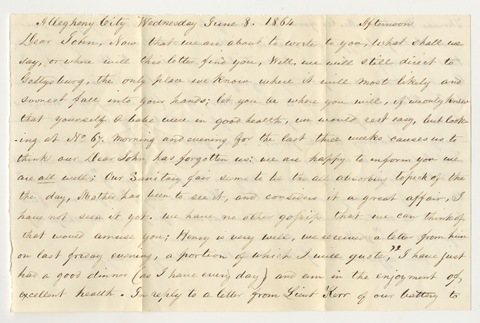
Allegheny City Wednesday June 8. 1865 Afternoon

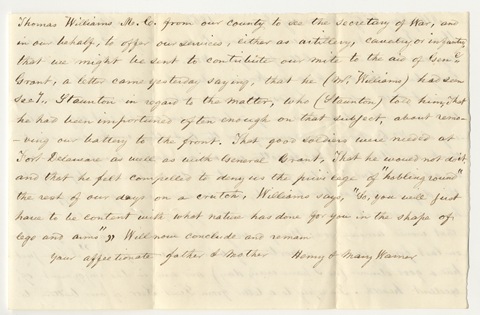
Dear John, Now that we are about to write to you, what shall we say, or where will this letter find you. Well, we will still direct to Gettysburg, the only place we know where it will most likely and soonest fall into your hands; let you be where you will, if we only knew that your self & babe were in good health, we would rest easy, but looking at No. 67. morning and evening for the last three weeks causes us to think our Dear John has forgotten us: we are happy to inform you we are all well; Our Sanitary fair seems to be the all absorbing topick of the the day, Mother has been to see it, and considers it a great affair. I have not seen it yet. We have no other gossip that we can think of that would amuse you; Henry is very well, we secured a letter from him on last Friday evening, a portion of which I will quote, “I have just had a good dinner (as I have every day) and am in the enjoyment of excellent health. In reply to a letter from Lieut Kerr of our battery to Thomas Williams [N.C.?] from our county to see the secretary of War, and in our behalf, to offer our services, either as artillery, cavalry, or infantry that we might be sent to contribute our mite to the aid of Gen’l Grant, a letter came yesterday saying, that he (Mr. Williams) had seen sec’y Staunton in regard to the matter, who (Staunton) told him, that he had been importuned often enough on that subject, about removing our battery to the front. That good soldiers were needed at Fort Delaware as well as with General Grant. That he would not do it and that he felt compelled to deny us the privilege of “hobbling round” the rest of our days on a crutch. Williams says, “So, you will just have to be content with what nature has done for you in the shape of legs and arms”. Will now conclude and remain

Your affectionate father & mother Henry & Mary Warner


Citation: Henry and Mary Warner, autograph letter signed to John Riddle Warner.  Allegheny City [Pittsburgh],8 June 1864. Moore VI:06:6

June 7, 1864: Robert E. Lee to U. S. Grant

 AMs 359-27 p1 Robert E Lee to US Grant AMs 359-27 p2 Robert E Lee to US Grant  AMs 359-27 p4 Robert E Lee to US Grant

AMs 359-27 p3 Robert E Lee to US Grant

Transcript:

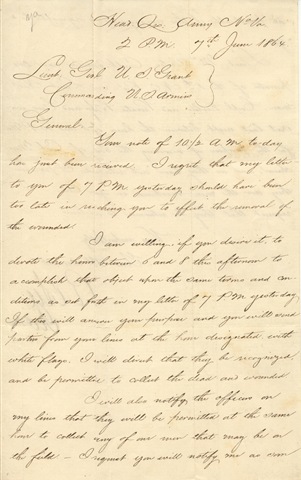
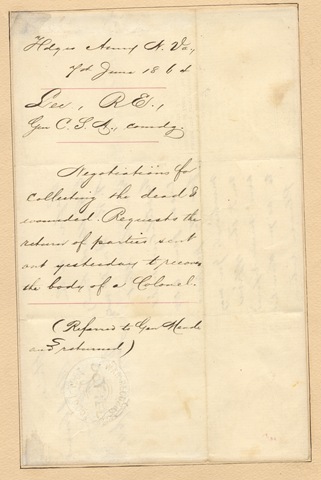
Head Qrs. Army No Va.

2 P.M. 7th June 1864

Lieut. Genl. U. S. Grant

Commanding U. S. Armies

General-

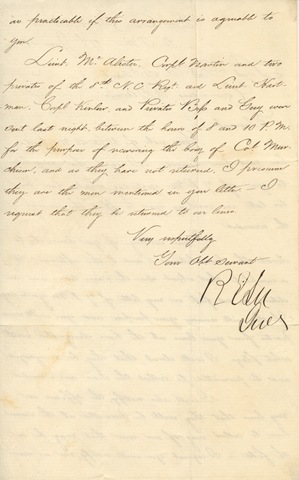
Your note of 10/2 A.M. to-day has just been received. I regret that my letter to you of 7 P.M. yesterday should have been too late in reaching you to effect the removal of the wounded.

I am willing, if you desire it, to devote the hours between 6 and 8 this afternoon to accomplish that object upon the same terms and conditions as set forth in my letter of 7 P.M. yesterday. If this will answer your purpose and you will send parties from your lines at the hour designated with white flags. I will direct that they be recognized and be permitted to collect the dead and wounded.

I will also notify the officers on my lines that they will be permitted at the same hour to collect any of our men that may be on the field—I request you will notify me as soon as practicable if this arrangement is agreeable to you.

Lieut. McAlister, Corpl. Martin and two privates of the 8th N.C. Regt. And Lieut. Hartman, Corpl. Kinler, and Privates Bass and Guy were sent last night, between the hours of 8 and 10 P.M. for the purpose of recovering the body of Col. Murchison, and as they have not returned, I presume they are the men mentioned in your letter—I request that they be returned to our lines.

Very respectfully

Your Obt. Servant

R. E. Lee


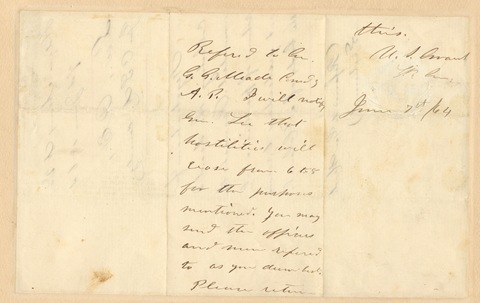
Referred to Gen. G. G. Meade Cmdg A. P.

I will notify Gen. Lee that hostilities will cease from 6 to 8 for the purpose mentioned. You may send the officers and men referred to as you deem best. Please return this.

U.S. Grant

Lt. Genl


Citation: Robert E. Lee (1807-1870) letter signed to Ulysses S. Grant. Cold Harbor, Va., 7 June  1864. AMs 359/27

June 6, 1864: New Book of Nonsense

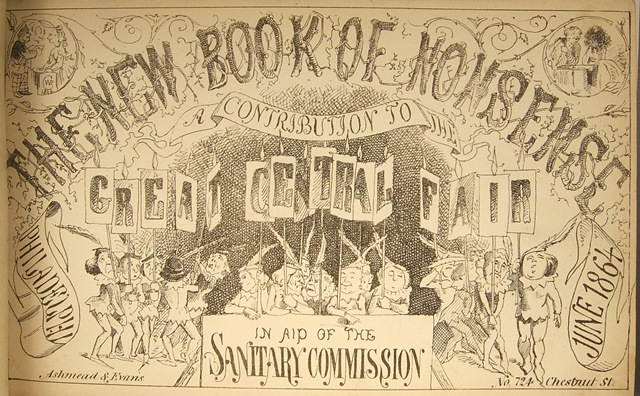
The New Book of Nonsense was published for sale at the Philadelphia Great Central Sanitary Fair, which ran from June 7-29, 1864. It’s an imitation of Edward Lear’s Book of Nonsense.

A 864n New Book of Nonsense

Citation: The new book of nonsense. A contribution to the Great Central Fair in Aid of the Sanitary Commission. Philadelphia: Ashmead & Evans, 1864. A 864n

June 5, 1864: John Henry Brown’s Journal

John Henry Brown was a painter of portrait miniatures, living and working in Philadelphia. He had met Lincoln in August of 1860 when he was commissioned to paint Lincoln’s portrait for a supporter, but although Brown liked Lincoln personally, he did not agree with Republican policies.

1864-06-05


Transcript:

Sunday. At Church. There has been severe fighting near Richmond without any definite result.


Citation: John Henry Brown, autograph journal/account book. Philadelphia, 1844-1890. AMs 573/14.1