July 16, 1864: U.S. Grant to Henry W. Halleck

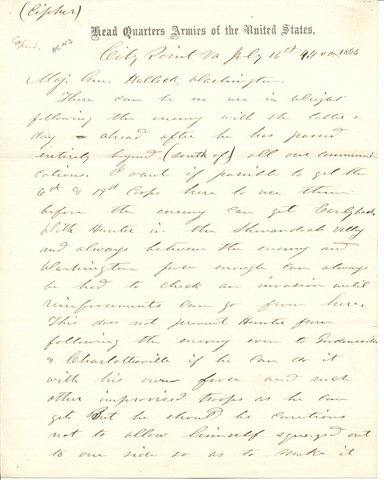
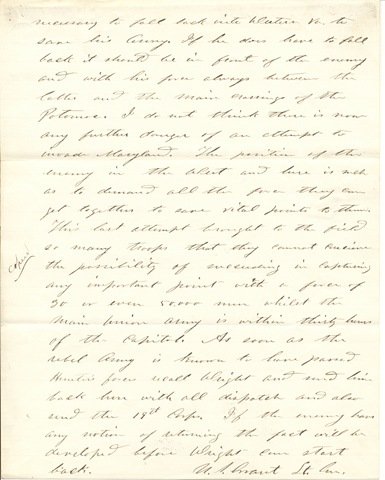
 AMs 357-24 p1 U.S. Grant to Henry W. Halleck AMs 357-24 p2 U.S. Grant to Henry W. Halleck

Transcript:

Head Quarters Armies of the United States

City Point Va July 16th 4.40 pm 1864

Maj. Gen. Halleck, Washington,

There can be no use in Wright following the enemy with the latter a day ahead after he has passed entirely beyond (south of) all our communications. I want if possible to get the 6th & 19th Corps here to use them before the enemy can get early back. With Hunter in the Shenandoah Valley and always behind the enemy and Washington forces enough can always be had to check an invasion until reinforcements can go from here. This does not prevent Hunter from following the enemy even to Gordonsville & Charlottesville if he can do it with his own force and such other improvised troops as he can get. But he should be cautious not to allow himself squeezed out to one side so as to make it necessary to fall back into Western Va. to save his army. If he does have to fall back it should be in front of the enemy and with his force always between the latter and the main crossing of the Potomac. I do not think there is now any further danger of an attempt to invade Maryland. The position of the enemy in the West and here is such as to demand all the force they can get to them. This last attempt brought to the field so many troops that they cannot conceive the possibility of succeeding in capturing any important point with a force of 30 or even 50,000 men whilst the main Union army is within thirty hours of the capitol. As soon as the rebel Army is known to have passed Hunter’s forces recall Wright and send him back here with all dispatch and also send the 19th Corps. If the enemy have any notion of returning the fact will be developed before Wright can start back.

U.S. Grant Lt. Gen.


Citation;Ulysses S. Grant (1822-1885), autograph letter signed to Henry W. Halleck. City Point, Va., 16 July 1864. AMs 357/24

July 15, 1864: John Henry Brown’s Journal

John Henry Brown was a painter of portrait miniatures, living and working in Philadelphia. He had met Lincoln in August of 1860 when he was commissioned to paint Lincoln’s portrait for a supporter, but although Brown liked Lincoln personally, he did not agree with Republican policies.

1864-07-15

Transcript:

Commenced a picture of Major Archie H. Engle dec.d who was killed in battle at Resaca, Ga. The rebels have retired from before Washington.


Citation: John Henry Brown, autograph journal/account book. Philadelphia, 1844-1890. AMs 573/14.1

July 14, 1864: New Book of Nonsense

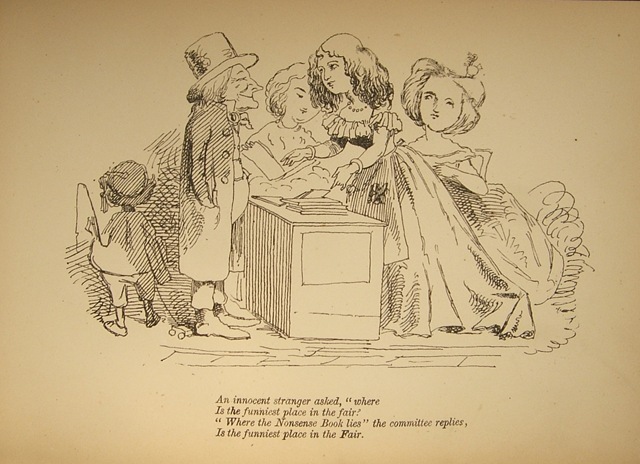
The New Book of Nonsense was published for sale at the Philadelphia Great Central Sanitary Fair, which ran from June 7 to June 29, 1864. It is an imitation of Edward Lear’s Book of Nonsense.

A 864n New Book of Nonsense (19)


  Transcript:

An innocent stranger asked, “where

Is the funniest place in the fair?

“Where the Nonsense Book lies” the committee replies

Is the funniest place in the fair.


Citation: The new book of nonsense. A contribution to the Great Central Fair in aid of the Sanitary Commission. Philadelphia: Ashmead & Evans, 1864. A 864n

July 13, 1864: Henry and Mary Warner to John Warner

Henry and Mary Warner lived in Allegheny City, Pennsylvania, now part of Pittsburgh. They are the great-grandparents of poet Marianne Moore.  By the 1860s they had three surviving children:  John, Henry, and Anne. Their letters to John, a Presbyterian minister living in Gettysburg, are preserved as part of Marianne Moore’s family papers.

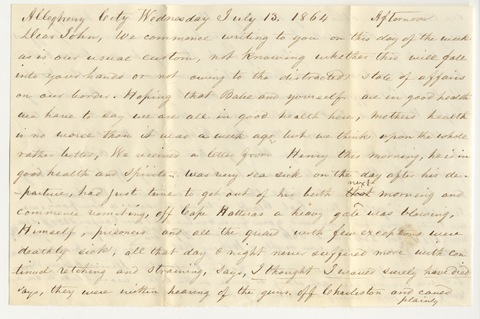
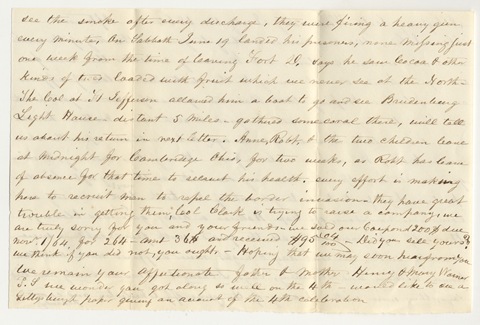
Moore VI-6-7 p1 letter to John from Henry and Mary 7-13-64 300 dpiMoore VI-6-7 p2 letter to John from Henry and Mary 7-13-64 300 

Transcript:

Allegheny City Wednesday July 13. 1864 Afternoon

Dear John, We commence writing to you on this day of the week as is our usual custom, not knowing whether this will fall into your hands or not owing to the distracted state of affairs on our border. Hoping that Babe and yourself are in good health we have to say we are all in good health here. Mother’s health is no worse than it was a week ago, but we think upon the whole rather better. We received a letter from Henry this morning, he is in good health and spirits, was very sea sick on the day after his departure, had just time to get out of his berth next morning and commence vomiting, off Cape Hatteras a heavy gale was blowing. Himself, prisoners and all the guard with few exceptions were deathly sick, all that day & night never suffered more with continued retching and straining. Says, I thought I would surely have died says, they were within hearing of the guns. Off Charleston and could plainly see the smoke after every discharge, they were firing a heavy gun every minute. On Sabbath June 19 landed his prisoners, none missing just one week from the time of leaving Fort D. says he saw Cocoa & other kinds of trees loaded with fruit which we never see at the North. The Col at Ft Jefferson allowed him a boat to go and see Brudenburg Light house distant 5 miles – gathered some coral there, will tell us about his return in next letter. Anne, Robb, & the two children leave at midnight for Cambridge Ohio, for two weeks, as Robb has leave of absence for that time to [?] his health., every effort is making here to recruit men to repel the border invasion. They have great trouble in getting them, Col Clark is trying to raise a company, we are truly sorry for you and your friends – we sold our Coupons / 200$ due now. 1/ 64 for 264 – and 36$ and received $95 04/100. Did you sell yours? We think if you did not, you ought. – Hoping that we may soon hear from you we remain your affectionate father & mother Henry & Mary Warner

P.S. We wonder you got along so well on the 4th – would like to see a Gettysburgh paper giving an account of the 4th celebration


Citation: Henry and Mary Warner, autograph letter signed to John Riddle Warner.  Allegheny City [Pittsburgh],13 July 1864. Moore VI:06:7

July 12, 1864: New Book of Nonsense

The New Book of Nonsense was published for sale at the Philadelphia Great Central Sanitary Fair, which ran from June 7 to June 29, 1864. It is an imitation of Edward Lear’s Book of Nonsense.

 A 864n New Book of Nonsense (18)


  Transcript:

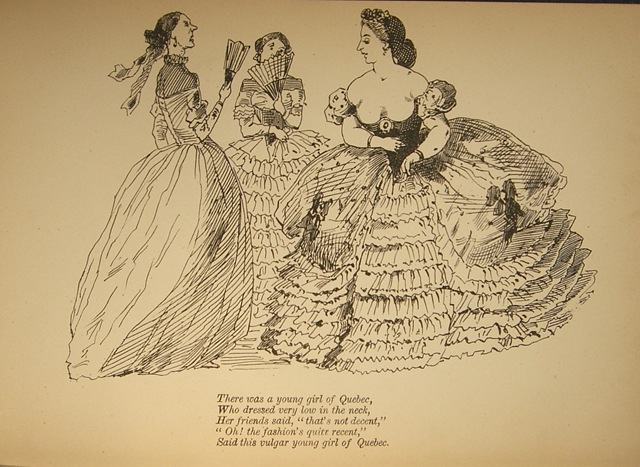
There was a young girl of Quebec,

Who dressed very low in the neck,

Her friends said, “that’s not decent,”

“Oh! The fashion’s quite recent,”

Said this vulgar young girl of Quebec.


Citation: The new book of nonsense. A contribution to the Great Central Fair in aid of the Sanitary Commission. Philadelphia: Ashmead & Evans, 1864. A 864n

July 11, 1864: John Henry Brown’s Journal

John Henry Brown was a painter of portrait miniatures, living and working in Philadelphia. He had met Lincoln in August of 1860 when he was commissioned to paint Lincoln’s portrait for a supporter, but although Brown liked Lincoln personally, he did not agree with Republican policies.

1864-07-11

Transcript:

An hour at Mrs Harris picture, too warm for work. Very bad news, the Confederates reported to be in large force near Baltimore & Washington


Citation: John Henry Brown, autograph journal/account book. Philadelphia, 1844-1890. AMs 573/14.1

July 10, 1864: New Book of Nonsense

The New Book of Nonsense was published for sale at the Philadelphia Great Central Sanitary Fair, which ran from June 7 to June 29, 1864. It is an imitation of Edward Lear’s Book of Nonsense.


A 864n New Book of Nonsense (17)

  Transcript:

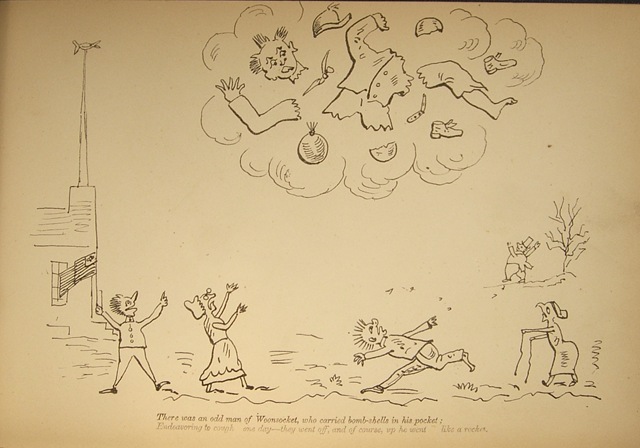
There was an odd man of Woonsocket,

Who carried bomb-shells in his pocket;

Endeavoring to cough

One day –they went off,

And of course; up he went like a rocket.


Citation: The new book of nonsense. A contribution to the Great Central Fair in aid of the Sanitary Commission. Philadelphia: Ashmead & Evans, 1864. A 864n

July 9, 1864: John Henry Brown’s Journal

John Henry Brown was a painter of portrait miniatures, living and working in Philadelphia. He had met Lincoln in August of 1860 when he was commissioned to paint Lincoln’s portrait for a supporter, but although Brown liked Lincoln personally, he did not agree with Republican policies.

1864-07-09

Transcript:

At Mrs Harris picture. The rebels are falling back.


Citation: John Henry Brown, autograph journal/account book. Philadelphia, 1844-1890. AMs 573/14.1

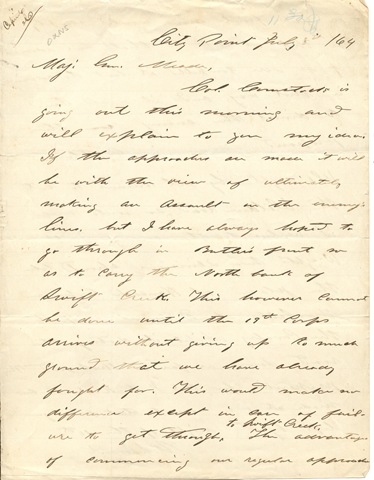
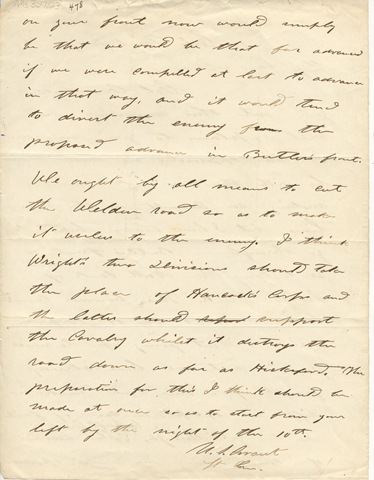
July 8, 1864: U.S. Grant to George G. Meade

AMs 357-23 p1 U.S. Grant to George G. Meade AMs 357-23 p2 U.S. Grant to George G. Meade

Transcript:

City Point July 8th / 64

Maj. Gen. Meade,

Col. Comstock is going out this evening and will explain to you my idea. If the approaches are made it will be with the view of ultimately making an assault on the enemy’s lines, but I have always hoped to go through in Butler’s front so as to carry the North bank of Swift Creek. This however cannot be done until the 19th Corps arrives without giving up to much ground that we have already fought for. This would make no difference except in case of fail-ure to get through to Swift Creek. The advantages of commencing our regular approach on your front now would simply be that we would be that far advanced if we were compelled at last to advance in that way, and it would tend to divert the enemy from the proposed advance in Butler’s front. We ought by all means to cut the Weldon road so as to make it useless to the enemy. I think Wright’s two divisions should take the place of Hancock’s Corps and the latter should suport support the cavalry whilst it destroys the road down as far as Hicksford. The preparation for this I think should be make at once so as to start from your left by the night of the 10th.

U. S. Grant

Lt. Gen.

Citation: Ulysses S. Grant (1822-1885), autograph letter signed to George G. Meade. City Point, Va., 8 July [18]64. AMs 357/23

July 7, 1864: P. G. T. Beauregard telegram to Robert E. Lee

Pierre Gustave Toutant Beauregard was a Louisiana-born general of the Confederate States Army. He had graduated second in his class from West Point in 1838 and was an admirer of Napoleon. He achieved fame early in the Civil War for commanding the Fort Sumter bombardment and as the victor of the first battle of Manassas. He later served in the Western Theater (including Shiloh and Corinth), Charleston, and the defense of Richmond, but his career was hampered by friction with Jefferson Davis and other generals.

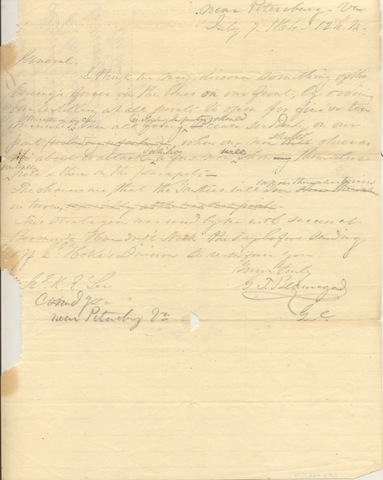
 AMs 358-17 p1 Beauregard G. T. to Robert E. Lee

Transcript:


G. T. B.

July 1864

Dispatch to Gen. R. E. Lee relative

To movements of The Enemy

Near Petersburg, Va

July 7, 1864, 12h. No.

General,

I think we may discover something of the Enemy’s forces in the lines on our ground, by ordering our artillery at all points to open for five or ten minutes this afternoon say 5h. Then all firing (including infantry) should cease suddenly on our part when our men should cheer as if about to attack while a few men will show themselves partially here & there on the parapets

The chances are that the Yankees will soon expose themselves to view in [illeg.]

This stratagem was used by me with success at Bermuda Hundred’s Neck the day before sending off Lt. Hokes’s Division to re-inforce you.

Yours Truly

G. T. Beauregard

Citation: G. T. Beauregard (1818-1893), autograph telegram signed to Robert E. Lee. Petersburg, Va.; 7 July 1864. AMs 358/17