August 6, 1864: New Book of Nonsense

The New Book of Nonsense was published for sale at the Philadelphia Great Central Sanitary Fair, which ran from June 7 to June 29, 1864. It is an imitation of Edward Lear’s Book of Nonsense.

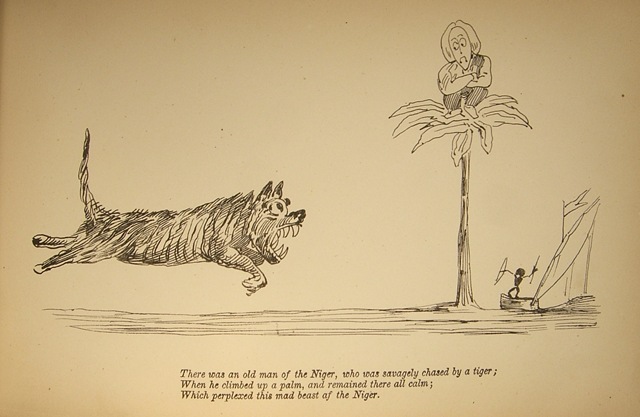
A 864n New Book of Nonsense (34)


  Transcript:

There was an old man of the Niger,

Who was savagely chased by a tiger,

When he climbed up a palm,

And remained there all calm;

Which perplexed the mad beast of the Niger.


Citation: The new book of nonsense. A contribution to the Great Central Fair in aid of the Sanitary Commission. Philadelphia: Ashmead & Evans, 1864. A 864n

August 4, 1864: Mary Craig Eyster to John Riddle Warner

Rev. John Riddle Warner was the grandfather of the poet Marianne Moore and during the Civil War, he lived in Gettysburg, Pennsylvania. Mary Craig Eyster was his sister-in-law, who lived in Chambersburg. These letters are preserved as part of Marianne Moore’s family papers. 
 Moore VI-6-8 p1 letter to John from Mary Eyster 8-4-64 300 dpi Moore VI-6-8 p2 letter to John from Mary Eyster 8-4-64 300 dpi

Transcript [excerpt]

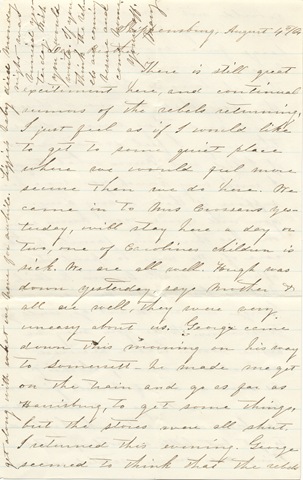
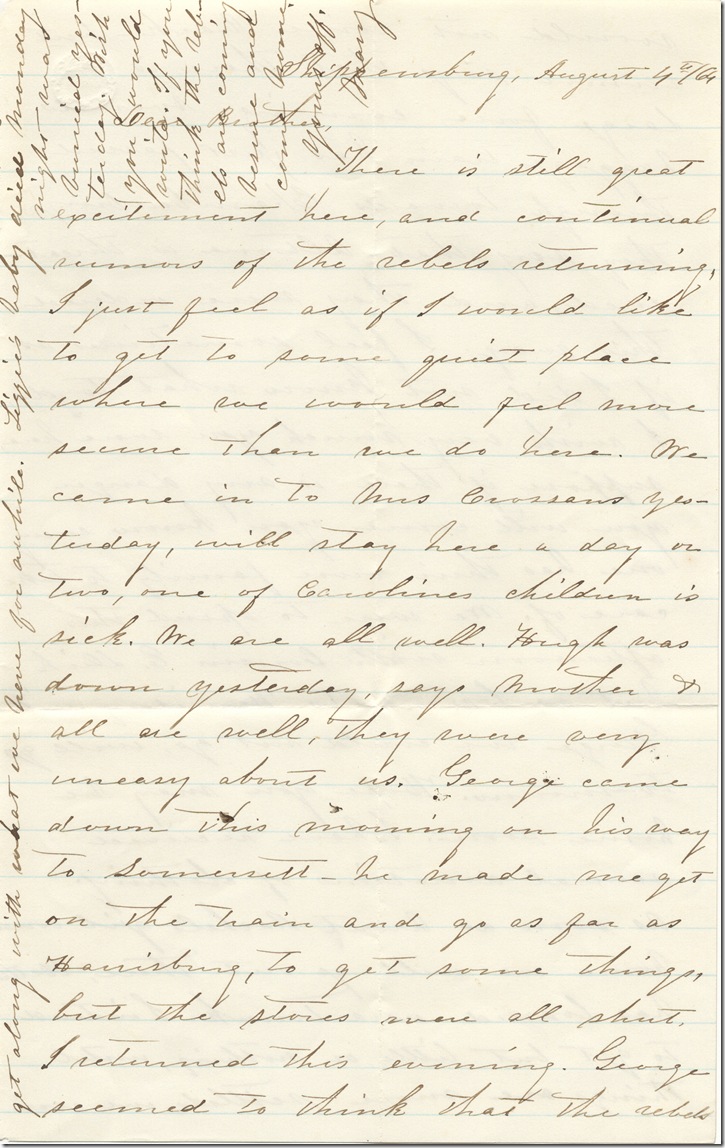
Shippensburg, August 4th / 64

Dear Brother,

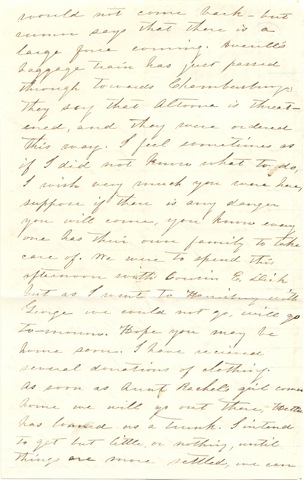
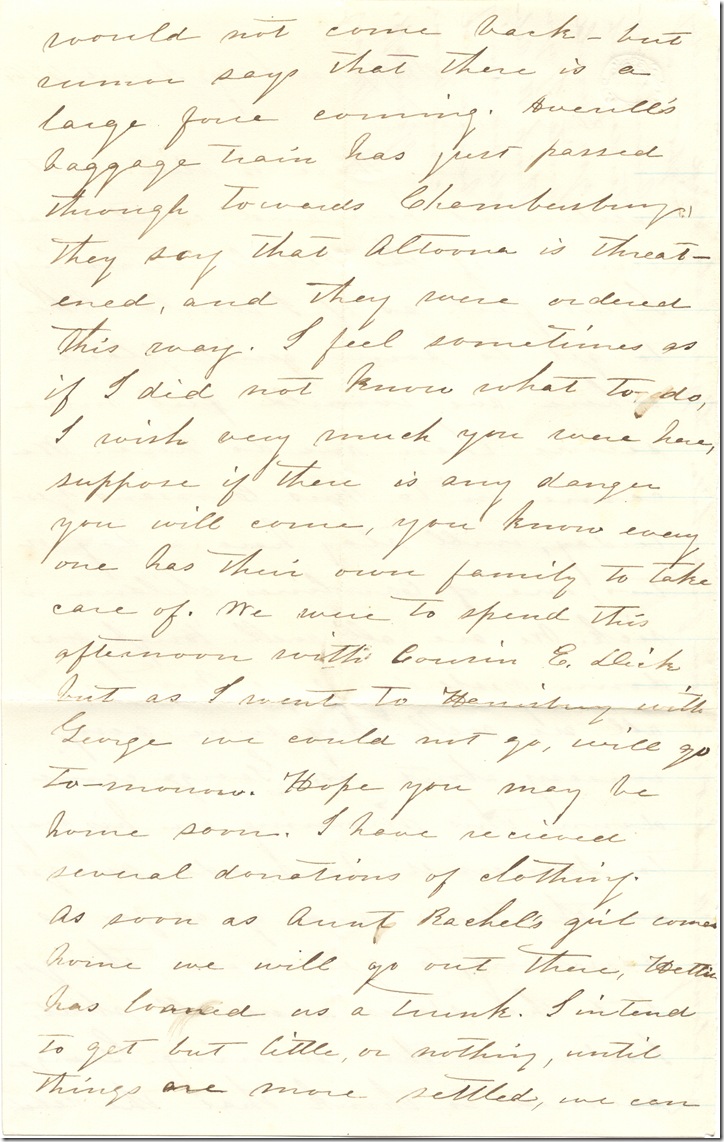
There is still great excitement here, and continual rumors of the rebels returning. I just feel as if I would like to get to some quiet place where we would feel more secure than we do here. We came in to Mrs Crossans yesterday, will stay here a day or two, one of Carolines children is sick. We are all well. Hugh was down yesterday, says Mother & all are well, they were very uneasy about us. George came down this morning on his way to Somersett – he made me get on the train and go as far as Harrisburg, to get some things, but the stores were all shut. I returned this morning. George seemed to think that the rebels would not come back – but rumor says that there is a large force coming. Averill’s baggage train has just passed through towards Chambersburg, they say that Altoona is threatened, and they were ordered this way. I feel sometimes as if I did not know what to do. I wish very much you were here, suppose if there is any danger you will come, you know every one has their own family to take care of. We were to spend this afternoon with Cousin E. Dick but as I went to Harrisburg with George we could not go, will go to-morrow. Hope you may be home soon. I have received several donations of clothing. As soon as Aunt Rachel’s girl comes home we will go out there. Hettie has loaned us a trunk. I intend to get but little, or nothing, until things are more settled, we can get along with what we have for awhile. Lizzie’s baby died Monday night was buried yesterday. Wish you would write. If you think the rebels are coming be sure and come home.

Yours off,

Mary


Citation: Mary Craig Eyster, autograph letter signed to John Riddle Warner.  Shippensburg, Pa.; 4 August 1864. Moore VI:06:08

August 3, 1864: New Book of Nonsense

The New Book of Nonsense was published for sale at the Philadelphia Great Central Sanitary Fair, which ran from June 7 to June 29, 1864. It is an imitation of Edward Lear’s Book of Nonsense.

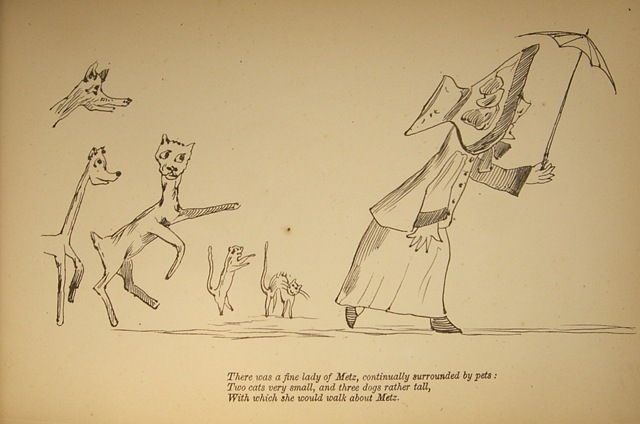
A 864n New Book of Nonsense (33)


  Transcript:

There was a fine lady of Metz,

Continually surrounded by pets:

Two cats very small, and three dogs rather tall,

With which she would walk about Metz.


Citation: The new book of nonsense. A contribution to the Great Central Fair in aid of the Sanitary Commission. Philadelphia: Ashmead & Evans, 1864. A 864n

August 2, 1864: New Book of Nonsense

The New Book of Nonsense was published for sale at the Philadelphia Great Central Sanitary Fair, which ran from June 7 to June 29, 1864. It is an imitation of Edward Lear’s Book of Nonsense.

A 864n New Book of Nonsense (32)


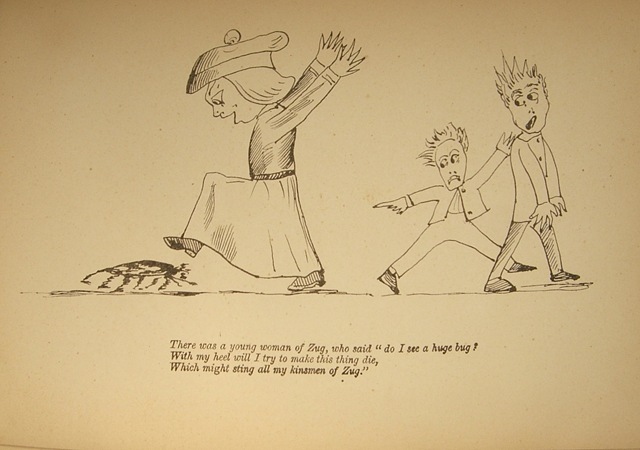
  Transcript:

There was a young woman of Zug,

Who said, “do I see a huge bug?

With my heel will I try to make this thing die,

Which might sting all my kinsmen of Zug.”


Citation: The new book of nonsense. A contribution to the Great Central Fair in aid of the Sanitary Commission. Philadelphia: Ashmead & Evans, 1864. A 864n

August 1, 1864: New Book of Nonsense

The New Book of Nonsense was published for sale at the Philadelphia Great Central Sanitary Fair, which ran from June 7 to June 29, 1864. It is an imitation of Edward Lear’s Book of Nonsense.

A 864n New Book of Nonsense (31)


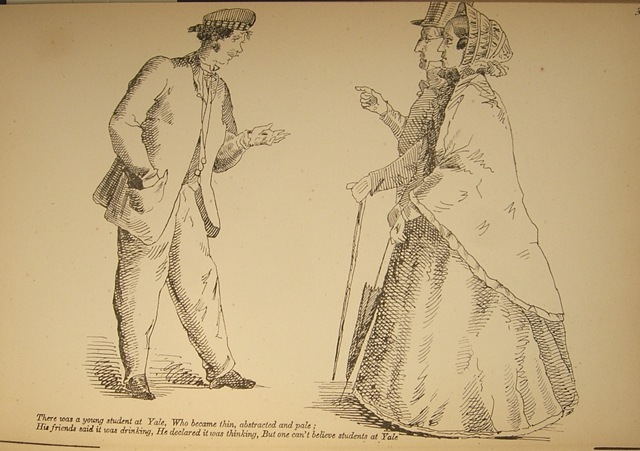
  Transcript:

There was a young student at Yale,

Who became thin, abstracted and pale;

His friends said it was drinking,

He declared it was thinking,

But one can’t believe students at Yale


Citation: The new book of nonsense. A contribution to the Great Central Fair in aid of the Sanitary Commission. Philadelphia: Ashmead & Evans, 1864. A 864n

July 31, 1864: John Henry Brown’s Journal

John Henry Brown was a painter of portrait miniatures, living and working in Philadelphia. He had met Lincoln in August of 1860 when he was commissioned to paint Lincoln’s portrait for a supporter, but although Brown liked Lincoln personally, he did not agree with Republican policies.

1864-07-31

Transcript:

At Mrs. Harris’s picture.

The rebels in Penna burned a part of Chambersburg.

Ada has been quite sick lately.


Citation: John Henry Brown, autograph journal/account book. Philadelphia, 1844-1890. AMs 573/14.1

July 30, 1864: New Book of Nonsense

The New Book of Nonsense was published for sale at the Philadelphia Great Central Sanitary Fair, which ran from June 7 to June 29, 1864. It is an imitation of Edward Lear’s Book of Nonsense.

A 864n New Book of Nonsense (30)


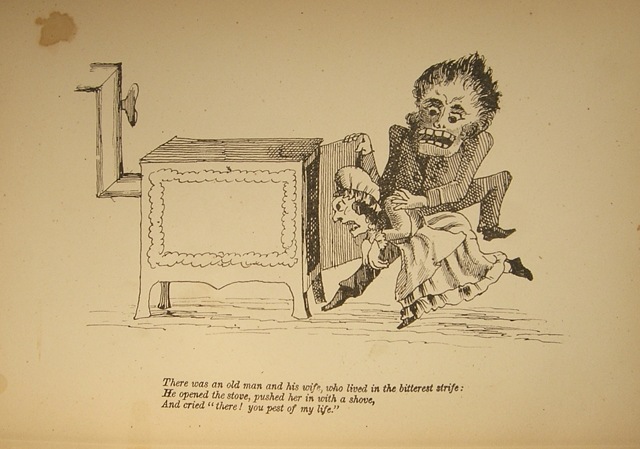
  Transcript:

There was an old man and his wife,

Who lived in the bitterest strife,

He opened the stove, pushed her in with a shove,

And cried “there! You pest of my life!”


Citation: The new book of nonsense. A contribution to the Great Central Fair in aid of the Sanitary Commission. Philadelphia: Ashmead & Evans, 1864. A 864n

July 29, 1864: New Book of Nonsense

The New Book of Nonsense was published for sale at the Philadelphia Great Central Sanitary Fair, which ran from June 7 to June 29, 1864. It is an imitation of Edward Lear’s Book of Nonsense.

A 864n New Book of Nonsense (29)


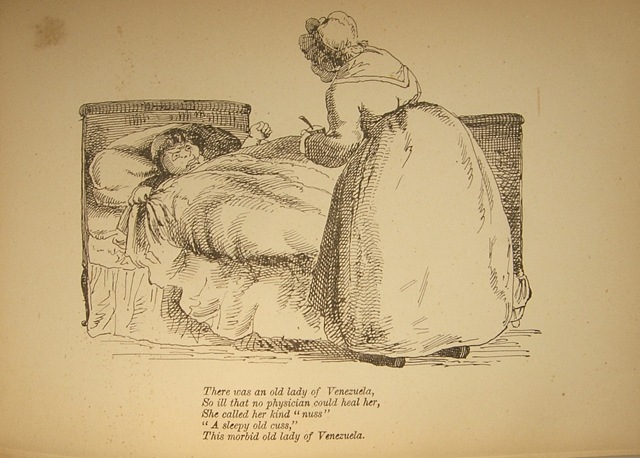
  Transcript:

There was an old lady of Venezuela,

So ill that no physician could heal her,

She called her kind “nuss”

“A sleepy old cuss,”

This morbid old lady of Venezuela.


Citation: The new book of nonsense. A contribution to the Great Central Fair in aid of the Sanitary Commission. Philadelphia: Ashmead & Evans, 1864. A 864n

July 28, 1864: Mary Craig Eyster to John Riddle Warner

Rev. John Riddle Warner was the grandfather of the poet Marianne Moore and during the Civil War, he lived in Gettysburg, Pennsylvania. Mary Craig Eyster was his sister-in-law, who lived in Chambersburg. These letters are preserved as part of Marianne Moore’s family papers. 
 Moore VI-6-7 p1 letter to John from Mary Eyster 7-28-64 300 dpi Moore VI-6-7 p2 letter to John from Mary Eyster 7-28-64 300 dpi

Transcript [excerpt]

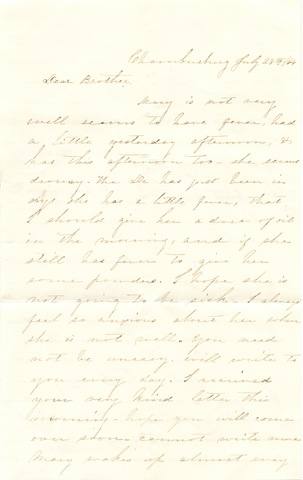
Chambersburg July 28th / 64

Dear Brother,

[…] It is now half-past six o’clock a.m. Mary seems better this morning but not well, will give her the oil. I suppose you will come over if there is any danger of the rebels coming. hope you will be sure to bring your trunk with you, am more anxious to have you as Mary is not well – don’t know what the news is this morning but there must have been some thing very important last night as the major sent for his blankets expecting to stay at the office all night – he is in his room now, don’t know what time he came. There has not been much excitement here – we feel a little safer as Headquarters are here, we have more reliable information than if they were not here. We expect George home tonight. I am as ever yours

Mary

:


Citation: Mary Craig Eyster, autograph letter signed to John Riddle Warner.  Chambersburg, Pa.; 28 July 1864. Moore VI:06:07

July 27, 1864: U. S. Grant to George Meade

 AMs 354-17 p1 US Grant to george Meade 300 dpi AMs 354-17 p2-3 US Grant to george Meade 300 dpi


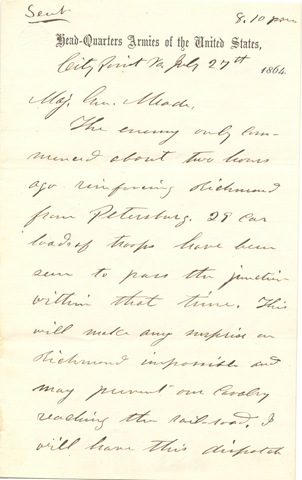
Sent 8.10 p.m.

City Point Va. July 27th 1864

Maj. Gen. Meade,

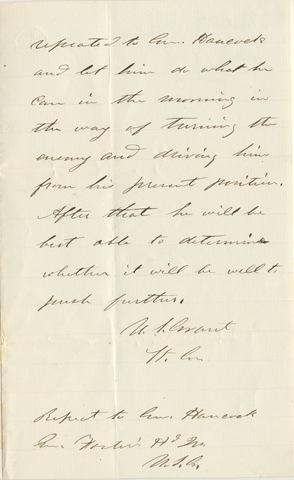
The enemy only commenced about two hours ago reinforcing Richmond from Petersburg. 29 carloads of troops have been seen to pass the junction within that time. This will make any surprise on Richmond impossible and may prevent our cavalry reaching the railroad. I will have this dispatch repeated to Gen. Hancock and let him do what he can in the morning in the way of turning the enemy and driving him from his present position. After that he will be best able to determine whether it will be well to push further.

U. S. Grant


Citation: Ulysses S. Grant (1822-1885), autograph letter signed to George G. Meade. City Point, Va; 27 July 1864. AMs 354/17