Alexander Biddle was a member of the prominent Philadelphia Biddle family and was married to Julia Williams Rush, the granddaughter of Dr. Benjamin Rush. Biddle served with the 121st Pennsylvania Volunteer Infantry, beginning in September 1862. Starting out as a major, he would participate in Fredericksburg and Gettysburg, among other engagements, and would leave the service as a lieutenant colonel. (He was commissioned, but never mustered, as colonel)
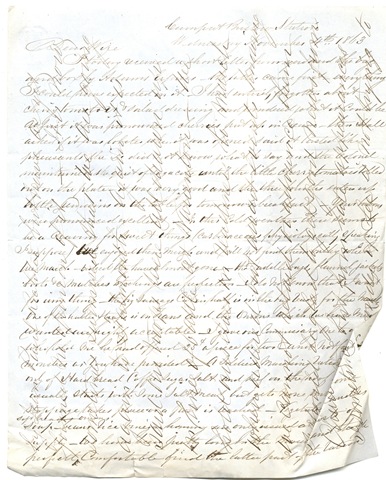
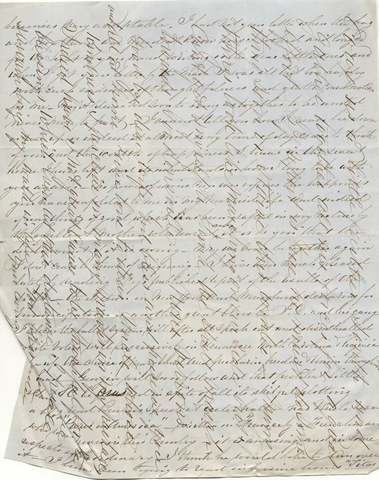
Transcript:
Camp at Bristow Station
Wednesday November 4th 1863
Dear Wife,
I today received a short letter from you and the bag and box by Adams Express. The latter came first- everything I could have expected in it. I had entirely forgotten about cherry tomatoes and salad dressing and wondered what it could be. At first it was pronounced cherries put up in cream—then Stall asked if it was lobster, when it was opened, said it tasted like pheasants, the D. did not know what to say and the Colonel maintained the quiet of sagacity until the little cherry tomatoes rolled out on the plate—it was very good and the three fourths eaten up but thee remains on the table for tomorrow’s breakfast. Your bonbons were pronounced excellent—In this cold weather there seems to be a craving for sweet things (carbonaceous, physiologically speaking, I suppose). We enjoyed them much and will not find them badly when we march—indeed they have almost gone. The saddle bags, flannel jackets, boots and matches, stockings are perfection. I do not know that I want for anything—the big sausage cut in half is in the bag ready for the march. One of the halter straps is on Frans, and the onions, which I have much wanted, were highly acceptable. I gave our Commissary one today who told me he had offered 25 ¢ a piece for two and not for such monsters are you have provided. A soldier’s marching rations consist only of hard bread, coffee, sugar, salt and beef on the hoof—He usually starts with some salt meat but gets none until some stoppage takes place or a post is reached. Vegetables, candles, soft bread, onions, soups, beans, rice, vinegar, hominy are only issued at posts of supply. We have been pretty long on the march and though perfectly comfortable find the latter part of the rations business very acceptable. I had not your letter when the bag and the box came and you don’t know how I looked and longed for the sight of your hand writing or the dear little ones and then I got your letter by the mail I was all but too happy with such evidences of thoughtfulness and gentle consideration for me. May it please God soon to bring us together to be united never more to part. I cannot tell you how I never lie down or rise up or indeed at almost any time of day cease to think of you and the wealth of happiness I have in the sweet home I have left and its inhabitants in how I long to be with you again. No power of mine can ever express the happiness you have unfolded to me in my married life and indeed of any thing of good which has been grafted in my nature by the excellent mother who reared me, it is to you that the development of it is owing. May we soon be together again. I don’t cease to think of resigning—I have been much pleased lately by reading [Foy’s?] published report of the results of the draft—the election in New York and Maryland declaring for Emancipation is another great blow to J.D. and his gang. I believe the ballot systems will after all speak out and disenthralled white voters will successively in Tennessee, North Carolina, Virginia, take up the advice of Maryland. Georgia will soon follow and that pestilent little state of SC will be crushed in spite of all its skillful plotting. Have you read Beecher’s speech at Exeter Hall—has Uncle seen a book “Paris in America”—written in France by the Frenchman who was never in this country—It is amusing and in some aspects extraordinary. I think he would like to run over it—I have been trying to read in leisure hours “Titan” by Jean Paul Richter but have as yet formed no opinion of it. It is now sometimes surmised that we are going again to Falmouth—Again it is said our troops were all drawn up in line of battle at Warrenton—We hold ourselves in readiness to march when ordered but await events knowing we cannot retard or advance them. I should be glad to get good news from Charleston but from late appearances I sometimes wonder if Lee is not trying to coax us a little farther South and gather together all his forces for a great effort. If report is true he must do something soon or starve this winter. Many things look like marching on our side but I can’t get myself to think we shall march towards Gordonville- Nous verrons. Goodbye dear wife, God bless and preserve you all at home. Give love to dear Uncle whose kindness I perceive in many marks in my package. Indeed have I not great cause to be thankful for the blessings which even at this distance I perceive surrounding my walk in life. God bless you all,
Your loving husband,
Alexander
Citation: Alexander Biddle (1819-1899), autograph letter signed to Julia Williams Rush Biddle,4 November 1863. Rush IV:30:37
.…
hello….
.…
áëàãîäàðåí!…
.…
good….
.…
tnx for info….
.…
tnx for info….