April 9, 1865: U.S. Grant and Robert E. Lee Correspondence on Surrender Terms

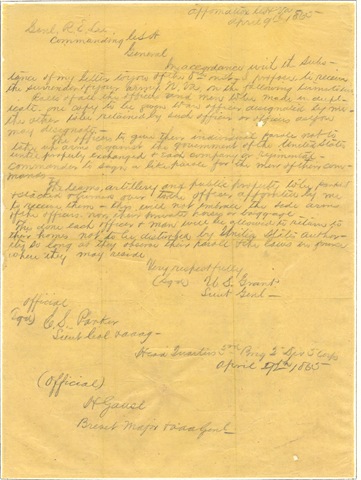
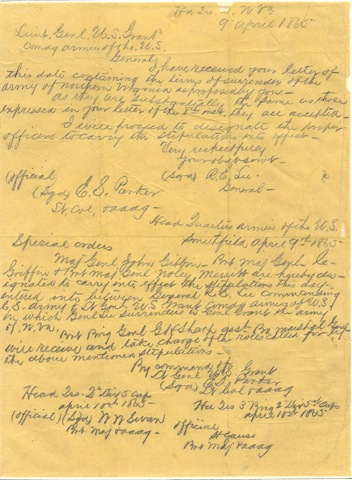
 These documents are official manifold copies made and signed on April 9 & 10  by Maj. H. Gause from other copies made by Lt. Col. Ely Parker AMs 473-19-4 p1 Grant and Lee Surrender AMs 473-19-4 p2 Grant and Lee Surrender

Transcript:

Appomattox Co Va

April 9th 1865

Genl. R. E. Lee

Commanding CSA

General

In accordance with the substance of my letter to you of the 8th inst. I propose to receive the surrender of your army. N. Va. on the following terms to wit.

Rolls of all the officers and men to be made in duplicate—one copy to be given to an officer designated by me—the other to be retained by such officer or officers as you may designate.—

The officers to give their individual parole not to take up arms against the government of the United States until properly exchanged & each company or regimental commander to sign a like parole for the men of their commands.—

The teams, artillery and public property to be parked & stacked & turned over to the officer appointed by me to receive them—this will not embrace the side arms of the officers, nor their private horses or baggage.—

This done each officer & man will be allowed to return to their homes not to be disturbed by United States authority so long as they observe their parole & laws in where they reside

Very respectfully

(Sgd) U.S. Grant

Lieut. Genl.


Hd Qrs. N. Va.

9 April 1865

Lieut. Genl. U.S. Grant

Comdg. Armies of the U.S.

General

I have received your letter of this date containing the terms of surrender of the Army of Northern Virginia as proposed by you—

As they are substantially the same as those expressed in your letter of the 8th inst, they are accepted—

I will proceed to designate the proper officers to carry the stipulations into effect—

Very respectfully

Your obd. Servant—

(Sgd) R.E. Lee

General


Citation: Documents relating to the surrender of the Army of Northern Virginia. 9-10 April 1865. AMs 473/19.4.

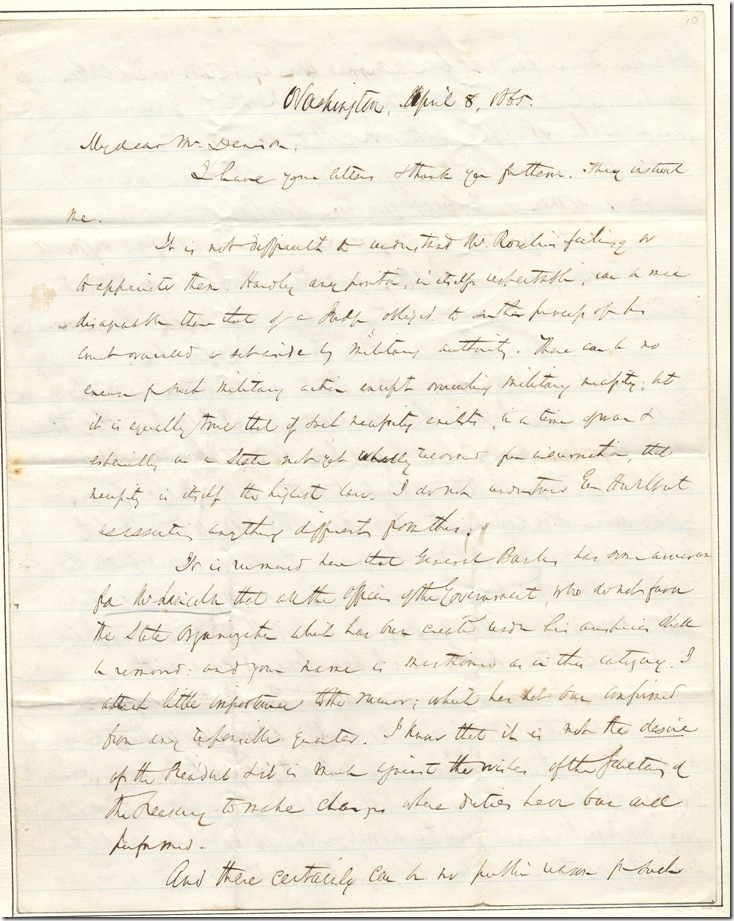
April 8, 1865: Salmon P Chase autograph letter signed to George P. Denison

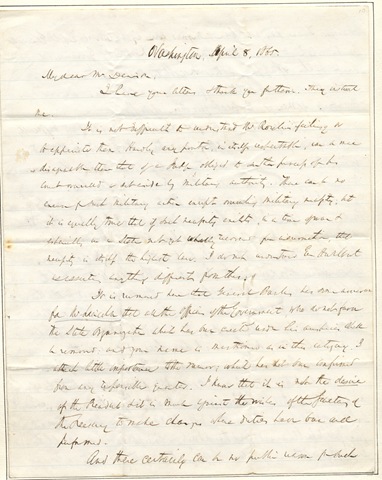
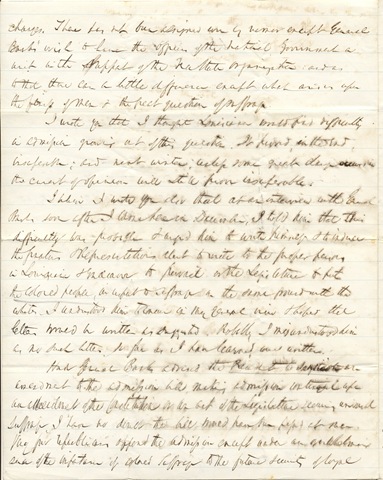
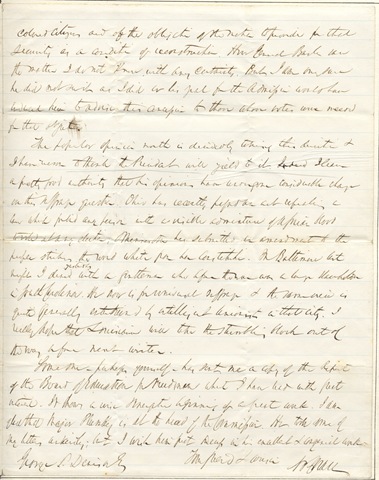
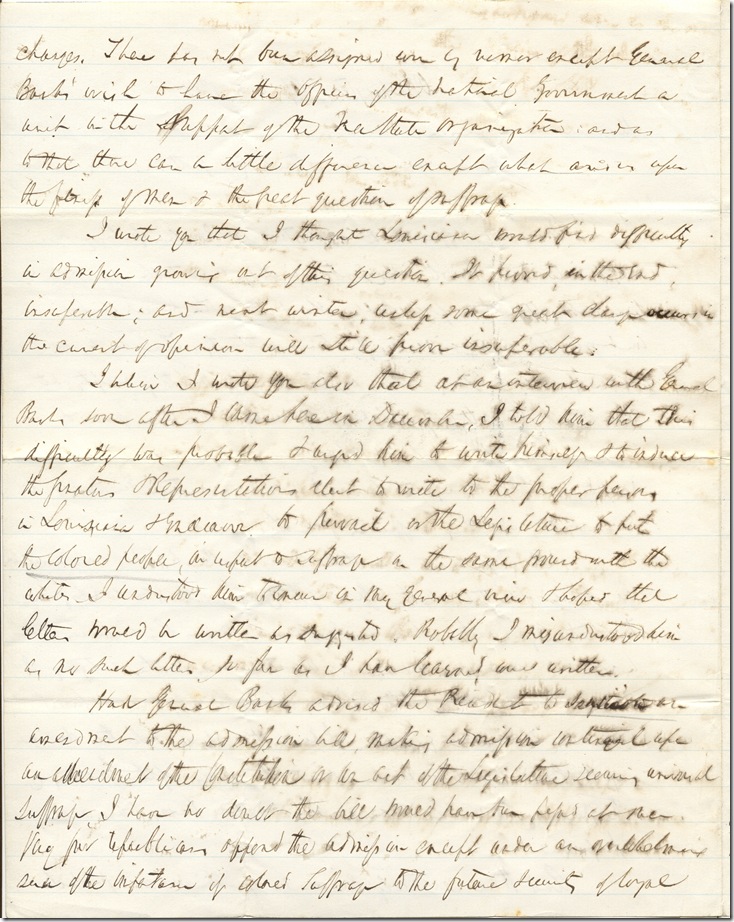
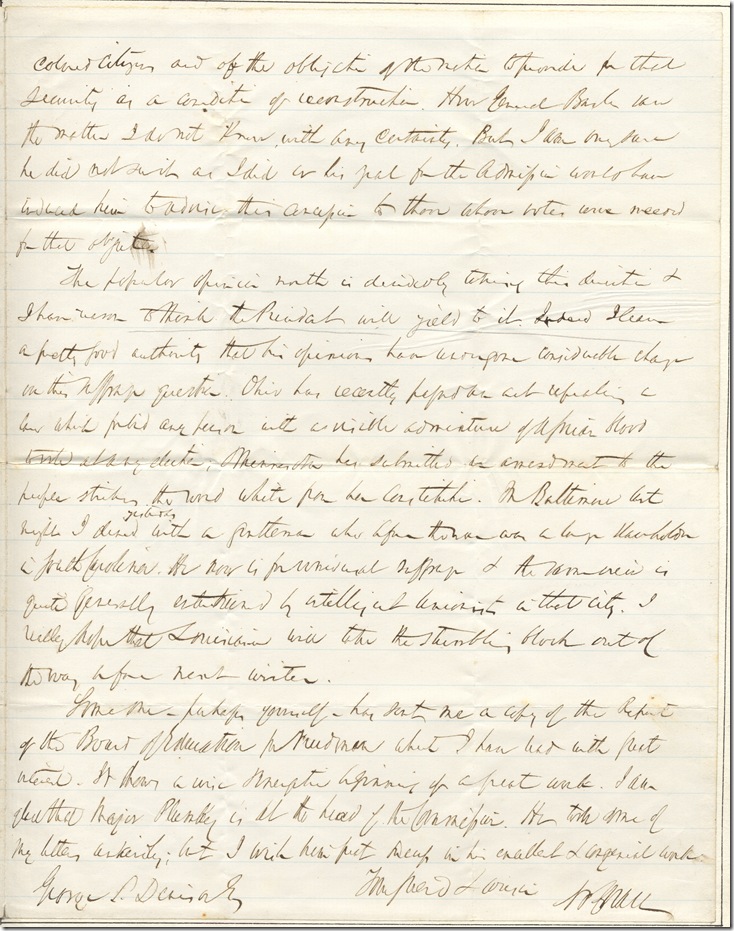
 AMs 527-8-3 p1 Salmon P Chase to George P Denison AMs 527-8-3 p2 Salmon P Chase to George P Denison AMs 527-8-3 p3 Salmon P Chase to George P Denison

Transcript:

Washington, April 8 1865

My dear Mr. Denison,

I have your letters & thank you for them. They interest me.

It is not difficult to understand Mr. Roskins failing or to appreciate them. Hardly any position, in itself unacceptable, can be more disprovable than that of a Judge obliged to process of his court overruled or set aside by military authority. There can be no excuse for such military action except overruling military necessity; but it is equally true that if such necessity exist in a time of war & especially in a State not yet cleared from insurrection, that necessity is itself the highest law. I do not understand Gen. Hurlbuts assertion anything different from this.

It is rumored here that General Banks has some answer for Mr. Lincoln that all the officers of the Government, who do not form the State Organization which has been created under his auspices shall be removed: and your name is mentioned in this category. I attach little importance to the rumor, which has not been confirmed from any responsible quarter. I know that it is not the desire of the President & it is much against the wishes of the Secretary of the Treasury to make changes where duties have been well performed.

And there certainly can be no public answer to such charges. That has not been affirmed even by rumor except General Banks’ wish to have the officers of the national Government a unit in the support of the National Organization; and as to that there can be little difference except what [arises?] upon the fitness of men & the great question of suffrage.

I wrote you that I thought Louisiana would find difficulty in admission growing out of this question. It found in the law insuferable; and next winter, unless some great change occurs in the current of opinion will still find insuferable.

I believe I wrote you about that at an interview with General Banks soon after I came here in December. I told him that this difficulty was probable & urged him to write himself & to induce the Senators& Representatives elect to write to the proper people in Louisiana & endeavor to prevail on the Legislature to put the colored people, in respect to suffrage on the same ground with the whites. I understood him to share in my general view & hoped that letter would be written as suggested. Probably I misunderstood him as no such letter so far as I have learned was written.

Had General Banks advised the [illeg.] an amendment to the admission bill, making admission dependent entirely an amendment of the Constitution or an act of the Legislature seeking universal suffrage, I have no doubt the bill would have been passed at once. The [poor?] republicans oppose the admission except under an overt statement of the importance of colored suffrage to the future security of loyal colored citizens and of the obligation of the nation to provide for the security as a condition of reconstruction. How General Banks saw the matter I dont know with any certainty. But I am only sure he did not do it as I did or his zeal for the Admission would have induced him to admit this [illeg.] to them when votes were needed for that object.

The popular opinion north is decidedly taking this direction & I have reason to think the President will yield to it. Indeed I hear a pretty good authority that his opinion has brought on considerable change on this suffrage question. Ohio has recently passed an act repealing a law which forbid any person with a visible admixture of African blood to [illeg.] [above duties?]. Minnesota has submitted an amendment to the peoples striking the word white from the Constitution. In Baltimore last night I dined with a gentleman who before the war was a large slaveholder in South Carolina. He now is for provisional suffrage & the same view is quite personally entertained by intelligent Unionists in that city. I really hope that Louisiana will take the stumbling block out of the way before next winter.

Some one—perhaps yourself—has sent me a copy of the Report of the Board of Education of Freedmen which I have read with great interest. It shows a [illeg.] beginning of a great work. I am glad that Major Plunkey is at the head of the Convention. He took some of my letters [illeg.]; but I wish him great success in his excellent & commendable work.

Your friend

SP Chase


Citation: Salmon P Chase, autograph letter signed to George P. Denison. Washington, D.C., 8 April 1865. AMs 527/8.3
April 6, 1865: U.S. Grant to William T. Sherman


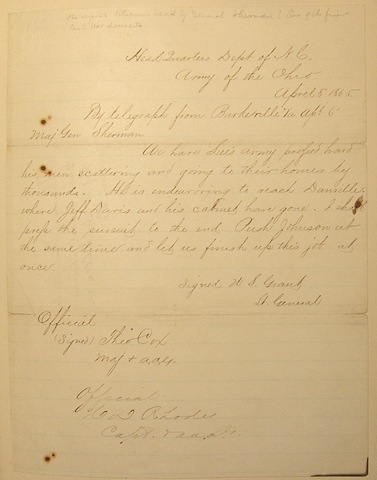
AMs 435-8_13 Grant to Sherman 4-6-1865

Transcript:

Head Quarters Dept. of N.C.

Army of the Ohio

April 8” 1865.

By telegraph from Burkeville Va Apl. 6”

Maj. Gen Sherman

We have Lee’s army pressed hard his men scattering and going to their homes by thousands. He is endeavoring to reach Danville where Jeff Davis and his cabinet have gone. I shall press the pursuit to the end. Push Johnson at the same time and let us finish up this job at once.

Signed U. S. Grant

Lt. General

Official

(Signed) Theo Cox

Maj. & A.A.G.

Citation: Ulysses S. Grant (1822-1885), autograph letter signed to William T. Sherman. Burkeville, Va.; 8 April 1865. AMs 435/8.13

April 5, 1865: U.S. Grant to William T. Sherman

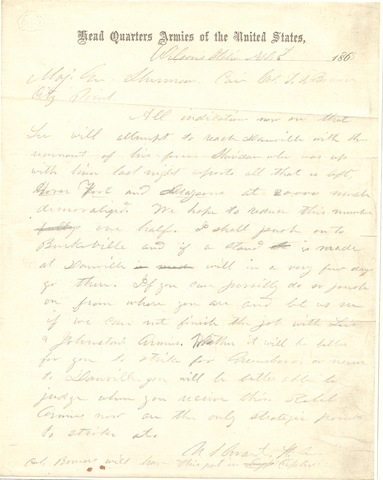
AMs 473-19-1 US Grant draft to WT Sherman

Transcript:

Wilson’s Station Apl 5th 1865

Maj Gen Sherman, Cav Col T.S. Bowers

City Point

All indications now are that Lee will attempt to reach Danville with the remnant of his force. Sheridan who was up with him last night reports all that is left, Horse Foot and Dragoons at 2000 much demoralized. We hope to reduce this number one half. I shall push on to Burkeville and if a stand is made at Danville will in a very few days go there. If you can possibly do so push on from where you are and let us see if we can not finish the job with Lee’s & Johnston’s Armies. Whether it will be better for you to strike for Greensboro or nearer to Danville you will be better off to judge when you receive this. Rebel Armies now are the only strategic points to strike at.

U.S. Grant

Citation:  Ulysses S. Grant (1822-1885).Autograph letter signed to William T. Sherman(draft). Wilson’s Station, Va.;  5 April 1865. AMs 473/19.1

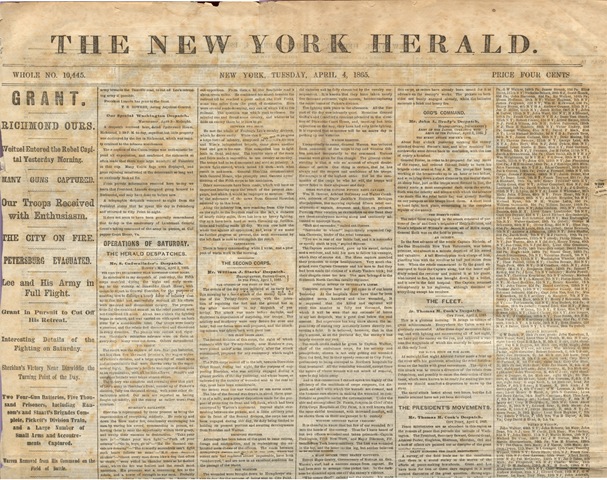
April 4, 1865: New York Herald

top

Transcript (excerpt):

Page 1, Upper Half

Our Special Washington Dispatch.

Washington, April 3 – Midnight

A dispatch received here, dated Spotswood House, Richmond, 1:30 P.M. to-day, says that but little property was destroyed by the fire in Richmond, which was mainly confined to the tobacco warehouses.

The reception of the Union Troops was enthusiastic beyond all expectation, and confirmed the statement so often made that there were large numbers of Unionists in that city. Many Union flags were displayed, and great rejoicing manifested at the deliverance so long and so anxiously looked for.

From private information received here to-day we learn that President Lincoln designed going himself to Richmond, and may have done so before now.

A telegraphic dispatch received here to-night from the President states that he spent the night in Petersburg and returned to City Point to-night.

It does not seem to have been generally remembered that to-day is the anniversary of Lieutenant General Grant’s taking command of the army in person at Culpepper Court House, Va.

Caption: New York Herald. 4 April 1865. Gift of Steven and Susan Raab. AN .N56792

April 3, 1865: Joseph E. Johnston to P. G. T. Beauregard

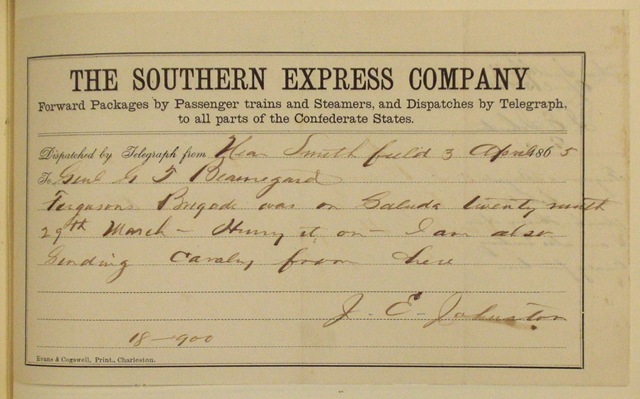
Pierre Gustave Toutant Beauregard was a Louisiana-born general of the Confederate States Army. He had graduated second in his class from West Point in 1838 and was an admirer of Napoleon. He achieved fame early in the Civil War for commanding the Fort Sumter bombardment and as the victor of the first battle of Manassas. He later served in the Western Theater (including Shiloh and Corinth), Charleston, and the defense of Richmond, but his career was hampered by friction with Jefferson Davis and other generals.

This telegram is from The Telegraphic History of the Civil War; a compiled album of telegrams to Beauregard from Davis, Lee, Johnston and others.

Telegram 4-3-65 Johnston to Beauregard 10 mp

Transcript:

Dispatched by Telegraph from Near Smithfield 3 April 1865

To Genl G T Beauregard

Fergusons Brigade was on Saluda twenty ninth 29th March – Hurry it on – I am also sending cavalry from there

J E Johnston

18-900

Citation:Joseph E. Johnston (1807-1891), telegram to G.T. Beauregard. 3 April 1865. In The telegraphic history of the Civil War, 1861-1865. AMs 434/16

April 2, 1865: U.S. Grant to George Meade

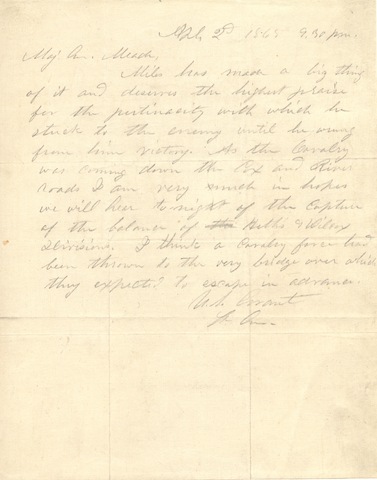
AMs 473-19-3 US Grant to George G Meade

Transcript:

Apl. 2d 1865 9.30 p.m.

Maj. Gen. Meade,

Miles has made a big thing of it and deserves the highest praise for the pertinacity with which he stuck to the enemy until he wrung from him victory. As the Cavalry was coming down the Cox and River Roads I am very much in hopes we will hear tonight of the capture of the balance of Heth’s & Wilcox Divisions. I think a Cavalry force had been thrown to the very bridge over which they expected to escape in advance.

U.S. Grant


Citation: Ulysses S. Grant (1822-1885), autograph letter signed to George G. Meade. 2 April 1865. AMs473/19.3

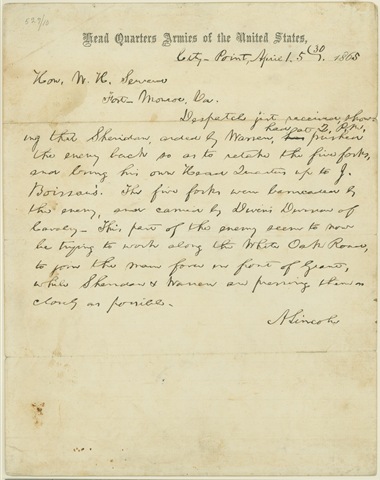
April 1, 1865: Abraham Lincoln Letter to William Seward

AMs 527-10_1

Transcription:

Head Quarters Armies of the United States,
City-Point, April 1. 5/30 [P.M.] 1865

Hon. W. H. Seward

Fort-Monroe, Va

Despatch just received, showing that Sheridan, aided by Warren, had at 2. P.M. pushed the enemy back so as to retake the five forks, and bring his own Head Quarters up to J. Boissau’s. The five forks were barricaded by the enemy, and carried by Devin’s Division of Cavalry. This part of the enemy seem to now be trying to work along the White Oak Road, to join the main force in front of Grant, while Sheridan & Warren are pressing them as closely as possible.

A Lincoln


Citation: Abraham Lincoln (1809-1865), autograph letter signed to William H. Seward. City Point, Va., 1 Apr. 1865

AMs 527/10