September 9, 1863: Henry and Mary Warner to Children

Henry and Mary Warner lived in Allegheny City, Pennsylvania, now part of Pittsburgh. They are the great-grandparents of poet Marianne Moore.  By the 1860s they had three surviving children:  John, Henry, and Anne. Their letters to John, a Presbyterian minister living in Gettysburg, are preserved as part of Marianne Moore’s family papers.
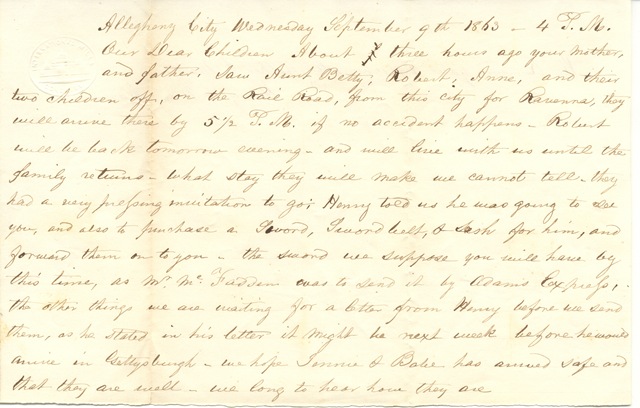
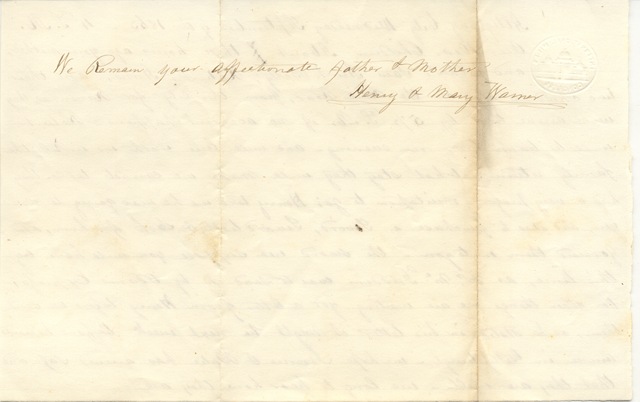
   Moore VI-5-23 p1 Henry and Mary Warner to Children 9-9-63 Moore VI-5-23 p2 Henry and Mary Warner to Children 9-9-63

Transcript:

Allegheny City Wednesday September 9th 1863—4 P.M.

Our Dear Children About three hours ago your mother, and father, saw Aunt Betty, Robert, Anne, and their two children off, on the Rail Road, from this city for Ravenna, they will arrive there by 5 ½ P.M. if no accident happens—Robert will be back tomorrow evening—and will live with us until the family returns—what stay they will make we cannot tell—they had a very pressing invitation to go; Henry told us he was going to see you, and also to purchase a Sword, Sword belt, & sash for him, and forward them to you—the sword we suppose you will have by this time, as Mr. McFadden was to send it by Adams Express, the other things we are waiting for a letter from Henry before we send them, as he stated in his letter it might be next week before he would arrive in Gettysburgh—we hope Jennie & Babe had arrived safe and that they are well—we long to hear how they are

We Remain your affectionate father & mother

Henry & Mary Warner


Citation: Henry and Mary Warner, autograph letter signed to John Riddle Warner. Allegheny City [Pittsburgh], 9 September 1863. Moore VI:05:23
September 7, 1863: G.H. Byrd to John Riddle Warner

Rev. John Riddle Warner was the grandfather of the poet Marianne Moore and during the Civil War, he lived in Gettysburg, Pennsylvania. These letters are preserved as part of Marianne Moore’s family papers. 

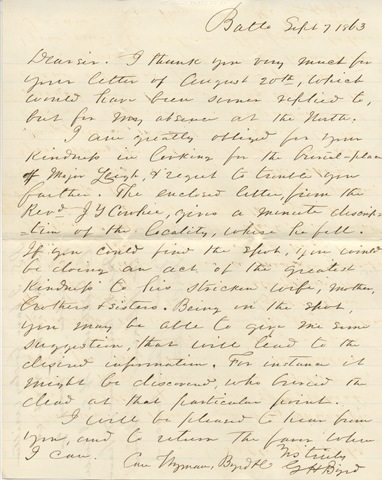
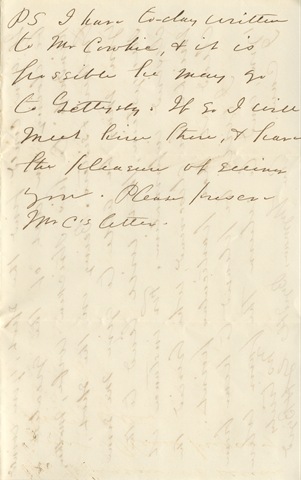
 Moore VI-5-23 p1 GH Byrd 9-7-63 Moore VI-5-23 p2 GH Byrd 9-7-63

Transcript;

Batto Sept 7 1863

Dear Sir, I thank you very much for your letter of August 20th, which would have been sooner replied to, but for my absence at the North.

I am greatly obliged for your kindness in looking for the burial-place of Major Leigh, & regret to trouble you farther. The enclosed letter, from the Revd JY Cowhic, gives a minute description of the locality, where he fell. If you could find the spot, you would be doing an act of the greatest kindness to his stricken wife, mother, brothers & sisters. Being in the spot, you may be able to give me some suggestion, that will lead to the desired information. For instance it might be discovered, who buried the dead at that particular point.

I will be pleased to hear from you, and to return the favor when I can.

Yours truly

Care Hyman, Byrd &C GH Byrd

PS I have to-day written to Mr Cowhic, & it is possible he may go to Gettysbg. If so I will meet him there, & have the pleasure of seeing you. Please preserve Mr C’s letter


Citation: G.H. Byrd, autograph letter to John Riddle Warner. 7 September 1863. Moore VI:5:23

September 6, 1863: Alexander Biddle to Julia Williams Rush Biddle

Alexander Biddle was a member of the prominent Philadelphia Biddle family and was married to Julia Williams Rush,  the granddaughter of Dr. Benjamin Rush.  Biddle served with the 121st Pennsylvania Volunteer Infantry, beginning in September 1862. Starting out as a major, he would participate in Fredericksburg and Gettysburg, among other engagements, and would leave the service as a lieutenant colonel. (He was commissioned, but never mustered, as colonel)Rush IV-30-35 p1 A. Biddle ALS to Julia William Rush, Sept 6 Rush IV-30-35 p2 A. Biddle ALS to Julia William Rush, Sept 6 Rush IV-30-35 p3 A. Biddle ALS to Julia William Rush, Sept 6 Rush IV-30-35 p4 A. Biddle ALS to Julia William Rush, Sept 6

Transcript (excerpt):

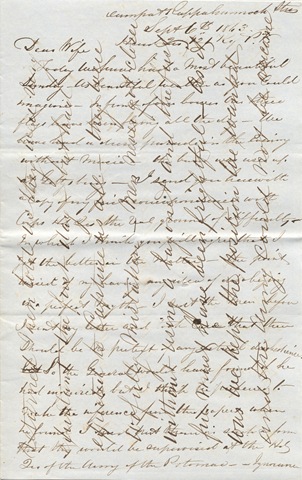
Camp at Rappahannock Sta

Sept 6th 1863

Head Qrs 121 Reg P.V.

Dear Wife

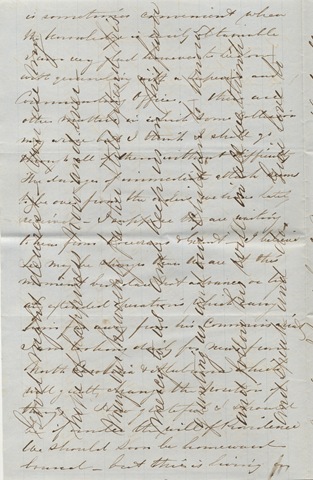
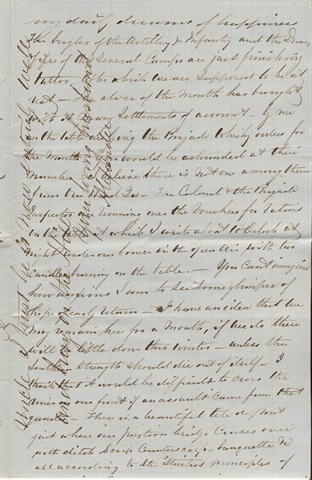
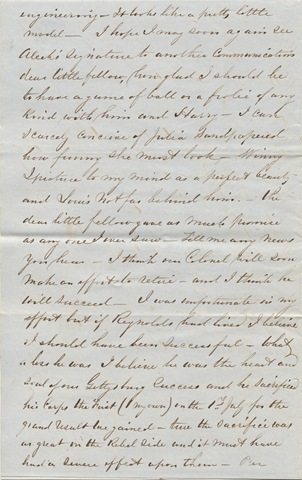
Today we have had a most beautiful Sunday – As beautiful weather as you could imagine – In front of our bower our three flags have been flying all the day – We have had a dress parade in the evening without music – the band was used up at Gettysburg – I send you herewith a copy of my first correspondence with Corps Hd Qrs the real ground of difficulty – In which I think you will agree that I get the better on the matter – the point raised of my having any idea of disobeying is a perfect myth – I sent the men before I sent my letter and took care that there should be no pretext of any actual disobedience but so the General would have found if he had inquired but I think he preferred to make the inference from the papers when he found I had put them in such a form that they would be surprised at the Hd Qrs of the Army of the Potomac – Ignorance is sometimes convenient when the knowledge is early obtainable I am very glad however to be done with quarreling with a superior and Commanding Officer. there are other matters in which some collision may arise but I think I shall go through all of them without difficulty The danger of immediate attack seems to be over from the orders we have lately received – I suppose they are waiting to hear from Rosecrans & Grant – I believe Lee may be stronger than we are at this moment but dare not advance or try any extended operations which carry him far away from his commissariat…

Citation: Alexander Biddle (1819-1899), autograph letter signed to Julia Williams Rush Biddle, 6 September 1863. Rush IV:30:35

September 3, 1863: Henry Warner to John Riddle Warner

Henry Warner Jr. was the younger brother of John Riddle Warner, the grandfather of the poet Marianne Moore.  Henry served in  Independent Battery G from August 1862 until June 1865.These family letters are preserved as part of the Marianne Moore family papers.

Moore VI-5-23 p1 Henry Warner to John Riddle Warner 9-3-63 Moore VI-5-23 p2 Henry Warner to John Riddle Warner 9-3-63

Transcript:

Fort Delaware

Sept. 3/63

Dear Brother

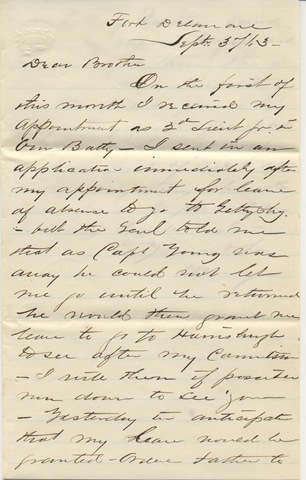
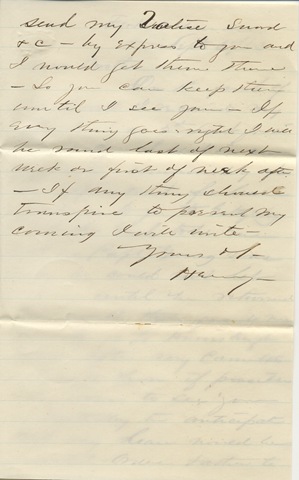
On the first of this month I received my appointment as 3d Lieut. Jr in our Battry—I sent in an application immediately after my appointment for leave of absence to go to Gettysbg.—but the Genl told me that as Capt Young was away he could not let me go until he returned he would then grant me leave to go to Harrisburgh to see after my Commission—I will then if possible move down to see you—Yesterday in anticipation that my leave would be granted—Ordered father to send my Valise sword &c—by express to you and I would get them there—So you can keep them until I see you—If every thing goes right I will be round last of next week or first of next after—If any thing should transpire to prevent my coming I will write

Yours—

Henry

Citation: Citation: Henry Warner Jr., autograph letter to John Riddle Warner. Fort Delaware, 3 September 1863. Moore VI:05:23
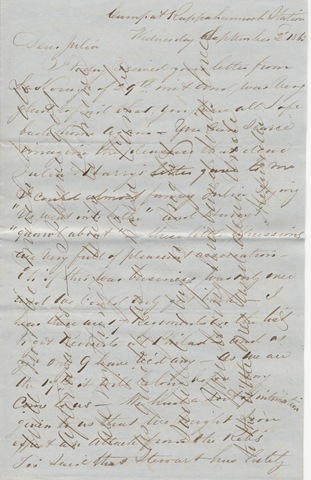
September 2, 1863: Alexander Biddle to Julia Williams Rush Biddle

Alexander Biddle was a member of the prominent Philadelphia Biddle family and was married to Julia Williams Rush,  the granddaughter of Dr. Benjamin Rush.  Biddle served with the 121st Pennsylvania Volunteer Infantry, beginning in September 1862. Starting out as a major, he would participate in Fredericksburg and Gettysburg, among other engagements, and would leave the service as a lieutenant colonel. (He was commissioned, but never mustered, as colonel)             Rush IV-30-35 p1 A. Biddle ALS to Julia William Rush, Sept 2 Rush IV-30-35 p2 A. Biddle ALS to Julia William Rush, Sept 2 Rush IV-30-35 p3 A. Biddle ALS to Julia William Rush, Sept 2 Rush IV-30-35 p4 A. Biddle ALS to Julia William Rush, Sept 2

Transcript(excerpt):

Camp at Rappahannock Station

Wednesday September 2d 1863

Dear Wife

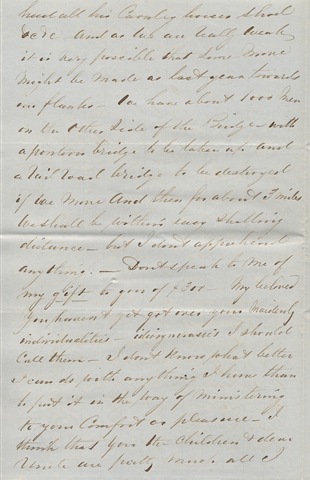
I today received your letter from La Noraye of 29th inst and was very glad to find that you were all Safe back home again – You can scarce imagine the pleasure that dear Julia & Harry’s letter gave to me I could almost fancy Julia saying “Us went into bathe” and Harry’s “quawl about” – their little expressions are very full of pleasant association – Oh if this war business was only over and we could only get back – I hear there are 17 Regiments on the list to get Recruits at Philad and as yet only 9 have rec’d any – As we are the 17th it will be long before any come to us – We had a sort of intimation given to us that we might soon expect an attack from the Reb’s Tis said that Stewart has lately had all his Cavalry horses shod &c &c – and as we are really weak it is very possible that some move might be made as last year towards our flanks. We have about 1000 men on the other side of the Bridge with a pontoon bridge to be taken up and a rail road bridge to be destroyed if we move and then for about 3 miles We shall be within easy shelling distance – but I don’t apprehend anything. Don’t speak to me of my gift to you of $300 – My beloved you haven’t yet got over your maidenly individualities – idiosyncrasies I should call them – I don’t know what better I can do with anything I have than to put it in the way of ministering to your Comfort or pleasure – I think that you the children & dear Uncle are pretty much all I have left…

Citation: Alexander Biddle (1819-1899), autograph letter signed to Julia Williams Rush Biddle, 2 September 1863. Rush IV:30:35

September 1, 1863: Alexander Biddle to Julia Williams Rush Biddle and Children

Alexander Biddle was a member of the prominent Philadelphia Biddle family and was married to Julia Williams Rush,  the granddaughter of Dr. Benjamin Rush.  Biddle served with the 121st Pennsylvania Volunteer Infantry, beginning in September 1862. Starting out as a major, he would participate in Fredericksburg and Gettysburg, among other engagements, and would leave the service as a lieutenant colonel. (He was commissioned, but never mustered, as colonel)

Rush IV-30-35 p1 A. Biddle ALS to Julia William Rush, Sept 1 Rush IV-30-35 p2 A. Biddle ALS to Julia William Rush, Sept 1 Rush IV-30-35 p3 A. Biddle ALS to Julia William Rush, Sept 1 Rush IV-30-35 p4 A. Biddle ALS to Julia William Rush, Sept 1

Transcript:

Camp at Rappahannock Sta

Sept 1st 1863. Tuesday

Dear Wife

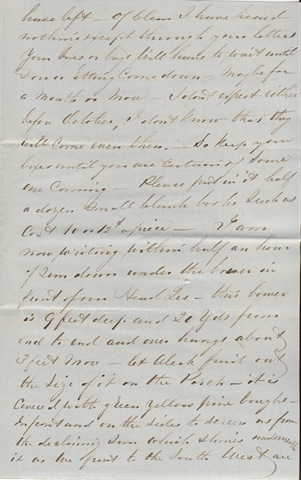
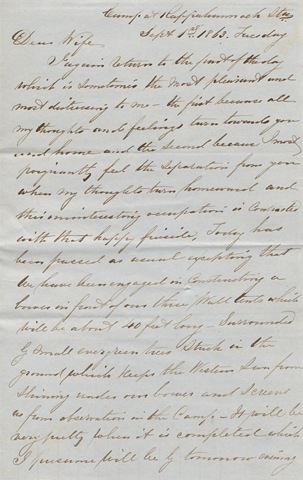
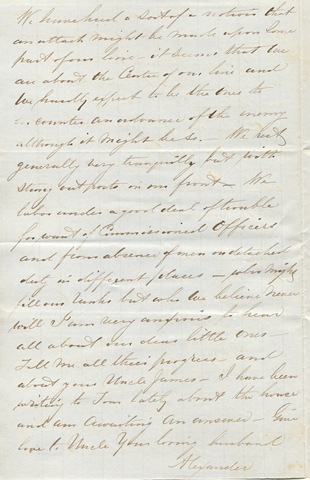
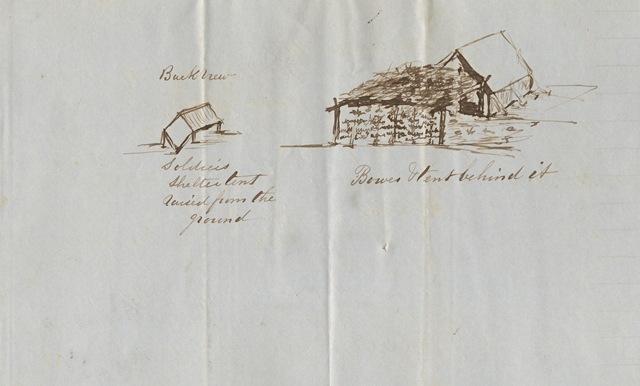
I again return to the part of the day which is sometimes the most pleasant and most distressing to me – the first because all my thoughts and feelings turn towards you and home and the second because I most poignantly feel the separation from you when my thoughts turn homeward and this uninteresting occupation is contrasted with that happy fireside. Today has been passed as usual excepting that we have been engaged in Constructing a bower in front of our three wall tents which will be about 40 feet long – Surrounded by small evergreen trees stuck in the ground which keeps the Western Sun from shining under our bower and screens us from observation in the Camp – It will be very pretty when it is completed which I presume will be by tomorrow evening We have had a sort of a notion that an attack might be made upon some part of our line – it seems that we are about the Centre of our line and we hardly expect to be the ones to encounter an advance of the enemy although it might be so. We rest generally very tranquilly but with strong outposts in our front – We labor under a good deal of trouble for want of Commissioned Officers and from absence of men on detached duty in different places – who might fill our ranks but who we believe never will I am very anxious to hear all about out dear little ones – Tell me all their progress and about your Uncle James – I have been writing to Tom lately about the house and am awaiting an answer – Give love to Uncle Your loving husband

Alexander

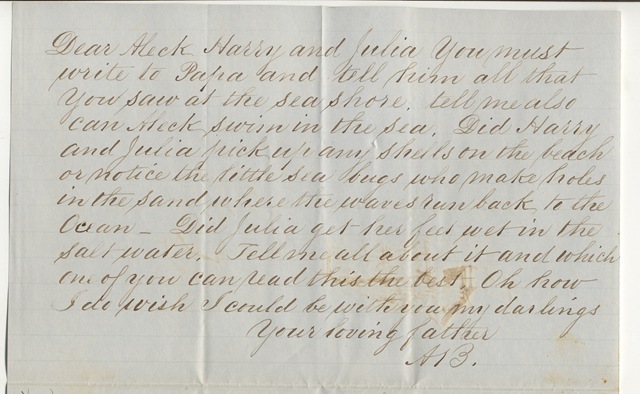
Dear Aleck Harry and Julia You must write to Papa and tell him all that You saw at the sea shore, tell me also can Aleck swim in the sea. Did Harry and Julia pick up any shells on the beach or notice the little sea bugs who make holes in the sand where the waves run back to the Ocean – Did Julia get her feet wet in the salt water, tell me all about it and which one of you can read this the best. Oh how I wish I could be with you my darlings

Your loving father

AB.

Citation: Alexander Biddle (1819-1899), autograph letter signed to Julia Williams Rush Biddle and children, 1 September 1863. Rush IV:30:35