May 6, 1861: John Henry Brown’s Journal

John Henry Brown was a painter of portrait miniatures, living and working in Philadelphia. He had met Lincoln in August of 1860 when he was commissioned to paint Lincoln’s portrait for a supporter, but although Brown liked Lincoln personally, he did not agree with Republican policies.

1861-05-06

Transcript:

At Com: Conovers picture.

These are fearful times. A silent, but nevertheless perfect, reign of terror exists here. Those who do not approve of a settlement of our troubles, by the sword, are, for prudential reasons, obliged to remain very quiet. 

This prudential silence has created a seeming oneness of sentiment in the North, which really does not exist.


Citation: John Henry Brown (1818-1891), autograph journal/account book. Philadelphia, 1844-1890. AMs 574/14.1
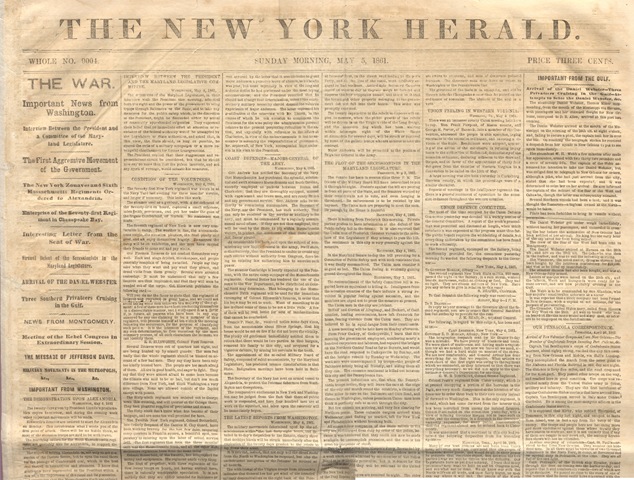
May 5, 1861: New York Herald

Top

Transcript (Excerpt):

Page 1, Upper Half

Condition of the Volunteers

Washington, May 4, 1861

The Seventy-first New York regiment was sworn in at the Navy Yard last evening for three months’ service, and longer if necessary. This looks like work. The steamer used as a gunboat, with a detachment of the Seventy-first on board, captured a small schooner, laden with provisions, and put her under the guns of the frigate Cumberland, off Norfolk. No resistance was made.

The Seventh regiment of New York is now very comfortable in camp. The weather is fine, the accommodations ample, the situation pleasant, the food plenty and good, and all enjoy themselves hugely. To-morrow the camp will be on exhibition, and the men have invited their friends to come out and pay visits.

Citation: New York Herald. 5 May 1861. Gift of Steven and Susan Raab. AN .N56792

May 4, 1861: John Henry Brown’s Journal

John Henry Brown was a painter of portrait miniatures, living and working in Philadelphia. He had met Lincoln in August of 1860 when he was commissioned to paint Lincoln’s portrait for a supporter, but although Brown liked Lincoln personally, he did not agree with Republican policies.

1861-05-04

Transcript:

At Com: Conovers picture.

Things are crowding so fast that it will be impossible to keep up with the news of each day. The reader of this must therefore, if anxious to know the daily events, turn to a file of newspapers or the written history of the times.


Citation: John Henry Brown (1818-1891), autograph journal/account book. Philadelphia, 1844-1890. AMs 574/14.1
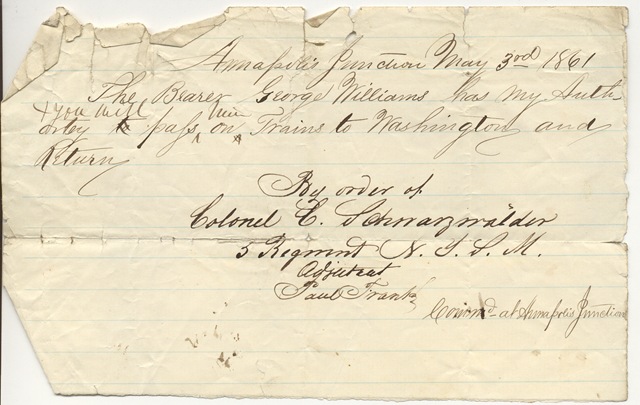
May 3, 1861: Pass for George Williams

AMs 811-2-6 pass for George Williams

Transcript:

Annapolis Junction May 3rd 1861

The Bearer George Williams has my Authority to pass here on Trains to Washington and Return

By order of
Colonel C. Schwarzwalder

5 Regiment N.Y.S.M.

Adjutant

Paul Frank

Commd at Annapolis Junction


Citation: Pass for George Williams. Annapolis Junction, 3 May 1861. Ams 811/2.6

May 1, 1861: New York Times

top

Transcript (excerpt):

Page 1, Lower Half

No Prospect of Secession

From information gained from gentlemen whose position and influence puts them in the way of knowing the feeling and views of the majority of the Legislature of Maryland, we feel warranted in saying that body will not even pass a bill to call a State Convention, but will content themselves with making a calm, dignified appeal to the country.

A dispatch from Frederick says: “A gentleman from Washington informs me that Gen. Scott showed him yesterday the copy of a proclamation to be issued immediately, declaring partial martial law in the District of Columbia and over the line of railway established by the Government for National purposes, so far as to suspend the right of habeas corpus.“

Citation: New York Times. 1 May 1861. Gift of Steven and Susan Raab. AN .N5682