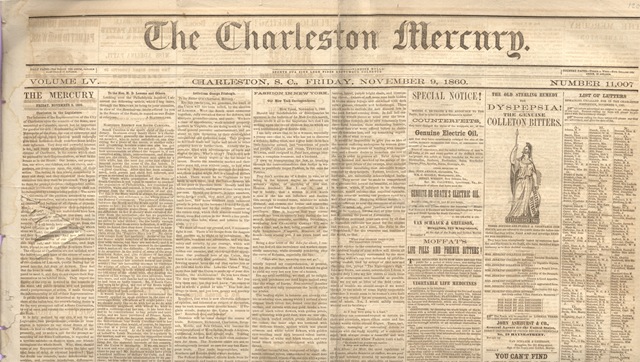
April 10, 1861: New York Herald

top

Transcript (excerpt):

Page 2, Lower Half

Interesting From Virginia.

Our Richmond Correspondence.

Richmond, Va., April 6, 1861.

The Present Attitude of Virginia – How Long is She to Remain in the Union? – The Union Men in the Convention Endeavoring to Escape from the Rising Tide of Revolution, &c., &c.

The cord which binds Virginia to the Union at this moment is so slight as to need but the pressure of any little emergency to snap it forever. It is fast yielding under the natural strain of Southern interest and Southern sympathy; and any sudden emergency which would abruptly rend it would but anticipate by a few months a result that is not inevitable.

Citation:New York Herald. 10 April 1861. Gift of Steven and Susan Raab. AN .N56792

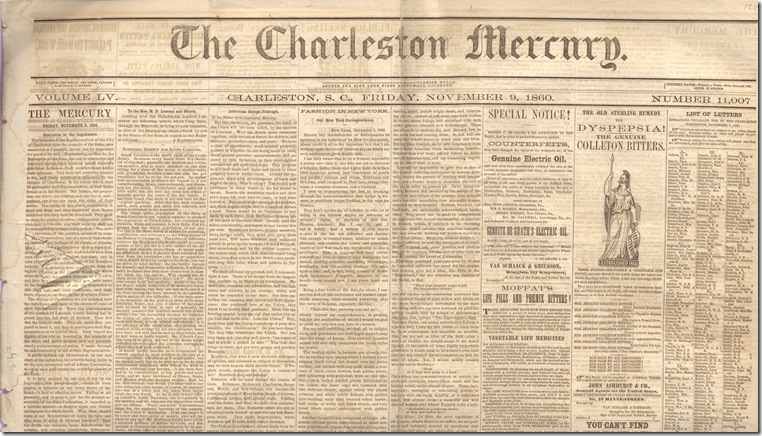
April 6, 1861: New York Herald

top

Transcript (excerpt):

Page 3, Lower Half

Important News from Charleston

Charleston, April 5, 1861

A terrible moment is evidently at hand. The news from Washington and New York to-night corroborates the general impression, that within twenty-four hours war will be upon us.

Every man has been ordered on duty, and the utmost activity prevails. The State is prepared for any emergency.

The highest officials say the present state of things cannot last but a short time longer.

The excitement throughout is intense, and everything wears a warlike aspect.

Citation: New York Herald. 6 April 1861. Gift of Steven and Susan Raab. AN .N56792

March 23, 1861: Charleston Mercury

Charleston Mercury 3-23-61

Transcript (excerpt):

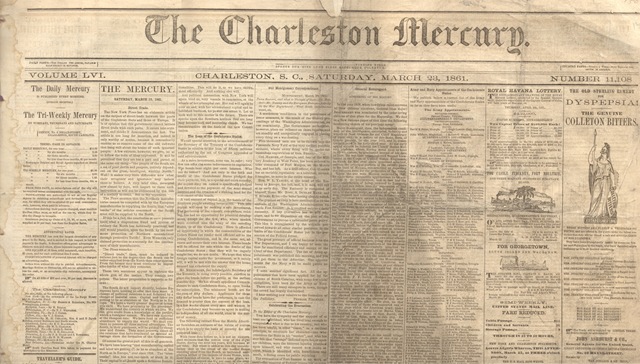
The Charleston Mercury, Charleston, S.C., Saturday, March 23, 1861.

Page 1, Upper Half

Direct Trade.

The New York Times has an elaborate article on the subject of direct trade between the ports of the Confederate States and those of Europe. It is of opinion that this government cannot initiate direct trade with such ports. It enters into argument, and thinks it demonstrates the fact. The article is too long for insertion, and indeed is only worth of notice, because it conveniently enables us to remove some of the old cobwebs that hang still about the brains of such ignorant people. A few extracts, however, we give so as to follow a train of ideas expressed. It will be perceived that they are but a part and parcel of the same old thing – “the people of the South are a set of poor devils and paupers, entirely dependent on the great, intelligent, wealthy North.” Well! it makes little difference now what their arrogance and ignorance may induce them to believe. A very brief time, measured now almost by days, will impart to them such instruction as will not be obliterated by the tide of a century to come. But to the argument.

The Times assumes that the Northern manufactories cannot be competed with by the European manufactories in supplying the South; that “nineteenths” of the articles consumed at the South must still be supplied by the North.

If this be fact, the conclusion at once presents itself, what a stupendous fraud and system of robbery the North has habitually practiced, and still would practice, upon the South by the enormous protection of Northern manufactures through protective Tariffs! Even Webster only claimed protection as a necessity for the continuance of their manufactures.

Citation: Charleston Mercury. Charleston, S.C., 23 March 1861. Gift of Steven and Susan Raab. AN .C477
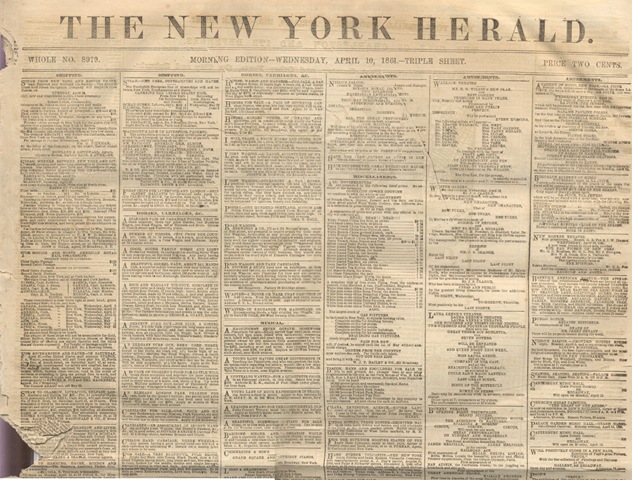
March 11, 1861: Charleston Mercury

top

Transcript (excerpt):

The Charleston Mercury, Charleston, S.C., Monday, March 11, 1861

Page 1, Upper Half

The Abolition Regime

Our Washington Correspondence.

Washington, March 7.

Douglas’ Opinion of the Inaugural – His Object in Interpreting it as a Peace Document – Crittenden nominated to the Supreme Court – Why Blair was made Postmaster General – Visits of the Delegations – Speeches working up the Feelings of the People to the War Point – Good bye to the Readers of The Mercury, etc., etc.

Every tongue is busy commenting on the inaugural. The papers are filled with quotations giving the opinions of the press in all directions. There is little agreement except in this – that all coincide as to the fact that it either means war or it does not mean war. The inference is that it was intended to mean both – the one and the other, according to circumstances. Mr. Douglas, in the Senate yesterday, expressed his belief, after a careful study of the mysterious document, that is was friendly and conciliatory. Now, it is known that Douglas was at first puzzled by it. He is still puzzled, his friends say, and had an object in putting a peaceful interpretation upon it, viz: to draw out a Republican translation.

Citation: Charleston Mercury. Charleston, S.C., 11 March 1861. Gift of Steven and Susan Raab. AN .C477
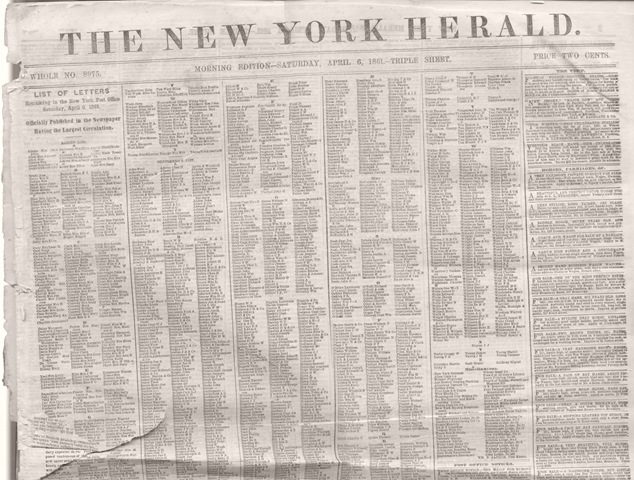
January 26, 1861: New York Herald

top

Transcript (Excerpt)

The New York Herald, New York, Saturday, January 26, 1861

Page 3, Upper Half

Reinforcements Sent to Fort Sumter and Pickens

There is no longer any doubt that the government have sent forces to relieve forts Sumter and Pickens. The administration do not regard this action as any declaration of war on the part of the government, but as simply a duty. The authorities of Charleston and Pensacola understand this, and if they choose to be the aggressors and make the attack, they must take the consequences.

It may be some days before it is known that forces have been sent. The movement has been quietly made, but the movement is in earnest now, as these people well understand. The destination of the steamer Brooklyn is Fort Pickens.

Citation: New York Herald. New York, 26 January 1861. Gift of Steven and Susan Raab. AN .N56792

January 18, 1861: New York Herald

top

Transcript (excerpt):

The New York Herald, New York, Morning Edition, Friday, January 18, 1861.

Page 1, Upper Half

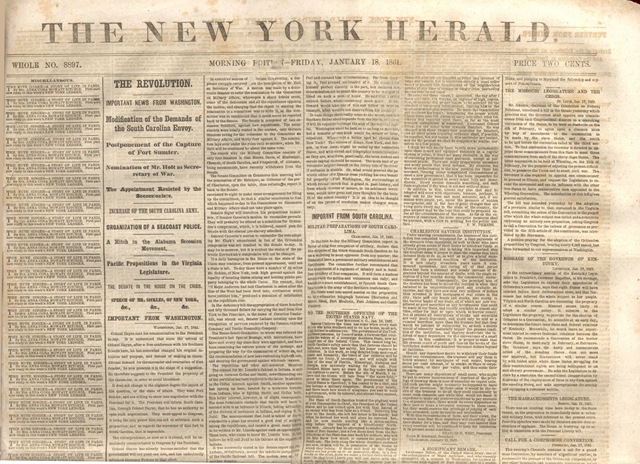
Colonel Hayne sent his communication to the President to-day. It is understood that since the arrival of Colonel Hayne, after a free conference with his Southern friends here, he has somewhat changed his original intention and purpose, and instead of making an unconditional demand for the surrender and evacuation of Fort Sumter, he now presents it in the shape of a suggestion. He therefore suggests to the President the property of the surrender, in order to avoid bloodshed.

It does not change in the slightest degree the aspect of the question, or the state of affairs. They want Fort Sumter, and are willing to enter into negotiation with the President for it. The President will inform South Carolina, through Colonel Hayne, that he has no authority to open such negotiations. They must appeal to Congress, it being the only power that can act or entertain such a proposition; and as regards the surrender of that fort to South Carolina, that is impossible.

Citation: New York Herald. New York, January 1861. Gift of Steven and Susan Raab. AN .N56792

December 29, 1860: New York Tribune

top

Transcription (excerpt p1):

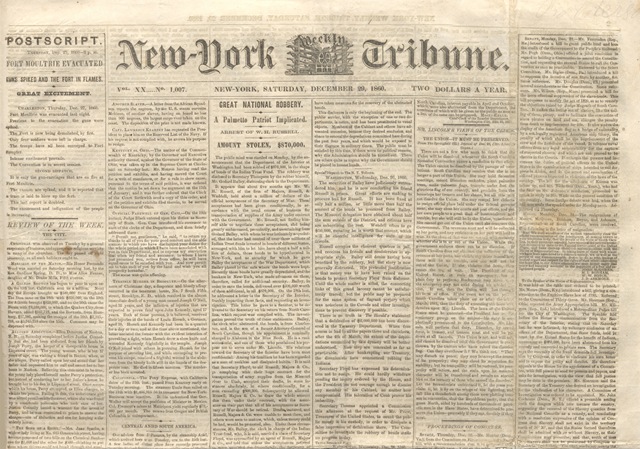
Mr. Lincoln’s Views of the Crisis.

The Union – It Must Be Preserved.

From the Springfield (Ill.) Journal of Dec. 20 (Mr. Lincoln’s Organ)

There are not a few who seem to think that the Union will be dissolved whenever the South Carolina Secession Convention passes a resolution to that effect. The Union cannot be dissolved by the passage of resolutions. South Carolina may resolve that she is no longer a part of this Union. She may hold Secession meetings, mount Disunion cockades, plant palmetto trees, make palmetto flags. Trample under foot the glorious flag of our country and proclaim from the housetops her treason and her shame, but all this will not dissolves the Union. She may compel her citizens to resign official place held under the federal government, she may close her courts and post offices, and put her own people to a great deal of inconvenience and trouble, but she will still be in the Union, unmolested. She cannot get out of the Union until she conquers this Government.


Citation: New York Weekly Tribune. New York, 29 December 1860. Gift of Steven and Susan Raab.

December 22, 1860: The Sun [Baltimore]

Baltimroe Sun 12-22-60

Transcript (excerpt, p1):

By Telegraph for the Baltimore Sun.

South Carolina Sovereign Convention.

Signing of the Secession Ordinance – Address to the Southern States – Secret Session of the Convention – Reports of Committees – Commissioners Elected to go to Washington – Grand Torchlight Procession and Illumination in Charleston – Rejoicing in Other Southern States, etc.

Charleston, Dec. 20th – The members of the convention assembled at Institute Hall at half-past 6 o’clock this evening and proceeded to sign this ordinance of secession, which was beautifully engrossed on parchment. The president signed first and was followed by all the members.
Citation: The Sun. Baltimore, 22 December 1860. Gift of Steven and Susan Raab. AN .S955

December 21, 1860: The Sun [Baltimore]

Baltimore Sun 12-21-60

Transcript [excerpt, p1]:

The Ordinance of Secession

Mr. Inglis made a report to the committee to prepare and draft an ordinance proper to be adopted by the convention as follows:

“An Ordinance to dissolve the Union between the State of South Carolina and other States united with her under the compact entitled the Constitution of the United States of America.

“We the people of South Carolina convention assembled, do declare and ordain, and it is hereby declared and ordained that the ordinance adopted by us in convention on the 23rd day of May, in the year of our Lord one thousand seven hundred and eighty-eight, whereby the Constitution of the United States of America was ratified, and also all acts and parts of acts of the General Assembly of this State ratifying the amendments of the said Constitution are hereby repealed.

“And that the Union now subsisting between South Carolina and other States, under the name of the United States of America, is hereby dissolved.”

The ordinance having been read was taken up and passed by a unanimous vote of one hundred and sixty-nine members.
Citation:The Sun. Baltimore, 21 December 1860. Gift of Steven and Susan Raab. AN .S955

November 9, 1860: Charleston Mercury

top

Transcription (excerpt):

(p1 top center column)

Fashion in New York.

Our New York Correspondence

New York, November 5, 1860

Should any incoherencies or discrepancies be apparent in the bulletin of La Mode for this month, please credit it all to the important fact that I am writing upon the eve of election day, to which my own restlessness gives double zest.

I am fully aware that to be a woman, especially a young one – that is, one who has yet to discover a wrinkle, fading roses, and a gray hair – is to be a little feminine animal, just “conscious of pearls and purple,” chicken and cream, Tennyson and Bulwer, until resigned to Point lace, orange blossoms, a complete trousseau, and a husband.

I own to transgressing the law, to breaking through the conventialities that hedge in woman, to positively forget Fashion, in the rage for Politics.

Pray don’t accuse me of a desire to vote, or of being in the faintest degree an advocate of woman’s rights, or anything of that sort. Heaven forefend! But I say it, and I say it boldly, that a woman is not worth a sous if she has not influence and fascination enough to control votes, minister to minds diseased, and cleanse the brains and masculine hearts of that foul black dye threatening us like a pestilence. Thus is happens that your correspondent has been excessively busy during the last month, making converts, sacrificing friendships, wondering how Charlotte Corday felt once upon a time, and, in fact being accused of downright haughtiness. N’importe, Messieurs of the South – born among you, I am yours heart and soul.

Being a dear lover of the dolce far niente, I cannot but feel all this turbulence and warfare excessively annoying, while dreamily pondering over the curse of Kehama, especially the line:

“Days after days, unvarying come and go.”

utterly beyond my comprehension, at present, but for the realization of which I would be glad to yield my very last new love of a bonnet.
Citation: Charleston Mercury, 9 November 1860. Gift of Steven and Susan Raab. AN .C477