June 5, 1861: Philadelphia Inquirer

top

Transcript (excerpt):

Page 1, Upper and Lower Halves

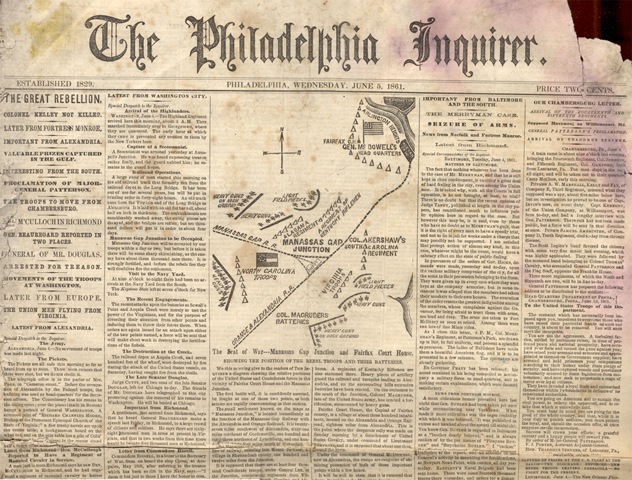
The Seat of War — Manassas Gap Junction and Fairfax Court House.

Showing the position of the Rebel Troops and Their Batteries.

We this morning give to the readers of The Inquirer a diagram showing the relative positions of the United States and Confederate forces in the vicinity of Fairfax Court House and the Manassas Junction.

The first battle will, it is confidently asserted, be fought at one of these two points, as both armies are rapidly concentrating in that section.

The small settlement known on the maps as “Manassas Junction,” is located immediately at the junction of the Manassas Gap Railway with the Alexandria and Orange Railroad. It is twenty-seven miles southwest of Alexandria, sixty-one miles northeast of Gordonsville, one hundred and forty-three northeast of Lynchburg, and one hundred thirty-four miles north of Richmond. The Manassas Gap Railroad is an uncompleted line of railway, entering into Mount Jackson, a village in the Shenandoah county, one hundred and twelve miles from the Junction.

It is supposed that there are at least four thousand Confederate troops, under General Lee, at the Junction, comprising regiments from Virginia, North Carolina, South Carolina, and Alabama. A regiment of Kentucky Riflemen are also stationed there. Heavy pieces of artillery guard the railroad and turnpike leading to Alexandria, and on the surrounding hills extensive batteries have been erected. On the eminence to the south of the Junction, Colonel Magruder, late of the United States army, has erected a fortification, surmounted by heavy guns.

Citation: Philadelphia Inquirer. 5 June 1861. Gift of Steven and Susan Raab. AN .P5546

June 4, 1861: Philadelphia Inquirer

top Transcript (excerpt):

Page 1, Upper Half

Special Correspondence of the Inquirer

Chambersburg, June 2, 1861.

A messenger arrived here last night from Capt. Kennedy, at Williamsport. His dispatches state that hostilities have commenced between the Union company at that point and the insurgent pickets on the Virginia shore. About 9 o’clock on Saturday morning, the insurgents fired upon the ferry boat from Williamsport, and the fire was returned. After exchanging several shots, Capt. Kennedy sent out a flag of truce, asking a cessation of hostilities, which was granted, and he immediately dispatched the messenger to General Williams, at this point, for reinforcement. It is also states that Lieut. Anderson, of Capt. Kennedy’s company, shot one of the Virginians on the other side of the river.

Citation. Philadelphia Inquirer. 4 June 1861. Gift of Steven and Susan Raab. AN .P5546

May 18, 1861: New York Herald

top for web

Transcript (excerpt): Page 1, Upper Half

Arrest Of A Suspected Spy

Washington, May 17, 1861

A man by the name of Wood, from Newark, was arrested as a spy yesterday by order of General Scott. Wood commenced his operations by tampering with the members of the Newark regiment, through which means he obtained an introduction to General Runyon, and thence to General Scott, who became fascinated with his plausible story, and employed him as a secret agent of the government to go South. Wood received some money from the secret service fund to pay his expenses. Before leaving the city he expended a portion of his funds in liquor, and while under the gay and festive influence of the same he pitched into several members of one of the Newark companies for taking up arms against the South. This threw suspicion upon him, and he was immediately reported to General Runyon, who was astounded, but immediately ordered him under arrest, and that his person and property in his room be searched. This was done last night, but nothing was found upon him but money. The Colonel of the Newark regiment ordered that a guard be kept over him all night, supposing that the report this morning would release him; but before General Scott read it he ordered Wood to be delivered over to the Marshal of the district and lodged in jail to await further orders. The supposition is that General Scott is in possession of other evidence than that alluded to, upon which the prisoner is held.

Wood is a man about forty years of age, and is said to be a secessionist. He is one of many such not only in this city, but in other places, who are receiving salaries under the government.

Citation: New York Herald. 18 May 1861. Gift of Steven and Susan Raab. AN .N56792

May 17, 1861: Springfield Republican

top

Transcript (excerpt):

What the Negroes are Thinking About

A gentleman from Virginia, in whose account the New York Times puts entire confidence, states that the negroes in that state comprehend very well the position of affairs, and are deeply interested in the war. A prevalent opinion among them is, that this war is a fulfillment of the prophecy recorded in the eleventh chapter of Daniel. They have their revolutionary and patriotic songs, which they sing in private. They hold secret religious meetings, the burthen of their prayers being that the Lord will help the North, and hasten the day of their emancipation. “A few days ago I was traveling in the interior of Virginia. Night overtook me in the neighborhood of a farm house, where I was entertained until the next day. That night I chanced to hear the evening devotions of the slaves in one of their huts. I was an unobserved spectator. I heard them pray for the success of the North, and one old woman wept for joy when told that the northern armies were soon coming to set them free. ‘Oh good massa Jesus,’ said she, ‘let the time be short.’ During this time they heard the clang of arms in their master’s house, for two of his sons were members of a troop of horse, ready to start in the morning for Richmond, and were practicing with the broadswords. To their masters, the slave pretend entire ignorance of this whole movement, but to white men in whom they confide, they reveal their hopes, fears, desires and plans. They have no arms, and could not use them if they had, but they have other means of destruction more potent and fearful, which no power can prevent their using. When the time comes for them to act, they will know no love stronger than the love of liberty.”

Useful Hints for Volunteers.

The governor has ordered the publication of the following important sanitary riles. Prepared by Dr Ware of Boston, which will be communicated to the Massachusetts troops in active service:-

Soldiers should recollect that in a campaign where one dies in battle, from three to five die from disease. You should be on your guard, therefore, more against this than the enemy, and you can do more for yourselves which nobody can do for you.

1. Avoid especially all use of ardent spirits. If you will take them-take them rather after fatigue than before. But tea and coffee are much better. Those who use ardent spirits are always the first to be sick and the most likely to die.

2. Avoid drinking freely if very cold water, especially when hot of fatigued., or directly after meals. Water quenches thirst better when not very cold and sipped in moderate quantities slowly- though less agreeable. At meals, tea, coffee and chocolate are best. Between meals, the less the better. The safest drink in hot weather is molasses and water with ginger or small beer.

3. Avoid all excesses and irregularities in eating and drinking. Eat sparingly of salt and smoked meats, and make it up by more vegetables, as squash potatoes, peas, rice, hominy, Indian meal , &c, when you can get them. Eat little between when you can get plenty of meals.

4. Wear flannel all over in all weathers. Have it washed often when you can-when not, have it hung up in the sun. Take every opportunity to do the same by all of your clothing and keep everything on your person dry, especially when it is cold.

5. Do not sit, and especially do not sleep upon the ground, even in hot weather. Spread your blanket upon hay, straw, shavings, brush-wood, or anything of the kind. If you sleep in the day, have some extra covering for you.

6. Sleep as much as you can and whenever you can. It is better to sleep too warm than too cold.

7. Recollect that cold and dampness are great breeders of disease. Have a fire to sit around in the evening and after rain, and take care to dry everything in and about your persons and tents.

8. Take every opportunity of washing the whole body with soap and water. Rub well afterwards. If you bathe, remain in the water but a little while.

9. If disease begins to prevail, wear a wide bandage of flannel around the bowels.

10. Keep in the open air, but not directly exposed to a hot sun. When obliged to do this, a thin, light, white covering over the head and neck in the form of a cap with a cape, is a good protection.

11. Wear shoes with very thick soles and keep them dry. When on the march, rubbing the feet after washing with oil, fat or tallow, protects from foot sores.

Citation:Springfield Republican. Springfield, Mass; 17 May 1861. Gift of Steven and Susan Raab. AN .S769
May 5, 1861: New York Herald

Top

Transcript (Excerpt):

Page 1, Upper Half

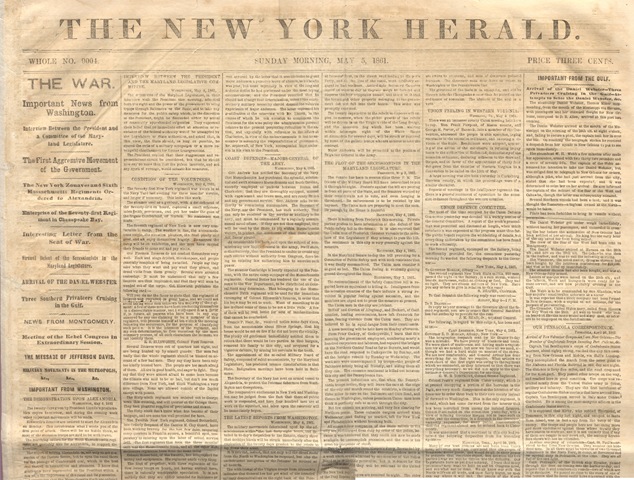
Condition of the Volunteers

Washington, May 4, 1861

The Seventy-first New York regiment was sworn in at the Navy Yard last evening for three months’ service, and longer if necessary. This looks like work. The steamer used as a gunboat, with a detachment of the Seventy-first on board, captured a small schooner, laden with provisions, and put her under the guns of the frigate Cumberland, off Norfolk. No resistance was made.

The Seventh regiment of New York is now very comfortable in camp. The weather is fine, the accommodations ample, the situation pleasant, the food plenty and good, and all enjoy themselves hugely. To-morrow the camp will be on exhibition, and the men have invited their friends to come out and pay visits.

Citation: New York Herald. 5 May 1861. Gift of Steven and Susan Raab. AN .N56792

May 1, 1861: New York Times

top

Transcript (excerpt):

Page 1, Lower Half

No Prospect of Secession

From information gained from gentlemen whose position and influence puts them in the way of knowing the feeling and views of the majority of the Legislature of Maryland, we feel warranted in saying that body will not even pass a bill to call a State Convention, but will content themselves with making a calm, dignified appeal to the country.

A dispatch from Frederick says: “A gentleman from Washington informs me that Gen. Scott showed him yesterday the copy of a proclamation to be issued immediately, declaring partial martial law in the District of Columbia and over the line of railway established by the Government for National purposes, so far as to suspend the right of habeas corpus.“

Citation: New York Times. 1 May 1861. Gift of Steven and Susan Raab. AN .N5682

April 22, 1861: The New York Herald

Top

Transcript (excerpt):

The New York Herald, New York, Morning Edition, Monday, April 22, 1861.

Page 1, Upper Half

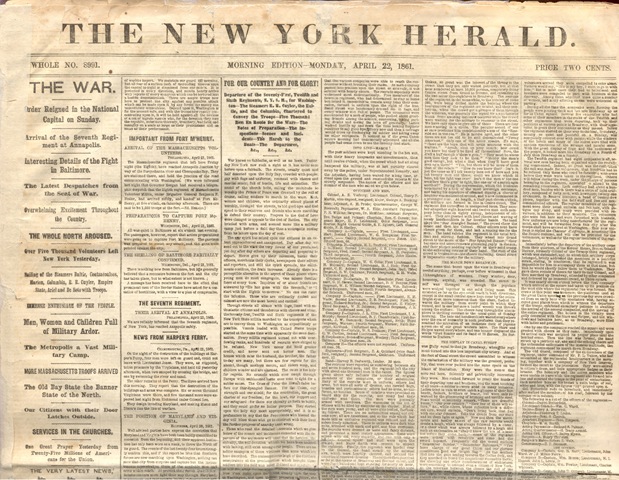
News From Harper’s Ferry.

Chambersburg, Pa., April 21, 1861.

On the night of the destruction of the buildings at Harper’s Ferry, four men were left on guard and, could not leave without Lieutenant Jones. They were, as supposed, taken prisoners by the Virginians, and held till yesterday afternoon, when two escaped by crossing the bridge, and one by swimming the river and canal.

The other remains at the Ferry. The three arrived here this morning. They report that the destruction of the buildings and arms was complete. Six or seven thousand Virginians were there, and five thousand more were expected last night from Richmond under Colonel Lee.

They design invading Maryland, and making Mason and Dixon’s line the line of warfare.

Citation: New York Herald. 22 April 1861. Gift of Susan and Steven Raab. AN .N56792

April 19, 1861: New Orleans Daily Crescent

New Orleans Daily Gazette

Transcript (excerpt):

New Orleans Daily Crescent, New Orleans, Friday Morning, April 19, 1861.

Page 1, Upper Half

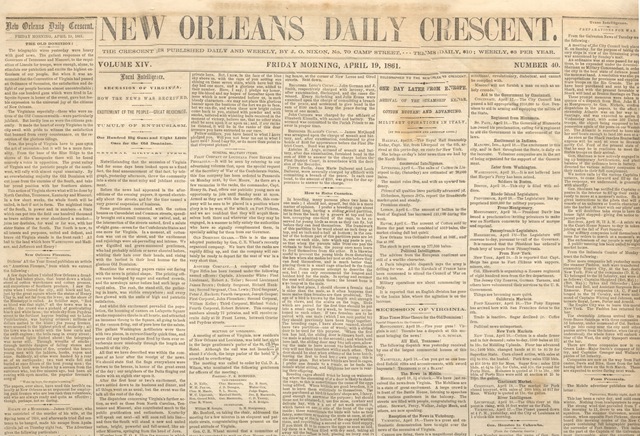
Notwithstanding that the secession of Virginia had for some days been looked upon as a fixed fact, the final announcement of that fact, by telegraph, yesterday afternoon, threw the community into a state of the most noisy and jubilant excitement.

Before the news had appeared in the after-editions of the evening papers, it spread electrically about the streets, and for the time caused a very general suspension of business.

Some gentlemen connected with the cotton houses on Carondelet and Common streets, speedily brought out a small cannon, or swivel, and, at the intersection of the streets named, fired a salute of eight guns – seven for the Confederate States and one more for Virginia. In a moment all cottondom was out on the street, and the excitement and rejoicings were all-pervading and intense. We saw dignified and grave-mannered gentlemen, who had probably seldom or never shouted before, whirling their hats over their heads, and vieing with the lustiest in their loud huzzahs for the glorious Old Dominion.

Citation: New Orleans Daily Crescent. New Orleans, 19 April 1861. Gift of Steven and Susan Raab. AN .N557

April 18, 1861: New York Herald

Top

Transcript:

Page 1, Upper Half

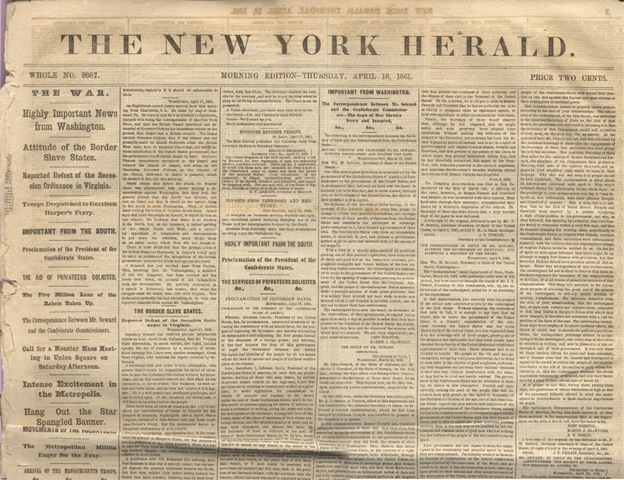
The Border Slave States

Reported Defeat of the Secession Ordinance in Virginia.

Washington, April 17, 1861.

Secretary Seward has received private information within an hour, direct from Richmond, that the Virginia State Convention, in secret session, last night, decided against the act of secession by a majority of seven. Since learning this I have seen another messenger, direct from Virginia, who confirms the report received by Mr. Seward.

A messenger has just come in from Alexandria, who asserts that it would be impossible for an act of secession to pass the Richmond Convention without his knowledge, and he this moment assures me that when he left Alexandria, at eleven o’clock this forenoon, no such action had been taken, and he does not believe it will happen. He is a well posted and intelligent gentleman, and can be relied upon. If the secession act should pass, it will have to be submitted to the people.

Citation. New York Herald. 18 April 1861. Gift of Steven and Susan Raab. AN .N56792

April 13, 1861: Charleston Mercury

Charleston Mercury 4-13-1861 edited

Transcript:

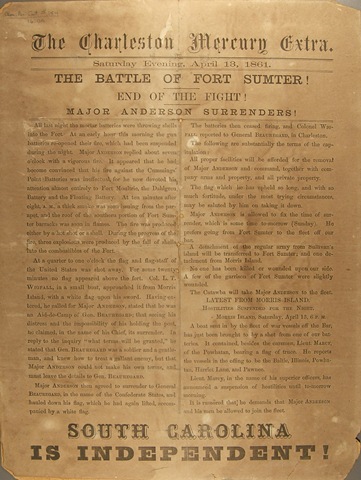
The Charleston Mercury Extra

Saturday Evening, April 13, 1861

THE BATTLE OF FORT SUMTER!

END OF THE FIGHT!

MAJOR ANDERSON SURRENDERS!

All last night the mortar batteries were throwing shells into the Fort. At an early hour this morning the gun batteries re-opened their fire, which had been suspended during the night. Major ANDERSON replied about seven o’clock with a vigorous fire. It appeared that he had become convinced that his fire against the Cummings’ Point Batteries was ineffectual, for he now devoted his attention almost immediately to Fort Moultrie, the Dahlgren Battery and the Floating Battery. At ten minutes after eight, A.M., a thick smoke was seen issuing from the parapet,and the roof of the southern portion of Fort Sumter barracks was soon in flames. The fire was produced either by a hot shot or a shell. During the progress of the fire, three explosions were produced by the fall of shells into the combustibles of the Fort.

At a quarter to one o’clock the flag and flag- staff of the United States was shot away. For some twenty minutes no flag appeared above the fort. Col. L.T. WIGFALL, in a small boat, approached it from Morris Island, with a white flag upon his sword. having entered, he called for Major ANDERSON, stated that he was an Aid-de-Campe of Gen. BEAUREGARD; that seeing his distress and the impossibility of his holding the post, he claimed, in the name of his Chief, its surrender. In reply to the inquiry “what terms will be granted,” he stated that Gen. BEAURGEARD was a soldier and a gentleman, and knew how to treat a gallant enemy, but that Major ANDERSON could not make his own terms, and must leave the details to Gen. BEAUREGARD,

Major ANDERSON then agreed to surrender to General BEUAREGARD, in the name of the Confederate States, and hauled down his flag, which he had again lifted, accompanied by a white flag.

The batteries then ceased firing, and Colonel WIGFALL reported to General BEAUREGARD, in Charleston. The following are substantially the terms of the capitulation:

All proper facilities will be afforded for the removal of Major ANDERSON and command, together with company arms and property, and all private property.

The flag which he has upheld so long, and with so much fortitude, under the most trying circumstances, may be saluted by him on taking it down.

Major ANDERSON is allowed to fix the time of surrender, which is some time to-morrow (Sunday). He prefers going from Fort Sumter to the fleet off our bar.

A detachment of the regular army from Sullivan’s island will be transferred to Fort Sumter; and one detachment from Morris island.

No one has been killed or wounded upon or side. A few of the garrison of Fort Sumter were slightly wounded.

The Catawba will take Major ANDERSON to the fleet.

LATEST FROM MORRIS ISLAND

HOSTILITIES SUSPENDED FOR THE NIGHT

MORRIS ISLAND, Saturday, April 13, 6 P.M.

a boat sent in by the fleet of war vessels off the Bar, has just been brought to by a shot from one of our batteries. it contained, besides the oarsmen, Lieut. MARCY, of the Powhatan, bearing a flag of truce. He reports the vessels in the offing to be the Baltic, Illinois, Powhatan, Harriet Lane, and Pawnee.

Lieut. Marcy, in the name of his superior officers, has announced a suspension of hostilities until tomorrow morning.

It is rumored that he demands that MAJOR ANDERSON and his men be allowed to join the fleet.

SOUTH CAROLINA IS INDEPENDENT!

Citation: Charleston Mercury extra. Charleston, 13 April 1861. AN .C477