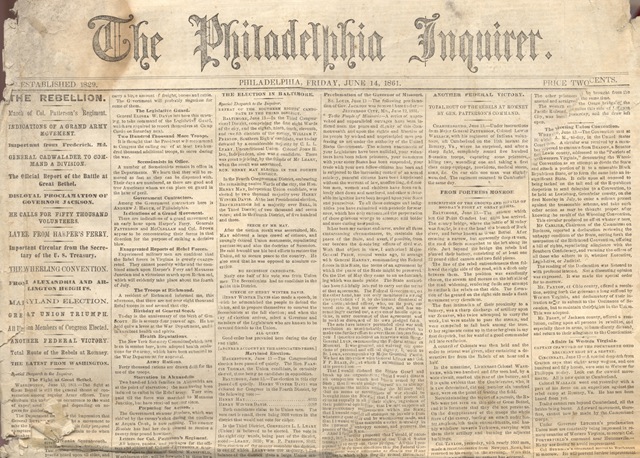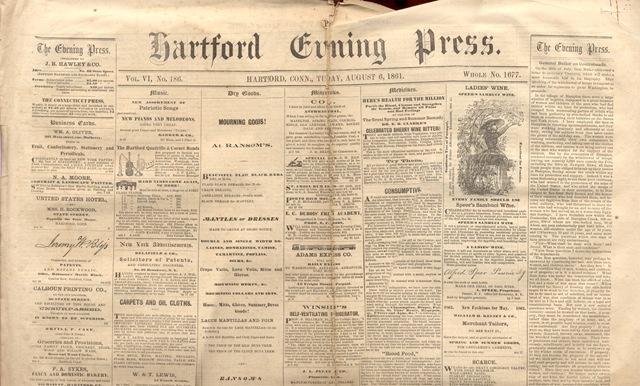
August 6, 1861: Hartford Evening Press

top

Transcript (excerpt):

Congressional War Measures

A bill has passed both houses, providing for the punishment of crimes against the United States. It visits with imprisonment and fines any one who enlists persons, white or black, to aid the rebellion, as well as those enlisted.

Another bill debars the owner of a slave who employs him in similar service, for any claim for his recovery, thus freeing the slave from his disloyal master.

Through the efforts of Gen. Sickles, an important provision has been adopted. All volunteers accepted by the President and mustered into service for one, two, or three years, or during the war, are to be paid from that time without waiting until they reach the rendezvous.

The increased pay of $4 per month to volunteers involves an additional yearly expenditure from the treasury of about $20,000,000. This has been embodied in the form of law.

[. . .]

Venomous Treason

“Our report elsewhere shows that there was a meeting at Bloomfield, on Monday evening of men who ought to be in camp at Manassas, blacking the boots of traitor officers, bringing water to the negroes at work on entrenchments, or the keener-scented among them, detailed to catch runaways. It would be more manly for these Eatonians to walk straight down to Manassas and put their necks under the yoke. They are alien to the soil of Connecticut. There are no hot jungles here whose steaming and pestilent air nourishes such creatures. They are false to their allegiance, to the state and the nation. They are false to every page of Connecticut history. As for liberty, they know nothing of it.

Their cowardice is not their least prominent characteristic. They carefully keep themselves just an inch beyond the reach of law. They dare not put into action the infamous sentiments that they express. They have studied law enough to know that the gibbet and the halter must wait till they commit the “over act.” They are safer from the rebels, for they are not in arms. They are safer than union men in the slave states, for we do not mob people here. Tar and feathers and scourges are the weapons that such men as Eaton and Miller use as they get where Lynch law reigns. In a community where such fellows rule, no union man lives in peace. Here we only warn them to confine themselves to vaporous words, for the gallows will grow quickly when they get caught in the actual deed.”

Citation: Hartford Evening Press. Hartford, 6 August 1861. Gift of Steven and Susan Raab. AN. H328

July 23, 1861: New York Times

top

Transcript (excerpt):

Page 1, Lower Half

Dispatch to the Associated Press.

Washington, Monday, July 22.

After the latest information was received from Centreville at 7 ½ o’clock last night, a series of events took place in the intensest degree disastrous.

Many confused statements are prevalent, but enough is known to warrant the statement that we have suffered in a degree which has cast a gloom over the remnants of the Army, and excited the deepest melancholy throughout Washington.

The carnage is tremendously high on both side, and on ours it is represented as frightful. We were advancing and taking the masked batteries gradually but surely, and driving the enemy towards Manassas Junction, when the enemy seemed to have been reinforced by Gen. Johnston, who, it is understood, took command, and immediately commenced driving us back, when a panic among our troops suddenly occurred and a regular stampede took place.

Citation: New York Times. 23 July 1861. Gift of Steven and Susan Raab. AN .N5682

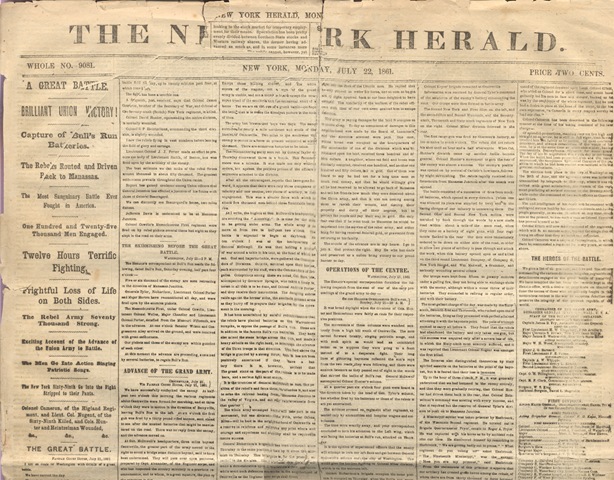
July 22, 1861: New York Herald

top

Transcript (excerpt):

Page 1, Lower Half

Washington, July 21, 1861.

The city is full of exaggerated rumors. It is difficult to tell what is reliable. Cannonading recommended at four o’clock this afternoon and ceased at five, probably occasioned by attempts of our troops to carry some rebel batteries between Bull’s Run and Manassas Junction. Official dispatches state that we have taken three batteries in the form of a crescent, numbering nineteen guns.

It is known that Manassas Junction was supplied with water by a canal from Bull’s Run. This, of course, will now be cut off, leaving the rebels without water for their cavalry.

Very few reliable details have yet reached us. That a most brilliant victory has been achieved by our gallant troops there is no doubt. Many encomiums are bestowed upon the Fire Zouaves and the Sixty-ninth stripped to the skin, except pants, and pitched into the night regardless of fatigue or personal safety.

Later

Gen. McDowell telegraphs that the enemy are completely routed from Bull’s Run, and retreating towards Manassas leaving their batteries in possession of the Union forces.

Citation: New York Herald. 22 July 1861. gift of Steven and Susan Raab. AN .N56792

June 24, 1861: Philadelphia Inquirer

top

Transcript (excerpt):

Page 1, Upper Half

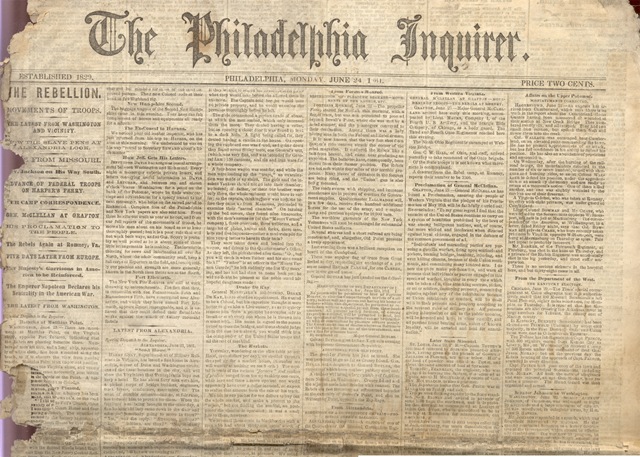
How Jeff. Gets His Letters

Jefferson Davis has a regular postal arrangement between Washington and Richmond. Every night a messenger collects private letters, and letters conveying useful information to Davis and Letcher, and between ten and eleven o’clock leaves Washington for a point on the bank of the Potomac, where he finds water carriage and conveniences for a speedy transit to the next messenger, who helps on the sacred parcel to Richmond. Complete files of the Philadelphia and New York papers are also sent him. From these he sifts out truth as near as he can, and from our full reports of the movements of troops, he moves his men about on his board so as to keep thoroughly posted; but it is a poor rule that will not work both ways, and so Gen. Scott is probably as well posted as he is about some of those little arrangements he is making. The insatiable thirsting for news and information all over the North, where the whole community read, keep, a full corps of Reporters in the field, and consequently our position and strength are more generally known in the North than theirs are in the South.

Citation: Philadelphia Inquirer. 24 June 1861. Gift of Steven and Susan Raab. AN .P5546

June 22, 1861: New York Times

NY Times 6-22-1861

Transcript (excerpt):

Saturday, June 22, 1861

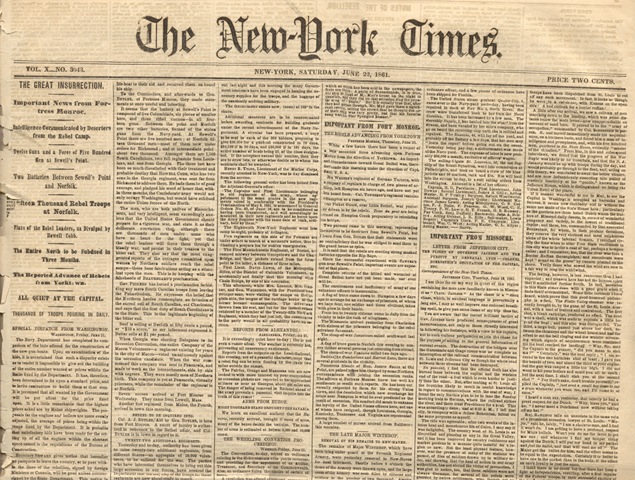
The Great Insurrection

Important News from Fortress Monroe.”

“Intelligence Communicated by deserters from the Rebel Camp.

Twelve Guns and a Force of Five Hundred Men at Sewell’s Point

Two Batteries Between Sewell’s Point and Norfolk.

Fifteen Thousand Rebel Troops as Norfolk

Plans of Rebel leaders, as divulged by IIewell Cobb.

The entire North to be subdued in Three Months

The reported Advance of Rebels from Yorktown

All quiet at the capital

Thousands of troops pouring in daily.”


“Important News from Fort Monroe

The Rebels Advancing from Yorktown

Fortress Monroe, Thursday June 20.

Within a few hours there has been a rumor of a large secession force advancing upon Fortress Monroe from the direction of Yorktown. An important reconnaissance toward Great Bethel was therefore, made this morning under the direction of Capt. Smith U.S.A.

Max Webber’s regiment of German Turners, with a company of regulars in charge of two pieces of artillery, left Hamptons six hours ago, and have not yet been heard from. Col. Townshead’s regiment remains at Hampton as a reserve

Our Picket Guard, near Little Bethel, was yesterday driven in by the rebels. Tetes du pout are being formed on Hampton Creek preparatory to rebuilding the bridge.

Two persons came in this morning, representing themselves to be deserters from Sewell’s Point, but I learn from Gen Butler that their statements were so contradictory that he was obliged to send them to the guardhouse as spies.


Citation: New York Times. New York, 22 June 1861. Gift of Steven and Susan Raab. AN .N5682

June 22, 1861: Philadelphia Inquirer

full page cropped edited


This unusual full-front page map shows the situation in northern Virginia as of late June. The map clearly shows the defenses assembled at Fredericksburg, Richmond, and along the major rivers, as well as batteries posted along the Orange and Alexandria Railroad, near the town of Manassas Junction, where the first pitched battle of the war would be fought. In an interesting allusion to Virginia’s role in the Revolutionary War, the map also noted where British troops landed on the York River, presumably indicating the upper reaches of the river’s navigability for large ships.


Citation: Philadelphia Inquirer. Philadelphia, 22 June 1861. Gift of Steven and Susan Raab. AN .P5546

June 21, 1861: New York Herald

top

Transcript: (excerpt)

Page 1, Upper Half

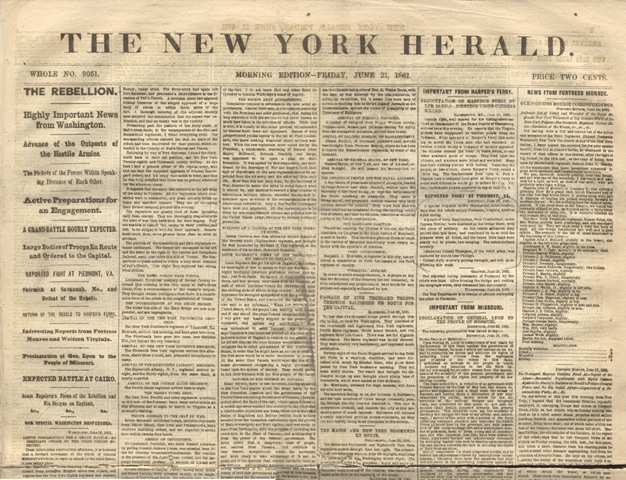
Important From Harper’s Ferry

REOCCUPATION OF HARPER’S FERRY BY THE REBELS – NINETEEN UNION CITIZENS KILLED.

Hagerstown, Md., June 20, 1861.

Captain Cook, well known for his distinguished services as Commander of the Home Guards of Sharpsburg, arrived here this evening. He reports that the Virginia pickets have reappeared at various points along the Potomac. Sixty appeared at Harper’s Ferry this morning to arrest the Union men who had returned. At twelve o’clock to-day a company of cavalry appeared. The citizens crossed the river in boats, swam, or any other available mode of escape. They fires upon the citizens, and nineteen were killed and wounded. Many had their clothing pierced with bullets. Yesterday the people, at two o’clock above Harper’s Ferry, raised a Union flag. The Confederate fired upon it. Part of Captain Cook’s company have gone to Harper’s Ferry to assist such citizens as would go to defend the flag. Fifteen Confederate pickets appeared to-day at dam No. 4.

Citation: New York Herald. 21 June 1861. Gift of Steven and Susan Raab. AN .N56792

June 19, 1861: Philadelphia Inquirer

top

Transcript (excerpt):

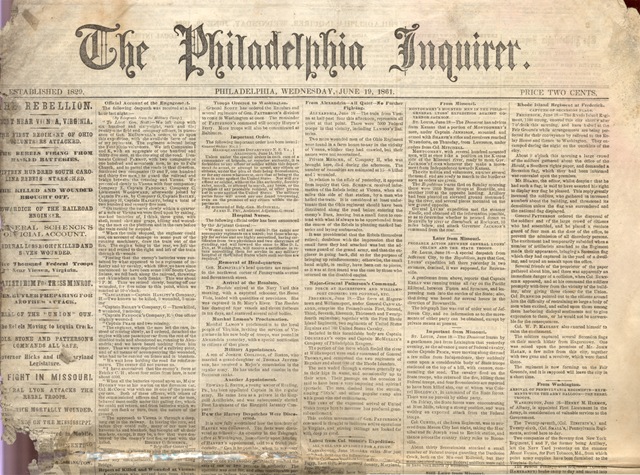
Official Account of the Engagement

The following dispatch was received at a late hour last night:-

(By Telegram from the Military Camp.)

“To Lieut Gen. Scott:-We left camp with six hundred and sixty-eight, rank and file; twenty-nine field and company officers; in pursuance of Gen. McDowell’s orders to go upon this expedition, with the available force of one of my regiments. The regiment selected selected being the First Ohio volunteers. We left companies I and K, with an aggregate of one hundred and thirty-five men at the crossing of the road. Lieutenant Colonel Parrot, with two companies of one hundred and seventeen men, to go to Falls Church, and to patrol the roads in that direction. Stationed two companies (D and F, one hundred and thirty-five men,) to guard the railroad and bridge between the crossing and Vienna. We proceeded slowly to Vienna with four companies; Company E. Captain Paddock; Company C, Lieutenant Woodward, afterwards joined by Captain Pease, by Company G, Captain Bailey, Company H, Captain Hazlett, being a total of two hundred and seventy-five men.

“On turning the curve slowly within a quarter of a mile of Vienna we were fired upon by raking, marked batteries of, I think, three guns, with shell, round shot and grape, killing and wounding the men on the platform and in the cars before the train could be stopped.”…

“…The approach to Vienna is through a deep, long cut in the railway. In leaving the cars and before they could rally, many of my men lost haversacks and blankets, but brought off all their muskets, except, it may be, a few that were destroyed by the enemy’s first fire, or lost with the killed.”

Robert C. Schenck

“Brigadier General”

Citation: The Philadelphia Inquirer. Philadelphia, 19 June 1861. Gift of Steven and Susan Raab. AN .P5546

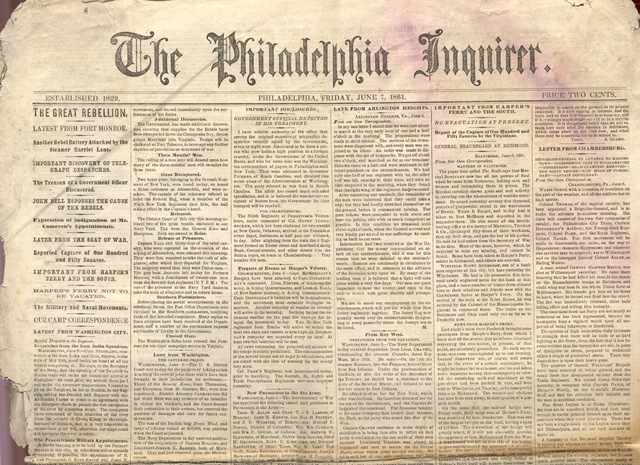
June 14, 1861: The Philadelphia Inquirer

top

Transcript (excerpt):

Page 1, Upper Half

Special Dispatch to the Inquirer.

The Flight at Great Bethel.

Washington, June 13, 1861 – The flight at Great Bethel is still the general theme of conversation among regular Army officers. They attribute the unfortunate occurrence to the want of experienced officers and depending on negroes for guides.

The Department are under the impression that General Butler will not make a movement to take the Rebel batteries until he is fully prepared to capture them, which he is certain to do when he makes the attempt.

Citation: The Philadelphia Inquirer. Philadelphia, 14 February 1861. Gift of Steven and Susan Raab. AN .P5546

June 7, 1861: Philadelphia Inquirer

top

Transcript (excerpt):

Page 1, Upper Half

Baltimore, June 6, 1861.

From Our Own Correspondent.

Matters in Baltimore.

The paper here called The South says that Marshal Bonifant now has all the powers of Saul when he came from Damascus, hailing men and women and committing them to prison. The Marshal certainly shows great zeal and activity in ferreting out the whereabouts of warlike munitions. He seized yesterday seventy-five thousand pounds of gunpowder, stored in the warehouses of Messrs. Webb & Foley, and to-day had it taken to Fort McHenry and deposited in the magazine there. He also seized all the breech-loading rifles at the factory of Merrill, Thomas & Co., discharged fifty-three of their workmen, shut up their shop, and put the key in his pocket. He said he had orders from the Secretary of War to do this. Most of the arms, however, which he expected to seize are missing, and cannot be found. Some have been taken to Harper’s Ferry, others to Richmond, and others are secreted.

Citation: Philadelphia Inquirer. 7 June 1861. Gift of Steven and Susan Raab. AN .P5546