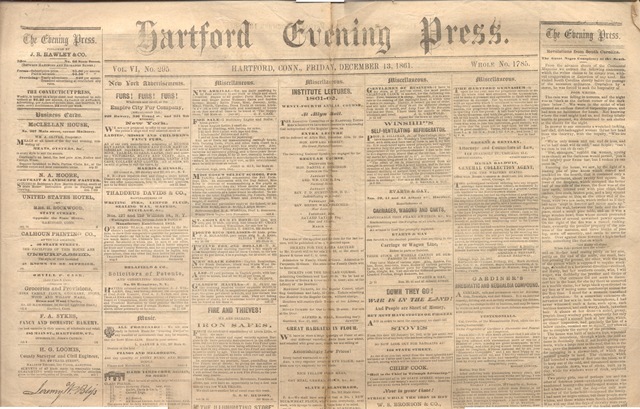
December 13, 1861: Hartford Evening Press

top

Transcript (excerpt):

Revelations from South Carolina

The Great Negro Conspiracy At the South

Black Free Masonry

“Jim this is Scip,” I said, seeing that the darkeys had taken notice of each other. “How d’ye do Scipio?” said Jim, extending a hand to him. A look of singular intelligence passed over the faces of the two negroes as their hands met; it vanished in an instant, and was so slight that none but a close observer would have detected it; but some words that Scip had previously let drop put me on the alert, and I felt sure it had a hidden significance…

“Scip did you know Jim before?” I asked.

“Neber seed him afore, massa, but hab heern ob him.”…

“Pshaw, Scip, you’re ‘coming de possum;’ that game won’t work with me”… “tell me, now, what that look you gave each other when you shook hands meant.” … “it means there is some secret understanding between you two.”…

“…de blacks am all free-masons. I gabe Jim de grip, and he know’d me. He’d ha known my name if you hadn’t told him.”…

“You have said enough, Scipio, to satisfy me that there is a secret league among the black, and that you’re a leader in it. Now, I tell you, you’ll get yourself into a scrape. I’ve taken a liking to you Scip, and I should be very sorry to see you run yourself into danger.”

“I tank you, massa-from de bottom ob my soul I tank you,” he said, as the tears moistened his eyes. “You bery kind, massa; it do me good to talk wid you. But what am my life wuth? What am any slave’s life wuth? Et you war me you’d do like me!”

I could not deny it, and made no reply.”

“From this and other conversations the writer deduces-nay, he declares that he knows it to be a fact– that there exists among the blacks a secret and wide-spread organization of a Masonic character, having its grip, password, and oath. ‘It has various grades of leaders, who are competent and earnest men, and its ultimate object is freedom.”


Citation: Hartford Evening Press. Hartford, 13 December 1861. AN. H328
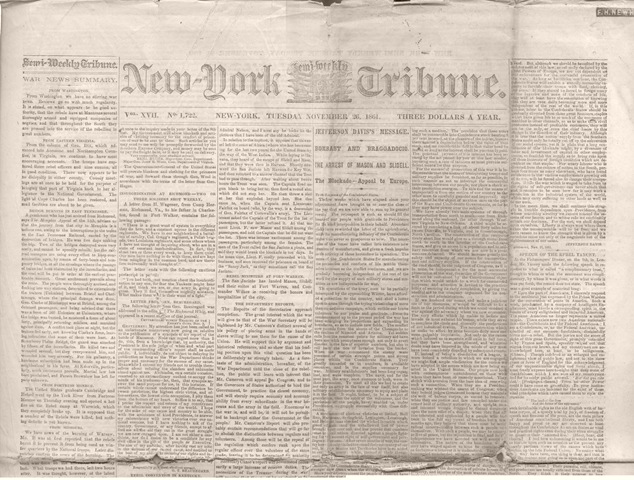
November 26, 1861: New York Tribune

top

Transcript (excerpt):

Page 1, Upper Half

Insubordination at Richmond – Two or Three Soldiers Shot Weekly

A letter from H. Wagener, from Camp Herman, Richmond, Va., to his gather in Charleston, found in Port Walker, contains the following passage:

“There is a fine want of system in everything they do here, and a constant uproar in the different regiments. We have in our neighborhood a battalion of cavalry, Col. Gregg’s regiment, a Polish brigade, two Louisiana regiments, and some others whom I have not thought of inquiring about, who are in a state of constant insubordination. In fact, they shoot two or three every week to keep them quiet. Our men have nothing to do with them, and are therefore universally well thought of.”

The letter ends with the following cautious postscript in pencil:

“You had better not mention about the insubordination to any one, for fear the Yankees might hear of it, and think we are, or our army is, going to grass. They’ll find themselves mightily mistaken. What makes them [weak?] is their want of a fight.”


Citation: New York Semi-Weekly Tribune. 26 November 1861. Gift of Steven and Susan Raab.

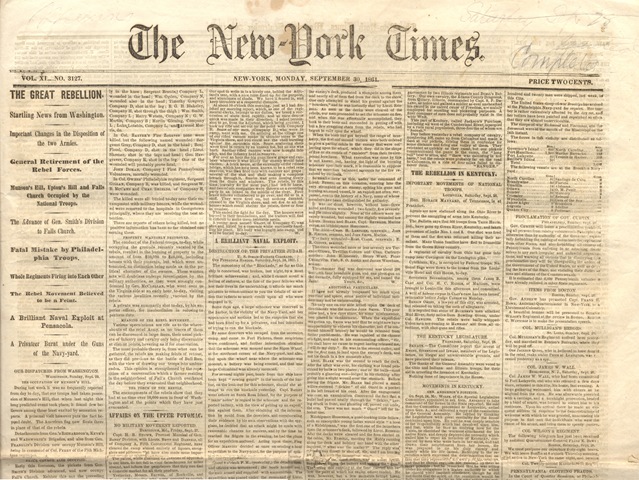
September 30, 1861: New York Times

top

Transcript (excerpt):

Page 1, Upper Half

Our Dispatches From Washington

Washington, Sunday, Sept. 29.

The Occupation of Munson’s Hill

During last week it was so frequently reported from day to day, that our troops had taken possession of Munson’s Hill, that when last night this long predicted event took place, it found few believers among those least excited by sensation reports. A personal visit however puts the fact beyond doubt. The American flag now floats there in place of that of the rebels.

Detachments from Gen.’s Richardson’s, Keye’s and Wadsworth’s Brigades, and also from Gen. Franklin’s Division now occupy Munson’s Hill, being in command of Col. Ferry of the Fifth Michigan regiment.

Citation: New York Times. 30 September 1861. Gift of Steven and Susan Raab. AN .N5682

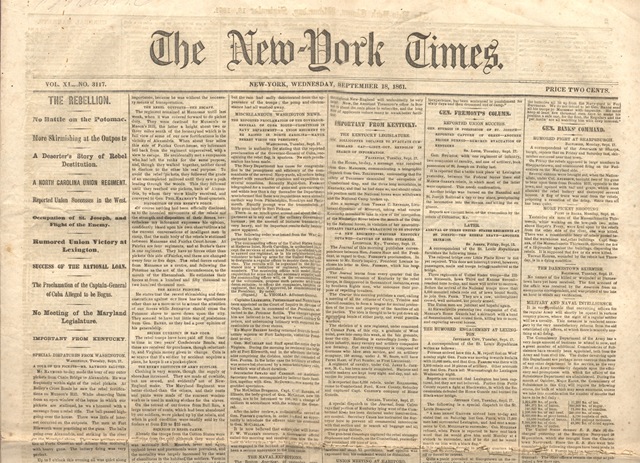
September 18, 1861: New York Times

top

Transcript (excerpt):

Page 1, Upper Half

Reported Union Success

Gen. Sturgis in possession of St. Joseph – Reported capture of Green – Another bridge burned – Rumored evacuation of Kentucky

St. Louis, Tuesday, Sept. 17.

Gen. Sturgis, with one regiment of infantry, two companies of cavalry, and one of artillery, took possession of St. Joseph on Friday last.

It is reported that a battle took place at Lexington yesterday, between the Federal forces there and Martin Green’s rebels, in which most of the latter were captured. This needs confirmation.

Another bridge was burned on the Hannibal and St. Joseph Railroad a day or two since, precipitating the locomotive into the stream and killing the engineer.

Reports are current here of the evacuation by the rebels of Columbus, Ky.

Citation: New York Times. 18 September 1861. Gift of Steven and Susan Raab. AN .N5682

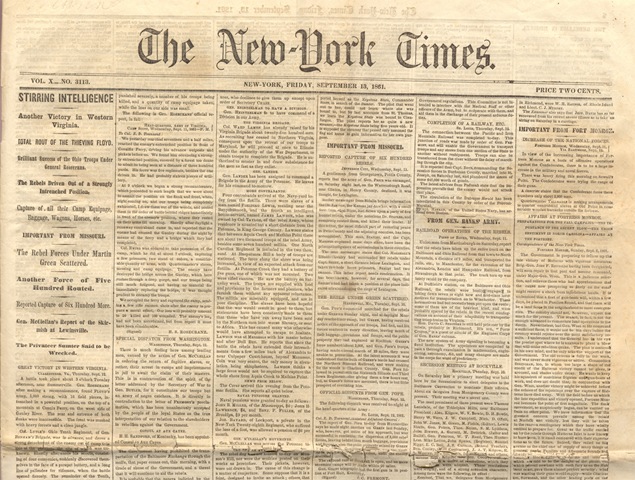
September 13, 1861: New York Times

top

Transcript (excerpt):

GREAT VICTORY IN WESTERN VIRGINIA.

Clarksburgh, Va. Thursday, Sept. 12.

A battle took place about 3 o’clock Tuesday afternoon, near Sumnerville. Gen. Rosecrans after making a reconnaissance, found Floyd’s army, 5,000 strong, with 16 field pieces, intrenched in a powerful position, on the top of a mountain at Cannix Ferry, on the west side of Gauley River. The rear and extreme of both flanks were inaccessible. The front was masked with heavy forests and a close jungle.

Citation: New York Times. 13 September 1861. Gift of Steven and Susan Raab. AN .N5682

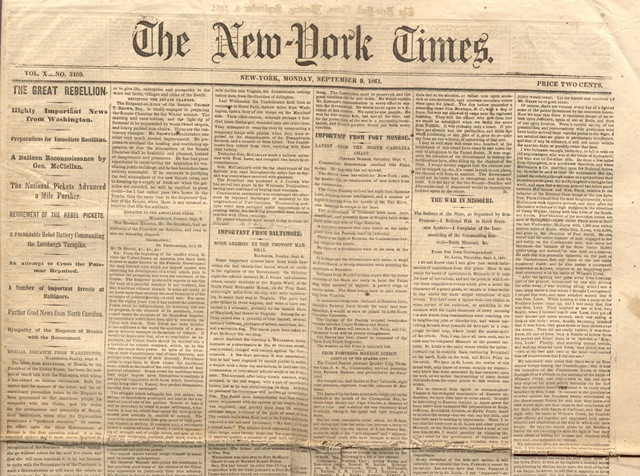
September 9, 1861: New York Times

top

Transcript (excerpt):

Page 1, Upper Half

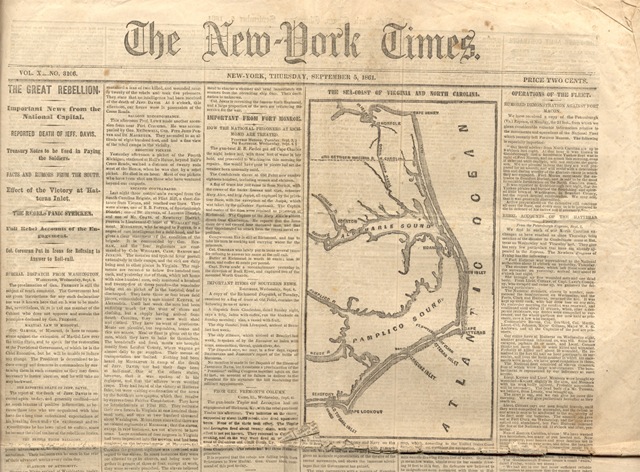
Important From Fort Monroe.

Latest From The North Carolina Coast.

Fortress Monroe, Saturday, Sept. 7.

Commodore Stringham reached Old Point to-day. His flag-ship has not arrived.

The Harriet Lane has sailed for New York; also, the Quaker City, in consequence of new orders from the Commodore.

It is supposed the Secessionists will make a stand at Fort Macon, a strong casemated work guarding the approach to Beaufort.

Refugees from North Carolina report that the lower counties of the State are ready to hoist the Union flag when assured of support. A perfect reign of terror exists. The State troops were in part returning from Virginia.

A prominent clergyman declared at the Hatteras Inlet, should a Federal force invade the main land near Beaufort, it would at once be joined by 2,000 North Carolina Unionists.

Citation: New York Times. 9 September 1861. Gift of Steven and Susan Raab. AN .N5682

September 5, 1861: New York Times

top

Transcript (excerpt):

Page 1, Upper Half

Martial Law in Missouri

Gov. Gamble, of Missouri, is here to remonstrate against the extension of Martial Law over the entire State, and to speak for the restoration of the Provisional Government, of which he is the Chief Executive, but he will be unable to induce any change. The President is determined to induce energy and firmness in commanders by sustaining them in such measures as they may deem necessary to insure success, and he will take no step backward.

The Reported Death of Jeff. Davis

The report of the death of Jeff. Davis is received again to-day, and generally credited – not as much because of positive information, as because those here who are acquainted with him have for a long time entertained expectations of his breaking down under the excitement and responsibilities he has been called to endure, since he became the chief traitor of the rebellious States.

Citation: New York Times. 5 September 1861. Gift of Steven and Susan Raab. AN .N5682

August 30, 1861: New York Tribune

top

Transcript (excerpt Page 1, Upper Half)


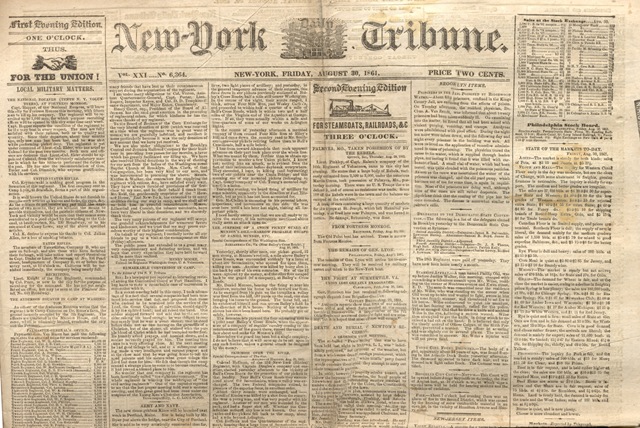
Palmyra, Mo., taken possession of by the Rebels.

Quincy, Ill. Thursday, Aug. 29, 1861

Lieut. Pinkley, of Capt. Ralson’s company of the 16th Regiment of Volunteers, came to this city last evening. He states that a large body of Rebels, variously estimated from 2,500 to 3,000, under the notorious Martin Green, took possession of Palmyra, Mo., yesterday morning. There were no U.S. Troops there to defend it, and of course no resistance was made. Some 500 of the Rebels were in the town and the balance encamped on the outskirts.

A train of cars containing a large quantity of muskets for the troops at St. Joseph, which left Hannibal yesterday, was fired into near Palmyra, and was forced to return. No damage, fortunately, was done.


Citation: New York Daily Tribune. New York, 30 August 1861. Gift of Steven and Susan Raab. AN .N5675

August 29, 1861: New York Tribune

top

Transcript: (excerpt, Page 1, Upper Half)


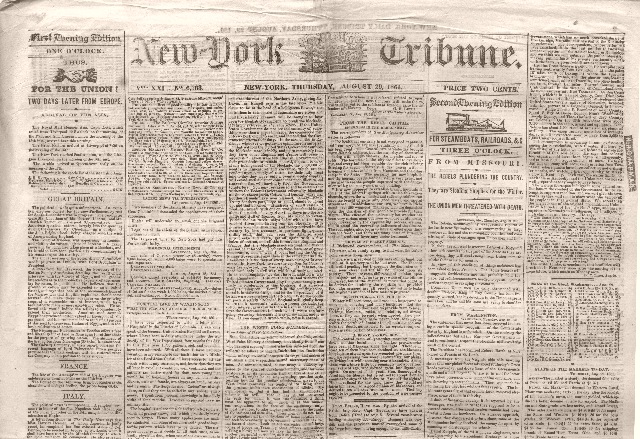
From the Rebel Capital.

Sickness in the Rebel Army.

The correspondent of The Montgomery Advertiser writes as follows:

“The health of our army is not very good at present, and I am sorry to say that the fatality among the sick has been great. The Central cars of yesterday brought down 350 sick soldiers, but the majority of them were suffering with slight diseases, like measles and severe colds. The hospitals in the city are filled to overflowing, and every building suitable for the sick is being fitted up for them. Scarcely a day passes without bringing in a number of sick from Manassas and the other camps in the State. The necessity for new hospitals and the increase of the medical staff is very great, and I am glad to see the people impressed with the danger of crowding too many sick in one building.


Citation: New York Daily Tribune. New York, 29 August 1861. Gift of Steven and Susan Raab. AN .N5675

August 17, 1861: New York Tribune

New York Tribune 8-17-1861 top

Transcript: (excerpt page 1)

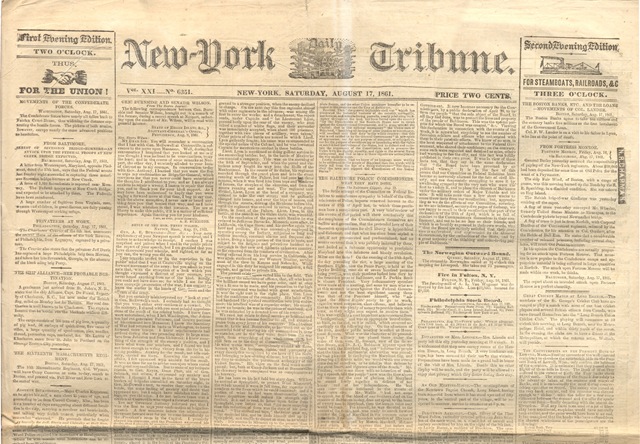
From Baltimore.

Arrest of Secession Bridge-Burners – An Attack upon the Federal Troops at New Creek Bridge Expected.

Baltimore, Saturday, Aug. 17, 1861.

A letter from Westernport, Maryland opposite Piedmont, dated the 13th, inst., says that the Federal scouts last Sunday night succeeded in capturing three notorious Secession bridge-burners at New Creek.

A force of 1,100 Secessionists is reported near Romney. The Federal troops are at New Creek Bridge, and expected to be attacked by them. The Federals have been reinforced.

A large number of fugitives from Virginia, men, women, and children, in great distress are daily passing through Washington seeking refuge.


Citation: New York Daily Tribune. New York, 17 August 1861. Gift of Steven and Susan Raab. AN .N5675