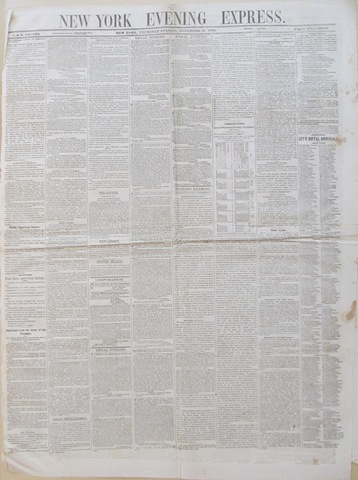
November 13, 1862: New York Evening Express

New York Evening Express

Thursday Evening, November 13, 1862

Important from the Army of the Potomac.

The Army-Rappahanock Station-Rebel Intentions- Tired of Secession.

“Gainsville, Va..Nov. 10th.-The armies of Sigel and Mc Clellan are closely pressing upon the enemy. Hardly a day passes but one of more of their strongholds fall into our possession. They are either driven out or compelled to retreat before us.

The rebels had placed Rappahannock Station in a defiant attitude; but on Friday afternoon our troops entered, the secesh having just cleverly vacated.

To them this was rather humiliating, and accordingly they thought they would drive the Unionists out. They brought up force infinitely larger than ours, and commenced an artillery fire.

The superiority of numbers did not intimidate our men, and they replied from their guns. The effect of the fire was evidently unhealthy, as the rebels retired without accomplishing their purpose. We still hold the place, and will continue to do so as our army moves forward to Richmond, which it is undoubtedly doing with success. It, at present, looks as though the rebels will make a temporary stand at Gordonsville, but they fear us too much now and to make one last struggle for their illegitimate cause , they will fall back to the Confederate Capital, and it then will, in turn fall back upon them.

The people of Virginia are getting tired of the war. Many who a year ago were violent secessionists now acknowledge that t hey would be glad if their state would return to their allegiance…”


Citation: New York Evening Express.  New York, 13 November 1862. Gift of Steven and Susan Raab.
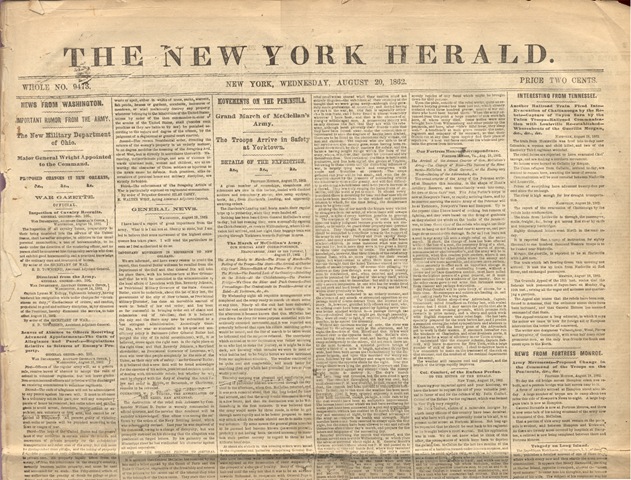
August 20, 1862: New York Herald

top

Transcript (excerpt):

Page 1, Upper Half

Fortress Monroe, August 17, 1862

A great number of steamships, steamboats and schooners are now in this harbor, loaded with disabled soldiers and commissary stores; also camp equipage, tents, &c., from Harrison’s Landing, and apparently awaiting orders.

The Harrison’s Landing mail boats made their regular trips up to yesterday, when they were hauled off.

Nothing has been heard from General McClellan’s army to-day; but last evening they were successfully crossing the Chickahominy, en route to Williamsburg, where his advance had arrived, and last night their baggage train was passing through Yorktown towards Fortress Monroe.

Citation: New York Herald. 20 August 1862. Gift of Steven and Susan Raab. AN .N56792
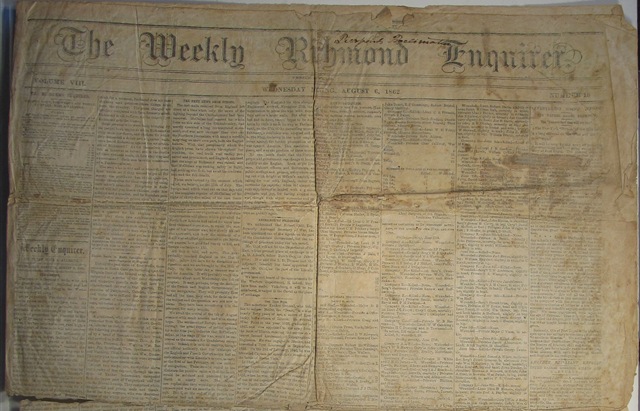
August 6, 1862: Richmond Enquirer

Transcript (excerpt)

Wednesday Morning Aug. 6, 1862

Number 18

“Movements of the Enemy”

“Tupelo, July 29.-The enemy made a demonstration on our front today with a cavalry force. It is supposed the movement was made with the intention of destroying the railroad track at some point above. If so, the movement has been anticipated and the designs of the Yankees frustrated. Our forces extend north of Guntown. “


Citation: The Weekly Richmond Enquirer. Richmond, 6 August 1862. AN .R532

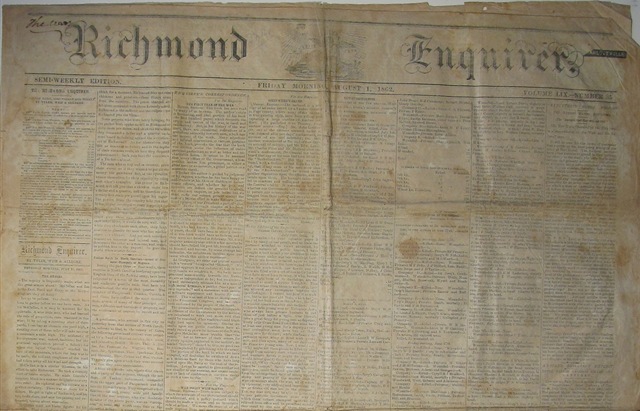
August 1, 1862: Richmond Enquirer

Transcript (excerpt):

“Another Brilliant Exploit”

Entire Yankee Garrison Killed and Captured

Lynchburg, July 30.-A special dispatch to the “Republican,” dated Narrows of New river, July 28th, via. Dublin, July 29th says The gallant Major Bailey , commanding four companies of cavalry, in all about one hundred and fifty men, sent to the rear of the enemy by Col. McCausland, stormed Summersville, the county seat of Nicholas, Friday morning at daylight and killed and captured the entire garrison including the Lieut colonel commanding , named Starr, three other commissioned officers, and sixty-two non-commissioned and privates-killing a large number

A few prisoners were paroled, not being able to bring away the large quantities of Commissary, Quartermaster, and Ordnance stores found at the place, Major Bailey committed them to the flames. Major B. brought to this place a large number of Enfield rifles and mules. The prisoners arrived this morning at the Salt Sulpher Springs.

The notorious renegade and spy, Dr. Wm. Rucker, is among the prisoners. The telegraph office was destroyed, and the government operator captured. This affair is regarded as the most brilliant exploit of the war in this section. Its successful execution spread the wildest consternation and dismay throughout the Yankee army in the neighborhood.


Citation: Richmond Enquirer. Richmond, 1 August 1862. AN .R532

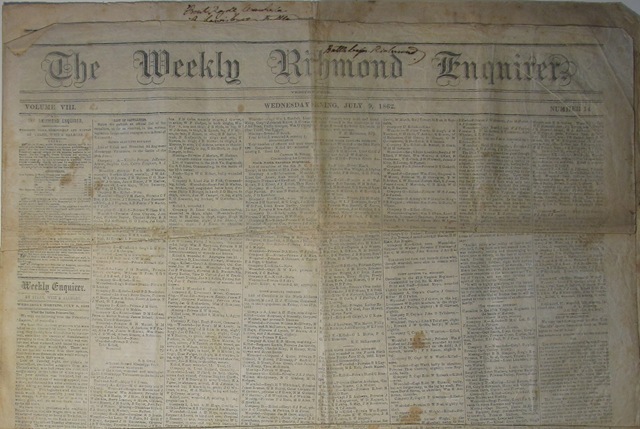
July 9, 1862: Richmond Enquirer

Transcript (excerpt):

“Cruelty to Confederate Officers”

“Our readers have doubtless noted the severity practiced by the Yankees upon Generals Buckner and Tilghman now confined in Fort Warren. We understand from a perfectly authentic source that Brig. Gen. Pettigrew, who was recently severely wounded and taken prisoner by the enemy, has been inhumanely removed from Baltimore, where he had the attention of friends, to Fort Delaware. His right arm is paralyzed and he is very feeble, and unfit for any exertion. In this condition he has been consigned to prison, and even refused permission to take a servant to assist him in his helplessness. The effect of this harshness is to retard Gen. Pettigrew’s recovery, and it may cost him his life. Yankee Generals in our hands have been treated heretofore by us with the greatest liberality, but unless Buckner, Tilghman and Pettigrew shall receive another sort of usage, they must prepare for prompt retaliation.”


Citation:The Weekly Richmond Enquirer. Richmond, 9 July 1862. AN .R532

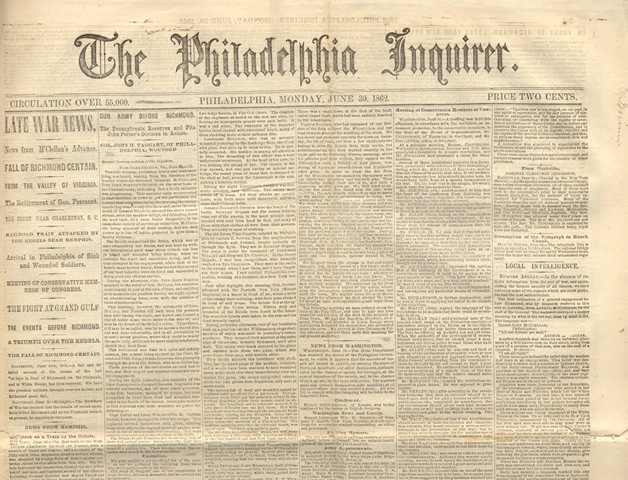
June 30, 1862: Philadelphia Inquirer

top

Transcript (excerpt):

Page 1, Upper Half

The Fall of Richmond Certain.

Baltimore, June 29th, 1862. – A full and detailed account of the events of the last [f]our days in front of Richmond, on the Peninsula, and at White House, has been received. We have the grandest military triumph over the Rebels, and Richmond must fall.

Baltimore, June 29 – Midnight. – The Secretary of War has decided that the details of recent operations before Richmond and on the Peninsula cannot, at present, be supplied to the press.

Citation: Philadelphia Inquirer. 30 June 1862. Gift of Steven and Susan Raab. AN .P5546
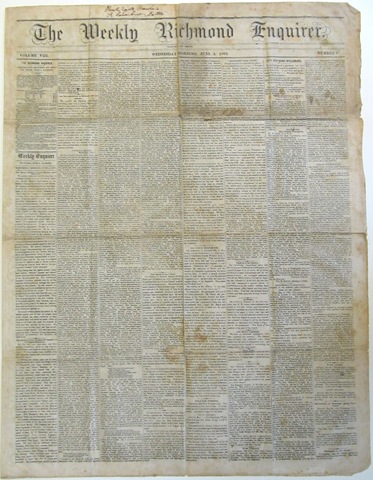
June 4, 1862: The Weekly Richmond Enquirer

Richmond Enquirer 6-4-1862

Transcript:

Wednesday Morning, June 4, 1862

Call # AN.R532

“The Evil which Jackson hath Wrought”

“The Philadelphia “Inquirer” argues that our Confederacy has lost, instead of gaining, by Jackson’s capture and expulsion of Bank’s army in the Valley of Virginia. Its theory is that the North will be exasperated and roused by it, and put forth greater efforts.

The argument of the “Inquirer” is based upon an idea which in the commencement of the war, found some to entertain it even in our Confederacy. The idea is, that in our war with the North we should moderate our blows so as not to offend the pride of our enemies. We must strike easy. After the battle of Manassas there were some who even supposed that a victory by the North sufficient to soothe the pain of that affront, would tend to restore peace.

These weak conceits have long ago been banished from the minds of our people. They have seen that every ray of success that favored our enemies’ cause has but made them more arrogant, intolerant and insufferable than before…” “…We must belabor them as with the club, and courage of Hercules. In pugilist’s phrase, we must “plant each blow right between the two eyes,” and with our whole strength.”

“…But the North is rushing to arms, says the “Inquirer,” to avenge the reverse. We will rush to arms, too, and try to give them another. But the rush to arms spoken of, seems to consist of a call on a number of New York Militia regiments to hurry to the defence of the Capitol; so that Lincoln is reduced to seeking his safety at the bayonets of the “Melish!” There is nothing so terrifying to us in that!”

Citation: The Weekly Richmond Enquirer. Richmond, 4 June 1862. AN .R532

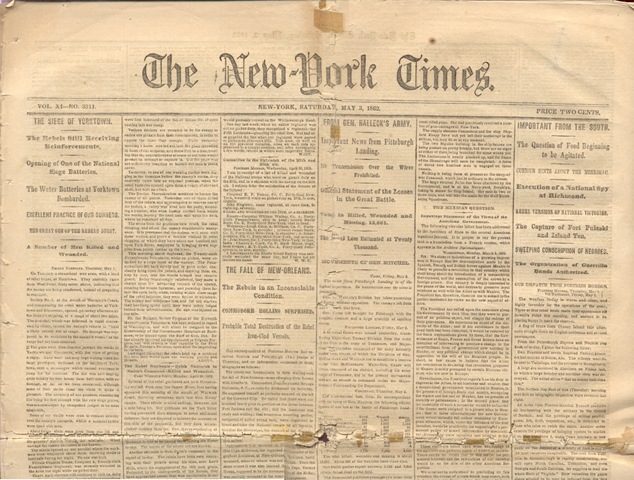
May 3, 1862: New York Times

top

Transcript (excerpt):

Page 1, Upper and Lower Halves

The Fall of New Orleans

The Rebels in an Inconsolable Condition

Commodore Hollins Surprised

Probable Total Destruction of the Rebel Iron-Clad Vessels

Our Correspondent at Fortress Monroe has received Norfolk and Petersburgh (Va.) papers of Thursday, and on information contained in them telegraphs as follows:

The rebels are inconsolable in their wailing over the fall of New-Orleans – some charging Gen Lowell with treachery. Commodore Hollins passed through Columbia, S.C. en route for Richmond on Saturday. He expressed himself as perfectly amazed at the fall of the Crescent City. He stated that there were one hundred heavy guns in position on the levee between Fort Jackson and the city; that the Louisiana was ready and waiting; that numerous boarding parties composed of active young men, were organized to board and take the National vessels at all hazards, and that the Mississippi, the consort of the Virginia [paper ripped along crease] into action.

Information was received at Norfolk, Virginia that Capt. McIntosh, the supposed commander of the gunboat Louisiana, at New-Orleans, had been badly wounded, when or where was not stated. From the same source it was also learned that Capt. Thomas Huger, supposed to be the commander of the McRae, was mortally wounded in the same engagement.

The following are all the additional items regarding the fall of New-Orleans that can be gleaned from the papers:

Commodore Farragut had proposed terms of capitulation to Mayor Monroe, which the latter had accepted, and the City of New-Orleans was at least accounts held by a battalion of marine from the squadron. Gen. Butler’s forces were within a few miles of the city, having landed on Lake Pontchartrain.

Citation: New York Times. 3 May 1862. Gift of Steven and Susan Raab. AN .N5682
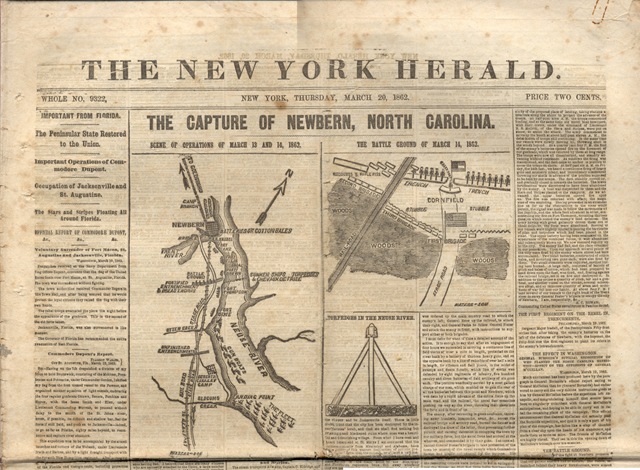
March 20, 1862: New York Herald

top for web

Transcript (excerpt):

Page 1, Lower Half

General Burnside’s Report,

Headquarters Department of North Carolina

Newbern, March 16, 1862

General L. Thomas, Adjutant General United States Army:-

General – I have the honor to report that, after embarking the troops with which I intended to attack Newbern, in conjunction with the naval force, on the morning of the 11th, a rendezvous was made at Hatteras Inlet. Flag Officer Goldsborough having been ordered to Hampton Roads, the naval fleet was left in command of Commodore Rowan. Early on the morning of the 12th the entire force started for Newbern, and that night anchored off the mouth of Slocum’s creek some eighteen miles from Newbern, where I had decided to make a landing. The landing commenced by seven o’clock the next morning, under cover of the naval fleet, and was affected with the greatest enthusiasm by the troops. Many, too impatient for the boats, leaped into the water, and waded waist deep to the short, and then, after a toilsome march through the mud, the head of the column marched within a mile and a half of the enemy’s stronghold, at eight P.M., a distance of twelve miles from the point of landing, where we bivouacked for the night, the rear of the column coming up with the boat howitzers about three o’clock next morning, the detention being caused by the shocking condition of the roads, consequent upon the heavy rain that had fallen during that day and the whole of the night, the men often wading knee deep in mud, and requiring a whole regiment to drag the eight pieces which had been landed from the navy and our own vessels.

Citation: New York Herald, 20 March 1862. Gift of Steven and Susan Raab. AN .N56792
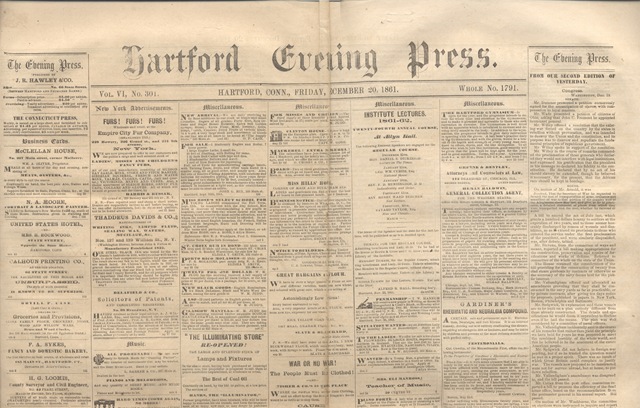
December 20, 1861: Hartford Evening Press

Hartford Evening Press 12-20-61

Transcript (excerpt):


Condition of Bragg’s Rebel Forces

“The rebel batteries are not of a formidable character. Many of them are constructed with sandbags, and some of them are mounted with “quakers” or wooden guns-very formidable in appearance, but not of any particular service in action, Instead of one hundred and fifty or sixty guns which have been counted by our forces, the real ones are less by about one-third. The serviceable ordnance of the rebels, including those in Fort Barrancas, the only fortification which is at all formidable, number one hundred and two pieces and there is not a rifled gun among them. Lieut. Baker is positive, although it has been reported that rifled shot were fired by the enemy, that they have nothing but smooth-bore guns. But he states that there are five batteries of “Bogg’s guns” which are of ten inch caliber and carry conical shell somewhat resembling the rifled shell now in use. There are in all nine of these guns in possession of the rebels at Pensacola-one of which, and only one, is at the navy yard. This is understood to be one which damaged the federal steamer “Richmond.”…

“…Lieutenant Baker has spent considerable time in Richmond, and other parts of the confederate states, traveling twice through the whole rebel region, and conversing with all sorts of people. He is confident-and this he asserts from admissions which have been made to him-that the confidence assumed by the rebel leaders and by the journals is not shared by the people. The change, especially since the result of the Port Royal expedition has become known, and in view of the belief that other federal expeditions are to follow rapidly, has been especially marked. The people are inquiring how the war is to end; and although there is no outspoken sentiment of disaffection or dissent as to the policy of the leaders, the feeling which precedes such a state of things already exists. In threatened regions this is particularly evident. In Pensacola, it is believed that nearly if not quite half of the people are at heart for the Union. In proof of this, the fact is cited that recently many business places have been closed by order of Gen. Bragg, because of the known or suspected sympathy of the owners with the cause of the Union.”


Citation: Hartford Evening Press. Hartford, 20 December 1861. AN. H328