May 26, 1864: R. W. Minor telegram to G. T. Beauregard

Pierre Gustave Toutant Beauregard was a Louisiana-born general of the Confederate States Army. He had graduated second in his class from West Point in 1838 and was an admirer of Napoleon. He achieved fame early in the Civil War for commanding the Fort Sumter bombardment and as the victor of the first battle of Manassas. He later served in the Western Theater (including Shiloh and Corinth), Charleston, and the defense of Richmond, but his career was hampered by friction with Jefferson Davis and other generals.
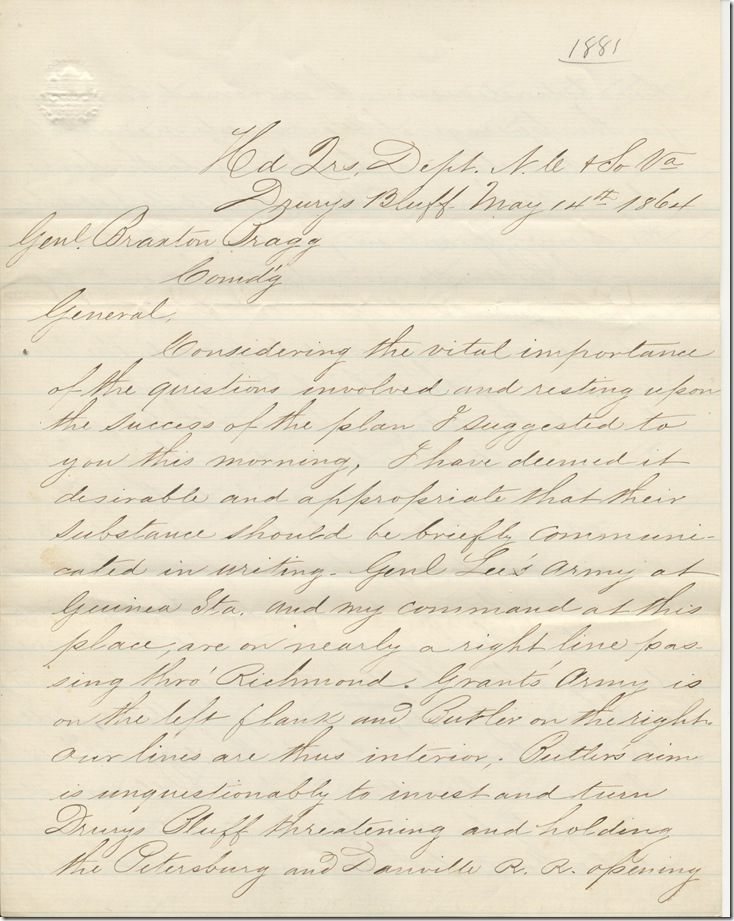
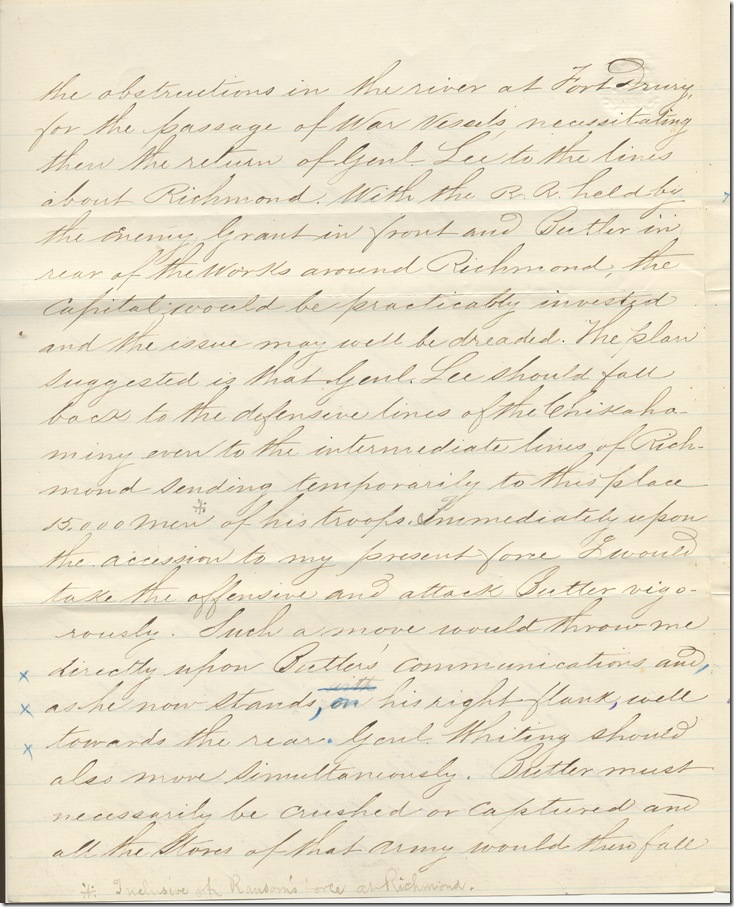
This is one of approximately 1000 military telegrams in P.G.T. Beauregard’s papers at the Rosenbach.

1168-11 1864-5-26

Transcript:

Dated Drewry’s Bluff 26 1864

Received at Chester 27 1864

To Genl G. T. Beauregard

5 P.M. Your telegram of the 26th has been rec’d. The Flag Officer is absent on duty. Immediately on his return tonight your dispatch will be laid before him.

R. W . Minor

Flag Lt

Citation: R. W . Minor, telegram to G. T. Beauregard. Drewry’s Bluff, Va.;26 May 1864. AMs 1168/11

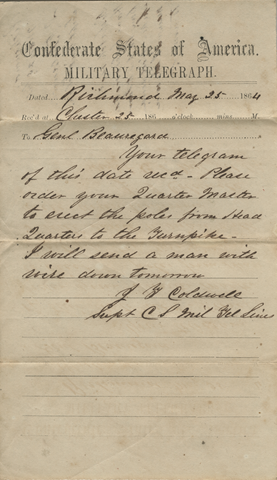
May 25, 1864: J. T. Coldwell telegram to P. G. T. Beauregard

Pierre Gustave Toutant Beauregard was a Louisiana-born general of the Confederate States Army. He had graduated second in his class from West Point in 1838 and was an admirer of Napoleon. He achieved fame early in the Civil War for commanding the Fort Sumter bombardment and as the victor of the first battle of Manassas. He later served in the Western Theater (including Shiloh and Corinth), Charleston, and the defense of Richmond, but his career was hampered by friction with Jefferson Davis and other generals.
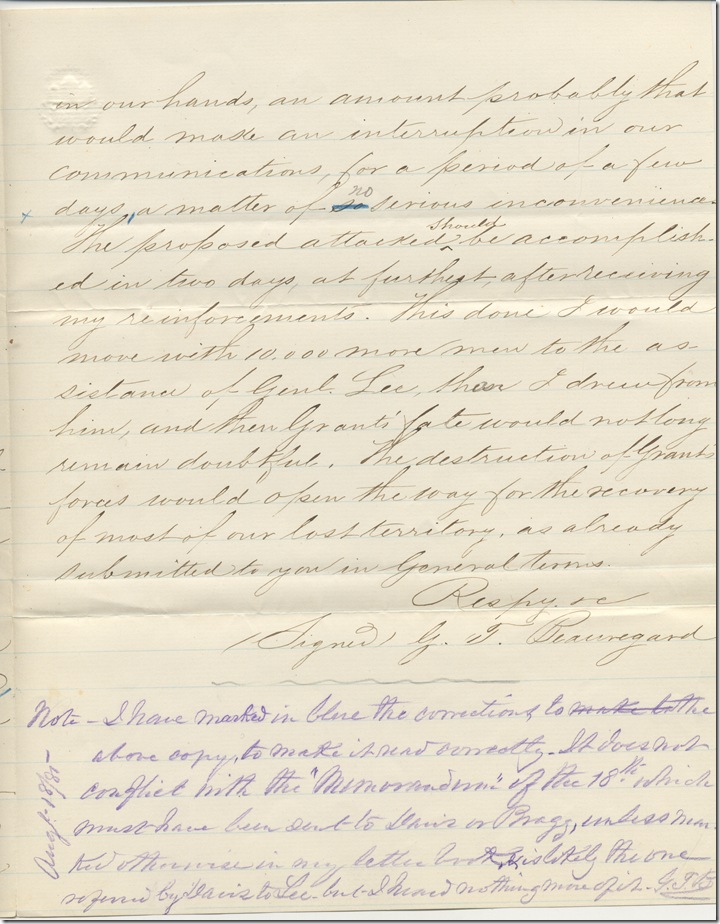
This is one of approximately 1000 military telegrams in P.G.T. Beauregard’s papers at the Rosenbach.

1168-11 1864-5-25

Transcript:

Dated Richmond May 25 1864

Rec’d at Chester 25

To Genl Beauregard

Your telegram of this date rec”d. Please order your Quarter Master to erect the poles from Head Quarters to the turnpike. I will send a man with wire down tomorrow.

J. T. Coldwell

Supt CS Mili Tel Lines


Citation: J. T. Coldwell, telegram to G. T. Beauregard. Richmond, 25 May 1864. AMs 1168/11

May 24, 2014: J. T. Coldwell telegram to P. G. T. Beauregard

Pierre Gustave Toutant Beauregard was a Louisiana-born general of the Confederate States Army. He had graduated second in his class from West Point in 1838 and was an admirer of Napoleon. He achieved fame early in the Civil War for commanding the Fort Sumter bombardment and as the victor of the first battle of Manassas. He later served in the Western Theater (including Shiloh and Corinth), Charleston, and the defense of Richmond, but his career was hampered by friction with Jefferson Davis and other generals.

This is one of approximately 1000 military telegrams in P.G.T. Beauregard’s papers at the Rosenbach.

1168-11 1864-5-24

Transcript:

Dated Richmond May 24 1864

Rec’d at Chester 1864

To Genl Beauregard

The operator at Goldsboro has charge of the office at that point and cannot be spared at this time but I will take great pleasure in sending you one to-day equally as good.

J. T. Coldwell

Supt. C S Mil Tel Lines


Citation: J. T. Coldwell, telegram to G. T. Beauregard. Richmond, 24 May 1864. AMs 1168/11

May 23, 1864: J. F. Milligan telegram to John M. Oley

Pierre Gustave Toutant Beauregard was a Louisiana-born general of the Confederate States Army. He had graduated second in his class from West Point in 1838 and was an admirer of Napoleon. He achieved fame early in the Civil War for commanding the Fort Sumter bombardment and as the victor of the first battle of Manassas. He later served in the Western Theater (including Shiloh and Corinth), Charleston, and the defense of Richmond, but his career was hampered by friction with Jefferson Davis and other generals.

This is one of approximately 1000 military telegrams in P.G.T. Beauregard’s papers at the Rosenbach.


1168-11 1864-5-23

Transcript:

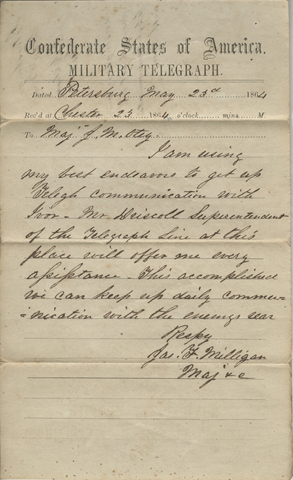
Petersburg May 23 1864

To Maj. J. M. Oley

I am using my best endeavors get up Telegh communication. Mr. Driscoll superintendent of the telegraph line at this place will offer me every assistance. This accomplished we can keep up daily communication with the enemy near.

Respy,

J. F. Milligan

Maj. &c


Citation:J. F. Milligan , telegram to John M. Oley. Petersburg, Va., 23 May 1864. AMs 1168/11

May 20, 1864: John A. Baker telegram to John M. Oley

Pierre Gustave Toutant Beauregard was a Louisiana-born general of the Confederate States Army. He had graduated second in his class from West Point in 1838 and was an admirer of Napoleon. He achieved fame early in the Civil War for commanding the Fort Sumter bombardment and as the victor of the first battle of Manassas. He later served in the Western Theater (including Shiloh and Corinth), Charleston, and the defense of Richmond, but his career was hampered by friction with Jefferson Davis and other generals.

This is one of approximately 1000 military telegrams in P.G.T. Beauregard’s papers at the Rosenbach.

1168-11 1864-5-20

Transcript:

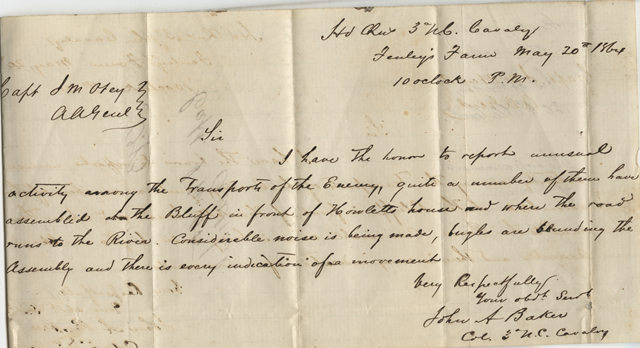
Hd Qrs 3d C. C. Cavalry

Fenley’s Farm May 20th 1864

10 oclock P.M.

Capt JM Oley

AA Genl

Sir

I have the honor to report unusual activity among the transports of the enemy. Quite a number of them have assembled at the Bluff in front of Howlett’s house and where the road runs to the river. Considerable noise is being made. Bugles are blowing the Assembly and there is every indication of a movement.

Very Respectfully,

Your obt servt

John A. Baker

Col. 3 N.C. Cavalry

Citation:John A Baker, telegram to John M. Oley. Fenley Farm, 20 May 1864. AMs 1168/11

May 14, 1864: P. G. T. Beauregard telegram to Braxton Bragg

Pierre Gustave Toutant Beauregard was a Louisiana-born general of the Confederate States Army. He had graduated second in his class from West Point in 1838 and was an admirer of Napoleon. He achieved fame early in the Civil War for commanding the Fort Sumter bombardment and as the victor of the first battle of Manassas. He later served in the Western Theater (including Shiloh and Corinth), Charleston, and the defense of Richmond, but his career was hampered by friction with Jefferson Davis and other generals.

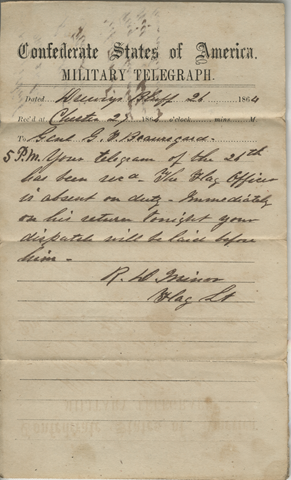
AMs 358-26 p1 Beauregard G. T. to Braxton Brigg AMs 358-26 p2 Beauregard G. T. to Braxton Brigg AMs 358-26 p3 Beauregard G. T. to Braxton Brigg

Transcript:

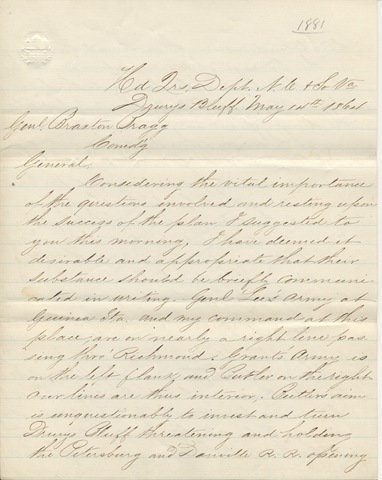
Hd. Qrs. Dept N.C. & So Va.

Drurys Bluff. May 14th 1864

Genl. Braxton Bragg

Comd’g

General,

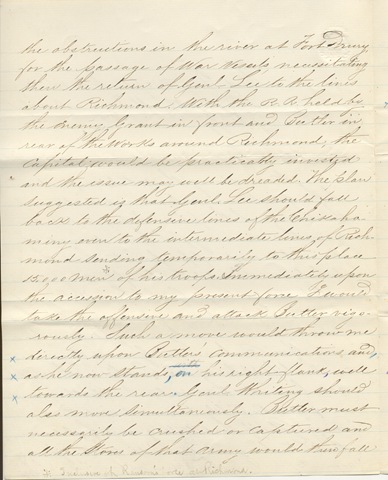
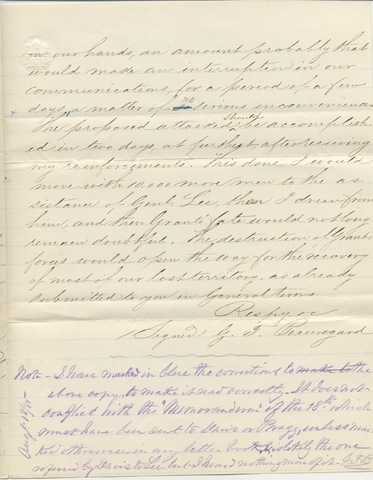
Considering the vital importance of the questions involved and resting upon the success of the plan I suggested to you this morning, I have deemed it desirable and appropriate that their substance should be briefly communicated in writing. Genl. Lee’s Army at Guinea Sta. and my command at this place are on nearly a right line passing thro’ Richmond. Grant’s Army is on the left flank and Butler on the right. Our lines are thus interior; Butler’s aim in unquestionably to invest and turn Drury’s Bluff threatening and holding the Petersburg and Danville R.R. opening the obstructions in the river at Fort Drury, for the passage of War Vessels, necessitating then the return of Genl. Lee to the lines about Richmond. With the R.R. held by the enemy Grant in front and Butler in rear of the works around Richmond, the Capitol would be practically invested and the issue may well be dreaded. The plan suggested is that Genl. Lee should fall back to the defensive lines of the Chikahominy even to the intermediate lines of Richmond sending temporarily to this place 15,000 men of his troops. Immediately upon the accession to my present force I would take the offensive and attack Butler vigorously. Such a move would throw me directly upon Butler’s communications and as he now stands, on his right flank, well towards the rear. Genl. Whiting should also move simultaneously. Butler must necessarily be crushed or captured and all the stores of that Army would then fall in our hands, an amount probably that would make an interruption in our communications, for a period of a few days, a matter of no serious inconvenience. The proposed attacks should be accomplished in two days at furthest, after receiving my reinforcements. This done I would move with 10,000 more men to the assistance of Genl. Lee, that I drew from him, and then Grant’s fate would not long remain doubtful. The destruction of Grant’s forces would open the way for the recovery of most of our lost territory, as already submitted to you in General terms.

Respy. &c

Signed G. T. Beauregard

Citation: G. T. Beauregard (1818-1893), telegram to Braxton Bragg. Drewry’s Bluff, Va.; 14 May 1864. AMs 358/26
May 13, 1864: E. Willis to John M. Oley

Pierre Gustave Toutant Beauregard was a Louisiana-born general of the Confederate States Army. He had graduated second in his class from West Point in 1838 and was an admirer of Napoleon. He achieved fame early in the Civil War for commanding the Fort Sumter bombardment and as the victor of the first battle of Manassas. He later served in the Western Theater (including Shiloh and Corinth), Charleston, and the defense of Richmond, but his career was hampered by friction with Jefferson Davis and other generals.

This is one of approximately 1000 military telegrams in the Rosenbach’s collection of papers from P.G.T. Beauregard.

AMs 1168-11 1864-05-13

Transcript:

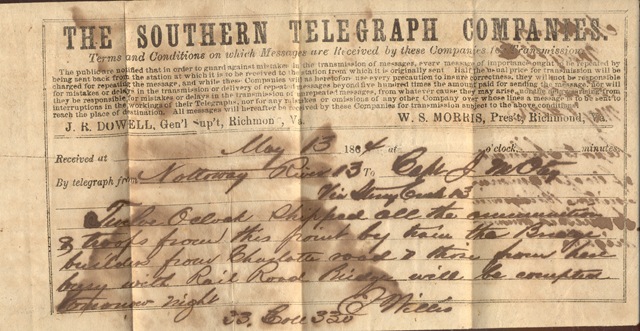
Received at May 13 1864

By telegraph from Nottoway River to Capt. J M Oley

Twelve O clock shipped all the ammunition & troops from this point by train[. T]he Bridge builders from Charlotte road & those from here busy with Rail Road Bridge will be [illeg.] tomorrow night.

E. Willis

Citation: E. Willis, telegram to John M. Oley. 13 May 1864. AMs 1168/11

May 12, 1864: Braxton Bragg to P. G. T. Beauregard

Pierre Gustave Toutant Beauregard was a Louisiana-born general of the Confederate States Army. He had graduated second in his class from West Point in 1838 and was an admirer of Napoleon. He achieved fame early in the Civil War for commanding the Fort Sumter bombardment and as the victor of the first battle of Manassas. He later served in the Western Theater (including Shiloh and Corinth), Charleston, and the defense of Richmond, but his career was hampered by friction with Jefferson Davis and other generals.

This is one of approximately 1000 military telegrams to and from Beauregard in the Rosenbach collection.

AMs 1168-11 1864-05-12 p1 AMs 1168-11 1864-05-12 p2

AMs 1168-11 1864-05-12 p3

Transcript:

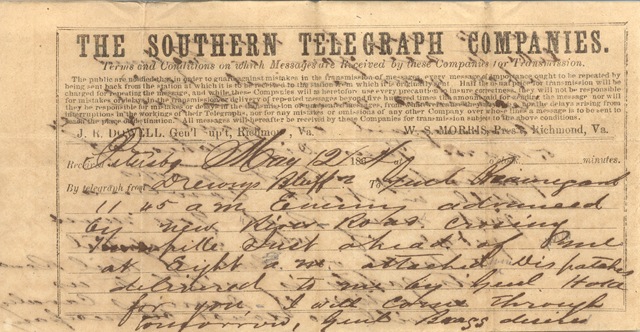
Received Petersbg May 12 1864

By telegraph from Drewry’s Bluff to Genl Beauregard

11 45 AM Enemy advanced by New River Road crossing [Thomasville?] Just ahead of [illeg.]

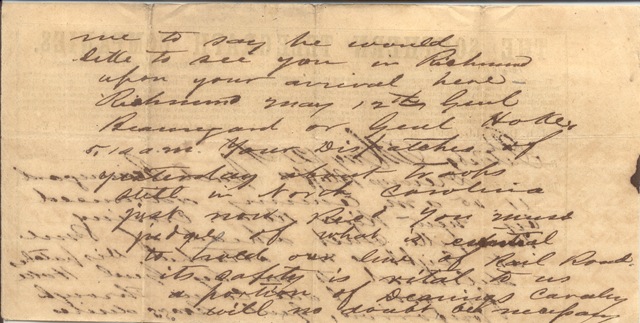
At Eight a.m. attacked. Dispatches delivered to me by Genl Hoke for you. I will come through tomorrow, Genl Bragg desires me to say he would like to see you in Richmond upon your arrival here.

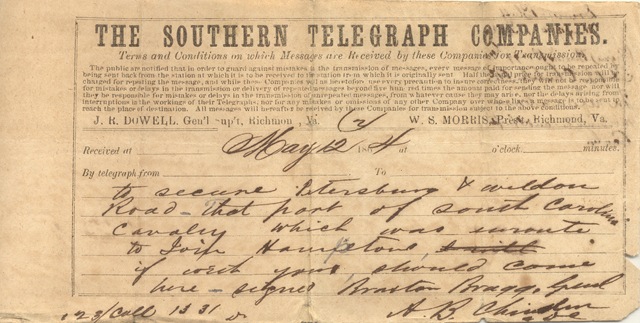
Richmond May 12th Genl Beauregard or  Genl Hoke 5.10 a.m. Your Dispatches of yesterday about troops still in North Carolina just now Rec.d You must judge of what is essential to hold our line of rail road its safety is vital to us . Position of [Dearings?] Cavalry will no doubt be necessary to secure Petersburg & Weldon Road_That part of South Carolina Cavalry which was en route to join Hamptons if with you should come here. Signed Braxton Bragg Genl

Citation: Braxton Bragg (1817-1876), telegram to G. T. Beauregard. Drewry’s Bluff, Va.; 12 May 1864. AMs 1168/11

May 9, 1864: Samuel B. Paul telegram to G. T. Beauregard

Pierre Gustave Toutant Beauregard was a Louisiana-born general of the Confederate States Army. He had graduated second in his class from West Point in 1838 and was an admirer of Napoleon. He achieved fame early in the Civil War for commanding the Fort Sumter bombardment and as the victor of the first battle of Manassas. He later served in the Western Theater (including Shiloh and Corinth), Charleston, and the defense of Richmond, but his career was hampered by friction with Jefferson Davis and other generals.

This is one of approximately 1000 military telegrams in P.G.T. Beauregard’s papers at the Rosenbach.

AMs 1168-11 1864-05-09 AMs 1168-11 1864-05-09 verso

Transcript:

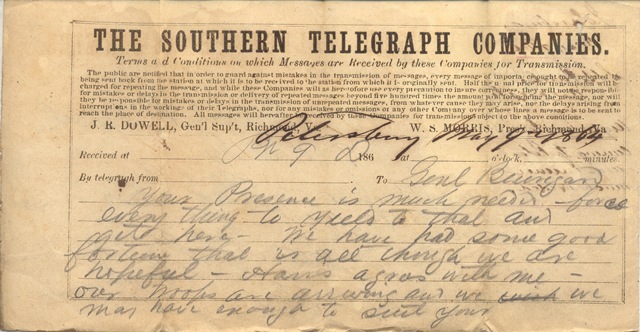
Petersburg May 9th, 1864

To Genl Beauregard

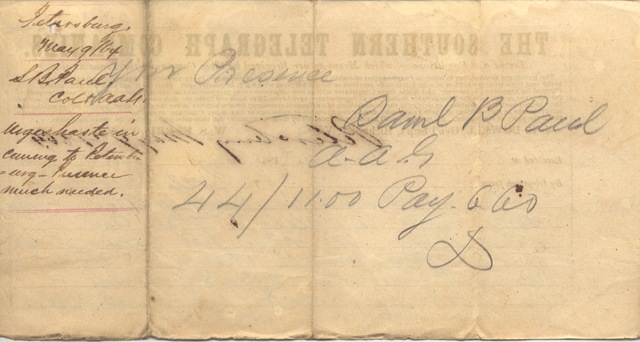
Your presence is much needed—force everything to yield to that and get here—We have had some good fortune that is all though we are hopeful—Harris agrees with me—our troops are arriving but we may have enough to suit your presence.

Saml B Paul

A.A.G.

Citation: Samuel B. Paul, telegram to G. T. Beauregard. Petersburg, 9 May 1864. AMs 1168/11

May 8, 1864: P. R. Page telegram to P. G. T. Beauregard

Pierre Gustave Toutant Beauregard was a Louisiana-born general of the Confederate States Army. He had graduated second in his class from West Point in 1838 and was an admirer of Napoleon. He achieved fame early in the Civil War for commanding the Fort Sumter bombardment and as the victor of the first battle of Manassas. He later served in the Western Theater (including Shiloh and Corinth), Charleston, and the defense of Richmond, but his career was hampered by friction with Jefferson Davis and other generals.

This is one of approximately 1000 military telegrams in P.G.T. Beauregard’s papers at the Rosenbach.

AMs 1168-11 1864-05-08

Transcript:

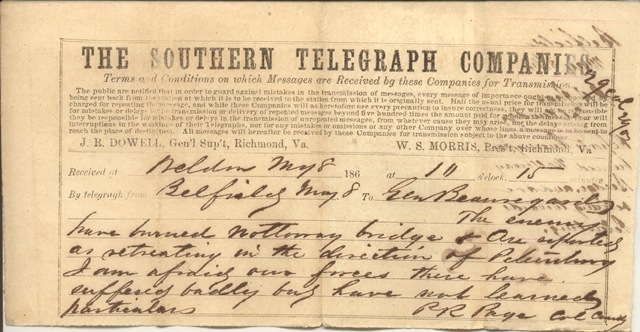
Received at Weldon May 8 at 11 o’clock 15 minutes

By telegraph from Belfield May 8 To Gen Beauregard

The enemy have burned Nottoway bridge & are reported as retreating in the direction of Petersburg. I am afraid our troops there have suffered badly but have not learned particulars.

P. R. Page Col. Cmdg


Citation: P. R. Page, telegram to G. T. Beauregard. Belfield, 8 May 1864. AMs 1168/11