September 15, 1861: George McCoffin telegram to P. G. T. Beauregard

Pierre Gustave Toutant Beauregard was a Louisiana-born general of the Confederate States Army. He had graduated second in his class from West Point in 1838 and was an admirer of Napoleon. He achieved fame early in the Civil War for commanding the Fort Sumter bombardment and as the victor of the first battle of Manassas. He later served in the Western Theater (including Shiloh and Corinth), Charleston, and the defense of Richmond, but his career was hampered by friction with Jefferson Davis and other generals.


This is one of approximately 1000 military telegrams in P.G.T. Beauregard’s papers at the Rosenbach.

AMs 1168-11 1861-09-15


Transcript:

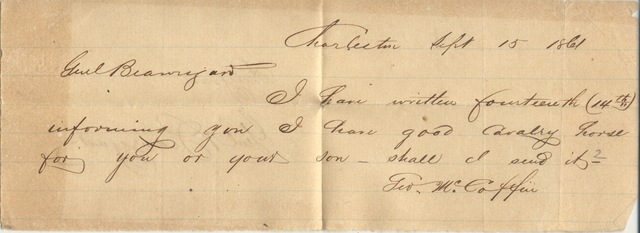
Charleston Sept 15 1861

Genl Beauregard,

I have written fourteenth (14th) informing you I have good cavalry horse for you or your son__shall I send it?

Geo Mc.Coffin


Citation:George McCoffin, telegram to G. T. Beauregard. Charleston, 15 September 1861. AMs 1168/11

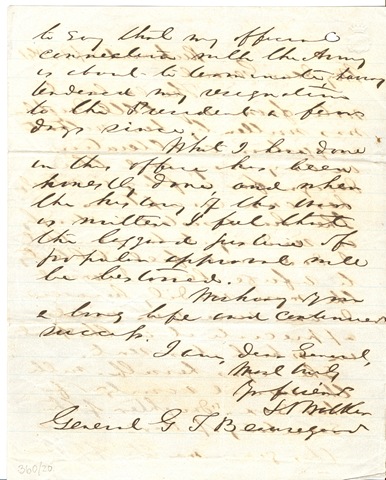
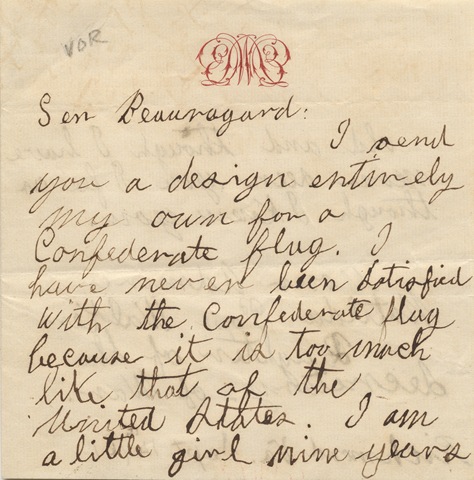
September 14, 1861: Leroy and Matilda Pope Walker to P. G. T. Beauregard

Pierre Gustave Toutant Beauregard was a Louisiana-born general of the Confederate States Army. He had graduated second in his class from West Point in 1838 and was an admirer of Napoleon. He achieved fame early in the Civil War for commanding the Fort Sumter bombardment and as the victor of the first battle of Manassas. He later served in the Western Theater (including Shiloh and Corinth), Charleston, and the defense of Richmond, but his career was hampered by friction with Jefferson Davis and other generals.


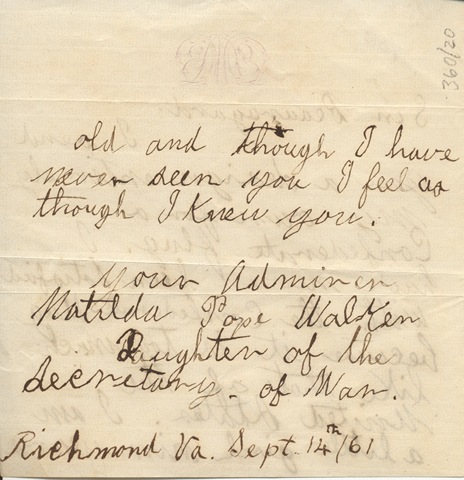
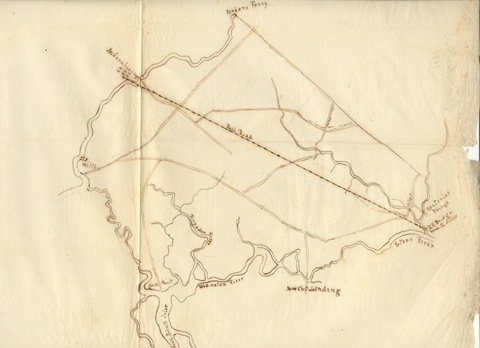
AMs 360-20  Leroy Pope to Beauregard p1 300 dpi AMs 360-20  Leroy Pope to Beauregard p2 300 dpi AMs 360-20 Matilda Pope to Beauregard p1 300 dpi AMs 360-20 Matilda Pope to Beauregard p2 300 dpi

Transcript:


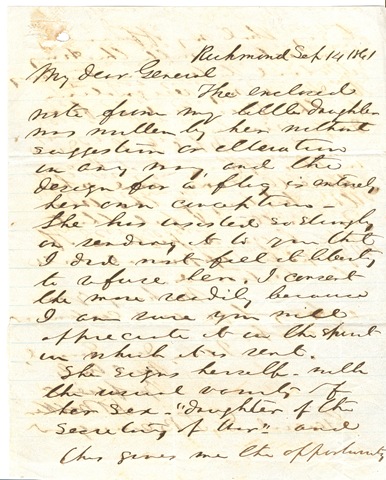
Richmond Sept 14 1861

My dear General

The enclosed note from my little daughter was written by her  without suggestion or alteration in any way, and the design for a flag is entirely her own conception. She has insisted so stringently on sending it to you that I did not feel at liberty to refuse her. I consent the more readily because I am sure you will appreciate it in the spirit in which it is sent.

She signs herself with the usual vanity of her sex—“daughter of the Secretary of War”—and she gives me the opportunity to say that my official connection with the Army is about to terminate, having tendered my resignation to the President a few days since.

What I have done in the office has been honestly done, and when the history of the war is written I feel that the [laggard justice?] of popular approval will be [bestirred?].

Wishing you a long life and continued success.

I am, dear General,

Most truly

Your friend

L P Walker


Gen Beauregard:

I send you a design entirely my own for a Confederate flag. I have never been satisfied with the Confederate flag because it is too much like that of the United States. I am a little girl nine years old and though I have never seen you I feel as though I know you.

Your Admirer

Matilda Pope Walker

Daughter of the Secretary of War


Citation: C. Richmond, 14 September 1861. AMs 360/20

August 14, 1861: Wilmot G. DeSaussure telegram to P. G. T. Beauregard

Pierre Gustave Toutant Beauregard was a Louisiana-born general of the Confederate States Army. He had graduated second in his class from West Point in 1838 and was an admirer of Napoleon. He achieved fame early in the Civil War for commanding the Fort Sumter bombardment and as the victor of the first battle of Manassas. He later served in the Western Theater (including Shiloh and Corinth), Charleston, and the defense of Richmond, but his career was hampered by friction with Jefferson Davis and other generals.


This is one of approximately 1000 military telegrams in P.G.T. Beauregard’s papers at the Rosenbach.

AMs 1168-11 1861-08-14


Transcript:

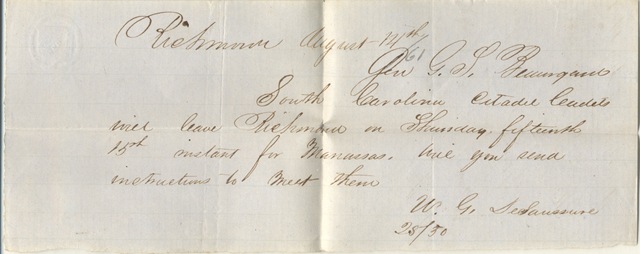
Richmond August 14th

Gen G.T. Beauregard

South Carolina Citadel Cadets will leave Richmond on Thursday fifteenth 15th instant for Manassas. Will you send instructions to meet them.

W.G. De Saussure


Citation:Wilmot G. DeSaussure, telegram to G. T. Beauregard. Richmond, Va.; 14 August 1861. AMs 1168/11

August 8, 1861: Frederick G. Skinner telegram to P. G. T. Beauregard

Pierre Gustave Toutant Beauregard was a Louisiana-born general of the Confederate States Army. He had graduated second in his class from West Point in 1838 and was an admirer of Napoleon. He achieved fame early in the Civil War for commanding the Fort Sumter bombardment and as the victor of the first battle of Manassas. He later served in the Western Theater (including Shiloh and Corinth), Charleston, and the defense of Richmond, but his career was hampered by friction with Jefferson Davis and other generals.


This is one of approximately 1000 military telegrams in P.G.T. Beauregard’s papers at the Rosenbach.

AMs 1168-11 1861-08-08


Transcript:

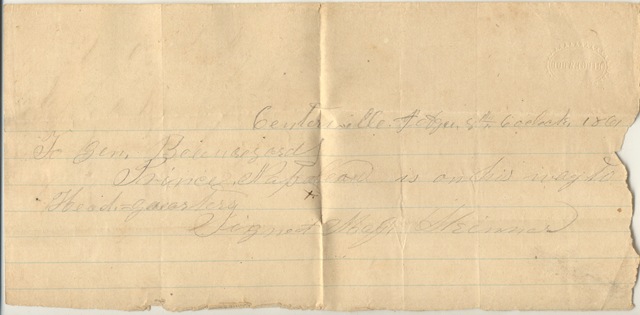
Centerville Aug 8th 6 o’clock 1861

To Gen. Beauregard

Prince Napoleon is on his way to Headquarters.

Signed Major Skinner


Citation:Frederick G Skinner, telegram to G. T. Beauregard. Centerville, Va.; 8 August 1861. AMs 1168/11

July 21, 1861: Beauregard’s Report of the Battle of Manassa

A charismatic and flamboyant figure, G. T. Beauregard was an early Confederate hero from his command of the Confederate troops in Charleston during Fort Sumter. By June 1861 he was a brigadier general headquartered at Manassas. The Battle of Manassas, or Bull Run, on July 21, 1861 was the first significant land battle of the war.


AMs 356-8 p1 Beauregard's Report of the Battle of Manassa[s]


Transcript :

[excerpts—p1]

Report of the Battle of Manassa

General

Before entering upon a narration of the general military operations in the presence of the enemy on the 21st of July, I propose, I hope not unreasonably, first to recite certain events, which belong to the strategy of the campaign and consequently, form an essential part of the history of the Battle.

Having become satisfied that the advance of the enemy, with a decidedly superior force both as to numbers and war equipage, to attack or turn my position in this quarter, was immediately impending. I dispatched, on the 13th of July, one of my Staff, Col. James Chestnut of South Carolina, to submit, for the consideration of the President, a plan of operations substantially as follows:

[bottom p31- 32]

Fully conscious of this portentous disparity of force, as I posted the lines for the encounter, I sought to infuse into the hearts of my officers and men the confidence and determined spirit of resistance to this wicked invasion of the homes of a free people which I felt. I informed them that reinforcements would rapidly come up to their support, and that we must at all hazards hold our posts until re-inforced. I reminded them that we fought for our homes, our firesides and for the independence of our Country. I urged them to the resolution of Victory or Death on that field. These sentiments were loudly, eagerly, cheered wheresoever proclaimed, and I then felt reassured of the inconquerable spirit of that Army, which would enable us to wrench victory from the host then threatening us with destruction.

Oh! My country: I would readily have sacrificed my life and those of all the brave men around me to save your homes, and to maintain your independence from the degrading yoke which these ruthless invaders had come to impose and render perpetual and the day issues assured me that such emotions must have also [illeg.] all under my command.

[bottom 58-60]

This Victory, the details of which I have thus sought to chronicle as fully as were fitting an official Report, it remains to record was clearly won by the death of many officers and men of inestimable value, belonging to all grades of our society.

In the death of General Barnard E. Bee the Confederacy has sustained an irreparable loss, for with great personal bravery and coolness, he possessed the qualities of an accomplished soldier, and an able reliable commander.

Cols. Bartow and Fisher, and Lt. Col. Johnston of Hampton’s Legion in the fearless command of their men gave earnest of great usefulness to the service, had they been spared to complete a career so brilliantly begun. Besides the Field officers already mentioned as having been wounded while in the gallant discharge of their duty, many others also received severe wounds after equally honorable and distinguished conduct whether in leading their men forward, or in rallying them when overpowered and temporarily shattered by the largely superior force to which we were generally opposed.

The subordinate grades were likewise abundantly conspicuous for zeal and capacity for the leadership of men in arms. To mention all, who fighting well, paid the lavish forfeit of their lives, or at least crippled, mutilated bodies on the field of Manassa, cannot well be done within the compass of this paper, but a grateful country and mourning friends will not suffer their names and services to be forgotten and pass away unhonored.

Nor are those officers and men who were so fortunate as to escape the thick of flying, deadly missiles of the enemy, less worthy of praise for their endurance firmness and valor than their brothers-in-arms whose lives were closed as bodies maimed on that memorable day.

To mention all who exhibited ability and brilliant courage were impossible in this Report, nor do the Reports of Brigade and other subordinate commanders supply full lists of all actually deserving of distinction. I can only mention those whose conduct came immediately under my notice, or the consequence of whose actions happened to be signally important.

[p77-78]

In the conclusion of this Report, it is proper, and doubtless expected, that I should acquaint my countrymen with some of the sufficient causes, that prevented the advance of our forces, and prolonged, rigorous, pursuit of the enemy to and beyond the Potomac. The War Department has been fully advised long since of all the causes, some of which only are proper to be here communicated.

An Army which had fought as ours that day, against uncommon odds, under a July sun, most of the time without water and without food, except a hastily snatched meal at dawn, was not in condition for the toil of an eager effective pursuit of an enemy immediately after the Battle. On the following day, an unusually heavy and unintermitting fall of rain intervened to obstruct our advance with reasonable prospects of fruitful results. Added to this the want of a Cavalry force of sufficient numbers made an efficient pursuit a military impossibility.

I remain very Resp.’ly

Your obt. Servt.

G. T. Beauregard

Gen.e Comdg.


Citation: G. T. (Gustave Toutant) Beauregard (1818-1893), Report of the battle of Manassas: manuscript. AMs 356/8
June 16, 1861: Proclamation by P.G.T. Beauregard

Pierre Gustave Toutant Beauregard was a Louisiana-born general of the Confederate States Army. He had graduated second in his class from West Point in 1838 and was an admirer of Napoleon. He achieved fame early in the Civil War for commanding the Fort Sumter bombardment and as the victor of the first battle of Manassas. He later served in the Western Theater (including Shiloh and Corinth), Charleston, and the defense of Richmond, but his career was hampered by friction with Jefferson Davis and other generals.

 AMs 356-6 p1 Beauregard A Proclamation AMs 356-6 p2 Beauregard A Proclamation

This proclamation is dated June 1861


Transcript:

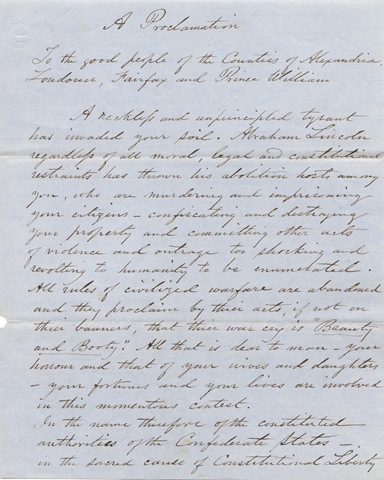
A Proclamation

To the good people of the Counties of Alexandria, Loudoun, Fairfax and Prince William

A reckless and unprincipled tyrant has invaded your soil. Abraham Lincoln regardless of all moral, legal and constitutional restraints has thrown his abolition hosts among you, who are murdering and imprisoning your citizens- confiscating and destroying your property and committing other acts of violence and outrage too shocking and revolting to humanity to be enumerated. All rules of civilized warfare are abandoned and they proclaim their acts, if not on their banners, that their war cry is “Beauty and Booty.” All that is dear to man- your honour and that of your wives and daughters- your fortunes and your lives are involved in this momentous contest.

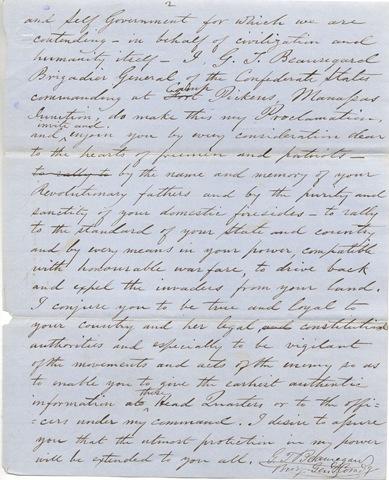
In the name therefore of the constituted authorities of the Confederate States- in the sacred cause of Constitutional Liberty and Self Government for which we are contending- in behalf of civilization and humanity itself- I, G. T. Beauregard Brigadier General of the Confederate States commanding at Camp Pickens, Manassas Junction, do make this my Proclamation, and invite and enjoin you by every consideration dear to the hearts of freemen and patriots- by the name and memory of your Revolutionary fathers and by the purity and sanctity of your domestic firesides- to rally to the standards of your State and country and by every means in your power, compatible with honourable warfare, to drive back and expel the invaders from your land. I conjure you to be true and loyal to your country and her legal, constitutional authorities and especially to be vigilant of the movements and acts of the enemy so as to enable you to give the earliest authentic information to these Head Quarters or to the officers under my command. I desire to assure you that the utmost protection in my power will be extended to you all.

G. T. Beauregard

Brig. Genl. Comdg.


Citation: G. T. (Gustave Toutant) Beauregard (1818-1893) Proclamation: manuscript signed.  Manassas Junction, [June, no day], 1861. AMs 356/6

June 13, 1861: Jefferson Davis to P.G.T. Beauregard

Pierre Gustave Toutant Beauregard was a Louisiana-born general of the Confederate States Army. He had graduated second in his class from West Point in 1838 and was an admirer of Napoleon. He achieved fame early in the Civil War for commanding the Fort Sumter bombardment and as the victor of the first battle of Manassas. He later served in the Western Theater (including Shiloh and Corinth), Charleston, and the defense of Richmond, but his career was hampered by friction with Jefferson Davis and other generals.

 AMs 356--25-2 p1 Jeff Davis to Beauregard 300 dpi AMs 356--25-2 p2 Jeff Davis to Beauregard 300 dpi AMs 356--25-2 p3 Jeff Davis to Beauregard 300 dpi

Transcript:

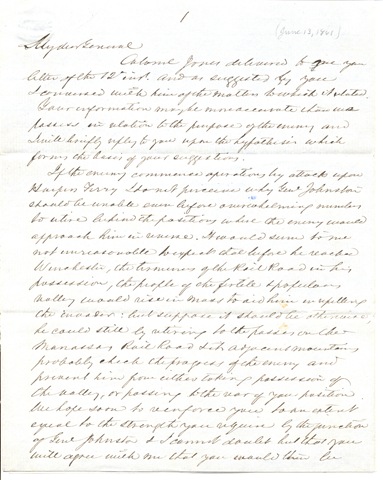
My dear General,

Colonel Jones delivered to me your letter of the 12th inst. and as suggested by you I conversed with him of the matters to which it stated.

Your information may be more accurate than we possess in relation to the purpose of the enemy and I will briefly reply to you upon the hypothesis which forms the basis of your suggestions.

If the enemy commence operations by attack upon Harper’s Ferry I do not perceive why Genl Johnston should be unable even before overwhelming numbers to retire behind the positions where the enemy would approach him in reverse. It would seem to me not unreasonable to expect that before he reached Winchester, the terminus of the Rail Road in his possession, the people of the fertile & populous valley would rise in mass to aid him in expelling the invader: but suppose it should be otherwise, he could still by retiring to the passes on the Manassas Rail Road & its adjacent mountains probably check the progress of the enemy and prevent him from either taking possession of the valley, or passing to the rear of your position. We hope soon to reinforce you to an extent equal to the strength you require by the junction of Genl Johnston & I cannot doubt but that you will agree with me that you would then be better circumstanced to advance upon Alexandria then if Genl Johnston by withdrawing from the valley had left the enemy the power to pass to your rear to cut your line of communication and advance to attack you in reverse, whilst you were engaged with the enemy in front.

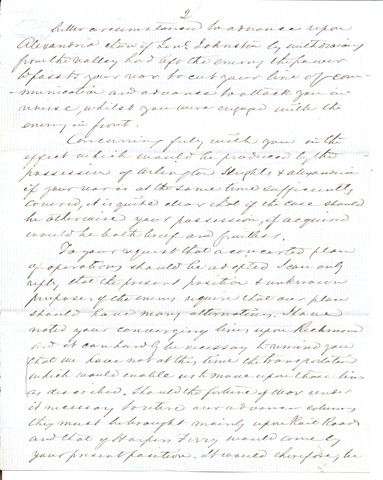
Concurring fully with you in the effect which would be produced by the possession of Arlington Heights & Alexandria if your rear is at the same time sufficiently covered, it is quite clear that if the case should be otherwise your possession, if acquired would be both brief and fruitless.

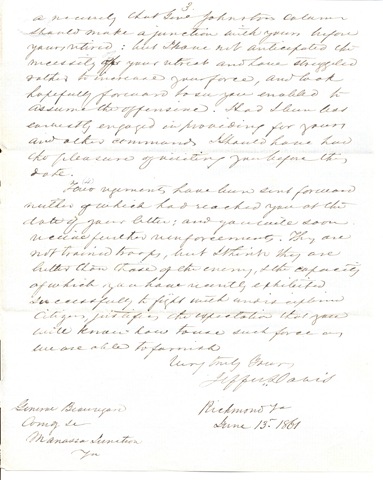
To your request that a concerted plan of operations should be adopted I can only reply that the present position & unknown purposes of the enemy require that our plans should have many alterations. I have noted your converging lines upon Richmond and it can hardly be necessary to remind you that we have not at this time the transportation which would enable us to move upon those lines as described. Should the fortune of War render it necessary to retire our advance columns they must be brought mainly upon Rail Road and that of Harpers Ferry would come by your present position. It would therefore be a necessity that Genl Johnstons column should make a junction with yours before yours retire: but I have not anticipated the necessity of your retreat and have struggled rather to increase your forces, and look hopefully forward to see you enabled to assume the offensive. Had I been less earnestly engaged in providing for yours and other command I should have had the pleasure of visiting you before this date.

Two regiments have been sent forward neither of which had reached you at the date of your letter: and you will soon receive further reinforcements. They are not trained troops, but I think they are better than those of the enemy, & the capacity of which you have recently exhibited successfully to fight with and under experienced citizens, justifies the expectation that you will know how to use such forces as we are able to furnish

Very truly yours

Jeffers. Davis


Citation: Jefferson Davis (1808-1889), letter signed to G.T. Beauregard. Richmond, 13 June 1861. AMs 356/25.2

June 12, 1861: P.G.T. Beauregard to Jefferson Davis

Pierre Gustave Toutant Beauregard was a Louisiana-born general of the Confederate States Army. He had graduated second in his class from West Point in 1838 and was an admirer of Napoleon. He achieved fame early in the Civil War for commanding the Fort Sumter bombardment and as the victor of the first battle of Manassas. He later served in the Western Theater (including Shiloh and Corinth), Charleston, and the defense of Richmond, but his career was hampered by friction with Jefferson Davis and other generals.

 AMs 356-25-1 p1 Beauregard letter to Jeff Davis AMs 356-25-1 p2 Beauregard letter to Jeff Davis AMs 356-25-1 p3 Beauregard letter to Jeff Davis

Transcript:

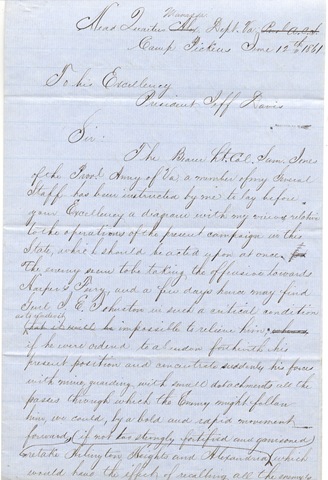
Head Quarters Manassa. Dept. Va.

Camp Pickens June 12th 1861

To his Excellency

President Jeff Davis

Sir:

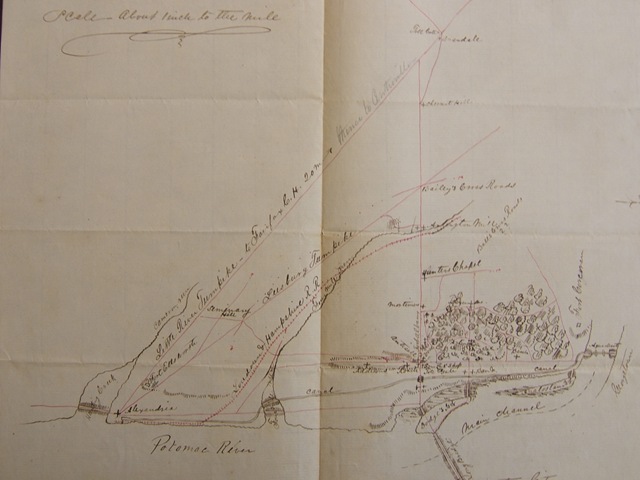
The Bearer Lt. Col. Sam. Jones of the Prov.l Army of Va, a member of my General Staff, has been instructed by me to lay before your Excellency a diagram with my views relative to the operations of the present campaign in this State, which should be acted upon at once. The enemy seem to be taking the offensive towards Harper’s Ferry, and a few days hence may find Genl. J. E. Johnston in such a critical condition as to render it impossible to relieve him; if he were ordered to abandon forthwith his present position and concentrate suddenly his forces with mine, guarding with small detachments all the passes through which the Enemy might follow him, we could, by a bold and rapid movement forward, retake Arlington Heights and Alexandria (if not too strongly fortified and garrisoned) which would have the effect of recalling all the enemy’s forces from Northern Va. For the protection of Washington.

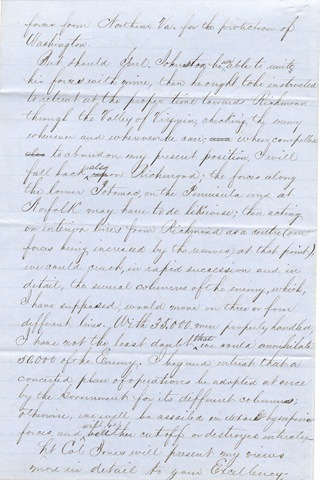
But should Genl. Johnston be unable to unite his forces with mine, then he ought to be instructed to retreat at the proper time towards Richmond through the Valley of Virginia, checking the enemy whenever and wherever he can; when compelled to abandon my present position, I will fall back also on Richmond; the forces along the lower Potomac, on the Peninsula and at Norfolk may have to do likewise; then acting on interior lines from Richmond as a centre (our forces being increased by the reserves at that point), we could crush, in rapid succession and in detail, the several columns of the enemy, which, I have supposed, would move on three or four different lines. With 35,000 men properly handled, I have not the least doubt that we would annihilate 50,000 of the Enemy. I beg and entreat that a concerted plan of operations be adopted at once by the Government for its different columns; otherwise, we will be assailable in detail by superior forces, and will be cut off or destroyed entirely.

Lt. Col. Jones will present my views more in detail to your Excellency

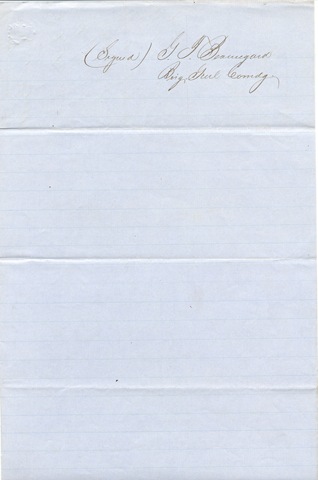
(Signed) G. T. Beauregard

Brig. Genl Comdg.


Citation: G. T. (Gustave Toutant) Beauregard (1818-1893), letter [draft] to Jefferson Davis. Manassas, 12 June 1861.AMs 356/25.1